
心理与行为研究 ›› 2025, Vol. 23 ›› Issue (3): 423-429.DOI: 10.12139/j.1672-0628.2025.03.018
梁瑜倩1,2, 李锐3, 屈智勇*,1( ), 傅王倩4
收稿日期:2024-07-30
出版日期:2025-05-20
发布日期:2025-05-20
通讯作者:
屈智勇
基金资助:
Yuqian LIANG1,2, Rui LI3, Zhiyong QU*,1(), Wangqian FU4
Received:2024-07-30
Online:2025-05-20
Published:2025-05-20
Contact:
Zhiyong QU
摘要:
为探讨高职教师付出−获得不平衡水平、自我控制能力与职业倦怠的关系,采用付出−获得不平衡量表、职业倦怠问卷和自我控制量表对全国37个市的1192名高职教师进行调查。研究结果显示:(1)付出−获得平衡状态(0<ERR<1)和付出−获得不平衡状态(ERR>1)下,付出−获得不平衡比率均对职业倦怠有显著正向预测作用。(2)自我控制能力在高职教师付出−获得不平衡与职业倦怠之间起调节作用。其中,在付出−获得平衡状态(0<ERR<1)下,自我控制能力具有正向调节作用;在付出−获得不平衡状态(ERR>1)下,自我控制能力具有负向调节作用。研究结果揭示了付出−获得不平衡与高职教师职业倦怠的关系及其机制,对改善高职教师职业倦怠现象具有一定实践参考价值。
梁瑜倩, 李锐, 屈智勇, 傅王倩. 高职教师付出−获得不平衡水平与职业倦怠的关系:自我控制能力的调节作用[J]. 心理与行为研究, 2025, 23(3): 423-429.
Yuqian LIANG, Rui LI, Zhiyong QU, Wangqian FU. The Relationship Between the Effort-Reward Imbalance Level and Job Burnout Among Teachers in Higher Vocational Colleges: Self-Control Ability as a Moderator[J]. Studies of Psychology and Behavior, 2025, 23(3): 423-429.
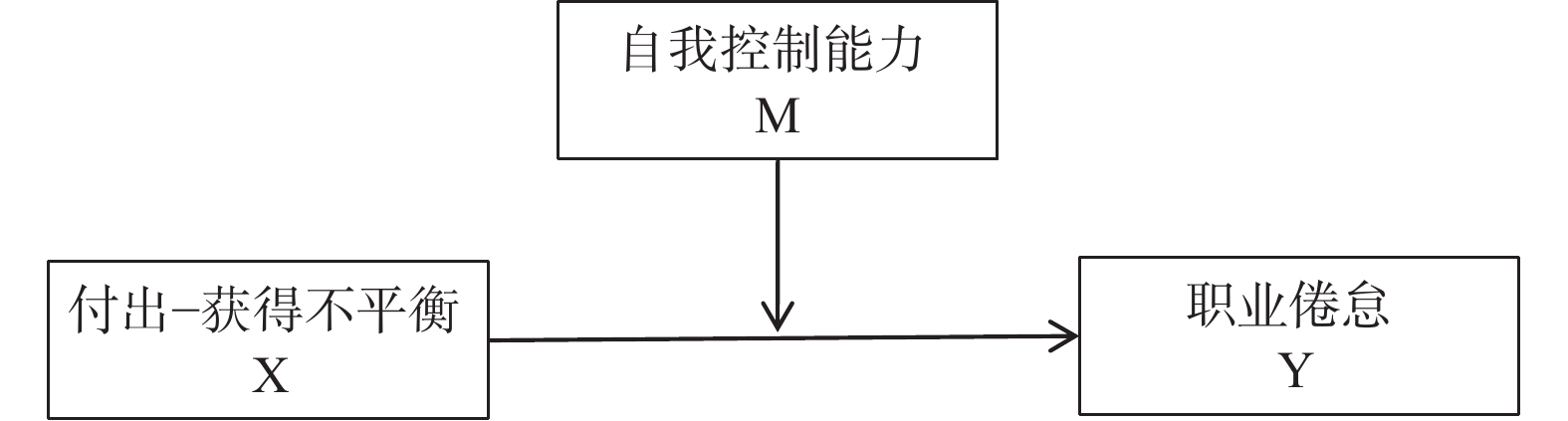
图1 理论模型
| 1 | 2 | 3 | |
| 1.付出−获得平衡状态(0<ERR<1) | |||
| 2.付出−获得不平衡状态(ERR>1) | |||
| 3.职业倦怠 | 0.52*** | 0.44*** | |
| 4.自我控制能力 | −0.31*** | −0.19*** | −0.31*** |
表1 各变量相关性检验
| 1 | 2 | 3 | |
| 1.付出−获得平衡状态(0<ERR<1) | |||
| 2.付出−获得不平衡状态(ERR>1) | |||
| 3.职业倦怠 | 0.52*** | 0.44*** | |
| 4.自我控制能力 | −0.31*** | −0.19*** | −0.31*** |
| 职业倦怠 | ||||
| M1 | M2 | M3 | M4 | |
| β | β | β | β | |
| 付出−获得不平衡比率 (0<ERR<1) | 0.52*** | 0.46*** | 0.38*** | 0.36*** |
| 自我控制能力 | −0.20*** | −0.22*** | −0.21*** | |
| 付出−获得不平衡比率 (0<ERR<1)×自我控制能力 | 0.21*** | 0.22*** | ||
| 性别 | 0.04 | |||
| 年龄 | 0.06 | |||
| 婚姻状态 | −0.00 | |||
| 学校类型−“双高型” 高职院校 | −0.03 | |||
| 学校类型−省示范性 高职院校 | −0.00 | |||
| 学历 | −0.07* | |||
| 所学专业与工作匹配程度 | −0.10** | |||
| 行政职务−副科 | 0.05 | |||
| 行政职务−正科 | 0.06 | |||
| 行政职务−副处及以上 | 0.07* | |||
| 工作性质−教学科研 | 0.02 | |||
| 工作性质−行政人员 | 0.05 | |||
| 教龄 | −0.17** | |||
| 是否坐班 | 0.01 | |||
| 年税后总收入 | −0.01 | |||
| R² | 0.27 | 0.30 | 0.34 | 0.38 |
| ∆R² | 0.27 | 0.03 | 0.04 | 0.04 |
| F | 230.86*** | 137.69*** | 109.86*** | 21.07*** |
表2 自我控制能力的调节效应检验(付出−获得平衡状态0<ERR<1)(n=634)
| 职业倦怠 | ||||
| M1 | M2 | M3 | M4 | |
| β | β | β | β | |
| 付出−获得不平衡比率 (0<ERR<1) | 0.52*** | 0.46*** | 0.38*** | 0.36*** |
| 自我控制能力 | −0.20*** | −0.22*** | −0.21*** | |
| 付出−获得不平衡比率 (0<ERR<1)×自我控制能力 | 0.21*** | 0.22*** | ||
| 性别 | 0.04 | |||
| 年龄 | 0.06 | |||
| 婚姻状态 | −0.00 | |||
| 学校类型−“双高型” 高职院校 | −0.03 | |||
| 学校类型−省示范性 高职院校 | −0.00 | |||
| 学历 | −0.07* | |||
| 所学专业与工作匹配程度 | −0.10** | |||
| 行政职务−副科 | 0.05 | |||
| 行政职务−正科 | 0.06 | |||
| 行政职务−副处及以上 | 0.07* | |||
| 工作性质−教学科研 | 0.02 | |||
| 工作性质−行政人员 | 0.05 | |||
| 教龄 | −0.17** | |||
| 是否坐班 | 0.01 | |||
| 年税后总收入 | −0.01 | |||
| R² | 0.27 | 0.30 | 0.34 | 0.38 |
| ∆R² | 0.27 | 0.03 | 0.04 | 0.04 |
| F | 230.86*** | 137.69*** | 109.86*** | 21.07*** |
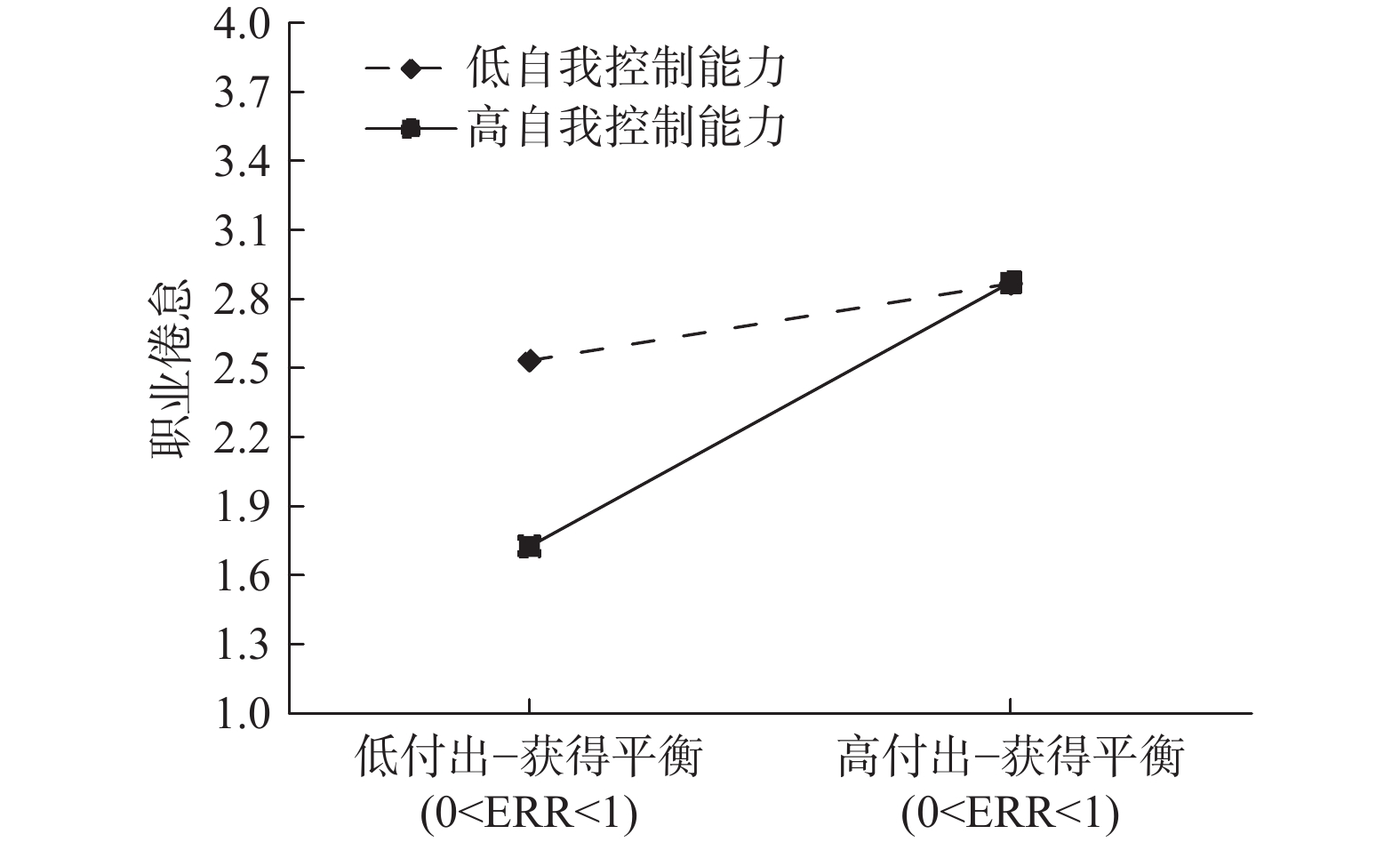
图2 简单斜率图 (付出−获得平衡状态0<ERR<1)
| 职业倦怠 | ||||
| M1 | M2 | M3 | M4 | |
| β | β | β | β | |
| 付出−获得不平衡比率 (0<ERR<1) | 0.41*** | 0.42*** | 0.27*** | 0.27*** |
| 自我控制能力 | 0.02 | 0.05 | 0.07 | |
| 付出−获得不平衡比率 (0<ERR<1)×自我控制能力 | −0.27*** | −0.28*** | ||
| 性别 | 0.02 | |||
| 年龄 | −0.11 | |||
| 婚姻状态 | 0.02 | |||
| 学校类型−“双高型”高职院校 | 0.01 | |||
| 学校类型−省示范性高职院校 | 0.08 | |||
| 学历 | 0.20 | |||
| 所学专业与工作匹配程度 | −0.04 | |||
| 行政职务−副科 | 0.01 | |||
| 行政职务−正科 | 0.06 | |||
| 行政职务−副处及以上 | 0.01 | |||
| 工作性质−教学科研 | 0.07 | |||
| 工作性质−行政人员 | 0.02 | |||
| 教龄 | −0.02 | |||
| 是否坐班 | 0.02 | |||
| 年税后总收入 | 0.07 | |||
| R² | 0.17 | 0.17 | 0.22 | 0.25 |
| ∆R² | 0.17 | 0.00 | 0.05 | 0.04 |
| F | 84.73*** | 42.41*** | 38.19*** | 7.44*** |
表3 自我控制能力的调节效应检验(付出−获得不平衡状态ERR>1)(n=413)
| 职业倦怠 | ||||
| M1 | M2 | M3 | M4 | |
| β | β | β | β | |
| 付出−获得不平衡比率 (0<ERR<1) | 0.41*** | 0.42*** | 0.27*** | 0.27*** |
| 自我控制能力 | 0.02 | 0.05 | 0.07 | |
| 付出−获得不平衡比率 (0<ERR<1)×自我控制能力 | −0.27*** | −0.28*** | ||
| 性别 | 0.02 | |||
| 年龄 | −0.11 | |||
| 婚姻状态 | 0.02 | |||
| 学校类型−“双高型”高职院校 | 0.01 | |||
| 学校类型−省示范性高职院校 | 0.08 | |||
| 学历 | 0.20 | |||
| 所学专业与工作匹配程度 | −0.04 | |||
| 行政职务−副科 | 0.01 | |||
| 行政职务−正科 | 0.06 | |||
| 行政职务−副处及以上 | 0.01 | |||
| 工作性质−教学科研 | 0.07 | |||
| 工作性质−行政人员 | 0.02 | |||
| 教龄 | −0.02 | |||
| 是否坐班 | 0.02 | |||
| 年税后总收入 | 0.07 | |||
| R² | 0.17 | 0.17 | 0.22 | 0.25 |
| ∆R² | 0.17 | 0.00 | 0.05 | 0.04 |
| F | 84.73*** | 42.41*** | 38.19*** | 7.44*** |
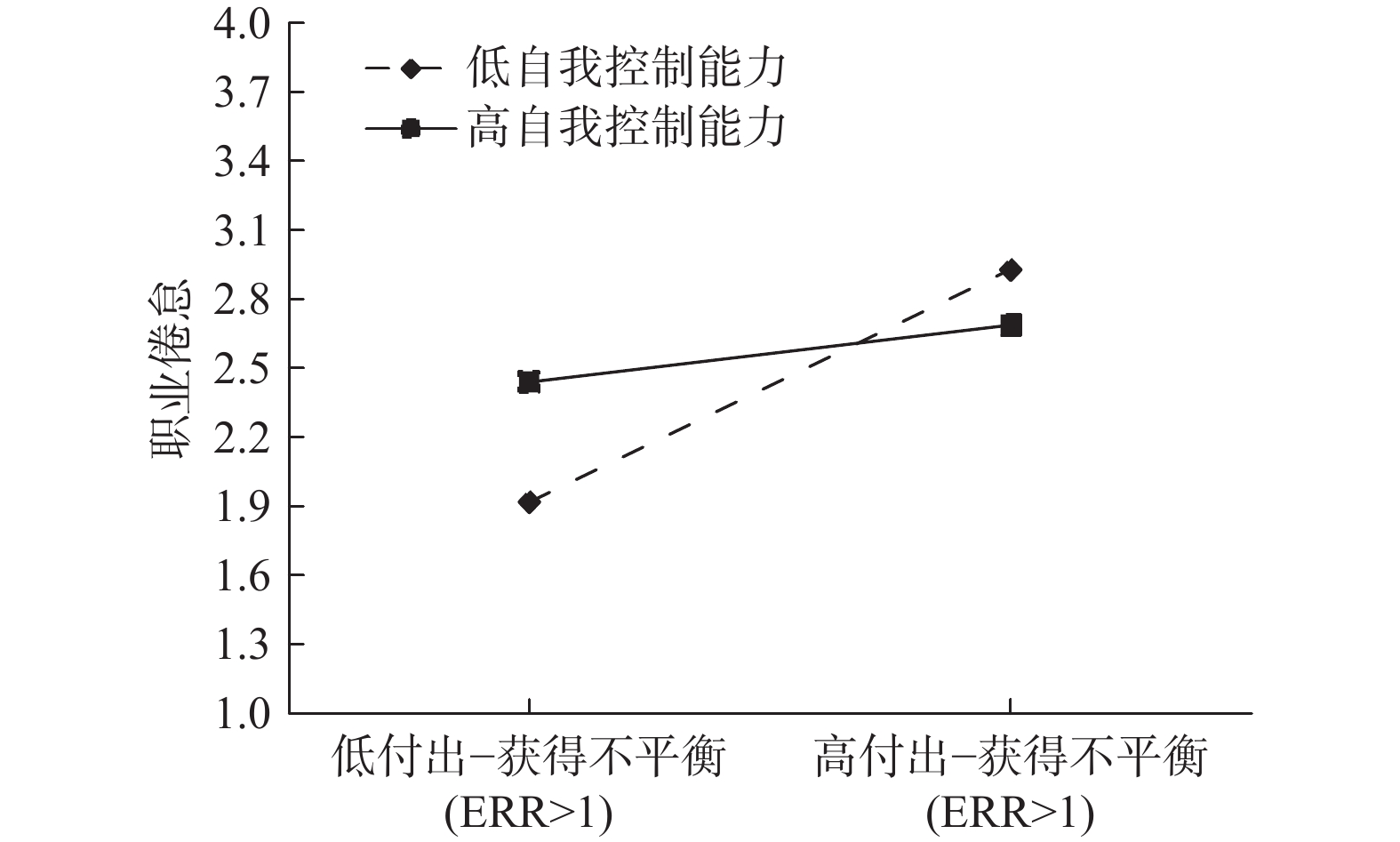
图3 简单斜率图(付出−获得不平衡状态ERR>1)
|
鲍威, 吴红斌. 象牙塔里的薪资定价: 中国高校教师薪资影响机制. 北京大学教育评论, 2016, 14 (2): 113- 132.
DOI |
|
|
卜南音, 李祚山, 朱小丹. 负性生活事件对大学生情绪性进食的影响: 自我控制的中介作用和自尊的调节作用. 心理研究, 2024, 17 (6): 554- 561.
|
|
|
范伟, 任梦梦, 张文洁, 钟毅平. 反馈对自我欺骗的影响: 来自ERP的证据. 心理学报, 2022, 54 (5): 481- 496.
|
|
|
范伟, 钟毅平, 李慧云, 孟楚熠, 游畅, 傅小兰. 欺骗判断与欺骗行为中自我控制的影响. 心理学报, 2016, 48 (7): 845- 856.
|
|
|
郭永松, 李秀央, 卢文军, Siegrist, J. 工作中付出-获得不平衡与健康的相关性研究. 中华劳动卫生职业病杂志, 2005, 23 (3): 232- 234.
DOI |
|
|
计荣. 高职教师工作压力源自何处. 职业技术教育, 2013, 34 (27): 72- 74.
DOI |
|
|
贾轶, 许雪峰. 高职院校教师职业倦怠现状及对策研究——以C学院为例. 滁州学院学报, 2022, 24 (1): 131- 136.
DOI |
|
|
金莱. 社会支持对高职教师工作压力和职业倦怠关系的调节作用研究. 中国职业技术教育, 2013, 29 (7): 87- 89, 92.
|
|
|
林莉萍, 张祥兰. 高职教师胜任特征要素的实证分析. 现代教育管理, 2014, (12): 66- 69.
DOI |
|
|
罗殿宏, 田翠英. 职业教育“双师型”教师资格认定的“结”与“解”. 职业技术教育, 2024, 45 (24): 30- 35.
DOI |
|
|
潘君利, 左瑞勇, 汤永隆, 邓丽俐. 民办园教师的职业倦怠与其心理健康的关系. 学前教育研究, 2009, (3): 53- 55.
|
|
|
谭树华, 郭永玉. 大学生自我控制量表的修订. 中国临床心理学杂志, 2008, 16 (5): 468- 470.
|
|
|
田瑾, 毛亚庆, 熊华夏. 变革型领导对教师职业倦怠的影响: 社会情感能力和幸福感的链式中介作用. 心理发展与教育, 2021, 37 (5): 743- 751.
|
|
|
汪国琴, 陈进, 杨文圣. 教师职业压力与心理健康状况调查报告——基于上海地区的调研. 思想理论教育, 2016, (3): 86- 91.
|
|
|
王海军. 职业学校教师心理压力的来源和缓解途径. 校园心理, 2011, 9 (4): 253- 254.
DOI |
|
|
王秋林, 杨鹏, 陶宝乐, 颜军. 我国篮球高水平裁判员自我控制与情绪稳定性的关系: 心境状态与心理弹性的链式中介作用. 体育与科学, 2021, 42 (6): 86- 95.
|
|
|
王晓蕾, 周萍, 任蔚虹, 李鲁. 护士付出-获得不平衡对护士离职意愿影响研究. 上海交通大学学报(医学版), 2010, 30 (4): 459- 462.
|
|
|
王芸萍, 朱麟, 杜慧, 刘聪慧. 自我同情和睡眠质量的关系: 积极和消极情绪与自我控制的中介作用. 心理科学, 2022, 45 (4): 785- 793.
|
|
|
温忠麟, 黄彬彬, 汤丹丹. 问卷数据建模前传. 心理科学, 2018, 41 (1): 204- 210.
|
|
|
伍新春, 齐亚静, 余蓉蓉, 臧伟伟. 中小学教师职业倦怠问卷的进一步修订. 中国临床心理学杂志, 2016, 24 (5): 856- 860.
|
|
|
尤玉钿, 曹科岩. 高职院校教师心理所有权对工作投入的影响研究. 高教探索, 2018, (10): 79- 83.
DOI |
|
|
章永, 魏欣. 特殊教育教师幸福感与职业倦怠、心理健康的关系——以四川省特殊学校为例. 基础教育, 2014, 11 (5): 70- 75.
DOI |
|
|
朱雯珊. “双高计划”背景下高职院校教师发展中心功能定位与实施路径研究. 职教论坛, 2021, 37 (10): 85- 89.
|
|
|
Baumeister, R. F. Ego depletion and self-regulation failure: A resource model of self-control. Alcoholism: Clinical and Experimental Research, 2003, 27 (2): 281- 284.
DOI |
|
|
Beck, A. T. (1967). Depression: Clinical, experimental, and theoretical aspects. New York: Harper & Row.
|
|
|
Brebner, J. Happiness and personality. Personality and Individual Differences, 1998, 25 (2): 279- 296.
DOI |
|
|
Cheung, T. T. L., Gillebaart, M., Kroese, F., & De Ridder, D. Why are people with high self-control happier? The effect of trait self-control on happiness as mediated by regulatory focus. Frontiers in Psychology, 2014, 5, 722.
|
|
|
Chirico, F. Job stress models for predicting burnout syndrome: A review. Annali dell’Istituto Superiore di Sanità, 2016, 52 (3): 443- 456.
|
|
|
Diekmann, K., Böckelmann, I., Karlsen, H. R., Lux, A., & Thielmann, B. Effort-reward imbalance, mental health and burnout in occupational groups that face mental stress. Journal of Occupational and Environmental Medicine, 2020, 62 (10): 847- 852.
DOI |
|
|
Freudenberger, H. J. Staff burn-out. Journal of Social Issues, 1974, 30 (1): 159- 165.
DOI |
|
|
Gluschkoff, K., Elovainio, M., Kinnunen, U., Mullola, S., Hintsanen, M., Keltikangas-Järvinen, L., & Hintsa, T. Work stress, poor recovery and burnout in teachers. Occupational Medicine, 2016, 66 (7): 564- 570.
DOI |
|
|
Guo, L. P., Huang, M. M., Wang, Y. Q., Shi, S., Yang, M. H., & Shuai, J. Effort-reward imbalance and job burnout in preschool teachers: A moderated mediation model. Social Behavior and Personality: An International Journal, 2022, 50 (1): 1- 13.
|
|
|
Hofmann, W., Luhmann, M., Fisher, R. R., Vohs, K. D., & Baumeister, R. F. Yes, but are they happy? Effects of trait self-control on affective well-being and life satisfaction. Journal of Personality, 2014, 82 (4): 265- 277.
DOI |
|
|
Jeon, L., Buettner, C. K., & Hur, E. Preschool teachers’ professional background, process quality, and job attitudes: A person-centered approach. Early Education and Development, 2016, 27 (4): 551- 571.
DOI |
|
|
Layton, R. L., & Muraven, M. Self-control linked with restricted emotional extremes. Personality and Individual Differences, 2014, 58, 48- 53.
DOI |
|
|
Lehr, D., Koch, S., & Hillert, A. Where is (im)balance? Necessity and construction of evaluated cut-off points for effort-reward imbalance and overcommitment. Journal of Occupational and Organizational Psychology, 2010, 83 (1): 251- 261.
DOI |
|
|
Maslach, C., & Jackson, S. E. (1981). Maslach Burnout Inventory. Palo Alto, CA: Consulting Psychologists Press.
|
|
|
Mitchell, J. Living a lie: Self-deception, habit, and social roles. Human Studies, 2000, 23 (2): 145- 156.
DOI |
|
|
Pilcher, J. J., & Bryant, S. A. Implications of social support as a self-control resource. Frontiers in Behavioral Neuroscience, 2016, 10, 228.
|
|
|
Ren, M. M., Zhong, B. W., Fan, W., Dai, H. M., Yang, B., Zhang, W. J., … Zhan, Y. L. The influence of self-control and social status on self-deception. Frontiers in Psychology, 2018, 9, 1256.
DOI |
|
|
Rutter, M. Implications of resilience concepts for scientific understanding. Annals of the New York Academy of Sciences, 2006, 1094 (1): 1- 12.
DOI |
|
|
Siegrist, J. Adverse health effects of high-effort/low-reward conditions. Journal of Occupational Health Psychology, 1996, 1 (1): 27- 41.
DOI |
|
|
Siegrist, J. (2002). Effort-reward imbalance at work and health. In P. L. Perrewe & D. C. Ganster (Eds.), Historical and current perspectives on stress and health (pp. 261–291). Amsterdam: Elsevier.
|
|
|
Siegrist, J., Starke, D., Chandola, T., Godin, I., Marmot, M., Niedhammer, I., & Peter, R. The measurement of effort-reward imbalance at work: European comparisons. Social Science & Medicine, 2004, 58 (8): 1483- 1499.
|
|
|
Tangney, J. P., Baumeister, R. F., & Boone, A. L. High self-control predicts good adjustment, less pathology, better grades, and interpersonal success. Journal of Personality, 2004, 72 (2): 271- 324.
DOI |
|
|
Timerbulatov, I. F., Khabibullina, I. R., & Tulitbaeva, G. F. Self-regulation as a way to prevent professional burnout of teachers of higher education institutions. SHS Web of Conferences, 2021, 113, 00086.
DOI |
|
|
Tversky, A., & Griffin, D. (1991). Endowment and contrast in judgments of well-being. In F. Strack, M. Argyle, & N. Schwarz (Eds.), Subjective well-being: An interdisciplinary perspective (pp. 101–118). New York: Pergamon Press.
|
|
|
Unterbrink, T., Hack, A., Pfeifer, R., Buhl-Grießhaber, V., Müller, U., Wesche, H., … Bauer, J. Burnout and effort-reward-imbalance in a sample of 949 German teachers. International Archives of Occupational and Environmental Health, 2007, 80 (5): 433- 441.
DOI |
| [1] | 李鹏, 张志超, 杨洋, 杨佳奇, 李洪玉. 工作压力对中小学教师职业倦怠的影响:情绪劳动和工作满意度的链式中介作用[J]. 心理与行为研究, 2022, 20(3): 412-418. |
| [2] | 朱海, 宋香, 周云, 杨晓平, 田泽永. 职业压力对西部山区中小学教师主观幸福感的影响:有调节的中介模型[J]. 心理与行为研究, 2022, 20(1): 115-121. |
| [3] | 姚崇, 惠琪, 王媛, 席海莎, 雒朝梁. 公费师范教师社会支持与职业倦怠的关系探究[J]. 心理与行为研究, 2021, 19(6): 816-823. |
| [4] | 黄明明, 陈丽萍, 郭莉萍, 赵守盈. 工作-家庭冲突与幼儿教师离职意向的关系:职业认同感与职业倦怠的序列中介作用[J]. 心理与行为研究, 2021, 19(5): 679-686. |
| [5] | 缪佩君, 谢姗姗, 陈则飞, 连榕. 幼儿教师心理弹性与职业倦怠的关系:大五人格的中介效应[J]. 心理与行为研究, 2018, 16(4): 512-517. |
| [6] | 黄旭, 王钢, 王德林. 幼儿教师组织支持和职业压力对离职意向的影响:职业倦怠的中介作用*[J]. 心理与行为研究, 2017, 15(4): 528-535. |
| [7] | 林赞歌, 连榕, 邓远平, 林荣茂. 制造业员工社会支持、职业倦怠与生活满意度的关系[J]. 心理与行为研究, 2017, 15(1): 108-112. |
| [8] | 轩希,徐晟,陈灜,王梦娇,吴捷. 舞动治疗对高校辅导员职业倦怠的干预研究[J]. 心理与行为研究, 2016, 14(5): 697-700. |
| [9] | 刘建平, 付丹. 高校教师的职业倦怠与心理健康关系:心理资本的中介与调节作用[J]. 心理与行为研究, 2013, 11(6): 765-769. |
| [10] | 郑显亮,顾海根. 大学生网络利他行为和网络行为偏好的关系:班级环境的作用[J]. 心理与行为研究, 2013, 11(5): 690-696. |
| [11] | 王国香,刘长江,伍新春. 教师职业倦怠与归因的关系探讨[J]. 心理与行为研究, 2006, 4(2): 139-142. |
| [12] | 伍新春,曾玲娟,秦宪刚,郑秋. 中小学教师职业倦怠的现状及相关因素研究[J]. 心理与行为研究, 2003, 1(4): 262-267. |
| 阅读次数 | ||||||
|
全文 |
|
|||||
|
摘要 |
|
|||||
