
心理与行为研究 ›› 2024, Vol. 22 ›› Issue (5): 704-712.DOI: 10.12139/j.1672-0628.2024.05.017
成子涵, 毕翠华*( ), 吴琪
), 吴琪
收稿日期:2023-09-14
出版日期:2024-09-20
发布日期:2024-09-20
通讯作者:
毕翠华
基金资助:
Zihan CHENG, Cuihua BI*(), Qi WU
Received:2023-09-14
Online:2024-09-20
Published:2024-09-20
Contact:
Cuihua BI
摘要:
采用三水平元分析技术探究未来情景思维(episodic future thinking, EFT)对金钱领域跨期决策的影响及调节变量。对纳入的46篇文献,89个效应量进行分析发现,相比控制组,EFT组更加偏好延迟奖励(g=0.50)。此外,EFT与金钱跨期决策的关系受到EFT效价、生动性、个人相关性等变量的调节。本研究揭示了EFT影响金钱跨期决策的内在机制,并证实EFT个人相关性对该关系的解释力,为跨期决策的干预提供了参考依据。
成子涵, 毕翠华, 吴琪. 未来情景思维对金钱跨期决策的影响—来自三水平元分析的证据[J]. 心理与行为研究, 2024, 22(5): 704-712.
Zihan CHENG, Cuihua BI, Qi WU. The Impact of Episodic Future Thinking on Money Intertemporal Decision Making: Evidence from Three-Level Meta-Analysis[J]. Studies of Psychology and Behavior, 2024, 22(5): 704-712.
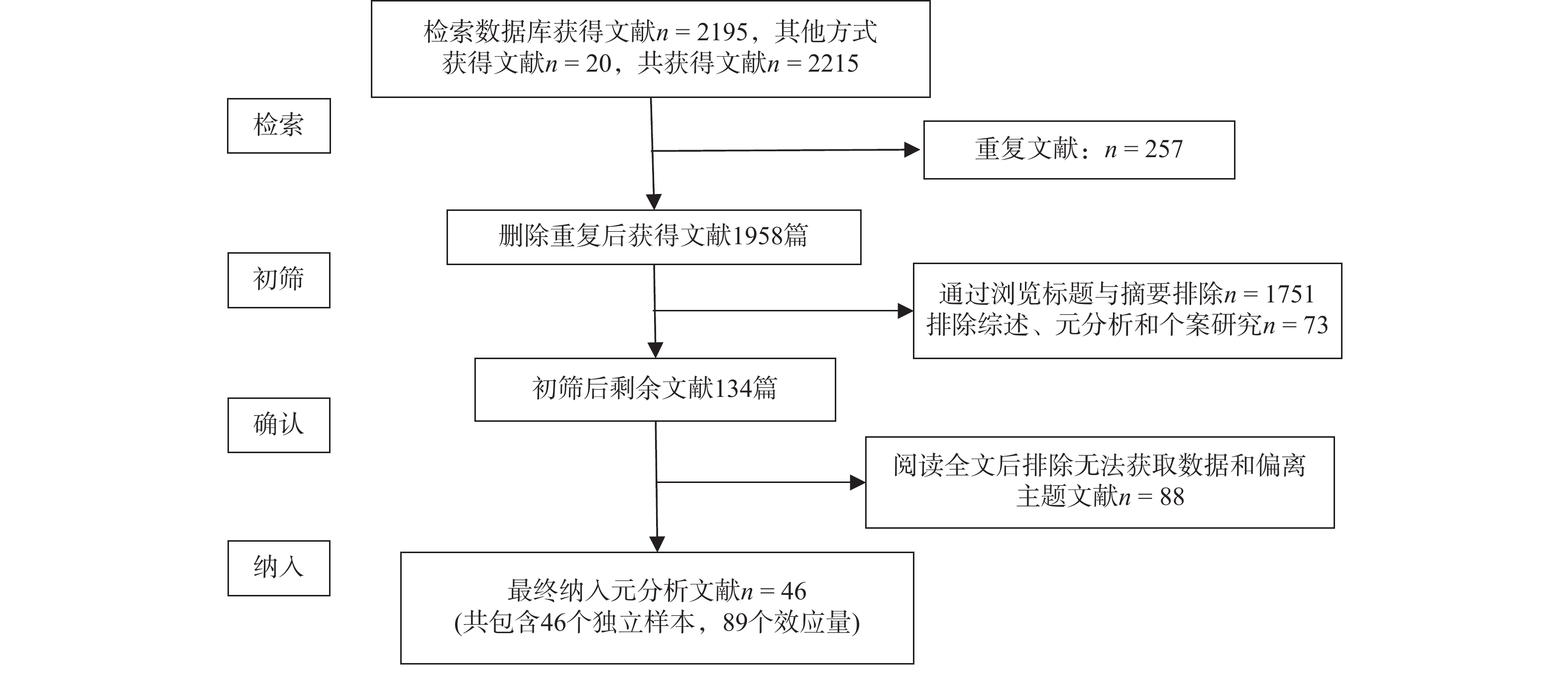
图1 PRISMA流程图 注:n代表文献数量。
| 调节变量 | k | #ES | Intercept/Hedges’g | β1 | F | p | 研究内方差 | 研究间方差 |
| 样本特征 | ||||||||
| 平均年龄 | 44 | 85 | −0.002(−0.01, 0.01) | 0.12 | 0.726 | 0.14*** | 0.10*** | |
| 性别比例 | 44 | 85 | 0.03(−0.66, 0.72) | 0.01 | 0.929 | 0.13** | 0.06*** | |
| 特殊人群 | 0.47 | 0.703 | 0.16** | 0.10*** | ||||
| 健康 | 27 | 63 | 0.46(0.29, 0.64)*** | |||||
| 肥胖 | 7 | 9 | 0.65(0.26, 1.05)** | 0.19(−0.24, 0.62) | ||||
| 吸烟者 | 6 | 8 | 0.41(0.01, 0.80)* | −0.06(−0.49, 0.38) | ||||
| 其他 | 7 | 9 | 0.61(0.22, 1.01)** | 0.15(−0.29, 0.59) | ||||
| 地域文化 | 0.80 | 0.373 | 0.16** | 0.08*** | ||||
| 东方 | 10 | 33 | 0.39(0.12, 0.66)** | |||||
| 西方 | 36 | 56 | 0.53(0.37, 0.69)*** | 0.14(−0.17, 0.45) | ||||
| 控制任务特征 | ||||||||
| 情景类型 | 1.71 | 0.170 | 0.16* | 0.07*** | ||||
| 特定事件 | 27 | 36 | 0.61(0.42, 0.80)*** | |||||
| 无关事件 | 6 | 8 | 0.45(0.05, 0.85)* | −0.16(−0.60, 0.27) | ||||
| 无操作 | 12 | 40 | 0.29(0.06, 0.53)* | −0.32(−0.62, 0.02)* | ||||
| 其他 | 5 | 5 | 0.70(0.20, 1.20)** | 0.09(−0.43, 0.61) | ||||
| 实验任务特征 | ||||||||
| 生动性 | 16 | 40 | 0.98(−0.01, 1.97) | 4.01 | 0.052 | 0.19 | 0.47*** | |
| 个人相关性 | 10 | 32 | 1.05(0.47, 1.64)*** | 13.43 | <0.001 | 0.13*** | 1.09*** | |
| 任务效价 | 13 | 37 | 0.41(0.28, 0.53)*** | 42.38 | <0.001 | 0.07** | 0.54*** | |
| 唤醒程度 | 8 | 21 | 0.93(−0.21, 2.07) | 2.94 | 0.103 | 0.39 | 1.37*** | |
| 情景类型 | 0.45 | 0.642 | 0.16** | 0.09*** | ||||
| 未来相关事件 | 41 | 80 | 0.49(0.34, 0.64)*** | |||||
| 健康事件 | 3 | 5 | 0.40(−0.12, 0.92) | −0.09(−0.62, 0.44) | ||||
| 其他 | 3 | 4 | 0.78(0.13, 1.42)* | 0.29(−0.37, 0.95) |
表1 未来情景思维对跨期决策影响的调节效应检验结果
| 调节变量 | k | #ES | Intercept/Hedges’g | β1 | F | p | 研究内方差 | 研究间方差 |
| 样本特征 | ||||||||
| 平均年龄 | 44 | 85 | −0.002(−0.01, 0.01) | 0.12 | 0.726 | 0.14*** | 0.10*** | |
| 性别比例 | 44 | 85 | 0.03(−0.66, 0.72) | 0.01 | 0.929 | 0.13** | 0.06*** | |
| 特殊人群 | 0.47 | 0.703 | 0.16** | 0.10*** | ||||
| 健康 | 27 | 63 | 0.46(0.29, 0.64)*** | |||||
| 肥胖 | 7 | 9 | 0.65(0.26, 1.05)** | 0.19(−0.24, 0.62) | ||||
| 吸烟者 | 6 | 8 | 0.41(0.01, 0.80)* | −0.06(−0.49, 0.38) | ||||
| 其他 | 7 | 9 | 0.61(0.22, 1.01)** | 0.15(−0.29, 0.59) | ||||
| 地域文化 | 0.80 | 0.373 | 0.16** | 0.08*** | ||||
| 东方 | 10 | 33 | 0.39(0.12, 0.66)** | |||||
| 西方 | 36 | 56 | 0.53(0.37, 0.69)*** | 0.14(−0.17, 0.45) | ||||
| 控制任务特征 | ||||||||
| 情景类型 | 1.71 | 0.170 | 0.16* | 0.07*** | ||||
| 特定事件 | 27 | 36 | 0.61(0.42, 0.80)*** | |||||
| 无关事件 | 6 | 8 | 0.45(0.05, 0.85)* | −0.16(−0.60, 0.27) | ||||
| 无操作 | 12 | 40 | 0.29(0.06, 0.53)* | −0.32(−0.62, 0.02)* | ||||
| 其他 | 5 | 5 | 0.70(0.20, 1.20)** | 0.09(−0.43, 0.61) | ||||
| 实验任务特征 | ||||||||
| 生动性 | 16 | 40 | 0.98(−0.01, 1.97) | 4.01 | 0.052 | 0.19 | 0.47*** | |
| 个人相关性 | 10 | 32 | 1.05(0.47, 1.64)*** | 13.43 | <0.001 | 0.13*** | 1.09*** | |
| 任务效价 | 13 | 37 | 0.41(0.28, 0.53)*** | 42.38 | <0.001 | 0.07** | 0.54*** | |
| 唤醒程度 | 8 | 21 | 0.93(−0.21, 2.07) | 2.94 | 0.103 | 0.39 | 1.37*** | |
| 情景类型 | 0.45 | 0.642 | 0.16** | 0.09*** | ||||
| 未来相关事件 | 41 | 80 | 0.49(0.34, 0.64)*** | |||||
| 健康事件 | 3 | 5 | 0.40(−0.12, 0.92) | −0.09(−0.62, 0.44) | ||||
| 其他 | 3 | 4 | 0.78(0.13, 1.42)* | 0.29(−0.37, 0.95) |
|
*为纳入元分析文献
|
|
|
*蔡曙光. (2017). 跨期选择的可塑性: 基于预期想象训练的研究(硕士学位论文). 西南大学, 重庆.
|
|
|
*郭逸群. (2018). 不同尺度的时间认知影响跨期选择的认知神经机制(博士学位论文). 西南大学, 重庆.
|
|
|
胡治国, 陈静, 吴惠君, Georg, N. 个人目标相关性对非临床抑郁者未来想象的影响. 心理学报, 2019, 51 (1): 58- 70.
|
|
|
纪丽君, 吴莹, 杨宜音. 中国人的时间知觉广度. 心理学报, 2023, 55 (3): 421- 434.
|
|
|
梁竹苑, 刘欢. 跨期选择的性质探索. 心理科学进展, 2011, 19 (7): 959- 966.
|
|
|
*秦玲玲. (2014). 预期情绪对跨期选择调控的认知神经机制(硕士学位论文). 西南大学, 重庆.
|
|
|
*王珂, 张顺民, 冯廷勇. 预期想象影响延迟折扣的内在机制: 情绪的作用——高、低冲动特质的分离效应. 西南大学学报(自然科学版), 2017, 39 (4): 151- 157.
|
|
|
王盼盼, 何嘉梅. 情景预见对跨期决策的影响机制. 心理学报, 2020, 52 (1): 38- 54.
|
|
|
*吴旭瑶. (2021). 不确定感对跨期决策的影响——未来取向的中介作用(硕士学位论文). 华中师范大学, 武汉.
|
|
|
杨莲莲. (2016). 情绪与自我相关性对情节式未来思考的影响及其神经机制(硕士学位论文). 西南大学, 重庆.
|
|
|
张亚利, 李森, 俞国良. 自尊与社交焦虑的关系: 基于中国学生群体的元分析. 心理科学进展, 2019, 27 (6): 1005- 1018.
|
|
|
Assink, M., & Wibbelink, C. J. M. Fitting three-level meta-analytic models in R: A step-by-step tutorial. The Quantitative Methods for Psychology, 2016, 12 (3): 154- 174.
DOI |
|
|
*Athamneh, L. N., Stein, M. D., Lin, E. H., Stein, J. S., Mellis, A. M., Gatchalian, K. M., … Bickel, W. K. Setting a goal could help you control: Comparing the effect of health goal versus general episodic future thinking on health behaviors among cigarette smokers and obese individuals. Experimental and Clinical Psychopharmacology, 2021, 29 (1): 59- 72.
DOI |
|
|
*Ballance, B. C., Tuen, Y. J., Petrucci, A. S., Orwig, W., Safi, O. K., Madan, C. R., & Palombo, D. J. Imagining emotional events benefits future-oriented decisions. Quarterly Journal of Experimental Psychology, 2022, 75 (12): 2332- 2348.
DOI |
|
|
*Banes, K. E. (2016). The effect of episodic future thought on delay discounting, outcome expectancies, and alcohol use among risky college drinkers (Unpublished doctorial dissertation). Virginia Tech, Blacksburg.
|
|
|
*Benoit, R. G., Gilbert, S. J., & Burgess, P. W. A neural mechanism mediating the impact of episodic prospection on farsighted decisions. The Journal of Neuroscience, 2011, 31 (18): 6771- 6779.
DOI |
|
|
*Bickel, W. K., Stein, J. S., Paluch, R. A., Mellis, A. M., Athamneh, L. N., Quattrin, T., … Epstein, L. H. Does episodic future thinking repair immediacy bias at home and in the laboratory in patients with prediabetes. Psychosomatic Medicine, 2020, 82 (7): 699- 707.
DOI |
|
|
Bobova, L., Finn, P. R., Rickert, M. E., & Lucas, J. Disinhibitory psychopathology and delay discounting in alcohol dependence: Personality and cognitive correlates. Experimental and Clinical Psychopharmacology, 2009, 17 (1): 51- 61.
DOI |
|
|
Boyer, P. Evolutionary economics of mental time travel. Trends in Cognitive Sciences, 2008, 12 (6): 219- 224.
DOI |
|
|
Bromberg, U., Wiehler, A., & Peters, J. Episodic future thinking is related to impulsive decision making in healthy adolescents. Child Development, 2015, 86 (5): 1458- 1468.
DOI |
|
|
Buhusi, C. V., & Meck, W. H. Interval timing with gaps and distracters: Evaluation of the ambiguity, switch, and time-sharing hypotheses. Journal of Experimental Psychology: Animal Behavior Processes, 2006, 32 (3): 329- 338.
DOI |
|
|
*Bulley, A., & Gullo, M. J. The influence of episodic foresight on delay discounting and demand for alcohol. Addictive Behaviors, 2017, 66, 1- 6.
DOI |
|
|
Bulley, A., Henry, J., & Suddendorf, T. Prospection and the present moment: The role of episodic foresight in intertemporal choices between immediate and delayed rewards. Review of General Psychology, 2016, 20 (1): 29- 47.
DOI |
|
|
*Bulley, A., Miloyan, B., Pepper, G. V., Gullo, M. J., Henry, J. D., & Suddendorf, T. Cuing both positive and negative episodic foresight reduces delay discounting but does not affect risk-taking. Quarterly Journal of Experimental Psychology, 2019, 72 (8): 1998- 2017.
DOI |
|
|
Busby Grant, J., & Wilson, N. Manipulating the valence of future thought: The effect on affect. Psychological Reports, 2021, 124 (1): 227- 239.
DOI |
|
|
*Canning, C., Graham, A. J., & McCormack, T. Reward-related episodic future thinking and delayed gratification in children. Journal of Experimental Child Psychology, 2023, 228, 105618.
DOI |
|
|
*Carr, K. A., Hollis-Hansen, K., Austin, K., & Epstein, L. H. Written or drawn episodic future thinking cues improves delay discounting in adults. Learning and Motivation, 2021, 74, 101727.
DOI |
|
|
*Cheng, Y. Y., Shein, P. P., & Chiou, W. B. Escaping the impulse to immediate gratification: The prospect concept promotes a future-oriented mindset, prompting an inclination towards delayed gratification. British Journal of Psychology, 2012, 103 (1): 129- 141.
DOI |
|
|
*Chiou, W. B., & Wu, W. H. Episodic future thinking involving the nonsmoking self can induce lower discounting and cigarette consumption. Journal of Studies on Alcohol and Drugs, 2017, 78 (1): 106- 112.
DOI |
|
|
Ciaramelli, E., Sellitto, M., Tosarelli, G., & Di Pellegrino, G. Imagining events alternative to the present can attenuate delay discounting. Frontiers in Behavioral Neuroscience, 2019, 13, 269.
DOI |
|
|
Cohen, J. A power primer. Psychological Bulletin, 1992, 112 (1): 155- 159.
DOI |
|
|
*Craft, W. H., Tegge, A. N., & Bickel, W. K. Episodic future thinking reduces chronic pain severity: A proof of concept study. Drug and Alcohol Dependence, 2020, 215, 108250.
DOI |
|
|
*Daniel, T. O., Said, M., Stanton, C. M., & Epstein, L. H. Episodic future thinking reduces delay discounting and energy intake in children. Eating Behaviors, 2015, 18, 20- 24.
DOI |
|
|
*Daniel, T. O., Sawyer, A., Dong, Y. L., Bickel, W. K., & Epstein, L. H. Remembering versus imagining: When does episodic retrospection and episodic prospection aid decision making. Journal of Applied Research in Memory and Cognition, 2016, 5 (3): 352- 358.
DOI |
|
|
*Daniel, T. O., Stanton, C. M., & Epstein, L. H. The future is now: Comparing the effect of episodic future thinking on impulsivity in lean and obese individuals. Appetite, 2013a, 71, 120- 125.
DOI |
|
|
*Daniel, T. O., Stanton, C. M., & Epstein, L. H. The future is now: Reducing impulsivity and energy intake using episodic future thinking. Psychological Science, 2013b, 24 (11): 2339- 2342.
DOI |
|
|
*Dassen, F. C. M., Jansen, A., Nederkoorn, C., & Houben, K. Focus on the future: Episodic future thinking reduces discount rate and snacking. Appetite, 2016, 96, 327- 332.
DOI |
|
|
D’Argembeau, A., Stawarczyk, D., Majerus, S., Collette, F., Van der Linden, M., Feyers, D., … Salmon, E. The neural basis of personal goal processing when envisioning future events. Journal of Cognitive Neuroscience, 2010, 22 (8): 1701- 1713.
DOI |
|
|
Frederick, S., Loewenstein, G., & O’donoghue, T. Time discounting and time preference: A critical review. Journal of Economic Literature, 2002, 40 (2): 351- 401.
DOI |
|
|
Gullo, M. J., & Potenza, M. N. Impulsivity: Mechanisms, moderators and implications for addictive behaviors. Addictive Behaviors, 2014, 39 (11): 1543- 1546.
DOI |
|
|
Harrer, M., Cuijpers, P., Furukawa, T., & Ebert, D. (2021). Doing meta-analysis with R: A hands-on guide. New York: Chapman and Hall/CRC.
|
|
|
*Hollis-Hansen, K., O’Donnell, S. E., Seidman, J. S., Brande, S. J., & Epstein, L. H. Improvements in episodic future thinking methodology: Establishing a standardized episodic thinking control. PLoS One, 2019, 14 (3): e0214397.
DOI |
|
|
*Hu, X. C., Kleinschmidt, H., Martin, J. A., Han, Y., Thelen, M., Meiberth, D., ... Weber, B. A reduction in delay discounting by using episodic future imagination and the association with episodic memory capacity. Frontiers in Human Neuroscience, 2017, 10, 663.
|
|
|
*Jia, L. X., Liu, Z., Cui, J. F., Ding, Q. Y., Ye, J. Y., Liu, L. L., ... Wang, Y. Future thinking is related to lower delay discounting than recent thinking, regardless of the magnitude of the reward, in individuals with schizotypy. Australian Psychologist, 2020, 55 (5): 572- 581.
DOI |
|
|
*Kakoschke, N., Hawker, C., Castine, B., de Courten, B., & Verdejo-Garcia, A. Smartphone-based cognitive bias modification training improves healthy food choice in obesity: A pilot study. European Eating Disorders Review, 2018, 26 (5): 526- 532.
DOI |
|
|
Krantz, D. H., & Kunreuther, H. C. Goals and plans in decision making. Judgment and Decision Making, 2007, 2 (3): 137- 168.
DOI |
|
|
Lempert, K. M., & Phelps, E. A. The malleability of intertemporal choice. Trends in Cognitive Sciences, 2016, 20 (1): 64- 74.
DOI |
|
|
Lempert, K. M., Speer, M. E., Delgado, M. R., & Phelps, E. A. Positive autobiographical memory retrieval reduces temporal discounting. Social Cognitive and Affective Neuroscience, 2017, 12 (10): 1584- 1593.
DOI |
|
|
Lin, H., & Epstein, L. H. Living in the moment: Effects of time perspective and emotional valence of episodic thinking on delay discounting. Behavioral Neuroscience, 2014, 128 (1): 12- 19.
DOI |
|
|
*Liu, L., Feng, T. Y., Chen, J., & Li, H. The value of emotion: How does episodic prospection modulate delay discounting. PLoS One, 2013, 8 (11): e81717.
DOI |
|
|
Lüdecke, D. (2019). Esc: Effect size computation for meta analysis. Retrieved July 6, 2022, from https://cran.r-project.org/web/packages/esc/
|
|
|
MacKillop, J., & Tidey, J. W. Cigarette demand and delayed reward discounting in nicotine-dependent individuals with schizophrenia and controls: An initial study. Psychopharmacology, 2011, 216 (1): 91- 99.
DOI |
|
|
*Mansouri, T. H., Crandall, A. K., & Temple, J. L. The effect of repeated episodic future thinking on the relative reinforcing value of snack food. Journal of Health Psychology, 2021, 26 (13): 2402- 2413.
DOI |
|
|
Moher, D., Shamseer, L., Clarke, M., Ghersi, D., Liberati, A., Petticrew, M., ... Stewart, L. A. Preferred reporting items for systematic review and meta-analysis protocols (PRISMA-P) 2015 statement. Systematic Reviews, 2015, 4 (1): 1.
DOI |
|
|
*Mok, J. N. Y., Kwan, D., Green, L., Myerson, J., Craver, C. F., & Rosenbaum, R. S. Is it time? Episodic imagining and the discounting of delayed and probabilistic rewards in young and older adults. Cognition, 2020, 199, 104222.
DOI |
|
|
*Naudé, G. P., Dolan, S. B., Strickland, J. C., Berry, M. S., Cox, D. J., & Johnson, M. W. The influence of episodic future thinking and graphic warning labels on delay discounting and cigarette demand. International Journal of Environmental Research and Public Health, 2021, 18 (23): 12637.
DOI |
|
|
*O’Donnell, S., Daniel, T. O., Koroschetz, J., Kilanowski, C., Otminski, A., Bickel, W. K., & Epstein, L. H. Do process simulations during episodic future thinking enhance the reduction of delay discounting for middle income participants and those living in poverty. Journal of Behavioral Decision Making, 2019, 32 (3): 231- 240.
DOI |
|
|
*O’Donnell, S., Hollis-Hansen, K., & Epstein, L. H. Mix and match: An investigation into whether episodic future thinking cues need to match discounting delays in order to be effective. Behavioral Sciences, 2018, 9 (1): 1.
DOI |
|
|
Ozdes, A. How did I do it then? How will I do it later? A theoretical review of the impact of mental time travel on decision-making processes. New Ideas in Psychology, 2021, 62, 100869.
DOI |
|
|
*Patel, H., & Amlung, M. Acute and extended exposure to episodic future thinking in a treatment seeking addiction sample: A pilot study. Journal of Substance Abuse Treatment, 2020, 116, 108046.
DOI |
|
|
Reynolds, B. A review of delay-discounting research with humans: Relations to drug use and gambling. Behavioural Pharmacology, 2006, 17 (8): 651- 667.
DOI |
|
|
Rösch, S. A., Stramaccia, D. F., & Benoit, R. G. Promoting farsighted decisions via episodic future thinking: A meta-analysis. Journal of Experimental Psychology: General, 2022, 151 (7): 1606- 1635.
DOI |
|
|
Rothstein, H. R., Sutton, A. J., & Borenstein, M. (2005). Publication bias in meta-analysis: Prevention, assessment and adjustments. Chichester, UK: John Wiley & Sons.
|
|
|
*Ruhi-Williams, P., King, M. J., Stein, J. S., & Bickel, W. K. Episodic future thinking about smoking-related illness: A preliminary investigation of effects on delay discounting, cigarette craving, and cigarette demand. International Journal of Environmental Research and Public Health, 2022, 19 (12): 7136.
DOI |
|
|
*Rung, J. M., & Epstein, L. H. Translating episodic future thinking manipulations for clinical use: Development of a clinical control. PLoS One, 2020, 15 (8): e0237435.
DOI |
|
|
Rung, J. M., & Madden, G. J. Experimental reductions of delay discounting and impulsive choice: A systematic review and meta-analysis. Journal of Experimental Psychology: General, 2018, 147 (9): 1349- 1381.
DOI |
|
|
*Sasse, L. K., Peters, J., Büchel, C., & Brassen, S. Effects of prospective thinking on intertemporal choice: The role of familiarity: Future event construction and delay discounting. Human Brain Mapping, 2015, 36 (10): 4210- 4221.
DOI |
|
|
Scholten, H., Scheres, A., De Water, E., Graf, U., Granic, I., & Luijten, M. Behavioral trainings and manipulations to reduce delay discounting: A systematic review. Psychonomic Bulletin & Review, 2019, 26 (6): 1803- 1849.
|
|
|
Smith, C. A., & Ellsworth, P. C. Patterns of cognitive appraisal in emotion. Journal of Personality and Social Psychology, 1985, 48 (4): 813- 838.
DOI |
|
|
Smith, S. M., & Krajbich, I. Gaze amplifies value in decision making. Psychological Science, 2019, 30 (1): 116- 128.
DOI |
|
|
*Snider, S. E., LaConte, S. M., & Bickel, W. K. Episodic future thinking: Expansion of the temporal window in individuals with alcohol dependence. Alcoholism: Clinical and Experimental Research, 2016, 40 (7): 1558- 1566.
DOI |
|
|
*Sofis, M. J., Lemley, S. M., Lee, D. C., & Budney, A. J. A web-based episodic specificity and future thinking session modulates delay discounting in cannabis users. Psychology of Addictive Behaviors, 2020, 34 (4): 532- 540.
DOI |
|
|
Stawarczyk, D., & D’Argembeau, A. Neural correlates of personal goal processing during episodic future thinking and mind-wandering: An ALE meta-analysis. Human Brain Mapping, 2015, 36 (8): 2928- 2947.
DOI |
|
|
*Stein, J. S., Craft, W. H., Paluch, R. A., Gatchalian, K. M., Greenawald, M. H., Quattrin, T., … Bickel, W. K. Bleak present, bright future: II. Combined effects of episodic future thinking and scarcity on delay discounting in adults at risk for type 2 diabetes. Journal of Behavioral Medicine, 2021, 44 (2): 222- 230.
DOI |
|
|
*Stein, J. S., Sze, Y. Y., Athamneh, L., Koffarnus, M. N., Epstein, L. H., & Bickel, W. K. Think fast: Rapid assessment of the effects of episodic future thinking on delay discounting in overweight/obese participants. Journal of Behavioral Medicine, 2017, 40 (5): 832- 838.
DOI |
|
|
*Stein, J. S., Tegge, A. N., Turner, J. K., & Bickel, W. K. Episodic future thinking reduces delay discounting and cigarette demand: An investigation of the good-subject effect. Journal of Behavioral Medicine, 2018, 41 (2): 269- 276.
DOI |
|
|
*Stein, J. S., Wilson, A. G., Koffarnus, M. N., Daniel, T. O., Epstein, L. H., & Bickel, W. K. Unstuck in time: Episodic future thinking reduces delay discounting and cigarette smoking. Psychopharmacology, 2016, 233 (21–22): 3771- 3778.
DOI |
|
|
Story, G. W., Vlaev, I., Seymour, B., Darzi, A., & Dolan, R. J. Does temporal discounting explain unhealthy behavior? A systematic review and reinforcement learning perspective. Frontiers in Behavioral Neuroscience, 2014, 8, 76.
|
|
|
Suddendorf, T., & Moore, C. Introduction to the special issue: The development of episodic foresight. Cognitive Development, 2011, 26 (4): 295- 298.
DOI |
|
|
*Sze, Y. Y., Stein, J. S., Bickel, W. K., Paluch, R. A., & Epstein, L. H. Bleak present, bright future: Online episodic future thinking, scarcity, delay discounting, and food demand. Clinical Psychological Science, 2017, 5 (4): 683- 697.
DOI |
|
|
Trope, Y., & Liberman, N. Temporal construal. Psychological Review, 2003, 110 (3): 403- 421.
DOI |
|
|
Viechtbauer, W. Conducting meta-analyses in R with the metafor package. Journal of Statistical Software, 2010, 36 (3): 1- 48.
|
|
|
*Voss, A. T., Jorgensen, M. K., & Murphy, J. G. Episodic future thinking as a brief alcohol intervention for heavy drinking college students: A pilot feasibility study. Experimental and Clinical Psychopharmacology, 2022, 30 (3): 313- 325.
DOI |
|
|
*Wu, W. H., Cheng, W., & Chiou, W. B. Episodic future thinking about the ideal self induces lower discounting, leading to a decreased tendency toward cheating. Frontiers in Psychology, 2017, 8, 287.
|
|
|
Ye, J. Y., Ding, Q. Y., Cui, J. F., Liu, Z., Jia, L. X., Qin, X. J., ... Wang, Y. A meta-analysis of the effects of episodic future thinking on delay discounting. Quarterly Journal of Experimental Psychology, 2022, 75 (10): 1876- 1891.
DOI |
|
|
*Yi, R., Stuppy-Sullivan, A., Pickover, A., & Landes, R. D. Impact of construal level manipulations on delay discounting. PLoS One, 2017, 12 (5): e0177240.
DOI |
| [1] | 颜志强, 曾祥路, 黄立群, 肖琳. 共情促进还是阻碍创造力?来自三水平元分析的证据[J]. 心理与行为研究, 2025, 23(5): 662-669. |
| [2] | 臧慧琳, 李强, 朱贞洁, 翟宏堃, 王玉钰. 抑郁症消极刻板印象的受众调节效应[J]. 心理与行为研究, 2023, 21(4): 549-555. |
| [3] | 白慧慧, 王雨晴, 孙婉靖. 留守儿童心理韧性的元分析[J]. 心理与行为研究, 2022, 20(2): 261-267. |
| [4] | 贾晓珊, 朱海东. 社会经济地位与儿童青少年心理健康关系的元分析[J]. 心理与行为研究, 2021, 19(5): 671-678. |
| [5] | 高峰, 白学军. 越努力越幸福—中国背景下成就动机与主观幸福感的元分析[J]. 心理与行为研究, 2021, 19(4): 466-472. |
| [6] | 吴国来, 张婧婧, 任方圆, 杨晶晶, 酒艳红. 工作记忆容量与走神频率关系的元分析[J]. 心理与行为研究, 2019, 17(4): 461-471. |
| [7] | 王超, 袁蒙蒙, 姜媛, 方平. 宜人性对企业家成就的影响:来自元分析的证据[J]. 心理与行为研究, 2019, 17(1): 126-133. |
| [8] | 袁博, 孙向超, 游冉, 刘福会, 李伟强. 情绪对信任的影响:来自元分析的证据[J]. 心理与行为研究, 2018, 16(5): 632-643. |
| [9] | 祖雅桐,杜健. 青少年自我效能感对现实-理想自我差异与抑郁间关系的调节效应[J]. 心理与行为研究, 2016, 14(3): 360-366. |
| [10] | 童辉杰, 刘轩. 大学生村官工作适应的影响因素分析[J]. 心理与行为研究, 2013, 11(6): 813-818. |
| [11] | 张国礼,;边玉芳;董奇3. 教师工作压力与职业枯竭的关系:职业承诺的调节效应[J]. , 2013, 11(1): 110-114. |
| [12] | 韩磊;高峰强;平凡;潘清泉4. 父母教养方式对羞怯的作用机制[J]. , 2012, 10(6): 464-467. |
| [13] | 郑建君,金盛华. 中国企业中员工创新能力与创新绩效的关系:以组织创新气氛为调节变量[J]. 心理与行为研究, 2010, 8(4): 274-278. |
| 阅读次数 | ||||||
|
全文 |
|
|||||
|
摘要 |
|
|||||
