
心理与行为研究 ›› 2024, Vol. 22 ›› Issue (5): 697-703.DOI: 10.12139/j.1672-0628.2024.05.016
阮玲玲1,2, 师艺菁*,1( ), 孟雯超1, 张一凡3, 史少佳1, 杨群*,1()
收稿日期:2024-04-19
出版日期:2024-09-20
发布日期:2024-09-20
通讯作者:
师艺菁, 杨群
基金资助:
Lingling RUAN1,2, Yijing SHI*,1(), Wenchao MENG1, Yifan ZHANG3, Shaojia SHI1, Qun YANG*,1()
Received:2024-04-19
Online:2024-09-20
Published:2024-09-20
Contact:
Yijing SHI, Qun YANG
摘要:
采用问卷法对某省26县的13 530名教师进行调查研究,考察教师能力增长观和课堂目标结构之间的关系,同时考察积极心理资本的中介作用以及教师愉悦情绪和教师焦虑情绪对该中介过程的调节作用。结果显示:(1)能力增长观对教师建立课堂掌握目标结构有显著正向预测作用;(2)积极心理资本在能力增长观和课堂掌握目标结构中起部分中介作用;(3)教师愉悦情绪和教师焦虑情绪分别调节了能力增长观和课堂掌握目标结构间中介作用的前半路径。具体来说,高愉悦情绪水平条件下,能力增长观对积极心理资本的促进作用更强;而高焦虑情绪水平条件下,能力增长观对积极心理资本的促进作用较弱。
阮玲玲, 师艺菁, 孟雯超, 张一凡, 史少佳, 杨群. 教师能力增长观对其课堂目标结构的预测—积极心理资本的中介机制和情绪的调节效应[J]. 心理与行为研究, 2024, 22(5): 697-703.
Lingling RUAN, Yijing SHI, Wenchao MENG, Yifan ZHANG, Shaojia SHI, Qun YANG. Predictions of Teachers’ Incremental Mindsets on Their Classroom Goal Structure: The Mediating Role of Positive Psychological Capital and the Moderating Role of Emotion[J]. Studies of Psychology and Behavior, 2024, 22(5): 697-703.
| 变量 | M | SD | 1 | 2 | 3 |
| 1.能力增长观 | 7.75 | 1.12 | |||
| 2.积极心理资本 | 4.90 | 0.75 | 0.42** | ||
| 3.课堂掌握目标结构 | 4.10 | 0.57 | 0.27** | 0.30** | |
| 4.课堂表现目标结构 | 2.85 | 0.83 | 0.004 | −0.02** | 0.15** |
表1 描述统计和相关分析
| 变量 | M | SD | 1 | 2 | 3 |
| 1.能力增长观 | 7.75 | 1.12 | |||
| 2.积极心理资本 | 4.90 | 0.75 | 0.42** | ||
| 3.课堂掌握目标结构 | 4.10 | 0.57 | 0.27** | 0.30** | |
| 4.课堂表现目标结构 | 2.85 | 0.83 | 0.004 | −0.02** | 0.15** |
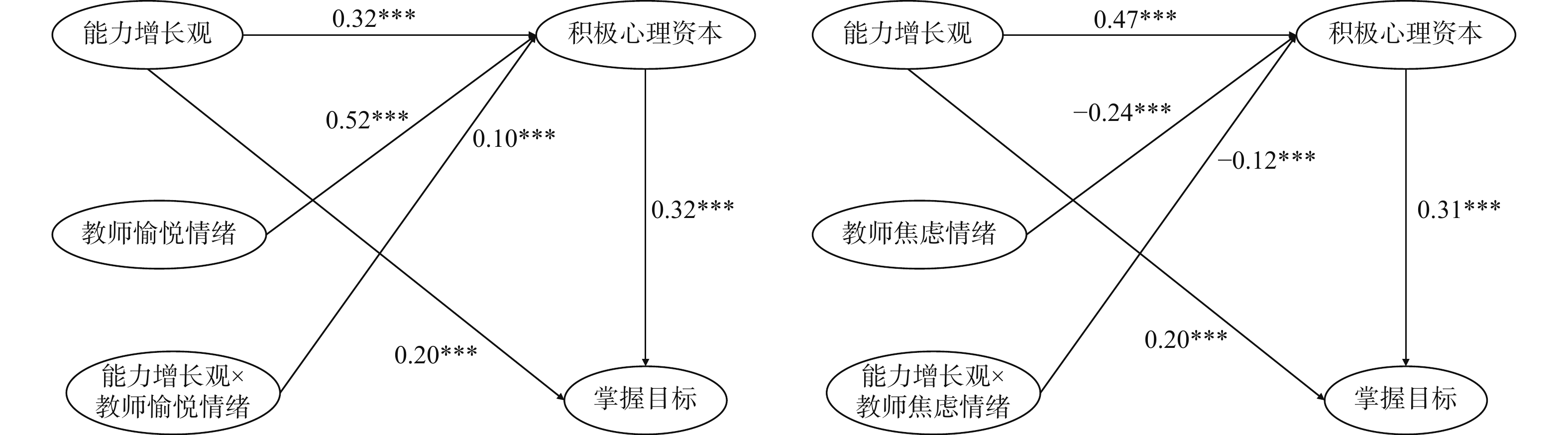
图1 教师情绪的调节作用
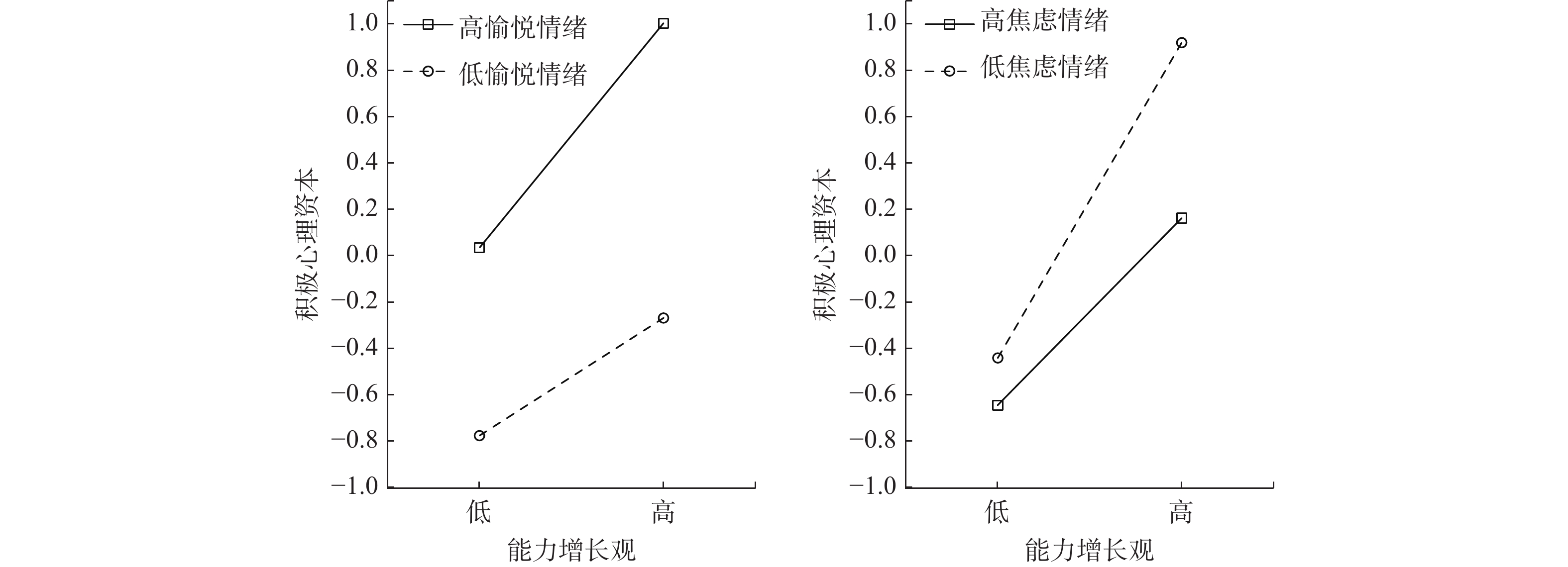
图2 教师情绪在能力增长观与积极心理资本间的调节作用
|
成子娟, 侯杰泰. 学科能力内隐观的普遍性及其年龄差异. 心理科学, 2000, 23 (2): 146- 150,252.
DOI |
|
|
侯杰泰, 温忠麟, 成子娟. (2004). 结构方程模型及其应用. 北京: 教育科学出版社.
|
|
|
毛晋平, 倪鑫庭, 钟妮, 宋灿. 差序式领导风格与中学教师工作投入的关系: 心理资本的中介作用. 中国临床心理学杂志, 2019, 27 (3): 604- 608.
|
|
|
王嘉莹, 姚梅林, 刘红瑞. 成就目标与教师效能感、焦虑、工作投入的关系: 基于变量中心和个体中心的视角. 心理与行为研究, 2022, 20 (1): 122- 129.
|
|
|
温忠麟, 侯杰泰, 马什赫伯特. 结构方程模型检验: 拟合指数与卡方准则. 心理学报, 2004, 36 (2): 186- 194.
|
|
|
温忠麟, 叶宝娟. 中介效应分析: 方法和模型发展. 心理科学进展, 2014, 22 (5): 731- 745.
|
|
|
吴佳桧, 傅海伦. 成就目标定向与学业成绩关系的元分析: 自我效能感、学习投入的中介作用. 心理科学进展, 2024, 32 (7): 1104- 1125.
|
|
|
吴艳, 温忠麟. 结构方程建模中的题目打包策略. 心理科学进展, 2011, 19 (12): 1859- 1867.
|
|
|
熊红星, 张璟, 叶宝娟, 郑雪, 孙配贞. 共同方法变异的影响及其统计控制途径的模型分析. 心理科学进展, 2012, 20 (5): 757- 769.
|
|
|
张阔, 张赛, 董颖红. 积极心理资本: 测量及其与心理健康的关系. 心理与行为研究, 2010, 8 (1): 58- 64.
|
|
|
Ames, C. Classrooms: Goals, structures, and student motivation. Journal of Educational Psychology, 1992, 84 (3): 261- 271.
DOI |
|
|
Anderman, E. M., & Wolters, C. A. (2006). Goals, values, and affect: Influences on student motivation. In P. A. Alexander & P. H. Winne (Eds.), Handbook of educational psychology (pp. 369–389). Mahwah, NJ: Erlbaum.
|
|
|
Aronson, J., Fried, C. B., & Good, C. Reducing the effects of stereotype threat on African American college students by shaping theories of intelligence. Journal of Experimental Social Psychology, 2002, 38 (2): 113- 125.
DOI |
|
|
Becker, E. S., Goetz, T., Morger, V., & Ranellucci, J. The importance of teachers’ emotions and instructional behavior for their students’ emotions–An experience sampling analysis. Teaching and Teacher Education, 2014, 43, 15- 26.
DOI |
|
|
Bempechat, J., London, P., & Dweck, C. S. Children’s conceptions of ability in major domains: An interview and experimental study. Child Study Journal, 1991, 21 (1): 11- 36.
|
|
|
Burić, I., & Moè, A. What makes teachers enthusiastic: The interplay of positive affect, self-efficacy and job satisfaction. Teaching and Teacher Education, 2020, 89, 103008.
DOI |
|
|
Burić, I., Slišković, A., & Sorić, I. Teachers’ emotions and self-efficacy: A test of reciprocal relations. Frontiers in Psychology, 2020, 11, 1650.
DOI |
|
|
Chen, X., Zeng, G., Chang, E. C., & Cheung, H. Y. What are the potential predictors of psychological capital for Chinese primary school teachers. Frontiers in Education, 2019, 4, 50.
DOI |
|
|
Cury, F., Elliot, A. J., Da Fonseca, D., & Moller, A. C. The social-cognitive model of achievement motivation and the 2×2 achievement goal framework. Journal of Personality and Social Psychology, 2006, 90 (4): 666- 679.
DOI |
|
|
Dinger, F. C., & Dickhäuser, O. Does implicit theory of intelligence cause achievement goals? Evidence from an experimental study. International Journal of Educational Research, 2013, 61, 38- 47.
|
|
|
Dweck, C. S. Motivational processes affecting learning. American Psychologist, 1986, 41 (10): 1040- 1048.
DOI |
|
|
Dweck, C. S. (1999). Self-Theories: Their role in motivation, personality, and development. New York: Psychology Press.
|
|
|
Dweck, C. S. (2006). Mindset: The new psychology of success. New York: Random House.
|
|
|
Dweck, C. S., Chiu, C. Y., & Hong, Y. Y. Implicit theories and their role in judgments and reactions: A word from two perspectives. Psychological Inquiry, 1995, 6 (4): 267- 285.
DOI |
|
|
Dweck, C. S., & Leggett, E. L. A social-cognitive approach to motivation and personality. Psychological Review, 1988, 95 (2): 256- 273.
DOI |
|
|
Dweck, C. S., & Yeager, D. S. Mindsets: A view from two eras. Perspectives on Psychological Science, 2019, 14 (3): 481- 496.
DOI |
|
|
Fokkens-Bruinsma, M., van Rooij, E. C. M., & Canrinus, E. T. Perceived classroom goal structures as predictors of students’ personal goals. Teachers and Teaching, 2020, 26 (1): 88- 102.
DOI |
|
|
Frenzel, A. C., Goetz, T., Lüdtke, O., Pekrun, R., & Sutton, R. E. Emotional transmission in the classroom: Exploring the relationship between teacher and student enjoyment. Journal of Educational Psychology, 2009, 101 (3): 705- 716.
DOI |
|
|
Frenzel, A. C., Goetz, T., Stephens, E. J., & Jacob, B. (2009). Antecedents and effects of teachers’ emotional experiences: An integrated perspective and empirical test. In P. A. Schutz & M. Zembylas (Eds.), Advances in teacher emotion research: The impact on teachers’ lives (pp. 129–151). Boston: Springer.
|
|
|
Frenzel, A. C., Pekrun, R., Goetz, T., Daniels, L. M., Durksen, T. L., Becker-Kurz, B., & Klassen, R. M. Measuring teachers’ enjoyment, anger, and anxiety: The Teacher Emotions Scales (TES). Contemporary Educational Psychology, 2016, 46, 148- 163.
DOI |
|
|
Grant, H., & Dweck, C. S. Clarifying achievement goals and their impact. Journal of Personality and Social Psychology, 2003, 85 (3): 541- 553.
DOI |
|
|
Hu, L. T., & Bentler, P. M. Cutoff criteria for fit indexes in covariance structure analysis: Conventional criteria versus new alternatives. Structural Equation Modeling: A Multidisciplinary Journal, 1999, 6 (1): 1- 55.
DOI |
|
|
Huang, X. X., Zhang, J., & Hudson, L. Impact of math self-efficacy, math anxiety, and growth mindset on math and science career interest for middle school students: The gender moderating effect. European Journal of Psychology of Education, 2019, 34 (3): 621- 640.
DOI |
|
|
Kaplan, A., Gheen, M., & Midgley, C. Classroom goal structure and student disruptive behaviour. British Journal of Educational Psychology, 2002, 72 (2): 191- 211.
DOI |
|
|
Keller, M. M., Frenzel, A. C., Goetz, T., Pekrun, R., & Hensley, L. (2014). Exploring teacher emotions: A literature review and an experience sampling study. In P. W. Richardson, S. A. Karabenick, & H. M. G. Watt (Eds.), Teacher motivation: Theory and practice (pp. 70–82). New York: Routledge.
|
|
|
Lou, N. M., & Noels, K. A. Changing language mindsets: Implications for goal orientations and responses to failure in and outside the second language classroom. Contemporary Educational Psychology, 2016, 46, 22- 33.
DOI |
|
|
Luthans, F., & Youssef, C. M. Emerging positive organizational behavior. Journal of Management, 2007, 33 (3): 321- 349.
DOI |
|
|
Ma, Y. F. Boosting teacher work engagement: The mediating role of psychological capital through emotion regulation. Frontiers in Psychology, 2023, 14, 1240943.
DOI |
|
|
Maree, D. J. F., Maree, M., & Collins, C. The relationship between hope and goal achievement. Journal of Psychology in Africa, 2008, 18 (1): 65- 74.
DOI |
|
|
Meece, J. L., Anderman, E. M., & Anderman, L. H.. Classroom goal structure, student motivation, and academic achievement. Annual Review of Psychology, 2006, 57 (1): 487- 503.
DOI |
|
|
Midgley, C., Maehr, M. L., Hruda, L. Z. Anderman, E., Anderman, L., Freeman, K. E., .. Urdan, T. (2000). Manual for the patterns of adaptive learning scales. Ann Arbor: University of Michigan.
|
|
|
Nicholls, J. G. (1989). The competitive ethos and democratic education. Cambridge: Harvard University Press.
|
|
|
Shannon, D., Salisbury-Glennon, J., & Shores, M. Examining the relationships among classroom goal structure, achievement goal orientation, motivation and self-regulated learning for ethnically diverse learners. Journal of Research in Education, 2012, 22 (2): 136- 168.
|
|
|
Shim, S. S., Cho, Y. J., & Cassady, J. Goal structures: The role of teachers’ achievement goals and theories of intelligence. The Journal of Experimental Education, 2013, 81 (1): 84- 104.
DOI |
|
|
Sutton, R. E., & Wheatley, K. F. Teachers’ emotions and teaching: A review of the literature and directions for future research. Educational Psychology Review, 2003, 15 (4): 327- 358.
DOI |
|
|
Urdan, T., Midgley, C., & Anderman, E. M. The role of classroom goal structure in students’ use of self-handicapping strategies. American Educational Research Journal, 1998, 35 (1): 101- 122.
DOI |
|
|
Uzuntiryaki-Kondakci, E., Kirbulut, Z. D., Sarici, E., & Oktay, O. Emotion regulation as a mediator of the influence of science teacher emotions on teacher efficacy beliefs. Educational Studies, 2022, 48 (5): 583- 601.
DOI |
|
|
Youssef-Morgan, C. M., & Luthans, F. (2013). Psychological capital theory: Toward a positive holistic model. In A. B. Bakker (Ed.), Advances in positive organizational psychology (pp. 145–166). Leeds, United Kingdom: Emerald Group Publishing Limited.
|
|
|
Yu, J. L., Kreijkes, P., & Salmela-Aro, K. Students’ growth mindset: Relation to teacher beliefs, teaching practices, and school climate. Learning and Instruction, 2022, 80, 101616.
DOI |
|
|
Zeng, G., Hou, H. C., & Peng, K. P. Effect of growth mindset on school engagement and psychological well-being of Chinese primary and middle school students: The mediating role of resilience. Frontiers in Psychology, 2016, 7, 1873.
|
| [1] | 王怀勇, 徐田田, 叶青. 过程追踪视角下焦虑情绪对延迟选择的影响及机制:任务框架的调节作用[J]. 心理与行为研究, 2026, 24(1): 122-129. |
| [2] | 张剑锋, 窦敏, 吴汶颖. 呼吸与脑的交互机制和情绪调节效应[J]. 心理与行为研究, 2025, 23(6): 731-739. |
| [3] | 黄爽, 凌感, 安平. 社会情感能力与幼儿园教师职业倦怠的关系:心理授权和积极应对方式的链式中介作用[J]. 心理与行为研究, 2025, 23(6): 847-853. |
| [4] | 杜江. 地方综合性院校师范生职业认同的双重解析:人口学差异检验与入学动机驱动的链式中介模型[J]. 心理与行为研究, 2025, 23(6): 854-860. |
| [5] | 高璇, 王瑞, 李雨桐, 隋雪. 儿童情绪识别能力的发展:基于言语与面孔启动的研究[J]. 心理与行为研究, 2025, 23(5): 612-619. |
| [6] | 郑玉玮, 王潇钰, 张雅茹, 张馨月, 卢红霞. 初中生累积生态风险与自杀意念的关系:积极心理资本和个人成长主动性的链式中介作用[J]. 心理与行为研究, 2025, 23(5): 627-634. |
| [7] | 颜志强, 曾祥路, 黄立群, 肖琳. 共情促进还是阻碍创造力?来自三水平元分析的证据[J]. 心理与行为研究, 2025, 23(5): 662-669. |
| [8] | 任思梦, 张珊珊, 曾翠莲, 包俊俊, 章晨阳. 睡眠质量在负性情绪粒度与日常生活满意度间的中介作用:来自经验取样法的证据[J]. 心理与行为研究, 2025, 23(5): 678-684. |
| [9] | 高垚杰, 齐运晓, 马苑秋, 刘拓. 基于ChatGPT的情绪稳定性自适应题库开发的探索[J]. 心理与行为研究, 2025, 23(5): 685-694. |
| [10] | 冯圆, 宋佳, 郭晶晶. 语境情绪及句子框架对二语词汇情绪学习的影响[J]. 心理与行为研究, 2025, 23(4): 433-440. |
| [11] | 张昕怡, 汤文芯, 黄亦彤, 张梦雪, 温碧璇, 刘威. 唤醒民族危机感与自豪感选择性增强后续记忆编码[J]. 心理与行为研究, 2025, 23(4): 464-471. |
| [12] | 袁悦, 张航, 陈亚楠, 李巧灵. 3~6岁儿童执行功能子成分与情绪理解的关系:一项交叉滞后分析[J]. 心理与行为研究, 2025, 23(4): 472-478. |
| [13] | 李萌, 马克健, 宋照祥, 齐铭铭. 定向遗忘促进中性信息情绪贬值[J]. 心理与行为研究, 2025, 23(3): 304-312. |
| [14] | 林代春, 王光亚, 王艳梅, 崔丽弦. 动态表情模仿中的情绪感染及其生理同步[J]. 心理与行为研究, 2025, 23(3): 313-321. |
| [15] | 钞淼, 张宇, 谢启慧, 刘拓. 情感忽视对农村青少年短视频成瘾的纵向影响:负性情绪中介及留守差异[J]. 心理与行为研究, 2025, 23(3): 361-368. |
| 阅读次数 | ||||||
|
全文 |
|
|||||
|
摘要 |
|
|||||
