
心理与行为研究 ›› 2025, Vol. 23 ›› Issue (4): 504-512.DOI: 10.12139/j.1672-0628.2025.04.010
鲍振宙, 刘花, 于明申*( )
)
收稿日期:2024-07-17
出版日期:2025-07-20
发布日期:2025-07-20
通讯作者:
于明申
基金资助:
Zhenzhou BAO, Hua LIU, Mingshen YU*()
Received:2024-07-17
Online:2025-07-20
Published:2025-07-20
Contact:
Mingshen YU
摘要:
对1083名青少年进行为期六个月的两次追踪调查,采用纵向网络分析法考察青少年焦虑抑郁的核心症状,探究校园欺凌旁观行为与焦虑抑郁症状的网络关系,并检验该网络结构的跨时间差异性。结果发现:(1)青少年焦虑抑郁的核心症状为T1时间的“我过分恐惧或担心”及T2时间的“我忧虑重重”;(2)“局外行为”是连接青少年校园欺凌旁观行为与焦虑抑郁症状的重要桥梁;(3)两个时间的网络结构相对稳定。研究结果揭示了校园欺凌旁观行为与焦虑抑郁症状的网络结构,为校园欺凌旁观者的心理适应提供了新的干预视角。
鲍振宙, 刘花, 于明申. 青少年校园欺凌旁观行为与焦虑抑郁症状的关系:基于纵向网络分析法[J]. 心理与行为研究, 2025, 23(4): 504-512.
Zhenzhou BAO, Hua LIU, Mingshen YU. The Relationship Between Adolescents’ Bystander Behaviors in School Bullying and Anxiety-Depression Symptoms: Based on Longitudinal Network Analysis[J]. Studies of Psychology and Behavior, 2025, 23(4): 504-512.
| 人口统计学因素 | |
| 年龄, M(SD)a | |
| T1: 14.40(1.30) | |
| T2: 14.90(1.30) | |
| 性别, n(%) | |
| 男 | 535(49.40%) |
| 女 | 548(50.60%) |
| 家庭经济困难, n(%)a | |
| 很大困难 | 16(1.48%) |
| 较大困难 | 63(5.82%) |
| 较小困难 | 386(35.64%) |
| 没有困难 | 475(43.86%) |
表1 被试人口统计学信息(n=1083)
| 人口统计学因素 | |
| 年龄, M(SD)a | |
| T1: 14.40(1.30) | |
| T2: 14.90(1.30) | |
| 性别, n(%) | |
| 男 | 535(49.40%) |
| 女 | 548(50.60%) |
| 家庭经济困难, n(%)a | |
| 很大困难 | 16(1.48%) |
| 较大困难 | 63(5.82%) |
| 较小困难 | 386(35.64%) |
| 没有困难 | 475(43.86%) |
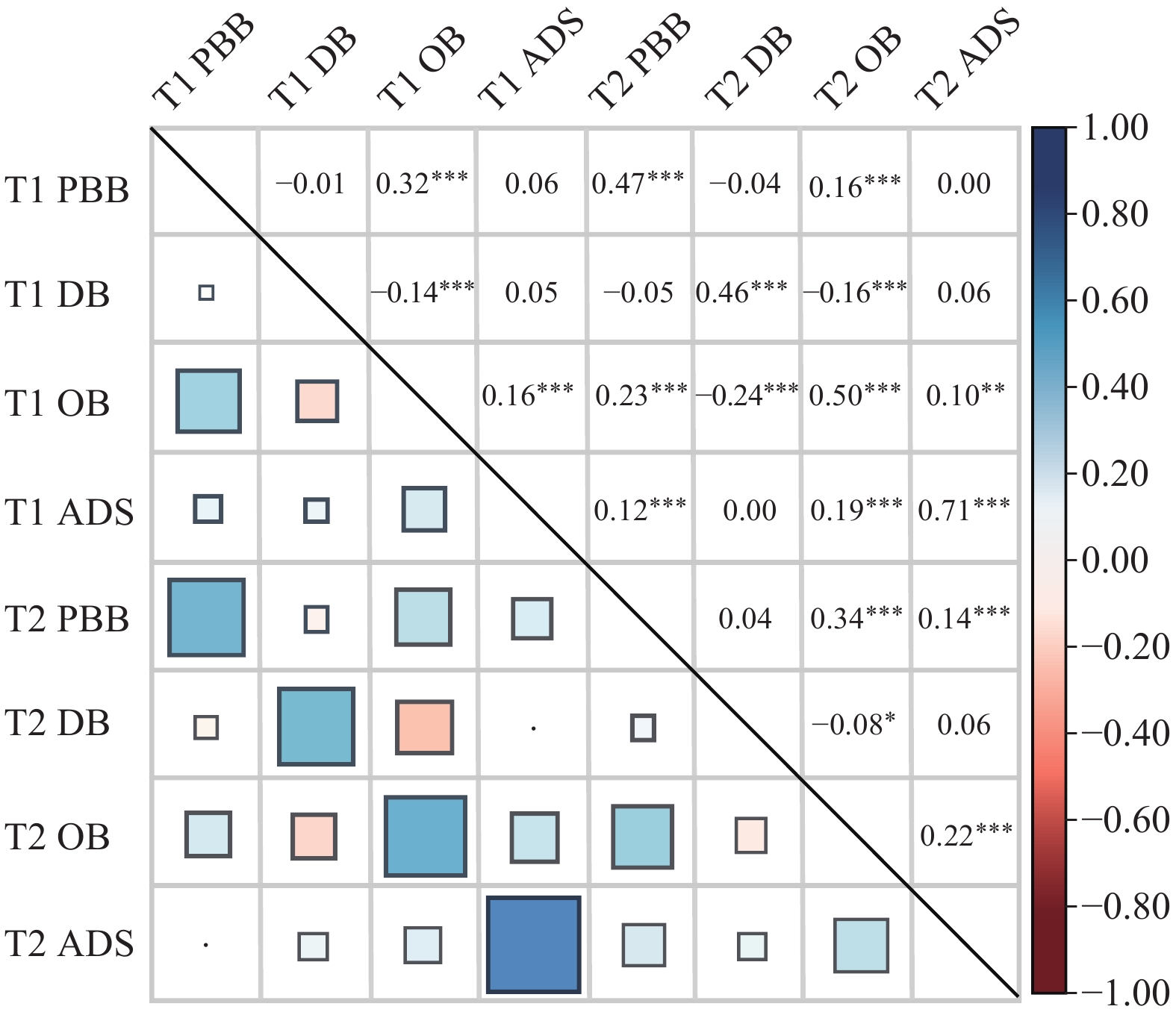
图1 青少年校园欺凌中的旁观行为与焦虑抑郁的相关关系 注:*p<0.05,**p<0.01,***p<0.001;ADS(Anxiety and Depression Scale)=焦虑抑郁,OB(outsider behaviors)=局外行为,PBB(pro-bullying behaviors)=亲欺凌行为,DB(defender behaviors)=保护行为,以下同。
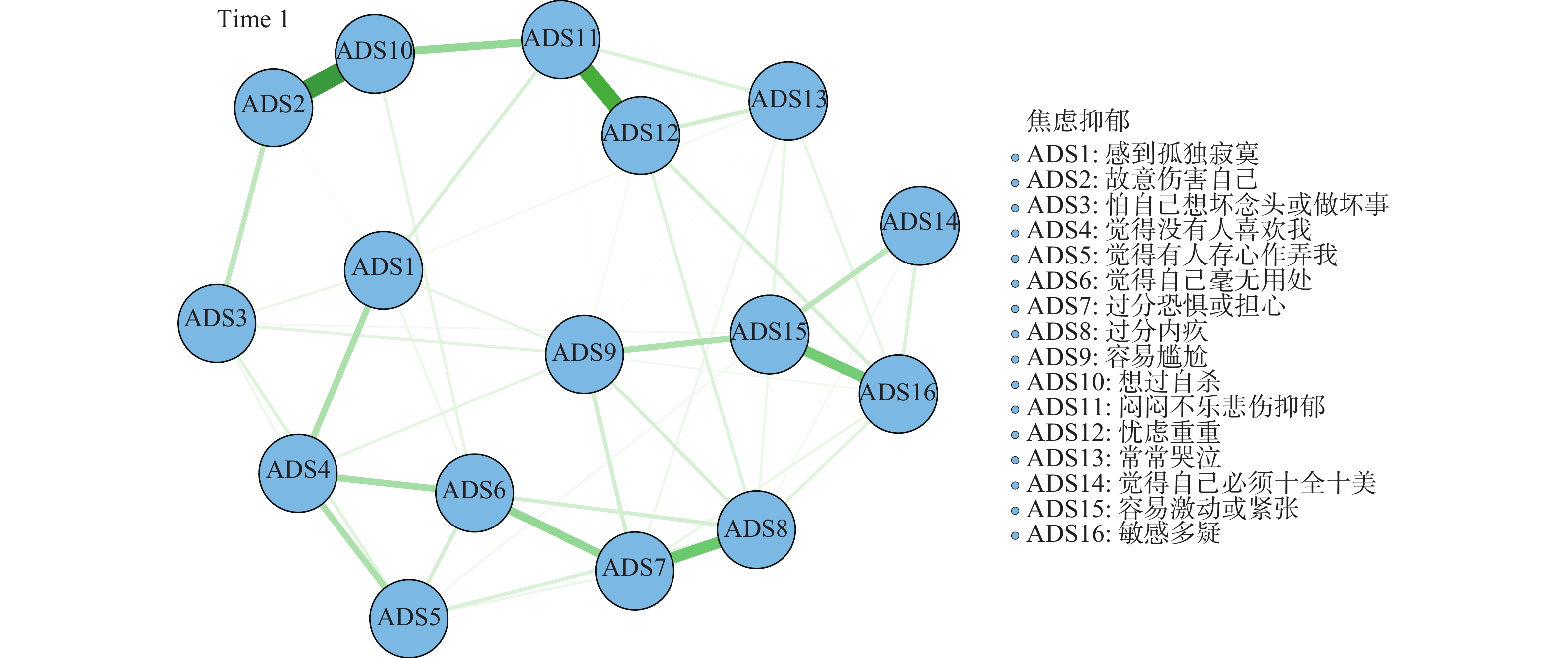
图2 T1时青少年焦虑抑郁的网络结构 注:节点表示焦虑抑郁量表中的不同题项,边线表示项目之间的相关性,红色边线表示负相关,绿色边线表示正相关,边线越粗代表相关性越强,以下同。
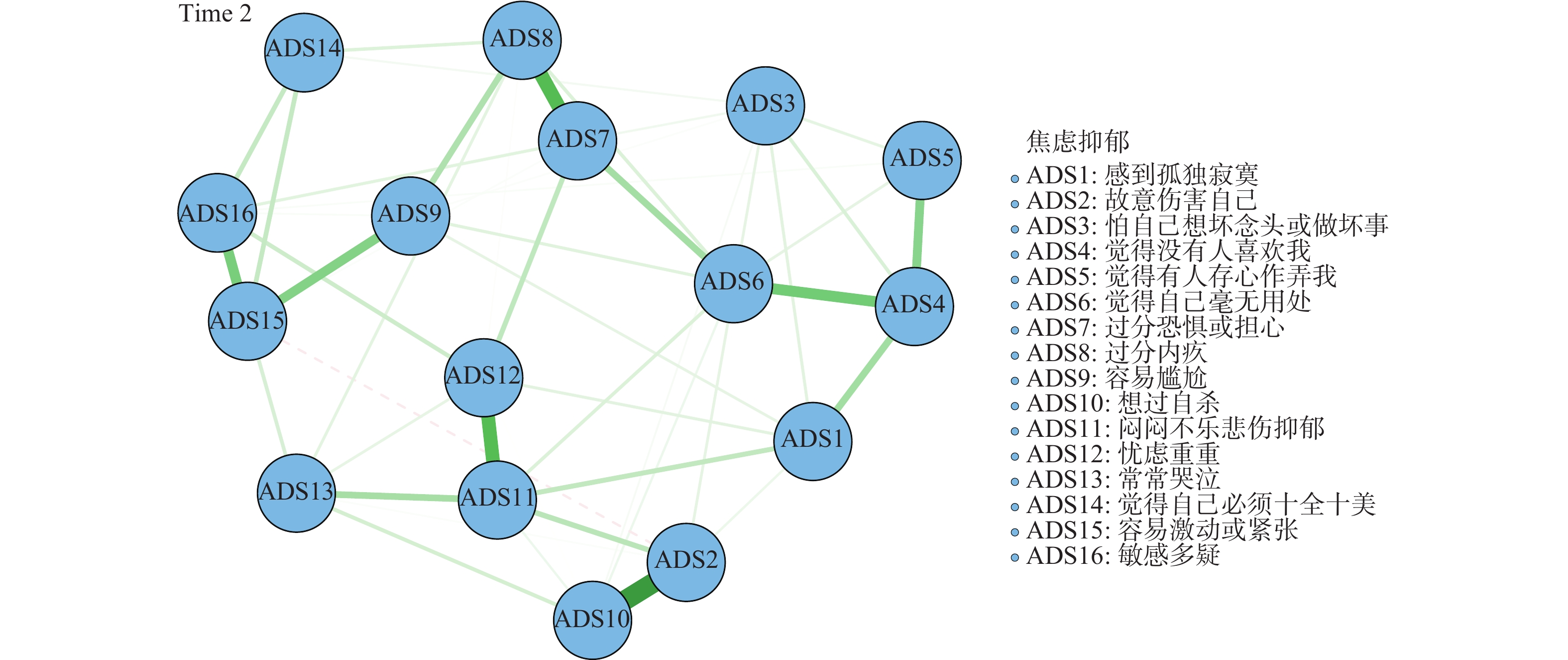
图3 T2时青少年焦虑抑郁的网络结构
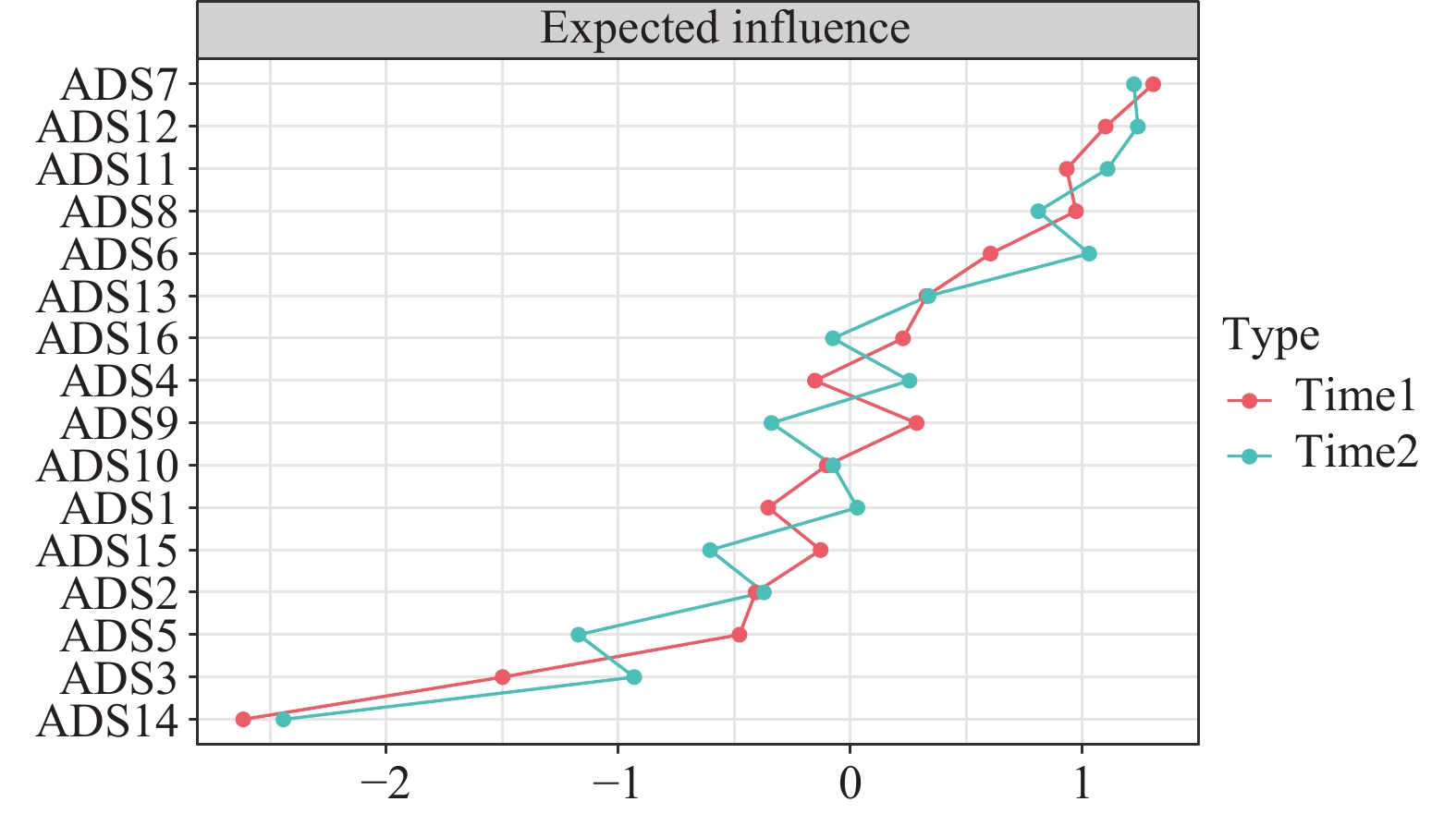
图4 焦虑抑郁各项目的预期影响 注:红色表示T1时的预期影响,绿色表示T2时的预期影响。
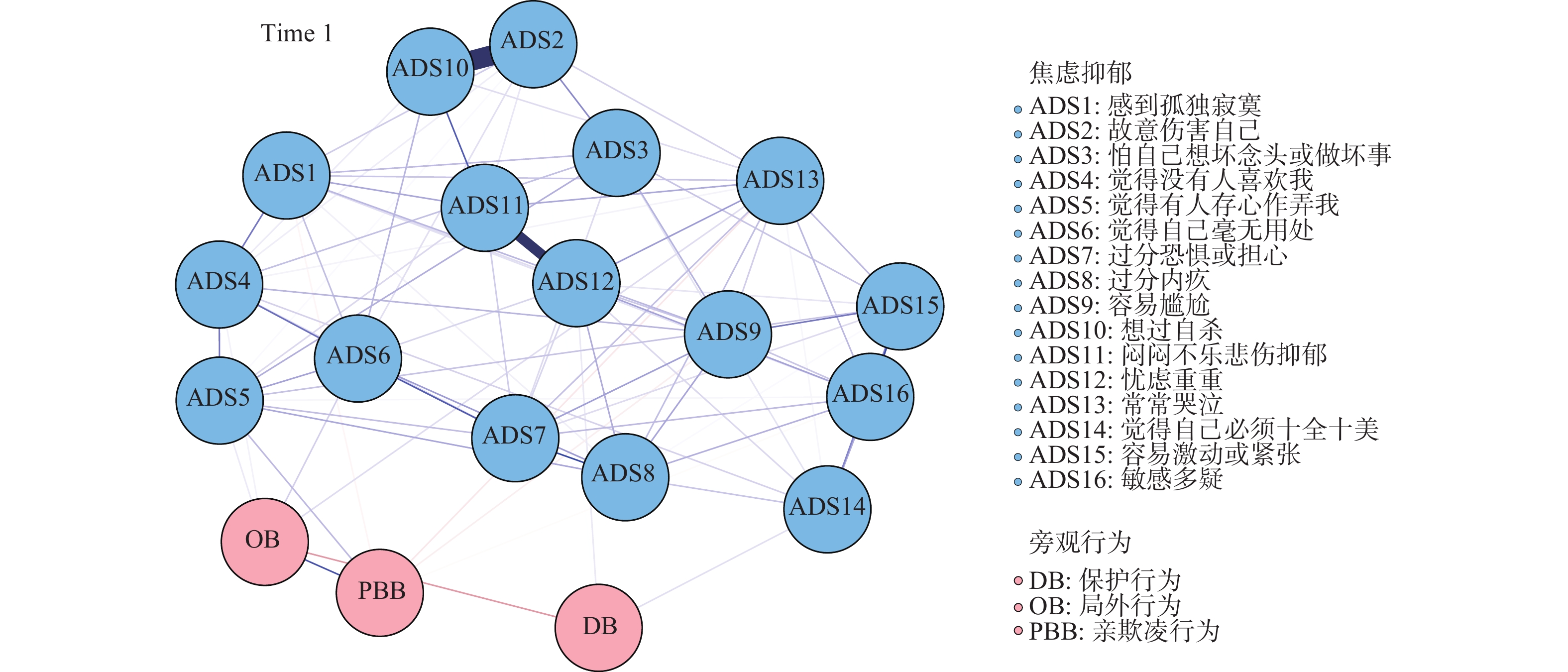
图5 T1时青少年校园欺凌旁观行为与焦虑抑郁的网络估计 注:红色边线表示负相关,蓝色边线表示正相关,以下同。
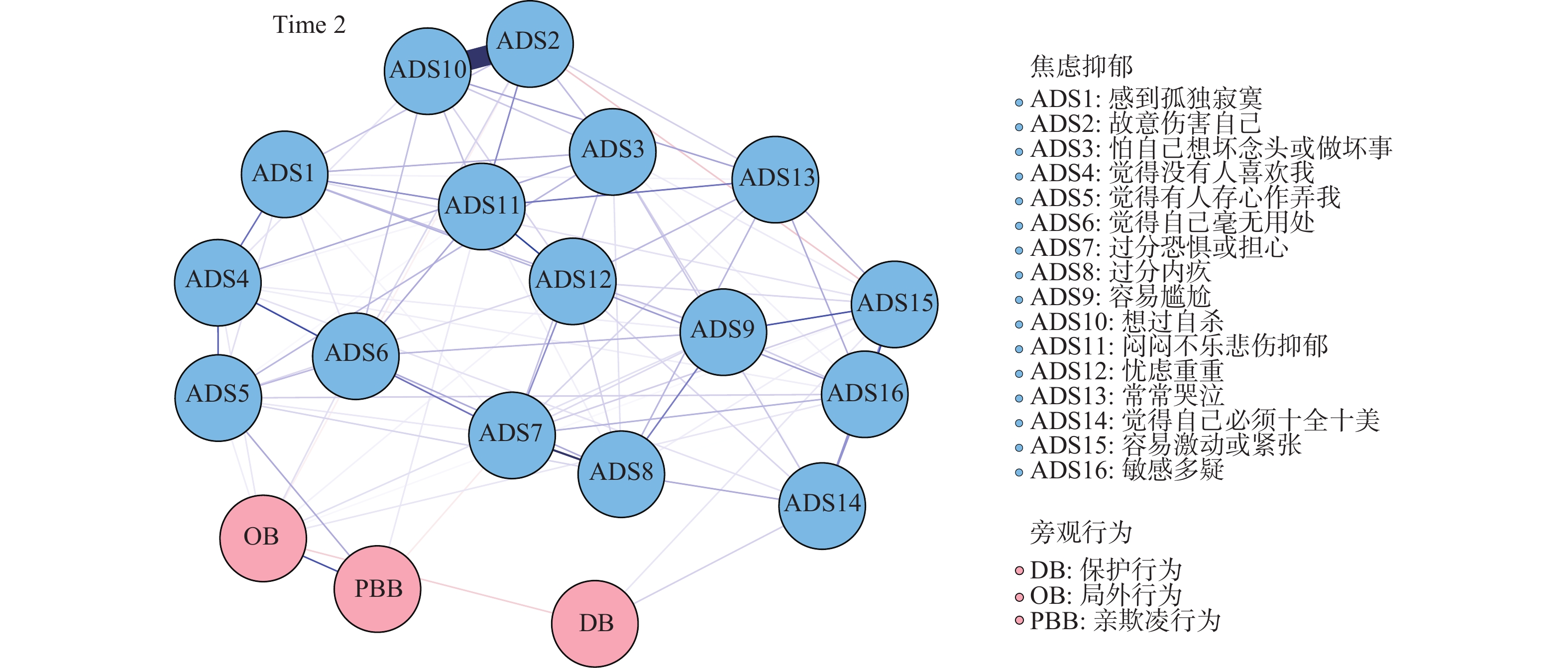
图6 T2时青少年校园欺凌旁观行为与焦虑抑郁的网络估计
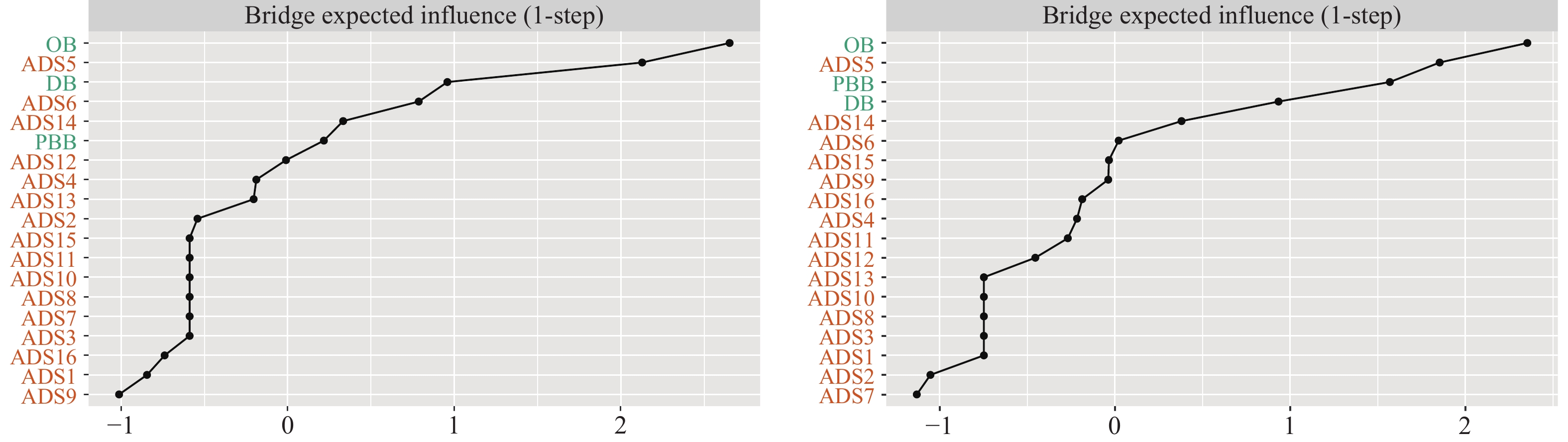
图7 T1(左)、T2(右)时青少年校园欺凌旁观行为与焦虑抑郁症状关系网络的桥接预期影响
| 节点 | 节点 | p | d(T2−T1) | |
| 焦虑抑郁 | ADS4 | ADS6 | 0.04 | −0.11 |
| ADS1 | ADS8 | 0.02 | −0.02 | |
| ADS6 | ADS9 | 0.02 | 0.09 | |
| ADS3 | ADS10 | 0.03 | 0.07 | |
| ADS2 | ADS11 | 0.03 | 0.14 | |
| ADS6 | ADS11 | 0.03 | 0.11 | |
| ADS11 | ADS12 | 0.05 | −0.09 | |
| ADS5 | ADS15 | 0.01 | −0.07 | |
| ADS9 | ADS13 | 0.05 | −0.02 | |
| 旁观行为−焦虑抑郁 | DB | ADS12 | 0.04 | −0.02 |
表2 T1、T2网络结构的边线不变性检验结果
| 节点 | 节点 | p | d(T2−T1) | |
| 焦虑抑郁 | ADS4 | ADS6 | 0.04 | −0.11 |
| ADS1 | ADS8 | 0.02 | −0.02 | |
| ADS6 | ADS9 | 0.02 | 0.09 | |
| ADS3 | ADS10 | 0.03 | 0.07 | |
| ADS2 | ADS11 | 0.03 | 0.14 | |
| ADS6 | ADS11 | 0.03 | 0.11 | |
| ADS11 | ADS12 | 0.05 | −0.09 | |
| ADS5 | ADS15 | 0.01 | −0.07 | |
| ADS9 | ADS13 | 0.05 | −0.02 | |
| 旁观行为−焦虑抑郁 | DB | ADS12 | 0.04 | −0.02 |
|
陈嘉慧, 任萍, 吕沐华, 李添. 童年晚期抑郁症状网络的演化及症状间的纵向关系. 心理科学, 2024, 47 (6): 1381- 1391.
|
|
|
储怡佳. (2023). 青少年亲欺凌旁观行为的发展轨迹及其前因与后果变量分析(硕士学位论文). 赣南师范大学, 赣州.
|
|
|
纪林芹, 陈亮, 徐夫真, 赵守盈, 张文新. 童年中晚期同伴侵害对儿童心理社会适应影响的纵向分析. 心理学报, 2011, 43 (10): 1151- 1162.
|
|
|
王大涛, 刘艳艳, 周建华. 同伴侵害对青少年内外化问题的影响: 有调节的中介模型. 心理与行为研究, 2023, 21 (5): 651- 657.
DOI |
|
|
王孟成, 张新彤, 吕昌嵩, 黎志华. 男性服刑人员抑郁焦虑症状网络结构及其与父母养育方式的关系. 中国临床心理学杂志, 2021, 29 (3): 496- 500.
|
|
|
杨晓霞, 陈亮, 曹衍淼, 毕馨文, 陈光辉, 张文新. 青少年早期同伴侵害的亚类别及其稳定性: 个体定向的分析. 心理发展与教育, 2020, 36 (2): 146- 156.
|
|
|
喻承甫, 张卫, 曾毅茵, 叶婷, 李月明, 王姝君. 青少年感恩与问题行为的关系: 学校联结的中介作用. 心理发展与教育, 2011, 27 (4): 425- 433.
|
|
|
张伟霞, 席敏, 阴甜甜, 王成, 司书宾. 基于网络分析的抑郁症产生与演变预测. 心理科学进展, 2023, 31 (11): 2129- 2141.
|
|
|
Bandura, A. Moral disengagement in the perpetration of inhumanities. Personality and Social Psychology Review, 1999, 3 (3): 193- 209.
DOI |
|
|
Beard, C., Millner, A. J., Forgeard, M. J. C., Fried, E. I., Hsu, K. J., Treadway, M. T., … Björgvinsson, T. Network analysis of depression and anxiety symptom relationships in a psychiatric sample. Psychological Medicine, 2016, 46 (16): 3359- 3369.
DOI |
|
|
Bekkhus, M., McVarnock, A., Coplan, R. J., Ulset, V., & Kraft, B. Developmental changes in the structure of shyness and internalizing symptoms from early to middle childhood: A network analysis. Child Development, 2023, 94 (4): 1078- 1086.
DOI |
|
|
Borkovec, T. D., Lyonfields, J. D., Wiser, S. L., & Deihl, L. The role of worrisome thinking in the suppression of cardiovascular response to phobic imagery. Behaviour Research and Therapy, 1993, 31 (3): 321- 324.
DOI |
|
|
Copeland, W. E., Shanahan, L., Costello, E. J., & Angold, A. Childhood and adolescent psychiatric disorders as predictors of young adult disorders. Archives of General Psychiatry, 2009, 66 (7): 764- 772.
DOI |
|
|
Copeland, W. E., Wolke, D., Angold, A., & Costello, E. J. Adult psychiatric outcomes of bullying and being bullied by peers in childhood and adolescence. JAMA Psychiatry, 2013, 70 (4): 419- 426.
DOI |
|
|
Craig, W. M., & Pepler, D. J. Observations of bullying and victimization in the school yard. Canadian Journal of School Psychology, 1998, 13 (2): 41- 59.
DOI |
|
|
D’Augelli, A. R., Pilkington, N. W., & Hershberger, S. L. Incidence and mental health impact of sexual orientation victimization of lesbian, gay, and bisexual youths in high school. School Psychology Quarterly, 2002, 17 (2): 148- 167.
DOI |
|
|
Dablander, F., & Hinne, M. Node centrality measures are a poor substitute for causal inference. Scientific Reports, 2019, 9 (1): 6846.
DOI |
|
|
Demaray, M. K., Malecki, C. K., Ryoo, J. H., & Summers, K. H. Deconstructing bullying roles: A longitudinal latent profile analysis of bullying participant behaviors for students in grades 4 through 12. Journal of School Psychology, 2021, 86, 32- 48.
DOI |
|
|
Doumas, D. M., & Midgett, A. The association between witnessing cyberbullying and depressive symptoms and social anxiety among elementary school students. Psychology in the Schools, 2021, 58 (3): 622- 637.
DOI |
|
|
Epskamp, S., Borsboom, D., & Fried, E. I. Estimating psychological networks and their accuracy: A tutorial paper. Behavior Research Methods, 2018, 50 (1): 195- 212.
DOI |
|
|
Festinger, L. (1957). A theory of cognitive dissonance. Palo Alto, CA: Stanford University Press.
|
|
|
Forbes, M. K., Wright, A. G. C., Markon, K. E., & Krueger, R. F. Evidence that psychopathology symptom networks have limited replicability. Journal of Abnormal Psychology, 2017, 126 (7): 969- 988.
DOI |
|
|
Georgiades, K., Lewinsohn, P. M., Monroe, S. M., & Seeley, J. R. Major depressive disorder in adolescence: The role of subthreshold symptoms. Journal of the American Academy of Child & Adolescent Psychiatry, 2006, 45 (8): 936- 944.
|
|
|
Haslbeck, J. M. B., & Fried, E. I. How predictable are symptoms in psychopathological networks? A reanalysis of 18 published datasets. Psychological Medicine, 2017, 47 (16): 2767- 2776.
DOI |
|
|
Kline, P. (2015). A handbook of test construction (psychology revivals): Introduction to psychometric design. London: Routledge.
|
|
|
McElroy, E., Fearon, P., Belsky, J., Fonagy, P., & Patalay, P. Networks of depression and anxiety symptoms across development. Journal of the American Academy of Child & Adolescent Psychiatry, 2018, 57 (12): 964- 973.
|
|
|
Midgett, A., & Doumas, D. M. Witnessing bullying at school: The association between being a bystander and anxiety and depressive symptoms. School Mental Health, 2019, 11 (3): 454- 463.
DOI |
|
|
Midgett, A., Doumas, D. M., & Trull, R. Evaluation of a bystander bullying intervention program for elementary school students. Professional School Counselor, 2018, 20 (1): 172- 183.
|
|
|
Midgett, A., Moody, S. J., Reilly, B., & Lyter, S. The phenomenological experience of student-advocates trained as defenders to stop school bullying. The Journal of Humanistic Counseling, 2017, 56 (1): 53- 71.
DOI |
|
|
Mills, N., Pajares, F., & Herron, C. A reevaluation of the role of anxiety: Self-efficacy, anxiety, and their relation to reading and listening proficiency. Foreign Language Annals, 2006, 39 (2): 276- 295.
DOI |
|
|
Panumaporn, J., Hongsanguansri, S., Atsariyasing, W., & Kiatrungrit, K. Bystanders’ behaviours and associated factors in cyberbullying. General Psychiatry, 2020, 33 (3): e100187.
DOI |
|
|
Raposa, E. B., Laws, H. B., & Ansell, E. B. Prosocial behavior mitigates the negative effects of stress in everyday life. Clinical Psychological Science, 2016, 4 (4): 691- 698.
DOI |
|
|
Ren, X. R. Artificial intelligence and depression: How AI powered chatbots in virtual reality games may reduce anxiety and depression levels. Journal of Artificial Intelligence Practice, 2020, 3 (1): 48- 58.
|
|
|
Rivers, I., Poteat, V. P., Noret, N., & Ashurst, N. Observing bullying at school: The mental health implications of witness status. School Psychology Quarterly, 2009, 24 (4): 211- 223.
DOI |
|
|
Salmivalli, C., Kärnä, A., & Poskiparta, E. Counteracting bullying in Finland: The KiVa program and its effects on different forms of being bullied. International Journal of Behavioral Development, 2011, 35 (5): 405- 411.
DOI |
|
|
Salmivalli, C., Lagerspetz, K., Björkqvist, K., Österman, K., & Kaukiainen, A. Bullying as a group process: Participant roles and their relations to social status within the group. Aggressive Behavior, 1996, 22 (1): 1- 15.
|
|
|
Troop-Gordon, W., Frosch, C. A., Wienke Totura, C. M., Bailey, A. N., Jackson, J. D., & Dvorak, R. D. Predicting the development of pro-bullying bystander behavior: A short-term longitudinal analysis. Journal of School Psychology, 2019, 77, 77- 89.
DOI |
|
|
van Borkulo, C. D., van Bork, R., Boschloo, L., Kossakowski, J. J., Tio, P., Schoevers, R. A., ... Waldorp, L. J. Comparing network structures on three aspects: A permutation test. Psychological Methods, 2023, 28 (6): 1273- 1285.
DOI |
|
|
Williford, A. P., Brisson, D., Bender, K. A., Jenson, J. M., & Forrest-Bank, S. Patterns of aggressive behavior and peer victimization from childhood to early adolescence: A latent class analysis. Journal of Youth and Adolescence, 2011, 40 (6): 644- 655.
DOI |
|
|
Xie, H., & Ngai, S. S. Y. Participant roles of peer bystanders in school bullying situations: Evidence from Wuhan, China. Children and Youth Services Review, 2020, 110, 104762.
DOI |
|
|
Yun, H. Y. New approaches to defender and outsider roles in school bullying. Child Development, 2020, 91 (4): e814- e832.
|
| [1] | 王惠惠, 唐慎佩, 赵双祐, 黄向圆, 兰松. 内在自我与外界眼光:自我评价与反射性评价一致性对青少年心理健康问题的影响[J]. 心理与行为研究, 2026, 24(2): 187-194. |
| [2] | 樊雪戎, 段依凡, 邢晓沛. 温暖的亲子感知差异与青少年内化问题的关系:基于二项式回归的响应面分析[J]. 心理与行为研究, 2026, 24(2): 195-203. |
| [3] | 杨昕玥, 赵永萍. 保护行为规范对初中生校园欺凌旁观者保护意愿的影响及自我决定动机的中介效应[J]. 心理与行为研究, 2026, 24(2): 251-257. |
| [4] | 张一林, 牛更枫, 白旭青, 辛素飞, 孙晓军. 社会逆境感知与青少年社交媒体成瘾的双向关系:控制感的作用[J]. 心理与行为研究, 2026, 24(2): 258-264. |
| [5] | 曾子豪, 何震, 袁言云, 赵纤, 印利红, 谭嵘, 常梦梦, 胡义秋. HPA轴系统多基因−亲子关系交互对青少年抑郁发展影响及性别差异[J]. 心理与行为研究, 2026, 24(1): 78-86. |
| [6] | 杨昕珠, 王腾飞, 郑晓龙. 青少年社会情感能力与学业倦怠的双向预测作用:一项交叉滞后研究[J]. 心理与行为研究, 2025, 23(6): 789-797. |
| [7] | 谷莉, 黄晓彤, 梁广华, 蔡頠, 郭丰波. 核心自我评价与青少年自伤行为的关系:有调节的中介模型[J]. 心理与行为研究, 2025, 23(6): 798-805. |
| [8] | 张春妹, 骆玉冰, 温冬雪, 郑航. 青少年逆反心理与偏差行为的关系:偏差同伴联系和偏差群体同一性的链式中介作用[J]. 心理与行为研究, 2025, 23(5): 645-652. |
| [9] | 刘鑫, 刘衍玲, 曾晋逸. 心理需要挫折与青少年抑郁症状的纵向联系:心理素质的调节作用[J]. 心理与行为研究, 2025, 23(4): 496-503. |
| [10] | 刘佳, 高培晋, 李楠, 孙敏, 白学军. 社会变化程度感知对青少年社会公平感的影响[J]. 心理与行为研究, 2025, 23(4): 551-559. |
| [11] | 张庆吉, 郭丰波, 涂叶满, 卿再花, 宋凤. 劳动价值观对青少年心理健康潜在类别及其转换的影响:双因素模型视角[J]. 心理与行为研究, 2025, 23(4): 569-576. |
| [12] | 张阔, 李珮瑜, 赵晋娥, 贾绪计. 二分还是多重?青少年成长型思维动机框架的异质性及其与学业适应的关系[J]. 心理与行为研究, 2025, 23(3): 346-353. |
| [13] | 钞淼, 张宇, 谢启慧, 刘拓. 情感忽视对农村青少年短视频成瘾的纵向影响:负性情绪中介及留守差异[J]. 心理与行为研究, 2025, 23(3): 361-368. |
| [14] | 王锦, 杨晓凡, 刘晓金, 徐紫陌. 中学生的未来自我连续性对主观幸福感的作用:价值冲突的中介模型[J]. 心理与行为研究, 2025, 23(2): 201-207. |
| [15] | 黎光明, 刘钰. 基于多组增长混合模型的青少年网络成瘾纵向分析[J]. 心理与行为研究, 2025, 23(2): 208-215. |
| 阅读次数 | ||||||
|
全文 |
|
|||||
|
摘要 |
|
|||||
