
心理与行为研究 ›› 2026, Vol. 24 ›› Issue (2): 187-194.DOI: 10.12139/j.1672-0628.2026.02.006
王惠惠*,1( ), 唐慎佩1, 赵双祐1, 黄向圆2, 兰松3
收稿日期:2024-12-16
出版日期:2026-03-20
发布日期:2026-03-20
通讯作者:
王惠惠
基金资助:
Huihui WANG*,1(), Shenpei TANG1, Shuangyou ZHAO1, Xiangyuan HUANG2, Song LAN3
Received:2024-12-16
Online:2026-03-20
Published:2026-03-20
Contact:
Huihui WANG
摘要:
以481名初中生为研究对象,采用多项式回归与响应面分析探讨自我评价与反射性评价一致性对心理健康问题的影响,并探讨性别在其中的调节作用。结果显示:(1)在自我评价与反射性评价一致时,评价水平越低,青少年心理健康问题越严重;(2)在自我评价与反射性评价不一致时,低自我评价−高反射性评价的青少年心理健康问题更严重;(3)性别在自我评价−反射性评价匹配模式对心理健康问题的影响中起调节作用。研究结果揭示了低自我评价是评价匹配对心理健康影响中的重要风险因素,并为青少年心理问题干预的性别差异化设计提供了依据。
王惠惠, 唐慎佩, 赵双祐, 黄向圆, 兰松. 内在自我与外界眼光:自我评价与反射性评价一致性对青少年心理健康问题的影响[J]. 心理与行为研究, 2026, 24(2): 187-194.
Huihui WANG, Shenpei TANG, Shuangyou ZHAO, Xiangyuan HUANG, Song LAN. The Inner Self and External Perspectives: The Impact of Self-Appraisal and Reflected Appraisal Consistency on Adolescents’ Mental Health Issues[J]. Studies of Psychology and Behavior, 2026, 24(2): 187-194.
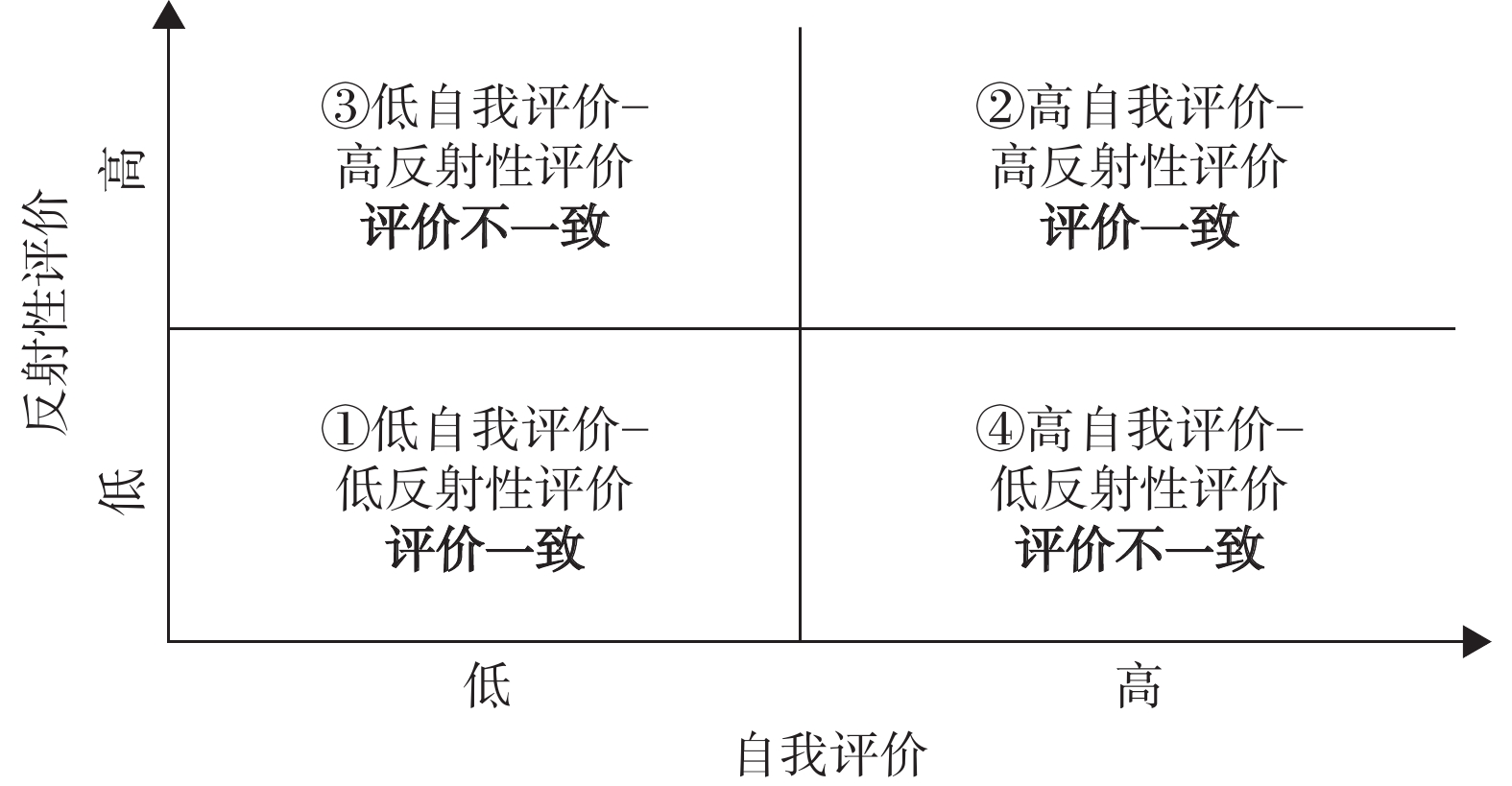
图1 评价一致与不一致模型
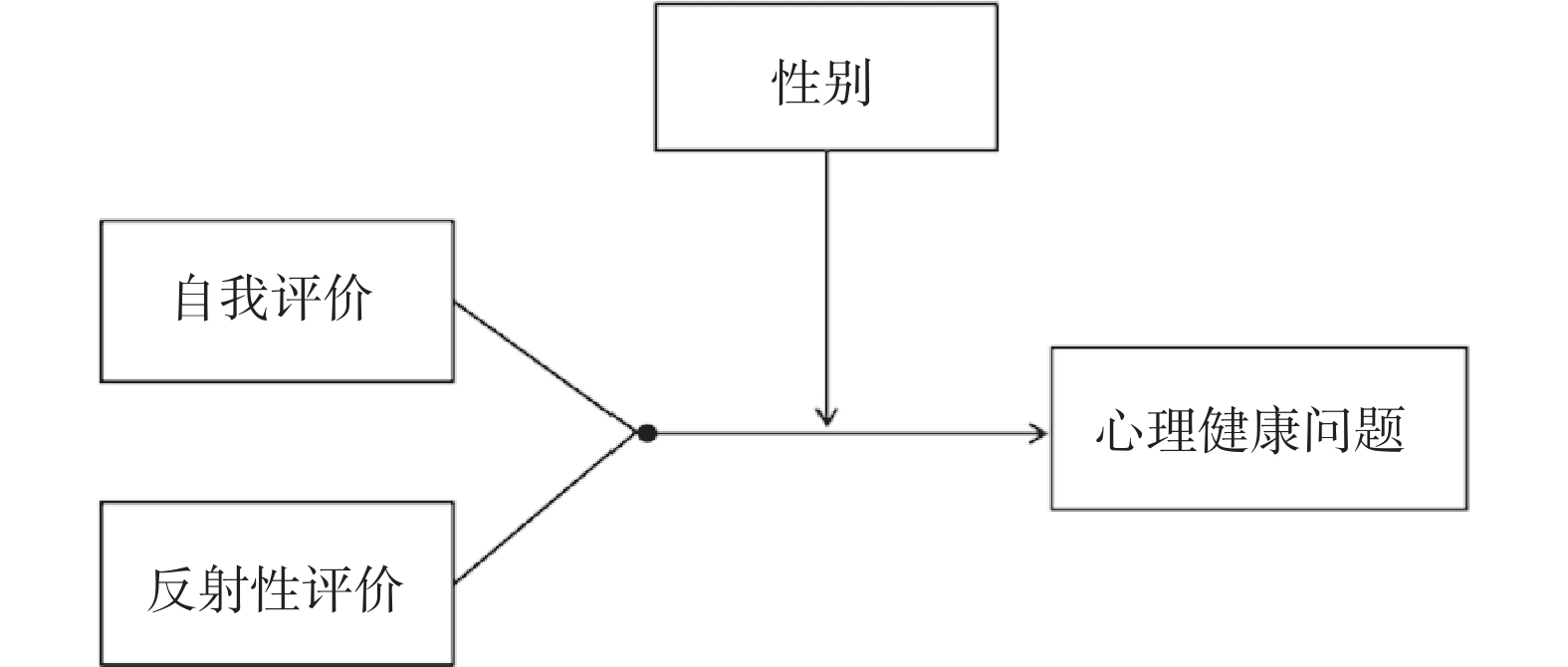
图2 研究框架
| 变量 | 自我评价 | 反射性评价 | 心理健康问题 |
| 自我评价 | 0.26***/0.42*** | −0.48***/−0.55*** | |
| 反射性评价 | 0.35*** | −0.65***/−0.69*** | |
| 心理健康问题 | −0.67*** | −0.52*** | |
| 总体 | 33.72±10.58 | 36.10±11.56 | 40.79±18.45 |
| 男生 | 34.95±10.74 | 37.68±11.90 | 37.29±18.96 |
| 女生 | 32.57±10.31 | 34.60±11.05 | 44.10±17.35 |
表1 各变量描述统计及相关分析
| 变量 | 自我评价 | 反射性评价 | 心理健康问题 |
| 自我评价 | 0.26***/0.42*** | −0.48***/−0.55*** | |
| 反射性评价 | 0.35*** | −0.65***/−0.69*** | |
| 心理健康问题 | −0.67*** | −0.52*** | |
| 总体 | 33.72±10.58 | 36.10±11.56 | 40.79±18.45 |
| 男生 | 34.95±10.74 | 37.68±11.90 | 37.29±18.96 |
| 女生 | 32.57±10.31 | 34.60±11.05 | 44.10±17.35 |
| 匹配情况 | n | 所占百分比(%) | 自我评价(M) | 反射性评价(M) |
| 自我>反射 | 166 | 34.51 | 40.79 | 29.65 |
| 自我=反射 | 153 | 31.81 | 31.80 | 34.22 |
| 自我<反射 | 162 | 33.68 | 28.29 | 44.48 |
表2 青少年自我评价与反射性评价匹配情况
| 匹配情况 | n | 所占百分比(%) | 自我评价(M) | 反射性评价(M) |
| 自我>反射 | 166 | 34.51 | 40.79 | 29.65 |
| 自我=反射 | 153 | 31.81 | 31.80 | 34.22 |
| 自我<反射 | 162 | 33.68 | 28.29 | 44.48 |
| 全样本 | 女生样本 | 男生样本 | ||||||
| 模型1 | 模型2 | 模型3 | 模型4 | 模型5 | 模型6 | |||
| 自我评价(b1) | −0.97*** | −1.08*** | −0.94*** | −1.00*** | −1.00*** | −1.15*** | ||
| 反射性评价(b2) | −0.52*** | −0.50*** | −0.48*** | −0.48*** | −0.53*** | −0.54*** | ||
| 自我评价的平方(b3) | 0.02*** | 0.01 | 0.03*** | |||||
| 自我评价×反射性评价(b4) | 0.02* | 0.01 | 0.02* | |||||
| 反射性评价的平方(b5) | −0.01* | −0.01 | −0.01 | |||||
| R2 | 0.55 | 0.57 | 0.55 | 0.56 | 0.53 | 0.57 | ||
| ΔR2 | 0.02*** | 0.01 | 0.04*** | |||||
| 响应面分析 | ||||||||
| 一致线(X=Y) | ||||||||
| a1(b1+b2) | −1.58*** | −1.48*** | −1.68*** | |||||
| a2(b3+b4+b5) | 0.03*** | 0.01 | 0.04*** | |||||
| 不一致线(X=−Y) | ||||||||
| a3(b1−b2) | −0.58*** | −0.52*** | −0.61*** | |||||
| a4(b3−b4+b5) | −0.01 | −0.01 | 0.00 | |||||
表3 自我评价−反射性评价对青少年心理健康问题影响的多项式回归分析
| 全样本 | 女生样本 | 男生样本 | ||||||
| 模型1 | 模型2 | 模型3 | 模型4 | 模型5 | 模型6 | |||
| 自我评价(b1) | −0.97*** | −1.08*** | −0.94*** | −1.00*** | −1.00*** | −1.15*** | ||
| 反射性评价(b2) | −0.52*** | −0.50*** | −0.48*** | −0.48*** | −0.53*** | −0.54*** | ||
| 自我评价的平方(b3) | 0.02*** | 0.01 | 0.03*** | |||||
| 自我评价×反射性评价(b4) | 0.02* | 0.01 | 0.02* | |||||
| 反射性评价的平方(b5) | −0.01* | −0.01 | −0.01 | |||||
| R2 | 0.55 | 0.57 | 0.55 | 0.56 | 0.53 | 0.57 | ||
| ΔR2 | 0.02*** | 0.01 | 0.04*** | |||||
| 响应面分析 | ||||||||
| 一致线(X=Y) | ||||||||
| a1(b1+b2) | −1.58*** | −1.48*** | −1.68*** | |||||
| a2(b3+b4+b5) | 0.03*** | 0.01 | 0.04*** | |||||
| 不一致线(X=−Y) | ||||||||
| a3(b1−b2) | −0.58*** | −0.52*** | −0.61*** | |||||
| a4(b3−b4+b5) | −0.01 | −0.01 | 0.00 | |||||
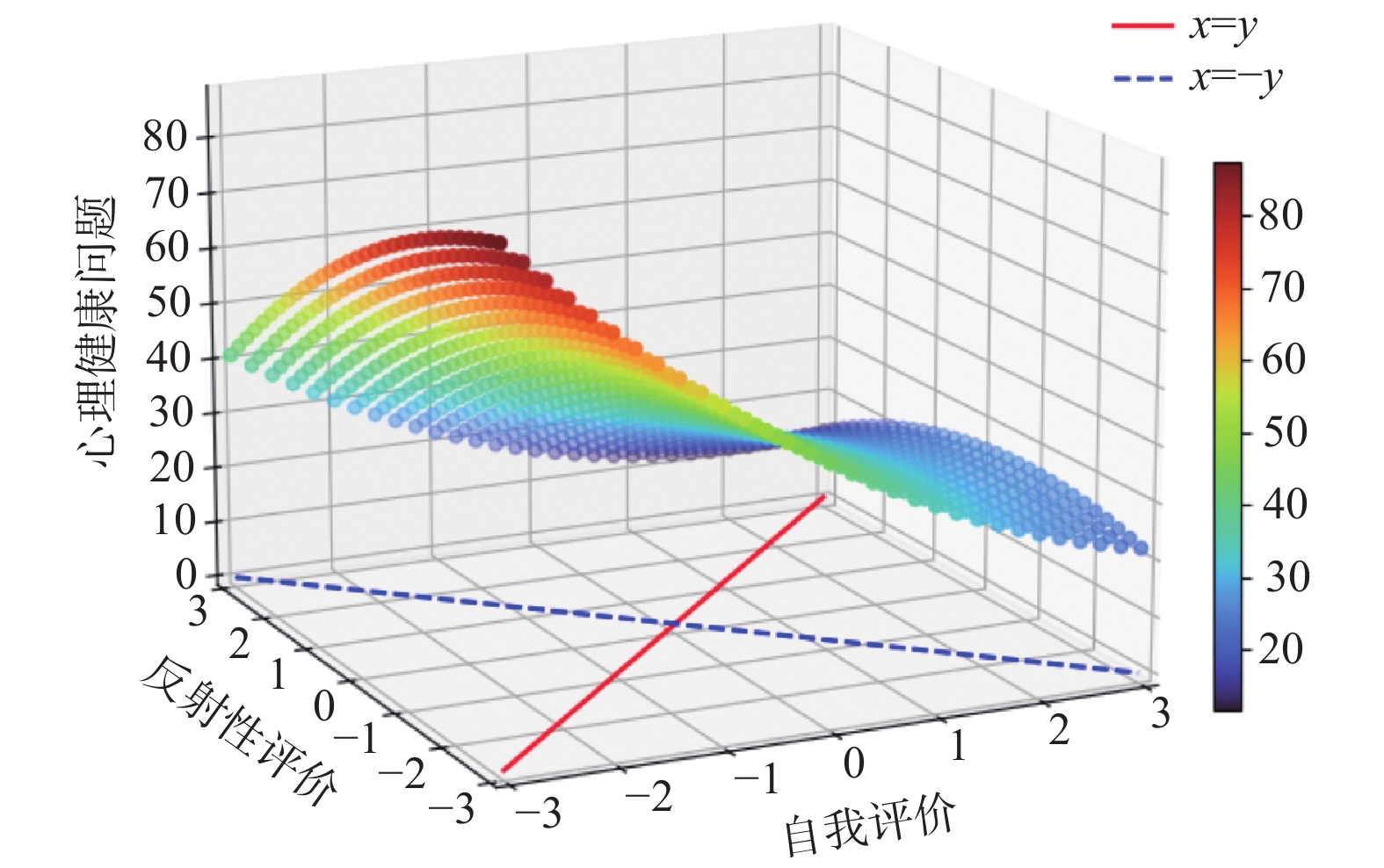
图3 自我评价−反射性评价一致性与青少年心理健康问题的响应面图
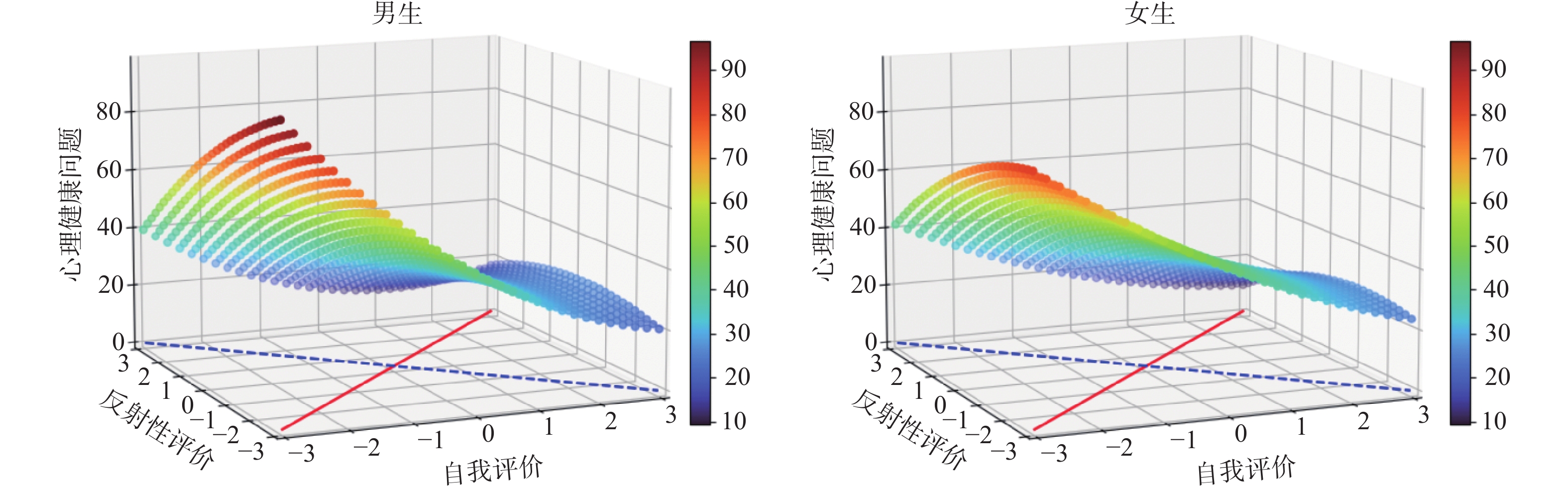
图5 不同性别青少年评价一致性与心理健康问题的响应面图
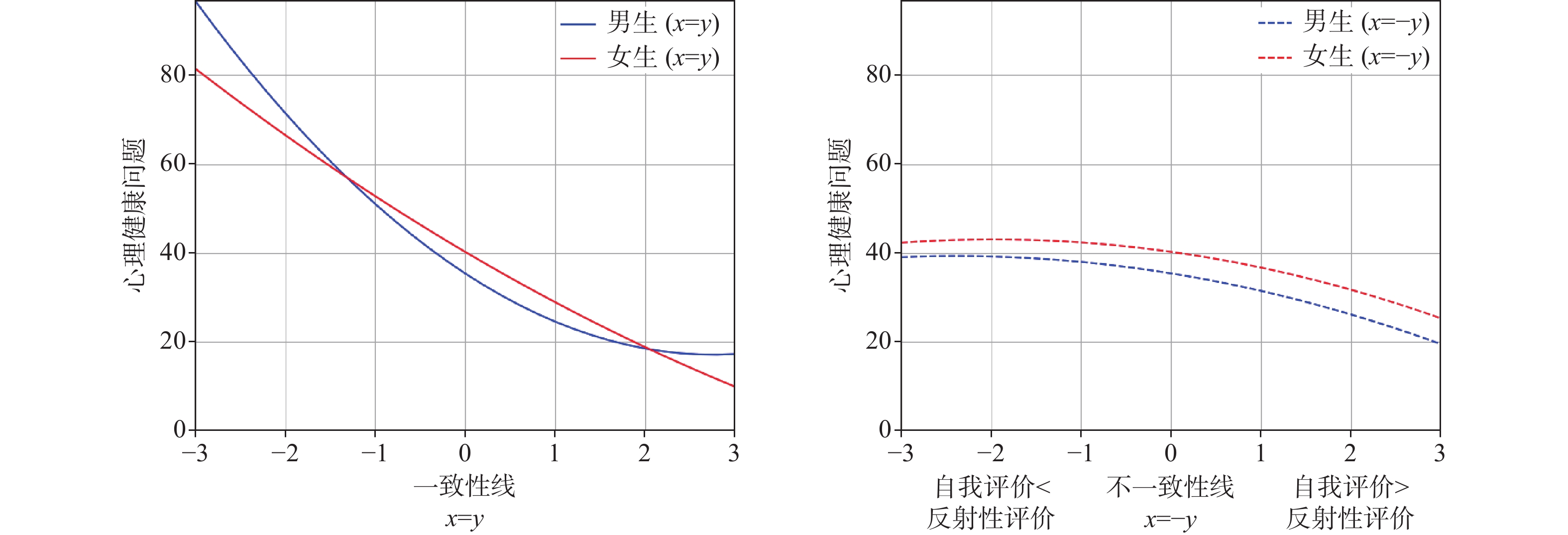
图6 不同性别青少年响应面的一致性与不一致性面投影图
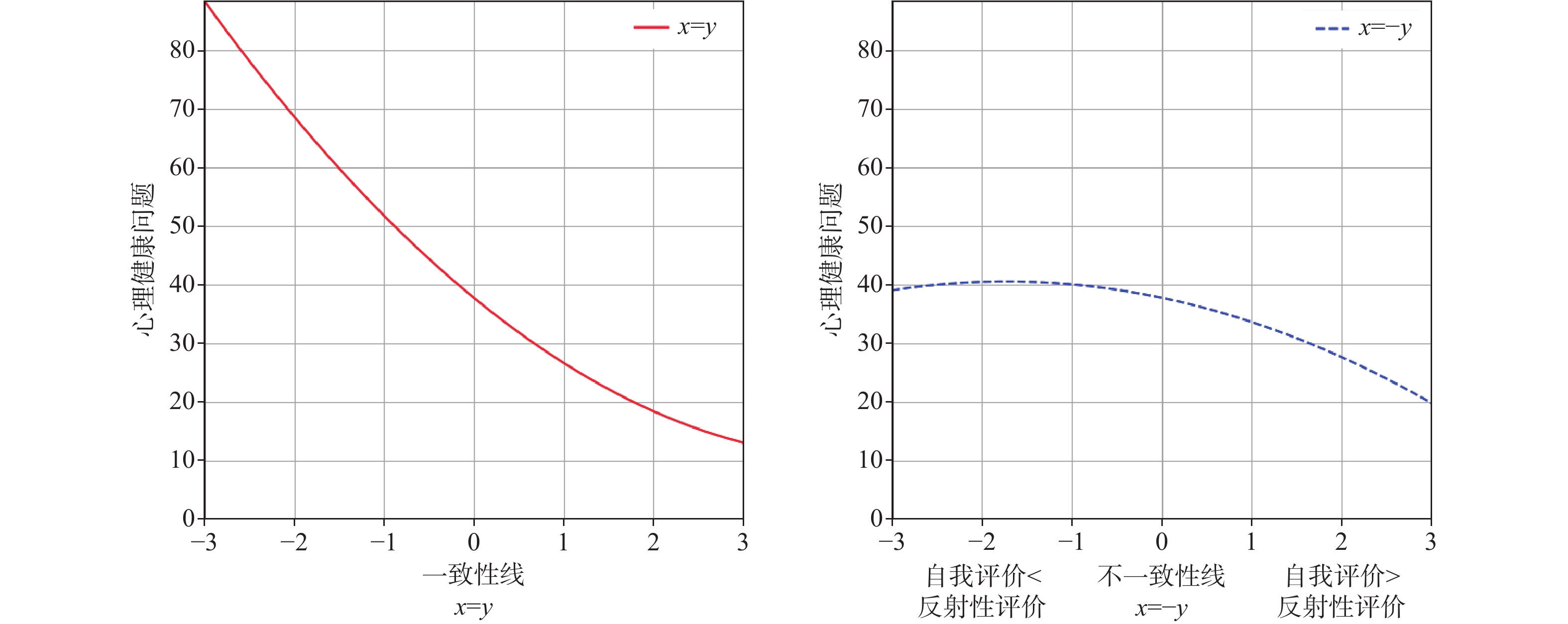
图4 响应面的一致性与不一致性面投影图
|
胡春梅, 岳彩镇, 何华敏, 杨丹丹. 师范生对教学能力的自我评价、他人评价和反射性评价的关系研究. 心理发展与教育, 2014, 30 (5): 520- 526.
DOI |
|
|
黄传浩, 王会秋, 王秀珍, 林贝尔. 青少年抑郁情绪、抑郁障碍因果信念和自我污名感对求助意愿的影响. 中国健康心理学杂志, 2021, 29 (7): 1091- 1095.
DOI |
|
|
李蓓蕾, 高婷, 邓林园, 陈珏君, 倪虹. 初中生核心自我评价在班级环境和学业压力之间的中介作用——性别的调节作用. 心理发展与教育, 2019, 35 (2): 192- 202.
DOI |
|
|
李娜. (2017). 初中生自我评价、反射性评价、他人评价和主观幸福感的关系及辅导研究(硕士学位论文). 华中师范大学, 武汉.
|
|
|
李强. 社会支持与个体心理健康. 天津社会科学, 1998 (1): 67- 70.
|
|
|
梁樱. 反射性评价VS. 自我评价?——对认同分裂理论潜在逻辑的澄清. 社会科学, 2016 (9): 81- 92.
DOI |
|
|
路翠萍, 郑希付. 低自尊还是高“他尊”?高、低社交焦虑者的不同内隐自尊特性——来自EAST的证据. 心理发展与教育, 2023, 39 (6): 808- 816.
DOI |
|
|
唐杰, 林志扬, 莫莉. 多项式回归与一致性研究: 应用及分析. 心理学报, 2011, 43 (12): 1454- 1461.
|
|
|
陶厚永, 曹伟. 多项式回归与响应面分析的原理及应用. 统计与决策, 2020, 36 (8): 36- 40.
DOI |
|
|
姚玉红, 刘亮, 赵旭东. 不同性别低年级大学生的自我分化与心理健康: 自尊的调节作用. 中国心理卫生杂志, 2011, 25 (11): 856- 861.
|
|
|
岳彩镇, 黄希庭. 反思自我评价研究述评. 心理科学, 2012, 35 (3): 735- 739.
|
|
|
张丽红. (2009). 大学生自我评价特点及自尊水平与心理健康关系的研究(硕士学位论文). 东北师范大学, 长春.
|
|
|
张寿松, 谢廷平. 关于浙江省567名高考生自我评价与心理健康状况的调查研究. 中国教育学刊, 2003 (10): 19- 21.
DOI |
|
|
钟毅平, 陈智勇, 罗西, 王锡爱, 易文婷. 自我肯定对自尊及自我评价的影响. 中国临床心理学杂志, 2014, 22 (3): 390- 393.
|
|
|
周步成. (1991). 心理健康诊断测验(MHT)手册. 上海: 华东师范大学出版社.
|
|
|
周浩, 龙立荣. 共同方法偏差的统计检验与控制方法. 心理科学进展, 2004, 12 (6): 942- 950.
DOI |
|
|
朱智贤. (1989). 心理学大词典 (第4版). 北京: 北京师范大学出版社.
|
|
|
Achenbach, T. M., McConaughy, S. H., Howell, C. T. Child/adolescent behavioral and emotional problems: Implications of cross-informant correlations for situational specificity. Psychological Bulletin, 1987, 101 (2): 213- 232.
DOI |
|
|
Bandura, A. (1997). Self-efficacy: The exercise of control. New York: W H Freeman/Times Books/Henry Holt & Co.
|
|
|
Brody, L. R., & Hall, J. A. (2008). Gender and emotion in context. In M. Lewis, J. M. Haviland-Jones, & L. F. Barrett (Eds.), Handbook of emotions (Vol. 3, pp. 395–408). New York: The Guilford Press.
|
|
|
Cui, Y., Li, F., Leckman, J. F., Guo, L., Ke, X., Liu, J., ... Li, Y. The prevalence of behavioral and emotional problems among Chinese school children and adolescents aged 6-16: A national survey. European Child & Adolescent Psychiatry, 2021, 30 (2): 233- 241.
DOI |
|
|
Eagly, A. H. (2013). Sex differences in social behavior: A social-role interpretation. New York: Psychology Press.
|
|
|
Eagly, A. H., & Wood, W. (2012). Social role theory. In P. A. M. Van Lange, A. W. Kruglanski, & E. T. Higgins (Eds.), Handbook of theories of social psychology (Vol. 2, pp. 458–476). Thousand Oaks, CA: Sage Publications Ltd.
|
|
|
Edwards, J. R., & Parry, M. E. On the use of polynomial regression equations as an alternative to difference scores in organizational research. Academy of Management Journal, 1993, 36 (6): 1577- 1613.
DOI |
|
|
Gütges, I. D., Xi, H., Gauggel, S., & Forster, S. D. Mirroring minds: Assessing the relative stability of self-appraisal and reflected appraisal in daily life. Frontiers in Psychology, 2025, 16, 1576353.
DOI |
|
|
Harter, S. (1999). The construction of the self: A developmental perspective. New York: Guilford Press.
|
|
|
Huang, X., Hu, N., Yao, Z., & Peng, B. Family functioning and adolescent depression: A moderated mediation model of self-esteem and peer relationships. Frontiers in Psychology, 2022, 13, 962147.
DOI |
|
|
Johns, G. Difference score measures of organizational behavior variables: A critique. Organizational Behavior and Human Performance, 1981, 27 (3): 443- 463.
DOI |
|
|
Joiner, T. E., Jr., Katz, J., & Lew, A. S. Self-verification and depression among youth psychiatric inpatients. Journal of Abnormal Psychology, 1997, 106 (4): 608- 618.
DOI |
|
|
Kiss, E., De Oliveira, O. R., Wittmann, E., Herczegh, Z., & Kapornai, K. The effect of psychological and behavioral problems on the quality of life of children and adolescents based on self-reports and proxy reports. Health and Quality of Life Outcomes, 2024, 22 (1): 1- 9.
|
|
|
Large, M. D., & Marcussen, K. (2000). Extending identity theory to predict differential forms and degrees of psychological distress. Social Psychology Quarterly, 63(1), 49–59.
|
|
|
Li, J., Cai, S., Liu, Y., Dang, J., Shi, D., Chen, Z.,... Song, Y. Mapping adolescent mental well-being—30 PLADs, China, 2019. China CDC Weekly, 2024, 6 (29): 703- 707.
|
|
|
Maslow, A. H. A theory of human motivation. Psychological Review, 1943, 50 (4): 370- 396.
|
|
|
Matud, M. P. Gender differences in stress and coping styles. Personality and Individual Differences, 2004, 37 (7): 1401- 1415.
DOI |
|
|
Orth, U., Robins, R. W., & Widaman, K. F. Life-span development of self-esteem and its effects on important life outcomes. Journal of Personality and Social Psychology, 2012, 102 (6): 1271- 1288.
DOI |
|
|
Ostroff, C., Shin, Y., & Kinicki, A. J. Multiple perspectives of congruence: Relationships between value congruence and employee attitudes. Journal of Organizational Behavior, 2005, 26 (6): 591- 623.
DOI |
|
|
Pelham, B. W., & Swann, W. B. From self-conceptions to self-worth: On the sources and structure of global self-esteem. Journal of Personality and Social Psychology, 1989, 57 (4): 672- 680.
DOI |
|
|
Richard, A. J., Trevino, R. A., Baker, M., & Valdez, J. Negative reflected appraisal, negative self-perception, and drug use intentions in a sample of suburban high school students. Journal of Child & Adolescent Substance Abuse, 2010, 19 (3): 193- 209.
DOI |
|
|
Rosen, L. H. (2006). The developmental interplay of behavioral confirmation and self-verification (Unpublished doctoral dissertation). Austin: The University of Texas at Austin.
|
|
|
Rosenberg, M. (1989). Society and the adolescent self-image. Middletown, NY: Wesleyan University Press.
|
|
|
Swann, W. B., Jr., Pelham, B. W., & Krull, D. S. Agreeable fancy or disagreeable truth? Reconciling self-enhancement and self-verification. Journal of Personality and Social Psychology, 1989, 57 (5): 782- 791.
DOI |
|
|
Thoits, P. A. Mechanisms linking social ties and support to physical and mental health. Journal of Health and Social Behavior, 2011, 52 (2): 145- 161.
DOI |
|
|
Vogel, R. M., Rodell, J. B., & Lynch, J. W. Engaged and productive misfits: How job crafting and leisure activity mitigate the negative effects of value incongruence. Academy of Management Journal, 2016, 59 (5): 1561- 1584.
DOI |
|
|
WHO. (2024). Mental health of adolescents. Retrieved October 10, 2024, from https://www.who.int/news-room/fact-sheets/detail/adolescent-mental-health
|
|
|
Yang, Y. Q., Xu, J. Y., Land, L. P. W., Yang, S. Q., & Chesney, T. Exploring active and passive interactions in social networking services: A psychological needs perspective. Information Technology & People, 2024, 37 (5): 1918- 1949.
DOI |
| [1] | 樊雪戎, 段依凡, 邢晓沛. 温暖的亲子感知差异与青少年内化问题的关系:基于二项式回归的响应面分析[J]. 心理与行为研究, 2026, 24(2): 195-203. |
| [2] | 张一林, 牛更枫, 白旭青, 辛素飞, 孙晓军. 社会逆境感知与青少年社交媒体成瘾的双向关系:控制感的作用[J]. 心理与行为研究, 2026, 24(2): 258-264. |
| [3] | 古美乔, 王骞, 郭莎莎, 邢增华, 丁桂凤. 主管与下属工作−家庭中心一致性对下属工作投入的影响:基于多项式回归与响应面的分析[J]. 心理与行为研究, 2026, 24(2): 281-288. |
| [4] | 曾子豪, 何震, 袁言云, 赵纤, 印利红, 谭嵘, 常梦梦, 胡义秋. HPA轴系统多基因−亲子关系交互对青少年抑郁发展影响及性别差异[J]. 心理与行为研究, 2026, 24(1): 78-86. |
| [5] | 杨昕珠, 王腾飞, 郑晓龙. 青少年社会情感能力与学业倦怠的双向预测作用:一项交叉滞后研究[J]. 心理与行为研究, 2025, 23(6): 789-797. |
| [6] | 谷莉, 黄晓彤, 梁广华, 蔡頠, 郭丰波. 核心自我评价与青少年自伤行为的关系:有调节的中介模型[J]. 心理与行为研究, 2025, 23(6): 798-805. |
| [7] | 张春妹, 骆玉冰, 温冬雪, 郑航. 青少年逆反心理与偏差行为的关系:偏差同伴联系和偏差群体同一性的链式中介作用[J]. 心理与行为研究, 2025, 23(5): 645-652. |
| [8] | 刘鑫, 刘衍玲, 曾晋逸. 心理需要挫折与青少年抑郁症状的纵向联系:心理素质的调节作用[J]. 心理与行为研究, 2025, 23(4): 496-503. |
| [9] | 鲍振宙, 刘花, 于明申. 青少年校园欺凌旁观行为与焦虑抑郁症状的关系:基于纵向网络分析法[J]. 心理与行为研究, 2025, 23(4): 504-512. |
| [10] | 刘佳, 高培晋, 李楠, 孙敏, 白学军. 社会变化程度感知对青少年社会公平感的影响[J]. 心理与行为研究, 2025, 23(4): 551-559. |
| [11] | 张庆吉, 郭丰波, 涂叶满, 卿再花, 宋凤. 劳动价值观对青少年心理健康潜在类别及其转换的影响:双因素模型视角[J]. 心理与行为研究, 2025, 23(4): 569-576. |
| [12] | 张阔, 李珮瑜, 赵晋娥, 贾绪计. 二分还是多重?青少年成长型思维动机框架的异质性及其与学业适应的关系[J]. 心理与行为研究, 2025, 23(3): 346-353. |
| [13] | 钞淼, 张宇, 谢启慧, 刘拓. 情感忽视对农村青少年短视频成瘾的纵向影响:负性情绪中介及留守差异[J]. 心理与行为研究, 2025, 23(3): 361-368. |
| [14] | 祖雯妍, 杨晓峰. 核心自我评价与时间贫困感的关系:压力知觉与短视频成瘾的链式中介作用[J]. 心理与行为研究, 2025, 23(3): 391-398. |
| [15] | 王锦, 杨晓凡, 刘晓金, 徐紫陌. 中学生的未来自我连续性对主观幸福感的作用:价值冲突的中介模型[J]. 心理与行为研究, 2025, 23(2): 201-207. |
| 阅读次数 | ||||||
|
全文 |
|
|||||
|
摘要 |
|
|||||
