
心理与行为研究 ›› 2023, Vol. 21 ›› Issue (5): 675-681.DOI: 10.12139/j.1672-0628.2023.05.014
刘峻君1, 何晓燕1, 李松2, 冉光明1,*( )
)
收稿日期:2022-12-21
出版日期:2023-09-20
发布日期:2023-09-20
通讯作者:
冉光明
基金资助:
Junjun LIU1, Xiaoyan HE1, Song LI2, Guangming RAN1,*()
Received:2022-12-21
Online:2023-09-20
Published:2023-09-20
Contact:
Guangming RAN
摘要:
本研究旨在探讨青少年社交回避对自杀意念的影响以及同伴侵害和心理韧性在其中的作用。青少年被试完成了自评问卷。结果发现:(1)在控制了害羞、社交淡漠、性别和年龄因素后,社交回避显著正向预测青少年自杀意念;(2)同伴侵害部分中介了社交回避对自杀意念的影响;(3)相较于高心理韧性青少年,在低心理韧性青少年中社交回避通过同伴侵害对自杀意念的影响更强。这些发现提示在降低社交回避青少年自杀意念水平时,减少同伴侵害和增强心理韧性也许是有效的途径。
中图分类号:
刘峻君, 何晓燕, 李松, 冉光明. 社交回避与青少年自杀意念的关系:有调节的中介模型[J]. 心理与行为研究, 2023, 21(5): 675-681.
Junjun LIU, Xiaoyan HE, Song LI, Guangming RAN. Social Avoidance and Adolescents’ Suicide Ideation: A Moderated Mediation Model[J]. Studies of Psychology and Behavior, 2023, 21(5): 675-681.
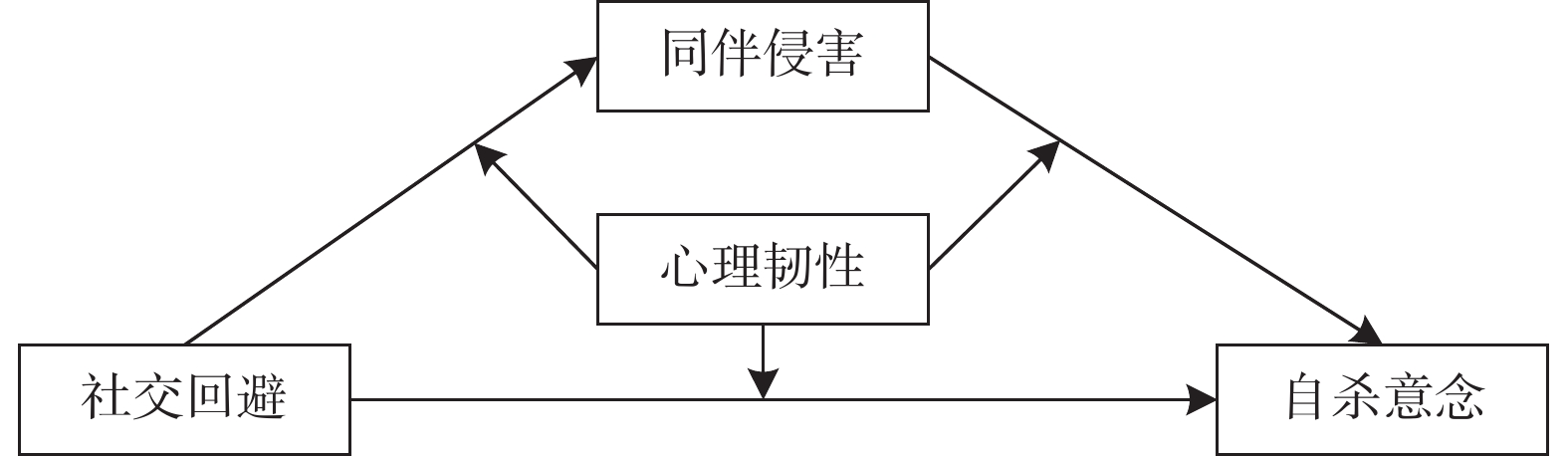
图1 假设模型
| 变量 | 1 | 2 | 3 | 4 | 5 | 6 | 7 |
| 1.社交淡漠 | |||||||
| 2.羞怯 | 0.26*** | ||||||
| 3.社交回避 | 0.66*** | 0.33*** | |||||
| 4.同伴侵害 | 0.25*** | 0.17*** | 0.34*** | ||||
| 5.自杀意念 | 0.41*** | 0.35*** | 0.44*** | 0.43*** | |||
| 6.心理韧性 | −0.48*** | −0.48*** | −0.49*** | −0.38*** | −0.71*** | ||
| 7.年龄 | 0.14*** | 0.06** | 0.12*** | −0.02 | 0.04 | − 0.08** | |
| 8.性别 | 0.14*** | 0.02 | 0.01 | −0.02 | 0.15*** | −0.12*** | −0.11*** |
| 峰度 | 0.04 | −0.14 | 1.24 | 9.22 | 2.72 | −0.22 | 0.32 |
| 偏度 | 0.60 | 0.09 | 1.00 | 2.65 | 1.54 | −0.12 | 0.09 |
| M | 2.34 | 2.69 | 1.85 | 1.56 | 1.72 | 3.53 | 12.67 |
| SD | 0.87 | 0.81 | 0.72 | 0.73 | 0.65 | 0.67 | 0.66 |
表1 主要变量的描述统计和相关分析
| 变量 | 1 | 2 | 3 | 4 | 5 | 6 | 7 |
| 1.社交淡漠 | |||||||
| 2.羞怯 | 0.26*** | ||||||
| 3.社交回避 | 0.66*** | 0.33*** | |||||
| 4.同伴侵害 | 0.25*** | 0.17*** | 0.34*** | ||||
| 5.自杀意念 | 0.41*** | 0.35*** | 0.44*** | 0.43*** | |||
| 6.心理韧性 | −0.48*** | −0.48*** | −0.49*** | −0.38*** | −0.71*** | ||
| 7.年龄 | 0.14*** | 0.06** | 0.12*** | −0.02 | 0.04 | − 0.08** | |
| 8.性别 | 0.14*** | 0.02 | 0.01 | −0.02 | 0.15*** | −0.12*** | −0.11*** |
| 峰度 | 0.04 | −0.14 | 1.24 | 9.22 | 2.72 | −0.22 | 0.32 |
| 偏度 | 0.60 | 0.09 | 1.00 | 2.65 | 1.54 | −0.12 | 0.09 |
| M | 2.34 | 2.69 | 1.85 | 1.56 | 1.72 | 3.53 | 12.67 |
| SD | 0.87 | 0.81 | 0.72 | 0.73 | 0.65 | 0.67 | 0.66 |
| 预测变量 | 模型1(自杀意念) | 模型2(同伴侵害) | 模型3(自杀意念) | |||||
| B | t | B | t | B | t | |||
| 年龄 | −0.01 | −0.47 | −0.08 | −2.66** | −0.01 | −0.42 | ||
| 性别 | 0.15 | 4.94*** | −0.06 | −1.47 | 0.17 | 5.73*** | ||
| 社交淡漠 | 0.13 | 5.43** | 0.04 | 1.54 | 0.12 | 5.20*** | ||
| 羞怯 | 0.18 | 9.03*** | 0.06 | 2.52* | 0.16 | 8.65*** | ||
| 社交回避 | 0.23 | 7.90*** | 0.30 | 8.37*** | 0.15 | 5.31*** | ||
| 同伴侵害 | 0.27 | 12.66*** | ||||||
| R2 | 0.28*** | 0.13*** | 0.35*** | |||||
| F | 101.42 | 38.76 | 121.37 | |||||
表2 社交回避对自杀意念的中介模型检验
| 预测变量 | 模型1(自杀意念) | 模型2(同伴侵害) | 模型3(自杀意念) | |||||
| B | t | B | t | B | t | |||
| 年龄 | −0.01 | −0.47 | −0.08 | −2.66** | −0.01 | −0.42 | ||
| 性别 | 0.15 | 4.94*** | −0.06 | −1.47 | 0.17 | 5.73*** | ||
| 社交淡漠 | 0.13 | 5.43** | 0.04 | 1.54 | 0.12 | 5.20*** | ||
| 羞怯 | 0.18 | 9.03*** | 0.06 | 2.52* | 0.16 | 8.65*** | ||
| 社交回避 | 0.23 | 7.90*** | 0.30 | 8.37*** | 0.15 | 5.31*** | ||
| 同伴侵害 | 0.27 | 12.66*** | ||||||
| R2 | 0.28*** | 0.13*** | 0.35*** | |||||
| F | 101.42 | 38.76 | 121.37 | |||||
| 预测变量 | 模型1(同伴侵害) | 模型2(自杀意念) | |||
| B | t | B | t | ||
| 年龄 | −0.08 | −2.88** | −0.01 | −0.47 | |
| 性别 | −0.10 | −2.65* | 0.10 | 3.96*** | |
| 社交淡漠 | −0.02 | −0.78 | 0.01 | 0.60 | |
| 羞怯 | −0.03 | −1.28 | 0.02 | 1.06 | |
| 社交回避 | 0.19 | 5.39*** | 0.05 | 1.92 | |
| 心理韧性 | −0.36 | −10.28*** | −0.58 | −24.76*** | |
| 社交回避×心理韧性 | −0.11 | −3.32*** | −0.08 | −3.28** | |
| 同伴侵害 | 0.08 | 3.79*** | |||
| 同伴侵害×心理韧性 | −0.14 | −5.49*** | |||
| R2 | 0.20*** | 0.57*** | |||
| F | 46.05 | 192.24 | |||
表3 社交回避对自杀意念的有调节的中介模型检验
| 预测变量 | 模型1(同伴侵害) | 模型2(自杀意念) | |||
| B | t | B | t | ||
| 年龄 | −0.08 | −2.88** | −0.01 | −0.47 | |
| 性别 | −0.10 | −2.65* | 0.10 | 3.96*** | |
| 社交淡漠 | −0.02 | −0.78 | 0.01 | 0.60 | |
| 羞怯 | −0.03 | −1.28 | 0.02 | 1.06 | |
| 社交回避 | 0.19 | 5.39*** | 0.05 | 1.92 | |
| 心理韧性 | −0.36 | −10.28*** | −0.58 | −24.76*** | |
| 社交回避×心理韧性 | −0.11 | −3.32*** | −0.08 | −3.28** | |
| 同伴侵害 | 0.08 | 3.79*** | |||
| 同伴侵害×心理韧性 | −0.14 | −5.49*** | |||
| R2 | 0.20*** | 0.57*** | |||
| F | 46.05 | 192.24 | |||
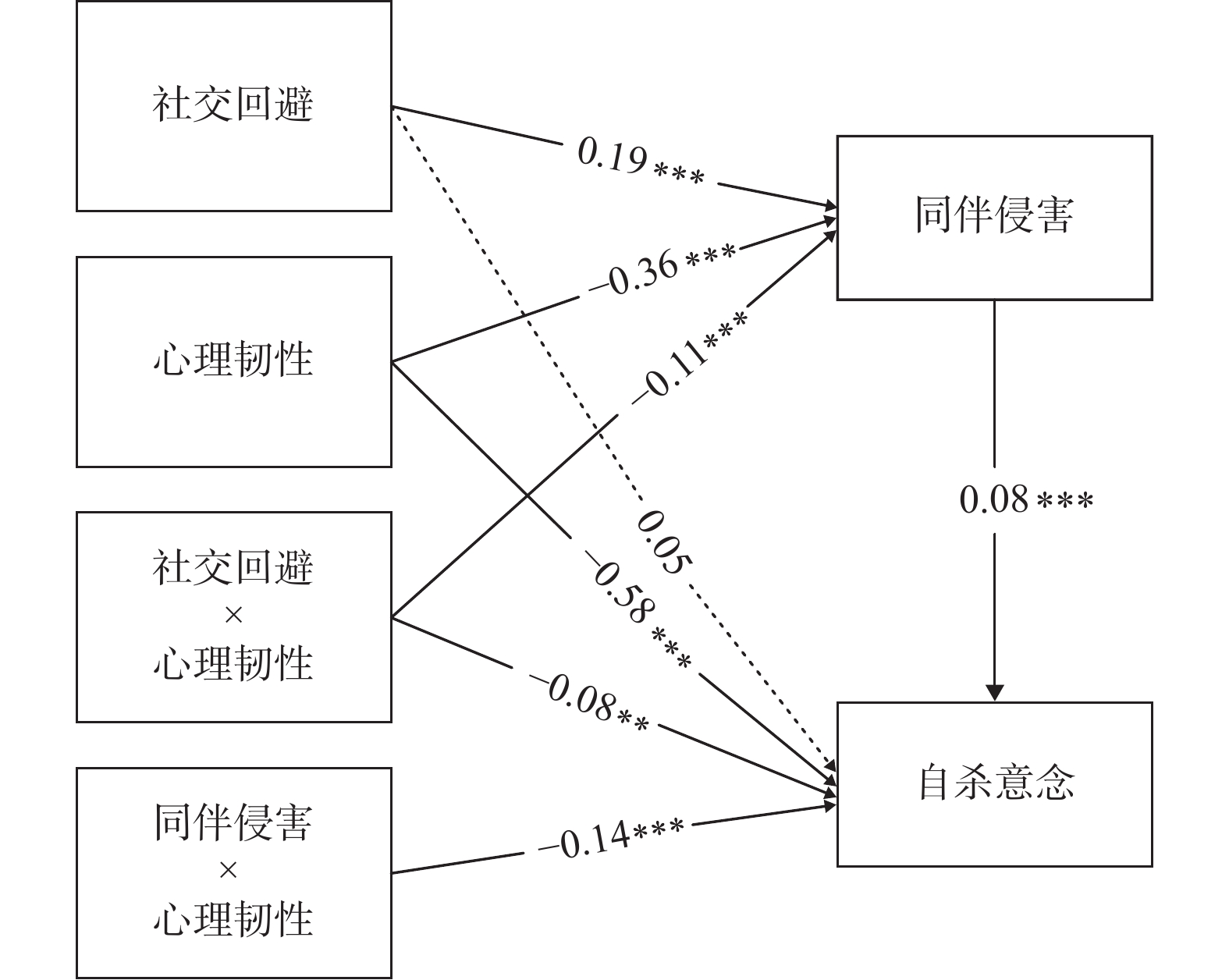
图2 社交回避影响自杀意念的有调节的中介模型
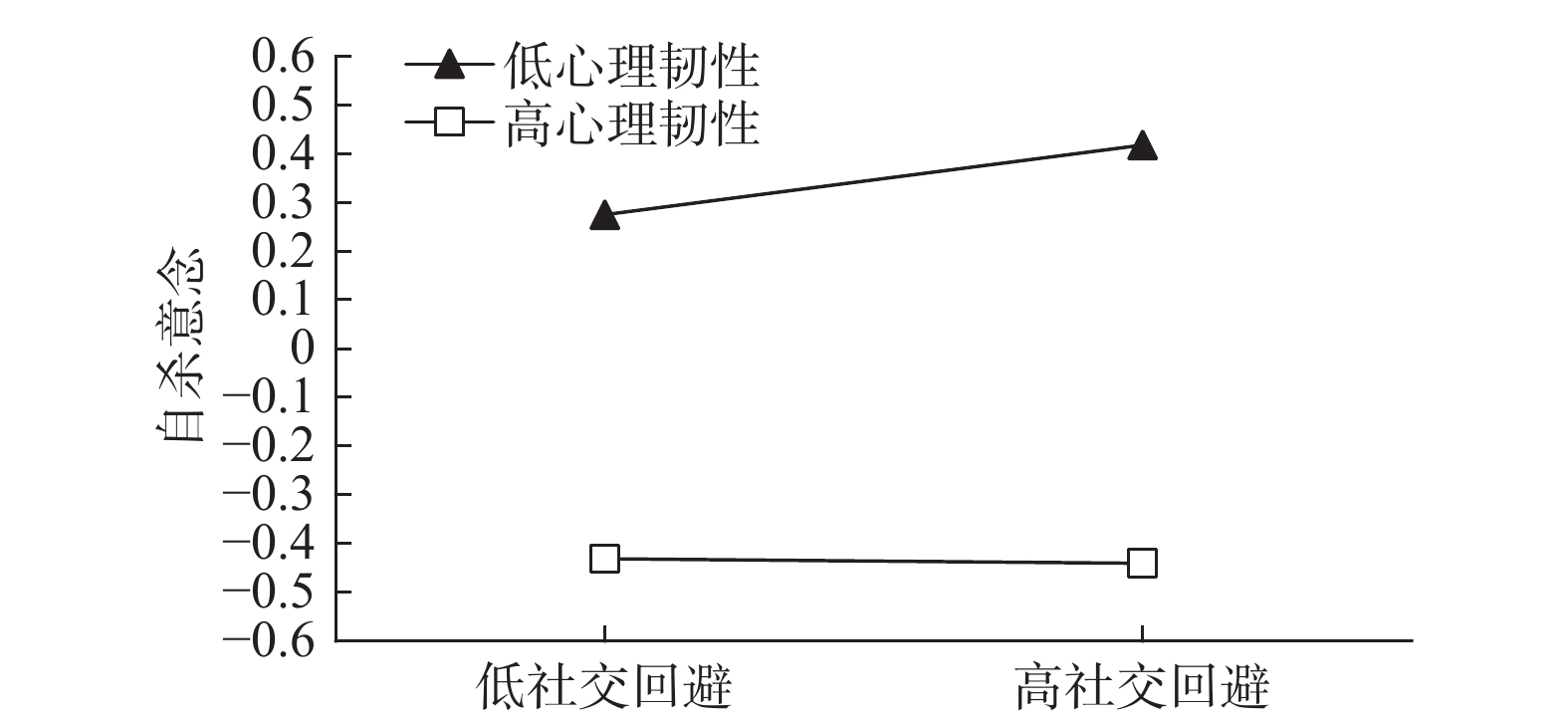
图3 心理韧性与社交回避对自杀意念的交互作用
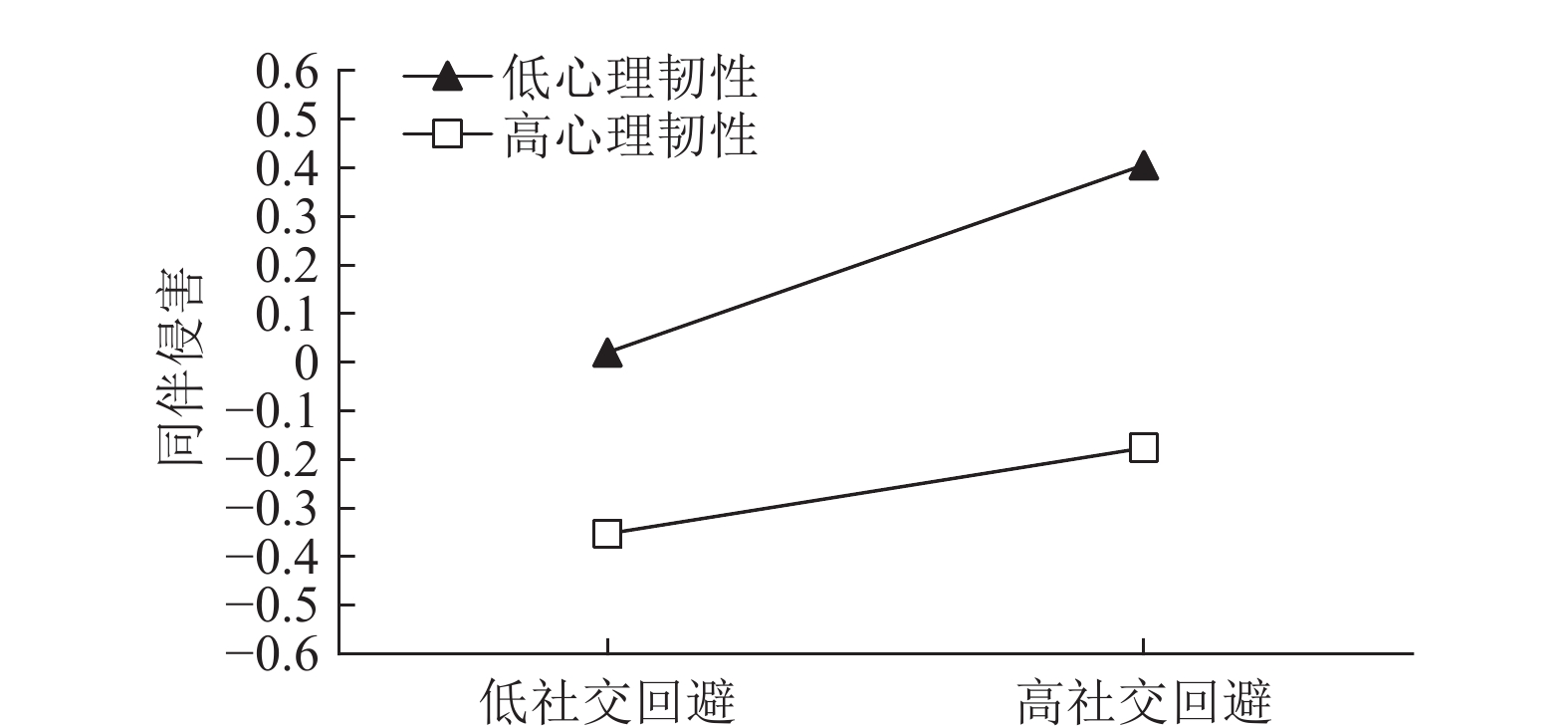
图4 心理韧性与社交回避对同伴侵害的交互作用
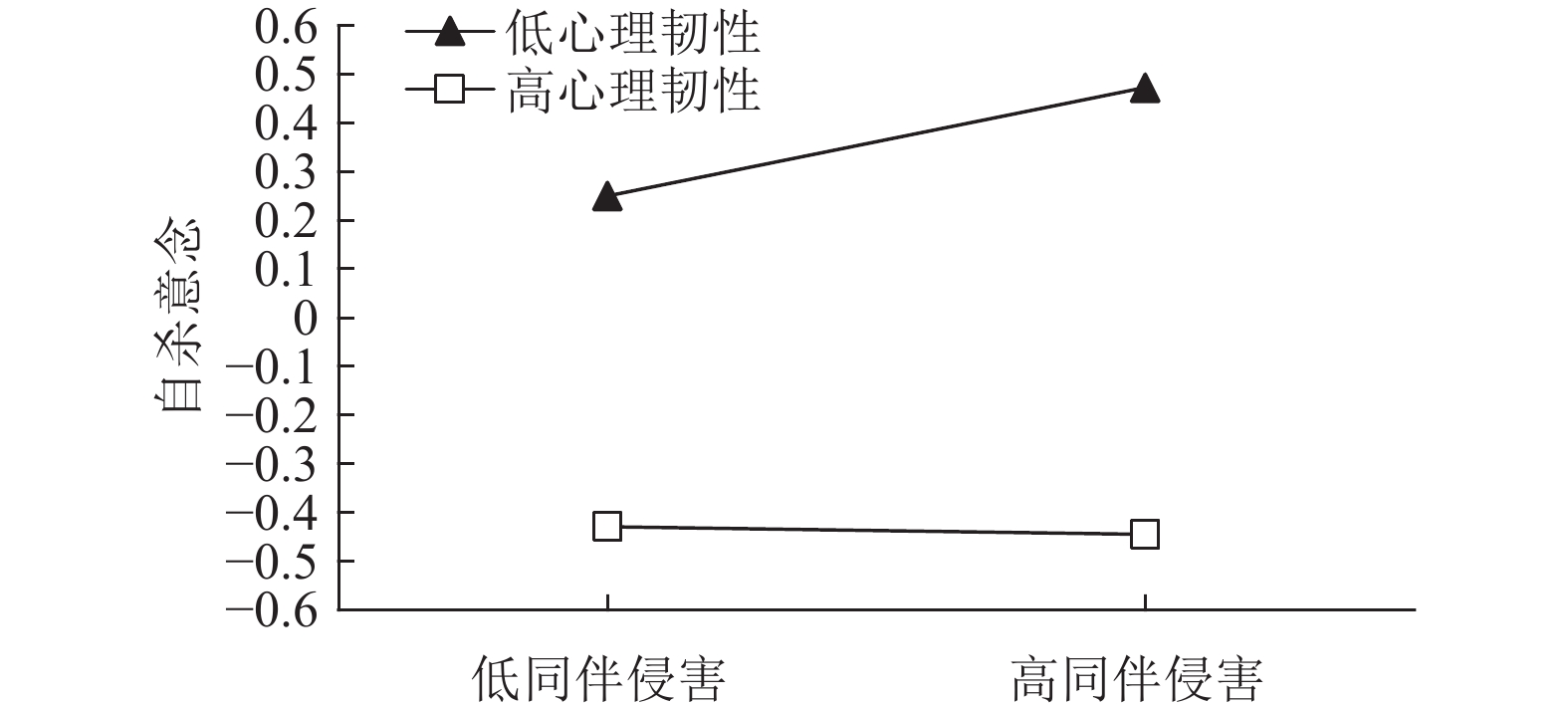
图5 心理韧性与同伴侵害对自杀意念的交互作用
| 丁雪辰, 邓欣媚, 桑标, 李丹. 青少年早期社交回避与同伴关系问题: 有调节的中介模型. 心理发展与教育, 2018, 34 (2): 137- 145. | |
| 丁雪辰, 周同, 张润竹, 周楠. 儿童社交回避行为: 成因、测量方式及适应功能. 心理科学, 2019, 42 (3): 604- 611. | |
| 胡月琴, 甘怡群. 青少年心理韧性量表的编制和效度验证. 心理学报, 2008, 40 (8): 902- 912. | |
| 李松, 陈旭, 冉光明, 张琪. 新时代青少年羞怯对同伴侵害的影响: 依存型和独立型自我建构的作用. 心理科学, 2021, 44 (4): 822- 828. | |
| 刘爱楼. 大学生自杀风险的发展轨迹: 基于潜变量混合增长模型的分析. 中国临床心理学杂志, 2021, 29 (2): 361- 365. | |
| 刘俊升, 周颖, 李丹, 陈欣银. 儿童中期和青春期早期独处偏好与心理适应之关系: 有调节的中介效应. 心理学报, 2015, 47 (8): 1004- 1012. | |
| 王学志, 宫火良, 康晓然, 刘雯雯, 董晓静, 马彦锋. 青少年自杀意念量表中文版在高中生应用的信效度分析. 中国健康心理学杂志, 2011, 19 (8): 964- 966. | |
| 谢家树, 吕永晓, Bear, G G, Yang, C Y, Marshall, S J, & Gong, R. 特拉华欺负受害量表(学生卷)中文版信、效度研究. 中国临床心理学杂志, 2015, 23 (4): 594- 596. | |
| 张丹, 胡雪庆, 刘勤学. 大学生压力和睡眠质量: 反刍思维和心理韧性的链式中介作用. 心理科学, 2021, 44 (1): 90- 96. | |
| 周菡, 余思, 刘勤学, 张微. 儿童心理虐待与忽视和自杀意念的关系: 有调节的中介模型. 心理科学, 2019, 42 (2): 335- 342. | |
|
Brown, L. H., Silvia, P. J., Myin-Germeys, I., & Kwapil, T. R.. When the need to belong goes wrong: The expression of social anhedonia and social anxiety in daily life. Psychological Science, 2007, 18 (9): 778- 782.
DOI |
|
|
Cheek, J. M., & Buss, A. H.. Shyness and sociability. Journal of Personality and Social Psychology, 1981, 41 (2): 330- 339.
DOI |
|
|
Chen, X. T.. Culture, peer interaction, and socioemotional development. Child Development Perspectives, 2012, 6 (1): 27- 34.
DOI |
|
|
Coplan, R. J., Liu, J. S., Ooi, L. L., Chen, X. Y., Li, D., & Ding, X. C.. A person-oriented analysis of social withdrawal in Chinese children. Social Development, 2016, 25 (4): 794- 811.
DOI |
|
|
Coplan, R. J., Ooi, L. L., & Nocita, G.. When one is company and two is a crowd: Why some children prefer solitude. Child Development Perspectives, 2015, 9 (3): 133- 137.
DOI |
|
|
Coplan, R. J., Ooi, L. L., Xiao, B. W., & Rose-Krasnor, L.. Assessment and implications of social withdrawal in early childhood: A first look at social avoidance. Social Development, 2018, 27 (1): 125- 139.
DOI |
|
|
Ding, X. C., Coplan, R. J., Deng, X. M., Ooi, L. L., Li, D., & Sang, B.. Sad, scared, or rejected? A short-term longitudinal study of the predictors of social avoidance in Chinese children. Journal of Abnormal Child Psychology, 2019, 47 (7): 1265- 1276.
DOI |
|
|
Ding, X. C., Coplan, R. J., Sang, B., Liu, J. S., Pan, T. T., & Cheng, C.. Young Chinese children’s beliefs about the implications of subtypes of social withdrawal: A first look at social avoidance. British Journal of Developmental Psychology, 2015, 33 (2): 159- 173.
DOI |
|
|
Fredrick, S. S., & Demaray, M. K.. Peer victimization and suicidal ideation: The role of gender and depression in a school-based sample. Journal of School Psychology, 2018, 67, 1- 15.
DOI |
|
|
Hirschtritt, M. E., Ordóñez, A. E., Rico, Y. C., & LeWinn, K. Z.. Internal resilience, peer victimization, and suicidal ideation among adolescents. International Journal of Adolescent Medicine and Health, 2015, 27 (4): 415- 423.
DOI |
|
|
Li, S., Chen, X., Ran, G. M., Zhang, Q., & Li, R.. Shyness and internalizing problems among Chinese adolescents: The roles of independent interpersonal stress and rumination. Children and Youth Services Review, 2021, 128, 106151.
DOI |
|
|
Navarro, R., Yubero, S., & Larrañaga, E.. Cyberbullying victimization and fatalism in adolescence: Resilience as a moderator. Children and Youth Services Review, 2018, 84, 215- 221.
DOI |
|
|
Nelson, L. J.. Going it alone: Comparing subtypes of withdrawal on indices of adjustment and maladjustment in emerging adulthood. Social Development, 2013, 22 (3): 522- 538.
DOI |
|
|
O’Connor, R. C., & Kirtley, O. J.. The integrated motivational-volitional model of suicidal behaviour. Philosophical Transactions of the Royal Society B: Biological Sciences, 2018, 373 (1754): 20170268.
DOI |
|
|
Oshri, A., Topple, T. A., & Carlson, M. W.. Positive youth development and resilience: Growth patterns of social skills among youth investigated for maltreatment. Child Development, 2017, 88 (4): 1087- 1099.
DOI |
|
|
Peng, W. Y., Li, D. P., Li, X., Jia, J. C., Wang, Y. H., & Xiao, J. L.. Peer victimization and adolescents’ suicidal ideation and suicide attempts: A moderated mediation model. Children and Youth Services Review, 2020, 112, 104888.
DOI |
|
| Sang, B., Ding, X. C., Coplan, R. J., Liu, J. S., Pan, T. T., & Feng, X. Y. (2018). Assessment and implications of social avoidance in Chinese early adolescents. The Journal of Early Adolescence, 38(4), 554–573. | |
|
van Geel, M., Goemans, A., Zwaanswijk, W., & Vedder, P.. Does peer victimization predict future suicidal ideation? A meta-analysis on longitudinal studies. Aggression and Violent Behavior, 2022, 64, 101577.
DOI |
|
|
van Orden, K. A., Witte, T. K., Cukrowicz, K. C., Braithwaite, S. R., Selby, E. A., & Joiner Jr, T. E.. The interpersonal theory of suicide. Psychological Review, 2010, 117 (2): 575- 600.
DOI |
|
| Wang, S., Li, A. Y., Su, J. Y., & Sun, E. R. (2022). Parent-child attachment and teacher-student relationships in Chinese children from low-income families: A moderated mediation model of shyness and resilience. Current Psychology, 1–11. | |
|
Wu, O., Lu, X., Yeo, K. J., Xiao, Y. Y., & Yip, P.. Assessing prevalence and unique risk factors of suicidal ideation among first-year university students in China using a unique multidimensional university personality inventor. International Journal of Environmental Research and Public Health, 2022, 19 (17): 10786.
DOI |
|
|
Yang, Y., Wang, R., Zhang, D., Zhao, X., & Su, Y. G.. How loneliness worked on suicidal ideation among Chinese nursing home residents: Roles of depressive symptoms and resilience. International Journal of Environmental Research and Public Health, 2021, 18 (10): 5472.
DOI |
|
| Zhou, P. Y., Zhang, C., Liu, J., & Wang, Z. (2017). The relationship between resilience and internet addiction: A multiple mediation model through peer relationship and depression. Cyberpsychology, Behavior, and Social Networking, 20(10), 634–639. |
| [1] | 王丹云, 王玉龙, 唐卓. 青少年运动习惯与自尊、心理韧性的动态关系:基于交叉滞后与随机截距交叉滞后模型的分析[J]. 心理与行为研究, 2026, 24(2): 178-186. |
| [2] | 王惠惠, 唐慎佩, 赵双祐, 黄向圆, 兰松. 内在自我与外界眼光:自我评价与反射性评价一致性对青少年心理健康问题的影响[J]. 心理与行为研究, 2026, 24(2): 187-194. |
| [3] | 樊雪戎, 段依凡, 邢晓沛. 温暖的亲子感知差异与青少年内化问题的关系:基于二项式回归的响应面分析[J]. 心理与行为研究, 2026, 24(2): 195-203. |
| [4] | 张一林, 牛更枫, 白旭青, 辛素飞, 孙晓军. 社会逆境感知与青少年社交媒体成瘾的双向关系:控制感的作用[J]. 心理与行为研究, 2026, 24(2): 258-264. |
| [5] | 曾子豪, 何震, 袁言云, 赵纤, 印利红, 谭嵘, 常梦梦, 胡义秋. HPA轴系统多基因−亲子关系交互对青少年抑郁发展影响及性别差异[J]. 心理与行为研究, 2026, 24(1): 78-86. |
| [6] | 谢开圣, 陈欣欣, 袁丹, 黄伟康, 方杰. 父母心理控制对中职生恶意创造力的影响:愤怒反刍的中介作用和心理韧性的调节作用[J]. 心理与行为研究, 2026, 24(1): 87-94. |
| [7] | 杨昕珠, 王腾飞, 郑晓龙. 青少年社会情感能力与学业倦怠的双向预测作用:一项交叉滞后研究[J]. 心理与行为研究, 2025, 23(6): 789-797. |
| [8] | 谷莉, 黄晓彤, 梁广华, 蔡頠, 郭丰波. 核心自我评价与青少年自伤行为的关系:有调节的中介模型[J]. 心理与行为研究, 2025, 23(6): 798-805. |
| [9] | 郑玉玮, 王潇钰, 张雅茹, 张馨月, 卢红霞. 初中生累积生态风险与自杀意念的关系:积极心理资本和个人成长主动性的链式中介作用[J]. 心理与行为研究, 2025, 23(5): 627-634. |
| [10] | 张春妹, 骆玉冰, 温冬雪, 郑航. 青少年逆反心理与偏差行为的关系:偏差同伴联系和偏差群体同一性的链式中介作用[J]. 心理与行为研究, 2025, 23(5): 645-652. |
| [11] | 刘鑫, 刘衍玲, 曾晋逸. 心理需要挫折与青少年抑郁症状的纵向联系:心理素质的调节作用[J]. 心理与行为研究, 2025, 23(4): 496-503. |
| [12] | 鲍振宙, 刘花, 于明申. 青少年校园欺凌旁观行为与焦虑抑郁症状的关系:基于纵向网络分析法[J]. 心理与行为研究, 2025, 23(4): 504-512. |
| [13] | 刘佳, 高培晋, 李楠, 孙敏, 白学军. 社会变化程度感知对青少年社会公平感的影响[J]. 心理与行为研究, 2025, 23(4): 551-559. |
| [14] | 张庆吉, 郭丰波, 涂叶满, 卿再花, 宋凤. 劳动价值观对青少年心理健康潜在类别及其转换的影响:双因素模型视角[J]. 心理与行为研究, 2025, 23(4): 569-576. |
| [15] | 张阔, 李珮瑜, 赵晋娥, 贾绪计. 二分还是多重?青少年成长型思维动机框架的异质性及其与学业适应的关系[J]. 心理与行为研究, 2025, 23(3): 346-353. |
| 阅读次数 | ||||||
|
全文 |
|
|||||
|
摘要 |
|
|||||
