
心理与行为研究 ›› 2025, Vol. 23 ›› Issue (2): 216-225.DOI: 10.12139/j.1672-0628.2025.02.010
卢林鑫1, 刘在花*,2( ), 杨爽3, 蒋政凯1,3, 党韦强3, 谭婧3, 班永飞1,3, 孙霁1,3,4, 蔺秀云*,5()
收稿日期:2024-10-14
出版日期:2025-03-20
发布日期:2025-03-20
通讯作者:
刘在花, 蔺秀云
基金资助:
Linxin LU1, Zaihua LIU*,2(), Shuang YANG3, Zhengkai JIANG1,3, Weiqiang DANG3, Jing TAN3, Yongfei BAN1,3, Ji SUN1,3,4, Xiuyun LIN*,5()
Received:2024-10-14
Online:2025-03-20
Published:2025-03-20
Contact:
Zaihua LIU, Xiuyun LIN
摘要:
为探讨先天轻度肢残青少年社会排斥与抑郁特征的纵向关联及其干预靶点,采用问卷法对1040名先天轻度肢残青少年进行了两次重复追踪测量,结果表明:(1)生成性模型与反映性模型结果均表明先天轻度肢残青少年社会排斥与抑郁相互影响。(2) T1与T2时点社会排斥与抑郁特征症候群之间存在联结桥梁的时间特异性特点。(3)抑郁子特征自杀意念是社会排斥与抑郁特征网络的活化节点,而社会排斥子特征“别人好像经常看不到我似的”、“别人总是对我很冷淡”、“别人常常对我封锁很重要的信息”以及“别人总是将我排除在外”是抑郁−人际脆弱性的重要影响靶点。
卢林鑫, 刘在花, 杨爽, 蒋政凯, 党韦强, 谭婧, 班永飞, 孙霁, 蔺秀云. 社会排斥与先天轻度肢残青少年抑郁特征的关联性:基于生成性模型与反映性模型的纵向分析[J]. 心理与行为研究, 2025, 23(2): 216-225.
Linxin LU, Zaihua LIU, Shuang YANG, Zhengkai JIANG, Weiqiang DANG, Jing TAN, Yongfei BAN, Ji SUN, Xiuyun LIN. The Association Between Social Exclusion and Depression Characteristics in Adolescents with Congenital Mild Limb Disability: A Longitudinal Analysis Based on Generative and Reflective Models[J]. Studies of Psychology and Behavior, 2025, 23(2): 216-225.
| M | SD | 1 | 2 | 3 | 4 | |
| 1. 性别 | 1.44 | 0.50 | ||||
| 2. T1社会排斥 | 12.31 | 5.42 | 0.06 | |||
| 3. T2社会排斥 | 13.28 | 6.61 | 0.01 | 0.51*** | ||
| 4. T1抑郁 | 6.04 | 4.90 | 0.09* | 0.51*** | 0.37*** | |
| 5. T2抑郁 | 7.24 | 5.87 | 0.03 | 0.35*** | 0.53*** | 0.50*** |
表1 各变量的描述性统计及相关分析
| M | SD | 1 | 2 | 3 | 4 | |
| 1. 性别 | 1.44 | 0.50 | ||||
| 2. T1社会排斥 | 12.31 | 5.42 | 0.06 | |||
| 3. T2社会排斥 | 13.28 | 6.61 | 0.01 | 0.51*** | ||
| 4. T1抑郁 | 6.04 | 4.90 | 0.09* | 0.51*** | 0.37*** | |
| 5. T2抑郁 | 7.24 | 5.87 | 0.03 | 0.35*** | 0.53*** | 0.50*** |
| 测量工具 | 模型 | S-Bχ2 | df | S-Bχ2/df | CFI | TLI | RMSEA(90%CI) | SRMR | ∆CFI | ∆RMSEA |
| 青少年社会排斥量表 | 形态等值 | 480.06 | 95 | 5.05 | 0.927 | 0.915 | 0.074[0.068, 0.081] | 0.045 | ||
| 弱等值 | 517.39 | 102 | 5.07 | 0.930 | 0.914 | 0.075[0.068, 0.081] | 0.060 | 0.003 | −0.001 | |
| 强等值 | 548.98 | 109 | 5.04 | 0.925 | 0.915 | 0.074[0.068, 0.080] | 0.059 | −0.005 | 0.001 | |
| 严格等值 | 521.35 | 117 | 4.46 | 0.932 | 0.920 | 0.069[0.063, 0.075] | 0.068 | 0.007 | −0.005 | |
| 病人健康问卷抑郁量表 | 形态等值 | 371.14 | 125 | 2.97 | 0.932 | 0.917 | 0.052[0.046, 0.058] | 0.042 | ||
| 弱等值 | 373.39 | 133 | 2.81 | 0.933 | 0.923 | 0.050[0.044, 0.056] | 0.043 | 0.001 | −0.002 | |
| 强等值 | 392.87 | 141 | 2.79 | 0.930 | 0.924 | 0.049[0.044, 0.055] | 0.043 | −0.003 | −0.001 | |
| 严格等值 | 408.42 | 150 | 2.72 | 0.929 | 0.927 | 0.049[0.043, 0.054] | 0.047 | −0.001 | 0.000 |
表2 测量工具的跨时间等值性检验
| 测量工具 | 模型 | S-Bχ2 | df | S-Bχ2/df | CFI | TLI | RMSEA(90%CI) | SRMR | ∆CFI | ∆RMSEA |
| 青少年社会排斥量表 | 形态等值 | 480.06 | 95 | 5.05 | 0.927 | 0.915 | 0.074[0.068, 0.081] | 0.045 | ||
| 弱等值 | 517.39 | 102 | 5.07 | 0.930 | 0.914 | 0.075[0.068, 0.081] | 0.060 | 0.003 | −0.001 | |
| 强等值 | 548.98 | 109 | 5.04 | 0.925 | 0.915 | 0.074[0.068, 0.080] | 0.059 | −0.005 | 0.001 | |
| 严格等值 | 521.35 | 117 | 4.46 | 0.932 | 0.920 | 0.069[0.063, 0.075] | 0.068 | 0.007 | −0.005 | |
| 病人健康问卷抑郁量表 | 形态等值 | 371.14 | 125 | 2.97 | 0.932 | 0.917 | 0.052[0.046, 0.058] | 0.042 | ||
| 弱等值 | 373.39 | 133 | 2.81 | 0.933 | 0.923 | 0.050[0.044, 0.056] | 0.043 | 0.001 | −0.002 | |
| 强等值 | 392.87 | 141 | 2.79 | 0.930 | 0.924 | 0.049[0.044, 0.055] | 0.043 | −0.003 | −0.001 | |
| 严格等值 | 408.42 | 150 | 2.72 | 0.929 | 0.927 | 0.049[0.043, 0.054] | 0.047 | −0.001 | 0.000 |
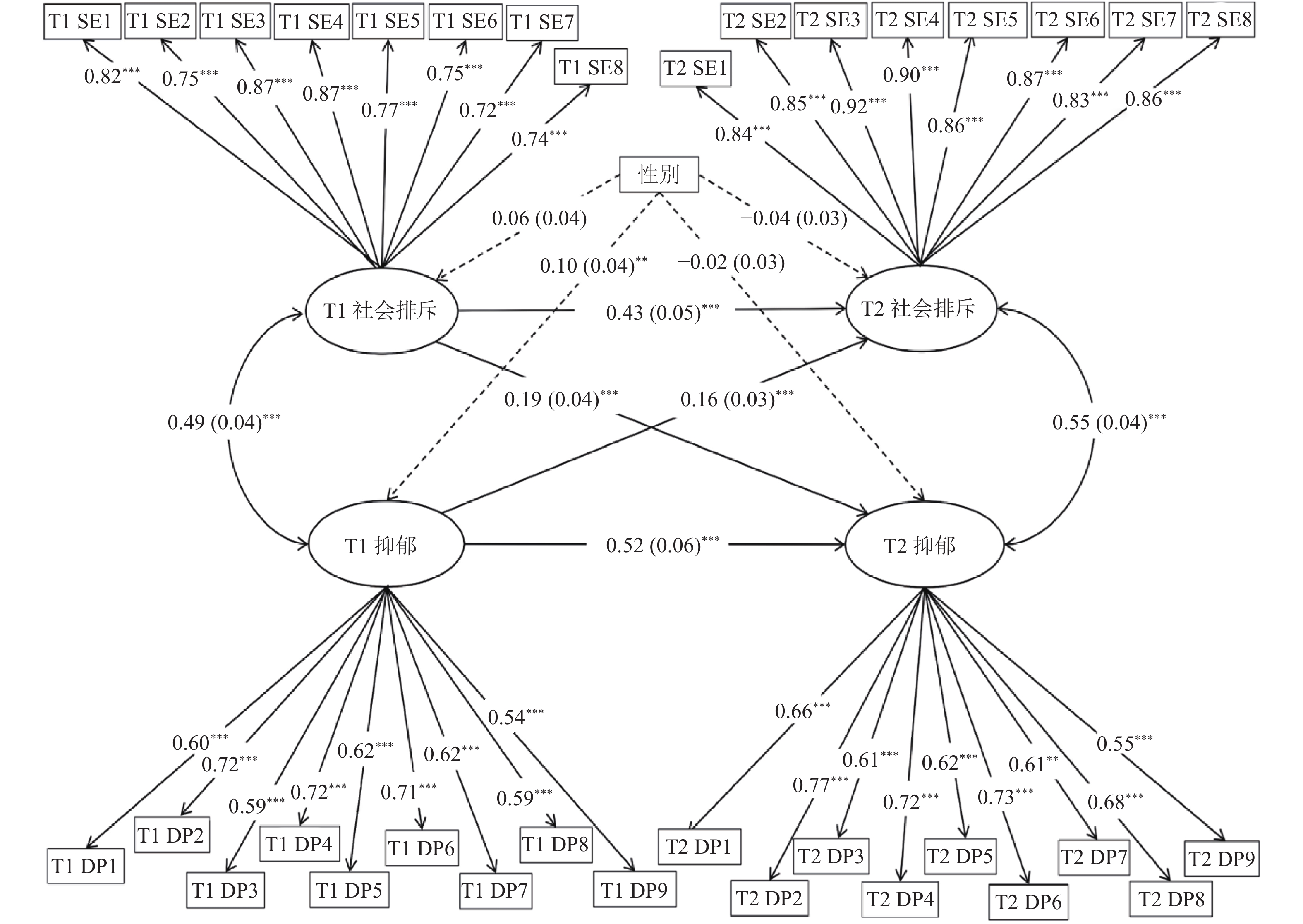
图1 先天轻度肢残青少年社会排斥与抑郁的交叉滞后面板模型

图2 先天轻度肢残青少年社会排斥与抑郁的网络分析
| 节点 | T1时点 | T2时点 | |||
| 桥接预期影响 | 桥接预期影响Z分数 | 桥接预期影响 | 桥接预期影响Z分数 | ||
| SE1 | 0.11 | 1.00 | 0.07 | 0.12 | |
| SE2 | 0.08 | 0.22 | 0.05 | −0.28 | |
| SE3 | 0.01 | −1.32 | 0.03 | −0.71 | |
| SE4 | 0.01 | −1.21 | 0.03 | −0.76 | |
| SE5 | 0.01 | −1.35 | 0.02 | −0.88 | |
| SE6 | 0.04 | −0.54 | 0.03 | −0.71 | |
| SE7 | 0.07 | 0.08 | 0.05 | −0.30 | |
| SE8 | 0.13 | 1.43 | 0.07 | 0.12 | |
| DP1 | 0.03 | −0.93 | 0.03 | −0.71 | |
| DP2 | 0.05 | −0.40 | 0.19 | 2.61 | |
| DP3 | 0.05 | −0.40 | 0.01 | −1.15 | |
| DP4 | 0.08 | 0.31 | 0.09 | 0.49 | |
| DP5 | 0.06 | −0.13 | 0.06 | −0.24 | |
| DP6 | 0.15 | 1.89 | 0.09 | 0.41 | |
| DP7 | 0.12 | 1.13 | 0.04 | −0.61 | |
| DP8 | 0.03 | −0.73 | 0.15 | 1.82 | |
| DP9 | 0.11 | 0.95 | 0.10 | 0.78 | |
表3 同期网络的桥接分析
| 节点 | T1时点 | T2时点 | |||
| 桥接预期影响 | 桥接预期影响Z分数 | 桥接预期影响 | 桥接预期影响Z分数 | ||
| SE1 | 0.11 | 1.00 | 0.07 | 0.12 | |
| SE2 | 0.08 | 0.22 | 0.05 | −0.28 | |
| SE3 | 0.01 | −1.32 | 0.03 | −0.71 | |
| SE4 | 0.01 | −1.21 | 0.03 | −0.76 | |
| SE5 | 0.01 | −1.35 | 0.02 | −0.88 | |
| SE6 | 0.04 | −0.54 | 0.03 | −0.71 | |
| SE7 | 0.07 | 0.08 | 0.05 | −0.30 | |
| SE8 | 0.13 | 1.43 | 0.07 | 0.12 | |
| DP1 | 0.03 | −0.93 | 0.03 | −0.71 | |
| DP2 | 0.05 | −0.40 | 0.19 | 2.61 | |
| DP3 | 0.05 | −0.40 | 0.01 | −1.15 | |
| DP4 | 0.08 | 0.31 | 0.09 | 0.49 | |
| DP5 | 0.06 | −0.13 | 0.06 | −0.24 | |
| DP6 | 0.15 | 1.89 | 0.09 | 0.41 | |
| DP7 | 0.12 | 1.13 | 0.04 | −0.61 | |
| DP8 | 0.03 | −0.73 | 0.15 | 1.82 | |
| DP9 | 0.11 | 0.95 | 0.10 | 0.78 | |
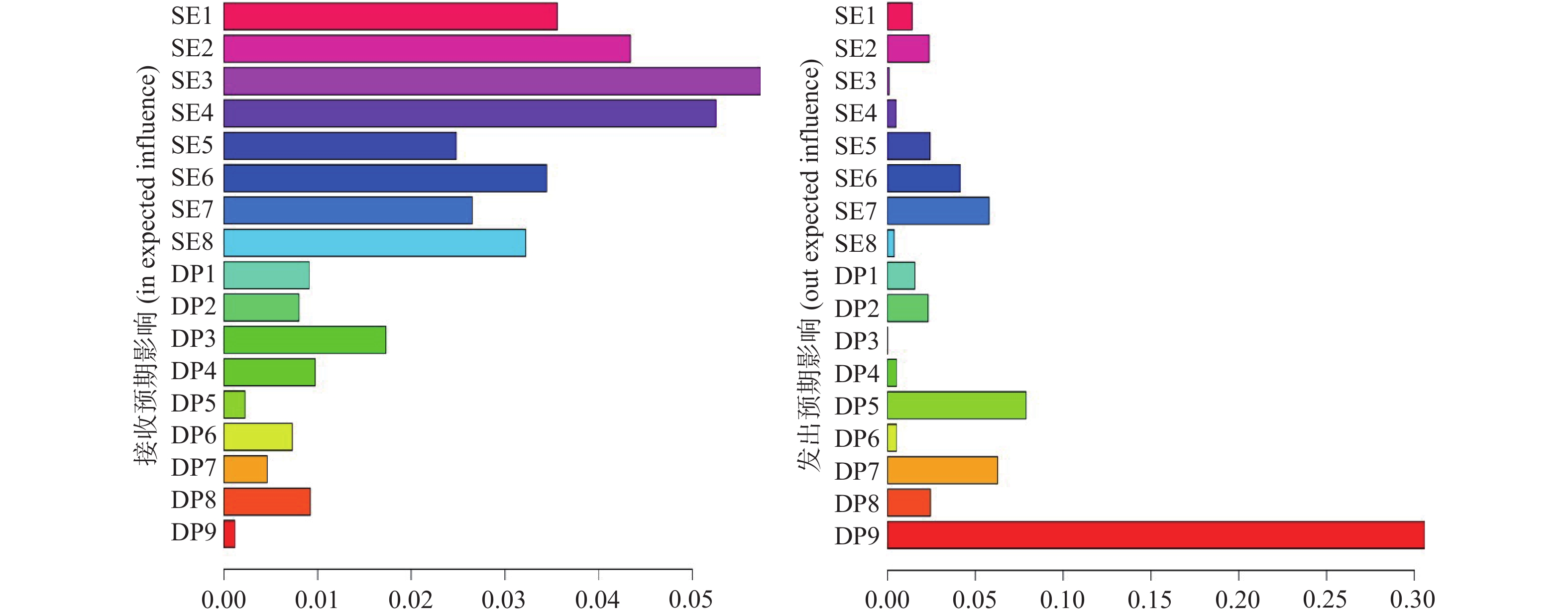
图3 时间网络的接收预期影响和发出预期影响
| 节点 | SE1 | SE2 | SE3 | SE4 | SE5 | SE6 | SE7 | SE8 | DP1 | DP2 | DP3 | DP4 | DP5 | DP6 | DP7 | DP8 | DP9 | 性别 |
| SE1 | 0.35 | 0.00 | 0.17 | 0.14 | 0.12 | 0.11 | 0.00 | 0.11 | 0.00 | 0.28 | 0.00 | 0.17 | 0.00 | 0.15 | 0.00 | 0.00 | 0.00 | 0.00 |
| SE2 | 0.00 | 0.35 | 0.00 | 0.13 | 0.00 | 0.00 | 0.13 | 0.13 | 0.00 | 0.24 | 0.19 | 0.17 | 0.12 | 0.19 | 0.11 | 0.12 | 0.12 | 0.00 |
| SE3 | 0.00 | 0.00 | 0.24 | 0.16 | 0.11 | 0.15 | 0.00 | 0.00 | 0.00 | 0.22 | 0.00 | 0.00 | 0.00 | 0.11 | 0.00 | 0.12 | 0.00 | 0.00 |
| SE4 | 0.00 | 0.00 | 0.00 | 0.28 | 0.11 | 0.00 | 0.19 | 0.14 | 0.00 | 0.00 | 0.11 | 0.00 | 0.00 | 0.00 | 0.00 | 0.17 | 0.11 | 0.00 |
| SE5 | 0.17 | 0.23 | 0.11 | 0.24 | 0.61 | 0.00 | 0.00 | 0.11 | 0.00 | 0.27 | 0.21 | 0.00 | 0.00 | 0.00 | 0.00 | 0.19 | 0.11 | 0.00 |
| SE6 | 0.26 | 0.31 | 0.30 | 0.33 | 0.15 | 0.28 | 0.18 | 0.27 | 0.00 | 0.29 | 0.19 | 0.16 | 0.16 | 0.00 | 0.00 | 0.24 | 0.00 | 0.00 |
| SE7 | 0.21 | 0.22 | 0.16 | 0.21 | 0.00 | 0.13 | 0.18 | 0.22 | 0.13 | 0.26 | 0.18 | 0.21 | 0.15 | 0.16 | 0.17 | 0.25 | 0.00 | 0.00 |
| SE8 | 0.18 | 0.25 | 0.21 | 0.22 | 0.12 | 0.19 | 0.18 | 0.32 | 0.00 | 0.21 | 0.00 | 0.00 | 0.13 | 0.00 | 0.00 | 0.15 | 0.00 | 0.00 |
| DP1 | 0.13 | 0.19 | 0.12 | 0.17 | 0.00 | 0.12 | 0.11 | 0.14 | 0.27 | 0.26 | 0.00 | 0.17 | 0.00 | 0.16 | 0.00 | 0.18 | 0.16 | 0.00 |
| DP2 | 0.00 | 0.11 | 0.15 | 0.17 | 0.00 | 0.21 | 0.13 | 0.16 | 0.00 | 0.26 | 0.20 | 0.16 | 0.00 | 0.00 | 0.00 | 0.13 | 0.00 | 0.00 |
| DP3 | 0.00 | 0.00 | 0.11 | 0.00 | 0.00 | 0.00 | 0.00 | 0.00 | 0.13 | 0.30 | 0.34 | 0.17 | 0.17 | 0.21 | 0.16 | 0.21 | 0.12 | 0.00 |
| DP4 | 0.12 | 0.16 | 0.00 | 0.13 | 0.00 | 0.12 | 0.00 | 0.11 | 0.00 | 0.25 | 0.15 | 0.27 | 0.00 | 0.00 | 0.00 | 0.00 | 0.12 | 0.00 |
| DP5 | 0.16 | 0.23 | 0.20 | 0.16 | 0.28 | 0.20 | 0.00 | 0.12 | 0.00 | 0.00 | 0.18 | 0.00 | 0.38 | 0.00 | 0.00 | 0.15 | 0.16 | 0.00 |
| DP6 | 0.00 | 0.00 | 0.11 | 0.17 | 0.00 | 0.00 | 0.00 | 0.00 | 0.16 | 0.31 | 0.19 | 0.22 | 0.15 | 0.33 | 0.18 | 0.17 | 0.12 | 0.00 |
| DP7 | 0.13 | 0.18 | 0.18 | 0.25 | 0.14 | 0.21 | 0.19 | 0.17 | 0.11 | 0.00 | 0.11 | 0.00 | 0.11 | 0.00 | 0.19 | 0.00 | 0.00 | 0.00 |
| DP8 | 0.20 | 0.15 | 0.17 | 0.14 | 0.00 | 0.14 | 0.00 | 0.16 | 0.19 | 0.22 | 0.16 | 0.15 | 0.14 | 0.14 | 0.11 | 0.29 | 0.15 | 0.00 |
| DP9 | 0.31 | 0.30 | 0.33 | 0.34 | 0.00 | 0.30 | 0.27 | 0.29 | 0.47 | 0.46 | 0.35 | 0.56 | 0.32 | 0.38 | 0.37 | 0.39 | 0.52 | 0.00 |
| 性别 | −0.06 | −0.03 | −0.06 | −0.07 | −0.13 | −0.09 | −0.07 | −0.14 | 0.00 | −0.03 | 0.03 | 0.00 | 0.04 | 0.00 | 0.04 | −0.04 | 0.02 | 0.00 |
表4 T1→T2时间网络的边缘权重(d)
| 节点 | SE1 | SE2 | SE3 | SE4 | SE5 | SE6 | SE7 | SE8 | DP1 | DP2 | DP3 | DP4 | DP5 | DP6 | DP7 | DP8 | DP9 | 性别 |
| SE1 | 0.35 | 0.00 | 0.17 | 0.14 | 0.12 | 0.11 | 0.00 | 0.11 | 0.00 | 0.28 | 0.00 | 0.17 | 0.00 | 0.15 | 0.00 | 0.00 | 0.00 | 0.00 |
| SE2 | 0.00 | 0.35 | 0.00 | 0.13 | 0.00 | 0.00 | 0.13 | 0.13 | 0.00 | 0.24 | 0.19 | 0.17 | 0.12 | 0.19 | 0.11 | 0.12 | 0.12 | 0.00 |
| SE3 | 0.00 | 0.00 | 0.24 | 0.16 | 0.11 | 0.15 | 0.00 | 0.00 | 0.00 | 0.22 | 0.00 | 0.00 | 0.00 | 0.11 | 0.00 | 0.12 | 0.00 | 0.00 |
| SE4 | 0.00 | 0.00 | 0.00 | 0.28 | 0.11 | 0.00 | 0.19 | 0.14 | 0.00 | 0.00 | 0.11 | 0.00 | 0.00 | 0.00 | 0.00 | 0.17 | 0.11 | 0.00 |
| SE5 | 0.17 | 0.23 | 0.11 | 0.24 | 0.61 | 0.00 | 0.00 | 0.11 | 0.00 | 0.27 | 0.21 | 0.00 | 0.00 | 0.00 | 0.00 | 0.19 | 0.11 | 0.00 |
| SE6 | 0.26 | 0.31 | 0.30 | 0.33 | 0.15 | 0.28 | 0.18 | 0.27 | 0.00 | 0.29 | 0.19 | 0.16 | 0.16 | 0.00 | 0.00 | 0.24 | 0.00 | 0.00 |
| SE7 | 0.21 | 0.22 | 0.16 | 0.21 | 0.00 | 0.13 | 0.18 | 0.22 | 0.13 | 0.26 | 0.18 | 0.21 | 0.15 | 0.16 | 0.17 | 0.25 | 0.00 | 0.00 |
| SE8 | 0.18 | 0.25 | 0.21 | 0.22 | 0.12 | 0.19 | 0.18 | 0.32 | 0.00 | 0.21 | 0.00 | 0.00 | 0.13 | 0.00 | 0.00 | 0.15 | 0.00 | 0.00 |
| DP1 | 0.13 | 0.19 | 0.12 | 0.17 | 0.00 | 0.12 | 0.11 | 0.14 | 0.27 | 0.26 | 0.00 | 0.17 | 0.00 | 0.16 | 0.00 | 0.18 | 0.16 | 0.00 |
| DP2 | 0.00 | 0.11 | 0.15 | 0.17 | 0.00 | 0.21 | 0.13 | 0.16 | 0.00 | 0.26 | 0.20 | 0.16 | 0.00 | 0.00 | 0.00 | 0.13 | 0.00 | 0.00 |
| DP3 | 0.00 | 0.00 | 0.11 | 0.00 | 0.00 | 0.00 | 0.00 | 0.00 | 0.13 | 0.30 | 0.34 | 0.17 | 0.17 | 0.21 | 0.16 | 0.21 | 0.12 | 0.00 |
| DP4 | 0.12 | 0.16 | 0.00 | 0.13 | 0.00 | 0.12 | 0.00 | 0.11 | 0.00 | 0.25 | 0.15 | 0.27 | 0.00 | 0.00 | 0.00 | 0.00 | 0.12 | 0.00 |
| DP5 | 0.16 | 0.23 | 0.20 | 0.16 | 0.28 | 0.20 | 0.00 | 0.12 | 0.00 | 0.00 | 0.18 | 0.00 | 0.38 | 0.00 | 0.00 | 0.15 | 0.16 | 0.00 |
| DP6 | 0.00 | 0.00 | 0.11 | 0.17 | 0.00 | 0.00 | 0.00 | 0.00 | 0.16 | 0.31 | 0.19 | 0.22 | 0.15 | 0.33 | 0.18 | 0.17 | 0.12 | 0.00 |
| DP7 | 0.13 | 0.18 | 0.18 | 0.25 | 0.14 | 0.21 | 0.19 | 0.17 | 0.11 | 0.00 | 0.11 | 0.00 | 0.11 | 0.00 | 0.19 | 0.00 | 0.00 | 0.00 |
| DP8 | 0.20 | 0.15 | 0.17 | 0.14 | 0.00 | 0.14 | 0.00 | 0.16 | 0.19 | 0.22 | 0.16 | 0.15 | 0.14 | 0.14 | 0.11 | 0.29 | 0.15 | 0.00 |
| DP9 | 0.31 | 0.30 | 0.33 | 0.34 | 0.00 | 0.30 | 0.27 | 0.29 | 0.47 | 0.46 | 0.35 | 0.56 | 0.32 | 0.38 | 0.37 | 0.39 | 0.52 | 0.00 |
| 性别 | −0.06 | −0.03 | −0.06 | −0.07 | −0.13 | −0.09 | −0.07 | −0.14 | 0.00 | −0.03 | 0.03 | 0.00 | 0.04 | 0.00 | 0.04 | −0.04 | 0.02 | 0.00 |
|
班永飞, 卢林鑫, 陈燕琴, 孙霁, 王庭照. 盲生的歧视知觉与心理健康的关系: 领悟社会支持和自尊的链式中介作用. 中国特殊教育, 2022, (9): 29- 38.
|
|
|
杜建政, 夏冰丽. 心理学视野中的社会排斥. 心理科学进展, 2008, 16 (6): 981- 986.
|
|
|
杜亚男, 邱纪方, 邢赛春. 浙江省肢体残疾人生活质量及心理健康状况调查. 预防医学, 2017, 29 (2): 121- 124.
|
|
|
高丹. (2023). 残疾青少年人际交往困境研究(硕士学位论文). 青海师范大学, 西宁.
|
|
|
洪伟, 唐勇, 张南平, 陈惠玲. 肢体残疾者心理健康状况研究. 中国民康医学, 2010, 22 (21): 2781- 2782.
DOI |
|
|
胡星辰, 张迎黎, 梁炜, 张红梅, 杨世昌. 病人健康问卷抑郁量表(PHQ-9)在青少年中应用的信效度检验. 四川精神卫生, 2014, 27 (4): 357- 360.
|
|
|
贾金玲, 卢林鑫, 班永飞, 孙霁, 蔺秀云. 留守听障学生同伴欺凌对抑郁的影响: 核心自我评价与社交焦虑的链式中介作用. 中国特殊教育, 2023, (6): 37- 46.
|
|
|
贾金玲, 卢林鑫, 邱天龙, 宋海迎, 周瀚翔, 吕向彬, 蔺秀云. 视障青少年生命意义追寻与生命意义感的相生相克: 基于随机截距交叉滞后模型. 中国特殊教育, 2024, (6): 44- 55.
|
|
|
李嫱. (2010). 肢体残疾青少年体育锻炼与心理健康的关系研究(硕士学位论文). 陕西师范大学, 西安.
|
|
|
刘玎, 卢宁, 金莹, 吴幼妹, 李嘉惠. 肢体残疾人社会适应与心理健康的关系: 安全感的中介效应. 心理学进展, 2021, 11 (6): 1402- 1409.
|
|
|
邵蕾, 董妍, 冯嘉溪, 张登浩. 社会排斥对居民主观幸福感的影响: 社会认同和控制感的链式中介作用. 中国临床心理学杂志, 2020, 28 (2): 234- 238.
|
|
|
汤丹丹, 温忠麟. 共同方法偏差检验: 问题与建议. 心理科学, 2020, 43 (1): 215- 223.
|
|
|
Bond, M. H., & Smith, P. B. (1996). Culture and social identity: The role of social identity in intergroup relations. In S. Worchel & W. G. Austin (Eds.), The Psychology of Intergroup Relations (pp. 107–125). Chicago: Nelson-Hall.
|
|
|
Borsboom, D. A network theory of mental disorders. World Psychiatry, 2017, 16 (1): 5- 13.
DOI |
|
|
Cheung, G. W., & Rensvold, R. B. Evaluating goodness-of-fit indexes for testing measurement invariance. Structural Equation Modeling: A Multidisciplinary, 2002, 9 (2): 233- 255.
DOI |
|
|
Epskamp, S., Borsboom, D., & Fried, E. I. Estimating psychological networks and their accuracy: A tutorial paper. Behavior Research Methods, 2018, 50 (1): 195- 212.
DOI |
|
|
Fried, E. I., Nesse, R. M. Depression sum-scores don’t add up: Why analyzing specific depression symptoms is essential. BMC Medicine, 2015a, 13 (1): 72.
DOI |
|
|
Fried, E. I., Nesse, R. M. Depression is not a consistent syndrome: An investigation of unique symptom patterns in the STAR*D study. Journal of Affective Disorders, 2015b, 172, 96- 102.
DOI |
|
|
Fung, H. W., Chung, H. M., & Ross, C. A. Demographic and mental health correlates of childhood emotional abuse and neglect in a Hong Kong sample. Child Abuse & Neglect, 2020, 99, 104288.
|
|
|
Gijzen, M. W. M., Rasing, S. P. A., Creemers, D. H. M., Smit, F., Engels, R. C. M. E., & De Beurs, D. Suicide ideation as a symptom of adolescent depression: A network analysis. Journal of Affective Disorders, 2021, 278, 68- 77.
DOI |
|
|
Güner, T. A., & Das Gecim, G. Y. Effects of social exclusion on psychological-well-being and suicidal possibilities among people with physical disabilities. OMEGA - Journal of Death and Dying, 2023, 87 (3): 962- 976.
DOI |
|
|
Hames, J. L., Hagan, C. R., & Joiner, T. E. Interpersonal processes in depression. Annual Review of Clinical Psychology, 2013, 9, 355- 377.
DOI |
|
|
Hartgerink, C. H. J., van Beest, I., Wicherts, J. M., & Williams, K. D. The ordinal effects of ostracism: A meta-analysis of 120 Cyberball studies. PLoS One, 2015, 10 (5): e0127002.
DOI |
|
|
Holme, P. An introduction to temporal networks. Journal of Complex Networks, 2018, 6 (3): 393- 418.
|
|
|
Joiner, T. E., Wingate, L. R., & Otamendi, A. An interpersonal addendum to the hopelessness theory of depression: Hopelessness as a stress and depression generator. Journal of Social and Clinical Psychology, 2005, 24 (5): 649- 664.
DOI |
|
|
Juvonen, J., Lessard, L. M., Rastogi, R., Schacter, H. L., & Smith, D. S. Promoting social inclusion in educational settings: Challenges and opportunities. Educational Psychologist, 2019, 54 (4): 250- 270.
DOI |
|
|
Kitayama, S., & Cohen, D. (2007). Handbook of cultural psychology (pp. 136–173). New York: Guilford Press.
|
|
|
Kitayama, S., Markus, H. R., & Kurokawa, M. Culture, emotion, and well-being: Good feelings in Japan and the United States. Cognition and Emotion, 2000, 14 (1): 93- 124.
|
|
|
Li, M. W., Rao, V. D., Gernat, T., & Dankowicz, H. (2018). Lifetime-preserving reference models for characterizing spreading dynamics on temporal networks. Scientific Reports, 8(1), 709.
|
|
|
Mullarkey, M. C., Marchetti, I., & Beevers, C. G. Using network analysis to identify central symptoms of adolescent depression. Journal of Clinical Child & Adolescent Psychology, 2019, 48 (4): 656- 668.
|
|
|
Mushtaq, S., & Akhouri, D. Self esteem, anxiety, depression and stress among physically disabled people. The International Journal of Indian Psychology, 2016, 3 (4): 125- 132.
|
|
|
Parmenter, T. R., & Knox, M. The post-school experiences of young people with a disability. International Journal of Rehabilitation Research, 1991, 14 (4): 281- 292.
DOI |
|
|
Piškur, B., Beurskens, A. J. H. M., Ketelaar, M., Jongmans, M. J., Casparie, B. M., & Smeets, R. J. E. M. Daily actions, challenges, and needs among Dutch parents while supporting the participation of their child with a physical disability at home, at school, and in the community: A qualitative diary study. BMC Pediatrics, 2017, 17 (1): 12.
DOI |
|
|
Tajfel, H. Social psychology of intergroup relation. Annual Review of Psychology, 1982, 33 (1): 1- 39.
DOI |
|
|
Uwimbabazi, M. P., Muziki, J. D., Muhayisa, A., Uwera, T., & Mutabaruka, J. The mediating role of anxiety between negative feelings and depression among students with congenital physical disabilities. PloS ONE, 2023, 18 (3): e0281430.
DOI |
|
|
van Bork, R., Rhemtulla, M., Waldorp, L. J., Kruis, J., Rezvanifar, S., & Borsboom, D. Latent variable models and networks: Statistical equivalence and testability. Multivariate Behavioral Research, 2019, 56 (2): 175- 198.
|
|
|
van Borkulo, C. D., van Bork, R., Boschloo, L., Kossakowski, J. J., Tio, P., Schoevers, R. A., … Waldorp, L. J. Comparing network structures on three aspects: A permutation test. Psychological Methods, 2023, 28 (6): 1273- 1285.
DOI |
|
|
Williams, K. D. Chapter 6 Ostracism: A temporal need-threat model. Advances in Experimental Social Psychology, 2009, 41, 275- 314.
|
|
|
Zhao, T., Liu, H., Roeder, K., Lafferty, J., & Wasserman, L. The huge package for high-dimensional undirected graph estimation in R. Journal of Machine Learning Research, 2012, 13, 1059- 1062.
|
| [1] | 王伊萌, 程昊. 个人成长主动性与大学生心理健康:智慧的路径分析[J]. 心理与行为研究, 2026, 24(1): 40-50. |
| [2] | 丁晓茜, 刘华语. 社会排斥影响个体社交行为的双路径机制:消极完美主义与注意偏向的作用[J]. 心理与行为研究, 2026, 24(1): 51-59. |
| [3] | 张野, 刘致宏, 赵丽云. 青少年网络社会排斥、敌意归因偏向与网络偏差行为的关系:一项纵向研究[J]. 心理与行为研究, 2026, 24(1): 60-68. |
| [4] | 赵纤, 黎志华. 童年累积创伤对成年早期抑郁症状的影响:压力知觉的中介机制[J]. 心理与行为研究, 2026, 24(1): 69-77. |
| [5] | 曾子豪, 何震, 袁言云, 赵纤, 印利红, 谭嵘, 常梦梦, 胡义秋. HPA轴系统多基因−亲子关系交互对青少年抑郁发展影响及性别差异[J]. 心理与行为研究, 2026, 24(1): 78-86. |
| [6] | 刘鑫, 刘衍玲, 曾晋逸. 心理需要挫折与青少年抑郁症状的纵向联系:心理素质的调节作用[J]. 心理与行为研究, 2025, 23(4): 496-503. |
| [7] | 鲍振宙, 刘花, 于明申. 青少年校园欺凌旁观行为与焦虑抑郁症状的关系:基于纵向网络分析法[J]. 心理与行为研究, 2025, 23(4): 504-512. |
| [8] | 王峥, 侯友, 韩洋, 杨邵峰, 陈丽霞. 执行意图编码促进抑郁症患者前瞻记忆的意图执行[J]. 心理与行为研究, 2025, 23(3): 322-329. |
| [9] | 于永菊, 何敏. 高校大学生生命意义感的演变模式及其与抑郁症状的关联[J]. 心理与行为研究, 2025, 23(3): 354-360. |
| [10] | 代晨辉, 赵小军, 石常秀, 李明臻, 赵尧瑶. 社会排斥对人际信任的影响:基于情景观和特质观的双重分析视角[J]. 心理与行为研究, 2025, 23(3): 384-390. |
| [11] | 张丽华, 杨博, 刘欣. 社会排斥对不同类型自恋者敌意解释偏向的影响[J]. 心理与行为研究, 2025, 23(2): 257-264. |
| [12] | 胡义秋, 何震, 曾子豪, 赵纤, 常梦梦. 初中生身体监控与抑郁症状的纵向关系研究:主观幸福感的中介作用[J]. 心理与行为研究, 2025, 23(1): 58-65. |
| [13] | 陈建新, 方紫梦, 黄蓉, 叶宝仪, 杨伟平, 魏柳青. 具身情绪对抑郁倾向个体创造性思维的影响[J]. 心理与行为研究, 2024, 22(5): 602-608. |
| [14] | 肖皓月, 张杉, 郝海平, 吕厚超. 高中生网络成瘾与未来时间洞察力的纵向关系:抑郁的中介作用[J]. 心理与行为研究, 2024, 22(5): 673-681. |
| [15] | 宋娟, 焦志彬, 杨雪, 韩高鑫, 陈祎玥, 连涛, 梁竞元. 共同经历社会排斥提高女性合作倾向:基于fNIRS的超扫描研究[J]. 心理与行为研究, 2024, 22(4): 553-561. |
| 阅读次数 | ||||||
|
全文 |
|
|||||
|
摘要 |
|
|||||
