
心理与行为研究 ›› 2026, Vol. 24 ›› Issue (1): 69-77.DOI: 10.12139/j.1672-0628.2026.01.008
赵纤1, 黎志华*,2( )
)
收稿日期:2024-08-02
出版日期:2026-01-20
发布日期:2026-01-20
通讯作者:
黎志华
基金资助:
Xian ZHAO1, Zhihua LI*,2()
Received:2024-08-02
Online:2026-01-20
Published:2026-01-20
Contact:
Zhihua LI
摘要:
基于累积风险模型,探讨童年累积创伤对成年早期抑郁症状的影响,并同时考察压力知觉的整体与相对中介作用机制。本研究对548名成年早期个体进行了问卷调查,并在1年后实施追踪测量。结果显示:(1)童年累积创伤与成年早期抑郁症状之间存在线性关系,即累积的童年创伤经历越多,成年早期抑郁症状的发病率越高;(2)童年累积创伤正向预测成年早期抑郁症状,而单一童年创伤对抑郁症状的直接预测作用不显著;(3)在考虑整体中介效应或相对中介效应时,压力知觉均是关键的中介机制。具体而言,压力知觉不仅在童年创伤与成年早期抑郁症状间起部分中介作用,在童年创伤多分类情况下,压力知觉还介导了单一童年创伤和童年累积创伤与成年早期抑郁症状之间的关系。
赵纤, 黎志华. 童年累积创伤对成年早期抑郁症状的影响:压力知觉的中介机制[J]. 心理与行为研究, 2026, 24(1): 69-77.
Xian ZHAO, Zhihua LI. The Association Between Childhood Cumulative Trauma and Depressive Symptoms in Emerging Adulthood: The Mediating Role of Perceived Stress[J]. Studies of Psychology and Behavior, 2026, 24(1): 69-77.
| 1 | 2 | 3 | 4 | 5 | 6 | 7 | 8 | 9 | 10 | |
| 1.性别 | ||||||||||
| 2.情感虐待T1 | 0.03 | |||||||||
| 3.情感忽视T1 | 0.01 | 0.43*** | ||||||||
| 4.躯体虐待T1 | −0.10 | 0.61*** | 0.19*** | |||||||
| 5.躯体忽视T1 | 0.01 | 0.52*** | 0.57*** | 0.40*** | ||||||
| 6.性虐待T1 | −0.01 | 0.69*** | 0.21*** | 0.71*** | 0.43*** | |||||
| 7.童年创伤T1 | −0.01 | 0.85*** | 0.66*** | 0.73*** | 0.78*** | 0.76*** | ||||
| 8.压力知觉T1 | 0.04 | 0.30*** | 0.20*** | 0.19*** | 0.12** | 0.25*** | 0.28*** | |||
| 9.抑郁症状T1 | 0.01 | 0.19*** | 0.15** | 0.10 | 0.08 | 0.13** | 0.18*** | 0.41*** | ||
| 10.抑郁症状T2 | 0.04 | 0.36*** | 0.20*** | 0.21*** | 0.18*** | 0.22*** | 0.31*** | 0.37*** | 0.36*** | |
| M | 8.39 | 13.23 | 6.16 | 8.60 | 7.29 | 43.67 | 28.94 | 21.23 | 21.58 | |
| SD | 3.28 | 3.28 | 2.52 | 3.14 | 2.43 | 11.19 | 21.23 | 4.55 | 5.23 |
表1 各变量描述统计及相关矩阵
| 1 | 2 | 3 | 4 | 5 | 6 | 7 | 8 | 9 | 10 | |
| 1.性别 | ||||||||||
| 2.情感虐待T1 | 0.03 | |||||||||
| 3.情感忽视T1 | 0.01 | 0.43*** | ||||||||
| 4.躯体虐待T1 | −0.10 | 0.61*** | 0.19*** | |||||||
| 5.躯体忽视T1 | 0.01 | 0.52*** | 0.57*** | 0.40*** | ||||||
| 6.性虐待T1 | −0.01 | 0.69*** | 0.21*** | 0.71*** | 0.43*** | |||||
| 7.童年创伤T1 | −0.01 | 0.85*** | 0.66*** | 0.73*** | 0.78*** | 0.76*** | ||||
| 8.压力知觉T1 | 0.04 | 0.30*** | 0.20*** | 0.19*** | 0.12** | 0.25*** | 0.28*** | |||
| 9.抑郁症状T1 | 0.01 | 0.19*** | 0.15** | 0.10 | 0.08 | 0.13** | 0.18*** | 0.41*** | ||
| 10.抑郁症状T2 | 0.04 | 0.36*** | 0.20*** | 0.21*** | 0.18*** | 0.22*** | 0.31*** | 0.37*** | 0.36*** | |
| M | 8.39 | 13.23 | 6.16 | 8.60 | 7.29 | 43.67 | 28.94 | 21.23 | 21.58 | |
| SD | 3.28 | 3.28 | 2.52 | 3.14 | 2.43 | 11.19 | 21.23 | 4.55 | 5.23 |
| 童年累积创伤数目 | n(%) | T1抑郁症状 | T2抑郁症状 |
| 0创伤 ① | 237(43.2%) | 20.61±4.14 | 20.45±4.12 |
| 1创伤 ② | 122(22.3%) | 21.05±4.82 | 21.14±4.81 |
| 2创伤 ③ | 92(16.8%) | 21.44±5.06 | 21.92±5.32 |
| 3创伤 ④ | 45(8.2%) | 22.04±4.40 | 23.88±7.17 |
| 4创伤 ⑤ | 31(5.7%) | 22.77±4.08 | 25.19±6.34 |
| 5创伤 ⑥ | 21(3.8%) | 24.38±4.38 | 25.69±6.62 |
| F(5, 542) | 4.05** | 9.87*** | |
| Post-hoc | ⑥>①②③④, ⑤>① | ⑥>①②③④, ⑤>①, ④>①②③, ③>①②③, ②>① |
表2 童年累积创伤变量的取值分布及其在抑郁症状上的得分
| 童年累积创伤数目 | n(%) | T1抑郁症状 | T2抑郁症状 |
| 0创伤 ① | 237(43.2%) | 20.61±4.14 | 20.45±4.12 |
| 1创伤 ② | 122(22.3%) | 21.05±4.82 | 21.14±4.81 |
| 2创伤 ③ | 92(16.8%) | 21.44±5.06 | 21.92±5.32 |
| 3创伤 ④ | 45(8.2%) | 22.04±4.40 | 23.88±7.17 |
| 4创伤 ⑤ | 31(5.7%) | 22.77±4.08 | 25.19±6.34 |
| 5创伤 ⑥ | 21(3.8%) | 24.38±4.38 | 25.69±6.62 |
| F(5, 542) | 4.05** | 9.87*** | |
| Post-hoc | ⑥>①②③④, ⑤>① | ⑥>①②③④, ⑤>①, ④>①②③, ③>①②③, ②>① |
| T1抑郁症状 | T2抑郁症状 | ||||||||
| ΔR2 | F(df) | β | 95%CI | ΔR2 | F(df) | β | 95%CI | ||
| 第一层 | 0.03 | 18.94(1) | 0.08 | 47.25(1) | |||||
| 性别 | 0.01 | [−1.05, 1.15] | 0.04 | [−0.62, 1.90] | |||||
| 童年累积创伤 | 0.18*** | [0.32, 0.85] | 0.28*** | [0.74, 1.34] | |||||
| 第二层 | 0.04 | 1.16(1) | 0.08 | 0.39(1) | |||||
| 童年累积创伤2 | 0.12 | [−0.08, 0.27] | 0.07 | [−0.13, 0.26] | |||||
表3 童年累积创伤数目与抑郁症状的关系模式
| T1抑郁症状 | T2抑郁症状 | ||||||||
| ΔR2 | F(df) | β | 95%CI | ΔR2 | F(df) | β | 95%CI | ||
| 第一层 | 0.03 | 18.94(1) | 0.08 | 47.25(1) | |||||
| 性别 | 0.01 | [−1.05, 1.15] | 0.04 | [−0.62, 1.90] | |||||
| 童年累积创伤 | 0.18*** | [0.32, 0.85] | 0.28*** | [0.74, 1.34] | |||||
| 第二层 | 0.04 | 1.16(1) | 0.08 | 0.39(1) | |||||
| 童年累积创伤2 | 0.12 | [−0.08, 0.27] | 0.07 | [−0.13, 0.26] | |||||
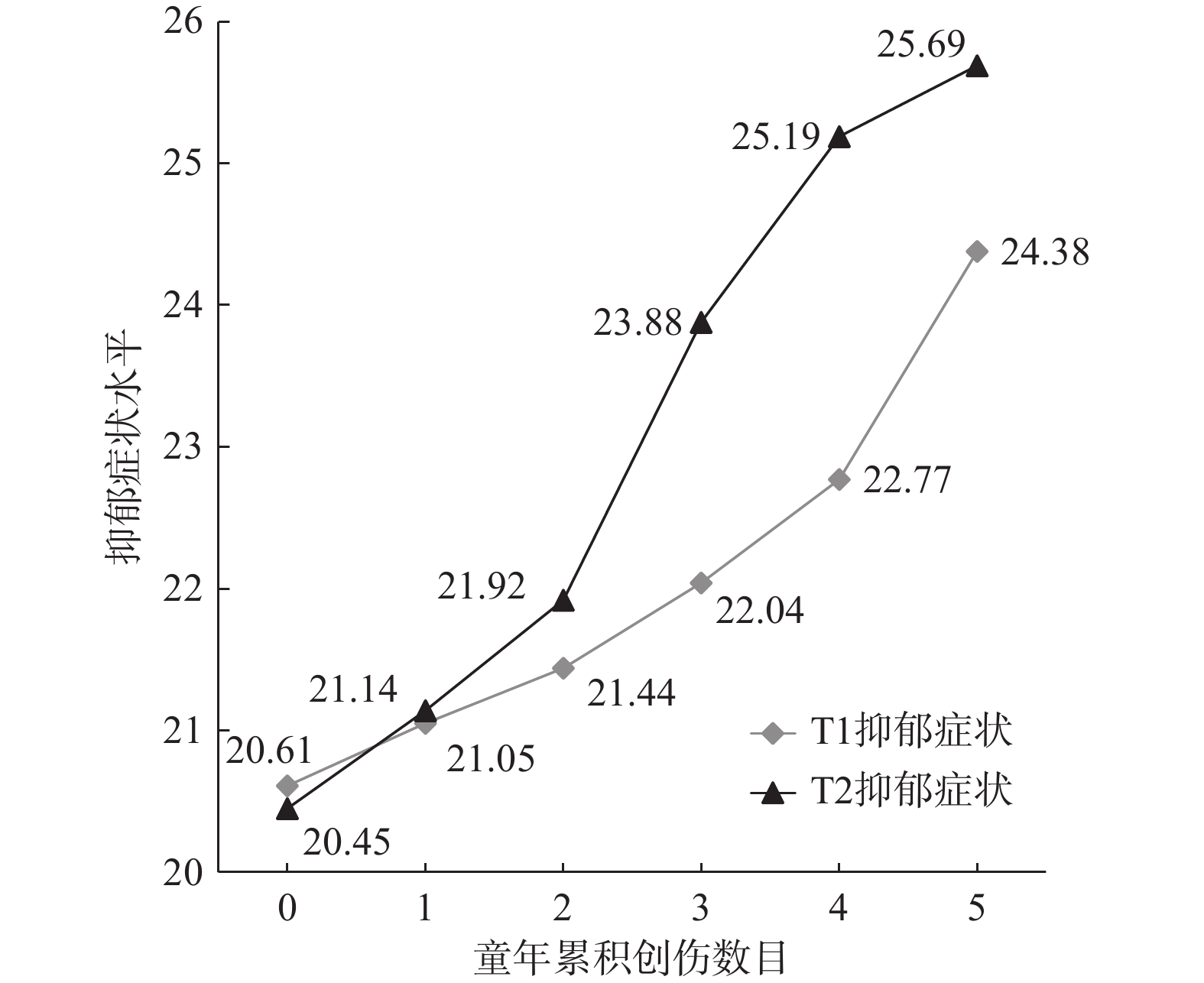
图1 童年累积创伤与成年早期抑郁症状的关系模式
| 预测变量 | T2抑郁症状(Y) | T1压力知觉(M) | T2抑郁症状(Y) | ||||||||
| β | SE | p | β | SE | p | β | SE | p | |||
| 性别 | 0.03 | 0.62 | 0.332 | 0.03 | 0.66 | 0.361 | 0.03 | 0.61 | 0.423 | ||
| T1抑郁症状 | 0.31 | 0.04 | <0.001 | 0.38 | 0.05 | <0.001 | 0.24 | 0.05 | <0.001 | ||
| 童年创伤(X) | 0.28 | 0.02 | <0.001 | 0.21 | 0.02 | <0.001 | 0.24 | 0.02 | <0.001 | ||
| T1压力知觉(M) | 0.20 | 0.04 | <0.001 | ||||||||
| R2=0.21 | R2=0.21 | R2=0.24 | |||||||||
| F=44.25, p<0.001 | F=24.91, p<0.001 | F=21.71, p<0.001 | |||||||||
表4 整体中介分析模型检验
| 预测变量 | T2抑郁症状(Y) | T1压力知觉(M) | T2抑郁症状(Y) | ||||||||
| β | SE | p | β | SE | p | β | SE | p | |||
| 性别 | 0.03 | 0.62 | 0.332 | 0.03 | 0.66 | 0.361 | 0.03 | 0.61 | 0.423 | ||
| T1抑郁症状 | 0.31 | 0.04 | <0.001 | 0.38 | 0.05 | <0.001 | 0.24 | 0.05 | <0.001 | ||
| 童年创伤(X) | 0.28 | 0.02 | <0.001 | 0.21 | 0.02 | <0.001 | 0.24 | 0.02 | <0.001 | ||
| T1压力知觉(M) | 0.20 | 0.04 | <0.001 | ||||||||
| R2=0.21 | R2=0.21 | R2=0.24 | |||||||||
| F=44.25, p<0.001 | F=24.91, p<0.001 | F=21.71, p<0.001 | |||||||||
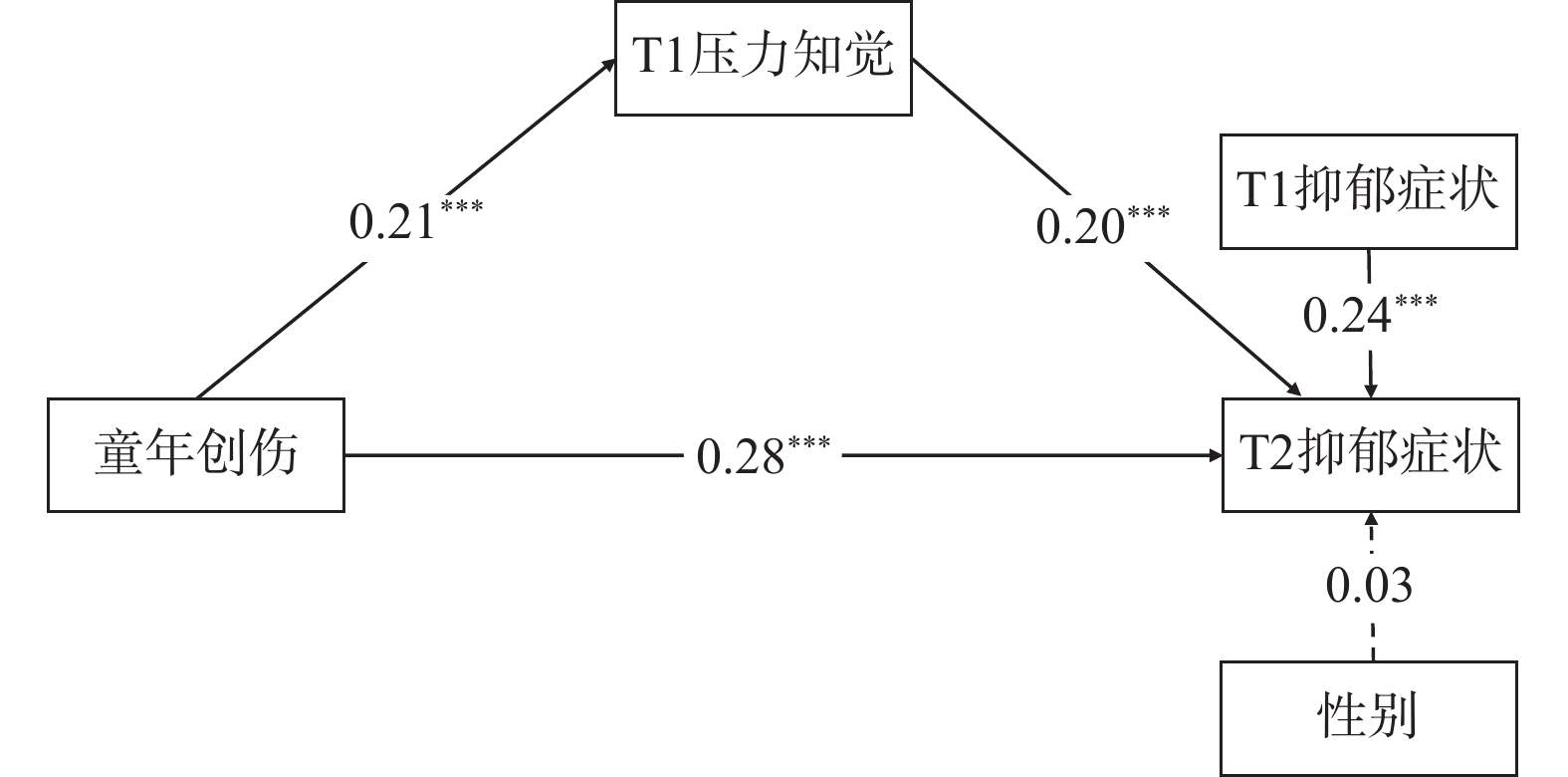
图2 整体中介作用模型
| 预测变量 | T2抑郁症状(Y) | T1压力知觉(M) | T2抑郁症状(Y) | |||||||||||
| β | SE | p | β | SE | p | β | SE | p | ||||||
| 性别 | 0.03 | 0.64 | 0.384 | 0.03 | 0.66 | 0.453 | 0.02 | 0.62 | 0.492 | |||||
| T1抑郁症状 | 0.36 | 0.04 | <0.001 | 0.38 | 0.05 | <0.001 | 0.24 | 0.05 | <0.001 | |||||
| 单一童年创伤组(X1) | c1 | 0.09 | 0.57 | 0.391 | a1 | 0.39 | 0.58 | <0.001 | c’1 | −0.01 | 0.56 | 0.973 | ||
| 累积童年创伤组(X2) | c2 | 0.45 | 0.51 | <0.001 | a2 | 0.43 | 0.52 | <0.001 | c’2 | 0.35 | 0.50 | <0.001 | ||
| T1压力知觉(M) | b | 0.23 | 0.04 | <0.001 | ||||||||||
| R2=0.17 | R2=0.21 | R2=0.22 | ||||||||||||
| F=25.90, p<0.001 | F=32.77, p<0.001 | F=27.29, p<0.001 | ||||||||||||
表5 相对中介分析模型检验
| 预测变量 | T2抑郁症状(Y) | T1压力知觉(M) | T2抑郁症状(Y) | |||||||||||
| β | SE | p | β | SE | p | β | SE | p | ||||||
| 性别 | 0.03 | 0.64 | 0.384 | 0.03 | 0.66 | 0.453 | 0.02 | 0.62 | 0.492 | |||||
| T1抑郁症状 | 0.36 | 0.04 | <0.001 | 0.38 | 0.05 | <0.001 | 0.24 | 0.05 | <0.001 | |||||
| 单一童年创伤组(X1) | c1 | 0.09 | 0.57 | 0.391 | a1 | 0.39 | 0.58 | <0.001 | c’1 | −0.01 | 0.56 | 0.973 | ||
| 累积童年创伤组(X2) | c2 | 0.45 | 0.51 | <0.001 | a2 | 0.43 | 0.52 | <0.001 | c’2 | 0.35 | 0.50 | <0.001 | ||
| T1压力知觉(M) | b | 0.23 | 0.04 | <0.001 | ||||||||||
| R2=0.17 | R2=0.21 | R2=0.22 | ||||||||||||
| F=25.90, p<0.001 | F=32.77, p<0.001 | F=27.29, p<0.001 | ||||||||||||
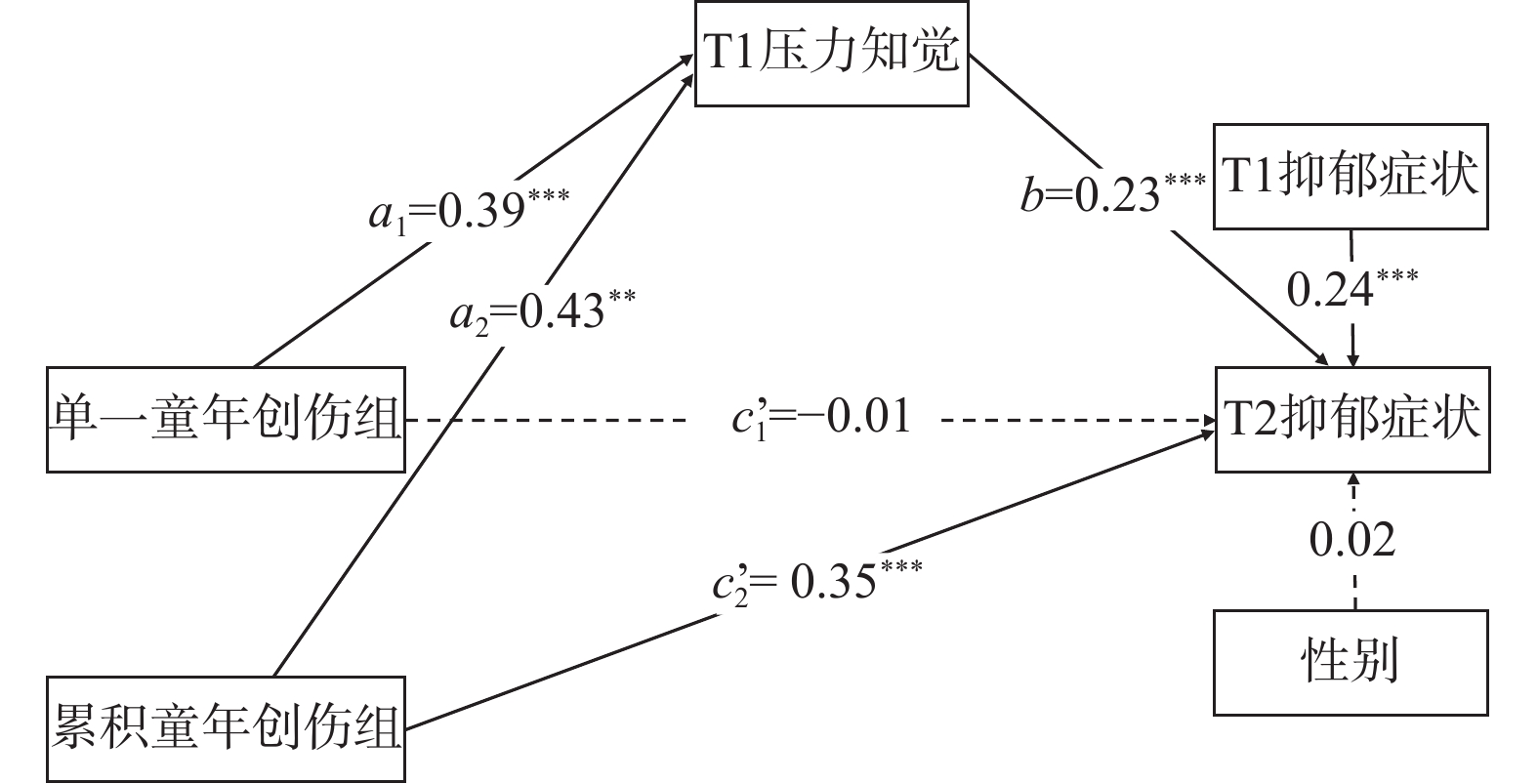
图3 相对中介作用模型图 注:单一童年创伤组(n=122, 22.3%),累积童年创伤组(n=189, 34.5%);参照组为无童年创伤组(n=237, 43.2%)。
|
范兴华, 余思, 彭佳, 方晓义. 留守儿童生活压力与孤独感、幸福感的关系: 心理资本的中介与调节作用. 心理科学, 2017, 40 (2): 388- 394.
DOI |
|
|
方杰, 温忠麟, 张敏强. 类别变量的中介效应分析. 心理科学, 2017, 40 (2): 471- 477.
DOI |
|
|
傅文青, 姚树桥, 于宏华, 赵幸福, 李茹, 李英, 张艳青. 儿童期创伤问卷在中国高校大学生中应用的信效度研究. 中国临床心理学杂志, 2005, 13 (1): 40- 42.
DOI |
|
|
刘贤臣, 唐茂芹, 陈琨, 胡蕾, 王爱祯. SDS和CES-D对大学生抑郁症状评定结果的比较. 中国心理卫生杂志, 1995, 9 (1): 19- 20, 37.
|
|
|
石智雷, 吴志明. 早年不幸对健康不平等的长远影响: 生命历程与双重累积劣势. 社会学研究, 2018, 33 (3): 166- 192.
|
|
|
Agorastos, A., Pittman, J. O. E., Angkaw, A. C., Nievergelt, C. M., Hansen, C. J., Aversa, L. H., ... Baker, D. G. The cumulative effect of different childhood trauma types on self-reported symptoms of adult male depression and PTSD, substance abuse and health-related quality of life in a large active-duty military cohort. Journal of Psychiatric Research, 2014, 58, 46- 54.
DOI |
|
|
Anda, R. F., Porter, L. E., & Brown, D. W. Inside the adverse childhood experience score: Strengths, limitations, and misapplications. American Journal of Preventive Medicine, 2020, 59 (2): 293- 295.
DOI |
|
|
Andresen, E. M., Malmgren, J. A., Carter, W. B., & Patrick, D. L. Screening for depression in well older adults: Evaluation of a short form of the CES-D. American Journal of Preventive Medicine, 1994, 10 (2): 77- 84.
DOI |
|
|
Antonovsky, A. The salutogenic model as a theory to guide health promotion. Health Promotion International, 1996, 11 (1): 11- 18.
DOI |
|
|
Appleyard, K., Egeland, B., van Dulmen, M. H. M., & Sroufe, L. A. When more is not better: The role of cumulative risk in child behavior outcomes. Journal of Child Psychology and Psychiatry, 2005, 46 (3): 235- 245.
DOI |
|
|
Arnett, J. J. Emerging adulthood: A theory of development from the late teens through the twenties. American Psychologist, 2000, 55 (5): 469- 480.
DOI |
|
|
Ashworth, E., & Humphrey, N. More than the sum of its parts: Cumulative risk effects on school functioning in middle childhood. British Journal of Educational Psychology, 2020, 90 (1): 43- 61.
DOI |
|
|
Baquero, M., & Martín, N. Depressive symptoms in neurodegenerative diseases. World Journal of Clinical Cases, 2015, 3 (8): 682- 693.
DOI |
|
|
Beekman, A. T. F., Penninx, B. W. J. H., van Oppen, P., Giltay, E. J., Wiersma, J. E., Hovens, J. G. F. M., & van Schaik, D. J. F. The importance of childhood trauma and childhood life events for chronicity of depression in adults. The Journal of Clinical Psychiatry, 2009, 70 (7): 983- 989.
DOI |
|
|
Bernstein, D. P., Fink, L., Handelsman, L., & Foote, J. (1994). Childhood trauma questionnaire. In Assessment of family violence: A handbook for researchers and practitioners. Retrieved July 31, 2024, from https://doi.org/10.1037/t02080-000
|
|
|
Briere, J., Kaltman, S., & Green, B. L. Accumulated childhood trauma and symptom complexity. Journal of Traumatic Stress, 2008, 21 (2): 223- 226.
DOI |
|
|
Cohen, J., Cohen, P., West, S. G., & Aiken, L. S. (2003). Applied multiple regression/correlation analysis for the behavioral sciences (3rd ed.). Mahwah, NJ: Lawrence Erlbaum Associates Publishers.
|
|
|
Cohen, S., Kamarck, T., & Mermelstein, R. A global measure of perceived stress. Journal of Health and Social Behavior, 1983, 24 (4): 385- 396.
|
|
|
Copeland, W. E., Shanahan, L., Hinesley, J., Chan, R. F., Aberg, K. A., Fairbank, J. A., ... Costello, E. J. Association of childhood trauma exposure with adult psychiatric disorders and functional outcomes. JAMA Network Open, 2018, 1 (7): e184493.
DOI |
|
|
Danese, A., & Uher, R. Treatment response in individuals with depression and a history of childhood maltreatment. The Lancet Psychiatry, 2023, 10 (1): e1- e2.
DOI |
|
|
Daníelsdóttir, H. B., Aspelund, T., Shen, Q., Halldorsdottir, T., Jakobsdóttir, J., Song, H., ... Valdimarsdóttir, U. A. Adverse childhood experiences and adult mental health outcomes. JAMA Psychiatry, 2024, 81 (6): 586- 594.
DOI |
|
|
Eckenrode, J., Campa, M. I., Morris, P. A., Henderson, C. R., Jr., Bolger, K. E., Kitzman, H., & Olds, D. L. The prevention of child maltreatment through the nurse family partnership program: Mediating effects in a long-term follow-up study. Child Maltreatment, 2017, 22 (2): 92- 99.
DOI |
|
|
Elder, G. H., Jr. The life course as developmental theory. Child Development, 1998, 69 (1): 1- 12.
DOI |
|
|
Evans, G. W., Li, D. P., & Whipple, S. S. Cumulative risk and child development. Psychological Bulletin, 2013, 139 (6): 1342- 1396.
|
|
|
Garmezy, N., & Masten, A. S. Stress, competence, and resilience: Common frontiers for therapist and psychopathologist. Behavior Therapy, 1986, 17 (5): 500- 521.
DOI |
|
|
Grummitt, L. R., Kreski, N. T., Kim, S. G., Platt, J., Keyes, K. M., & McLaughlin, K. A. Association of childhood adversity with morbidity and mortality in US adults: A systematic review. JAMA Pediatrics, 2021, 175 (12): 1269- 1278.
DOI |
|
|
Hayes, A. F., & Preacher, K. J. Statistical mediation analysis with a multicategorical independent variable. British Journal of Mathematical and Statistical Psychology, 2014, 67 (3): 451- 470.
DOI |
|
|
Heim, C., Newport, D. J., Mletzko, T., Miller, A. H., & Nemeroff, C. B. The link between childhood trauma and depression: Insights from HPA axis studies in humans. Psychoneuroendocrinology, 2008, 33 (6): 693- 710.
DOI |
|
|
Hertzman, C. The biological embedding of early experience and its effects on health in adulthood. Annals of the New York Academy of Sciences, 1999, 896 (1): 85- 95.
DOI |
|
|
Huh, H. J., Kim, K. H., Lee, H. K., & Chae, J. H. The relationship between childhood trauma and the severity of adulthood depression and anxiety symptoms in a clinical sample: The mediating role of cognitive emotion regulation strategies. Journal of Affective Disorders, 2017, 213, 44- 50.
DOI |
|
|
Humphreys, K. L., LeMoult, J., Wear, J. G., Piersiak, H. A., Lee, A., & Gotlib, I. H. Child maltreatment and depression: A meta-analysis of studies using the Childhood Trauma Questionnaire. Child Abuse & Neglect, 2020, 102, 104361.
DOI |
|
|
Jones, C. M., Merrick, M. T., & Houry, D. E. Identifying and preventing adverse childhood experiences: Implications for clinical practice. JAMA, 2020, 323 (1): 25- 26.
DOI |
|
|
Maercker, A., Hilpert, P., & Burri, A. Childhood trauma and resilience in old age: Applying a context model of resilience to a sample of former indentured child laborers. Aging & Mental Health, 2016, 20 (6): 616- 626.
DOI |
|
|
Mandelli, L., Petrelli, C., & Serretti, A. The role of specific early trauma in adult depression: A meta-analysis of published literature. Childhood trauma and adult depression. European Psychiatry, 2015, 30 (6): 665- 680.
DOI |
|
|
Merrick, M. T., Ford, D. C., Ports, K. A., & Guinn, A. S. Prevalence of adverse childhood experiences from the 2011–2014 behavioral risk factor surveillance system in 23 states. JAMA Pediatrics, 2018, 172 (11): 1038- 1044.
DOI |
|
|
Norman, R. E., Byambaa, M., De, R., Butchart, A., Scott, J., & Vos, T. The long-term health consequences of child physical abuse, emotional abuse, and neglect: A systematic review and meta-analysis. PLoS Medicine, 2012, 9 (11): e1001349.
DOI |
|
|
Ross, N. D., Kaminski, P. L., & Herrington, R. From childhood emotional maltreatment to depressive symptoms in adulthood: The roles of self-compassion and shame. Child Abuse & Neglect, 2019, 92, 32- 42.
DOI |
|
|
Rutter, M. Resilience as a dynamic concept. Development and Psychopathology, 2012, 24 (2): 335- 344.
DOI |
|
|
Sawyer, S. M., Azzopardi, P. S., Wickremarathne, D., & Patton, G. C. The age of adolescence. The Lancet Child & Adolescent Health, 2018, 2 (3): 223- 228.
DOI |
|
|
Seery, M. D., Holman, E. A., & Silver, R. C. Whatever does not kill us: Cumulative lifetime adversity, vulnerability, and resilience. Journal of Personality and Social Psychology, 2010, 99 (6): 1025- 1041.
DOI |
|
|
Shchaslyvyi, A. Y., Antonenko, S. V., & Telegeev, G. D. Comprehensive review of chronic stress. Pathways and the efficacy of Behavioral Stress Reduction Programs (BSRPs) in managing diseases. International Journal of Environmental Research and Public Health, 2024, 21 (8): 1077.
DOI |
|
|
Yu, Y., Cui, X., Du, J. M., Wilson, A., Xu, S. C., & Wang, Y. Y. Linear and curvilinear association of pain tolerance and social anxiety symptoms among youth with different subgroups of childhood trauma. Journal of Affective Disorders, 2024, 354, 491- 499.
DOI |
|
|
Zheng, K. L., Chu, J., Zhang, X. C., Ding, Z. X., Song, Q., Liu, Z. X., ... Yi, J. Y. Psychological resilience and daily stress mediate the effect of childhood trauma on depression. Child Abuse & Neglect, 2022, 125, 105485.
DOI |
| [1] | 鲍振宙, 刘花, 于明申. 青少年校园欺凌旁观行为与焦虑抑郁症状的关系:基于纵向网络分析法[J]. 心理与行为研究, 2025, 23(4): 504-512. |
| [2] | 刘鑫, 刘衍玲, 曾晋逸. 心理需要挫折与青少年抑郁症状的纵向联系:心理素质的调节作用[J]. 心理与行为研究, 2025, 23(4): 496-503. |
| [3] | 祖雯妍, 杨晓峰. 核心自我评价与时间贫困感的关系:压力知觉与短视频成瘾的链式中介作用[J]. 心理与行为研究, 2025, 23(3): 391-398. |
| [4] | 于永菊, 何敏. 高校大学生生命意义感的演变模式及其与抑郁症状的关联[J]. 心理与行为研究, 2025, 23(3): 354-360. |
| [5] | 胡义秋, 何震, 曾子豪, 赵纤, 常梦梦. 初中生身体监控与抑郁症状的纵向关系研究:主观幸福感的中介作用[J]. 心理与行为研究, 2025, 23(1): 58-65. |
| [6] | 郑柯君, 李妍, 陈欣银, 边玉芳. 青少年早期抑郁症状对父母温暖与社交淡漠关系的中介作用:一项三年追踪研究[J]. 心理与行为研究, 2024, 22(1): 71-78. |
| [7] | 李文福, 刘燕, 段熙明, 牛四方, 许瑞雪, 慕福芹. 反刍思维量表在不同性别和抑郁症状医学院校新生中的测量等值性[J]. 心理与行为研究, 2023, 21(6): 854-860. |
| [8] | 高斌, 谭莉华, 张丹丹, 黎明新, 蔡艳香. 网络社会支持与高中生网络学习投入:有调节的中介模型[J]. 心理与行为研究, 2023, 21(3): 403-409. |
| [9] | 丁轶飞, 陈兰双, 张镇. 中老年人线上社会参与和抑郁症状的关系:基于自我决定理论[J]. 心理与行为研究, 2023, 21(1): 86-93. |
| [10] | 陈兰双, 宋惠敏, 董静, 赵欢, 张镇. 老年大学学员组织融入度和抑郁症状的关系及其机制探索[J]. 心理与行为研究, 2021, 19(5): 706-713. |
| [11] | 陈佩儀, 陈瑜, 杨雪岭. 中庸思维对大学生抑郁症状的影响机制:消极认知情绪调节策略的中介作用[J]. 心理与行为研究, 2021, 19(4): 571-576. |
| [12] | 申琳琳, 张镇. 隔代照料与中老年人心理健康:家庭亲密度的中介作用[J]. 心理与行为研究, 2020, 18(2): 234-240. |
| [13] | 凌宇. 神经质人格调节青少年应激与抑郁症状的追踪研究[J]. 心理与行为研究, 2013, 11(3): 411-416. |
| [14] | 郑林科, 杨静. 生活应激诱发大学生抑郁症状及轻生意念预警模型[J]. 心理与行为研究, 2005, 3(4): 260-264. |
| 阅读次数 | ||||||
|
全文 |
|
|||||
|
摘要 |
|
|||||
