
心理与行为研究 ›› 2026, Vol. 24 ›› Issue (2): 258-264.DOI: 10.12139/j.1672-0628.2026.02.015
张一林1,2, 牛更枫1,2, 白旭青1,2, 辛素飞*,3( ), 孙晓军*,1,2()
收稿日期:2025-03-19
出版日期:2026-03-20
发布日期:2026-03-20
通讯作者:
辛素飞, 孙晓军
基金资助:
Yilin ZHANG1,2, Gengfeng Niu1,2, Xuqing BAI1,2, Sufei XIN*,3(), Xiaojun SUN*,1,2()
Received:2025-03-19
Online:2026-03-20
Published:2026-03-20
Contact:
Sufei XIN, Xiaojun SUN
摘要:
为考察社会逆境感知与青少年社交媒体成瘾的双向关系及控制感的中介作用,采用问卷法对3所中学1370名中学生进行间隔7个月的追踪调查。结果发现:(1)社会逆境感知与社交媒体成瘾存在相互正向预测关系;(2)控制感在社会逆境感知与青少年社交媒体成瘾之间起中介作用。本研究结果表明,提高控制感对于打破社会逆境感知与社交媒体成瘾的恶性循环具有重要意义。
张一林, 牛更枫, 白旭青, 辛素飞, 孙晓军. 社会逆境感知与青少年社交媒体成瘾的双向关系:控制感的作用[J]. 心理与行为研究, 2026, 24(2): 258-264.
Yilin ZHANG, Gengfeng Niu, Xuqing BAI, Sufei XIN, Xiaojun SUN. The Bidirectional Relationship Between Perceived Chronic Social Adversity and Social Media Addiction Among Adolescents: The Role of Sense of Control[J]. Studies of Psychology and Behavior, 2026, 24(2): 258-264.
| 变量 | 1 | 2 | 3 | 4 | 5 | 6 |
| T1社会逆境感知 | ||||||
| T1控制感 | −0.59*** | |||||
| T1社交媒体成瘾 | 0.38*** | −0.44*** | ||||
| T2社会逆境感知 | 0.52*** | −0.43*** | 0.34*** | |||
| T2控制感 | −0.52*** | 0.63*** | −0.37*** | −0.52*** | ||
| T2社交媒体成瘾 | 0.32*** | −0.38*** | 0.68*** | 0.43*** | −0.45*** | |
| M | 1.63 | 4.63 | 2.03 | 1.61 | 4.66 | 2.00 |
| SD | 0.70 | 0.99 | 0.83 | 0.74 | 1.01 | 0.89 |
表1 研究变量的平均数、标准差和相关系数(n=1370)
| 变量 | 1 | 2 | 3 | 4 | 5 | 6 |
| T1社会逆境感知 | ||||||
| T1控制感 | −0.59*** | |||||
| T1社交媒体成瘾 | 0.38*** | −0.44*** | ||||
| T2社会逆境感知 | 0.52*** | −0.43*** | 0.34*** | |||
| T2控制感 | −0.52*** | 0.63*** | −0.37*** | −0.52*** | ||
| T2社交媒体成瘾 | 0.32*** | −0.38*** | 0.68*** | 0.43*** | −0.45*** | |
| M | 1.63 | 4.63 | 2.03 | 1.61 | 4.66 | 2.00 |
| SD | 0.70 | 0.99 | 0.83 | 0.74 | 1.01 | 0.89 |
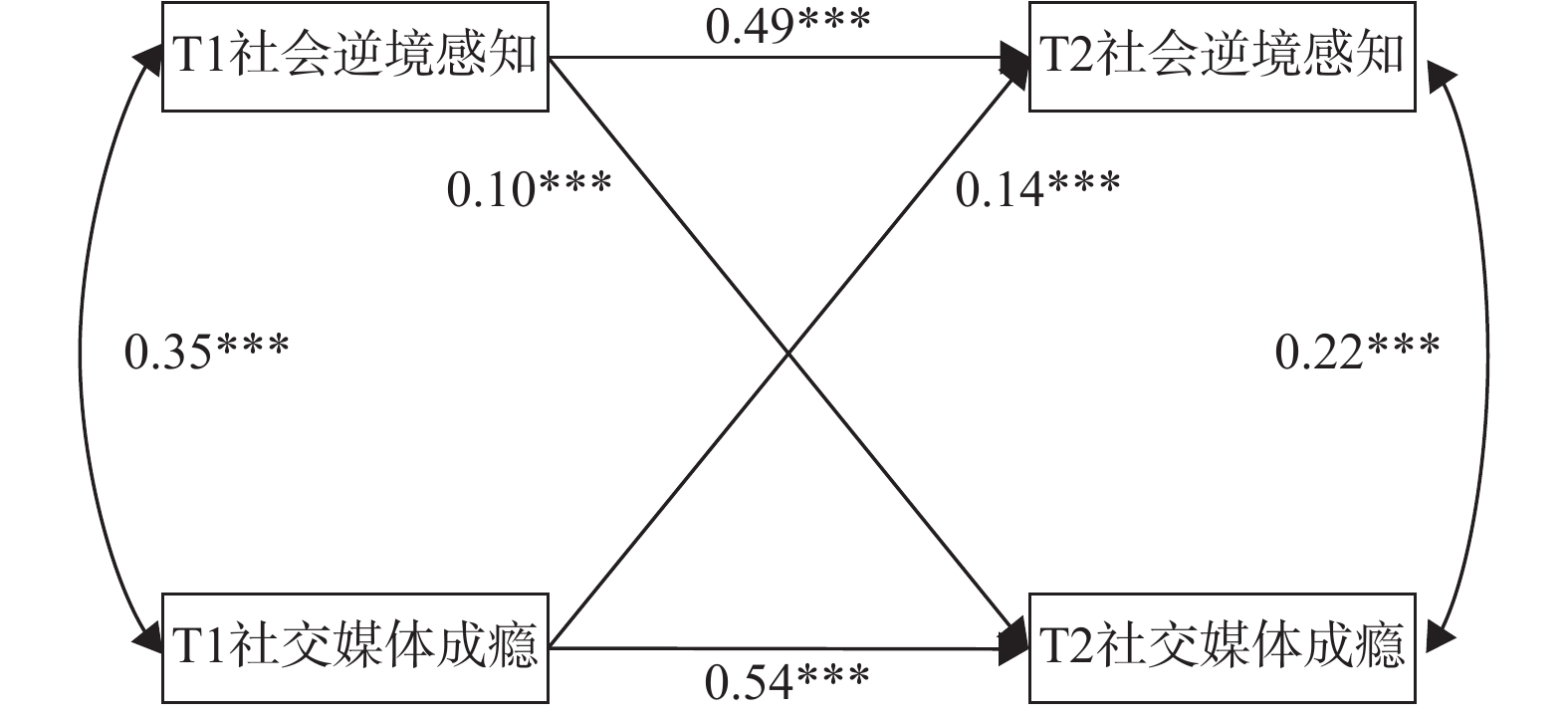
图1 社会逆境感知和社交媒体成瘾的交叉滞后模型
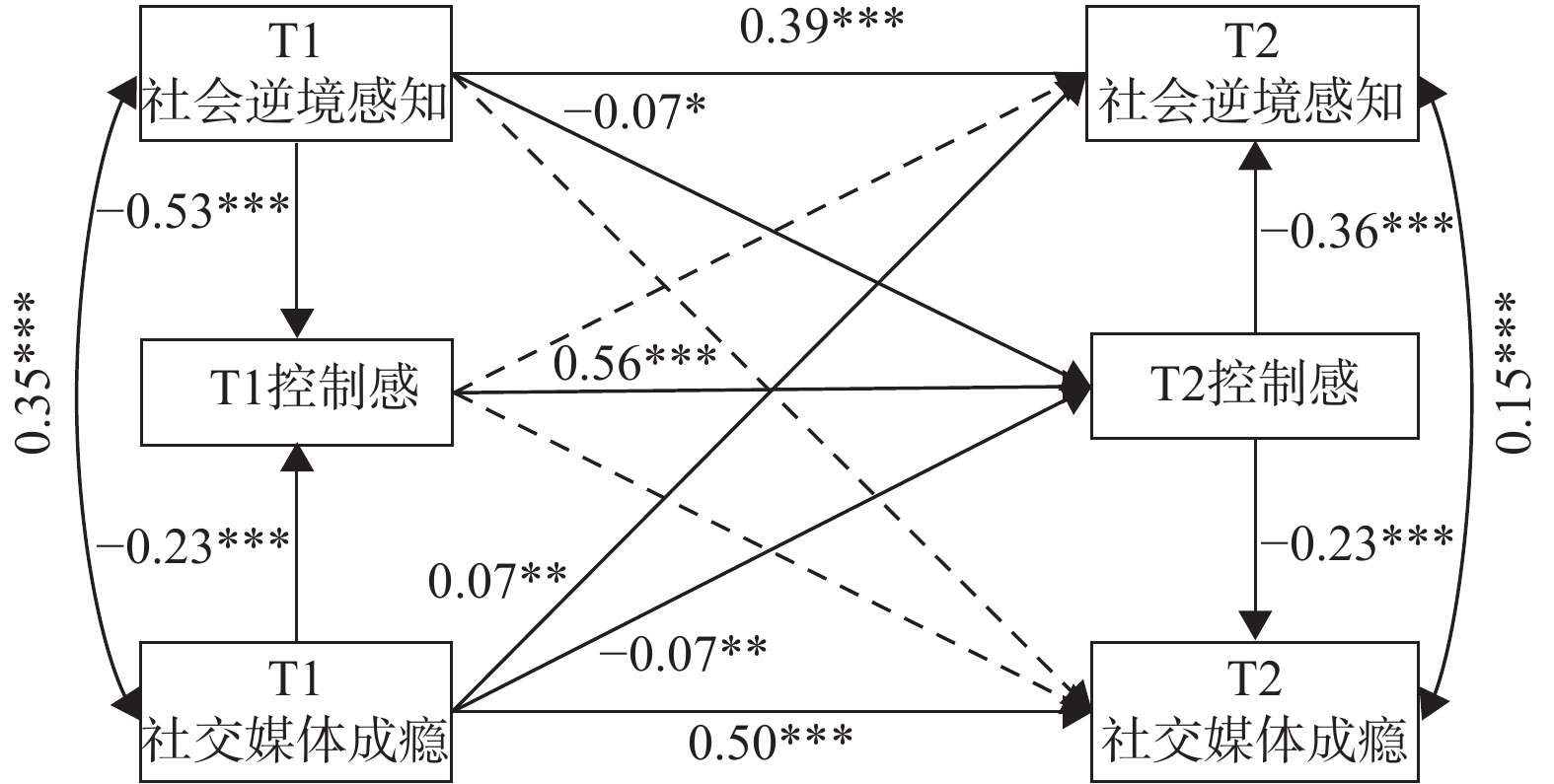
图2 社会逆境感知、控制感和社交媒体成瘾的交叉滞后模型 注:实线为显著路线,虚线为不显著路线。
| 路径 | 效应值 | 效果量(%) | 95%置信区间 | |
| 下限 | 上限 | |||
| T1逆境→T1控制→T2控制→T2成瘾 | 0.07 | 66.34 | 0.05 | 0.09 |
| T1成瘾→T1控制→T2控制→T2逆境 | 0.05 | 35.07 | 0.03 | 0.06 |
表2 中介效应检验结果
| 路径 | 效应值 | 效果量(%) | 95%置信区间 | |
| 下限 | 上限 | |||
| T1逆境→T1控制→T2控制→T2成瘾 | 0.07 | 66.34 | 0.05 | 0.09 |
| T1成瘾→T1控制→T2控制→T2逆境 | 0.05 | 35.07 | 0.03 | 0.06 |
|
白洁, 郭永玉, 杨沈龙. 人在丧失控制感后会如何?——来自补偿性控制理论的揭示. 中国临床心理学杂志, 2017, 25 (5): 982- 985, 981.
|
|
|
邓林园, 杨梦茜, 杨雨萌, 周楠, 李蓓蕾. 父母自主支持、父母心理控制和青少年网络成瘾的关系: 一项交叉滞后研究. 心理与行为研究, 2022, 20 (2): 190- 196, 254.
DOI |
|
|
窦凯, 黎彦余, 王林欣, 聂衍刚. 错失恐惧还是社交回避? 同伴排斥对粤澳青少年问题性社交媒体使用的影响. 心理科学, 2023, 46 (5): 1081- 1089.
DOI |
|
|
方勇, 季为民, 沈杰. (2024).中国未成年人互联网运用报告(2024). 北京: 社会科学文献出版社.
|
|
|
侯娟, 朱英格, 方晓义. 手机成瘾与抑郁: 社交焦虑和负性情绪信息注意偏向的多重中介作用. 心理学报, 2021, 53 (4): 362- 373.
|
|
|
金童林, 乌云特娜, 张璐, 杨雪, 贾彦茹, 杨宏. 社会逆境感知对大学生攻击行为的影响: 反刍思维与领悟社会支持的作用. 心理发展与教育, 2020, 36 (4): 414- 421.
|
|
|
李静. (2012). 不同社会阶层对贫富差距的归因倾向研究(博士学位论文). 华中师范大学, 武汉.
|
|
|
刘致宏, 张野, 王凯, 许晴. 校园排斥与青少年问题性社交媒体使用的关系: 基于潜调节结构方程模型. 心理与行为研究, 2023, 21 (4): 533- 540.
|
|
|
马娟, 吴晓靓, 闫艳, 盖笑松, 周茹. 留守经历对初中生心理繁荣的影响: 控制感的补偿作用和调节作用. 心理与行为研究, 2025, 23 (3): 377- 383.
DOI |
|
|
田雨, 丁洪君, 郭宗新. 大学新生负性生活事件与手机成瘾的双向关系: 领悟社会支持的作用. 心理发展与教育, 2025, 41 (4): 579- 588.
|
|
|
王甦平, 蔡泳, 朱睿, 李思聪, 刘心怡, 龚睿婕. 青少年社交网络成瘾评估量表初步编制和信效度检验. 中华全科医学, 2022, 20 (2): 324- 326.
|
|
|
王永丽, 曾盼盼, 李玉华. 面向儿童青少年的心理健康服务现状和启示——基于对美国、芬兰等12国经验的文献分析. 心理与行为研究, 2025, 23 (2): 226- 232.
|
|
|
徐荣华, 丁毅, 张跃, 郭永玉. 系统合理信念维护心理健康: 缓和作用与拓展. 心理科学进展, 2024, 32 (2): 386- 397.
DOI |
|
|
张静秋. (2018). 慢性社会困境感知、个体负性本质化与创伤性症状的关系(博士学位论文). 西南大学, 重庆.
|
|
|
赵立, 白莎. 数媒时代焦虑、抑郁与社会比较的关系. 心理科学进展, 2025, 33 (1): 92- 106.
|
|
|
周浩, 龙立荣. 共同方法偏差的统计检验与控制方法. 心理科学进展, 2004, 12 (6): 942- 950.
|
|
|
周姿言, 胡潇, 张一林, 苏瑞琳, 辛素飞, 盛靓. 负性生活事件与初中生网络成瘾的关系: 社交焦虑和无聊倾向的作用. 心理发展与教育, 2025, 41 (1): 109- 116.
|
|
|
Alimoradi, Z., Broström, A., Potenza, M. N., Lin, C. Y., & Pakpour, A. H. Associations between behavioral addictions and mental health concerns During the COVID-19 pandemic: A systematic review and meta-analysis. Current Addiction Reports, 2024, 11 (3): 565- 587.
DOI |
|
|
Andreassen, C. S., Pallesen, S., & Griffiths, M. D. The relationship between addictive use of social media, narcissism, and self-esteem: Findings from a large national survey. Addictive Behaviors, 2017, 64, 287- 293.
DOI |
|
|
Baumeister, R. F., Vohs, K. D., & Tice, D. M. The strength model of self-control. Current Directions in Psychological Science, 2007, 16 (6): 351- 355.
DOI |
|
|
Boer, M., Stevens, G. W. J. M., Finkenauer, C., De Looze, M. E., & van Den Eijnden, R. J. J. M. Social media use intensity, social media use problems, and mental health among adolescents: Investigating directionality and mediating processes. Computers in Human Behavior, 2021, 116, 106645.
DOI |
|
|
Brailovskaia, J., & Margraf, J. Positive mental health and mindfulness as protective factors against addictive social media use during the COVID-19 outbreak. PLoS One, 2022, 17 (11): e0277631.
DOI |
|
|
Brand, M., Wegmann, E., Stark, R., Müller, A., Wölfling, K., Robbins, T. W., & Potenza, M. N. The interaction of person-affect-cognition-execution (I-PACE) model for addictive behaviors: Update, generalization to addictive behaviors beyond internet-use disorders, and specification of the process character of addictive behaviors. Neuroscience & Biobehavioral Reviews, 2019, 104, 1- 10.
DOI |
|
|
Craparo, G. Post-stress traumatic disorder a provocative proposal. Clinical Neuropsychiatry, 2016, 13 (4-5): 77- 81.
|
|
|
Davis, R. A. A cognitive-behavioral model of pathological internet use. Computers in Human Behavior, 2001, 17 (2): 187- 195.
DOI |
|
|
Dhir, A., Yossatorn, Y., Kaur, P., & Chen, S. F. Online social media fatigue and psychological wellbeing—A study of compulsive use, fear of missing out, fatigue, anxiety and depression. International Journal of Information Management, 2018, 40, 141- 152.
DOI |
|
|
Ding, C., Zhang, J. Q., & Yang, D. A pathway to psychological difficulty: Perceived chronic social adversity and its symptomatic reactions. Frontiers in Psychology, 2018, 9, 615.
DOI |
|
|
Gao, W., Liu, Z. P. & Li, J. Y. How does social presence influence SNS addiction? A belongingness theory perspective. Computers in Human Behavior, 2017, 77, 347- 355.
DOI |
|
|
Griffiths, M. D. Social networking addiction: Emerging themes and issues. Journal of Addiction Research & Therapy, 2013, 4 (5): 1000e118.
DOI |
|
|
Hobfoll, S. E., Freedy, J., Lane, C., & Geller, P. Conservation of social resources: Social support resource theory. Journal of Personality and Social Psychology, 1990, 7 (4): 465- 478.
DOI |
|
|
Jin, T., & Zhu, X. X. Perceived chronic social adversity, perceived social support, and depression among Chinese college students: Mediating role of self-esteem. American Journal of Applied Psychology, 2022, 11 (1): 1- 8.
DOI |
|
|
Kardefelt-Winther, D. A conceptual and methodological critique of internet addiction research: Towards a model of compensatory internet use. Computers in Human Behavior, 2014, 31, 351- 354.
DOI |
|
|
Kircaburun, K., Pontes, H. M., Stavropoulos, V., & Griffiths, M. D. A brief psychological overview of disordered gaming. Current Opinion in Psychology, 2020, 36, 38- 43.
DOI |
|
|
Kurten, S., Ghai, S., Odgers, C., Kievit, R. A., & Orben, A. Deprivation’s role in adolescent social media use and its links to life satisfaction. Computers in Human Behavior, 2025, 165, 108541.
DOI |
|
|
Li, W. Q., & Peng, H. X. The impact of strain, constraints, and morality on different cyberbullying roles: A partial test of Agnew’s general strain theory. Frontiers in Psychology, 2022, 13, 980669.
DOI |
|
|
Meng, K. S., & Leung, L. Factors influencing TikTok engagement behaviors in China: An examination of gratifications sought, narcissism, and the big five personality traits. Telecommunications Policy, 2021, 45 (7): 102172.
DOI |
|
|
Sala, A., Porcaro, L., & Gómez, E. Social media use and adolescents’ mental health and well-being: An umbrella review. Computers in Human Behavior Reports, 2024, 14, 100404.
DOI |
|
|
Salari, N., Hosseinian-Far, A., Jalali, R., Vaisi-Raygani, A., Rasoulpoor, S., Mohammadi, M., ... Khaledi-Paveh, B. Prevalence of stress, anxiety, depression among the general population during the COVID-19 pandemic: A systematic review and meta-analysis. Globalization and Health, 2020, 16 (1): 57.
DOI |
|
|
Seligman, M. E. P. Learned helplessness. Annual Review of Medicine, 1972, 23, 407- 412.
DOI |
|
|
Tian, Y., Li, W., Guo, J. L., Yue, W., Chen, P. P., & Li, Y. F. Longitudinal associations among cumulative ecological risk, maladaptive cognitions and smartphone addiction in Chinese university freshmen: A two-wave study. Computers in Human Behavior, 2023, 149, 107921.
DOI |
|
|
Turel, O., & Qahri-Saremi, H. Problematic use of social networking sites: Antecedents and consequence from a dual-system theory perspective. Journal of Management Information Systems, 2016, 33 (4): 1087- 1116.
DOI |
|
|
Wang, C., Lee, M. K. O. & Hua, Z. S. A theory of social media dependence: Evidence from microblog users. Decision Support Systems, 2015, 69, 40- 49.
DOI |
|
|
Xue, J., Huang, H., Guo, Z. Y., Chen, J., & Feng, W. T. Adverse childhood experiences and short-form video addiction: A serial mediation model of resilience and life satisfaction. Computers in Human Behavior, 2025, 162, 108449.
DOI |
|
|
Yan, W. S., Li, Y. H., & Sui, N. The relationship between recent stressful life events, personality traits, perceived family functioning and internet addiction among college students. Stress and Health, 2014, 30 (1): 3- 11.
DOI |
|
|
Yang, S. Q., Liu, Y. & Wei, J. Social capital on mobile SNS addiction: A perspective from online and offline channel integrations. Internet Research, 2016, 26 (4): 982- 1000.
DOI |
|
|
Young, K. S. Internet addiction: The emergence of a new clinical disorder. CyberPsychology & Behavior, 1998, 1 (3): 237- 244.
DOI |
|
|
Zahrai, K., Veer, E., Ballantine, P. W., De Vries, H. P., & Prayag, G. Either you control social media or social media controls you: Understanding the impact of self-control on excessive social media use from the dual-system perspective. Journal of Consumer Affairs, 2022, 56 (2): 806- 848.
DOI |
|
|
Zhang, J. Q., Ding, C., Tang, Y. L., Zhang, C. Y., & Yang, D. A measure of perceived chronic social adversity: Development and validation. Frontiers in Psychology, 2017, 8, 2168.
DOI |
|
|
Zhang, Y. H., Liao, H. P., Gu, J. J., & Wang, J. L. Anxiety and depression related to childhood maltreatment in teenagers: Comparing multiple individual risk model, cumulative risk model and latent profile analysis. Child Abuse & Neglect, 2022, 128, 105630.
DOI |
|
|
Zhou, Z. Y., Jin, X. L. & Fang, Y. L. Moderating role of gender in the relationships between perceived benefits and satisfaction in social virtual world continuance. Decision Support Systems, 2014, 65, 69- 79.
DOI |
| [1] | 王惠惠, 唐慎佩, 赵双祐, 黄向圆, 兰松. 内在自我与外界眼光:自我评价与反射性评价一致性对青少年心理健康问题的影响[J]. 心理与行为研究, 2026, 24(2): 187-194. |
| [2] | 樊雪戎, 段依凡, 邢晓沛. 温暖的亲子感知差异与青少年内化问题的关系:基于二项式回归的响应面分析[J]. 心理与行为研究, 2026, 24(2): 195-203. |
| [3] | 曾子豪, 何震, 袁言云, 赵纤, 印利红, 谭嵘, 常梦梦, 胡义秋. HPA轴系统多基因−亲子关系交互对青少年抑郁发展影响及性别差异[J]. 心理与行为研究, 2026, 24(1): 78-86. |
| [4] | 杨昕珠, 王腾飞, 郑晓龙. 青少年社会情感能力与学业倦怠的双向预测作用:一项交叉滞后研究[J]. 心理与行为研究, 2025, 23(6): 789-797. |
| [5] | 谷莉, 黄晓彤, 梁广华, 蔡頠, 郭丰波. 核心自我评价与青少年自伤行为的关系:有调节的中介模型[J]. 心理与行为研究, 2025, 23(6): 798-805. |
| [6] | 张春妹, 骆玉冰, 温冬雪, 郑航. 青少年逆反心理与偏差行为的关系:偏差同伴联系和偏差群体同一性的链式中介作用[J]. 心理与行为研究, 2025, 23(5): 645-652. |
| [7] | 刘鑫, 刘衍玲, 曾晋逸. 心理需要挫折与青少年抑郁症状的纵向联系:心理素质的调节作用[J]. 心理与行为研究, 2025, 23(4): 496-503. |
| [8] | 鲍振宙, 刘花, 于明申. 青少年校园欺凌旁观行为与焦虑抑郁症状的关系:基于纵向网络分析法[J]. 心理与行为研究, 2025, 23(4): 504-512. |
| [9] | 刘佳, 高培晋, 李楠, 孙敏, 白学军. 社会变化程度感知对青少年社会公平感的影响[J]. 心理与行为研究, 2025, 23(4): 551-559. |
| [10] | 张庆吉, 郭丰波, 涂叶满, 卿再花, 宋凤. 劳动价值观对青少年心理健康潜在类别及其转换的影响:双因素模型视角[J]. 心理与行为研究, 2025, 23(4): 569-576. |
| [11] | 张阔, 李珮瑜, 赵晋娥, 贾绪计. 二分还是多重?青少年成长型思维动机框架的异质性及其与学业适应的关系[J]. 心理与行为研究, 2025, 23(3): 346-353. |
| [12] | 钞淼, 张宇, 谢启慧, 刘拓. 情感忽视对农村青少年短视频成瘾的纵向影响:负性情绪中介及留守差异[J]. 心理与行为研究, 2025, 23(3): 361-368. |
| [13] | 马娟, 吴晓靓, 闫艳, 盖笑松, 周茹. 留守经历对初中生心理繁荣的影响:控制感的补偿作用和调节作用[J]. 心理与行为研究, 2025, 23(3): 377-383. |
| [14] | 代晨辉, 赵小军, 石常秀, 李明臻, 赵尧瑶. 社会排斥对人际信任的影响:基于情景观和特质观的双重分析视角[J]. 心理与行为研究, 2025, 23(3): 384-390. |
| [15] | 王锦, 杨晓凡, 刘晓金, 徐紫陌. 中学生的未来自我连续性对主观幸福感的作用:价值冲突的中介模型[J]. 心理与行为研究, 2025, 23(2): 201-207. |
| 阅读次数 | ||||||
|
全文 |
|
|||||
|
摘要 |
|
|||||
