
心理与行为研究 ›› 2026, Vol. 24 ›› Issue (2): 265-272.DOI: 10.12139/j.1672-0628.2026.02.016
孔旭, 熊思成, 曾成伟, 张斌*( )
)
收稿日期:2025-05-15
出版日期:2026-03-20
发布日期:2026-03-20
通讯作者:
张斌
基金资助:
Xu KONG, Sicheng XIONG, Chengwei ZENG, Bin ZHANG*()
Received:2025-05-15
Online:2026-03-20
Published:2026-03-20
Contact:
Bin ZHANG
摘要:
为探究青少年社交焦虑与手机依赖的纵向发展关系,以及自我控制的纵向调节作用,采用社交焦虑量表、手机依赖量表和自我控制量表对750名青少年进行为期1年3次的追踪调查。结果发现:(1)社交焦虑和手机依赖呈线性增长趋势,自我控制呈线性下降趋势;(2)社交焦虑的初始水平和发展速度分别对手机依赖的初始水平和发展速度起显著正向预测作用;(3)自我控制的初始水平在社交焦虑和青少年手机依赖的初始水平之间的负向调节效应显著;(4)自我控制的发展速度在社交焦虑和青少年手机依赖的发展速度之间的负向调节效应显著。研究结果说明自我控制在社交焦虑对青少年手机依赖的影响中起纵向调节作用。
孔旭, 熊思成, 曾成伟, 张斌. 社交焦虑对青少年手机依赖的影响:自我控制的纵向调节作用[J]. 心理与行为研究, 2026, 24(2): 265-272.
Xu KONG, Sicheng XIONG, Chengwei ZENG, Bin ZHANG. The Impact of Social Anxiety on Adolescents’ Mobile Phone Dependency: The Longitudinal Moderating Role of Self-Control[J]. Studies of Psychology and Behavior, 2026, 24(2): 265-272.
| 变量 | 1 | 2 | 3 | 4 | 5 | 6 | 7 | 8 | 9 | 10 |
| 1.性别 | ||||||||||
| 2.社交焦虑T1 | 0.21** | |||||||||
| 3.社交焦虑T2 | 0.16** | 0.57** | ||||||||
| 4.社交焦虑T3 | 0.15** | 0.60** | 0.59** | |||||||
| 5.手机依赖T1 | 0.19** | 0.32** | 0.29** | 0.28** | ||||||
| 6.手机依赖T2 | 0.11** | 0.30** | 0.33** | 0.27** | 0.62** | |||||
| 7.手机依赖T3 | 0.18** | 0.28** | 0.30** | 0.34** | 0.56** | 0.64** | ||||
| 8.自我控制T1 | –0.14** | –0.36** | –0.31** | –0.30** | –0.59** | –0.47** | –0.44** | |||
| 9.自我控制T2 | –0.08* | –0.27** | –0.31** | –0.26** | –0.45** | –0.59** | –0.44** | 0.60** | ||
| 10.自我控制T3 | –0.15** | –0.32** | –0.29** | –0.38** | –0.48** | –0.47** | –0.58** | 0.57** | 0.59** | |
| M | 2.50 | 2.55 | 2.61 | 2.65 | 2.80 | 2.95 | 3.09 | 3.03 | 2.94 | |
| SD | 0.68 | 0.65 | 0.68 | 1.09 | 1.11 | 1.24 | 0.74 | 0.72 | 0.74 |
表1 变量的描述统计和相关分析(n=750)
| 变量 | 1 | 2 | 3 | 4 | 5 | 6 | 7 | 8 | 9 | 10 |
| 1.性别 | ||||||||||
| 2.社交焦虑T1 | 0.21** | |||||||||
| 3.社交焦虑T2 | 0.16** | 0.57** | ||||||||
| 4.社交焦虑T3 | 0.15** | 0.60** | 0.59** | |||||||
| 5.手机依赖T1 | 0.19** | 0.32** | 0.29** | 0.28** | ||||||
| 6.手机依赖T2 | 0.11** | 0.30** | 0.33** | 0.27** | 0.62** | |||||
| 7.手机依赖T3 | 0.18** | 0.28** | 0.30** | 0.34** | 0.56** | 0.64** | ||||
| 8.自我控制T1 | –0.14** | –0.36** | –0.31** | –0.30** | –0.59** | –0.47** | –0.44** | |||
| 9.自我控制T2 | –0.08* | –0.27** | –0.31** | –0.26** | –0.45** | –0.59** | –0.44** | 0.60** | ||
| 10.自我控制T3 | –0.15** | –0.32** | –0.29** | –0.38** | –0.48** | –0.47** | –0.58** | 0.57** | 0.59** | |
| M | 2.50 | 2.55 | 2.61 | 2.65 | 2.80 | 2.95 | 3.09 | 3.03 | 2.94 | |
| SD | 0.68 | 0.65 | 0.68 | 1.09 | 1.11 | 1.24 | 0.74 | 0.72 | 0.74 |
| 变量 | χ2 | df | CFI | TLI | RMSEA(90%CI) | 均值 | 协相关 | |
| 截距 | 斜率 | |||||||
| 社交焦虑 | 0.01 | 1 | 1.00 | 1.01 | 0.00[0.00, 0.03] | 2.50*** | 0.06*** | 0.028 |
| 手机依赖 | 0.07 | 1 | 1.00 | 1.01 | 0.00[0.00, 0.06] | 2.65*** | 0.15*** | –0.001 |
| 自我控制 | 0.19 | 1 | 1.00 | 1.00 | 0.00[0.00, 0.07] | 3.09*** | –0.07*** | –0.004 |
表2 主要研究变量的潜在增长模型拟合指数及截距和斜率
| 变量 | χ2 | df | CFI | TLI | RMSEA(90%CI) | 均值 | 协相关 | |
| 截距 | 斜率 | |||||||
| 社交焦虑 | 0.01 | 1 | 1.00 | 1.01 | 0.00[0.00, 0.03] | 2.50*** | 0.06*** | 0.028 |
| 手机依赖 | 0.07 | 1 | 1.00 | 1.01 | 0.00[0.00, 0.06] | 2.65*** | 0.15*** | –0.001 |
| 自我控制 | 0.19 | 1 | 1.00 | 1.00 | 0.00[0.00, 0.07] | 3.09*** | –0.07*** | –0.004 |
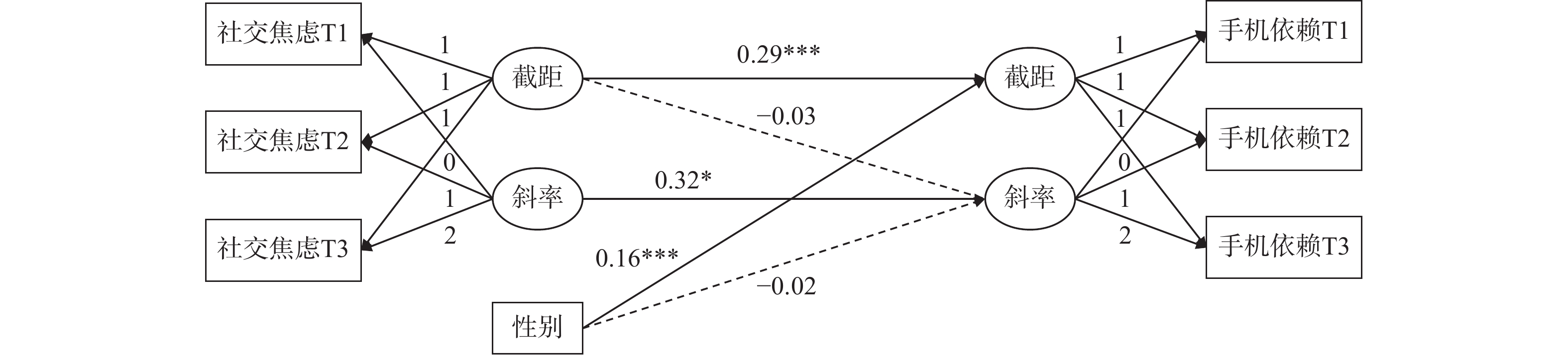
图1 社交焦虑作为预测变量的平行潜变量增长模型
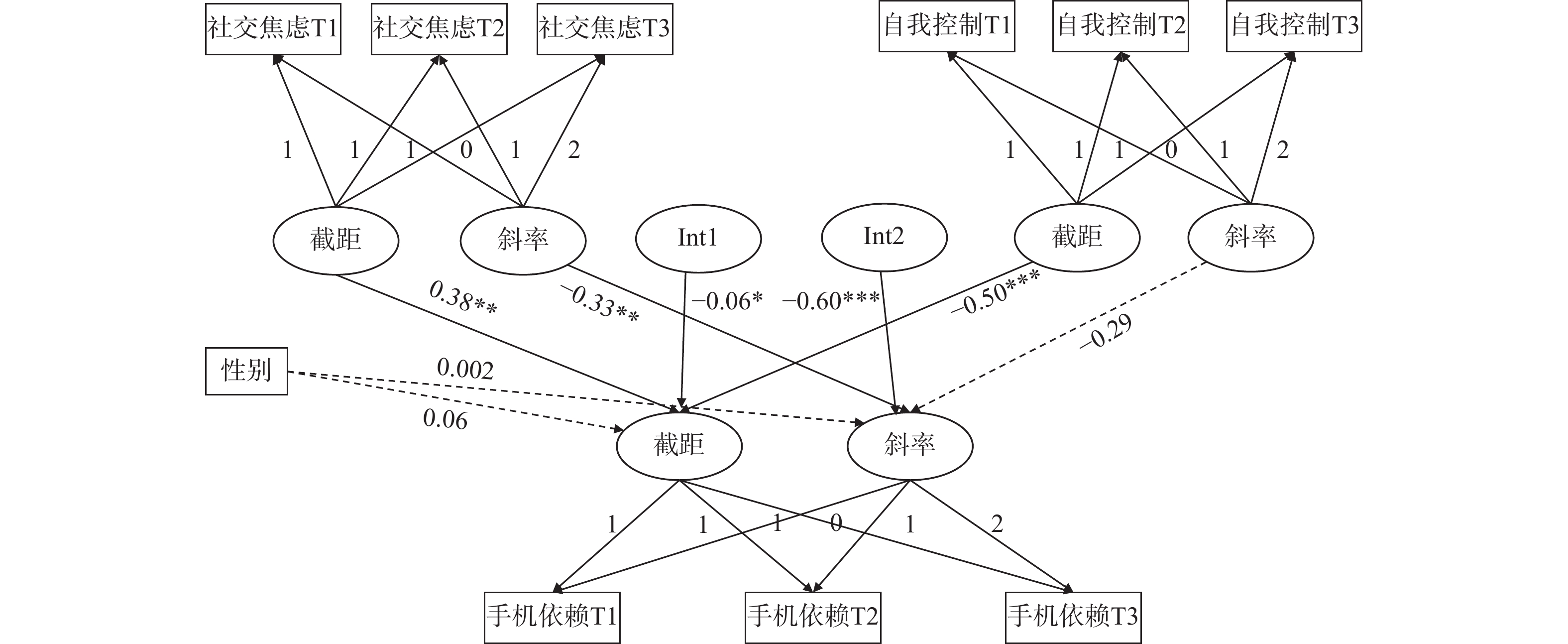
图2 自我控制在社交焦虑和青少年手机依赖之间的纵向调节作用 注:Int1=社交焦虑截距×自我控制截距,Int2=社交焦虑斜率×自我控制斜率。
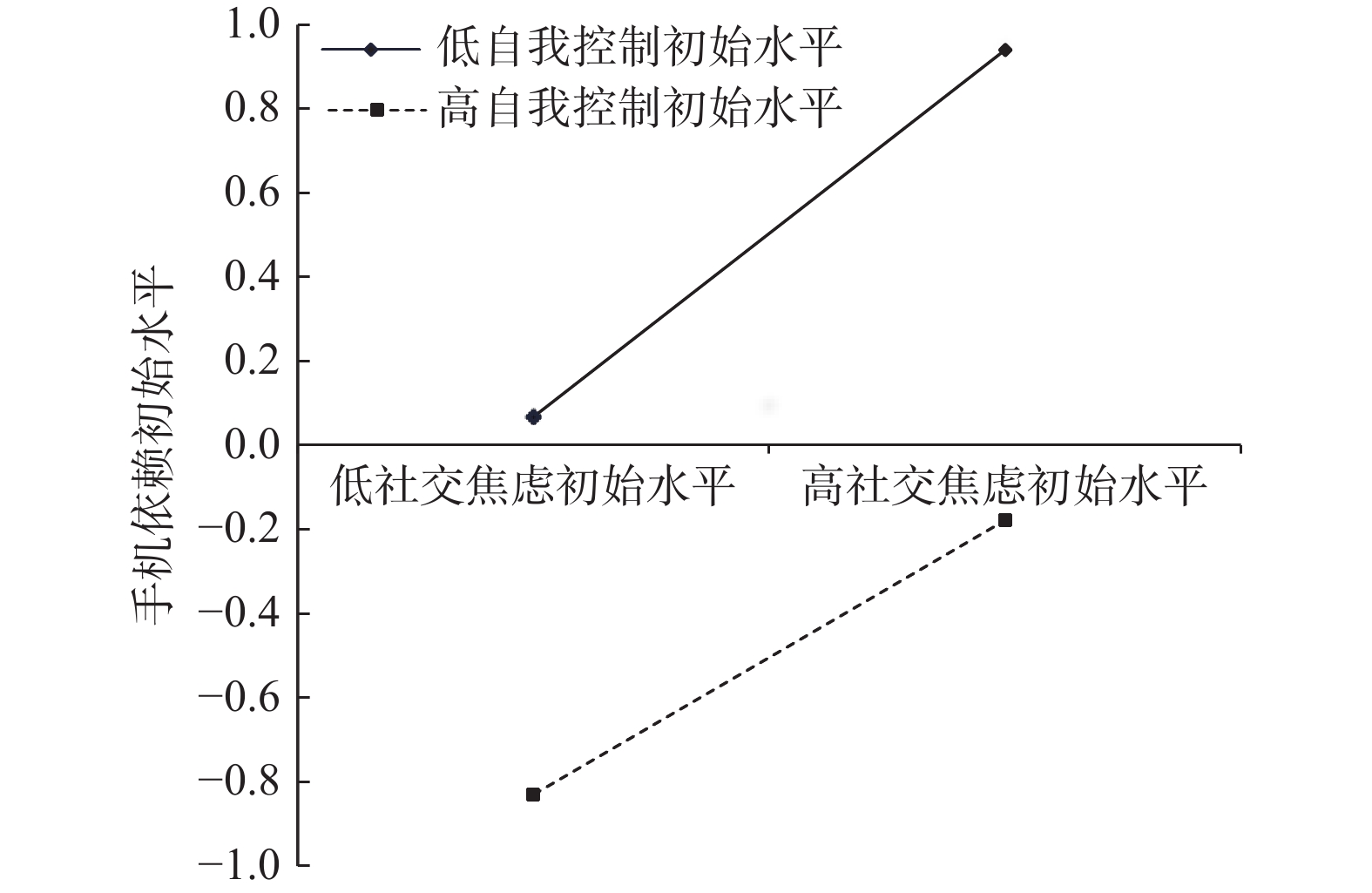
图3 自我控制初始水平的调节作用
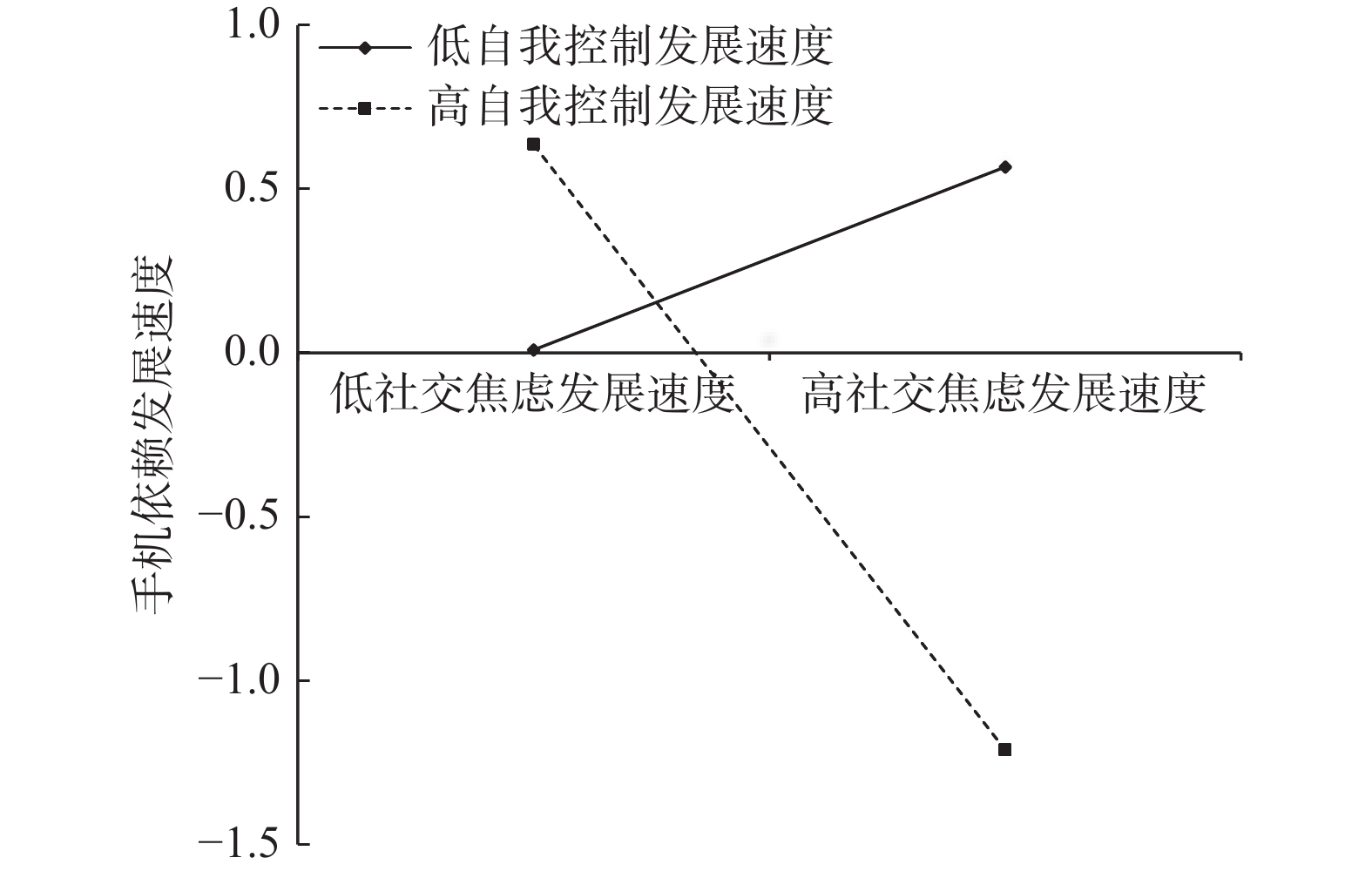
图4 自我控制发展速度的调节作用
|
方杰, 温忠麟. 纵向数据的调节效应分析. 心理科学进展, 2022, 30 (11): 2461- 2472.
|
|
|
葛文婷. (2024). 高中生成长型思维对社交焦虑的影响: 核心自我评价的中介作用及干预(硕士学位论文). 广西民族大学, 南宁.
|
|
|
关元, 何嘉梅. 自我控制: 内涵、理论及展望. 心理技术与应用, 2018, 6 (2): 118- 128.
DOI |
|
|
郭晓薇. 大学生社交焦虑成因的研究. 心理学探新, 2000, 20 (1): 55- 58.
DOI |
|
|
黄凤, 郭锋, 丁倩, 洪建中. 社交焦虑对大学生手机成瘾的影响: 认知失败和情绪调节自我效能感的作用. 中国临床心理学杂志, 2021, 29 (1): 56- 59,13.
|
|
|
蒋舒阳, 刘儒德, 冯毛, 洪伟, 金芳凯. 自尊与中学生问题性手机使用: 社交焦虑和逃避动机的中介作用. 心理科学, 2024, 47 (4): 940- 946.
DOI |
|
|
罗涛, 程李梅, 秦立霞, 肖水源. 简式自我控制量表中文版的信效度检验. 中国临床心理学杂志, 2021, 29 (1): 83- 86.
DOI |
|
|
潘朝霞, 张大均, 潘彦谷, 胡天强. 中学生自尊和评价恐惧在心理素质与社交焦虑中的中介作用. 中国心理卫生杂志, 2018, 32 (8): 676- 681.
DOI |
|
|
汪向东, 王希林, 马弘. (1999). 心理卫生评定量表手册(增订版) (pp. 490–493). 北京: 中国心理卫生杂志社.
|
|
|
魏忠凤. 自我控制与大学生学业拖延的关系: 手机成瘾与学习投入的链式中介作用. 中国临床心理学杂志, 2023, 31 (5): 1248- 1252.
|
|
|
项明强, 王梓蓉, 马奔. 智能手机依赖量表中文版在青少年中的信效度检验. 中国临床心理学杂志, 2019, 27 (5): 959- 964.
DOI |
|
|
熊思成, 张斌, 姜永志, 蒋怀滨, 陈芸. 手机成瘾流行率及其影响因素的元分析. 心理与行为研究, 2021, 19 (6): 802- 808.
DOI |
|
|
徐扬, 刘海燕, 刘慧敏. 大学生社交焦虑和手机成瘾的关系: 科技侵扰和负面评价恐惧的并行中介作用. 中国健康心理学杂志, 2024, 32 (6): 926- 933.
|
|
|
于晓琪, 李哲能, 方圆, 董妍. 青少年智能手机问题性使用与焦虑的交叉滞后分析. 心理科学, 2021, 44 (4): 866- 872.
|
|
|
曾奕欣, 张斌, 熊思成, 龙专, 张安琪, 曾成伟, … 杨莹. 手机依赖对初中生社交焦虑发展的影响: 身体羞耻的纵向中介作用. 心理科学, 2024, 47 (2): 316- 324.
DOI |
|
|
中国互联网络信息中心. (2023). 第5次全国未成年人互联网使用情况调查报告. 2025-01-20取自https://cnnic.cn/NMediaFile/2023/1225/MAIN1703484375296SPBHV29S0V.pdf
|
|
|
Allemand, M., Job, V., & Mroczek, D. K. Self-control development in adolescence predicts love and work in adulthood. Journal of Personality and Social Psychology, 2019, 117 (3): 621- 634.
DOI |
|
|
Baumeister, R. F., & Vohs, K. D. Self-regulation, ego depletion, and motivation. Social and Personality Psychology Compass, 2007, 1 (1): 115- 128.
|
|
|
Busch, P. A., & McCarthy, S. Antecedents and consequences of problematic smartphone use: A systematic literature review of an emerging research area. Computers in Human Behavior, 2021, 114, 106414.
DOI |
|
|
Casey, B. J., Duhoux, S., & Cohen, M. M. Adolescence: What do transmission, transition, and translation have to do with it?. Neuron, 2010, 67 (5): 749- 760.
DOI |
|
|
Choe, C., & Yu, S. (2022). Longitudinal cross-lagged analysis between mobile phone dependence, friendships, and depressive symptoms among Korean adolescents. Cyberpsychology, Behavior and Social Networking, 25(7), 450–457.
|
|
|
Danneel, S., Geukens, F., Maes, M., Bastin, M., Bijttebier, P., Colpin, H., … Goossens, L. Loneliness, social anxiety symptoms, and depressive symptoms in adolescence: Longitudinal distinctiveness and correlated change. Journal of Youth and Adolescence, 2020, 49 (11): 2246- 2264.
DOI |
|
|
De Freitas, B. H. B. M., Gaíva, M. A. M., Bernardino, F. B. S., & Diogo, P. M. J. Smartphone addiction in adolescents, part 2: Scoping review—prevalence and associated factors. Trends in Psychology, 2021, 29 (1): 12- 30.
DOI |
|
|
De Lijster, J. M., Dieleman, G. C., Utens, E. M. W. J., Dierckx, B., Wierenga, M., Verhulst, F. C., & Legerstee, J. S. Social and academic functioning in adolescents with anxiety disorders: A systematic review. Journal of Affective Disorders, 2018, 230, 108- 117.
DOI |
|
|
Denaro, C. M., Hartley, A. A., Couperus, J. W., Bukach, C. M., & Reed, C. L. Procrastination and anxiety aspects of self-control predict individual differences in the mismatch negativity (MMN). International Journal of Psychophysiology, 2025, 214, 113202.
DOI |
|
|
Gao, L. F., Zhao, W., Caselli, G., Zhang, Y. H., Wang, X. M., Zhang, Y. W., & Chen, H. D. Weak and interfered self-control fails to block problematic mobile phone use: The role of craving and desire thinking. Journal of Psychiatric Research, 2024, 179, 191- 198.
DOI |
|
|
Hagger, M. S., Wood, C., Stiff, C., & Chatzisarantis, N. L. D. Ego depletion and the strength model of self-control: A meta-analysis. Psychological Bulletin, 2010, 136 (4): 495- 525.
DOI |
|
|
Hofmann, W., Friese, M., & Strack, F. Impulse and self-control from a dual-systems perspective. Perspectives on Psychological Science, 2009, 4 (2): 162- 176.
DOI |
|
|
İnal, Ö., & Serel Arslan, S. Investigating the effect of smartphone addiction on musculoskeletal system problems and cognitive flexibility in university students. Work, 2021, 68 (1): 107- 113.
DOI |
|
|
Jin Jeong, Y., Suh, B., & Gweon, G. Is smartphone addiction different from Internet addiction? Comparison of addiction-risk factors among adolescents. Behaviour & Information Technology, 2020, 39 (5): 578- 593.
DOI |
|
|
Kardefelt-Winther, D. A conceptual and methodological critique of internet addiction research: Towards a model of compensatory internet use. Computers in Human Behavior, 2014, 31, 351- 354.
DOI |
|
|
Kong, F. C., Qin, J. K., Huang, B., Zhang, H. B., & Lei, L. The effect of social anxiety on mobile phone dependence among Chinese adolescents: A moderated mediation model. Children and Youth Services Review, 2020, 108, 104517.
DOI |
|
|
Luo, J., Cai, G. Q., Zu, X. F., Huang, Q. M., & Cao, Q. Mobile phone addiction and negative emotions: An empirical study among adolescents in Jiangxi Province. Frontiers in Psychiatry, 2025, 16, 1541605.
DOI |
|
|
Mei, S. L., Hu, Y. Y., Wu, X. G., Cao, R. L., Kong, Y. X., Zhang, L. W., … Li, L. Health risks of mobile phone addiction among college students in China. International Journal of Mental Health and Addiction, 2023, 21 (4): 2650- 2665.
DOI |
|
|
Moffitt, T. E., Arseneault, L., Belsky, D., Dickson, N., Hancox, R. J., Harrington, H., … Caspi, A. A gradient of childhood self-control predicts health, wealth, and public safety. Proceedings of the National Academy of Sciences of the United States of America, 2011, 108 (7): 2693- 2698.
DOI |
|
|
Ng-Knight, T., Shelton, K. H., Riglin, L., McManus, I. C., Frederickson, N., & Rice, F. A longitudinal study of self-control at the transition to secondary school: Considering the role of pubertal status and parenting. Journal of Adolescence, 2016, 50, 44- 55.
DOI |
|
|
Peng, Y., Zhou, H. L., Zhang, B., Mao, H. L., Hu, R. T., & Jiang, H. B. Perceived stress and mobile phone addiction among college students during the 2019 coronavirus disease: The mediating roles of rumination and the moderating role of self-control. Personality and Individual Differences, 2022, 185, 111222.
DOI |
|
|
Saunders, T., Driskell, J. E., Johnston, J. H., & Salas, E. The effect of stress inoculation training on anxiety and performance. Journal of Occupational Health Psychology, 1996, 1 (2): 170- 186.
DOI |
|
|
Shen, X. W., Wang, C. G., Chen, C. Y., Wang, Y. F., Wang, Z. N., Zheng, Y. P., & Liu, H. Y. Stress and internet addiction: Mediated by anxiety and moderated by self-control. Psychology Research and Behavior Management, 2023, 16, 1975- 1986.
DOI |
|
|
Singer, J. D., & Willett, J. B. (2003). Applied longitudinal data analysis: Modeling change and event occurrence (pp. 644). New York: Oxford University Press.
|
|
|
Su, D., Zhang, J. H., Ma, Y. Y., & Geng, Z. Self-control, academic anxiety, and mobile phone addiction: The moderating role of being an only child. Frontiers in Psychology, 2025, 16, 1587279.
DOI |
|
|
Wang, L. X., Dou, K., Li, J. B., Zhang, M. C., & Guan, J. Y. The association between interparental conflict and problematic internet use among Chinese adolescents: Testing a moderated mediation model. Computers in Human Behavior, 2021, 122, 106832.
DOI |
|
|
Wang, P. C., Zhao, M., Wang, X. C., Xie, X. C., Wang, Y. H., & Lei, L. Peer relationship and adolescent smartphone addiction: The mediating role of self-esteem and the moderating role of the need to belong. Journal of Behavioral Addictions, 2017, 6 (4): 708- 717.
DOI |
|
|
Wei, X. Y., Ren, L., Jiang, H. B., Liu, C., Wang, H. X., Geng, J. Y., … Lei, L. Does adolescents’ social anxiety trigger problematic smartphone use, or vice versa? A comparison between problematic and unproblematic smartphone users. Computers in Human Behavior, 2023, 140, 107602.
DOI |
|
|
Wills, T. A., Ainette, M. G., Stoolmiller, M., Gibbons, F. X., & Shinar, O. Good self-control as a buffering agent for adolescent substance use: An investigation in early adolescence with time-varying covariates. Psychology of Addictive Behaviors, 2008, 22 (4): 459- 471.
DOI |
|
|
Zhang, H., Chen, C. J., Zhang, L. Y., Xue, S., & Tang, W. J. The association between the deviation from balanced time perspective on adolescent pandemic mobile phone addiction: The moderating role of self-control and the mediating role of psychological distress. Frontiers in Psychology, 2024, 14, 1298256.
DOI |
|
|
Zhou, H., Dang, L., Lam, L. W., Zhang, M. X., & Wu, A. M. S. A cross-lagged panel model for testing the bidirectional relationship between depression and smartphone addiction and the influences of maladaptive metacognition on them in Chinese adolescents. Addictive Behaviors, 2021, 120, 106978.
DOI |
| [1] | 庞溢序, 彭梓轩, 李佳, 宋怡萱, 余萌. 利他的魔力:高社交焦虑大学生利己/利他行为对风险决策的影响[J]. 心理与行为研究, 2025, 23(4): 560-568. |
| [2] | 向燕辉, 周李卓瑶. 父爱缺失对青少年非自杀性自伤的影响:自我控制和手机成瘾的纵向中介作用[J]. 心理与行为研究, 2025, 23(3): 369-376. |
| [3] | 梁瑜倩, 李锐, 屈智勇, 傅王倩. 高职教师付出−获得不平衡水平与职业倦怠的关系:自我控制能力的调节作用[J]. 心理与行为研究, 2025, 23(3): 423-429. |
| [4] | 赵黎明, 韩蒙蒙, 贾津津. 中学生社交焦虑与攻击性的关系:言语流畅性的中介作用和情绪智力的调节作用[J]. 心理与行为研究, 2025, 23(2): 265-272. |
| [5] | 孙姗, 陈翩, 杨阳, 黄奥迪, 王美萍. 父母冲突与青少年早期攻击行为:情绪不安全感和自我控制的链式中介作用[J]. 心理与行为研究, 2024, 22(6): 784-790. |
| [6] | 关文军, 吴添昊, 程毓可, 多强. 孤独症儿童父母负面评价恐惧和社交焦虑的关系:一个有调节的中介效应模型[J]. 心理与行为研究, 2024, 22(3): 418-424. |
| [7] | 史滋福, 陈火红, 张艺瀚, 管锦亮, 夏笔奇, 靳紫阳. 父母直升机教养对大学生主观幸福感的影响:自我控制和抑郁的链式中介作用[J]. 心理与行为研究, 2024, 22(1): 116-122. |
| [8] | 吴明证, 陈迪, 严梦瑶, 倪苏杭, 王士祺, 尹金荣, 孙晓玲. 家庭仪式与青少年自我控制的关系:亲子依恋与生命意义感的链式中介作用[J]. 心理与行为研究, 2023, 21(6): 832-838. |
| [9] | 郭志英. 父母教养方式与流动儿童自我控制的关系:家庭功能与自尊的链式中介作用[J]. 心理与行为研究, 2023, 21(4): 503-509. |
| [10] | 刘海东, 虞芷筠, 叶宝娟, 杨强. 家庭亲密度与大学生抑郁:社交焦虑和感恩的作用[J]. 心理与行为研究, 2023, 21(4): 556-563. |
| [11] | 张思敏, 董亓易如, 陈飞, 阿尔升•海达别克, 丁雪辰, 朱仲敏. 儿童社交自我知觉与情绪适应问题的关系:回避应对策略和社交敏感性的作用[J]. 心理与行为研究, 2023, 21(3): 336-343. |
| [12] | 李娇娇, 袁海龙, 徐碧波. 大学生自我分化与网络游戏成瘾的关系:羞怯和自我控制的链式中介作用[J]. 心理与行为研究, 2023, 21(3): 395-402. |
| [13] | 陈姣, 熊猛. 相对剥夺感与大学生社交焦虑的关系:一个有调节的中介模型[J]. 心理与行为研究, 2023, 21(1): 65-71. |
| [14] | 马丽云, 莫文. 自我损耗下积极情绪对亲社会行为的影响[J]. 心理与行为研究, 2022, 20(5): 684-691. |
| [15] | 李甜甜, 徐鹤文. 大学生自我概念清晰性与社交焦虑的关系:多重中介效应分析[J]. 心理与行为研究, 2022, 20(5): 700-706. |
| 阅读次数 | ||||||
|
全文 |
|
|||||
|
摘要 |
|
|||||
