
心理与行为研究 ›› 2026, Vol. 24 ›› Issue (3): 295-302.DOI: 10.12139/j.1672-0628.2026.03.002
张苏媛1, 管瑜*,2,3( ), 李赛男4, 张水5
收稿日期:2025-04-11
出版日期:2026-05-20
发布日期:2026-05-20
通讯作者:
管瑜
基金资助:
Suyuan ZHANG1, Yu GUAN*,2,3(), Sainan LI4, Shui ZHANG5
Received:2025-04-11
Online:2026-05-20
Published:2026-05-20
Contact:
Yu GUAN
摘要:
本研究采用眼动技术,操纵背景音(有意义言语、无意义言语、白噪音、安静),探讨1~5年级儿童阅读中的无关言语效应及其发展变化。结果发现:有意义言语对1~5年级儿童均造成干扰,而无意义言语仅干扰二年级儿童阅读理解;有意义言语干扰词汇加工的全过程(早期、晚期阶段),无意义言语仅影响低年级儿童词汇加工的晚期阶段。结果表明:无关言语对儿童阅读的干扰主要是由于其语义成分,支持了语义干扰假说;语音成分的干扰作用仅表现在低年级,部分支持了语音干扰假说。儿童阅读中的无关言语效应随着年龄的增长而降低,到三年级趋于稳定。
中图分类号:
张苏媛, 管瑜, 李赛男, 张水. 1~5年级小学生阅读中无关言语效应的发展轨迹:来自眼动的证据[J]. 心理与行为研究, 2026, 24(3): 295-302.
Suyuan ZHANG, Yu GUAN, Sainan LI, Shui ZHANG. The Developmental Trends of the Irrelevant Speech Effect in Reading Among Grades 1−5: Evidence from Eye Movements[J]. Studies of Psychology and Behavior, 2026, 24(3): 295-302.
| 年级 | 人数(男/女) | 年龄(岁)(M±SD) |
| 一 | 48(23/25) | 7.68±0.21 |
| 二 | 44(20/24) | 8.71±0.28 |
| 三 | 40(18/22) | 9.23±0.34 |
| 四 | 40(21/19) | 10.54±0.32 |
| 五 | 44(23/21) | 11.78±0.21 |
表1 被试基本信息
| 年级 | 人数(男/女) | 年龄(岁)(M±SD) |
| 一 | 48(23/25) | 7.68±0.21 |
| 二 | 44(20/24) | 8.71±0.28 |
| 三 | 40(18/22) | 9.23±0.34 |
| 四 | 40(21/19) | 10.54±0.32 |
| 五 | 44(23/21) | 11.78±0.21 |
| 类型 | 句子 |
| 练习句 | 草丛里住着一只小虫子 |
| 填充句 | 我一回到家就开始学习 |
| 实验句 | 妈妈给我织了一件毛衣 |
表2 阅读材料示例
| 类型 | 句子 |
| 练习句 | 草丛里住着一只小虫子 |
| 填充句 | 我一回到家就开始学习 |
| 实验句 | 妈妈给我织了一件毛衣 |
| 年级 | 阅读速度(字/分) | 平均注视时间(ms) | 注视次数 | 回视次数 | |||||||||||||||
| 有意义 言语 | 无意义 言语 | 白噪音 | 安静 | 有意义 言语 | 无意义 言语 | 白噪音 | 安静 | 有意义 言语 | 无意义 言语 | 白噪音 | 安静 | 有意义 言语 | 无意义 言语 | 白噪音 | 安静 | ||||
| 一 | 158(4) | 156(3) | 163(4) | 167(4) | 310(2) | 308(2) | 306(2) | 307(2) | 14.53(0.22) | 14.24(0.20) | 14.12(0.20) | 13.71(0.19) | 3.38(0.07) | 3.12(0.06) | 3.10(0.06) | 3.17(0.07) | |||
| 二 | 210(5) | 216(5) | 228(5) | 236(6) | 278(2) | 270(2) | 271(2) | 267(2) | 11.60(0.19) | 11.51(0.18) | 10.79(0.17) | 10.61(0.16) | 3.27(0.07) | 3.26(0.07) | 3.10(0.07) | 3.03(0.07) | |||
| 三 | 210(4) | 220(4) | 225(4) | 218(4) | 268(2) | 266(2) | 267(2) | 262(2) | 11.50(0.18) | 10.66(0.15) | 10.39(0.15) | 10.90(0.15) | 3.39(0.08) | 3.09(0.08) | 2.95(0.07) | 3.13(0.08) | |||
| 四 | 256(5) | 264(4) | 272(4) | 265(5) | 257(2) | 252(2) | 252(2) | 250(2) | 9.64(0.15) | 9.35(0.14) | 9.03(0.12) | 9.49(0.13) | 3.01(0.07) | 2.85(0.06) | 2.74(0.06) | 2.82(0.06) | |||
| 五 | 267(5) | 276(5) | 288(6) | 283(5) | 249(2) | 247(2) | 246(2) | 244(2) | 9.93(0.17) | 9.63(0.16) | 9.34(0.14) | 9.52(0.15) | 3.22(0.07) | 3.05(0.07) | 2.91(0.06) | 2.99(0.07) | |||
表3 小学生在不同背景音下的句子阅读结果[M(SE)]
| 年级 | 阅读速度(字/分) | 平均注视时间(ms) | 注视次数 | 回视次数 | |||||||||||||||
| 有意义 言语 | 无意义 言语 | 白噪音 | 安静 | 有意义 言语 | 无意义 言语 | 白噪音 | 安静 | 有意义 言语 | 无意义 言语 | 白噪音 | 安静 | 有意义 言语 | 无意义 言语 | 白噪音 | 安静 | ||||
| 一 | 158(4) | 156(3) | 163(4) | 167(4) | 310(2) | 308(2) | 306(2) | 307(2) | 14.53(0.22) | 14.24(0.20) | 14.12(0.20) | 13.71(0.19) | 3.38(0.07) | 3.12(0.06) | 3.10(0.06) | 3.17(0.07) | |||
| 二 | 210(5) | 216(5) | 228(5) | 236(6) | 278(2) | 270(2) | 271(2) | 267(2) | 11.60(0.19) | 11.51(0.18) | 10.79(0.17) | 10.61(0.16) | 3.27(0.07) | 3.26(0.07) | 3.10(0.07) | 3.03(0.07) | |||
| 三 | 210(4) | 220(4) | 225(4) | 218(4) | 268(2) | 266(2) | 267(2) | 262(2) | 11.50(0.18) | 10.66(0.15) | 10.39(0.15) | 10.90(0.15) | 3.39(0.08) | 3.09(0.08) | 2.95(0.07) | 3.13(0.08) | |||
| 四 | 256(5) | 264(4) | 272(4) | 265(5) | 257(2) | 252(2) | 252(2) | 250(2) | 9.64(0.15) | 9.35(0.14) | 9.03(0.12) | 9.49(0.13) | 3.01(0.07) | 2.85(0.06) | 2.74(0.06) | 2.82(0.06) | |||
| 五 | 267(5) | 276(5) | 288(6) | 283(5) | 249(2) | 247(2) | 246(2) | 244(2) | 9.93(0.17) | 9.63(0.16) | 9.34(0.14) | 9.52(0.15) | 3.22(0.07) | 3.05(0.07) | 2.91(0.06) | 2.99(0.07) | |||
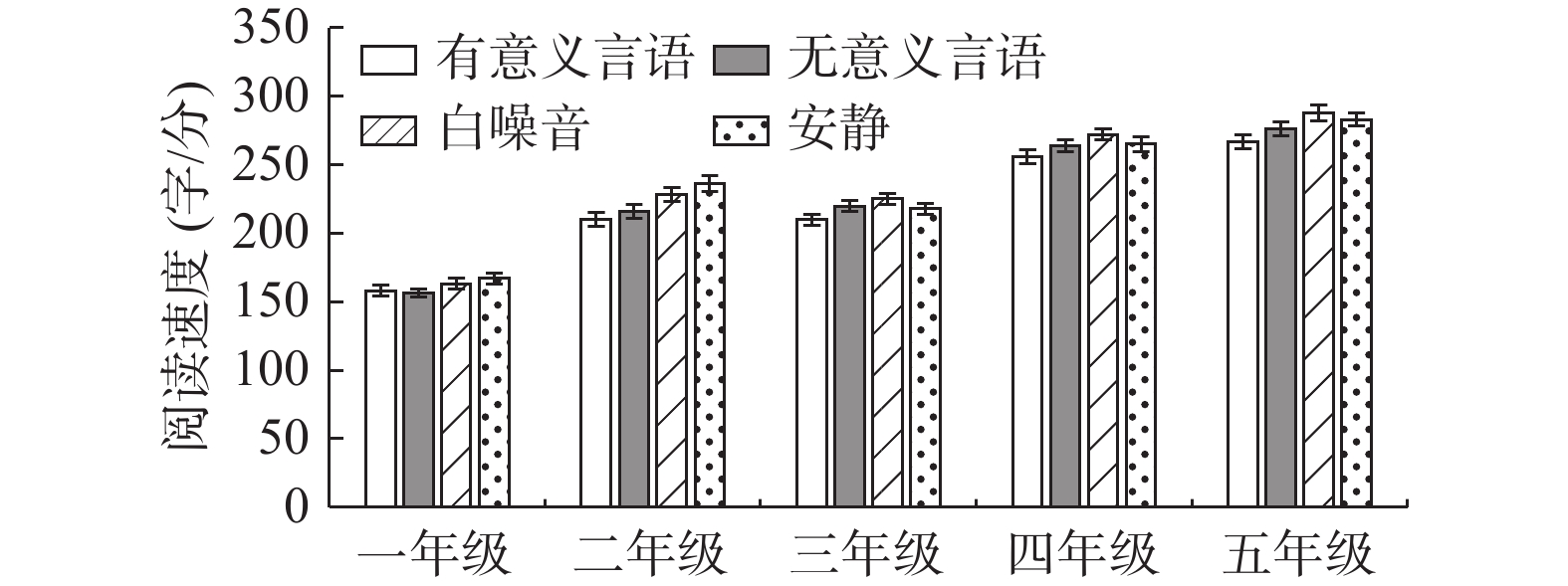
图1 1~5年级小学生在不同背景音下的阅读速度
| 年级 | FFD | GD | TFD | |||||||||||
| 有意义 言语 | 无意义 言语 | 白噪音 | 安静 | 有意义 言语 | 无意义 言语 | 白噪音 | 安静 | 有意义 言语 | 无意义 言语 | 白噪音 | 安静 | |||
| 一 | 311(2) | 311(2) | 310(2) | 311(2) | 366(3) | 372(3) | 375(3) | 368(3) | 584(5) | 556(5) | 558(5) | 561(5) | ||
| 二 | 274(4) | 264(4) | 257(4) | 258(3) | 307(5) | 291(4) | 286(5) | 286(4) | 481(5) | 453(4) | 442(4) | 433(4) | ||
| 三 | 255(4) | 258(3) | 258(4) | 258(3) | 284(4) | 288(4) | 280(4) | 281(4) | 439(4) | 418(4) | 415(4) | 419(4) | ||
| 四 | 251(4) | 247(3) | 244(3) | 249(3) | 269(4) | 266(4) | 263(4) | 267(4) | 401(4) | 390(4) | 374(4) | 387(4) | ||
| 五 | 243(3) | 240(3) | 241(3) | 243(3) | 263(4) | 258(4) | 259(4) | 263(4) | 387(4) | 382(3) | 374(3) | 379(3) | ||
表4 小学生在不同背景音下的词汇加工结果[M(SE)]
| 年级 | FFD | GD | TFD | |||||||||||
| 有意义 言语 | 无意义 言语 | 白噪音 | 安静 | 有意义 言语 | 无意义 言语 | 白噪音 | 安静 | 有意义 言语 | 无意义 言语 | 白噪音 | 安静 | |||
| 一 | 311(2) | 311(2) | 310(2) | 311(2) | 366(3) | 372(3) | 375(3) | 368(3) | 584(5) | 556(5) | 558(5) | 561(5) | ||
| 二 | 274(4) | 264(4) | 257(4) | 258(3) | 307(5) | 291(4) | 286(5) | 286(4) | 481(5) | 453(4) | 442(4) | 433(4) | ||
| 三 | 255(4) | 258(3) | 258(4) | 258(3) | 284(4) | 288(4) | 280(4) | 281(4) | 439(4) | 418(4) | 415(4) | 419(4) | ||
| 四 | 251(4) | 247(3) | 244(3) | 249(3) | 269(4) | 266(4) | 263(4) | 267(4) | 401(4) | 390(4) | 374(4) | 387(4) | ||
| 五 | 243(3) | 240(3) | 241(3) | 243(3) | 263(4) | 258(4) | 259(4) | 263(4) | 387(4) | 382(3) | 374(3) | 379(3) | ||
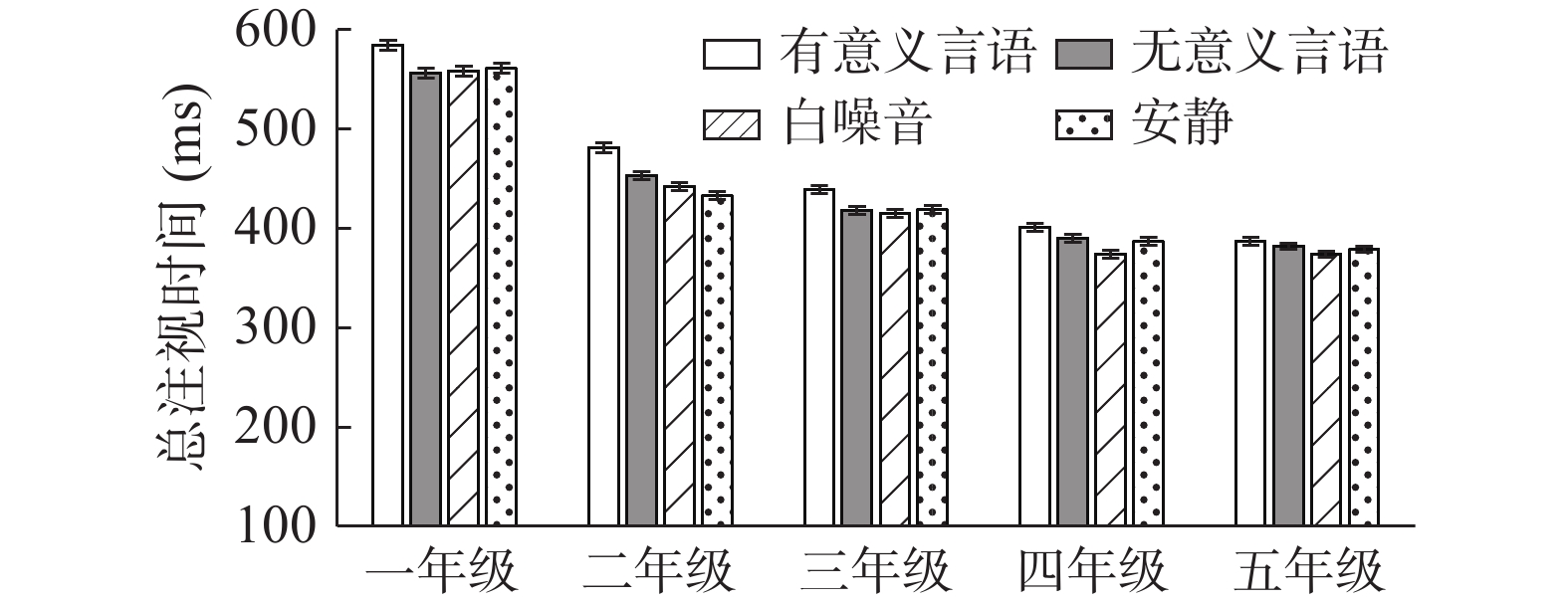
图2 1~5年级小学生在不同背景音条件下的词汇总注视时间
|
何立媛, 田雪, 李悦, 沈凤丹, 王永胜, 吴捷. 无关言语影响老年人阅读过程的眼动研究. 心理与行为研究, 2021, 19 (3): 375- 381.
|
|
|
刘妮娜, 吴舒沁, 闫国利. 小学生难易数学应用题解答过程中的无关背景音效应. 心理科学, 2023, 46 (5): 1098- 1105.
|
|
|
王梦轩, 王璐, 黄有玉, 闫国利. 电视剧对话对小学五年级学生解应用题影响的眼动研究. 天津师范大学学报(基础教育版), 2015, 16 (2): 22- 26.
|
|
|
吴三美, 田良苏, 陈家侨, 陈广耀, 王敬欣. 中文阅读中无关言语效应的认知机制探究: 眼动证据. 心理学报, 2021, 53 (7): 729- 745.
|
|
|
闫国利, 孟珠. 无关言语对阅读的干扰基于内容还是过程?——来自眼动研究的证据. 心理科学, 2018, 41 (1): 2- 7.
DOI |
|
|
闫国利, 熊建萍, 臧传丽, 余莉莉, 崔磊, 白学军. 阅读研究中的主要眼动指标评述. 心理科学进展, 2013, 21 (4): 589- 605.
|
|
|
张苏媛, 兰泽波, 张水, 孟珠, 闫国利. 无关言语对一年级小学生阅读影响的眼动研究. 心理与行为研究, 2021, 19 (4): 433- 438,446.
|
|
|
Baddeley, A. D., & Hitch, G. Working memory. Psychology of Learning and Motivation, 1974, 8, 47- 89.
DOI |
|
|
Bayliss, D. M., Jarrold, C., Gunn, D. M., & Baddeley, A. D. The complexities of complex span: Explaining individual differences in working memory in children and adults. Journal of Experimental Psychology: General, 2003, 132 (1): 71- 92.
DOI |
|
|
Best, J. R., Miller, P. H., & Jones, L. L. Executive functions after age 5: Changes and correlates. Developmental Review, 2009, 29 (3): 180- 200.
DOI |
|
|
Buttelmann, F., & Karbach, J. Development and plasticity of cognitive flexibility in early and middle childhood. Frontiers in Psychology, 2017, 8, 1040.
DOI |
|
|
Cauchard, F., Cane, J. E., & Weger, U. W. Influence of background speech and music in interrupted reading: An eye-tracking study. Applied Cognitive Psychology, 2012, 26 (3): 381- 390.
DOI |
|
|
Colle, H. A., & Welsh, A. Acoustic masking in primary memory. Journal of Verbal Learning and Verbal Behavior, 1976, 15 (1): 17- 31.
DOI |
|
|
Dockrell, J. E., & Shield, B. M. Acoustical barriers in classrooms: The impact of noise on performance in the classroom. British Educational Research Journal, 2006, 32 (3): 509- 525.
DOI |
|
|
Elliott, E. M. The irrelevant-speech effect and children: Theoretical implications of developmental change. Memory & Cognition, 2002, 30 (3): 478- 487.
DOI |
|
|
Elliott, E. M., & Briganti, A. M. Investigating the role of attentional resources in the irrelevant speech effect. Acta Psychologica, 2012, 140 (1): 64- 74.
DOI |
|
|
Elliott, E. M., Hughes, R. W., Briganti, A., Joseph, T. N., Marsh, J. E., & Macken, B. Distraction in verbal short-term memory: Insights from developmental differences. Journal of Memory and Language, 2016, 88, 39- 50.
DOI |
|
|
Gomes, H., Molholm, S., Christodoulou, C., Ritter, W., & Cowan, N. The development of auditory attention in children. Frontiers in Bioscience, 2000, 5 (3): 108- 120.
|
|
|
Guerra, G., Tijms, J., Vaessen, A., Tierney, A., Dick, F., & Bonte, M. (2021). Loudness and intelligibility of irrelevant background speech differentially hinder children’s short story reading. Mind, Brain, and Education, 15(1), 77–87.
|
|
|
Hughes, R. W. Auditory distraction: A duplex-mechanism account. PsyCh Journal, 2014, 3 (1): 30- 41.
DOI |
|
|
Hyönä, J., & Ekholm, M. Background speech effects on sentence processing during reading: An eye movement study. PLoS One, 2016, 11 (3): e0152133.
DOI |
|
|
Jones, D. M., & Macken, W. J. (1993). Irrelevant tones produce an irrelevant speech effect: Implications for phonological coding in working memory. Journal of Experimental Psychology: Learning, Memory, and Cognition, 19(2), 369–381.
|
|
|
Joseph, T. N., Hughes, R. W., Sörqvist, P., & Marsh, J. E. Differences in auditory distraction between adults and children: A duplex-mechanism approach. Journal of Cognition, 2018, 1 (1): 13.
DOI |
|
|
Klatte, M., Lachmann, T., Schlittmeier, S., & Hellbrück, J. The irrelevant sound effect in short-term memory: Is there developmental change?. European Journal of Cognitive Psychology, 2010, 22 (8): 1168- 1191.
DOI |
|
|
Ljung, R., Sörqvist, P., & Hygge, S. Effects of road traffic noise and irrelevant speech on children’s reading and mathematical performance. Noise and Health, 2009, 11 (45): 194- 198.
DOI |
|
|
Marsh, J. E., Hughes, R. W., & Jones, D. M. Interference by process, not content, determines semantic auditory distraction. Cognition, 2009, 110 (1): 23- 38.
DOI |
|
|
Martin, R. C., Wogalter, M. S., & Forlano, J. G. Reading comprehension in the presence of unattended speech and music. Journal of Memory and Language, 1988, 27 (4): 382- 398.
DOI |
|
|
Massonnié, J., Mareschal, D., & Kirkham, N. Z. (2022). Individual differences in dealing with classroom noise disturbances. Mind, Brain, and Education, 16(3), 252–262.
|
|
|
McCormack, T., Brown, G. D. A., Vousden, J. I., & Henson, R. N. A. Children’s serial recall errors: Implications for theories of short-term memory development. Journal of Experimental Child Psychology, 2000, 76 (3): 222- 252.
DOI |
|
|
Meinhardt-Injac, B., Schlittmeier, S., Klatte, M., Otto, A., Persike, M., & Imhof, M. Auditory distraction by meaningless irrelevant speech: A developmental study. Applied Cognitive Psychology, 2015, 29 (2): 217- 225.
DOI |
|
|
Meng, Z., Lan, Z. B., Yan, G., Marsh, J. E., & Liversedge, S. P. (2020). Task demands modulate the effects of speech on text processing. Journal of Experimental Psychology: Learning, Memory, and Cognition, 46(10), 1892–1905.
|
|
|
Oswald, C. J. P., Tremblay, S., & Jones, D. M. Disruption of comprehension by the meaning of irrelevant sound. Memory, 2000, 8 (5): 345- 350.
DOI |
|
|
Perham, N., & Vizard, J. Can preference for background music mediate the irrelevant sound effect?. Applied Cognitive Psychology, 2011, 25 (4): 625- 631.
DOI |
|
|
Salamé, P., & Baddeley, A. Disruption of short-term memory by unattended speech: Implications for the structure of working memory. Journal of Verbal Learning and Verbal Behavior, 1982, 21 (2): 150- 164.
DOI |
|
|
Salamé, P., & Baddeley, A. Noise, unattended speech and short-term memory. Ergonomics, 1987, 30 (8): 1185- 1194.
DOI |
|
|
Schwarz, H., Schlittmeier, S., Otto, A., Persike, M., Klatte, M., Imhof, M., & Meinhardt-Injac, B. Age differences in the irrelevant sound effect: A serial recognition paradigm. Psihologija, 2015, 48 (1): 35- 43.
|
|
|
Simpson, A., & Carroll, D. J. Understanding early inhibitory development: Distinguishing two ways that children use inhibitory control. Child Development, 2019, 90 (5): 1459- 1473.
|
|
|
Tipper, S. P., Bourque, T. A., Anderson, S. H., & Brehaut, J. C. Mechanisms of attention: A developmental study. Journal of Experimental Child Psychology, 1989, 48 (3): 353- 378.
|
|
|
Vasilev, M. R., Liversedge, S. P., Rowan, D., Kirkby, J. A., & Angele, B. Reading is disrupted by intelligible background speech: Evidence from eye-tracking. Journal of Experimental Psychology: Human Perception and Performance, 2019, 45 (11): 1484- 1512.
|
|
|
Yan, G. L., Meng, Z., Liu, N. N., He, L. Y., & Paterson, K. B. Effects of irrelevant background speech on eye movements during reading. Quarterly Journal of Experimental Psychology, 2018, 71 (6): 1270- 1275.
|
|
|
Zang, C. L., Wang, S. S., Guan, Y., Meng, Z., Zhang, M. M., & Liversedge, S. P. Does meaningful background speech modulate predictability effects during Chinese reading?. Journal of Cognitive Psychology, 2025, 37 (6): 616- 629.
|
| [1] | 王娅珂, 张雨轩, 冯琳琳, 卡明芳, 梁菲菲. 小学三到五年级儿童阅读眼动模式的发展及其与阅读理解的关系[J]. 心理与行为研究, 2026, 24(2): 161-169. |
| [2] | 张雪, 路杨, 刘文. 有无代价与不公平方向对4~6岁儿童第三方惩罚的影响[J]. 心理与行为研究, 2026, 24(2): 212-219. |
| [3] | 赵聪, 张镇, 赵怡霖, 金东艳. 父母社会情感能力与儿童社会情感能力:亲子沟通的中介作用和家庭氛围的调节作用[J]. 心理与行为研究, 2026, 24(2): 234-241. |
| [4] | 丁晓茜, 刘华语. 社会排斥影响个体社交行为的双路径机制:消极完美主义与注意偏向的作用[J]. 心理与行为研究, 2026, 24(1): 51-59. |
| [5] | 王怀勇, 徐田田, 叶青. 过程追踪视角下焦虑情绪对延迟选择的影响及机制:任务框架的调节作用[J]. 心理与行为研究, 2026, 24(1): 122-129. |
| [6] | 王旭瑛, 邵杨, 阴晓娟, 金晓康, 金花. 恐惧诉求下希望类健康错误信息的更正:来自行为和眼动的证据[J]. 心理与行为研究, 2025, 23(6): 813-821. |
| [7] | 高璇, 王瑞, 李雨桐, 隋雪. 儿童情绪识别能力的发展:基于言语与面孔启动的研究[J]. 心理与行为研究, 2025, 23(5): 612-619. |
| [8] | 李文静, 孙雯, 朱海迪. 流行背景音乐对休闲阅读的影响:来自眼动的证据[J]. 心理与行为研究, 2025, 23(4): 448-455. |
| [9] | 袁悦, 张航, 陈亚楠, 李巧灵. 3~6岁儿童执行功能子成分与情绪理解的关系:一项交叉滞后分析[J]. 心理与行为研究, 2025, 23(4): 472-478. |
| [10] | 钞淼, 张宇, 谢启慧, 刘拓. 情感忽视对农村青少年短视频成瘾的纵向影响:负性情绪中介及留守差异[J]. 心理与行为研究, 2025, 23(3): 361-368. |
| [11] | 于棋, 巫金根, 吴俊杰, 闫国利. 儿童汉字书写习得年龄效应:来自抄写和听写的证据[J]. 心理与行为研究, 2025, 23(2): 145-152. |
| [12] | 杜宇菲, 张志超, 张慢慢, 臧传丽. 语义优先于世界知识参与句子理解过程:来自眼动的证据[J]. 心理与行为研究, 2025, 23(2): 153-160. |
| [13] | 包金金, 丁芳, 左晓扬. 小学儿童互动公平认知能力的发展及其对社会善念的影响[J]. 心理与行为研究, 2025, 23(2): 177-184. |
| [14] | 程黎, 陈啸宇, 刘玉娟. 教师支持、同伴支持、心理韧性与情绪智力的关系:超常与常态儿童的比较[J]. 心理与行为研究, 2025, 23(2): 185-192. |
| [15] | 王永丽, 曾盼盼, 李玉华. 面向儿童青少年的心理健康服务现状和启示—基于对美国、芬兰等12国经验的文献分析[J]. 心理与行为研究, 2025, 23(2): 226-232. |
| 阅读次数 | ||||||
|
全文 |
|
|||||
|
摘要 |
|
|||||
