
心理与行为研究 ›› 2026, Vol. 24 ›› Issue (3): 410-417.DOI: 10.12139/j.1672-0628.2026.03.016
孟鸿兴1,2, 王晓庄3, 马红宇*,1,2,4( )
)
收稿日期:2024-11-25
出版日期:2026-05-20
发布日期:2026-05-20
通讯作者:
马红宇
基金资助:
Hongxing MENG1,2, Xiaozhuang WANG3, Hongyu MA*,1,2,4()
Received:2024-11-25
Online:2026-05-20
Published:2026-05-20
Contact:
Hongyu MA
摘要:
年长员工的个体心理因素及其感知组织因素均对退休后继续工作动机产生影响,然而这些因素协同作用的模式尚不明确。本研究采用模糊集定性比较分析法探索年长员工退休后继续工作动机的前因条件组合与多元提升模式。对789名年长员工进行调查,结果显示:存在三种组态提升年长员工产生高退休后继续工作动机,分别是个体强−组织强提升模式、组织强−个体中提升模式、个体强−组织中提升模式。研究识别出年长员工退休后继续工作动机的多条前因组态路径,从而为有效干预和促进年长员工退休后继续工作动机提供新的思路。
中图分类号:
孟鸿兴, 王晓庄, 马红宇. 年长员工退休后继续工作动机的前因组态研究:基于模糊集定性比较分析方法[J]. 心理与行为研究, 2026, 24(3): 410-417.
Hongxing MENG, Xiaozhuang WANG, Hongyu MA. A Study on the Antecedents of Older Workers’ Motivation to Continue Working Beyond Retirement: Based on Fuzzy-Set Qualitative Comparative Analysis Method[J]. Studies of Psychology and Behavior, 2026, 24(3): 410-417.
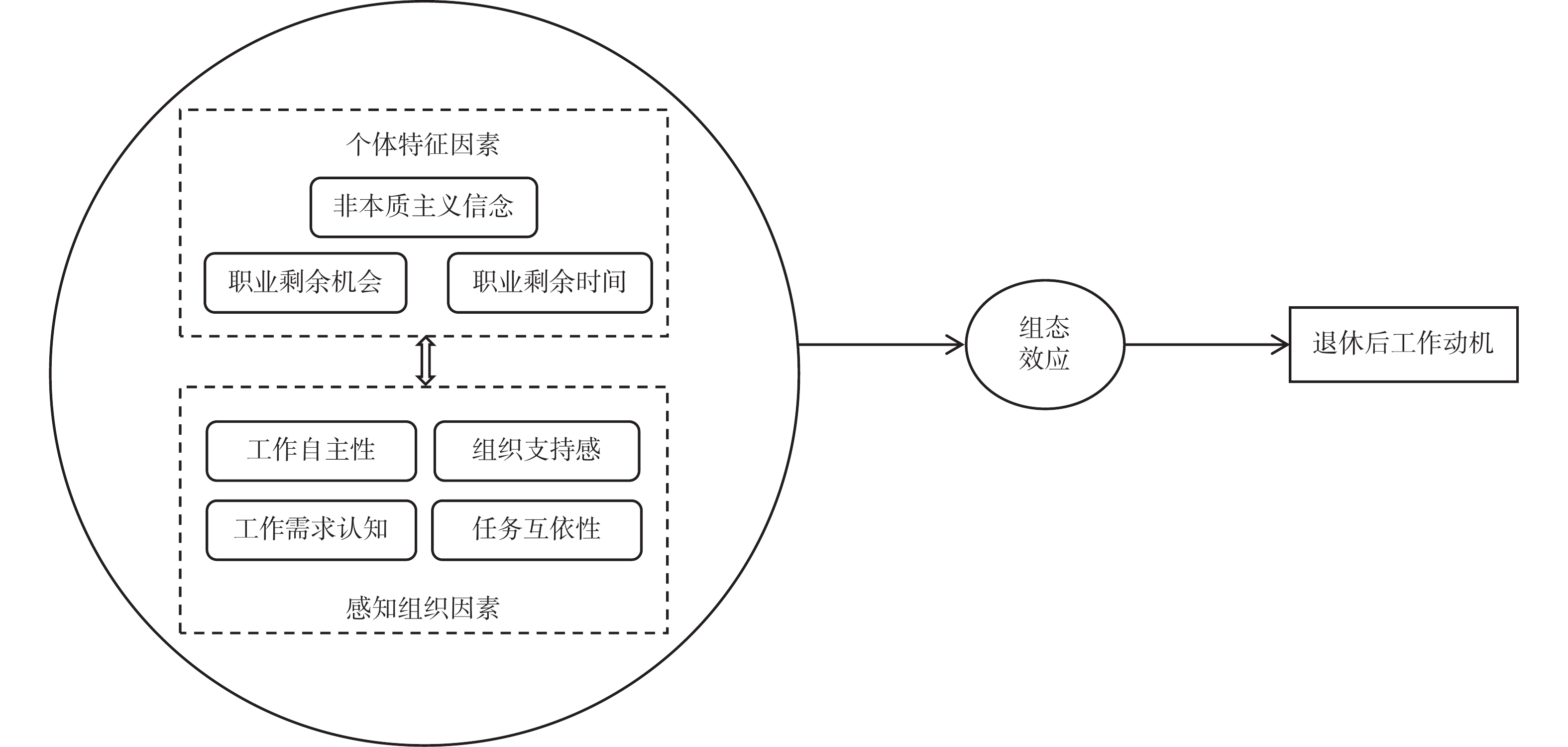
图1 组态模型图
| M±SD | 1 | 2 | 3 | 4 | 5 | 6 | 7 | |
| 1.职业未来剩余机会 | 3.98±1.53 | |||||||
| 2.职业未来剩余时间 | 3.36±1.45 | 0.77*** | ||||||
| 3.非本质主义信念 | 4.22±1.50 | 0.58*** | 0.56*** | |||||
| 4.工作自主性 | 3.68±0.93 | 0.49*** | 0.44*** | 0.45*** | ||||
| 5.任务互依性 | 3.14±0.92 | 0.41*** | 0.35*** | 0.36*** | 0.43*** | |||
| 6.工作需求认知 | 3.30±0.91 | 0.37*** | 0.33*** | 0.29*** | 0.35*** | 0.53*** | ||
| 7.组织支持感 | 4.20±1.55 | 0.59*** | 0.53*** | 0.46*** | 0.54*** | 0.43*** | 0.38*** | |
| 8.退休后继续工作动机 | 3.64±1.20 | 0.40*** | 0.32*** | 0.38*** | 0.41*** | 0.23*** | 0.22*** | 0.36*** |
表1 各变量的描述性统计与相关分析结果(n=789)
| M±SD | 1 | 2 | 3 | 4 | 5 | 6 | 7 | |
| 1.职业未来剩余机会 | 3.98±1.53 | |||||||
| 2.职业未来剩余时间 | 3.36±1.45 | 0.77*** | ||||||
| 3.非本质主义信念 | 4.22±1.50 | 0.58*** | 0.56*** | |||||
| 4.工作自主性 | 3.68±0.93 | 0.49*** | 0.44*** | 0.45*** | ||||
| 5.任务互依性 | 3.14±0.92 | 0.41*** | 0.35*** | 0.36*** | 0.43*** | |||
| 6.工作需求认知 | 3.30±0.91 | 0.37*** | 0.33*** | 0.29*** | 0.35*** | 0.53*** | ||
| 7.组织支持感 | 4.20±1.55 | 0.59*** | 0.53*** | 0.46*** | 0.54*** | 0.43*** | 0.38*** | |
| 8.退休后继续工作动机 | 3.64±1.20 | 0.40*** | 0.32*** | 0.38*** | 0.41*** | 0.23*** | 0.22*** | 0.36*** |
| 变量 | 锚点 | ||
| 完全隶属 | 交叉点 | 完全不隶属 | |
| 职业未来剩余机会 | 5.51 | 3.98 | 2.45 |
| 职业未来剩余时间 | 4.81 | 3.36 | 1.91 |
| 非本质主义信念 | 5.73 | 4.22 | 2.72 |
| 工作自主性 | 4.61 | 3.68 | 2.75 |
| 任务互依性 | 4.07 | 3.14 | 2.22 |
| 工作需求认知 | 4.21 | 3.30 | 2.39 |
| 组织支持感 | 5.75 | 4.20 | 2.64 |
| 退休后继续工作动机 | 4.84 | 3.64 | 2.43 |
表2 各变量锚定点(n=789)
| 变量 | 锚点 | ||
| 完全隶属 | 交叉点 | 完全不隶属 | |
| 职业未来剩余机会 | 5.51 | 3.98 | 2.45 |
| 职业未来剩余时间 | 4.81 | 3.36 | 1.91 |
| 非本质主义信念 | 5.73 | 4.22 | 2.72 |
| 工作自主性 | 4.61 | 3.68 | 2.75 |
| 任务互依性 | 4.07 | 3.14 | 2.22 |
| 工作需求认知 | 4.21 | 3.30 | 2.39 |
| 组织支持感 | 5.75 | 4.20 | 2.64 |
| 退休后继续工作动机 | 4.84 | 3.64 | 2.43 |
| 前因条件 | 高退休后继续工作动机 | |
| 一致性 | 覆盖率 | |
| 职业未来剩余机会 | 0.71 | 0.64 |
| ~职业未来剩余机会 | 0.47 | 0.43 |
| 职业未来剩余时间 | 0.69 | 0.61 |
| ~职业未来剩余时间 | 0.50 | 0.45 |
| 非本质主义信念 | 0.71 | 0.65 |
| ~非本质主义信念 | 0.48 | 0.43 |
| 工作自主性 | 0.71 | 0.68 |
| ~工作自主性 | 0.50 | 0.43 |
| 任务互依性 | 0.66 | 0.60 |
| ~任务互依性 | 0.53 | 0.47 |
| 工作需求认知 | 0.65 | 0.61 |
| ~工作需求认知 | 0.55 | 0.47 |
| 组织支持感 | 0.69 | 0.65 |
| ~组织支持感 | 0.50 | 0.44 |
表3 必要条件分析结果
| 前因条件 | 高退休后继续工作动机 | |
| 一致性 | 覆盖率 | |
| 职业未来剩余机会 | 0.71 | 0.64 |
| ~职业未来剩余机会 | 0.47 | 0.43 |
| 职业未来剩余时间 | 0.69 | 0.61 |
| ~职业未来剩余时间 | 0.50 | 0.45 |
| 非本质主义信念 | 0.71 | 0.65 |
| ~非本质主义信念 | 0.48 | 0.43 |
| 工作自主性 | 0.71 | 0.68 |
| ~工作自主性 | 0.50 | 0.43 |
| 任务互依性 | 0.66 | 0.60 |
| ~任务互依性 | 0.53 | 0.47 |
| 工作需求认知 | 0.65 | 0.61 |
| ~工作需求认知 | 0.55 | 0.47 |
| 组织支持感 | 0.69 | 0.65 |
| ~组织支持感 | 0.50 | 0.44 |
| 前因条件 | 高退休后继续工作动机 | 低退休后继续工作动机 | ||||
| R1 | R2 | R3 | NR1 | NR2 | ||
| 非本质主义信念 | ● | ● | ● |  |  | |
| 职业未来剩余机会 | ● | • | ● |  |  | |
| 职业未来剩余时间 | • | • |  |  | ||
| 工作自主性 | ● | ● | • |  |  | |
| 任务互依性 |  | • |  | |||
| 工作需求认知 |  | • |  |  | ||
| 组织支持感 | ● | ● | • |  |  | |
| 一致性 | 0.88 | 0.88 | 0.90 | 0.89 | 0.89 | |
| 原始覆盖度 | 0.23 | 0.22 | 0.18 | 0.34 | 0.35 | |
| 唯一覆盖度 | 0.05 | 0.03 | 0.05 | 0.02 | 0.03 | |
| 总体一致性 | 0.86 | 0.89 | ||||
| 总体覆盖度 | 0.33 | 0.37 | ||||
表4 年长员工退休后继续工作动机前因条件组态
| 前因条件 | 高退休后继续工作动机 | 低退休后继续工作动机 | ||||
| R1 | R2 | R3 | NR1 | NR2 | ||
| 非本质主义信念 | ● | ● | ● | | | |
| 职业未来剩余机会 | ● | • | ● | | | |
| 职业未来剩余时间 | • | • | | | ||
| 工作自主性 | ● | ● | • | | | |
| 任务互依性 | | • | | |||
| 工作需求认知 | | • | | | ||
| 组织支持感 | ● | ● | • | | | |
| 一致性 | 0.88 | 0.88 | 0.90 | 0.89 | 0.89 | |
| 原始覆盖度 | 0.23 | 0.22 | 0.18 | 0.34 | 0.35 | |
| 唯一覆盖度 | 0.05 | 0.03 | 0.05 | 0.02 | 0.03 | |
| 总体一致性 | 0.86 | 0.89 | ||||
| 总体覆盖度 | 0.33 | 0.37 | ||||
|
陈耘, 陈祝慧, 赵富强, 刘晰. 身未老, 心先衰? 老龄化本质主义信念影响工作倦怠的作用机制研究. 中国人力资源开发, 2023, 40 (3): 24- 36.
|
|
|
冯立杰, 李燕燕, 王金凤, 张珂, 刘鹏. 组态视角下后发企业颠覆式创新驱动模式研究. 科技进步与对策, 2024, 41 (10): 89- 98.
|
|
|
贾汇源, 李林懋, 李慕轼, 王海侠. 老当益壮: 职业未来时间洞察力对职场成功老龄化的影响. 中国人力资源开发, 2023, 40 (2): 38- 51.
|
|
|
李丽源, 高祥宇, 郑晓明. 员工积极主动行为的组态效应: 基于过程的视角. 心理学报, 2023, 55 (5): 792- 811.
|
|
|
李强, 郭雯羽. 上海老年人力资源开发的现状、困境及对策研究. 华东师范大学学报(哲学社会科学版), 2024, 56 (3): 150- 163.
DOI |
|
|
清华大学社会科学学院. (2016). 中国劳动力市场技能缺口研究. 2024-11-25取自https://www.soc.tsinghua.edu.cn/__local/4/E6/DA/A12EB75B9D564353167D4F107C5_D711D7DB_79EC7D.pdf
|
|
|
王晓庄, 孟鸿兴, 李洪玉. 年长员工退休后继续工作动机的影响因素及群体间比较: 基于网络分析法. 中国人力资源开发, 2023, 40 (8): 37- 53.
DOI |
|
|
王振源, 陈阳, 陈柳旭. 年龄刻板印象威胁对年长员工工作投入的影响: 一个有调节的中介模型. 预测, 2021, 40 (4): 60- 66.
DOI |
|
|
张明, 杜运周. 组织与管理研究中QCA方法的应用: 定位、策略和方向. 管理学报, 2019, 16 (9): 1312- 1323.
|
|
|
张奇林, 周艺梦. 中国城镇低龄退休老年人工作与幸福感的关系. 心理学报, 2017, 49 (4): 472- 481.
|
|
|
Ackerman, P. L., & Kanfer, R. Work in the 21st century: New directions for aging and adult development. American Psychologist, 2020, 75 (4): 486- 498.
DOI |
|
|
Audenaert, M., George, B., Bauwens, R., Decuypere, A., Descamps, A. M., Muylaert, J., ... Decramer, A. Empowering leadership, social support, and job crafting in public organizations: A multilevel study. Public Personnel Management, 2020, 49 (3): 367- 392.
DOI |
|
|
Bal, P. M., De Jong, S. B., Jansen, P. G. W., & Bakker, A. B. Motivating employees to work beyond retirement: A multi-level study of the role of I-deals and unit climate. Journal of Management Studies, 2012, 49 (2): 306- 331.
DOI |
|
|
Burmeister, A., van Der Heijden, B., Yang, J., & Deller, J. Knowledge transfer in age-diverse coworker dyads in China and Germany: How and when do age-inclusive human resource practices have an effect?. Human Resource Management Journal, 2018, 28 (4): 605- 620.
DOI |
|
|
Carstensen, L. L., Isaacowitz, D. M., & Charles, S. T. Taking time seriously: A theory of socioemotional selectivity. American Psychologist, 1999, 54 (3): 165- 181.
DOI |
|
|
Chen, M. K. L., & Gardiner, E. Supporting older workers to work: A systematic review. Personnel Review, 2019, 48 (5): 1318- 1335.
DOI |
|
|
Edwards, J. R., & Cooper, C. L. The person-environment fit approach to stress: Recurring problems and some suggested solutions. Journal of Organizational Behavior, 1990, 11 (4): 293- 307.
DOI |
|
|
Eisenberger, R., Armeli, S., Rexwinkel, B., Lynch, P. D., & Rhoades, L. Reciprocation of perceived organizational support. Journal of Applied Psychology, 2001, 86 (1): 42- 51.
DOI |
|
|
Eppler-Hattab, R., Meshoulam, I., & Doron, I. Conceptualizing age-friendliness in workplaces: Proposing a new multidimensional model. The Gerontologist, 2020, 60 (1): 12- 21.
DOI |
|
|
Fiss, P. C. Building better causal theories: A fuzzy set approach to typologies in organization research. Academy of Management Journal, 2011, 54 (2): 393- 420.
DOI |
|
|
Garcia, P. R. J. M., Amarnani, R. K., Bordia, P., & Restubog, S. L. D. When support is unwanted: The role of psychological contract type and perceived organizational support in predicting bridge employment intentions. Journal of Vocational Behavior, 2021, 125, 103525.
DOI |
|
|
Gupta, K., Crilly, D., & Greckhamer, T. Stakeholder engagement strategies, national institutions, and firm performance: A configurational perspective. Strategic Management Journal, 2020, 41 (10): 1869- 1900.
DOI |
|
|
Heckhausen, J., Shane, J., & Kanfer, R. (2017). Competence and motivation at work throughout adulthood: Making the most of changing capacities and opportunities. In A. J. Elliot, C. S. Dweck, & D. S. Yeager (Eds.), Handbook of competence and motivation: Theory and application (2nd ed., pp. 449–470). New York: The Guilford Press.
|
|
|
Heckhausen, J., Wrosch, C., & Schulz, R. A motivational theory of life-span development. Psychological Review, 2010, 117 (1): 32- 60.
DOI |
|
|
Jokisaari, M., Ruokolainen, M., & Vuori, J. The moderating role of social capital for late-career management intervention effects on older employees’ work engagement. Human Resource Management, 2024, 63 (3): 463- 476.
DOI |
|
|
Kanfer, R., Beier, M. E., & Ackerman, P. L. Goals and motivation related to work in later adulthood: An organizing framework. European Journal of Work and Organizational Psychology, 2013, 22 (3): 253- 264.
DOI |
|
|
Kooij, D. T. A. M., De Lange, A. H., & van De Voorde, K. Stimulating job crafting behaviors of older workers: The influence of opportunity-enhancing human resource practices and psychological empowerment. European Journal of Work and Organizational Psychology, 2022, 31 (1): 22- 34.
DOI |
|
|
Kulik, C. T., Perera, S., Cregan, C. Engage me: The mature-age worker and stereotype threat. Academy of Management Journal, 2016, 59 (6): 2132- 2156.
DOI |
|
|
Livanos, I., & Nuñez, I. Early exit or longer stay? The effect of precarious employment on planned age of retirement. Personnel Review, 2017, 46 (8): 1571- 1589.
DOI |
|
|
Marques, T., E Sousa, I. C., & Ramos, S. Engaging age-diverse workers with autonomy and feedback: The role of task variety. Journal of Managerial Psychology, 2023, 38 (3): 210- 224.
DOI |
|
|
Morgeson, F. P., & Humphrey, S. E. The Work Design Questionnaire (WDQ): Developing and validating a comprehensive measure for assessing job design and the nature of work. Journal of Applied Psychology, 2006, 91 (6): 1321- 1339.
DOI |
|
|
Ng, T. W. H., & Feldman, D. C. Evaluating six common stereotypes about older workers with meta-analytical data. Personnel Psychology, 2012, 65 (4): 821- 858.
DOI |
|
|
Podsakoff, P. M., MacKenzie, S. B., Lee, J. Y., & Podsakoff, N. P. Common method biases in behavioral research: A critical review of the literature and recommended remedies. Journal of Applied Psychology, 2003, 88 (5): 879- 903.
DOI |
|
|
Ragin, C. C., & Pennings, P. Fuzzy sets and social research. Sociological Methods and Research, 2005, 33 (4): 423- 430.
DOI |
|
|
Rudolph, C. W., Kooij, D. T. A. M., Rauvola, R. S., & Zacher, H. Occupational future time perspective: A meta analysis of antecedents and outcomes. Journal of Organizational Behavior, 2018, 39 (2): 229- 248.
DOI |
|
|
Schneider, C. Q., & Wagemann, C. (2012). Set-theoretic methods for the social sciences: A guide to qualitative comparative analysis. Cambridge, United Kingdom: Cambridge University Press.
|
|
|
Taylor, M. A., & Bisson, J. B. Changes in cognitive function: Practical and theoretical considerations for training the aging workforce. Human Resource Management Review, 2020, 30 (2): 100684.
DOI |
|
|
Vanajan, A., Bültmann, U., & Henkens, K. Health-related work limitations among older workers—The role of flexible work arrangements and organizational climate. The Gerontologist, 2020a, 60 (3): 450- 459.
DOI |
|
|
Vanajan, A., Bültmann, U., & Henkens, K. Why do older workers with chronic health conditions prefer to retire early?. Age and Ageing, 2020b, 49 (3): 403- 410.
DOI |
|
|
van Vianen, A. E. M. Person-environment fit: A review of its basic tenets. Annual Review of Organizational Psychology and Organizational Behavior, 2018, 5, 75- 101.
DOI |
|
|
Weiss, D. On the inevitability of aging: Essentialist beliefs moderate the impact of negative age stereotypes on older adults’ memory performance and physiological reactivity. The Journals of Gerontology: Series B, 2018, 73 (6): 925- 933.
DOI |
|
|
Weiss, D., Job, V., Mathias, M., Grah, S., & Freund, A. M. The end is (not) near: Aging, essentialism, and future time perspective. Developmental Psychology, 2016, 52 (6): 996- 1009.
DOI |
|
|
Zacher, H., & Frese, M. Remaining time and opportunities at work: Relationships between age, work characteristics, and occupational future time perspective. Psychology and Aging, 2009, 24 (2): 487- 493.
DOI |
| [1] | 翟宏堃, 周详, 付江洪, 李坤钊, 崔虞馨, 魏晓薇. 面向数智时代的新素养:人智协同创新素养的结构与测量[J]. 心理与行为研究, 2026, 24(3): 375-383. |
| [2] | 杜雪娇, 孟子凡, 李瑶, 王楚雯, 董颖红. 教学代理语言风格及AI生成方式对不同认知风格小学生视频学习的影响[J]. 心理与行为研究, 2026, 24(3): 384-392. |
| [3] | 盖笑松, 刘本扬, 邸楠. 人工智能技术在青少年未来取向评分中的适用性[J]. 心理与行为研究, 2026, 24(3): 393-400. |
| [4] | 杨海波, 李奕康, 郭雅雯, 刘冰洁. 不同网络游戏成瘾程度青少年对游戏信息注意偏向的差异[J]. 心理与行为研究, 2026, 24(3): 401-409. |
| [5] | 刘路培, 秦刚, 冯才华. 生命意义感与大学生抑郁的关系:反刍思维和自尊的链式中介作用[J]. 心理与行为研究, 2026, 24(3): 418-424. |
| [6] | 高永金, 钱璟烨, 高结, 马晓琳, 蒋珊珊. 高中生综合幸福感量表的编制[J]. 心理与行为研究, 2026, 24(3): 425-432. |
| [7] | 白博仁, 周详, 张婧婧, 崔虞馨. 人工智能自恋提升人机合作创新意愿及其机制[J]. 心理与行为研究, 2024, 22(1): 137-144. |
| [8] | 支慧晶, 刘阳. 竞走裁判员在多人情景下判罚决策的视觉搜索特征[J]. 心理与行为研究, 2024, 22(1): 130-136. |
| [9] | 张耀华, 徐敏, 黄云云, 辛素飞. 心理韧性缓冲压力生活事件与青少年学业倦怠之间的非线性关系[J]. 心理与行为研究, 2024, 22(1): 123-129. |
| [10] | 史滋福, 陈火红, 张艺瀚, 管锦亮, 夏笔奇, 靳紫阳. 父母直升机教养对大学生主观幸福感的影响:自我控制和抑郁的链式中介作用[J]. 心理与行为研究, 2024, 22(1): 116-122. |
| [11] | 王兴超, 田芳芳. 儿童期虐待与欺负行为:青少年道德推脱与父亲道德推脱的作用[J]. 心理与行为研究, 2024, 22(1): 108-115. |
| [12] | 韩迎春, 王琳萱. 有氧运动、情绪与创造力:流体智力的调节作用[J]. 心理与行为研究, 2024, 22(1): 100-107. |
| [13] | 林祟德. “教育家精神”也是中国心理学家精神之追求[J]. 心理与行为研究, 2023, 21(6): 721-724. |
| [14] | 张克, 杜秀敏, 李立言, 张雪寒, 赵海霞. 酸味与创造力的关系研究[J]. 心理与行为研究, 2023, 21(6): 815-823. |
| [15] | 闫景蕾, 傅苗苗, 黄贝, 连帅磊. 问题性社交媒介使用与主观幸福感的关系:技术冲突和疲惫感的链式中介作用[J]. 心理与行为研究, 2023, 21(6): 824-831. |
| 阅读次数 | ||||||
|
全文 |
|
|||||
|
摘要 |
|
|||||
