
心理与行为研究 ›› 2026, Vol. 24 ›› Issue (4): 500-508.DOI: 10.12139/j.1672-0628.2026.04.009
张驰1,2, 杨嘉翌3, 万琨4, 邓林园*,3( )
)
收稿日期:2026-01-24
出版日期:2026-07-20
发布日期:2026-07-21
通讯作者:
邓林园
基金资助:
Chi ZHANG1,2, Jiayi YANG3, Kun WAN4, Linyuan DENG*,3()
Received:2026-01-24
Online:2026-07-20
Published:2026-07-21
Contact:
Linyuan DENG
摘要:
本研究考察工作家庭冲突与中小学生母亲养育倦怠的关系,探讨教育焦虑的中介作用与核心自我评价的调节作用。采用工作−家庭冲突量表的工作指向家庭冲突分量表、养育倦怠评估量表、中小学生家长教育焦虑量表、核心自我评价量表对来自重庆、贵州、河南等地2157名中小学生的母亲进行调查。结果发现:(1)母亲的工作家庭冲突显著正向预测养育倦怠水平;(2)母亲的教育焦虑部分中介了其工作家庭冲突对养育倦怠的影响;(3)核心自我评价在模型的直接路径和中介过程的后半路径中起调节作用,核心自我评价缓冲了工作家庭冲突和教育焦虑对养育倦怠的影响。结果表明,缓解中小学生母亲的工作家庭冲突和教育焦虑、提升其核心自我评价水平可减轻其养育倦怠。
中图分类号:
张驰, 杨嘉翌, 万琨, 邓林园. 工作家庭冲突与中小学生母亲养育倦怠的关系:教育焦虑与核心自我评价的作用[J]. 心理与行为研究, 2026, 24(4): 500-508.
Chi ZHANG, Jiayi YANG, Kun WAN, Linyuan DENG. Work-to-Family Conflict and Parental Burnout Among Mothers of Primary and Secondary School Students: The Role of Educational Anxiety and Core Self-Evaluation[J]. Studies of Psychology and Behavior, 2026, 24(4): 500-508.
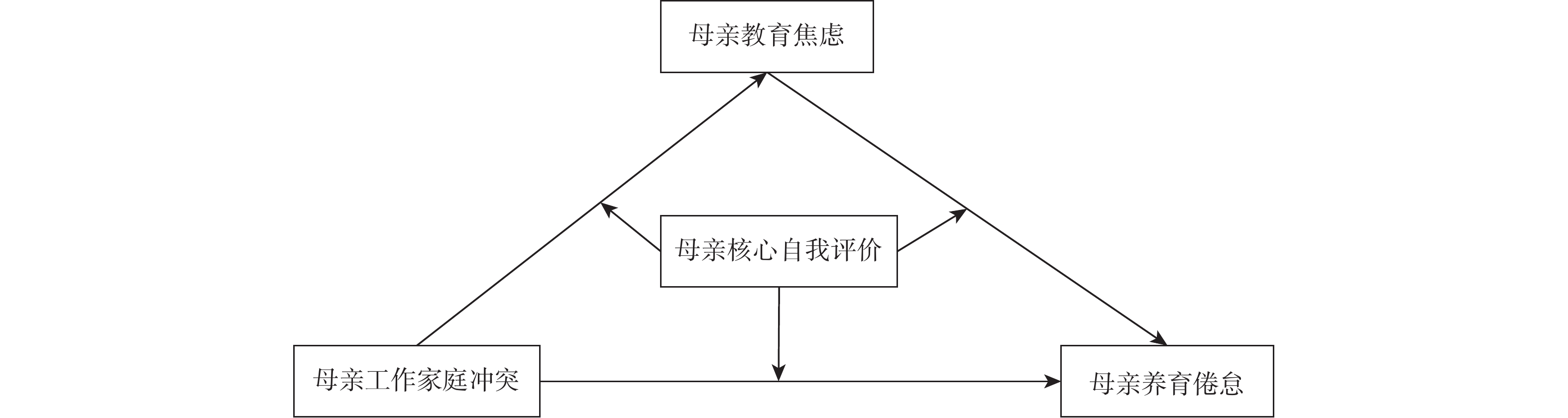
图1 假设模型
| M | SD | 1 | 2 | 3 | 4 | 5 | 6 | |
| 1.工作家庭冲突 | 2.93 | 0.94 | ||||||
| 2.学业表现焦虑 | 3.28 | 0.79 | 0.37*** | |||||
| 3.竞争环境焦虑 | 2.57 | 0.89 | 0.38*** | 0.63*** | ||||
| 4.教育效能焦虑 | 3.31 | 0.90 | 0.37*** | 0.45*** | 0.39*** | |||
| 5.教育焦虑总分 | 3.11 | 0.71 | 0.44*** | 0.94*** | 0.81*** | 0.64*** | ||
| 6.养育倦怠 | 2.35 | 1.50 | 0.43*** | 0.39*** | 0.49*** | 0.29*** | 0.47*** | |
| 7.核心自我评价 | 3.52 | 0.60 | −0.39*** | −0.36*** | −0.33*** | −0.38*** | −0.42*** | −0.41*** |
表1 各变量描述统计及相关分析
| M | SD | 1 | 2 | 3 | 4 | 5 | 6 | |
| 1.工作家庭冲突 | 2.93 | 0.94 | ||||||
| 2.学业表现焦虑 | 3.28 | 0.79 | 0.37*** | |||||
| 3.竞争环境焦虑 | 2.57 | 0.89 | 0.38*** | 0.63*** | ||||
| 4.教育效能焦虑 | 3.31 | 0.90 | 0.37*** | 0.45*** | 0.39*** | |||
| 5.教育焦虑总分 | 3.11 | 0.71 | 0.44*** | 0.94*** | 0.81*** | 0.64*** | ||
| 6.养育倦怠 | 2.35 | 1.50 | 0.43*** | 0.39*** | 0.49*** | 0.29*** | 0.47*** | |
| 7.核心自我评价 | 3.52 | 0.60 | −0.39*** | −0.36*** | −0.33*** | −0.38*** | −0.42*** | −0.41*** |
| 效应 | 效应值 | 标准误 | 95%置信区间 | 效应量占比(%) | |
| 下限 | 上限 | ||||
| 工作家庭冲突对母亲养育倦怠的总效应 | 0.40*** | 0.02 | 0.36 | 0.44 | |
| 工作家庭冲突对母亲养育倦怠的直接效应 | 0.20*** | 0.02 | 0.16 | 0.24 | 49.75 |
| 教育焦虑的中介效应 | 0.20*** | 0.02 | 0.17 | 0.23 | 50.25 |
表2 中介效应分析和Bootstrap检验结果
| 效应 | 效应值 | 标准误 | 95%置信区间 | 效应量占比(%) | |
| 下限 | 上限 | ||||
| 工作家庭冲突对母亲养育倦怠的总效应 | 0.40*** | 0.02 | 0.36 | 0.44 | |
| 工作家庭冲突对母亲养育倦怠的直接效应 | 0.20*** | 0.02 | 0.16 | 0.24 | 49.75 |
| 教育焦虑的中介效应 | 0.20*** | 0.02 | 0.17 | 0.23 | 50.25 |
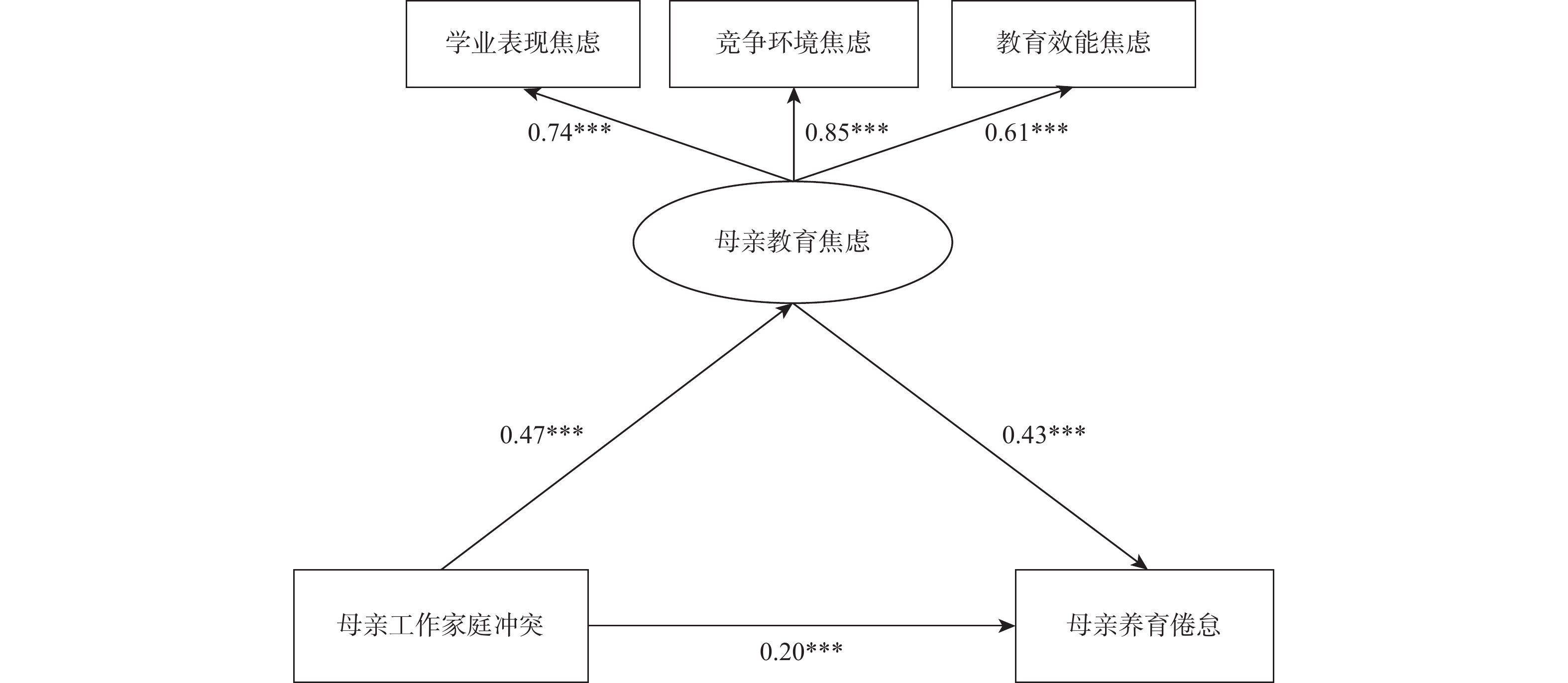
图2 教育焦虑在工作家庭冲突与母亲养育倦怠之间的中介作用模型 注:母亲学历、年龄段、子女数量、子女学段、地域和居住地类型为控制变量;图中所有参数估计值均为标准化结果,以下同。
| 结果变量 | 预测变量 | β | SE | 95%置信区间 |
| 教育焦虑 | 工作家庭冲突 | 0.32*** | 0.03 | [0.28, 0.37] |
| 核心自我评价 | −0.30*** | 0.02 | [−0.34, −0.25] | |
| 核心自我评价×工作家庭冲突 | 0.01 | 0.02 | [−0.03, 0.05] | |
| 养育倦怠 | 工作家庭冲突 | 0.23*** | 0.02 | [0.19, 0.28] |
| 教育焦虑 | 0.29*** | 0.02 | [0.24, 0.33] | |
| 核心自我评价 | −0.19*** | 0.02 | [−0.23, −0.15] | |
| 核心自我评价×工作家庭冲突 | −0.07*** | 0.02 | [−0.11, −0.03] | |
| 核心自我评价×教育焦虑 | −0.07*** | 0.02 | [−0.11, −0.03] |
表3 有调节的中介效应检验
| 结果变量 | 预测变量 | β | SE | 95%置信区间 |
| 教育焦虑 | 工作家庭冲突 | 0.32*** | 0.03 | [0.28, 0.37] |
| 核心自我评价 | −0.30*** | 0.02 | [−0.34, −0.25] | |
| 核心自我评价×工作家庭冲突 | 0.01 | 0.02 | [−0.03, 0.05] | |
| 养育倦怠 | 工作家庭冲突 | 0.23*** | 0.02 | [0.19, 0.28] |
| 教育焦虑 | 0.29*** | 0.02 | [0.24, 0.33] | |
| 核心自我评价 | −0.19*** | 0.02 | [−0.23, −0.15] | |
| 核心自我评价×工作家庭冲突 | −0.07*** | 0.02 | [−0.11, −0.03] | |
| 核心自我评价×教育焦虑 | −0.07*** | 0.02 | [−0.11, −0.03] |
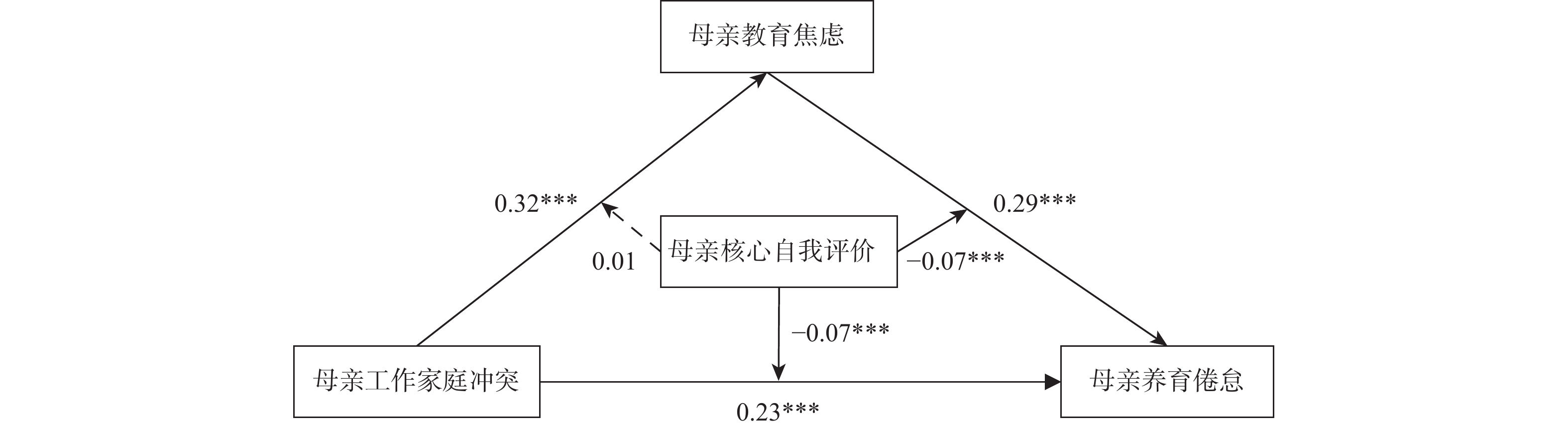
图3 有调节的中介模型
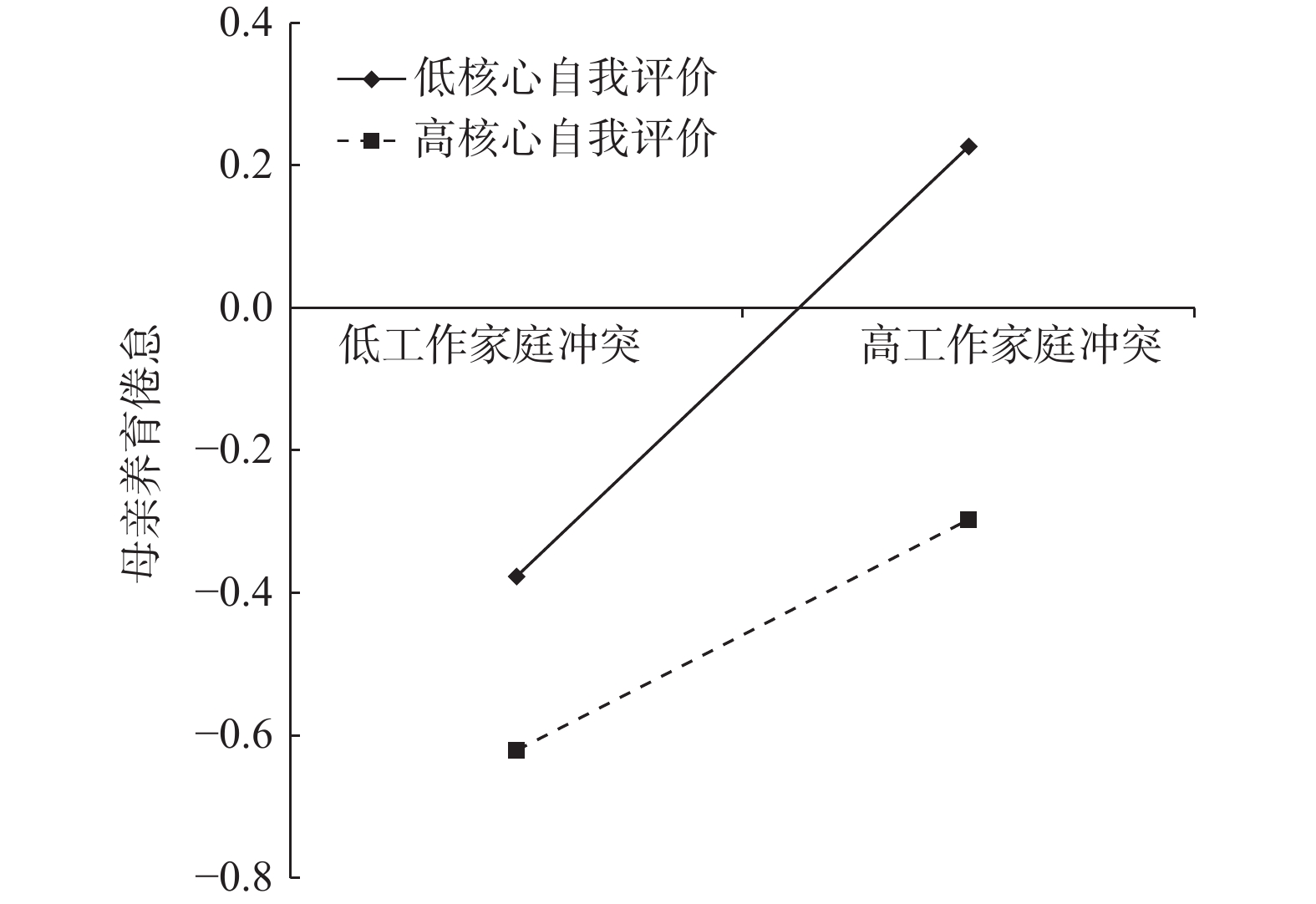
图4 核心自我评价在工作家庭冲突影响母亲养育倦怠中的调节作用
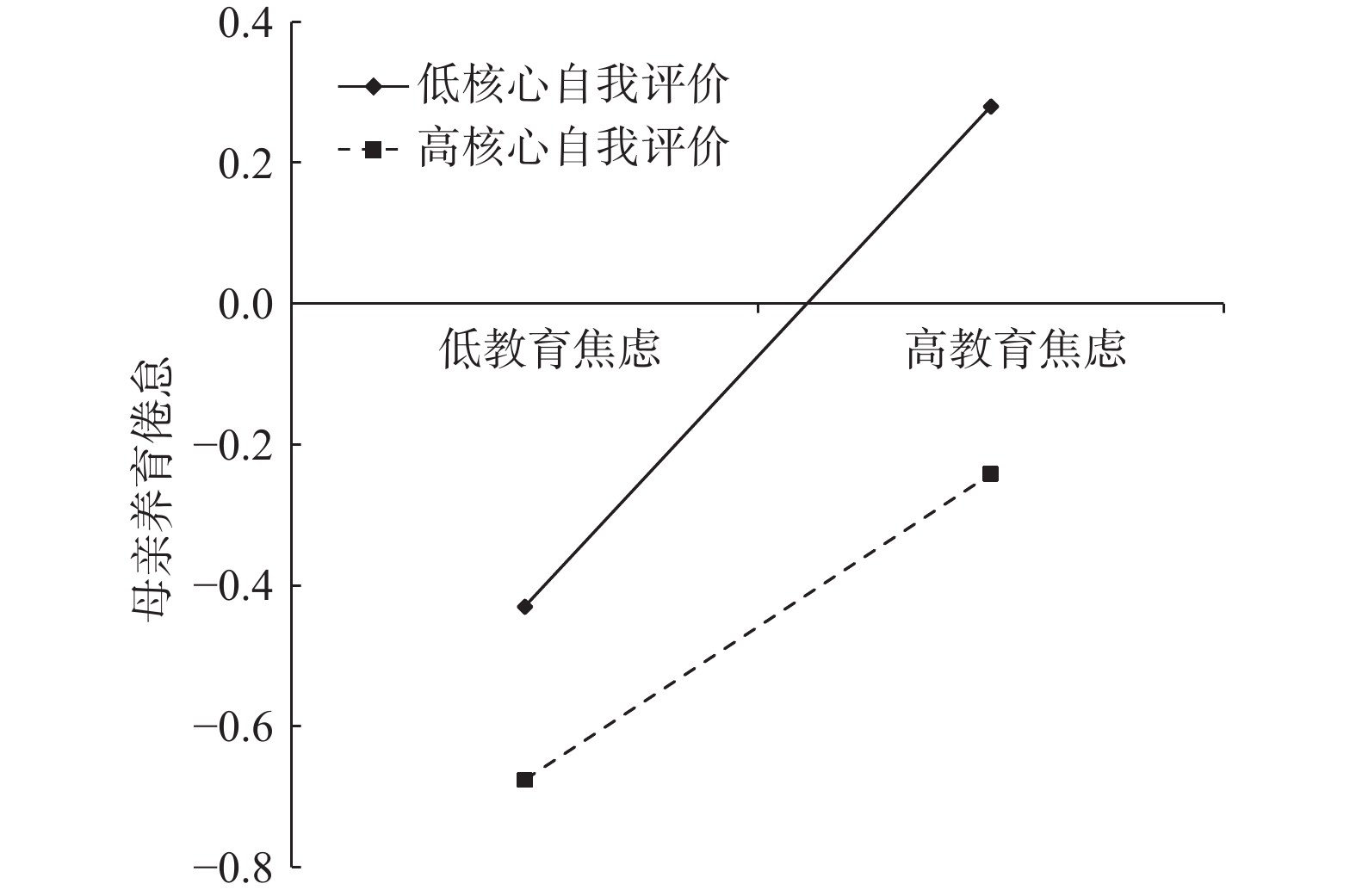
图5 核心自我评价在教育焦虑影响母亲养育倦怠中的调节作用
| 核心自我评价 | 中介效应量 | 标准误 | 95%置信区间 | |
| 下限 | 上限 | |||
| M−SD | 0.11 | 0.02 | 0.08 | 0.15 |
| M | 0.09 | 0.01 | 0.07 | 0.11 |
| M+SD | 0.07 | 0.01 | 0.05 | 0.10 |
表4 核心自我评价不同水平下的中介效应量
| 核心自我评价 | 中介效应量 | 标准误 | 95%置信区间 | |
| 下限 | 上限 | |||
| M−SD | 0.11 | 0.02 | 0.08 | 0.15 |
| M | 0.09 | 0.01 | 0.07 | 0.11 |
| M+SD | 0.07 | 0.01 | 0.05 | 0.10 |
|
戴一希, 李思思, 林小清, 陈德裕. 双相情感障碍儿童父母社会融入对养育倦怠的影响. 中华全科医学, 2025, 23 (12): 2084- 2087, 2177.
DOI |
|
|
邓林园, 高诗晴, 王婧怡, 李蓓蕾. 新冠疫情期间中小学教师工作-家庭冲突和抑郁: 有调节的中介模型. 心理发展与教育, 2023, 39 (1): 121- 131.
DOI |
|
|
邓林园, 王婧怡, 唐逸文, 乔丹桔, 田宏杰. 中小学家长教育焦虑的解释现象学分析. 北京师范大学学报(社会科学版), 2023 (6): 141- 151.
DOI |
|
|
丁亚东, 薛海平. 家长教育焦虑的现状、特征及影响因素——基于35162名家长的实证研究. 首都师范大学学报(社会科学版), 2022 (5): 145- 156, 188.
DOI |
|
|
杜建政, 张翔, 赵燕. 核心自我评价的结构验证及其量表修订. 心理研究, 2012, 5 (3): 54- 60.
|
|
|
高中华, 赵晨. 工作家庭两不误为何这么难?基于工作家庭边界理论的探讨. 心理学报, 2014, 46 (4): 552- 568.
|
|
|
李杰. 核心自我评价对工作家庭冲突和负性情绪的调节作用. 社会心理科学, 2012 (4): 66- 72, 76.
|
|
|
李树超, 贺琳惠, 杜思妙, 卓然, 袁晓娇. 工作家庭冲突对父母养育倦怠的影响: 一个有调节的中介模型. 中国临床心理学杂志, 2024, 32 (5): 1080- 1084, 1089.
DOI |
|
|
刘根荣, 李茜. 望子成龙与中国家庭高储蓄率之谜——基于中国家庭追踪调查的实证研究. 教育与经济, 2023, 39 (4): 54- 63.
|
|
|
刘旺, 冯建新, 刘鸣, 雷文斌. 高中教师的工作家庭冲突: 特点及其对生活满意度的影响. 中国特殊教育, 2010 (3): 77- 81.
|
|
|
史丛丛, 赵媚. 中小学生家长正念和教育焦虑在社会导向完美主义和养育倦怠间的链式中介作用. 职业与健康, 2025, 41 (10): 1373- 1378.
|
|
|
唐逸文, 杨雨萌, 张雅骐, 邓林园, 田宏杰. 中小学生家长教育焦虑: 概念建构及影响机制研究. 北京师范大学学报(社会科学版), 2025 (1): 85- 98.
|
|
|
陶艳兰, 风笑天. “理想照顾者”文化规则的破解: 社会政策支持母亲就业的关键问题. 社会科学, 2020 (4): 77- 89.
|
|
|
王玮, 王胜男, 程华斌, 王云鹤, 李永鑫. 父亲养育倦怠在养育压力与青少年心理健康之间的中介作用. 中国临床心理学杂志, 2021a, 29 (4): 858- 861.
DOI |
|
|
王玮, 王胜男, 程华斌, 王云鹤, 李永鑫. 简式养育倦怠量表中文版的修订. 中国心理卫生杂志, 2021b, 35 (11): 941- 946.
|
|
|
温忠麟, 黄彬彬, 汤丹丹. 问卷数据建模前传. 心理科学, 2018, 41 (1): 204- 210.
DOI |
|
|
吴信英. 教育焦虑现象的成因及纾解之道. 人民论坛, 2019 (24): 138- 139.
DOI |
|
|
曾玲娟, 罗深秋, 唐思琦. 歧视知觉对初中生攻击行为的影响: 心理韧性和核心自我评价的链式中介. 中国健康心理学杂志, 2024, 32 (3): 440- 445.
|
|
|
曾玲娟, 莫晓琼, 江丽晶, 童天宇. 工作家庭冲突对养育倦怠的影响: 有调节的中介模型. 天津师范大学学报(社会科学版), 2024 (2): 151- 159.
DOI |
|
|
张珮馨. (2023). 家长教育焦虑对初中生学习投入的影响及干预研究 (硕士学位论文). 中南民族大学, 武汉.
|
|
|
Bipp, T., Kleingeld, A., & Ebert, T. Core self-evaluations as a personal resource at work for motivation and health. Personality and Individual Differences, 2019, 151, 109556.
DOI |
|
|
Cheng, H. B., Wang, W., Wang, S. N., Li, Y. M., Liu, X., & Li, Y. X. Validation of a Chinese version of the parental burnout assessment. Frontiers in Psychology, 2020, 11, 321.
DOI |
|
|
Cinamon, R. G., & Rich, Y. Gender differences in the importance of work and family roles: Implications for work-family conflict. Sex Roles, 2002, 47 (11–12): 531- 541.
DOI |
|
|
Folkman, S., Lazarus, R. S., Dunkel-Schetter, C., DeLongis, A., & Gruen, R. J. Dynamics of a stressful encounter: Cognitive appraisal, coping, and encounter outcomes. Journal of Personality and Social Psychology, 1986, 50 (5): 992- 1003.
DOI |
|
|
Greenhaus, J. H., & Beutell, N. J. Sources of conflict between work and family roles. The Academy of Management Review, 1985, 10 (1): 76- 88.
|
|
|
Haines, V. Y., III, Harvey, S., Durand, P., & Marchand, A. Core self-evaluations, work-family conflict, and burnout. Journal of Marriage and Family, 2013, 75 (3): 778- 793.
DOI |
|
|
Hubert, S., & Aujoulat, I. Parental burnout: When exhausted mothers open up. Frontiers in Psychology, 2018, 9, 1021.
DOI |
|
|
Instinske, J., & Kandler, C. Structure and sources of core self-evaluations: Construct validation using Multi-Rater and genetically informative designs. European Journal of Personality, 2024, 38 (3): 516- 533.
DOI |
|
|
Jin, X. Z., & Ahn, J. The impact of maternal work-family conflict on problem behaviors among preschoolers during the COVID-19 epidemic: A moderated mediation model of maternal anxiety and trait mindfulness. Frontiers in Psychology, 2023, 14, 1290597.
DOI |
|
|
Judge, T. A., Bono, J. E., & Locke, E. A. Personality and job satisfaction: The mediating role of job characteristics. Journal of Applied Psychology, 2000, 85 (2): 237- 249.
DOI |
|
|
Kammeyer-Mueller, J. D., Judge, T. A., & Scott, B. A. The role of core self-evaluations in the coping process. Journal of Applied Psychology, 2009, 94 (1): 177- 195.
DOI |
|
|
Lazarus, R. S., & Folkman, S. (1984). Stress, appraisal, and coping. New York: Springer Publishing Company.
|
|
|
Mikolajczak, M., & Roskam, I. A theoretical and clinical framework for parental burnout: The balance between risks and resources (BR2). Frontiers in Psychology, 2018, 9, 886.
DOI |
|
|
Netemeyer, R. G., Boles, J. S., & McMurrian, R. Development and validation of work-family conflict and family-work conflict scales. Journal of Applied Psychology, 1996, 81 (4): 400- 410.
|
|
|
Pedersen, D. E., & Kilzer, G. Work-to-family conflict and the maternal gatekeeping of dual-earner mothers with young children. Journal of Family and Economic Issues, 2014, 35 (2): 251- 262.
DOI |
|
|
Peltokorpi, V., & Michel, J. The moderating effect of core self-evaluations between the relationships of work-family conflict and voluntary turnover, job promotions and physical health. Stress and Health, 2021, 37 (1): 162- 174.
DOI |
|
|
Podsakoff, P. M., MacKenzie, S. B., Lee, J. Y., & Podsakoff, N. P. Common method biases in behavioral research: A critical review of the literature and recommended remedies. Journal of Applied Psychology, 2003, 88 (5): 879- 903.
|
|
|
Pujol-Cols, L., & Lazzaro-Salazar, M. Psychological demands and health: An examination of the role of core self-evaluations in the stress-coping process. Psychological Studies, 2020, 65 (4): 408- 419.
DOI |
|
|
Ren, X. H., Cai, Y. Y., Wang, J. Y., & Chen, O. A systematic review of parental burnout and related factors among parents. BMC Public Health, 2024, 24 (1): 376.
DOI |
|
|
Roskam, I., Aguiar, J., Akgun, E., Arikan, G., Artavia, M., Avalosse, H., ... Mikolajczak, M. Parental burnout around the globe: A 42-country study. Affective Science, 2021, 2 (1): 58- 79.
DOI |
|
|
Roskam, I., Brianda, M. E., & Mikolajczak, M. A step forward in the conceptualization and measurement of parental burnout: The Parental Burnout Assessment (PBA). Frontiers in Psychology, 2018, 9, 758.
DOI |
|
|
Roskam, I., Raes, M. E., & Mikolajczak, M. Exhausted parents: Development and preliminary validation of the parental burnout inventory. Frontiers in Psychology, 2017, 8, 163.
DOI |
|
|
Su, C. C., Yang, M., Huang, Q. X., & Yang, M. Balancing act: Exploring the impact of work-family conflict on anxiety among working parents with family health as a mediator. Frontiers in Psychology, 2025, 16, 1531091.
DOI |
|
|
Ten Brummelhuis, L. L., & Bakker, A. B. A resource perspective on the work-home interface: The work-home resources model. American Psychologist, 2012, 67 (7): 545- 556.
|
|
|
van den Eynde, A., Claessens, E., & Mortelmans, D. The consequences of work-family conflict in families on the behavior of the child. Journal of Family Research, 2020, 32 (1): 123- 144.
DOI |
|
|
Wu, K., Wang, F., Wang, W., & Li, Y. X. Parents’ education anxiety and children’s academic burnout: The role of parental burnout and family function. Frontiers in Psychology, 2022, 12, 764824.
DOI |
| [1] | 谷莉, 黄晓彤, 梁广华, 蔡頠, 郭丰波. 核心自我评价与青少年自伤行为的关系:有调节的中介模型[J]. 心理与行为研究, 2025, 23(6): 798-805. |
| [2] | 祖雯妍, 杨晓峰. 核心自我评价与时间贫困感的关系:压力知觉与短视频成瘾的链式中介作用[J]. 心理与行为研究, 2025, 23(3): 391-398. |
| [3] | 刘湍丽, 许杨, 陈昌明. 中年人的母亲与子女参照加工优势:知觉匹配任务证据[J]. 心理与行为研究, 2025, 23(1): 1-7. |
| [4] | 吴旻, 谢燕, 李妍. 母亲温暖和父亲温暖教养的一致性与农村儿童亲社会行为:心理资本的中介作用[J]. 心理与行为研究, 2024, 22(2): 251-257, 273. |
| [5] | 林丽云, 向梦涵, 吴泳桃, 刘学兰. 父母养育倦怠对亲子关系的影响:婚姻质量和共同教养的链式中介作用[J]. 心理与行为研究, 2023, 21(6): 807-814. |
| [6] | 吴旻, 宋文琦, 鞠佳雯. 父母粗暴养育与儿童睡眠质量的关系:核心自我评价和消极情绪的中介作用[J]. 心理与行为研究, 2023, 21(3): 344-351. |
| [7] | 陈姣, 熊猛. 相对剥夺感与大学生社交焦虑的关系:一个有调节的中介模型[J]. 心理与行为研究, 2023, 21(1): 65-71. |
| [8] | 李甜甜, 武兵. 母亲消极情绪表露与儿童焦虑的关系:有调节的中介模型[J]. 心理与行为研究, 2023, 21(1): 72-78. |
| [9] | 江盈颖, 马丽, 张丽锦, 朱莉琪. 子女数量与育龄母亲生活满意度的链式中介模型[J]. 心理与行为研究, 2022, 20(5): 651-656. |
| [10] | 黄杰, 朱丹, 周丽敏, 刘望. 核心自我评价的代际传递:父母支持和子女基本心理需要满足的链式中介作用[J]. 心理与行为研究, 2022, 20(4): 515-521. |
| [11] | 孙洪蕊, 柳铭心, 张兴利, 周晨浩, 刁雅欣, 包乃丽. 父亲和母亲自主支持的特点及其与青少年社会适应的关系:自尊的中介作用[J]. 心理与行为研究, 2022, 20(3): 375-381. |
| [12] | 龚扬, 姜露, 秦雯雯. 祖辈参与教养与幼儿社会能力的关系:母亲育儿压力和母亲教养效能感的链式中介作用[J]. 心理与行为研究, 2021, 19(3): 348-353. |
| [13] | 李喜乐, 孙安琪, 高平圆, 晏妮. 母亲的情景特异性归因与儿童问题行为:儿童消极情绪的调节作用[J]. 心理与行为研究, 2021, 19(1): 74-81. |
| [14] | 刘啸莳. 母亲受教育水平和青少年学业自尊的关系:母亲教养方式的中介作用和性别的调节作用[J]. 心理与行为研究, 2021, 19(1): 59-65. |
| [15] | 马心宇, 陈福美, 罗芮, 赵云燕, 王耘. 学前儿童问题行为对父母抚养压力的影响及夫妻亲密的调节作用[J]. 心理与行为研究, 2020, 18(6): 762-769. |
| 阅读次数 | ||||||
|
全文 |
|
|||||
|
摘要 |
|
|||||
