
Studies of Psychology and Behavior ›› 2026, Vol. 24 ›› Issue (4): 474-482.DOI: 10.12139/j.1672-0628.2026.04.006
• ? • Previous Articles Next Articles
Juan SONG*,1,2,3( ), Yiyue CHEN4, Tuo LIU1,2,3, Yan CHEN5, Qing LIU2, Wanqing BU2
Received:2024-04-15
Online:2026-07-21
Published:2026-07-20
Contact:
Juan SONG
宋娟*,1,2,3(), 陈祎玥4, 刘拓1,2,3, 陈衍5, 刘晴2, 卜婉晴2
通讯作者:
宋娟
基金资助:CLC Number:
Juan SONG, Yiyue CHEN, Tuo LIU, Yan CHEN, Qing LIU, Wanqing BU. The Characteristics and Development of Induced ERP of Pain Empathy: A Meta-analysis Review[J]. Studies of Psychology and Behavior, 2026, 24(4): 474-482.
宋娟, 陈祎玥, 刘拓, 陈衍, 刘晴, 卜婉晴. 疼痛共情诱发的ERP与年龄发展:一项元分析[J]. 心理与行为研究, 2026, 24(4): 474-482.
Add to citation manager EndNote|Ris|BibTeX
URL: https://psybeh.tjnu.edu.cn/EN/10.12139/j.1672-0628.2026.04.006
| 成分类型 | Q检验 | I2检验(%) | ||
| Q | df | p | ||
| N1 | 223.63 | 36 | <0.001 | 86.93 |
| N2 | 936.52 | 78 | <0.001 | 93.54 |
| P3 | 824.66 | 86 | <0.001 | 90.78 |
| LPP | 501.87 | 42 | <0.001 | 92.98 |
| 成分类型 | Q检验 | I2检验(%) | ||
| Q | df | p | ||
| N1 | 223.63 | 36 | <0.001 | 86.93 |
| N2 | 936.52 | 78 | <0.001 | 93.54 |
| P3 | 824.66 | 86 | <0.001 | 90.78 |
| LPP | 501.87 | 42 | <0.001 | 92.98 |
| 成分类型 | k | 效应值及95%置信区间 | 双尾检验 | ||||
| Hedges’ g | 下限 | 上限 | Z | p | |||
| N1 | 37 | 0.26 | 0.01 | 0.50 | 2.01 | 0.039 | |
| N2 | 79 | 0.75 | 0.52 | 0.98 | 6.27 | <0.001 | |
| P3 | 87 | 1.23 | 1.02 | 1.43 | 11.77 | <0.001 | |
| LPP | 43 | 1.41 | 1.09 | 1.73 | 8.58 | <0.001 | |
| 成分类型 | k | 效应值及95%置信区间 | 双尾检验 | ||||
| Hedges’ g | 下限 | 上限 | Z | p | |||
| N1 | 37 | 0.26 | 0.01 | 0.50 | 2.01 | 0.039 | |
| N2 | 79 | 0.75 | 0.52 | 0.98 | 6.27 | <0.001 | |
| P3 | 87 | 1.23 | 1.02 | 1.43 | 11.77 | <0.001 | |
| LPP | 43 | 1.41 | 1.09 | 1.73 | 8.58 | <0.001 | |
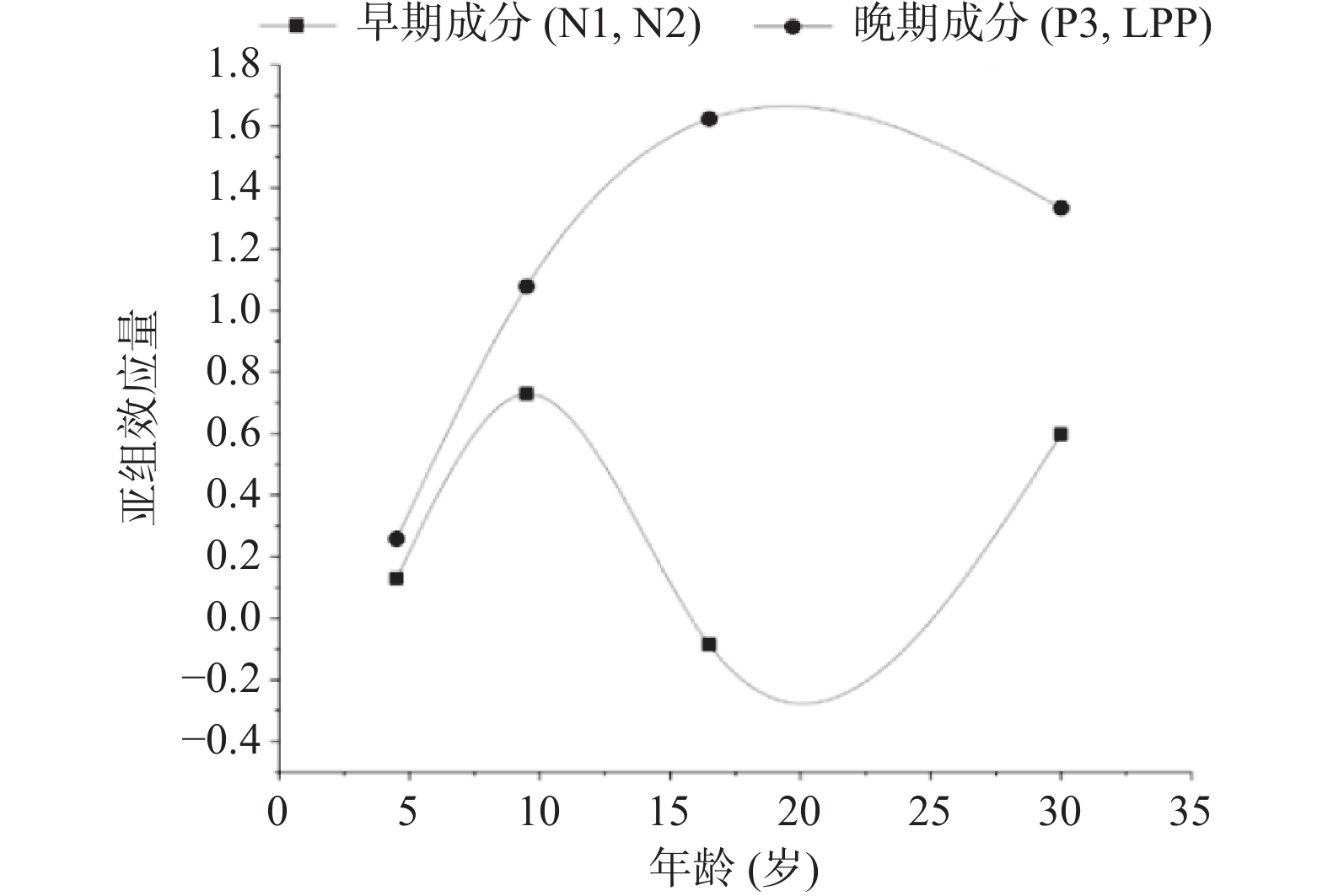
| 调节变量 | 成分类型 | 异质性检验 | 类别 | k | 效应值及95%置信区间 | ||||
| QB | df | p | Hedges’ g | 下限 | 上限 | ||||
| 年龄 | N1 | 6.68 | 1 | 0.035 | 青春期 | 8 | −0.19 | −0.65 | 0.28 |
| 成年早期 | 29 | 0.31 | 0.06 | 0.56 | |||||
| N2 | 47.52 | 3 | <0.001 | 学前期 | 3 | 0.13 | −1.02 | 1.28 | |
| 儿童中期 | 2 | 0.73 | −0.67 | 2.11 | |||||
| 青春期 | 9 | 0.02 | −0.65 | 0.69 | |||||
| 成年早期 | 65 | 0.89 | 0.63 | 1.14 | |||||
| P3 | 126.50 | 1 | <0.001 | 青春期 | 15 | 1.55 | 1.03 | 2.07 | |
| 成年早期 | 72 | 1.17 | 0.93 | 1.41 | |||||
| LPP | 80.97 | 3 | <0.001 | 学前期 | 3 | 0.26 | −0.90 | 1.41 | |
| 儿童中期 | 2 | 1.08 | −0.33 | 2.48 | |||||
| 青春期 | 6 | 1.70 | 0.85 | 2.55 | |||||
| 成年早期 | 32 | 1.50 | 1.13 | 1.86 | |||||
| 刺激类型 | N1 | 7.14 | 2 | 0.068 | 面孔 | 5 | 0.82 | 0.02 | 1.44 |
| 肢体 | 29 | 0.15 | −0.14 | 0.31 | |||||
| 声音 | 3 | 0.38 | −0.39 | 1.15 | |||||
| N2 | 66.11 | 2 | <0.001 | 面孔 | 30 | 1.29 | 0.94 | 1.63 | |
| 肢体 | 47 | 0.37 | 0.10 | 0.64 | |||||
| 声音 | 2 | 1.74 | 0.43 | 3.05 | |||||
| P3 | 137.82 | 2 | <0.001 | 面孔 | 27 | 1.14 | 0.76 | 1.52 | |
| 肢体 | 59 | 1.24 | 0.98 | 1.49 | |||||
| 声音 | 1 | 3.87 | 1.87 | 5.88 | |||||
| LPP | 75.06 | 2 | <0.001 | 面孔 | 8 | 1.55 | 0.75 | 3.77 | |
| 肢体 | 33 | 1.33 | 0.96 | 1.69 | |||||
| 声音 | 2 | 2.30 | 0.84 | 3.77 | |||||
| 调节变量 | 成分类型 | 异质性检验 | 类别 | k | 效应值及95%置信区间 | ||||
| QB | df | p | Hedges’ g | 下限 | 上限 | ||||
| 年龄 | N1 | 6.68 | 1 | 0.035 | 青春期 | 8 | −0.19 | −0.65 | 0.28 |
| 成年早期 | 29 | 0.31 | 0.06 | 0.56 | |||||
| N2 | 47.52 | 3 | <0.001 | 学前期 | 3 | 0.13 | −1.02 | 1.28 | |
| 儿童中期 | 2 | 0.73 | −0.67 | 2.11 | |||||
| 青春期 | 9 | 0.02 | −0.65 | 0.69 | |||||
| 成年早期 | 65 | 0.89 | 0.63 | 1.14 | |||||
| P3 | 126.50 | 1 | <0.001 | 青春期 | 15 | 1.55 | 1.03 | 2.07 | |
| 成年早期 | 72 | 1.17 | 0.93 | 1.41 | |||||
| LPP | 80.97 | 3 | <0.001 | 学前期 | 3 | 0.26 | −0.90 | 1.41 | |
| 儿童中期 | 2 | 1.08 | −0.33 | 2.48 | |||||
| 青春期 | 6 | 1.70 | 0.85 | 2.55 | |||||
| 成年早期 | 32 | 1.50 | 1.13 | 1.86 | |||||
| 刺激类型 | N1 | 7.14 | 2 | 0.068 | 面孔 | 5 | 0.82 | 0.02 | 1.44 |
| 肢体 | 29 | 0.15 | −0.14 | 0.31 | |||||
| 声音 | 3 | 0.38 | −0.39 | 1.15 | |||||
| N2 | 66.11 | 2 | <0.001 | 面孔 | 30 | 1.29 | 0.94 | 1.63 | |
| 肢体 | 47 | 0.37 | 0.10 | 0.64 | |||||
| 声音 | 2 | 1.74 | 0.43 | 3.05 | |||||
| P3 | 137.82 | 2 | <0.001 | 面孔 | 27 | 1.14 | 0.76 | 1.52 | |
| 肢体 | 59 | 1.24 | 0.98 | 1.49 | |||||
| 声音 | 1 | 3.87 | 1.87 | 5.88 | |||||
| LPP | 75.06 | 2 | <0.001 | 面孔 | 8 | 1.55 | 0.75 | 3.77 | |
| 肢体 | 33 | 1.33 | 0.96 | 1.69 | |||||
| 声音 | 2 | 2.30 | 0.84 | 3.77 | |||||
|
黄翯青, 苏彦捷. 共情中的认知调节和情绪分享过程及其关系. 西南大学学报(社会科学版), 2010, 36 (6): 13- 19.
|
|
|
黄翯青, 苏彦捷. 共情的毕生发展: 一个双过程的视角. 心理发展与教育, 2012, 28 (4): 434- 441.
DOI |
|
|
孟景, 陈有国, 黄希庭. 疼痛共情的影响因素及其认知机制. 心理科学进展, 2010, 18 (3): 432- 440.
|
|
|
孙亚茹, 刘泽军, 段亚杰, 陈宁, 刘伟. 协作如何减少记忆错误: 一项元分析研究. 心理学报, 2023, 55 (11): 1780- 1792.
DOI |
|
|
王启忱, 刘赞, 苏彦捷. 共情的毕生发展及其神经基础. 中国科学: 生命科学, 2021, 51 (6): 717- 729.
DOI |
|
|
魏祺, 苏彦捷. 学龄前儿童中的共情及其不同成分. 心理技术与应用, 2019, 7 (9): 523- 535.
DOI |
|
|
吴雨蓓, 刘欣禹. 小学生共情与亲社会行为的关系. 教育观察, 2020, 9 (3): 84- 85, 97.
|
|
|
武侠, 包玉玲, 吕欢欢. 儿童共情能力及其发展: 回顾与前瞻. 绍兴文理学院学报, 2020, 40 (6): 1- 9.
|
|
|
颜志强, 苏彦捷. 认知共情和情绪共情的发展差异: 元分析初探. 心理发展与教育, 2021, 37 (1): 1- 9.
DOI |
|
|
袁晓劲, 刘昌, 柳林. 共情的心理加工过程机制. 心理技术与应用, 2019, 7 (11): 683- 692.
|
|
|
Addabbo, M., Bolognini, N., & Turati, C. Neural time course of pain observation in infancy. Developmental Science, 2021, 24 (4): e13074.
DOI |
|
|
Aziz-Zadeh, L., Sheng, T., & Gheytanchi, A. Common premotor regions for the perception and production of prosody and correlations with empathy and prosodic ability. PLoS One, 2010, 5 (1): e8759.
DOI |
|
|
Barr, R. G., Hopkins, B., & Green, J. A. Crying as a sign, a symptom, and a signal: Clinical, emotional and developmental aspects of infant and toddler crying. JAMA, 2001, 286 (17): 2166- 2167.
|
|
|
Blakemore, S. J. The social brain in adolescence. Nature Reviews Neuroscience, 2008, 9 (4): 267- 277.
DOI |
|
|
Bradley, M. M., Greenwald, M. K., Petry, M. C., & Lang, P. J. (1992). Remembering pictures: Pleasure and arousal in memory. Journal of Experimental Psychology: Learning, Memory, and Cognition, 18(2), 379–390.
|
|
|
Brink, T. T., Urton, K., Held, D., Kirilina, E., Hofmann, M. J., Klann-Delius, G., … Kuchinke, L. The role of orbitofrontal cortex in processing empathy stories in 4- to 8-year-old children. Frontiers in Psychology, 2011, 2, 80.
DOI |
|
|
Carrington, S. J., & Bailey, A. J. Are there theory of mind regions in the brain? A review of the neuroimaging literature. Human Brain Mapping, 2009, 30 (8): 2313- 2335.
DOI |
|
|
Carstensen, L. L., Fung, H. H., & Charles, S. T. Socioemotional selectivity theory and the regulation of emotion in the second half of life. Motivation and Emotion, 2003, 27 (2): 103- 123.
DOI |
|
|
Catmur, C., Walsh, V., & Heyes, C. Associative sequence learning: The role of experience in the development of imitation and the mirror system. Philosophical Transactions of the Royal Society B: Biological Sciences, 2009, 364 (1528): 2369- 2380.
DOI |
|
|
Cheng, Y. W., Chen, C. Y., & Decety, J. An EEG/ERP investigation of the development of empathy in early and middle childhood. Developmental Cognitive Neuroscience, 2014, 10, 160- 169.
DOI |
|
|
Cheng, Y. W., Hung, A. Y., & Decety, J. Dissociation between affective sharing and emotion understanding in juvenile psychopaths. Development and Psychopathology, 2012, 24 (2): 623- 636.
DOI |
|
|
Cohen, J. Statistical power analysis. Current Directions in Psychological Science, 1992, 1 (3): 98- 101.
DOI |
|
|
Coll, M. P. Meta-analysis of ERP investigations of pain empathy underlines methodological issues in ERP research. Social Cognitive and Affective Neuroscience, 2018, 13 (10): 1003- 1017.
DOI |
|
|
Decety, J. The neurodevelopment of empathy in humans. Developmental Neuroscience, 2010a, 32 (4): 257- 267.
DOI |
|
|
Decety, J. To what extent is the experience of empathy mediated by shared neural circuits?. Emotion Review, 2010b, 2 (3): 204- 207.
DOI |
|
|
Decety, J. Dissecting the neural mechanisms mediating empathy. Emotion Review, 2011, 3 (1): 92- 108.
DOI |
|
|
Decety, J. The neural pathways, development and functions of empathy. Current Opinion in Behavioral Sciences, 2015, 3, 1- 6.
|
|
|
Decety, J., & Michalska, K. J. Neurodevelopmental changes in the circuits underlying empathy and sympathy from childhood to adulthood. Developmental Science, 2010, 13 (6): 886- 899.
DOI |
|
|
Decety, J., Yang, C. Y., & Cheng, Y. W. Physicians down-regulate their pain empathy response: An event-related brain potential study. Neuroimage, 2010, 50 (4): 1676- 1682.
DOI |
|
|
Delplanque, S., Silvert, L., Hot, P., & Sequeira, H. Event-related P3a and P3b in response to unpredictable emotional stimuli. Biological Psychology, 2005, 68 (2): 107- 120.
DOI |
|
|
Fabes, R. A., Carlo, G., Kupanoff, K., & Laible, D. Early adolescence and prosocial/moral behavior I: The role of individual processes. The Journal of Early Adolescence, 1999, 19 (1): 5- 16.
DOI |
|
|
Fan, Y., & Han, S. H. Temporal dynamic of neural mechanisms involved in empathy for pain: An event-related brain potential study. Neuropsychologia, 2008, 46 (1): 160- 173.
DOI |
|
|
Fan, Y. T., Chen, C. Y., Chen, S. C., Decety, J., & Cheng, Y. W. Empathic arousal and social understanding in individuals with autism: Evidence from fMRI and ERP measurements. Social Cognitive and Affective Neuroscience, 2014, 9 (8): 1203- 1213.
DOI |
|
|
Frith, C. D., & Singer, T. The role of social cognition in decision making. Philosophical Transactions of the Royal Society B: Biological Sciences, 2008, 363 (1511): 3875- 3886.
DOI |
|
|
Gladstein, G. A. Understanding empathy: Integrating counseling, developmental, and social psychology perspectives. Journal of Counseling Psychology, 1983, 30 (4): 467- 482.
DOI |
|
|
Grissom, R. J., & Kim, J. J. (2005). Effect sizes for research: A broad practical approach. New York: Routledge.
|
|
|
Grynberg, D., & Maurage, P. Pain and empathy: The effect of self-oriented feelings on the detection of painful facial expressions. PLoS One, 2014, 9 (7): e100434.
DOI |
|
|
Hajcak, G., MacNamara, A., & Olvet, D. M. Event-related potentials, emotion, and emotion regulation: An integrative review. Developmental Neuropsychology, 2010, 35 (2): 129- 155.
DOI |
|
|
Hajcak, G., & Olvet, D. M. The persistence of attention to emotion: Brain potentials during and after picture presentation. Emotion, 2008, 8 (2): 250- 255.
DOI |
|
|
Higgins, J. P. T., Thompson, S. G., Deeks, J. J., & Altman, D. G. Measuring inconsistency in meta-analyses. BMJ, 2003, 327 (7414): 557- 560.
DOI |
|
|
Jia, L., Zheng, Z., Sung, B., Compton, B. J., & Wang, J. Resisting repeated exposure: Characteristics of pain empathy for experienced physicians. Behavioural Brain Research, 2023, 436, 114099.
DOI |
|
|
Kujawa, A., Hajcak, G., Torpey, D., Kim, J., & Klein, D. N. (2012). Electrocortical reactivity to emotional faces in young children and associations with maternal and paternal depression. Journal of Child Psychology and Psychiatry, and Allied Disciplines, 53(2), 207–215.
|
|
|
Lamm, C., Batson, C. D., & Decety, J. The neural substrate of human empathy: Effects of perspective-taking and cognitive appraisal. Journal of Cognitive Neuroscience, 2007, 19 (1): 42- 58.
DOI |
|
|
Lamm, C., Decety, J., & Singer, T. Meta-analytic evidence for common and distinct neural networks associated with directly experienced pain and empathy for pain. NeuroImage, 2011, 54 (3): 2492- 2502.
DOI |
|
|
Lang, P. J., & Bradley, M. M. Emotion and the motivational brain. Biological Psychology, 2010, 84 (3): 437- 450.
DOI |
|
|
Lang, P. J., Greenwald, M. K., Bradley, M. M., & Hamm, A. O. Looking at pictures: Affective, facial, visceral, and behavioral reactions. Psychophysiology, 1993, 30 (3): 261- 273.
DOI |
|
|
Lang, S., Yu, T., Markl, A., Müller, F., & Kotchoubey, B. (2011). Hearing others’ pain: Neural activity related to empathy. Cognitive, Affective, & Behavioral Neuroscience, 11(3), 386–395.
|
|
|
Ledoux, J. E. Emotion: Clues from the brain. Annual Review of Psychology, 1995, 46, 209- 235.
DOI |
|
|
Leppänen, J. M., & Nelson, C. A. Tuning the developing brain to social signals of emotions. Nature Reviews Neuroscience, 2009, 10 (1): 37- 47.
DOI |
|
|
Luna, B., & Sweeney, J. A. The emergence of collaborative brain function: FMRI studies of the development of response inhibition. Annals of the New York Academy of Sciences, 2004, 1021 (1): 296- 309.
DOI |
|
|
Magai, C. (2008). Long-lived emotions. In Handbook of Emotions(pp. 376–394), New York: Guilford Press.
|
|
|
Mella, N., Studer, J., Gilet, A. L., & Labouvie-Vief, G. Empathy for pain from adolescence through adulthood: An event-related brain potential study. Frontiers in Psychology, 2012, 3, 501.
DOI |
|
|
Meltzoff, A. N., & Decety, J. What imitation tells us about social cognition: A rapprochement between developmental psychology and cognitive neuroscience. Philosophical Transactions of the Royal Society B: Biological Sciences, 2003, 358 (1431): 491- 500.
DOI |
|
|
Meng, J., Hu, L., Shen, L., Yang, Z., Chen, H., Huang, X. T., & Jackson, T. Emotional primes modulate the responses to others’ pain: An ERP study. Experimental Brain Research, 2012, 220 (3–4): 277- 286.
DOI |
|
|
Meng, J., Li, Z. S., & Shen, L. Responses to others’ pain in adults with autistic traits: The influence of gender and stimuli modality. PLoS One, 2017, 12 (3): e0174109.
DOI |
|
|
Moher, D., Liberati, A., Tetzlaff, J., Altman, D. G., & The PRISMA Group. Preferred reporting items for systematic reviews and meta-analyses: The PRISMA statement. PLoS Medicine, 2009, 6 (7): e1000097.
DOI |
|
|
Moore, R. C., Dev, S. I., Jeste, D. V., Dziobek, I., & Eyler, L. T. Distinct neural correlates of emotional and cognitive empathy in older adults. Psychiatry Research: Neuroimaging, 2015, 232 (1): 42- 50.
DOI |
|
|
Morris, J. S., Öhman, A., & Dolan, R. J. Conscious and unconscious emotional learning in the human amygdala. Nature, 1998, 393 (6684): 467- 470.
DOI |
|
|
Morrison, I., Lloyd, D., Di Pellegrino, G., & Roberts, N. (2004). Vicarious responses to pain in anterior cingulate cortex: Is empathy a multisensory issue? Cognitive, Affective, & Behavioral Neuroscience, 4(2), 270−278.
|
|
|
Regenbogen, C., Schneider, D. A., Finkelmeyer, A., Kohn, N., Derntl, B., Kellermann, T., … Habel, U. The differential contribution of facial expressions, prosody, and speech content to empathy. Cognition & Emotion, 2012, 26 (6): 995- 1014.
DOI |
|
|
Singer, T., & Lamm, C. The social neuroscience of empathy. Annals of the New York Academy of Sciences, 2009, 1156 (1): 81- 96.
DOI |
|
|
Singer, T., Seymour, B., O’Doherty, J., Kaube, H., Dolan, R. J., & Frith, C. D. Empathy for pain involves the affective but not sensory components of pain. Science, 2004, 303 (5661): 1157- 1162.
DOI |
|
|
Song, J., Wei, Y. Q., & Ke, H. The effect of emotional information from eyes on empathy for pain: A subliminal ERP study. PLoS One, 2019, 14 (12): e0226211.
DOI |
|
|
Steinberg, L. A social neuroscience perspective on adolescent risk-taking. Developmental Review, 2008, 28 (1): 78- 106.
DOI |
|
|
Sun, Y. B., Lin, X. X., Ye, W., Wang, N., Wang, J. Y., & Luo, F. A screening mechanism differentiating true from false pain during empathy. Scientific Reports, 2017, 7 (1): 11492.
DOI |
|
|
Timmers, I., Park, A. L., Fischer, M. D., Kronman, C. A., Heathcote, L. C., Hernandez, J. M., & Simons, L. E. Is empathy for pain unique in its neural correlates? A meta-analysis of neuroimaging studies of empathy. Frontiers in Behavioral Neuroscience, 2018, 12, 289.
DOI |
|
|
van Overwalle, F., & Baetens, K. Understanding others’ actions and goals by mirror and mentalizing systems: A meta-analysis. NeuroImage, 2009, 48 (3): 564- 584.
DOI |
|
|
Vogel, E. K., & Luck, S. J. The visual N1 component as an index of a discrimination process. Psychophysiology, 2000, 37 (2): 190- 203.
DOI |
|
|
Wang, H., Ao, L. H., Gao, Y., Liu, Y. J., & Zhang, X. J. Empathy for pain in individuals influenced by moral identity: Evidence from an ERP study. Physiology & Behavior, 2023, 266, 114202.
DOI |
| [1] | Guobin WU, Yongquan HUO, Ning HE. A Study on the Academic Contributions and Historical Significance of Psychologist Hao Yaodong [J]. Studies of Psychology and Behavior, 2026, 24(3): 289-294. |
| [2] | Haiyan ZHAO, Yan MA, Aibao ZHOU. Developmental Trajectories of Adolescent Resilience and the Role of Gender: A Dynamic Developmental Approach [J]. Studies of Psychology and Behavior, 2026, 24(3): 335-342. |
| [3] | Hongkun ZHAI, Xiang ZHOU, Jianghong FU, Kunzhao LI, Yuxin CUI, Xiaowei WEI. New Literacy for the Digital Intelligence Era: The Structure and Measurement of Human-AI Collaborative Creativity Literacy [J]. Studies of Psychology and Behavior, 2026, 24(3): 375-383. |
| [4] | Yongjin GAO, Jingye QIAN, Jie GAO, Xiaolin MA, Shanshan JIANG. Development of a Comprehensive Well-Being Scale for High School Students [J]. Studies of Psychology and Behavior, 2026, 24(3): 425-432. |
| [5] | Chongde LIN. The View of Psychological Development in Traditional Chinese Culture [J]. Studies of Psychology and Behavior, 2026, 24(2): 145-150. |
| [6] | Weiqing FAN, Zhe GONG. Development and Psychometric Evaluation of the Government-Funded Normal University Students’ Identity Scale [J]. Studies of Psychology and Behavior, 2026, 24(2): 273-280. |
| [7] | Haijuan LIU, Yan LI, Xuejun BAI, Xiting MA. The Development and Suggestions of Mental Health Education in Chinese Universities in the New Era [J]. Studies of Psychology and Behavior, 2026, 24(1): 1-9. |
| [8] | Zihao ZENG, Zhen HE, Yanyun YUAN, Xian ZHAO, Lihong YIN, Rong TAN, Mengmeng CHANG, Yiqiu HU. The Impact of HPA Axis System Polygenes and Parent-Child Interaction on Adolescent Depression Development and Gender Differences [J]. Studies of Psychology and Behavior, 2026, 24(1): 78-86. |
| [9] | Zeqi LIU, Yuhua LI, Yan GAO, Jiaxin LIU, Mengmeng SU. Development and Validation of the Home Literacy Environment Scale for Chinese Children [J]. Studies of Psychology and Behavior, 2026, 24(1): 113-121. |
| [10] | Xiaoting ZHAO, Haidong LIU, Li LI, Libin ZHANG, Guangzhen ZAHNG, Yunyun ZHANG. Development of a Group Assessment Tool for Social Domain in Children Aged 3-6 Years [J]. Studies of Psychology and Behavior, 2025, 23(5): 653-661. |
| [11] | Zhiqiang YAN, Xianglu ZENG, Liqun HUANG, Lin XIAO. Does Empathy Promote or Hinder Creativity? The Evidence from Three-Level Meta-Analysis [J]. Studies of Psychology and Behavior, 2025, 23(5): 662-669. |
| [12] | Xiaowen LIU, Jing ZHANG, Jianhua WU, Jingtai LIU, Qingqing CHEN, Muwang YE. The Development and Application of a Public Robot Attitude Scale [J]. Studies of Psychology and Behavior, 2025, 23(5): 695-705. |
| [13] | Jieying ZHANG, Meiling CHEN, Yunquan CAI, Min WANG, Dixiu LIU. The Quantitative Cognitive Deficits and Spatial Ability Characteristics of Children with Developmental Dyscalculia [J]. Studies of Psychology and Behavior, 2025, 23(4): 520-527. |
| [14] | Jie LIU, Weiwei CUI, Shu WANG. Personality and Aggression Among Students: A Meta-Analysis of Evidence from the Past Twenty Years [J]. Studies of Psychology and Behavior, 2025, 23(2): 168-176. |
| [15] | Peng WU, Yuliang WANG, Xingyu JIANG. The Developmental Trajectories of Future Occupation Planning Among Chinese High School Students: A Latent Growth Model [J]. Studies of Psychology and Behavior, 2025, 23(1): 115-122. |
| Viewed | ||||||
|
Full text |
|
|||||
|
Abstract |
|
|||||
