
Studies of Psychology and Behavior ›› 2025, Vol. 23 ›› Issue (2): 233-240.DOI: 10.12139/j.1672-0628.2025.02.012
• ? • Previous Articles Next Articles
Kuo CHANG, Sujun ZHOU, Xiang ZHOU*( )
)
Received:2024-09-18
Online:2025-03-20
Published:2025-03-20
Contact:
Xiang ZHOU
常扩, 周肃军, 周详*()
通讯作者:
周详
基金资助:Kuo CHANG, Sujun ZHOU, Xiang ZHOU. The Impact of AI Identity and Anthropomorphism on Moral Dilemma Judgments: An Analysis Based on the CNI Model[J]. Studies of Psychology and Behavior, 2025, 23(2): 233-240.
常扩, 周肃军, 周详. 人工智能身份与拟人化对道德困境判断的影响:基于CNI模型的分析[J]. 心理与行为研究, 2025, 23(2): 233-240.
Add to citation manager EndNote|Ris|BibTeX
URL: https://psybeh.tjnu.edu.cn/EN/10.12139/j.1672-0628.2025.02.012
| 组别 | C参数 | N参数 | I参数 | |||||
| M | 95%CI | M | 95%CI | M | 95%CI | |||
| 人类组 | 0.19 | [0.155, 0.232] | 0.19 | [0.133, 0.227] | 0.33 | [0.295, 0.355] | ||
| AI组 | 0.22 | [0.184, 0.262] | 0.09 | [0.045, 0.143] | 0.33 | [0.288, 0.345] | ||
| 组别 | C参数 | N参数 | I参数 | |||||
| M | 95%CI | M | 95%CI | M | 95%CI | |||
| 人类组 | 0.19 | [0.155, 0.232] | 0.19 | [0.133, 0.227] | 0.33 | [0.295, 0.355] | ||
| AI组 | 0.22 | [0.184, 0.262] | 0.09 | [0.045, 0.143] | 0.33 | [0.288, 0.345] | ||
| 分组 | t | p | Cohen’s d | ||
| 人类组(n=77) | AI组(n=73) | ||||
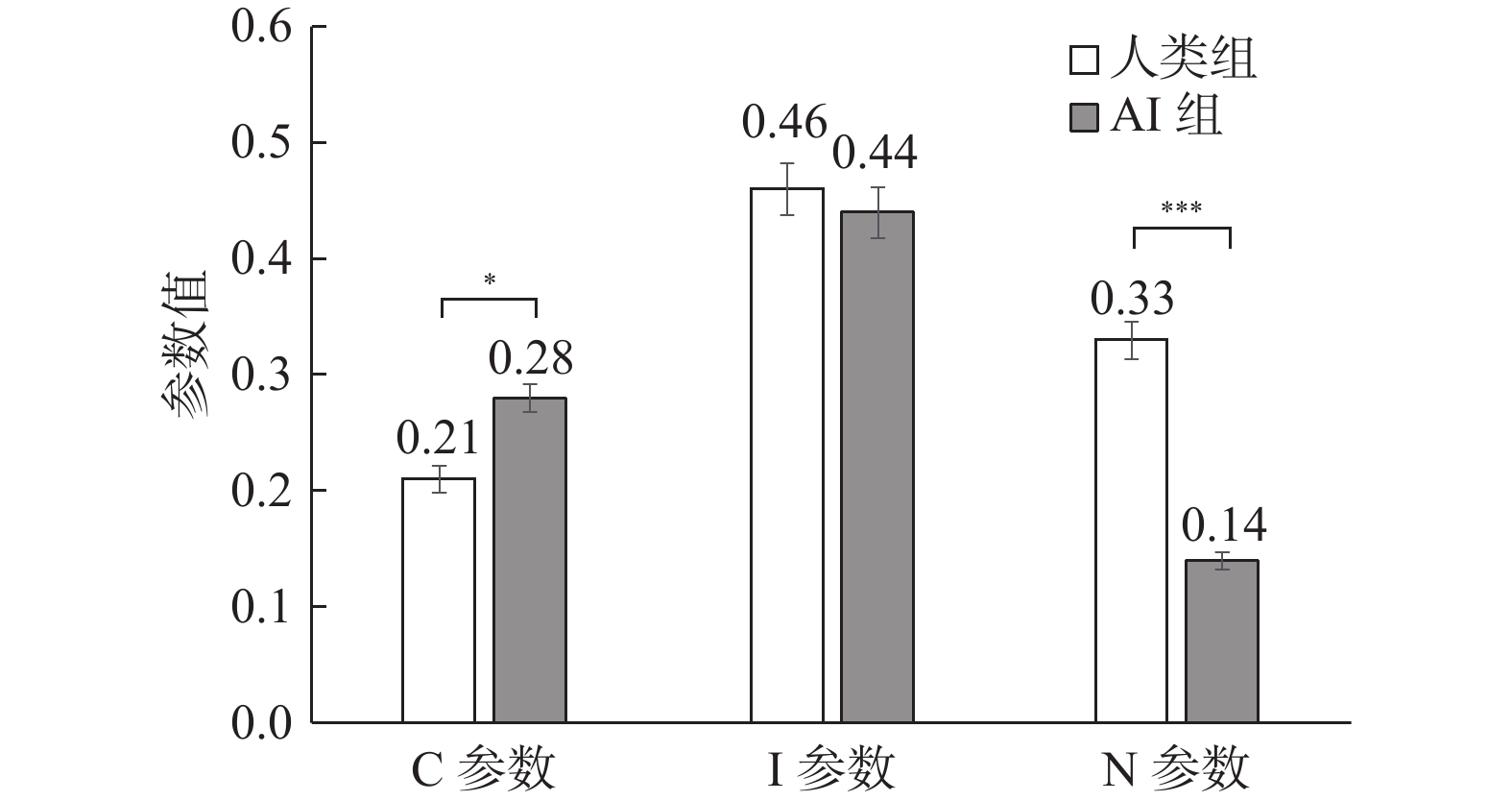
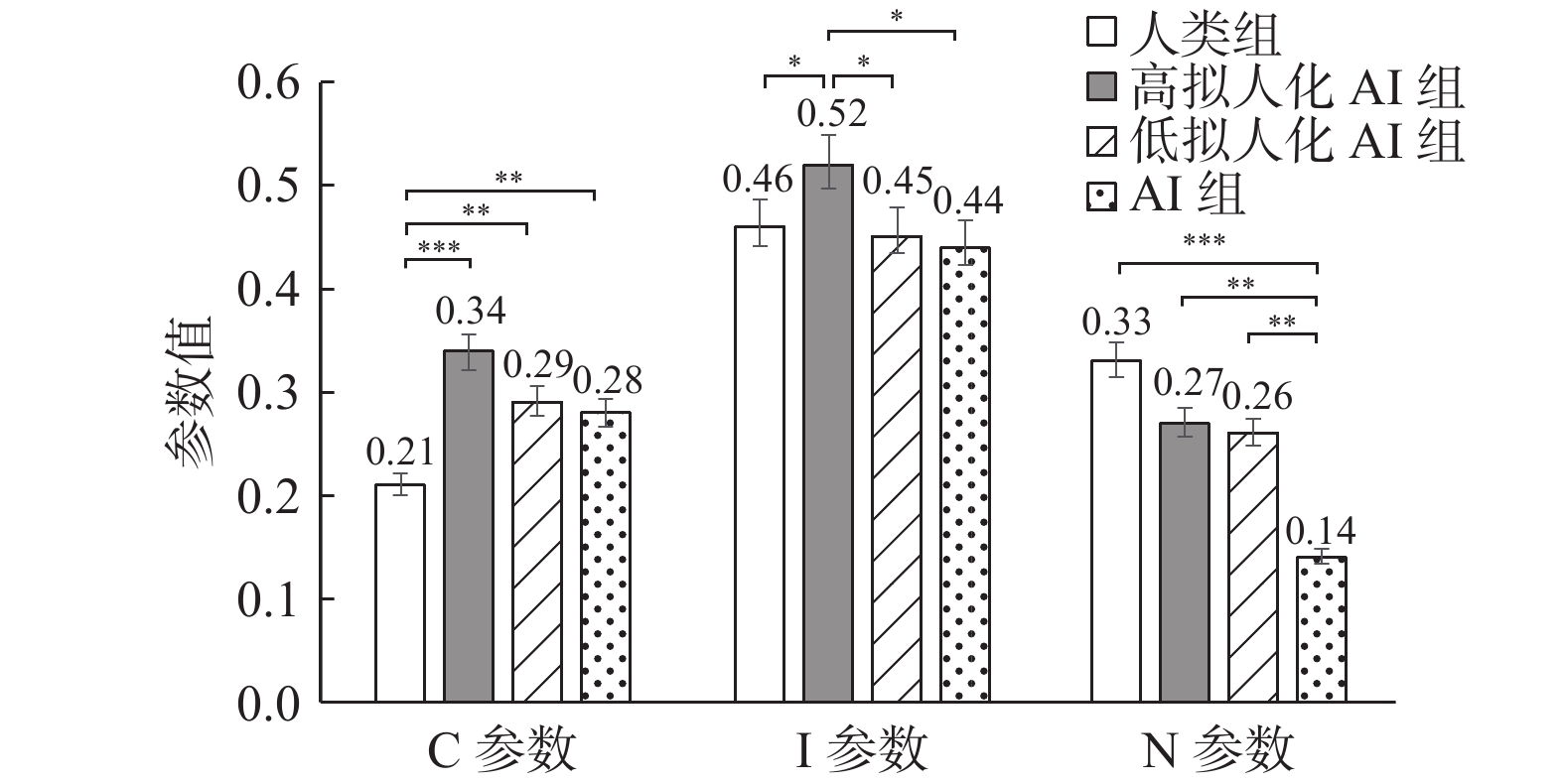
| C参数 | 0.21±0.17 | 0.28±0.21 | −2.56 | 0.012 | 0.42 |
| N参数 | 0.33±0.29 | 0.14±0.19 | 4.58 | <0.001 | 0.78 |
| I参数 | 0.46±0.19 | 0.44±0.13 | 0.58 | 0.562 | 0.12 |
| 分组 | t | p | Cohen’s d | ||
| 人类组(n=77) | AI组(n=73) | ||||
| C参数 | 0.21±0.17 | 0.28±0.21 | −2.56 | 0.012 | 0.42 |
| N参数 | 0.33±0.29 | 0.14±0.19 | 4.58 | <0.001 | 0.78 |
| I参数 | 0.46±0.19 | 0.44±0.13 | 0.58 | 0.562 | 0.12 |
| 指标 | M(SD) | 1 | 2 | 3 | 4 | 5 |
| 1.机器启发式 | 34.37(3.82) | |||||
| 2.感知能力 | 18.26(1.78) | 0.63*** | ||||
| 3.感知温情 | 14.64(1.89) | 0.22** | 0.05 | |||
| 4.C参数 | 0.32(0.19) | 0.03 | −0.12 | 0.01 | ||
| 5.N参数 | 0.27(0.29) | −0.13 | 0.02 | 0.04 | −0.23** | |
| 6.I参数 | 0.49(0.19) | −0.05 | −0.08 | 0.01 | 0.15* | 0.09 |
| 指标 | M(SD) | 1 | 2 | 3 | 4 | 5 |
| 1.机器启发式 | 34.37(3.82) | |||||
| 2.感知能力 | 18.26(1.78) | 0.63*** | ||||
| 3.感知温情 | 14.64(1.89) | 0.22** | 0.05 | |||
| 4.C参数 | 0.32(0.19) | 0.03 | −0.12 | 0.01 | ||
| 5.N参数 | 0.27(0.29) | −0.13 | 0.02 | 0.04 | −0.23** | |
| 6.I参数 | 0.49(0.19) | −0.05 | −0.08 | 0.01 | 0.15* | 0.09 |
| 变量 | 高拟人化AI组 (n=107) | 低拟人化AI组 (n=101) | t | p | Cohen’s d |
| 机器启发式 | 34.44±3.76 | 34.29±3.89 | 0.29 | 0.775 | 0.04 |
| 感知能力 | 18.16±1.78 | 18.38±1.79 | −0.88 | 0.381 | 0.12 |
| 感知温情 | 15.86±3.09 | 13.36±4.23 | 4.89 | <0.001 | 0.66 |
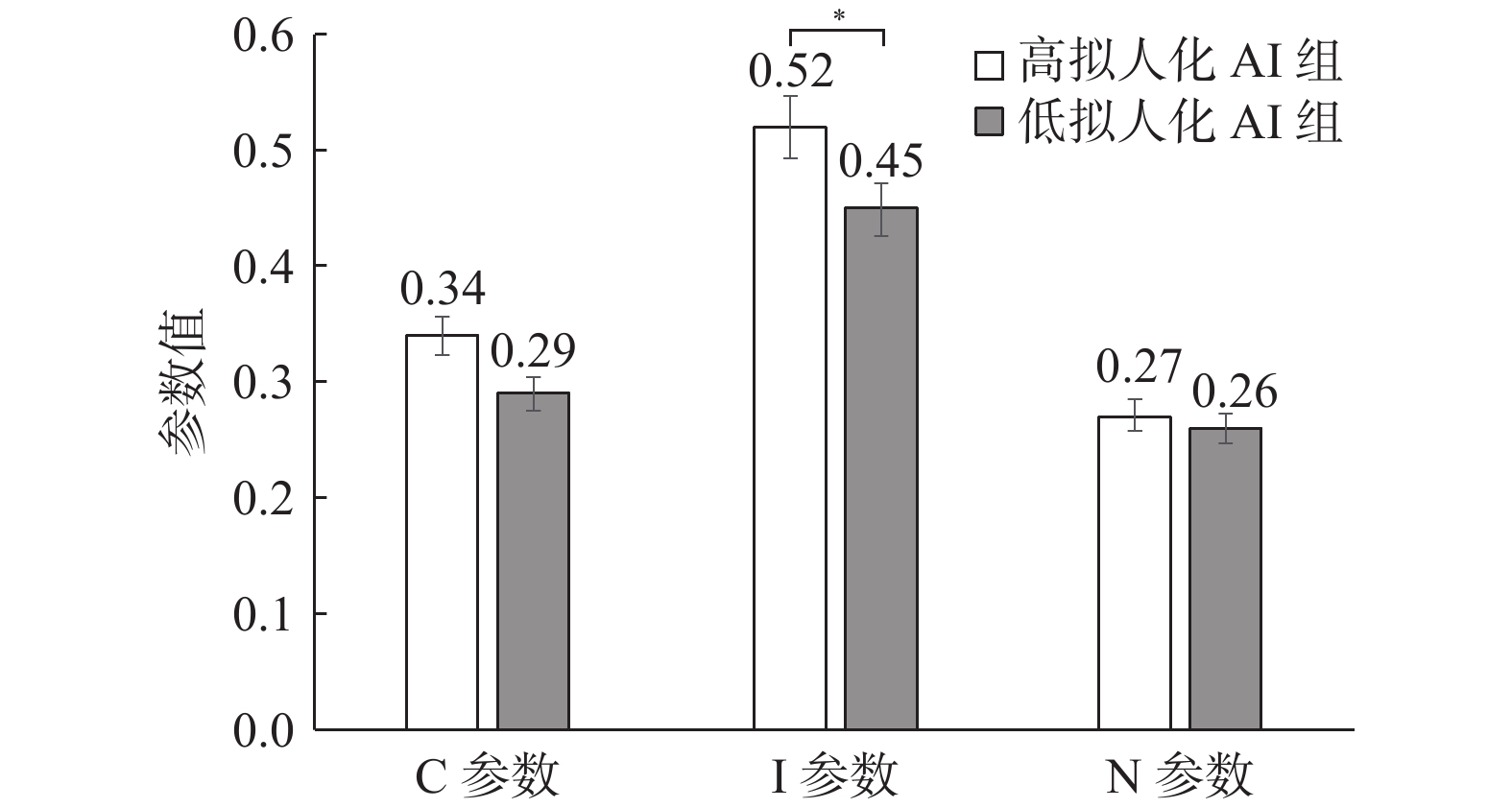
| C参数 | 0.34±0.20 | 0.29±0.18 | 1.81 | 0.072 | 0.26 |
| N参数 | 0.27±0.29 | 0.26±0.28 | 0.12 | 0.904 | 0.04 |
| I参数 | 0.52±0.20 | 0.45±0.17 | 2.62 | 0.009 | 0.38 |
| 变量 | 高拟人化AI组 (n=107) | 低拟人化AI组 (n=101) | t | p | Cohen’s d |
| 机器启发式 | 34.44±3.76 | 34.29±3.89 | 0.29 | 0.775 | 0.04 |
| 感知能力 | 18.16±1.78 | 18.38±1.79 | −0.88 | 0.381 | 0.12 |
| 感知温情 | 15.86±3.09 | 13.36±4.23 | 4.89 | <0.001 | 0.66 |
| C参数 | 0.34±0.20 | 0.29±0.18 | 1.81 | 0.072 | 0.26 |
| N参数 | 0.27±0.29 | 0.26±0.28 | 0.12 | 0.904 | 0.04 |
| I参数 | 0.52±0.20 | 0.45±0.17 | 2.62 | 0.009 | 0.38 |
| 路径 | 中介效应值 | 95%CI |
| AI拟人化→感知温情→C参数 | −0.03 | [−0.099, 0.052] |
| AI拟人化→感知温情→N参数 | 0.07 | [0.006, 0.155] |
| AI拟人化→感知温情→I参数 | −0.01 | [−0.075, 0.080] |
| 路径 | 中介效应值 | 95%CI |
| AI拟人化→感知温情→C参数 | −0.03 | [−0.099, 0.052] |
| AI拟人化→感知温情→N参数 | 0.07 | [0.006, 0.155] |
| AI拟人化→感知温情→I参数 | −0.01 | [−0.075, 0.080] |
|
徐科朋, 杨凌倩, 吴家虹, 薛宏, 张姝玥. CNI模型在道德决策研究中的应用. 心理科学进展, 2020, 28 (12): 2102- 2113.
|
|
|
许丽颖, 喻丰, 彭凯平. 算法歧视比人类歧视引起更少道德惩罚欲. 心理学报, 2022, 54 (9): 1076- 1092.
|
|
|
许丽颖, 喻丰, 邬家骅, 韩婷婷, 赵靓. 拟人化: 从“它”到“他”. 心理科学进展, 2017, 25 (11): 1942- 1954.
|
|
|
云祥. 权力感对道德困境判断的影响: 基于CNI模型的分析. 心理与行为研究, 2020, 18 (4): 544- 551.
|
|
|
周详, 祖冲, 崔虞馨. (2024). 创造力与人工智能. 西安: 陕西师范大学出版总社.
|
|
|
Aaker, J. L., Garbinsky, E. N., & Vohs, K. D. Cultivating admiration in brands: Warmth, competence, and landing in the “golden quadrant”. Journal of Consumer Psychology, 2012, 22 (2): 191- 194.
DOI |
|
|
Aharoni, E., Fernandes, S., Brady, D. J., Alexander, C., Criner, M., Queen, K., … Crespo, V. Attributions toward artificial agents in a modified Moral Turing Test. Scientific Reports, 2024, 14 (1): 8458.
DOI |
|
|
Ayad, R., & Plaks, J. E. Attributions of intent and moral responsibility to AI agents. Computers in Human Behavior: Artificial Humans, 2025, 3, 100107.
DOI |
|
|
Bai, S. Z., Yu, D. Y., Han, C. J., Yang, M., Gupta, B. B., Arya, V., … Zhao, J. Y. Warmth trumps competence? Uncovering the influence of multimodal AI anthropomorphic interaction experience on intelligent service evaluation: Insights from the high-evoked automated social presence. Technological Forecasting and Social Change, 2024, 204, 123395.
DOI |
|
|
Banks, J., Edwards, A. P., & Westerman, D. (2021). The space between: Nature and machine heuristics in evaluations of organisms, cyborgs, and robots. Cyberpsychology, Behavior and Social Networking, 24(5), 324–331.
|
|
|
Bigman, Y. E., & Gray, K. People are averse to machines making moral decisions. Cognition, 2018, 181, 21- 34.
DOI |
|
|
Bigman, Y. E., Wilson, D., Arnestad, M. N., Waytz, A., & Gray, K. Algorithmic discrimination causes less moral outrage than human discrimination. Journal of Experimental Psychology: General, 2023, 152 (1): 4- 27.
DOI |
|
|
Bonaccio, S., & Dalal, R. S. Advice taking and decision-making: An integrative literature review, and implications for the organizational sciences. Organizational Behavior and Human Decision Processes, 2006, 101 (2): 127- 151.
DOI |
|
|
Brink, K. A., Gray, K., & Wellman, H. M. Creepiness creeps in: Uncanny valley feelings are acquired in childhood. Child Development, 2019, 90 (4): 1202- 1214.
DOI |
|
|
Chu, Y. Y., & Liu, P. Machines and humans in sacrificial moral dilemmas: Required similarly but judged differently. Cognition, 2023, 239, 105575.
DOI |
|
|
Fabre, E. F., Mouratille, D., Bonnemains, V., Palmiotti, G. P., & Causse, M. Making moral decisions with artificial agents as advisors. A fNIRS study. Computers in Human Behavior: Artificial Humans, 2024, 2 (2): 100096.
DOI |
|
|
Ferrari, F., Paladino, M. P., & Jetten, J. Blurring human-machine distinctions: Anthropomorphic appearance in social robots as a threat to human distinctiveness. International Journal of Social Robotics, 2016, 8, 287- 302.
DOI |
|
|
Fiske, S. T., Cuddy, A. J. C., & Glick, P. Universal dimensions of social cognition: Warmth and competence. Trends in Cognitive Sciences, 2007, 11 (2): 77- 83.
DOI |
|
|
Gawronski, B., Armstrong, J., Conway, P., Friesdorf, R., & Hütter, M. Consequences, norms, and generalized inaction in moral dilemmas: The CNI model of moral decision-making. Journal of Personality and Social Psychology, 2017, 113 (3): 343- 376.
DOI |
|
|
Gawronski, B., & Brannon, S. M. Power and moral dilemma judgments: Distinct effects of memory recall versus social roles. Journal of Experimental Social Psychology, 2020, 86, 103908.
DOI |
|
|
Gray, H. M., Gray, K., & Wegner, D. M. Dimensions of mind perception. Science, 2007, 315 (5812): 619- 619.
DOI |
|
|
Gray, K., & Wegner, D. M. Feeling robots and human zombies: Mind perception and the uncanny valley. Cognition, 2012, 125 (1): 125- 130.
DOI |
|
|
Greene, J. D., Sommerville, R. B., Nystrom, L. E., Darley, J. M., & Cohen, J. D. An fMRI investigation of emotional engagement in moral judgment. Science, 2001, 293 (5537): 2105- 2108.
DOI |
|
|
Hayes, A. F. (2017). Introduction to mediation, moderation, and conditional process analysis: A regression-based approach. New York: Guilford Press.
|
|
|
Komatsu, T., Malle, B. F., & Scheutz, M. (2021). Blaming the reluctant robot: Parallel blame judgments for robots in moral dilemmas across U.S. and Japan. Paper presented at the 16th ACM/IEEE International Conference on Human-Robot Interaction (HRI), Boulder, CO.
|
|
|
Körner, A., Deutsch, R., & Gawronski, B. Using the CNI model to investigate individual differences in moral dilemma judgments. Personality and Social Psychology Bulletin, 2020, 46 (9): 1392- 1407.
DOI |
|
|
Liu, S. X., Shen, Q., & Hancock, J. Can a social robot be too warm or too competent? Older Chinese adults’ perceptions of social robots and vulnerabilities. Computers in Human Behavior, 2021, 125, 106942.
DOI |
|
|
Liu, Y. M., & Wang, T. H. (2025). Treating differently or equally: A study exploring attitudes towards AI moral advisors. Technology in Society. Advance online publication. https://doi.org/10.1016/j.techsoc.2025.102862
|
|
|
Malle, B. F., Scheutz, M., Cusimano, C., Voiklis, J., Komatsu, T., Thapa, S., & Aladia, S. People’s judgments of humans and robots in a classic moral dilemma. Cognition, 2025, 254, 105958.
DOI |
|
|
Maninger, T., & Shank, D. B. Perceptions of violations by artificial and human actors across moral foundations. Computers in Human Behavior Reports, 2022, 5, 100154.
DOI |
|
|
Moshagen, M. multiTree: A computer program for the analysis of multinomial processing tree models. Behavior Research Methods, 2010, 42 (1): 42- 54.
DOI |
|
|
Myers, S., & Everett, J. A. C. People expect artificial moral advisors to be more utilitarian and distrust utilitarian moral advisors. Cognition, 2025, 256, 106028.
DOI |
|
|
Nass, C., & Moon, Y. Machines and mindlessness: Social responses to computers. Journal of Social Issues, 2000, 56 (1): 81- 103.
DOI |
|
|
Obermeyer, Z., Powers, B., Vogeli, C., & Mullainathan, S. Dissecting racial bias in an algorithm used to manage the health of populations. Science, 2019, 366 (6464): 447- 453.
DOI |
|
|
Onwuegbuzie, A. J., & Daniel, L. G. A framework for reporting and interpreting internal consistency reliability estimates. Measurement and Evaluation in Counseling and Development, 2002, 35 (2): 89- 103.
DOI |
|
|
Rom, S. C., Weiss, A., & Conway, P. Judging those who judge: Perceivers infer the roles of affect and cognition underpinning others’ moral dilemma responses. Journal of Experimental Social Psychology, 2017, 69, 44- 58.
DOI |
|
|
Sundar, S. S., & Kim, J. (2019). Machine heuristic: When we trust computers more than humans with our personal information. Paper presented at the 2019 CHI Conference on Human Factors in Computing Systems, Glasgow, United Kingdom.
|
|
|
Wilson, A., Stefanik, C., & Shank, D. B. How do people judge the immorality of artificial intelligence versus humans committing moral wrongs in real-world situations. Computers in Human Behavior Reports, 2022, 8, 100229.
DOI |
|
|
Xu, K., Chen, X. B., & Huang, L. L. Deep mind in social responses to technologies: A new approach to explaining the computers are social actors phenomena. Computers in Human Behavior, 2022, 134, 107321.
DOI |
|
|
Zhang, Z. X., Chen, Z. S., & Xu, L. Y. Artificial intelligence and moral dilemmas: Perception of ethical decision-making in AI. Journal of Experimental Social Psychology, 2022, 101, 104327.
DOI |
| [1] | Su GUO, Shuzhen JING, Ning FAN. The Effect of Horizontal and Vertical Spatial Orientations on Moral Judgments [J]. Studies of Psychology and Behavior, 2024, 22(5): 609-616. |
| [2] | Boren BAI, Xiang ZHOU, Jingjing ZHANG, Yuxin CUI. Artificial Intelligence Narcissism Enhances Human-Agent Collaborative Innovation Willingness and Its Mechanisms [J]. Studies of Psychology and Behavior, 2024, 22(1): 137-144. |
| [3] | Siyuan LIU, Lin ZHU, Ruibing WANG, Chuyan XU, Yunping WANG, Conghui LIU. Is there Dialect Effect in Moral Decision-Making? [J]. Studies of Psychology and Behavior, 2024, 22(1): 31-38. |
| [4] | Kepeng XU, Jiali CHEN, Jiahong WU, Lingqian YANG, Qianqian OU, Dongli LUO, Shuyue ZHANG. Differential Order Loyalty Bias Effect: The Influence of Interpersonal Intimacy and Moral Value Initiation on Behavior and Moral Judgment [J]. Studies of Psychology and Behavior, 2023, 21(4): 464-470. |
| [5] | DING Fengqin, MA Xiaohong. The Influence of Clean Dirty Priming on Moral Judgment: Moderated Mediation Effect [J]. Studies of Psychology and Behavior, 2023, 21(2): 193-199. |
| [6] | ZHOU Song, LENG Man, JIANG Tao, SUN Yihan, GUAN Qingli, LI Shiyi. Perspective Taking in Gaze-Liking-Effect [J]. Studies of Psychology and Behavior, 2023, 21(2): 185-192. |
| [7] | Peng WU, Chanchan FENG, Qi ZHANG. The Foreign Language Effect on Moral Judgment: The Mediation of Psychological Distance and the Moderation of Foreign Language Proficiency [J]. Studies of Psychology and Behavior, 2023, 21(1): 130-137. |
| [8] | LIU Chuanjun, XIE Zhongju, WANG Xingyuan. Will Incidental Happiness Reduce the Agent’s Moral Norms Sensitivity? [J]. Studies of Psychology and Behavior, 2021, 19(5): 687-694. |
| [9] | YUN Xiang. The Effect of Power on Moral Dilemma Judgment: An Exploration with the CNI Model [J]. Studies of Psychology and Behavior, 2020, 18(4): 544-551. |
| [10] | XIE Xiaoming, HE Weijie, XIAO Qianguo. The Judgment of the Disadvantaged Moderates the Moral Judgment Under Different Semantic Priming of Moral Values [J]. Studies of Psychology and Behavior, 2018, 16(5): 644-649,693. |
| [11] | Zhu Ying. How do we do in the face of a real threat from AI? [J]. Studies of Psychology and Behavior, 2017, 15(1): 1-2. |
| [12] | Wang Rong, Sang Biao, Li Yazhen. Implicit Cognition Bias in 4 ~ 8 Grade Children′s Peer Rolationship [J]. Studies of Psychology and Behavior, 2016, 14(3): 338-345. |
| [13] | Song Juan, Zhang Zhen, Huang Liang, Wang Yiwen. Automatic Process and its Brain Mechanisms in Cognition and Social Cognition [J]. Studies of Psychology and Behavior, 2014, 12(4): 572-580. |
| [14] | Du Wei;Yan Chunping;Li Jian;Zhang Houcan. THE MANIFESTATION OF INDUCTION-DEDUCTION ASYMMETRY IN CHINESE CULTURAL BACKGROUND [J]. , 2009, 7(1): 56-60. |
| Viewed | ||||||
|
Full text |
|
|||||
|
Abstract |
|
|||||
