
Studies of Psychology and Behavior ›› 2025, Vol. 23 ›› Issue (2): 257-264.DOI: 10.12139/j.1672-0628.2025.02.015
• ? • Previous Articles Next Articles
Lihua ZHANG*( ), Bo YANG, Xin LIU
Received:2023-10-23
Online:2025-03-20
Published:2025-03-20
Contact:
Lihua ZHANG
张丽华*(), 杨博, 刘欣
通讯作者:
张丽华
基金资助:Lihua ZHANG, Bo YANG, Xin LIU. The Impact of Social Exclusion on Hostile Interpretation Bias of Different Types of Narcissists[J]. Studies of Psychology and Behavior, 2025, 23(2): 257-264.
张丽华, 杨博, 刘欣. 社会排斥对不同类型自恋者敌意解释偏向的影响[J]. 心理与行为研究, 2025, 23(2): 257-264.
Add to citation manager EndNote|Ris|BibTeX
URL: https://psybeh.tjnu.edu.cn/EN/10.12139/j.1672-0628.2025.02.015
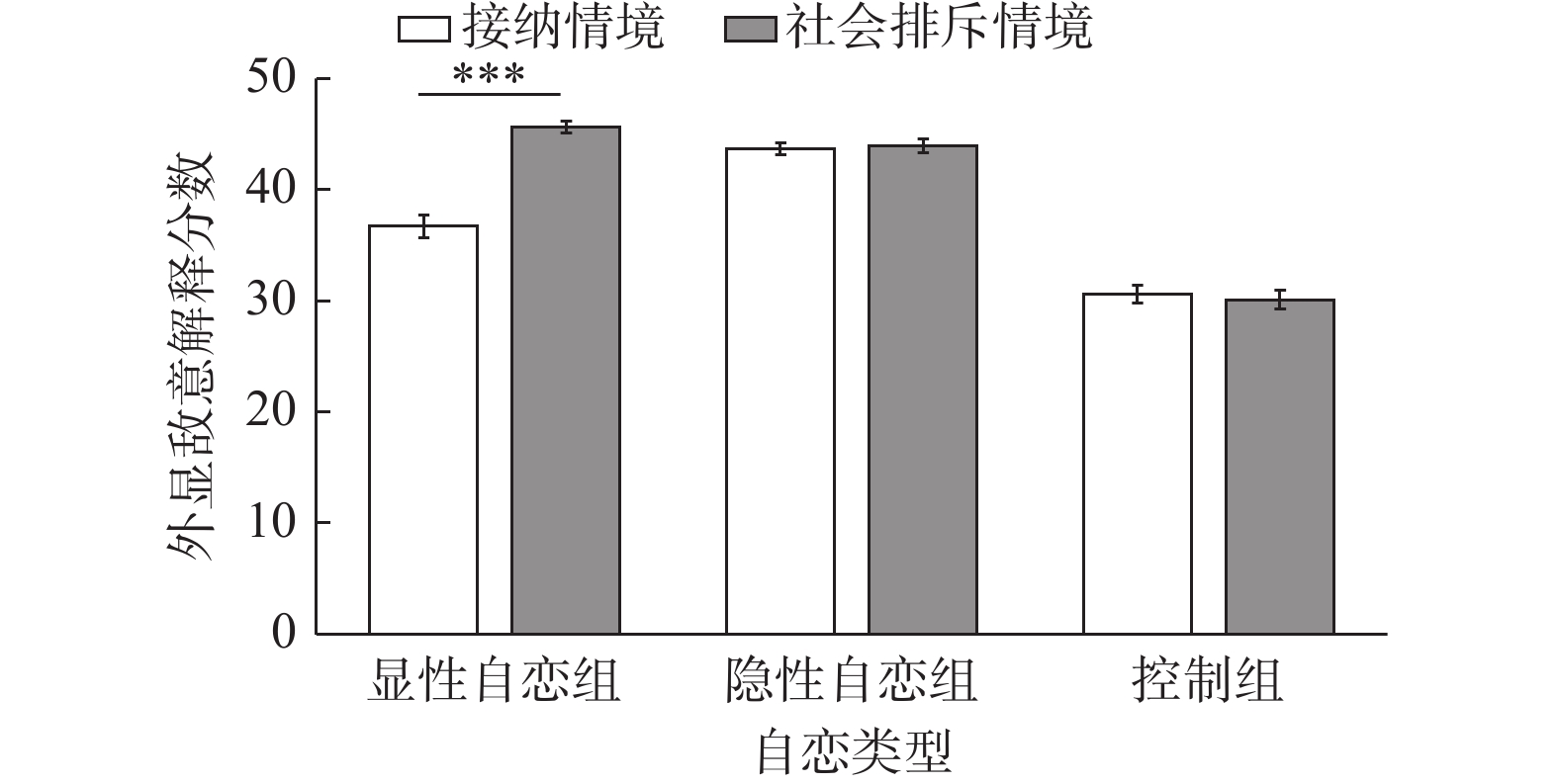
| 自恋类型 | 接纳情境 | 社会排斥情境 |
| 显性自恋组 | 36.68±7.70 | 45.65±4.06 |
| 隐性自恋组 | 43.64±4.55 | 43.91±4.95 |
| 控制组 | 30.56±6.53 | 30.09±6.65 |
| 自恋类型 | 接纳情境 | 社会排斥情境 |
| 显性自恋组 | 36.68±7.70 | 45.65±4.06 |
| 隐性自恋组 | 43.64±4.55 | 43.91±4.95 |
| 控制组 | 30.56±6.53 | 30.09±6.65 |
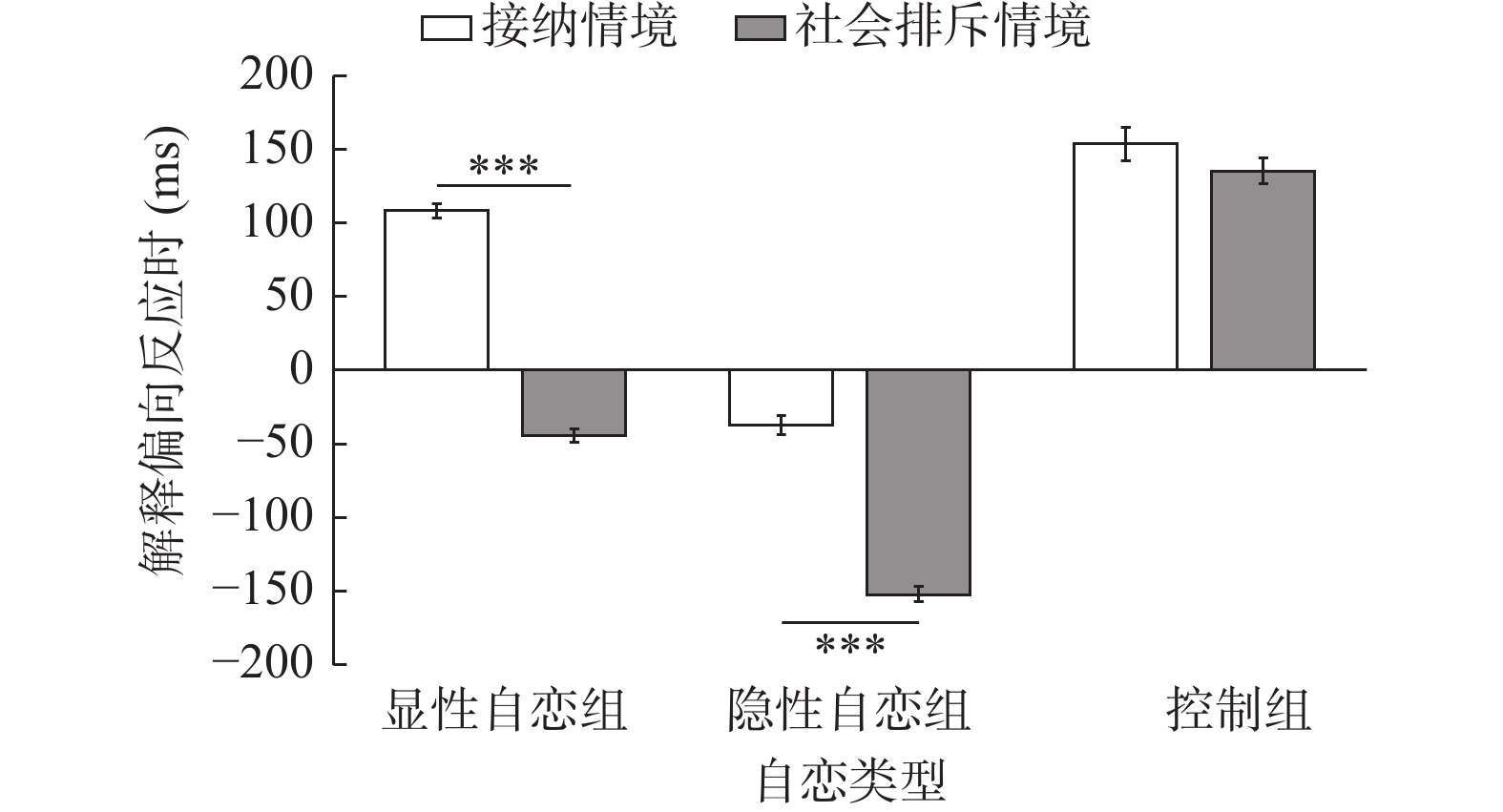
| 自恋类型 | 接纳情境 | 社会排斥情境 |
| 显性自恋组 | 108±25 | −44±24 |
| 隐性自恋组 | −37±33 | −152±26 |
| 控制组 | 153±56 | 135±43 |
| 自恋类型 | 接纳情境 | 社会排斥情境 |
| 显性自恋组 | 108±25 | −44±24 |
| 隐性自恋组 | −37±33 | −152±26 |
| 控制组 | 153±56 | 135±43 |
|
金一波, 李娇, 张锋. 害羞者对模糊情境信息的解释偏向. 心理科学, 2014, 37 (3): 700- 703.
|
|
|
刘宇平, 李姗珊, 何赟, 王豆豆, 杨波. 消除威胁或无能狂怒? 自恋对暴力犯攻击的影响机制. 心理学报, 2021, 53 (3): 244- 258.
|
|
|
王晓燕. (2008). 大学生自恋人格对自尊和主观幸福感的影响研究(硕士学位论文). 陕西师范大学, 西安.
|
|
|
谢莹, 葛若瑾, 张文海, 陈晓惠. 不同自恋类型大学生的日常情绪特征及调节方式. 中国心理卫生杂志, 2022, 36 (4): 344- 346.
DOI |
|
|
张丽华, 苗丽. 敌意解释偏向与攻击的关系. 心理科学进展, 2019, 27 (12): 2097- 2108.
|
|
|
郑伟建, 林炫炫, 高华. 父母心理控制对大学生人际关系困扰的影响: 隐性自恋和述情障碍的链式中介作用. 内江师范学院学报, 2023, 38 (2): 14- 21.
|
|
|
Ames, D. R., Rose, P., & Anderson, C. P. The NPI-16 as a short measure of narcissism. Journal of Research in Personality, 2006, 40 (4): 440- 450.
DOI |
|
|
Anderson, C. A., & Bushman, B. J. Human aggression. Annual Review of Psychology, 2002, 53 (1): 27- 51.
DOI |
|
|
Barry, C. T., & Malkin, M. L. The relation between adolescent narcissism and internalizing problems depends on the conceptualization of narcissism. Journal of Research in Personality, 2010, 44 (6): 684- 690.
DOI |
|
|
Baumeister, R. F., Smart, L., & Boden, J. M. Relation of threatened egotism to violence and aggression: The dark side of high self-esteem. Psychological Review, 1996, 103 (1): 5- 33.
DOI |
|
|
Brunell, A. B., Gentry, W. A., Campbell, W. K., Hoffman, B. J., Kuhnert, K. W., & DeMarree, K. G. Leader emergence: The case of the narcissistic leader. Personality and Social Psychology Bulletin, 2008, 34 (12): 1663- 1676.
DOI |
|
|
Copello, A. G., & Tata, P. R. Violent behaviour and interpretative bias: An experimental study of the resolution of ambiguity in violent offenders. British Journal of Clinical Psychology, 1990, 29 (4): 417- 428.
DOI |
|
|
Curran, H. V., Rees, H., Hoare, T., Hoshi, R., & Bond, A. Empathy and aggression: Two faces of ecstasy? A study of interpretative cognitive bias and mood change in ecstasy users. Psychopharmacology, 2004, 173 (3): 425- 433.
|
|
|
Di Sarno, M., Zimmermann, J., Madeddu, F., Casini, E., & Di Pierro, R. Shame behind the corner? A daily diary investigation of pathological narcissism. Journal of Research in Personality, 2020, 85, 103924.
DOI |
|
|
Erkoreka, L., & Navarro, B. Vulnerable narcissism is associated with severity of depressive symptoms in dysthymic patients. Psychiatry Research, 2017, 257, 265- 269.
DOI |
|
|
Fatima, N., Naqvi, S. U., Israr, L., Aziz, A., & Khan, N. A. Overt narcissism and its impact on interpersonal relationships of young adults. Journal of Arts and Social Sciences, 2023, 10 (1): 161- 166.
|
|
|
Faul, F., Erdfelder, E., Lang, A. G., & Buchner, A. G*Power 3: A flexible statistical power analysis program for the social, behavioral, and biomedical sciences. Behavior Research Methods, 2007, 39 (2): 175- 191.
DOI |
|
|
Hansen-Brown, A. A., & Freis, S. D. Assuming the worst: Hostile attribution bias in vulnerable narcissists. Self and Identity, 2021, 20 (2): 152- 164.
DOI |
|
|
Hart, W., Adams, J. M., & Tortoriello, G. Narcissistic responses to provocation: An examination of the rage and threatened-egotism accounts. Personality and Individual Differences, 2017, 106, 152- 156.
DOI |
|
|
Holaday, M., Smith, D. A., & Sherry, A. Sentence completion tests: A review of the literature and results of a survey of members of the Society for Personality Assessment. Journal of Personality Assessment, 2000, 74 (3): 371- 383.
DOI |
|
|
Kinrade, C., Hart, W., & Lambert, J. T. Mental toughness, rather than self-esteem, moderates effects of grandiose narcissism on aggression under conditions of ego-threat. Personality and Individual Differences, 2022, 189, 111518.
DOI |
|
|
Kjærvik, S. L., & Bushman, B. J. The link between narcissism and aggression: A meta-analytic review. Psychological Bulletin, 2021, 147 (5): 477- 503.
DOI |
|
|
Kuckertz, J. M., & Amir, N. (2014). Cognitive biases in social anxiety disorder. In S. G. Hofmann & P. M. DiBartolo (Eds.), Social anxiety: clinical, developmental, and social perspectives (3rd ed., pp. 483–510). San Diego, CA: Elsevier.
|
|
|
Lamarche, V. M., & Seery, M. D. Come on, give it to me baby: Self-esteem, narcissism, and endorsing sexual coercion following social rejection. Personality and Individual Differences, 2019, 149, 315- 325.
DOI |
|
|
Li, J., Wang, X., Wu, X. Y., & Guo, Y. Y. Early material parenting and adolescents’ materialism: The mediating role of overt narcissism. Current Psychology, 2023, 42 (13): 10543- 10555.
DOI |
|
|
Löckenhoff, C. E., Cook, M. A., Anderson, J. F., & Zayas, V. Age differences in responses to progressive social exclusion: The role of cognition and socioemotional functioning. The Journals of Gerontology: Series B: Psychological Sciences and Social Sciences, 2013, 68 (1): 13- 22.
DOI |
|
|
Loeffler, L. A. K., Huebben, A. K., Radke, S., Habel, U., & Derntl, B. The association between vulnerable/grandiose narcissism and emotion regulation. Frontiers in Psychology, 2020, 11, 519330.
DOI |
|
|
Maciantowicz, O., & Zajenkowski, M. Is narcissistic anger fueled by neuroticism? The relationship between grandiose and vulnerable narcissism, neuroticism, and trait anger. Current Psychology, 2020, 39 (5): 1674- 1681.
DOI |
|
|
Maciantowicz, O., Zajenkowski, M., & Thomaes, S. Vulnerable and grandiose narcissism in adolescence: Associations with anger and hostility. Current Psychology, 2022, 41 (1): 146- 154.
DOI |
|
|
Malesza, M., & Poland W. Grandiose narcissism and vulnerable narcissism in prisoner’s dilemma game. Personality and Individual Differences, 2020, 158, 109841.
DOI |
|
|
Mazinani, Z., Shakiba, S., Pourshahbaz, A., & Vahedi, M. Five factor narcissism and threat to fundamental needs following social exclusion engendered by the Cyberball game. Personality and Individual Differences, 2021, 168, 110279.
DOI |
|
|
Miller, J. D., & Campbell, W. K. Comparing clinical and social‐personality conceptualizations of narcissism. Journal of Personality, 2008, 76 (3): 449- 476.
DOI |
|
|
Miller, J. D., Hoffman, B. J., Gaughan, E. T., Gentile, B., Maples, J., & Campbell, W. K. Grandiose and vulnerable narcissism: A nomological network analysis. Journal of Personality, 2011, 79 (5): 1013- 1042.
DOI |
|
|
Miller, J. D., Lynam, D. R., Vize, C., Crowe, M., Sleep, C., Maples‐Keller, J. L., ... Campbell, W. K. Vulnerable narcissism is (mostly) a disorder of neuroticism. Journal of Personality, 2018, 86 (2): 186- 199.
DOI |
|
|
Moon, C., & Lee, S. Narcissism and anger: The moderating role of social exclusion and the mediating role of hostile attribution bias mechanism. Studies in Humanities and Social Sciences, 2021, 64 (1): 53- 72.
|
|
|
Mück, M., Ohmann, K., Dummel, S., Mattes, A., Thesing, U., & Stahl, J. (2020). Face perception and narcissism: Variations of event-related potential components (P1 & N170) with admiration and rivalry. Cognitive, Affective, & Behavioral Neuroscience, 20(5), 1041–1055.
|
|
|
Pincus, A. L., Ansell, E. B., Pimentel, C. A., Cain, N. M., Wright, A. G. C., & Levy, K. N. Initial construction and validation of the Pathological Narcissism Inventory. Psychological Assessment, 2009, 21 (3): 365- 379.
DOI |
|
|
Ren, D. N., Wesselmann, E. D., & Williams, K. D. Hurt people hurt people: Ostracism and aggression. Current Opinion in Psychology, 2018, 19, 34- 38.
DOI |
|
|
Smith, H. L., Summers, B. J., Dillon, K. H., Macatee, R. J., & Cougle, J. R. Hostile interpretation bias in depression. Journal of Affective Disorders, 2016, 203, 9- 13.
DOI |
|
|
Stone, B. M., & Bartholomay, E. M. A two-factor structure of the Hypersensitive Narcissism Scale describes gender-dependent manifestations of covert narcissism. Current Psychology, 2022, 41 (9): 6051- 6062.
DOI |
|
|
Twenge, J. M., & Campbell, W. K. “Isn’t it fun to get the respect that we’re going to deserve?” Narcissism, social rejection, and aggression. Personality and Social Psychology Bulletin, 2003, 29 (2): 261- 272.
DOI |
|
|
Wang, Y. Y., Cao, S., Dong, Y., & Xia, L. X. Hostile attribution bias and angry rumination: A longitudinal study of undergraduate students. PLoS One, 2019, 14 (5): e0217759.
DOI |
|
|
Weiss, M., & Huppert, J. D. Narcissistic reflections after social rejection: Grandiose and vulnerable narcissism in terms of explicit and implicit interpretation bias. Cognitive Therapy and Research, 2022, 46 (1): 171- 181.
DOI |
|
|
Williams, K. D. Chapter 6 ostracism: A temporal need‐threat model. Advances in Experimental Social Psychology, 2009, 41, 275- 314.
|
|
|
Williams, K. D., Cheung, C. K. T., & Choi, W. Cyberostracism: Effects of being ignored over the Internet. Journal of Personality and Social Psychology, 2000, 79 (5): 748- 762.
DOI |
|
|
Zajenkowski, M., Rogoza, R., Maciantowicz, O., Witowska, J., & Jonason, P. K. Narcissus locked in the past: Vulnerable narcissism and the negative views of the past. Journal of Research in Personality, 2021, 93, 104123.
DOI |
| [1] | Xiaoqian DING, Huayu LIU. The Dual-Path Mechanisms of Social Exclusion on Individuals’ Social Behaviors: The Roles of Negative Perfectionism and Attentional Bias [J]. Studies of Psychology and Behavior, 2026, 24(1): 51-59. |
| [2] | Chenhui DAI, Xiaojun ZHAO, Changxiu SHI, Mingzhen LI, Yaoyao ZHAO. The Influence of Social Exclusion on Interpersonal Trust: A Dual Analytical View Based on the Scenario Perspective and Trait Perspective [J]. Studies of Psychology and Behavior, 2025, 23(3): 384-390. |
| [3] | Linxin LU, Zaihua LIU, Shuang YANG, Zhengkai JIANG, Weiqiang DANG, Jing TAN, Yongfei BAN, Ji SUN, Xiuyun LIN. The Association Between Social Exclusion and Depression Characteristics in Adolescents with Congenital Mild Limb Disability: A Longitudinal Analysis Based on Generative and Reflective Models [J]. Studies of Psychology and Behavior, 2025, 23(2): 216-225. |
| [4] | Juan SONG, Zhibin JIAO, Xue YANG, Gaoxin HAN, Yiyue CHEN, Tao LIAN, Jingyuan LIANG. Shared Experience of Social Exclusion Increases Female’s Cooperative Tendency: An fNIRS-Based Hyperscanning Study [J]. Studies of Psychology and Behavior, 2024, 22(4): 553-561. |
| [5] | Junqing HUANG, Kaizheng LI, Shuyue ZHANG. Development of Ostracism Paradigm Under the Frame of Public Good Game [J]. Studies of Psychology and Behavior, 2023, 21(3): 320-327. |
| [6] | CHANG Baorui, LIN Peitian, HUANG Jiangxi, FANG Jiandong. The Effect of Materialism and Future Orientation on the Relationship Between Social Exclusion and Prosocial Behavior [J]. Studies of Psychology and Behavior, 2022, 20(4): 556-562. |
| [7] | LIANG Fenghua. A Research on the Relationship Between Small Self Acquisitive Face Orientation, Big Self Acquisitive Face Orientation and Social Exclusion [J]. Studies of Psychology and Behavior, 2018, 16(2): 283-288. |
| [8] | Sun Xiaojun, Tong Yuantian, Fan Cuiying. Social Exclusion and Cyberostracism on Depression: the Mediating Role of Self-control [J]. Studies of Psychology and Behavior, 2017, 15(2): 169-174. |
| Viewed | ||||||
|
Full text |
|
|||||
|
Abstract |
|
|||||
