
Studies of Psychology and Behavior ›› 2025, Vol. 23 ›› Issue (3): 377-383.DOI: 10.12139/j.1672-0628.2025.03.012
• ? • Previous Articles Next Articles
Juan MA1, Xiaojing WU*,1,2( ), Yan YAN3, Xiaosong GAI1,2, Ru ZHOU1,4
Received:2024-09-04
Online:2025-05-20
Published:2025-05-20
Contact:
Xiaojing WU
马娟1, 吴晓靓*,1,2(), 闫艳3, 盖笑松1,2, 周茹1,4
通讯作者:
吴晓靓
基金资助:Juan MA, Xiaojing WU, Yan YAN, Xiaosong GAI, Ru ZHOU. The Relationship of Left-Behind Experience and the Flourishing in Junior High School Students: The Compensatory and Moderation Effects of the Sense of Control[J]. Studies of Psychology and Behavior, 2025, 23(3): 377-383.
马娟, 吴晓靓, 闫艳, 盖笑松, 周茹. 留守经历对初中生心理繁荣的影响:控制感的补偿作用和调节作用[J]. 心理与行为研究, 2025, 23(3): 377-383.
Add to citation manager EndNote|Ris|BibTeX
URL: https://psybeh.tjnu.edu.cn/EN/10.12139/j.1672-0628.2025.03.012
| 变量 | M | SD | 1 | 2 | 3 | 4 | 5 |
| 1.性别 | |||||||
| 2.上学方式 | −0.09 | ||||||
| 3.家庭社会 经济地位 | −0.45 | 0.69 | 0.15* | −0.04 | |||
| 4.留守经历 | 0.00 | 0.00 | 0.09 | ||||
| 5.控制感 | 0.00 | 1.31 | −0.18** | 0.14* | −0.15* | −0.03 | |
| 6.心理繁荣 | 5.21 | 1.34 | 0.03 | 0.16** | −0.04 | −0.15* | 0.50*** |
| 变量 | M | SD | 1 | 2 | 3 | 4 | 5 |
| 1.性别 | |||||||
| 2.上学方式 | −0.09 | ||||||
| 3.家庭社会 经济地位 | −0.45 | 0.69 | 0.15* | −0.04 | |||
| 4.留守经历 | 0.00 | 0.00 | 0.09 | ||||
| 5.控制感 | 0.00 | 1.31 | −0.18** | 0.14* | −0.15* | −0.03 | |
| 6.心理繁荣 | 5.21 | 1.34 | 0.03 | 0.16** | −0.04 | −0.15* | 0.50*** |
| B | t | 95%置信区间 | R2 | ΔR2 | F | |
| 方程1 | ||||||
| 上学方式 | 0.34 | 2.77** | [0.10, 0.58] | 0.03 | 0.03 | 7.68** |
| 方程2 | 0.28 | 0.25 | 35.89*** | |||
| 上学方式 | 0.20 | 1.90 | [−0.01, 0.41] | |||
| 留守经历 | −0.27 | −2.61* | [−0.47, −0.07] | |||
| 控制感 | 0.49 | 9.44*** | [0.38, 0.59] |
| B | t | 95%置信区间 | R2 | ΔR2 | F | |
| 方程1 | ||||||
| 上学方式 | 0.34 | 2.77** | [0.10, 0.58] | 0.03 | 0.03 | 7.68** |
| 方程2 | 0.28 | 0.25 | 35.89*** | |||
| 上学方式 | 0.20 | 1.90 | [−0.01, 0.41] | |||
| 留守经历 | −0.27 | −2.61* | [−0.47, −0.07] | |||
| 控制感 | 0.49 | 9.44*** | [0.38, 0.59] |
| 变量 | B | SE | t | 95%置信区间 |
| 上学方式 | 0.21 | 0.11 | 1.95 | [0.00, 0.42] |
| 留守经历 | −0.26 | 0.10 | −2.61** | [−0.46, −0.07] |
| 控制感 | 0.60 | 0.08 | 7.79*** | [0.45, 0.75] |
| 留守经历×控制感 | −0.20 | 0.10 | −1.94 | [−0.40, 0.00] |
| R2 | 0.29 | |||
| F | 28.12*** | |||
| 变量 | B | SE | t | 95%置信区间 |
| 上学方式 | 0.21 | 0.11 | 1.95 | [0.00, 0.42] |
| 留守经历 | −0.26 | 0.10 | −2.61** | [−0.46, −0.07] |
| 控制感 | 0.60 | 0.08 | 7.79*** | [0.45, 0.75] |
| 留守经历×控制感 | −0.20 | 0.10 | −1.94 | [−0.40, 0.00] |
| R2 | 0.29 | |||
| F | 28.12*** | |||
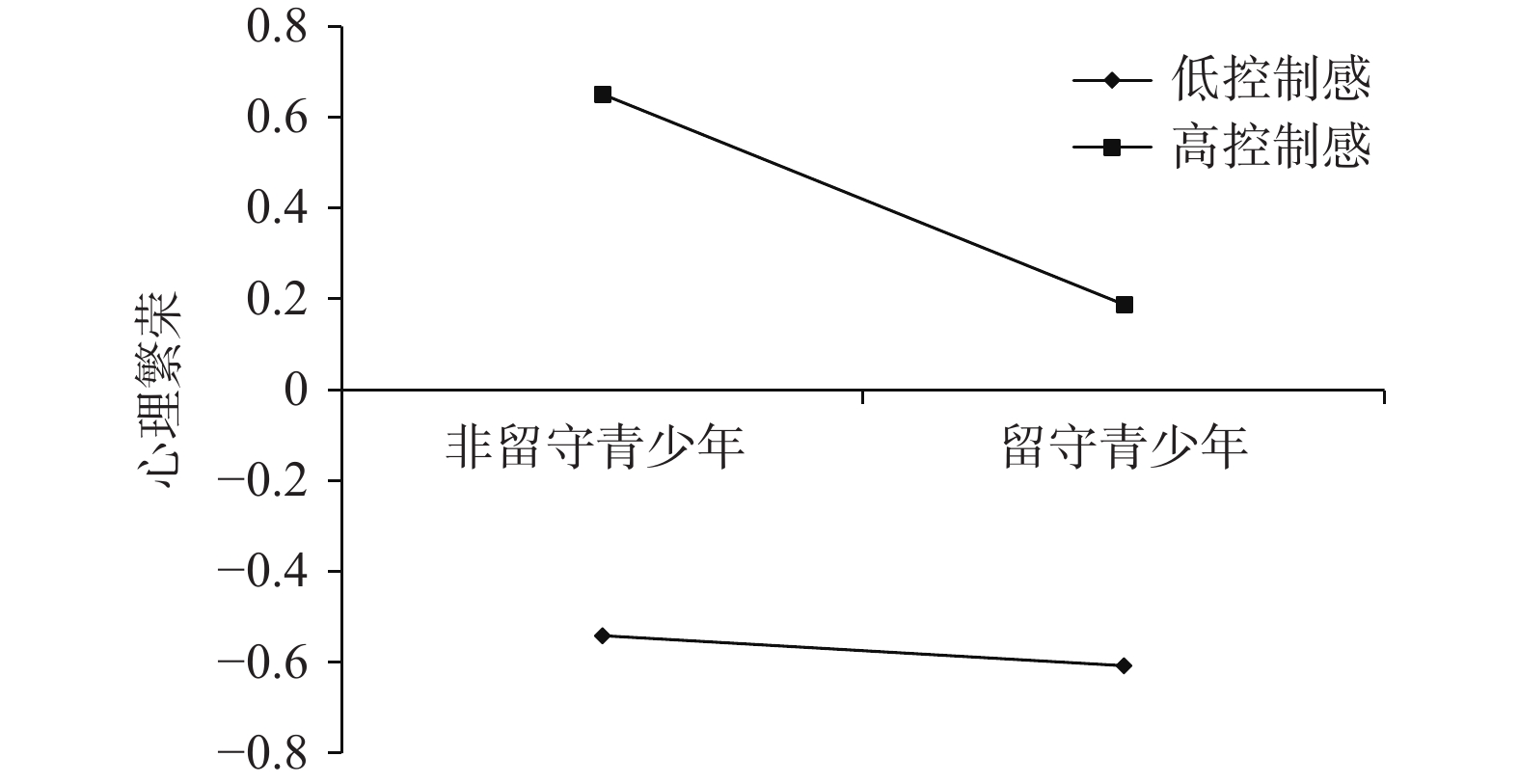
|
陈维, 高荣芬, 王力. 情绪调节量表在性别、是否留守和时间变量上的测量等值性. 中国临床心理学杂志, 2023, 31 (1): 112- 115.
|
|
|
董蔚然, 钟景迅. 不同家庭结构对农村留守儿童自我效能感的影响研究——以广东省15个县域107所乡村学校留守儿童为例. 教育导刊, 2023, (7): 86- 96.
DOI |
|
|
范兴华. (2010). 家庭处境不利与留守儿童情绪适应不良: 人格特征与社会支持的调节作用(博士学位论文). 北京师范大学.
|
|
|
范兴华, 陈小依, 谷爱庆, 杨芳, 王娅丽, 王艺橙, 朱素平. 留守困境与儿童心理适应: 压力与个人成长主动性的作用. 中国临床心理学杂志, 2024, 32 (1): 149- 154, 159.
|
|
|
范兴华, 方晓义, 赵纤, 陈锋菊. 留守儿童家庭处境不利累积风险与社会适应: 压力的中介作用与心理社会资源的调节作用. 心理学报, 2023, 55 (8): 1270- 1284.
|
|
|
黄爱玲. “留守孩”心理健康水平分析. 中国心理卫生杂志, 2004, 18 (5): 351- 353.
DOI |
|
|
李静. (2014). 不同社会阶层对贫富差距的心理归因研究. 广州: 世界图书出版广东有限公司.
|
|
|
欧阳智, 范兴华. 家庭社会经济地位、心理资本对农村留守儿童自尊的影响. 中国临床心理学杂志, 2018, 26 (6): 1182- 1185, 1190.
|
|
|
彭阳, 盘海云. 留守儿童亲子依恋、友谊质量对自我意识的影响. 中国临床心理学杂志, 2023, 31 (1): 218- 221.
|
|
|
师保国, 申继亮. 家庭社会经济地位、智力和内部动机与创造性的关系. 心理发展与教育, 2007, 23 (1): 30- 34.
DOI |
|
|
石雷山, 陈英敏, 侯秀, 高峰强. 家庭社会经济地位与学习投入的关系: 学业自我效能的中介作用. 心理发展与教育, 2013, 29 (1): 71- 78.
|
|
|
王启忱, 苏彦捷. 留守经历与儿童心理理解发展的相关因素及其干预. 苏州大学学报(教育科学版), 2021, 9 (4): 47- 56.
|
|
|
魏华, 何灿, 刘元, 周宗奎, 李倩. 青少年留守经历对网络成瘾的影响: 病理性互联网使用的认知行为模型视角. 心理发展与教育, 2022, 38 (3): 399- 406.
|
|
|
吴晓靓, 盖笑松, 李晓天, 顾婷玉, 王宏. 家庭经济压力与初中生幸福感的关系: 歧视知觉的中介作用和控制感的调节作用. 心理发展与教育, 2023, 39 (6): 877- 886.
|
|
|
席居哲, 左志宏, Wei, W. 心理韧性研究诸进路. 心理科学进展, 2012, 20 (9): 1426- 1447.
|
|
|
谢玲平, 邹维兴. 留守初中生的心理弹性及其与自我效能感的相关研究. 教育测量与评价(理论版), 2014, (11): 47- 51.
|
|
|
叶婷, 吴慧婷. 低家庭社会经济地位与青少年社会适应的关系: 感恩的补偿和调节效应. 心理学探新, 2012, 32 (1): 61- 66.
DOI |
|
|
岳鹏飞, 胡汉玉, 方媛. 留守经历及心理弹性对情绪识别的影响. 中国特殊教育, 2019, (6): 72- 77.
DOI |
|
|
Burns, R. A., & Ma, J. Examining the association between psychological wellbeing with daily and intra-individual variation in subjective wellbeing. Personality and Individual Differences, 2015, 82, 34- 39.
DOI |
|
|
Chen, B., Luo, L. J., Wu, X., Chen, Y. J., & Zhao, Y. F. Are the lower class really unhappy? Social class and subjective well-being in Chinese adolescents: Moderating role of sense of control and mediating role of self-esteem. Journal of Happiness Studies, 2021, 22 (2): 825- 843.
DOI |
|
|
Diener, E., & Biswas-Diener, R. (2019). Well-being interventions to improve societies. In Global happiness and wellbeing policy report 2019 (pp. 95–110). New York: Global Happiness Council.
|
|
|
Diener, E., Wirtz, D., Tov, W., Kim-Prieto, C., Choi, D. W., Oishi, S., & Biswas-Diener, R. New well-being measures: Short scales to assess flourishing and positive and negative feelings. Social Indicators Research, 2010, 97 (2): 143- 156.
DOI |
|
|
Fergus, S., & Zimmerman, M. A. Adolescent resilience: A framework for understanding healthy development in the face of risk. Annual Review of Public Health, 2005, 26, 399- 419.
DOI |
|
|
Fredrickson, B. L. Updated thinking on positivity ratios. American Psychologist, 2013, 68 (9): 814- 822.
DOI |
|
|
Griffin, K. W., & Rabkin, J. G. Perceived control over illness, realistic acceptance, and psychological adjustment in people with aids. Journal of Social and Clinical Psychology, 1998, 17 (4): 407- 424.
DOI |
|
|
Hayes, A. F. (2013). Introduction to mediation, moderation, and conditional process analysis: A regression-based approach. New York: Guilford Press.
|
|
|
Hilton, C. L., Ratcliff, K., Collins, D. M., Flanagan, J., & Hong, I. Flourishing in children with autism spectrum disorders. Autism Research, 2019, 12 (6): 952- 966.
DOI |
|
|
Keyes, C. L. M. Promoting and protecting mental health as flourishing: A complementary strategy for improving national mental health. American Psychologist, 2007, 62 (2): 95- 108.
DOI |
|
|
Keyes, C. L. M., & Simoes, E. J. To flourish or not: Positive mental health and all-cause mortality. American Journal of Public Health, 2012, 102 (11): 2164- 2172.
DOI |
|
|
Lachman, M. E., & Weaver, S. L. The sense of control as a moderator of social class differences in health and well-being. Journal of Personality and Social Psychology, 1998, 74 (3): 763- 773.
DOI |
|
|
Lazarus, R. S., & Folkman, S. (1984). Stress, appraisal, and coping. New York: Springer.
|
|
|
Lin, N., & Bian, Y. J. Getting ahead in urban China. American Journal of Sociology, 1991, 97 (3): 657- 688.
DOI |
|
|
Luthar, S. S., Cicchetti, D., & Becker, B. The construct of resilience: A critical evaluation and guidelines for future work. Child Development, 2000, 71 (3): 543- 562.
DOI |
|
|
Masten, A. S., & Reed, M. G. J. (2002). Resilience in development. In C. R. Snyder & S. J. Lopez (Eds.), Handbook of positive psychology (pp. 74–88). Oxford: Oxford University Press.
|
|
|
Podsakoff, P. M., & Organ, D. W. Self-reports in organizational research: Problems and prospects. Journal of Management, 1986, 12 (4): 531- 544.
DOI |
|
|
Ross, C. E., & Mirowsky, J. Age and the gender gap in the sense of personal control. Social Psychology Quarterly, 2002, 65 (2): 125- 145.
DOI |
|
|
Ryan, R. M., & Deci, E. L. On happiness and human potentials: A review of research on hedonic and eudaimonic well-being. Annual Review of Psychology, 2001, 52, 141- 166.
DOI |
|
|
Ryff, C. D., & Singer, B. H. Know thyself and become what you are: A eudaimonic approach to psychological well-being. Journal of Happiness Studies, 2008, 9 (1): 13- 39.
DOI |
|
|
Seligman, M. E. P. (1975). Helplessness: On depression, development, and death. San Francisco: W. H. Freeman & Co Ltd.
|
|
|
Skinner, E. A. A guide to constructs of control. Journal of Personality and Social Psychology, 1996, 71 (3): 549- 570.
DOI |
|
|
Tang, X. Q., Duan, W. J., Wang, Z. Z., & Liu, T. Y. Psychometric evaluation of the simplified Chinese version of Flourishing Scale. Research on Social Work Practice, 2016, 26 (5): 591- 599.
DOI |
|
|
Tomer, J. F. Enduring happiness: Integrating the hedonic and eudaimonic approaches. The Journal of Socio-Economics, 2011, 40 (5): 530- 537.
DOI |
|
|
Wang, H., Gai, X. S., & Li, S. L. (2023). A person-centered analysis of meaning in life, purpose orientations, and attitudes toward life among Chinese youth. Behavioral Sciences, 13(9), 748.
|
|
|
Waterman, A. S. Reconsidering happiness: A eudaemonist’s perspective. The Journal of Positive Psychology, 2008, 3 (4): 234- 252.
DOI |
|
|
Yong, N., Luo, J., Luo, J. M., Yao, Y. S., Wu, J., Yang, H., … Pan, J. Y. Non-suicidal self-injury and professional psychological help-seeking among Chinese left-behind children: Prevalence and influencing factors. BMC Psychiatry, 2023, 23 (1): 291.
DOI |
|
|
Zhou, Q. S., Guo, S. L. Y., & Lu, H. J. Well-being and health of children in rural China: The roles of parental absence, economic status, and neighborhood environment. Applied Research in Quality of Life, 2021, 16 (5): 2023- 2037.
DOI |
|
|
Zimmerman, M. A., Stoddard, S. A., Eisman, A. B., Caldwell, C. H., Aiyer, S. M., & Miller, A. Adolescent resilience: Promotive factors that inform prevention. Child Development Perspectives, 2013, 7 (4): 215- 220.
DOI |
| Viewed | ||||||
|
Full text |
|
|||||
|
Abstract |
|
|||||
