
Studies of Psychology and Behavior ›› 2026, Vol. 24 ›› Issue (1): 69-77.DOI: 10.12139/j.1672-0628.2026.01.008
• ? • Previous Articles Next Articles
Xian ZHAO1, Zhihua LI*,2( )
)
Received:2024-08-02
Online:2026-01-20
Published:2026-01-20
Contact:
Zhihua LI
赵纤1, 黎志华*,2()
通讯作者:
黎志华
基金资助:Xian ZHAO, Zhihua LI. The Association Between Childhood Cumulative Trauma and Depressive Symptoms in Emerging Adulthood: The Mediating Role of Perceived Stress[J]. Studies of Psychology and Behavior, 2026, 24(1): 69-77.
赵纤, 黎志华. 童年累积创伤对成年早期抑郁症状的影响:压力知觉的中介机制[J]. 心理与行为研究, 2026, 24(1): 69-77.
Add to citation manager EndNote|Ris|BibTeX
URL: https://psybeh.tjnu.edu.cn/EN/10.12139/j.1672-0628.2026.01.008
| 1 | 2 | 3 | 4 | 5 | 6 | 7 | 8 | 9 | 10 | |
| 1.性别 | ||||||||||
| 2.情感虐待T1 | 0.03 | |||||||||
| 3.情感忽视T1 | 0.01 | 0.43*** | ||||||||
| 4.躯体虐待T1 | −0.10 | 0.61*** | 0.19*** | |||||||
| 5.躯体忽视T1 | 0.01 | 0.52*** | 0.57*** | 0.40*** | ||||||
| 6.性虐待T1 | −0.01 | 0.69*** | 0.21*** | 0.71*** | 0.43*** | |||||
| 7.童年创伤T1 | −0.01 | 0.85*** | 0.66*** | 0.73*** | 0.78*** | 0.76*** | ||||
| 8.压力知觉T1 | 0.04 | 0.30*** | 0.20*** | 0.19*** | 0.12** | 0.25*** | 0.28*** | |||
| 9.抑郁症状T1 | 0.01 | 0.19*** | 0.15** | 0.10 | 0.08 | 0.13** | 0.18*** | 0.41*** | ||
| 10.抑郁症状T2 | 0.04 | 0.36*** | 0.20*** | 0.21*** | 0.18*** | 0.22*** | 0.31*** | 0.37*** | 0.36*** | |
| M | 8.39 | 13.23 | 6.16 | 8.60 | 7.29 | 43.67 | 28.94 | 21.23 | 21.58 | |
| SD | 3.28 | 3.28 | 2.52 | 3.14 | 2.43 | 11.19 | 21.23 | 4.55 | 5.23 |
| 1 | 2 | 3 | 4 | 5 | 6 | 7 | 8 | 9 | 10 | |
| 1.性别 | ||||||||||
| 2.情感虐待T1 | 0.03 | |||||||||
| 3.情感忽视T1 | 0.01 | 0.43*** | ||||||||
| 4.躯体虐待T1 | −0.10 | 0.61*** | 0.19*** | |||||||
| 5.躯体忽视T1 | 0.01 | 0.52*** | 0.57*** | 0.40*** | ||||||
| 6.性虐待T1 | −0.01 | 0.69*** | 0.21*** | 0.71*** | 0.43*** | |||||
| 7.童年创伤T1 | −0.01 | 0.85*** | 0.66*** | 0.73*** | 0.78*** | 0.76*** | ||||
| 8.压力知觉T1 | 0.04 | 0.30*** | 0.20*** | 0.19*** | 0.12** | 0.25*** | 0.28*** | |||
| 9.抑郁症状T1 | 0.01 | 0.19*** | 0.15** | 0.10 | 0.08 | 0.13** | 0.18*** | 0.41*** | ||
| 10.抑郁症状T2 | 0.04 | 0.36*** | 0.20*** | 0.21*** | 0.18*** | 0.22*** | 0.31*** | 0.37*** | 0.36*** | |
| M | 8.39 | 13.23 | 6.16 | 8.60 | 7.29 | 43.67 | 28.94 | 21.23 | 21.58 | |
| SD | 3.28 | 3.28 | 2.52 | 3.14 | 2.43 | 11.19 | 21.23 | 4.55 | 5.23 |
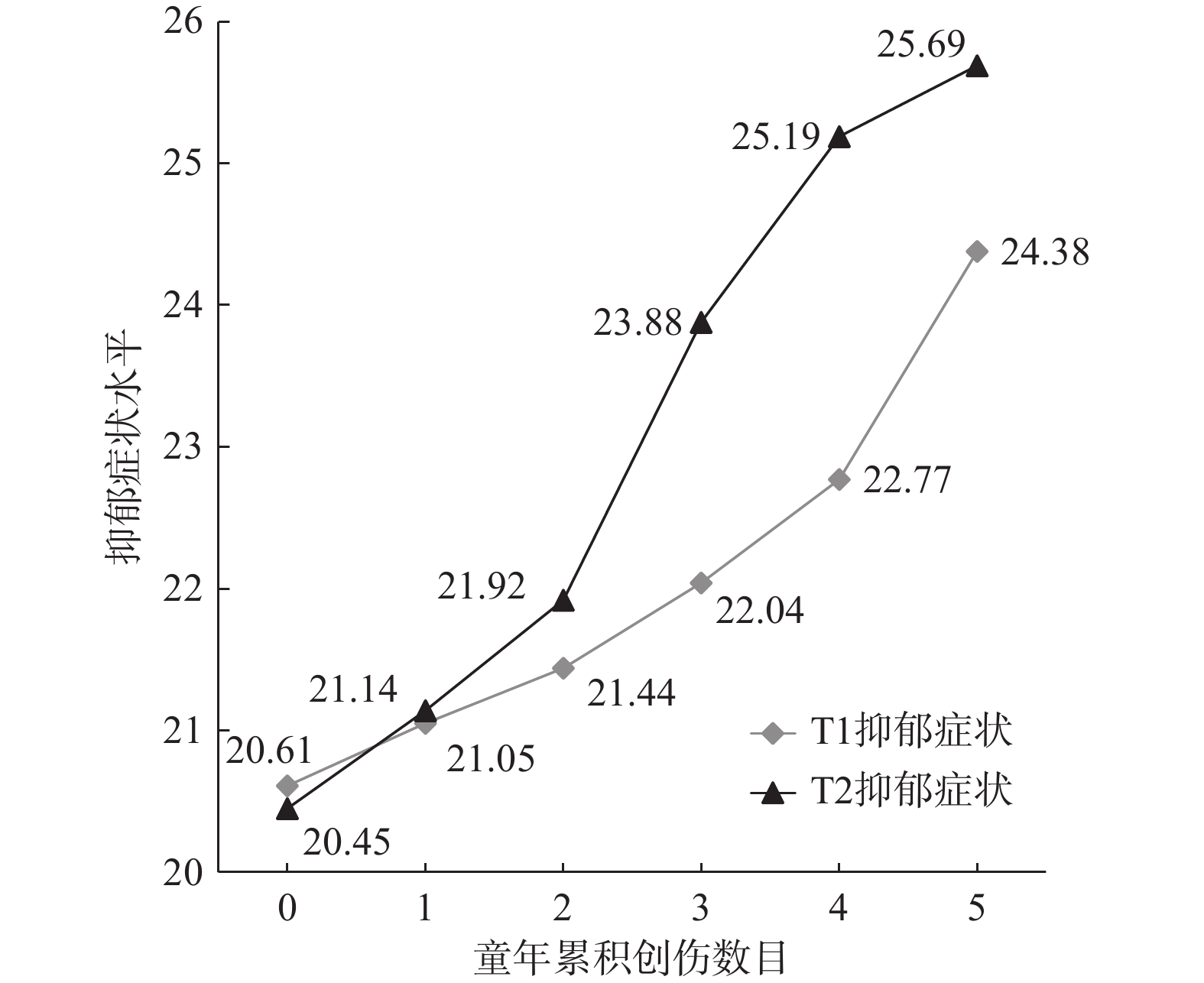
| 童年累积创伤数目 | n(%) | T1抑郁症状 | T2抑郁症状 |
| 0创伤 ① | 237(43.2%) | 20.61±4.14 | 20.45±4.12 |
| 1创伤 ② | 122(22.3%) | 21.05±4.82 | 21.14±4.81 |
| 2创伤 ③ | 92(16.8%) | 21.44±5.06 | 21.92±5.32 |
| 3创伤 ④ | 45(8.2%) | 22.04±4.40 | 23.88±7.17 |
| 4创伤 ⑤ | 31(5.7%) | 22.77±4.08 | 25.19±6.34 |
| 5创伤 ⑥ | 21(3.8%) | 24.38±4.38 | 25.69±6.62 |
| F(5, 542) | 4.05** | 9.87*** | |
| Post-hoc | ⑥>①②③④, ⑤>① | ⑥>①②③④, ⑤>①, ④>①②③, ③>①②③, ②>① |
| 童年累积创伤数目 | n(%) | T1抑郁症状 | T2抑郁症状 |
| 0创伤 ① | 237(43.2%) | 20.61±4.14 | 20.45±4.12 |
| 1创伤 ② | 122(22.3%) | 21.05±4.82 | 21.14±4.81 |
| 2创伤 ③ | 92(16.8%) | 21.44±5.06 | 21.92±5.32 |
| 3创伤 ④ | 45(8.2%) | 22.04±4.40 | 23.88±7.17 |
| 4创伤 ⑤ | 31(5.7%) | 22.77±4.08 | 25.19±6.34 |
| 5创伤 ⑥ | 21(3.8%) | 24.38±4.38 | 25.69±6.62 |
| F(5, 542) | 4.05** | 9.87*** | |
| Post-hoc | ⑥>①②③④, ⑤>① | ⑥>①②③④, ⑤>①, ④>①②③, ③>①②③, ②>① |
| T1抑郁症状 | T2抑郁症状 | ||||||||
| ΔR2 | F(df) | β | 95%CI | ΔR2 | F(df) | β | 95%CI | ||
| 第一层 | 0.03 | 18.94(1) | 0.08 | 47.25(1) | |||||
| 性别 | 0.01 | [−1.05, 1.15] | 0.04 | [−0.62, 1.90] | |||||
| 童年累积创伤 | 0.18*** | [0.32, 0.85] | 0.28*** | [0.74, 1.34] | |||||
| 第二层 | 0.04 | 1.16(1) | 0.08 | 0.39(1) | |||||
| 童年累积创伤2 | 0.12 | [−0.08, 0.27] | 0.07 | [−0.13, 0.26] | |||||
| T1抑郁症状 | T2抑郁症状 | ||||||||
| ΔR2 | F(df) | β | 95%CI | ΔR2 | F(df) | β | 95%CI | ||
| 第一层 | 0.03 | 18.94(1) | 0.08 | 47.25(1) | |||||
| 性别 | 0.01 | [−1.05, 1.15] | 0.04 | [−0.62, 1.90] | |||||
| 童年累积创伤 | 0.18*** | [0.32, 0.85] | 0.28*** | [0.74, 1.34] | |||||
| 第二层 | 0.04 | 1.16(1) | 0.08 | 0.39(1) | |||||
| 童年累积创伤2 | 0.12 | [−0.08, 0.27] | 0.07 | [−0.13, 0.26] | |||||
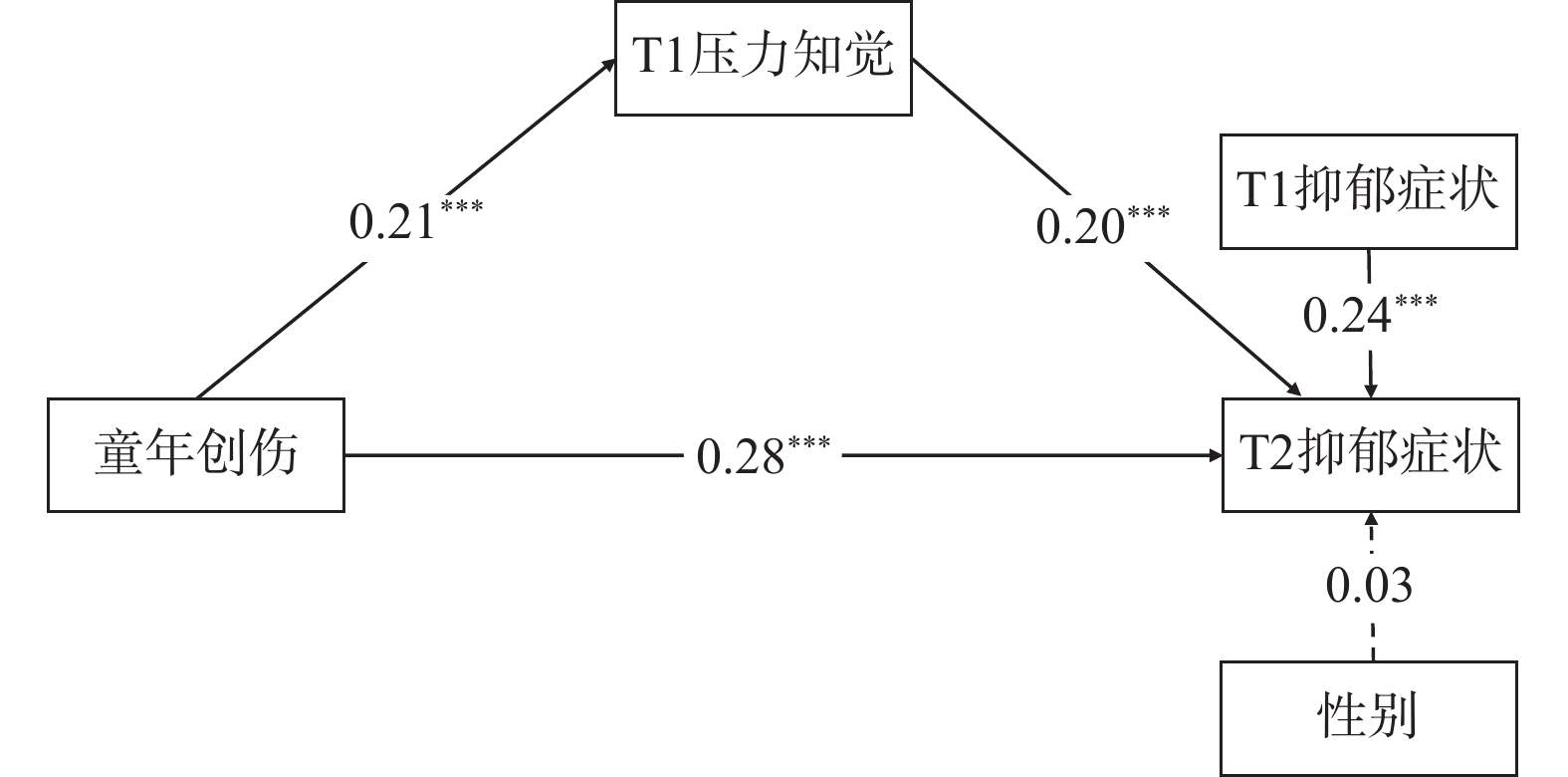
| 预测变量 | T2抑郁症状(Y) | T1压力知觉(M) | T2抑郁症状(Y) | ||||||||
| β | SE | p | β | SE | p | β | SE | p | |||
| 性别 | 0.03 | 0.62 | 0.332 | 0.03 | 0.66 | 0.361 | 0.03 | 0.61 | 0.423 | ||
| T1抑郁症状 | 0.31 | 0.04 | <0.001 | 0.38 | 0.05 | <0.001 | 0.24 | 0.05 | <0.001 | ||
| 童年创伤(X) | 0.28 | 0.02 | <0.001 | 0.21 | 0.02 | <0.001 | 0.24 | 0.02 | <0.001 | ||
| T1压力知觉(M) | 0.20 | 0.04 | <0.001 | ||||||||
| R2=0.21 | R2=0.21 | R2=0.24 | |||||||||
| F=44.25, p<0.001 | F=24.91, p<0.001 | F=21.71, p<0.001 | |||||||||
| 预测变量 | T2抑郁症状(Y) | T1压力知觉(M) | T2抑郁症状(Y) | ||||||||
| β | SE | p | β | SE | p | β | SE | p | |||
| 性别 | 0.03 | 0.62 | 0.332 | 0.03 | 0.66 | 0.361 | 0.03 | 0.61 | 0.423 | ||
| T1抑郁症状 | 0.31 | 0.04 | <0.001 | 0.38 | 0.05 | <0.001 | 0.24 | 0.05 | <0.001 | ||
| 童年创伤(X) | 0.28 | 0.02 | <0.001 | 0.21 | 0.02 | <0.001 | 0.24 | 0.02 | <0.001 | ||
| T1压力知觉(M) | 0.20 | 0.04 | <0.001 | ||||||||
| R2=0.21 | R2=0.21 | R2=0.24 | |||||||||
| F=44.25, p<0.001 | F=24.91, p<0.001 | F=21.71, p<0.001 | |||||||||
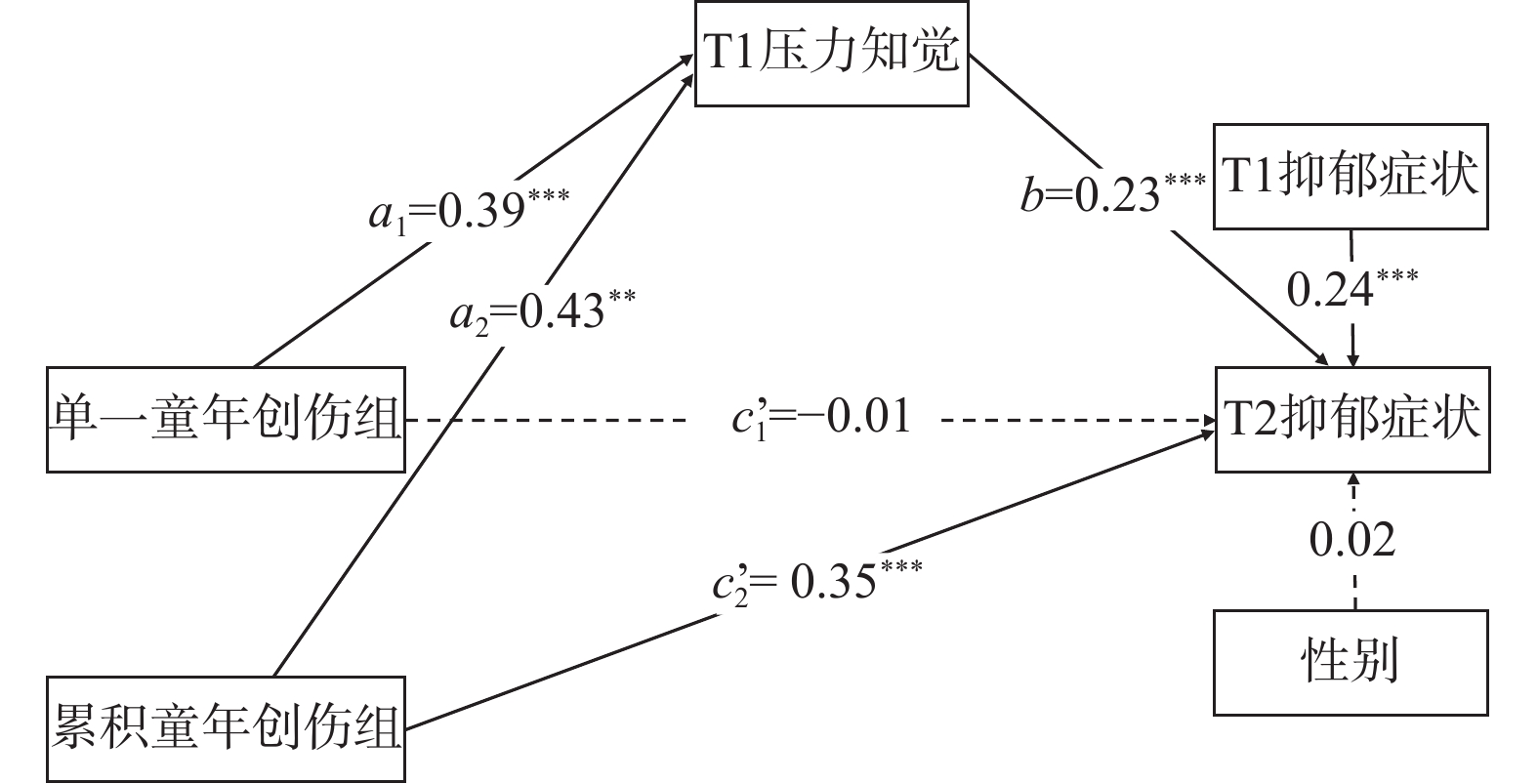
| 预测变量 | T2抑郁症状(Y) | T1压力知觉(M) | T2抑郁症状(Y) | |||||||||||
| β | SE | p | β | SE | p | β | SE | p | ||||||
| 性别 | 0.03 | 0.64 | 0.384 | 0.03 | 0.66 | 0.453 | 0.02 | 0.62 | 0.492 | |||||
| T1抑郁症状 | 0.36 | 0.04 | <0.001 | 0.38 | 0.05 | <0.001 | 0.24 | 0.05 | <0.001 | |||||
| 单一童年创伤组(X1) | c1 | 0.09 | 0.57 | 0.391 | a1 | 0.39 | 0.58 | <0.001 | c’1 | −0.01 | 0.56 | 0.973 | ||
| 累积童年创伤组(X2) | c2 | 0.45 | 0.51 | <0.001 | a2 | 0.43 | 0.52 | <0.001 | c’2 | 0.35 | 0.50 | <0.001 | ||
| T1压力知觉(M) | b | 0.23 | 0.04 | <0.001 | ||||||||||
| R2=0.17 | R2=0.21 | R2=0.22 | ||||||||||||
| F=25.90, p<0.001 | F=32.77, p<0.001 | F=27.29, p<0.001 | ||||||||||||
| 预测变量 | T2抑郁症状(Y) | T1压力知觉(M) | T2抑郁症状(Y) | |||||||||||
| β | SE | p | β | SE | p | β | SE | p | ||||||
| 性别 | 0.03 | 0.64 | 0.384 | 0.03 | 0.66 | 0.453 | 0.02 | 0.62 | 0.492 | |||||
| T1抑郁症状 | 0.36 | 0.04 | <0.001 | 0.38 | 0.05 | <0.001 | 0.24 | 0.05 | <0.001 | |||||
| 单一童年创伤组(X1) | c1 | 0.09 | 0.57 | 0.391 | a1 | 0.39 | 0.58 | <0.001 | c’1 | −0.01 | 0.56 | 0.973 | ||
| 累积童年创伤组(X2) | c2 | 0.45 | 0.51 | <0.001 | a2 | 0.43 | 0.52 | <0.001 | c’2 | 0.35 | 0.50 | <0.001 | ||
| T1压力知觉(M) | b | 0.23 | 0.04 | <0.001 | ||||||||||
| R2=0.17 | R2=0.21 | R2=0.22 | ||||||||||||
| F=25.90, p<0.001 | F=32.77, p<0.001 | F=27.29, p<0.001 | ||||||||||||
|
范兴华, 余思, 彭佳, 方晓义. 留守儿童生活压力与孤独感、幸福感的关系: 心理资本的中介与调节作用. 心理科学, 2017, 40 (2): 388- 394.
DOI |
|
|
方杰, 温忠麟, 张敏强. 类别变量的中介效应分析. 心理科学, 2017, 40 (2): 471- 477.
DOI |
|
|
傅文青, 姚树桥, 于宏华, 赵幸福, 李茹, 李英, 张艳青. 儿童期创伤问卷在中国高校大学生中应用的信效度研究. 中国临床心理学杂志, 2005, 13 (1): 40- 42.
DOI |
|
|
刘贤臣, 唐茂芹, 陈琨, 胡蕾, 王爱祯. SDS和CES-D对大学生抑郁症状评定结果的比较. 中国心理卫生杂志, 1995, 9 (1): 19- 20, 37.
|
|
|
石智雷, 吴志明. 早年不幸对健康不平等的长远影响: 生命历程与双重累积劣势. 社会学研究, 2018, 33 (3): 166- 192.
|
|
|
Agorastos, A., Pittman, J. O. E., Angkaw, A. C., Nievergelt, C. M., Hansen, C. J., Aversa, L. H., ... Baker, D. G. The cumulative effect of different childhood trauma types on self-reported symptoms of adult male depression and PTSD, substance abuse and health-related quality of life in a large active-duty military cohort. Journal of Psychiatric Research, 2014, 58, 46- 54.
DOI |
|
|
Anda, R. F., Porter, L. E., & Brown, D. W. Inside the adverse childhood experience score: Strengths, limitations, and misapplications. American Journal of Preventive Medicine, 2020, 59 (2): 293- 295.
DOI |
|
|
Andresen, E. M., Malmgren, J. A., Carter, W. B., & Patrick, D. L. Screening for depression in well older adults: Evaluation of a short form of the CES-D. American Journal of Preventive Medicine, 1994, 10 (2): 77- 84.
DOI |
|
|
Antonovsky, A. The salutogenic model as a theory to guide health promotion. Health Promotion International, 1996, 11 (1): 11- 18.
DOI |
|
|
Appleyard, K., Egeland, B., van Dulmen, M. H. M., & Sroufe, L. A. When more is not better: The role of cumulative risk in child behavior outcomes. Journal of Child Psychology and Psychiatry, 2005, 46 (3): 235- 245.
DOI |
|
|
Arnett, J. J. Emerging adulthood: A theory of development from the late teens through the twenties. American Psychologist, 2000, 55 (5): 469- 480.
DOI |
|
|
Ashworth, E., & Humphrey, N. More than the sum of its parts: Cumulative risk effects on school functioning in middle childhood. British Journal of Educational Psychology, 2020, 90 (1): 43- 61.
DOI |
|
|
Baquero, M., & Martín, N. Depressive symptoms in neurodegenerative diseases. World Journal of Clinical Cases, 2015, 3 (8): 682- 693.
DOI |
|
|
Beekman, A. T. F., Penninx, B. W. J. H., van Oppen, P., Giltay, E. J., Wiersma, J. E., Hovens, J. G. F. M., & van Schaik, D. J. F. The importance of childhood trauma and childhood life events for chronicity of depression in adults. The Journal of Clinical Psychiatry, 2009, 70 (7): 983- 989.
DOI |
|
|
Bernstein, D. P., Fink, L., Handelsman, L., & Foote, J. (1994). Childhood trauma questionnaire. In Assessment of family violence: A handbook for researchers and practitioners. Retrieved July 31, 2024, from https://doi.org/10.1037/t02080-000
|
|
|
Briere, J., Kaltman, S., & Green, B. L. Accumulated childhood trauma and symptom complexity. Journal of Traumatic Stress, 2008, 21 (2): 223- 226.
DOI |
|
|
Cohen, J., Cohen, P., West, S. G., & Aiken, L. S. (2003). Applied multiple regression/correlation analysis for the behavioral sciences (3rd ed.). Mahwah, NJ: Lawrence Erlbaum Associates Publishers.
|
|
|
Cohen, S., Kamarck, T., & Mermelstein, R. A global measure of perceived stress. Journal of Health and Social Behavior, 1983, 24 (4): 385- 396.
|
|
|
Copeland, W. E., Shanahan, L., Hinesley, J., Chan, R. F., Aberg, K. A., Fairbank, J. A., ... Costello, E. J. Association of childhood trauma exposure with adult psychiatric disorders and functional outcomes. JAMA Network Open, 2018, 1 (7): e184493.
DOI |
|
|
Danese, A., & Uher, R. Treatment response in individuals with depression and a history of childhood maltreatment. The Lancet Psychiatry, 2023, 10 (1): e1- e2.
DOI |
|
|
Daníelsdóttir, H. B., Aspelund, T., Shen, Q., Halldorsdottir, T., Jakobsdóttir, J., Song, H., ... Valdimarsdóttir, U. A. Adverse childhood experiences and adult mental health outcomes. JAMA Psychiatry, 2024, 81 (6): 586- 594.
DOI |
|
|
Eckenrode, J., Campa, M. I., Morris, P. A., Henderson, C. R., Jr., Bolger, K. E., Kitzman, H., & Olds, D. L. The prevention of child maltreatment through the nurse family partnership program: Mediating effects in a long-term follow-up study. Child Maltreatment, 2017, 22 (2): 92- 99.
DOI |
|
|
Elder, G. H., Jr. The life course as developmental theory. Child Development, 1998, 69 (1): 1- 12.
DOI |
|
|
Evans, G. W., Li, D. P., & Whipple, S. S. Cumulative risk and child development. Psychological Bulletin, 2013, 139 (6): 1342- 1396.
|
|
|
Garmezy, N., & Masten, A. S. Stress, competence, and resilience: Common frontiers for therapist and psychopathologist. Behavior Therapy, 1986, 17 (5): 500- 521.
DOI |
|
|
Grummitt, L. R., Kreski, N. T., Kim, S. G., Platt, J., Keyes, K. M., & McLaughlin, K. A. Association of childhood adversity with morbidity and mortality in US adults: A systematic review. JAMA Pediatrics, 2021, 175 (12): 1269- 1278.
DOI |
|
|
Hayes, A. F., & Preacher, K. J. Statistical mediation analysis with a multicategorical independent variable. British Journal of Mathematical and Statistical Psychology, 2014, 67 (3): 451- 470.
DOI |
|
|
Heim, C., Newport, D. J., Mletzko, T., Miller, A. H., & Nemeroff, C. B. The link between childhood trauma and depression: Insights from HPA axis studies in humans. Psychoneuroendocrinology, 2008, 33 (6): 693- 710.
DOI |
|
|
Hertzman, C. The biological embedding of early experience and its effects on health in adulthood. Annals of the New York Academy of Sciences, 1999, 896 (1): 85- 95.
DOI |
|
|
Huh, H. J., Kim, K. H., Lee, H. K., & Chae, J. H. The relationship between childhood trauma and the severity of adulthood depression and anxiety symptoms in a clinical sample: The mediating role of cognitive emotion regulation strategies. Journal of Affective Disorders, 2017, 213, 44- 50.
DOI |
|
|
Humphreys, K. L., LeMoult, J., Wear, J. G., Piersiak, H. A., Lee, A., & Gotlib, I. H. Child maltreatment and depression: A meta-analysis of studies using the Childhood Trauma Questionnaire. Child Abuse & Neglect, 2020, 102, 104361.
DOI |
|
|
Jones, C. M., Merrick, M. T., & Houry, D. E. Identifying and preventing adverse childhood experiences: Implications for clinical practice. JAMA, 2020, 323 (1): 25- 26.
DOI |
|
|
Maercker, A., Hilpert, P., & Burri, A. Childhood trauma and resilience in old age: Applying a context model of resilience to a sample of former indentured child laborers. Aging & Mental Health, 2016, 20 (6): 616- 626.
DOI |
|
|
Mandelli, L., Petrelli, C., & Serretti, A. The role of specific early trauma in adult depression: A meta-analysis of published literature. Childhood trauma and adult depression. European Psychiatry, 2015, 30 (6): 665- 680.
DOI |
|
|
Merrick, M. T., Ford, D. C., Ports, K. A., & Guinn, A. S. Prevalence of adverse childhood experiences from the 2011–2014 behavioral risk factor surveillance system in 23 states. JAMA Pediatrics, 2018, 172 (11): 1038- 1044.
DOI |
|
|
Norman, R. E., Byambaa, M., De, R., Butchart, A., Scott, J., & Vos, T. The long-term health consequences of child physical abuse, emotional abuse, and neglect: A systematic review and meta-analysis. PLoS Medicine, 2012, 9 (11): e1001349.
DOI |
|
|
Ross, N. D., Kaminski, P. L., & Herrington, R. From childhood emotional maltreatment to depressive symptoms in adulthood: The roles of self-compassion and shame. Child Abuse & Neglect, 2019, 92, 32- 42.
DOI |
|
|
Rutter, M. Resilience as a dynamic concept. Development and Psychopathology, 2012, 24 (2): 335- 344.
DOI |
|
|
Sawyer, S. M., Azzopardi, P. S., Wickremarathne, D., & Patton, G. C. The age of adolescence. The Lancet Child & Adolescent Health, 2018, 2 (3): 223- 228.
DOI |
|
|
Seery, M. D., Holman, E. A., & Silver, R. C. Whatever does not kill us: Cumulative lifetime adversity, vulnerability, and resilience. Journal of Personality and Social Psychology, 2010, 99 (6): 1025- 1041.
DOI |
|
|
Shchaslyvyi, A. Y., Antonenko, S. V., & Telegeev, G. D. Comprehensive review of chronic stress. Pathways and the efficacy of Behavioral Stress Reduction Programs (BSRPs) in managing diseases. International Journal of Environmental Research and Public Health, 2024, 21 (8): 1077.
DOI |
|
|
Yu, Y., Cui, X., Du, J. M., Wilson, A., Xu, S. C., & Wang, Y. Y. Linear and curvilinear association of pain tolerance and social anxiety symptoms among youth with different subgroups of childhood trauma. Journal of Affective Disorders, 2024, 354, 491- 499.
DOI |
|
|
Zheng, K. L., Chu, J., Zhang, X. C., Ding, Z. X., Song, Q., Liu, Z. X., ... Yi, J. Y. Psychological resilience and daily stress mediate the effect of childhood trauma on depression. Child Abuse & Neglect, 2022, 125, 105485.
DOI |
| Viewed | ||||||
|
Full text |
|
|||||
|
Abstract |
|
|||||
