
Studies of Psychology and Behavior ›› 2026, Vol. 24 ›› Issue (3): 367-374.DOI: 10.12139/j.1672-0628.2026.03.011
• ? • Previous Articles Next Articles
Baorui CHANG*,1( ), Jianing GUO2, Yuechen AO2
Received:2025-05-28
Online:2026-05-20
Published:2026-05-20
Contact:
Baorui CHANG
常保瑞*,1(), 郭佳宁2, 敖月晨2
通讯作者:
常保瑞
基金资助:CLC Number:
Baorui CHANG, Jianing GUO, Yuechen AO. The Influence of Awe on Creativity: The Chain Mediating Effect of Cognitive Flexibility and Creative Self-Efficacy[J]. Studies of Psychology and Behavior, 2026, 24(3): 367-374.
常保瑞, 郭佳宁, 敖月晨. 敬畏提升创造力:认知灵活性和创造自我效能感的链式中介效应[J]. 心理与行为研究, 2026, 24(3): 367-374.
Add to citation manager EndNote|Ris|BibTeX
URL: https://psybeh.tjnu.edu.cn/EN/10.12139/j.1672-0628.2026.03.011
| 变量 | M±SD | 1 | 2 | 3 | 4 | 5 | 6 |
| 1.性别 | |||||||
| 2.年龄 | 19.22±1.69 | 0.36** | |||||
| 3.是否独生 | 0.04 | −0.04 | |||||
| 4.敬畏 | 4.78±0.96 | 0.03 | 0.10* | −0.04 | |||
| 5.认知灵活性 | 3.38±0.47 | −0.06 | 0.11* | −0.06 | 0.49*** | ||
| 6.创造自我效能感 | 3.33±0.75 | −0.13** | 0.06 | −0.08 | 0.53*** | 0.62*** | |
| 7.创造力 | 2.94±0.59 | 0.03 | 0.13** | −0.06 | 0.42*** | 0.47*** | 0.61*** |
| 变量 | M±SD | 1 | 2 | 3 | 4 | 5 | 6 |
| 1.性别 | |||||||
| 2.年龄 | 19.22±1.69 | 0.36** | |||||
| 3.是否独生 | 0.04 | −0.04 | |||||
| 4.敬畏 | 4.78±0.96 | 0.03 | 0.10* | −0.04 | |||
| 5.认知灵活性 | 3.38±0.47 | −0.06 | 0.11* | −0.06 | 0.49*** | ||
| 6.创造自我效能感 | 3.33±0.75 | −0.13** | 0.06 | −0.08 | 0.53*** | 0.62*** | |
| 7.创造力 | 2.94±0.59 | 0.03 | 0.13** | −0.06 | 0.42*** | 0.47*** | 0.61*** |
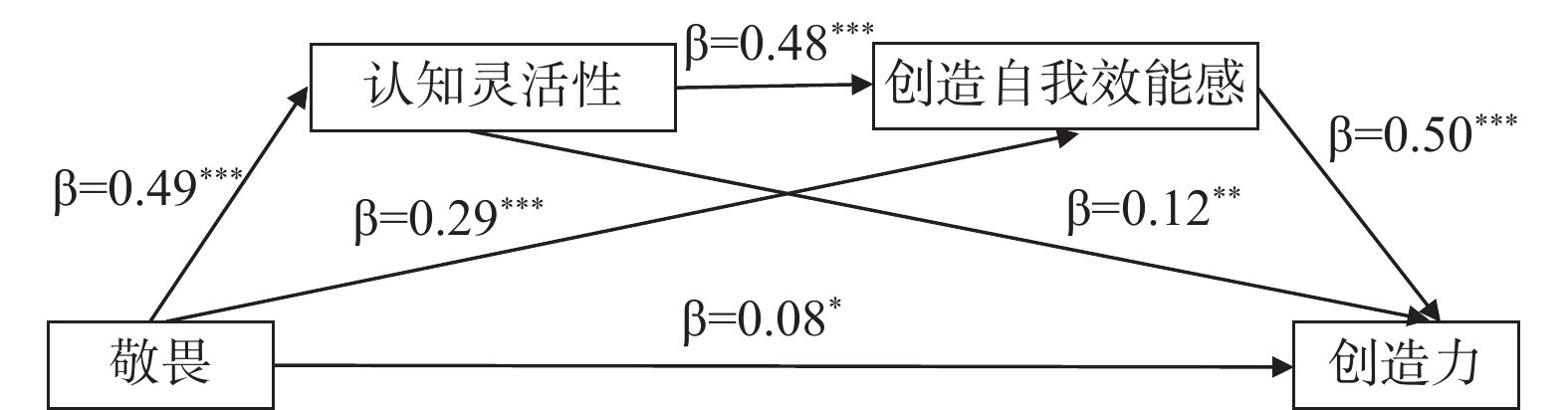
| 效应值 | Boot SE | Boot LLCI | Boot ULCI | |
| 直接效应 | 0.08 | 0.03 | 0.02 | 0.14 |
| 总间接效应 | 0.33 | 0.02 | 0.21 | 0.43 |
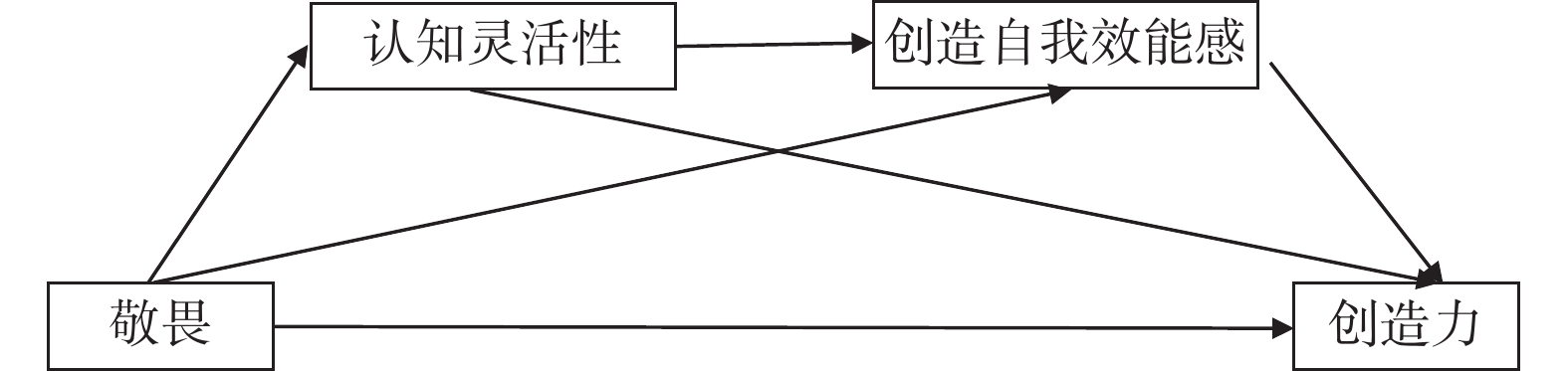
| 敬畏→认知灵活性→创造力 | 0.06 | 0.02 | 0.02 | 0.10 |
| 敬畏→创造自我效能感→创造力 | 0.15 | 0.01 | 0.09 | 0.20 |
| 敬畏→认知灵活性→ 创造自我效能感→创造力 | 0.12 | 0.01 | 0.07 | 0.16 |
| 效应值 | Boot SE | Boot LLCI | Boot ULCI | |
| 直接效应 | 0.08 | 0.03 | 0.02 | 0.14 |
| 总间接效应 | 0.33 | 0.02 | 0.21 | 0.43 |
| 敬畏→认知灵活性→创造力 | 0.06 | 0.02 | 0.02 | 0.10 |
| 敬畏→创造自我效能感→创造力 | 0.15 | 0.01 | 0.09 | 0.20 |
| 敬畏→认知灵活性→ 创造自我效能感→创造力 | 0.12 | 0.01 | 0.07 | 0.16 |
| 变量 | M±SD | 1 | 2 | 3 | 4 | 5 |
| 1.性别 | ||||||
| 2.年龄 | 18.97±1.41 | 0.00 | ||||
| 3.敬畏 | 0.50±0.50 | 0.02 | 0.20* | |||
| 4.认知灵活性 | 3.65±0.42 | 0.04 | 0.15 | 0.31*** | ||
| 5.创造自我效能感 | 3.28±0.63 | −0.07 | 0.01 | 0.35*** | 0.61*** | |
| 6.创造力 | 3.43±0.56 | 0.04 | 0.04 | 0.47*** | 0.64*** | 0.67*** |
| 变量 | M±SD | 1 | 2 | 3 | 4 | 5 |
| 1.性别 | ||||||
| 2.年龄 | 18.97±1.41 | 0.00 | ||||
| 3.敬畏 | 0.50±0.50 | 0.02 | 0.20* | |||
| 4.认知灵活性 | 3.65±0.42 | 0.04 | 0.15 | 0.31*** | ||
| 5.创造自我效能感 | 3.28±0.63 | −0.07 | 0.01 | 0.35*** | 0.61*** | |
| 6.创造力 | 3.43±0.56 | 0.04 | 0.04 | 0.47*** | 0.64*** | 0.67*** |
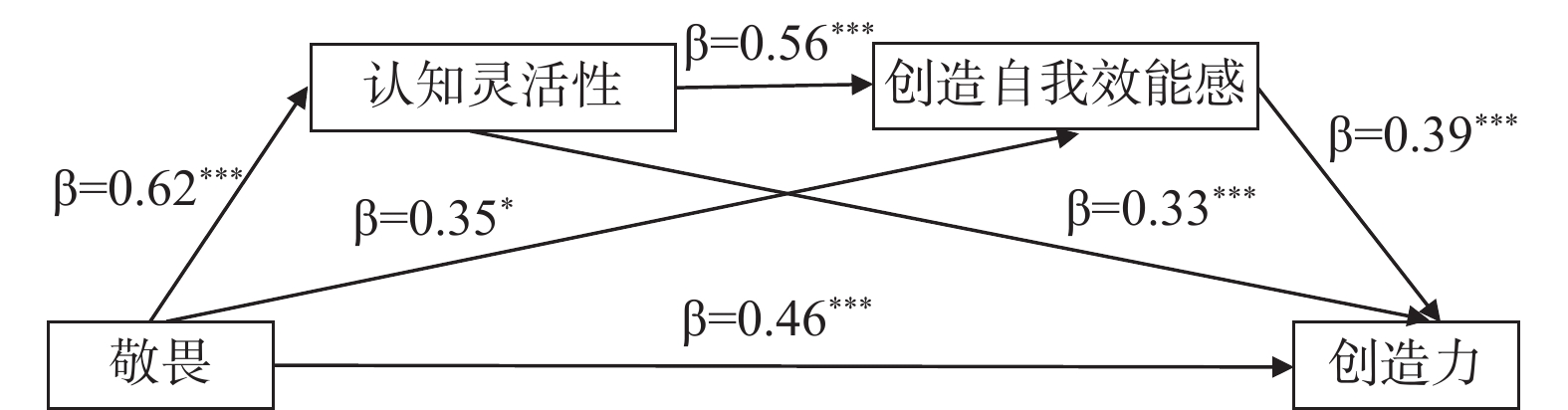
| 效应值 | Boot SE | Boot LLCI | Boot ULCI | |
| 直接效应 | 0.46 | 0.04 | 0.38 | 0.54 |
| 总间接效应 | 0.48 | 0.05 | 0.31 | 0.52 |
| 敬畏→认知灵活性→创造力 | 0.20 | 0.03 | 0.14 | 0.23 |
| 敬畏→创造自我效能感→创造力 | 0.14 | 0.03 | 0.09 | 0.20 |
| 敬畏→认知灵活性→ 创造自我效能感→创造力 | 0.14 | 0.01 | 0.07 | 0.16 |
| 效应值 | Boot SE | Boot LLCI | Boot ULCI | |
| 直接效应 | 0.46 | 0.04 | 0.38 | 0.54 |
| 总间接效应 | 0.48 | 0.05 | 0.31 | 0.52 |
| 敬畏→认知灵活性→创造力 | 0.20 | 0.03 | 0.14 | 0.23 |
| 敬畏→创造自我效能感→创造力 | 0.14 | 0.03 | 0.09 | 0.20 |
| 敬畏→认知灵活性→ 创造自我效能感→创造力 | 0.14 | 0.01 | 0.07 | 0.16 |
|
董蕊, 彭凯平, 喻丰. 积极情绪之敬畏. 心理科学进展, 2013, 21 (11): 1996- 2005.
|
|
|
贡喆. (2018). 创造力与道德的关系: 个体和团体的视角(博士学位论文). 南京师范大学.
|
|
|
何少颖, 方沛, 李洋, 江怀, 任志洪. 大学生创造力量表编制. 中国健康心理学杂志, 2015, 23 (1): 122- 125.
DOI |
|
|
李宏利, 郁巧玲. 自我独立与员工创造力的关系: 一个有调节的中介模型. 心理研究, 2018, 11 (1): 43- 51.
DOI |
|
|
刘占波. (2019). 大学生自我效能感对创造力的预测: 班级氛围的调节作用(硕士学位论文). 山东师范大学, 济南.
|
|
|
齐冰, 赵兵, 王琨, 刘欢欢. 大学生认知灵活性问卷的修订及初步使用. 心理与行为研究, 2013, 11 (1): 120- 123.
|
|
|
王阳, 杨燕, 肖婉婷, 苏勤. 认知灵活性问卷中文版测评大学生样本的效度和信度. 中国心理卫生杂志, 2016, 30 (1): 58- 63.
DOI |
|
|
谢莉, 金辉, 王志英, 叶桥键, 杨喜兰. 导师排斥感知对研究生科研创造力的影响: 科研自我效能感和科研焦虑的双向链式中介作用. 心理发展与教育, 2023, 39 (6): 833- 841.
|
|
|
熊红星, 张璟, 叶宝娟, 郑雪, 孙配贞. 共同方法变异的影响及其统计控制途径的模型分析. 心理科学进展, 2012, 20 (5): 757- 769.
DOI |
|
|
张潮, 安彦名, 刘金蕙, 吕一超, 喻丰. 敬畏情绪对创造力的影响: 认知灵活性的中介作用. 中国社会心理学评论, 2020, (2): 153- 176.
|
|
|
张军伟, 唐娇, 谢锟, 张亚军. 包容性导师对研究生科研创造力的影响: 认知灵活性的中介作用与经验开放性的调节作用. 心理研究, 2023, 16 (4): 354- 363.
DOI |
|
|
张勇, 刘海全, 王明旋, 青平. 挑战性压力和阻断性压力对员工创造力的影响: 自我效能的中介效应与组织公平的调节效应. 心理学报, 2018, 50 (4): 450- 461.
DOI |
|
|
诸彦含, 陈国良, 徐俊英. 组织中的正念: 基于认知的动态衍生过程及干预. 心理科学进展, 2020, 28 (3): 510- 522.
DOI |
|
|
Atamba, C., Popelnukha, A., & Ibrahim, F. L. Awe guards my creativity: The interactive effect of perceived abusive supervisory behavior, dispositional awe, and creative self-efficacy on Chinese employee creativity. Frontiers in Sociology, 2020, 5, 51.
DOI |
|
|
Baas, M., De Dreu, C. K. W., & Nijstad, B. A. A meta-analysis of 25 years of mood-creativity research: Hedonic tone, activation, or regulatory focus. Psychological Bulletin, 2008, 134 (6): 779- 806.
|
|
|
Bandura, A. Self-efficacy: Toward a unifying theory of behavioral change. Psychological Review, 1977, 84 (2): 191- 215.
DOI |
|
|
Bargh, J. A., Chaiken, S., Raymond, P., & Hymes, C. The automatic evaluation effect: Unconditional automatic attitude activation with a pronunciation task. Journal of Experimental Social Psychology, 1996, 32 (1): 104- 128.
DOI |
|
|
Batey, M. The measurement of creativity: From definitional consensus to the introduction of a new heuristic framework. Creativity Research Journal, 2012, 24 (1): 55- 65.
DOI |
|
|
Beresford, K., Kern, M. L., & Jarden, A. The creative-being model: The role of negative emotion in creative flourishing and the impact on positive education. The Journal of Positive Psychology, 2025, 20 (1): 59- 71.
DOI |
|
|
Chirico, A., Glaveanu, V. P., Cipresso, P., Riva, G., & Gaggioli, A. Awe enhances creative thinking: An experimental study. Creativity Research Journal, 2018, 30 (2): 123- 131.
DOI |
|
|
Demirtaş, A. S. Cognitive flexibility and mental well-being in Turkish adolescents: The mediating role of academic, social and emotional self-efficacy. Anales de Psicología/Annals of Psychology, 2020, 36 (1): 111- 121.
DOI |
|
|
Diamond, A. Executive functions. Annual Review of Psychology, 2013, 64, 135- 168.
DOI |
|
|
Gong, Y. P., Huang, J. C., & Farh, J. L. Employee learning orientation, transformational leadership, and employee creativity: The mediating role of employee creative self-efficacy. Academy of Management Journal, 2009, 52 (4): 765- 778.
DOI |
|
|
Jiang, T. L., Hicks, J. A., Yuan, W. Y., Yin, Y. G., Needy, L., & Vess, M. The unique nature and psychosocial implications of awe. Nature Reviews Psychology, 2024, 3 (7): 475- 488.
DOI |
|
|
Jiang, T. L., & Sedikides, C. Awe motivates authentic-self pursuit via self-transcendence: Implications for prosociality. Journal of Personality and Social Psychology, 2022, 123 (3): 576- 596.
DOI |
|
|
Karwowski, M., Lebuda, I., & Wiśniewska, E. Measuring creative self-efficacy and creative personal identity. The International Journal of Creativity & Problem Solving, 2018, 28 (1): 45- 57.
|
|
|
Kaynak, H., Denizci Nazlıgül, M., & Cengil, B. B. Your need for cognition, cognitive flexibility, and cognitive emotion regulation strategies matter! The path beyond a satisfied life. The Journal of Psychology, 2024, 158 (7): 611- 626.
DOI |
|
|
Keltner, D., & Haidt, J. Approaching awe, a moral, spiritual, and aesthetic emotion. Cognition and Emotion, 2003, 17 (2): 297- 314.
DOI |
|
|
Kiss, A. N., Libaers, D., Barr, P. S., Wang, T., & Zachary, M. A. CEO cognitive flexibility, information search, and organizational ambidexterity. Strategic Management Journal, 2020, 41 (12): 2200- 2233.
DOI |
|
|
Liberman, N., Polack, O., Hameiri, B., & Blumenfeld, M. Priming of spatial distance enhances children’s creative performance. Journal of Experimental Child Psychology, 2012, 111 (4): 663- 670.
DOI |
|
|
Lin, W. L., Tsai, P. H., Lin, H. Y., & Chen, H. C. How does emotion influence different creative performances? The mediating role of cognitive flexibility. Cognition & Emotion, 2014, 28 (5): 834- 844.
DOI |
|
|
Malik, M. A. R., Butt, A. N., & Choi, J. N. Rewards and employee creative performance: Moderating effects of creative self-efficacy, reward importance, and locus of control. Journal of Organizational Behavior, 2015, 36 (1): 59- 74.
DOI |
|
|
Martin, M. M., & Rubin, R. B. A new measure of cognitive flexibility. Psychological Reports, 1995, 76 (2): 623- 626.
DOI |
|
|
Meinel, M., Wagner, T. F., Baccarella, C. V., & Voigt, K. I. Exploring the effects of creativity training on creative performance and creative self‐efficacy: Evidence from a longitudinal study. The Journal of Creative Behavior, 2019, 53 (4): 546- 558.
DOI |
|
|
OECD. (2021). OECD future of education and skills 2030. Paris: OECD.
|
|
|
Petersen, S. E., Fineburg, A. C., Sheldon, K. M., Rettew, J. G., Beaumont, S. L., Lopez, F. G., … Sundararajan, L. (2009). The encyclopedia of positive psychology (pp. 73–75). Chichester, United Kingdom: Wiley-Blackwell.
|
|
|
Piaget, J. (1952). The origins of intelligence in children (M. Cook, Trans.). New York: W. W. Norton & Company.
|
|
|
Piff, P. K., Dietze, P., Feinberg, M., Stancato, D. M., & Keltner, D. Awe, the small self, and prosocial behavior. Journal of Personality and Social Psychology, 2015, 108 (6): 883- 899.
|
|
|
Rachmad, Y. E. (2022). Adaptive cognitive theory. Ferrara, Italy: Castello Libri Internazionali.
|
|
|
Reed, P. G. Toward a nursing theory of selftranscendence: Deductive reformulation using developmental theories. Advances in Nursing Science, 1991, 13 (4): 64- 77.
|
|
|
Rios, K., Markman, K. D., Schroeder, J., & Dyczewski, E. A. A (creative) portrait of the uncertain individual: Self-uncertainty and individualism enhance creative generation. Personality and Social Psychology Bulletin, 2014, 40 (8): 1050- 1062.
DOI |
|
|
Rudd, M., Hildebrand, C., & Vohs, K. D. Inspired to create: Awe enhances openness to learning and the desire for experiential creation. Journal of Marketing Research, 2018, 55 (5): 766- 781.
DOI |
|
|
Runco, M. A., Plucker, J. A., & Lim, W. Development and psychometric integrity of a measure of ideational behavior. Creativity Research Journal, 2001, 13 (3–4): 393- 400.
DOI |
|
|
Schaffer, V., Huckstepp, T., & Kannis-Dymand, L. Awe: A systematic review within a cognitive behavioural framework and proposed cognitive behavioural model of awe. International Journal of Applied Positive Psychology, 2024, 9 (1): 101- 136.
DOI |
|
|
Shiota, M. N., Keltner, D., & John, O. P. Positive emotion dispositions differentially associated with Big Five personality and attachment style. The Journal of Positive Psychology, 2006, 1 (2): 61- 71.
|
|
|
Spiro, R. J. (1988). Cognitive flexibility theory: Advanced knowledge acquisition in ill-structured domains. In The tenth annual conference of Cognitive Science Society. Montreal, Canada: Lawrence Erlbaum Assoc.
|
|
|
Tierney, P., & Farmer, S. M. Creative self-efficacy: Its potential antecedents and relationship to creative performance. Academy of Management Journal, 2002, 45 (6): 1137- 1148.
DOI |
|
|
Woodman, R. W., Sawyer, J. E., & Griffin, R. W. Toward a theory of organizational creativity. The Academy of Management Review, 1993, 18 (2): 293- 321.
|
|
|
Yang, Y., Hu, J., Jing, F. J., & Nguyen, B. From awe to ecological behavior: The mediating role of connectedness to nature. Sustainability, 2018, 10 (7): 2477.
DOI |
|
|
Yu, P. L., He, A. H., Wang, Q. Y., Li, Y. T., Hu, S., & Gao, Y. W. Psychological richness can enhance innovative behavior of Chinese college students: The chain mediating role of cognitive flexibility and creative self-efficacy. Frontiers in Psychology, 2025, 16, 1630873.
DOI |
|
|
Zajonc, R. B. Feeling and thinking: Preferences need no inferences. American Psychologist, 1980, 35 (2): 151- 175.
DOI |
| [1] | Qin WU, Xianguo HAN, Liying CUI, Wen HE. The Promotion of Adolescent Cooperative Behavior by Awe with Different Valences: The Roles of Need for Accommodation and Quiet Ego [J]. Studies of Psychology and Behavior, 2026, 24(3): 359-366. |
| [2] | ZHAI Hongkun, ZHOU Xiang, FU Jianghong, LI Kunzhao, CUI Yuxin, WEI Xiaowei. New Literacy for the Digital Intelligence Era: The Structure and Measurement of Human-AI Collaborative Creativity Literacy [J]. Studies of Psychology and Behavior, 2026, 24(3): 375-383. |
| [3] | Kaisheng XIE, Xinxin CHEN, Dan YUAN, Weikang HUANG, Jie FANG. The Effect of Parental Psychological Control on Malevolent Creativity: The Role of Anger Rumination and Resilience [J]. Studies of Psychology and Behavior, 2026, 24(1): 87-94. |
| [4] | Yuhan ZHANG, Fengqin DING. Awe and Prosocial Behavior in Junior High School Students: The Mediating Role of Meaning in Life [J]. Studies of Psychology and Behavior, 2026, 24(1): 130-137. |
| [5] | Zhiqiang YAN, Xianglu ZENG, Liqun HUANG, Lin XIAO. Does Empathy Promote or Hinder Creativity? The Evidence from Three-Level Meta-Analysis [J]. Studies of Psychology and Behavior, 2025, 23(5): 662-669. |
| [6] | Xiaoxiao WANG, Yimeng WANG, Fengyan WANG. Awe and Wise Reasoning: The Differential Mechanism of Positive and Negative Valence [J]. Studies of Psychology and Behavior, 2025, 23(1): 17-24. |
| [7] | Sa XIAO, Ying GUO, Xiaohong TAN, Yingxiong WU, Qun LIN. The Effect of Belief in a Just World on Malevolent Creativity of College Students: The Chain Mediating Roles of Relative Deprivation and Anger Rumination [J]. Studies of Psychology and Behavior, 2024, 22(6): 854-860. |
| [8] | Hang XU, Xinguang SHI, Jinyun DUAN, Hongxu LU. The Effect of Gratitude on Malevolent Creativity [J]. Studies of Psychology and Behavior, 2024, 22(4): 470-477. |
| [9] | Shujin ZHOU, Xianguo HAN, Dan LI, Xinyin CHEN, Jiaxi ZHOU, Xiaopeng CHEN, Junlong LUO. Relations Between Creativity and Internalizing and Externalizing Problem Behaviors in Rural Children [J]. Studies of Psychology and Behavior, 2024, 22(4): 486-493. |
| [10] | Haiyan ZHAO, Aibao ZHOU, Haixia CHI, Hongmin BAI, Changchun YE, Yanni JIANG. The Connection Between Perceived Interparental Conflict, Parent-Child Relationship and Adolescent Psychological Crisis: The Mediation of Cognitive Flexibility [J]. Studies of Psychology and Behavior, 2024, 22(2): 227-233. |
| [11] | Yingchun HAN, Linxuan WANG. Aerobic Exercise, Emotion, and Creativity: The Moderating Role of Fluid Intelligence [J]. Studies of Psychology and Behavior, 2024, 22(1): 100-107. |
| [12] | Boren BAI, Xiang ZHOU, Jingjing ZHANG, Yuxin CUI. Artificial Intelligence Narcissism Enhances Human-Agent Collaborative Innovation Willingness and Its Mechanisms [J]. Studies of Psychology and Behavior, 2024, 22(1): 137-144. |
| [13] | Ke ZHANG, Xiumin DU, Liyan LI, Xuehan ZHANG, Haixia ZHAO. Studies on the Relationship Between Sour Taste and Creativity [J]. Studies of Psychology and Behavior, 2023, 21(6): 815-823. |
| [14] | Zheng ZHANG, Xuexin LI. Fear of Negative Evaluation and Compulsive Buying: Materialism as a Mediator and Dispositional Awe as a Moderator [J]. Studies of Psychology and Behavior, 2023, 21(4): 541-548. |
| [15] | Xiaoshi LIU, Jingwen LI, Lei ZHANG, Cheng XIANG, Yun WU. Relationships Between Subjective Socioeconomic Status and Psychological Well-Being: The Mediating Effect of Creativity and the Moderating Effect of Security [J]. Studies of Psychology and Behavior, 2023, 21(1): 138-144. |
| Viewed | ||||||
|
Full text |
|
|||||
|
Abstract |
|
|||||
