
Studies of Psychology and Behavior ›› 2024, Vol. 22 ›› Issue (5): 673-681.DOI: 10.12139/j.1672-0628.2024.05.013
• ? • Previous Articles Next Articles
Haoyue XIAO, Shan ZHANG*( ), Haiping HAO, Houchao LYU*()
Received:2023-12-19
Online:2024-09-20
Published:2024-09-20
Contact:
Shan ZHANG, Houchao LYU
肖皓月, 张杉*(), 郝海平, 吕厚超*()
通讯作者:
张杉, 吕厚超
基金资助:Haoyue XIAO, Shan ZHANG, Haiping HAO, Houchao LYU. The Longitudinal Relationship Between Internet Addiction and Future Time Perspective Among High School Students: The Mediating Role of Depression[J]. Studies of Psychology and Behavior, 2024, 22(5): 673-681.
肖皓月, 张杉, 郝海平, 吕厚超. 高中生网络成瘾与未来时间洞察力的纵向关系:抑郁的中介作用[J]. 心理与行为研究, 2024, 22(5): 673-681.
Add to citation manager EndNote|Ris|BibTeX
URL: https://psybeh.tjnu.edu.cn/EN/10.12139/j.1672-0628.2024.05.013
| 变量 | 1 | 2 | 3 | 4 | 5 | 6 | 7 | 8 |
| 1. 性别 | ||||||||
| 2. 年龄 | −0.097* | |||||||
| 3. T1网络成瘾 | −0.085* | −0.017 | ||||||
| 4. T2网络成瘾 | −0.001 | −0.046 | 0.462** | |||||
| 5. T1抑郁 | −0.004 | 0.029 | 0.354** | 0.290** | ||||
| 6. T2抑郁 | −0.080* | 0.018 | 0.277** | 0.417** | 0.515** | |||
| 7. T1未来时间洞察力 | 0.003 | −0.039 | −0.300** | −0.215** | −0.343** | −0.222** | ||
| 8. T2未来时间洞察力 | −0.110** | −0.002 | −0.193** | −0.317** | −0.300** | −0.383** | 0.315** | |
| 均值(标准差) | 16.39(0.94) | 2.86(2.58) | 3.34(2.93) | 10.67(4.68) | 11.03(5.21) | 17.42(3.16) | 16.63(3.52) |
| 变量 | 1 | 2 | 3 | 4 | 5 | 6 | 7 | 8 |
| 1. 性别 | ||||||||
| 2. 年龄 | −0.097* | |||||||
| 3. T1网络成瘾 | −0.085* | −0.017 | ||||||
| 4. T2网络成瘾 | −0.001 | −0.046 | 0.462** | |||||
| 5. T1抑郁 | −0.004 | 0.029 | 0.354** | 0.290** | ||||
| 6. T2抑郁 | −0.080* | 0.018 | 0.277** | 0.417** | 0.515** | |||
| 7. T1未来时间洞察力 | 0.003 | −0.039 | −0.300** | −0.215** | −0.343** | −0.222** | ||
| 8. T2未来时间洞察力 | −0.110** | −0.002 | −0.193** | −0.317** | −0.300** | −0.383** | 0.315** | |
| 均值(标准差) | 16.39(0.94) | 2.86(2.58) | 3.34(2.93) | 10.67(4.68) | 11.03(5.21) | 17.42(3.16) | 16.63(3.52) |
| 变量 | 模型 | χ2 | df | CFI | TLI | RMSEA | 90 % CI | SRMR | 模型比较 | ∆χ2 | ∆df | p | ∆CFI | ∆TLI |
| 网络成瘾 | M1 | 433.40 | 159 | 0.93 | 0.91 | 0.05 | [0.04, 0.06] | 0.04 | ||||||
| M2 | 442.53 | 168 | 0.93 | 0.92 | 0.05 | [0.04, 0.05] | 0.04 | M2-M1 | 9.13 | 9 | >0.05 | |||
| M3 | 483.84 | 178 | 0.92 | 0.91 | 0.05 | [0.04, 0.06] | 0.05 | M3-M2 | 41.32 | 10 | <0.05 | −0.008 | −0.004 | |
| M4 | 521.97 | 188 | 0.91 | 0.91 | 0.05 | [0.05, 0.06] | 0.05 | M4-M3 | 38.12 | 10 | <0.05 | −0.007 | −0.003 | |
| 抑郁 | M1 | 618.92 | 157 | 0.92 | 0.90 | 0.07 | [0.06, 0.07] | 0.05 | ||||||
| M2 | 623.56 | 166 | 0.92 | 0.91 | 0.06 | [0.06, 0.07] | 0.05 | M2-M1 | 4.64 | 9 | >0.05 | |||
| M3 | 648.66 | 176 | 0.92 | 0.91 | 0.06 | [0.06, 0.07] | 0.06 | M3-M2 | 25.10 | 10 | <0.05 | −0.002 | 0.002 | |
| M4 | 676.61 | 186 | 0.91 | 0.91 | 0.06 | [0.06, 0.07] | 0.06 | M4-M3 | 27.95 | 10 | <0.05 | −0.004 | 0.002 | |
| 未来时间洞察力 | M1 | 67.52 | 29 | 0.98 | 0.97 | 0.04 | [0.03, 0.06] | 0.03 | ||||||
| M2 | 71.05 | 33 | 0.98 | 0.98 | 0.04 | [0.03, 0.05] | 0.03 | M2-M1 | 3.53 | 4 | >0.05 | |||
| M3 | 110.94 | 38 | 0.97 | 0.96 | 0.05 | [0.04, 0.06] | 0.05 | M3-M2 | 39.89 | 5 | <0.05 | −0.016 | −0.016 | |
| M4 | 117.72 | 43 | 0.97 | 0.96 | 0.05 | [0.04, 0.06] | 0.06 | M4-M3 | 6.77 | 5 | >0.05 |
| 变量 | 模型 | χ2 | df | CFI | TLI | RMSEA | 90 % CI | SRMR | 模型比较 | ∆χ2 | ∆df | p | ∆CFI | ∆TLI |
| 网络成瘾 | M1 | 433.40 | 159 | 0.93 | 0.91 | 0.05 | [0.04, 0.06] | 0.04 | ||||||
| M2 | 442.53 | 168 | 0.93 | 0.92 | 0.05 | [0.04, 0.05] | 0.04 | M2-M1 | 9.13 | 9 | >0.05 | |||
| M3 | 483.84 | 178 | 0.92 | 0.91 | 0.05 | [0.04, 0.06] | 0.05 | M3-M2 | 41.32 | 10 | <0.05 | −0.008 | −0.004 | |
| M4 | 521.97 | 188 | 0.91 | 0.91 | 0.05 | [0.05, 0.06] | 0.05 | M4-M3 | 38.12 | 10 | <0.05 | −0.007 | −0.003 | |
| 抑郁 | M1 | 618.92 | 157 | 0.92 | 0.90 | 0.07 | [0.06, 0.07] | 0.05 | ||||||
| M2 | 623.56 | 166 | 0.92 | 0.91 | 0.06 | [0.06, 0.07] | 0.05 | M2-M1 | 4.64 | 9 | >0.05 | |||
| M3 | 648.66 | 176 | 0.92 | 0.91 | 0.06 | [0.06, 0.07] | 0.06 | M3-M2 | 25.10 | 10 | <0.05 | −0.002 | 0.002 | |
| M4 | 676.61 | 186 | 0.91 | 0.91 | 0.06 | [0.06, 0.07] | 0.06 | M4-M3 | 27.95 | 10 | <0.05 | −0.004 | 0.002 | |
| 未来时间洞察力 | M1 | 67.52 | 29 | 0.98 | 0.97 | 0.04 | [0.03, 0.06] | 0.03 | ||||||
| M2 | 71.05 | 33 | 0.98 | 0.98 | 0.04 | [0.03, 0.05] | 0.03 | M2-M1 | 3.53 | 4 | >0.05 | |||
| M3 | 110.94 | 38 | 0.97 | 0.96 | 0.05 | [0.04, 0.06] | 0.05 | M3-M2 | 39.89 | 5 | <0.05 | −0.016 | −0.016 | |
| M4 | 117.72 | 43 | 0.97 | 0.96 | 0.05 | [0.04, 0.06] | 0.06 | M4-M3 | 6.77 | 5 | >0.05 |
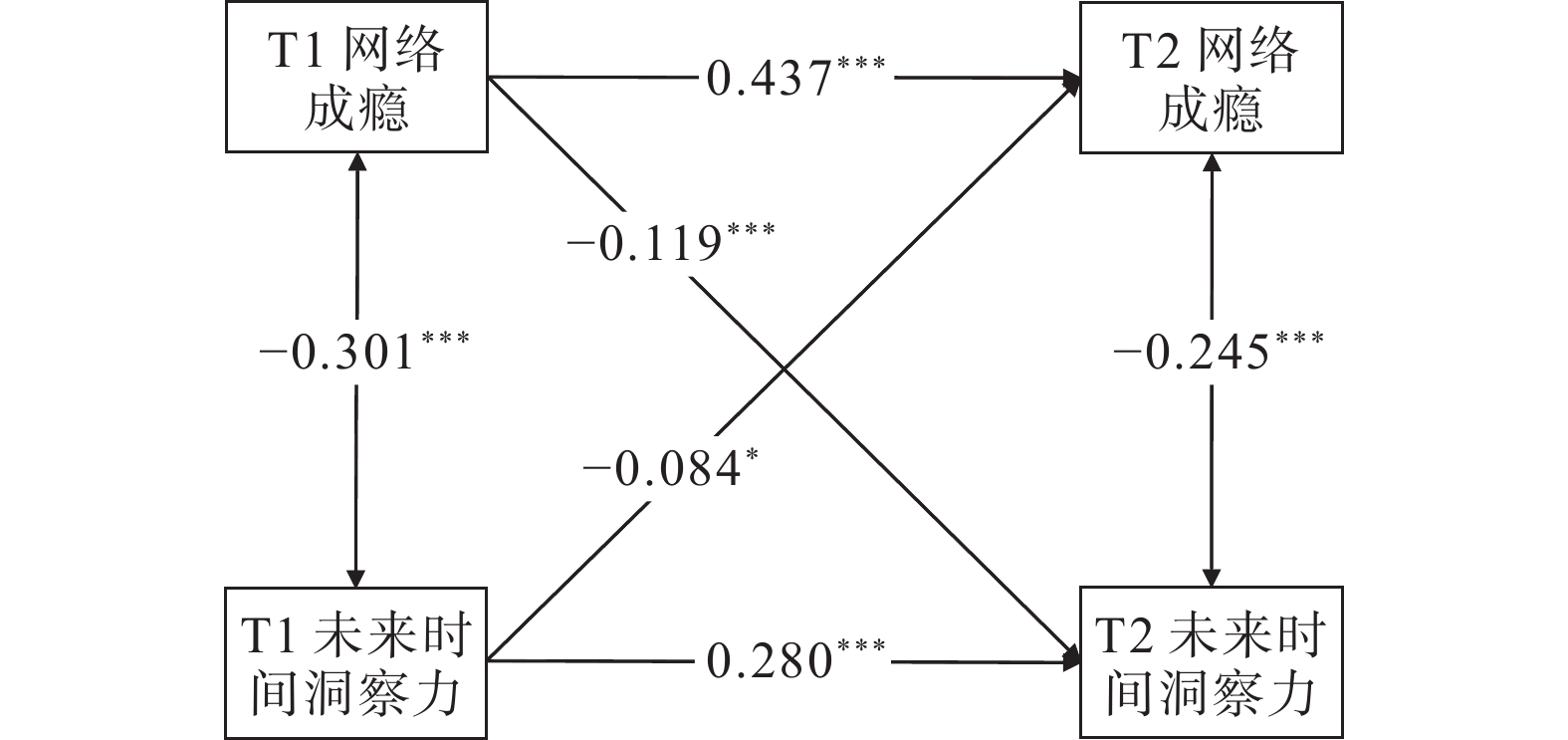
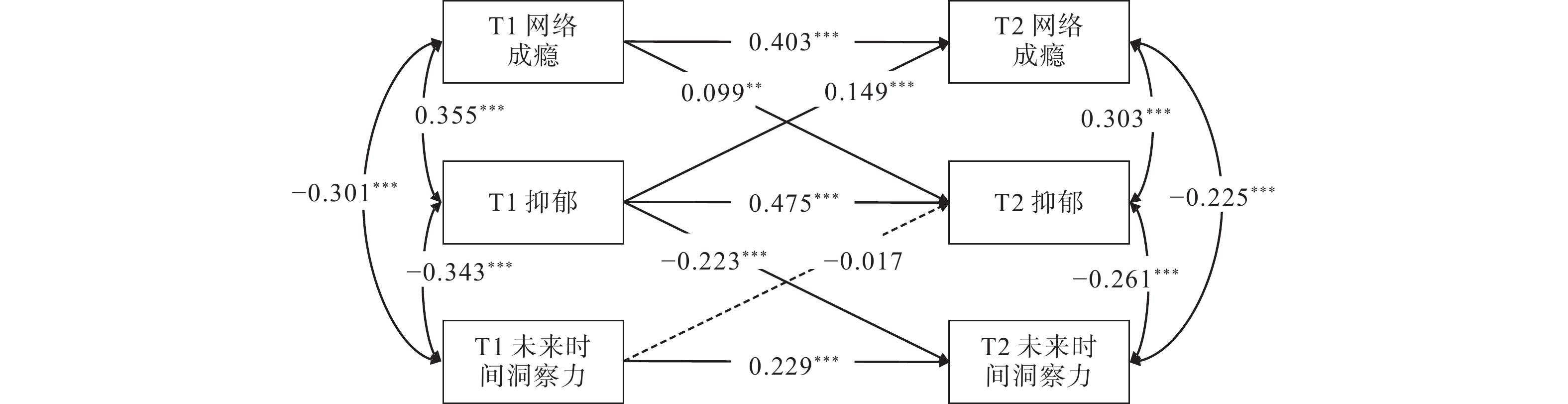
| 模型 | χ2 | df | GFI | CFI | IFI | RMSEA |
| M1 | 25.399 | 6 | 0.988 | 0.978 | 0.978 | 0.068 |
| M2 | 32.159 | 12 | 0.985 | 0.977 | 0.977 | 0.049 |
| M3 | 60.109 | 24 | 0.973 | 0.958 | 0.959 | 0.047 |
| 模型 | χ2 | df | GFI | CFI | IFI | RMSEA |
| M1 | 25.399 | 6 | 0.988 | 0.978 | 0.978 | 0.068 |
| M2 | 32.159 | 12 | 0.985 | 0.977 | 0.977 | 0.049 |
| M3 | 60.109 | 24 | 0.973 | 0.958 | 0.959 | 0.047 |
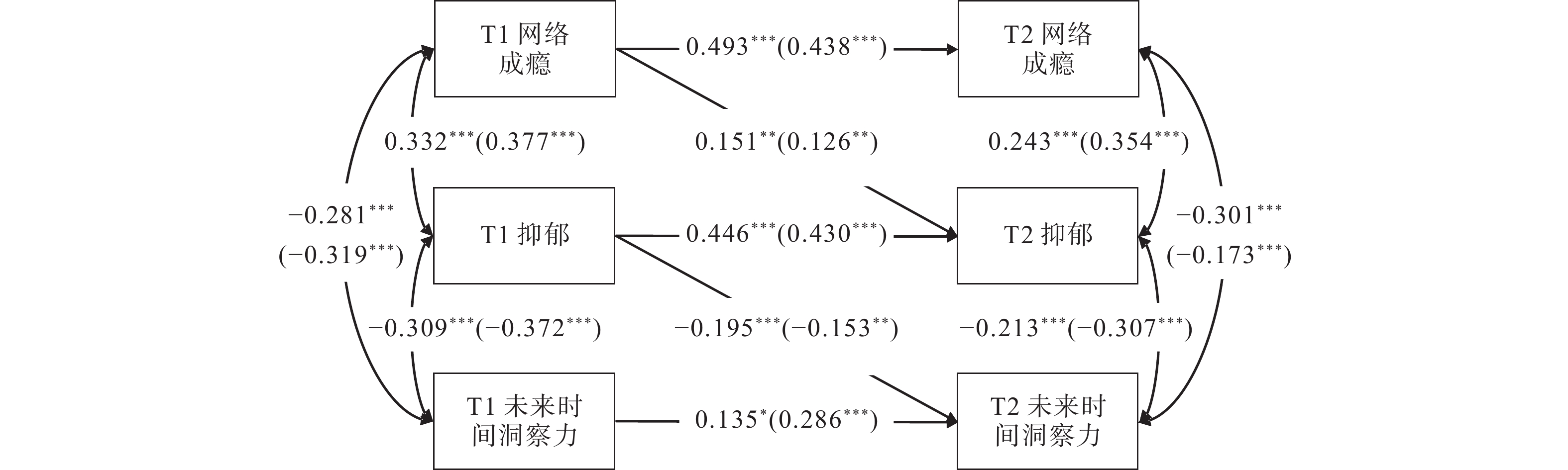
|
董奇, 林崇德. (2011). 中国儿童青少年心理发育标准化测验简介. 北京: 科学出版社.
|
|
|
杜刚, 吕厚超. 青少年未来时间洞察力和学业成绩的关系: 时间管理倾向的中介作用. 心理科学, 2017, 40 (1): 96- 102.
|
|
|
李明霞, 郑昊, 刘正奎. 农村青少年抑郁症状和亲社会行为的关系. 中国学校卫生, 2019, 40 (11): 1665- 1668.
|
|
|
李小保, 吴澜婷, 吕厚超. 自尊、未来时间洞察力与学业成就之间的关系: 一项追踪研究. 应用心理学, 2021, 27 (3): 244- 251,261.
DOI |
|
|
庞雪, 吕厚超, 华生旭. 延迟满足: 基于未来时间洞察力的自我调节. 心理科学, 2014, 37 (1): 78- 82.
|
|
|
Abramson, L. Y., Seligman, M. E., & Teasdale, J. D. Learned helplessness in humans: Critique and reformulation. Journal of Abnormal Psychology, 1978, 87 (1): 49- 74.
DOI |
|
|
Agbaria, Q. Internet addiction and aggression: The mediating roles of self-control and positive affect. International Journal of Mental Health and Addiction, 2021, 19 (4): 1227- 1242.
DOI |
|
|
Akin, A., & İskender, M. Internet addiction and depression, anxiety and stress. International Online Journal of Educational Sciences, 2011, 3 (1): 138- 148.
|
|
|
Andresen, E. M., Malmgren, J. A., Carter, W. B., & Patrick, D. L. Screening for depression in well older adults: Evaluation of a short form of the CES-D. American Journal of Preventive Medicine, 1994, 10 (2): 77- 84.
DOI |
|
|
Baird, H. M., Webb, T. L., Sirois, F. M., & Gibson-Miller, J. Understanding the effects of time perspective: A meta-analysis testing a self-regulatory framework. Psychological Bulletin, 2021, 147 (3): 233- 267.
DOI |
|
|
Baker, T. B., Piper, M. E., McCarthy, D. E., Majeskie, M. R., & Fiore, M. C. Addiction motivation reformulated: An affective processing model of negative reinforcement. Psychological Review, 2004, 111 (1): 33- 51.
DOI |
|
|
Borisenkov, M. F., Popov, S. V., Smirnov, V. V., Gubin, D. G., Petrov, I. M., Vasilkova, T. N., .. Symaniuk, E. E. (2022). Association between food addiction and time perspective during COVID-19 isolation. Eating and Weight Disorders-Studies on Anorexia, Bulimia and Obesity, 27(5), 1585–1591.
|
|
|
Carstensen, L. L. The influence of a sense of time on human development. Science, 2006, 312 (5782): 1913- 1915.
DOI |
|
|
Cate, R. A., & John, O. P. Testing models of the structure and development of future time perspective: Maintaining a focus on opportunities in middle age. Psychology and Aging, 2007, 22 (1): 186- 201.
DOI |
|
|
Cerniglia, L., Zoratto, F., Cimino, S., Laviola, G., Ammaniti, M., & Adriani, W. Internet addiction in adolescence: Neurobiological, psychosocial and clinical issues. Neuroscience & Biobehavioral Reviews, 2017, 76, 174- 184.
|
|
|
Cheng, Y. S., Ko, H. C., Sun, C. K., & Yeh, P. Y. The relationship between delay discounting and internet addiction: A systematic review and meta-analysis. Addictive Behaviors, 2021, 114, 106751.
DOI |
|
|
Chi, X. L., Hong, X., & Chen, X. C. Profiles and sociodemographic correlates of internet addiction in early adolescents in southern China. Addictive Behaviors, 2020, 106, 106385.
DOI |
|
|
Choung, Y., Chatterjee, S., & Pak, T. Y. Depression and financial planning horizon. Journal of Behavioral and Experimental Economics, 2022, 98, 101877.
DOI |
|
|
Christakis, D. A. Internet addiction: A 21st century epidemic. BMC Medicine, 2010, 8 (1): 61.
DOI |
|
|
de Leval, N. Scales of depression, ill-being and the quality of life—is there any difference? An assay in taxonomy. Quality of Life Research, 1995, 4 (3): 259- 269.
DOI |
|
|
Figner, B., Knoch, D., Johnson, E. J., Krosch, A. R., Lisanby, S. H., Fehr, E., & Weber, E. U. Lateral prefrontal cortex and self-control in intertemporal choice. Nature Neuroscience, 2010, 13 (5): 538- 539.
DOI |
|
|
Giordano, A. L., Schmit, M. K., & McCall, J. Exploring adolescent social media and internet gaming addiction: The role of emotion regulation. Journal of Addictions & Offender Counseling, 2023, 44 (1): 69- 80.
|
|
|
Goldstein, R. Z., & Volkow, N. D. Dysfunction of the prefrontal cortex in addiction: Neuroimaging findings and clinical implications. Nature Reviews Neuroscience, 2011, 12 (11): 652- 669.
DOI |
|
|
Hayat, A. A., Kojuri, J., & Amini, M. Academic procrastination of medical students: The role of internet addiction. Journal of Advances in Medical Education & Professionalism, 2020, 8 (2): 83- 89.
|
|
|
Karacic, S., & Oreskovic, S. Internet addiction through the phase of adolescence: A questionnaire study. JMIR Mental Health, 2017, 4 (2): e11.
DOI |
|
|
Kardefelt-Winther, D. A conceptual and methodological critique of internet addiction research: Towards a model of compensatory internet use. Computers in Human Behavior, 2014, 31, 351- 354.
DOI |
|
|
Kato, T. A., Shinfuku, N., & Tateno, M. Internet society, internet addiction, and pathological social withdrawal: The chicken and egg dilemma for internet addiction and hikikomori. Current Opinion in Psychiatry, 2020, 33 (3): 264- 270.
DOI |
|
|
Ko, C. H., Yen, J. Y., Yen, C. F., Chen, C. S., & Chen, C. C. The association between internet addiction and psychiatric disorder: A review of the literature. European Psychiatry, 2012, 27 (1): 1- 8.
DOI |
|
|
Kooij, D. T. A. M., Kanfer, R., Betts, M., & Rudolph, C. W. Future time perspective: A systematic review and meta-analysis. Journal of Applied Psychology, 2018, 103 (8): 867- 893.
DOI |
|
|
Lee, Z. W. Y., Cheung, C. M. K., & Chan, T. K. H. (2014). Explaining the development of the excessive use of massively multiplayer online games: A positive-negative reinforcement perspective. In 2014 47th Hawaii International Conference on System Sciences (pp. 668–677). Waikoloa, HI: IEEE.
|
|
|
Li, G. M., Liu, J., Wen, H. Y., & Shen, Q. Y. Changes in depression among adolescents: A multiple-group latent profile transition analysis. Psychology Research and Behavior Management, 2023, 16, 319- 332.
DOI |
|
|
Li, H. X., Guo, Y. F., & Yu, Q. L. Self-control makes the difference: The psychological mechanism of dual processing model on internet addicts’ unusual behavior in intertemporal choice. Computers in Human Behavior, 2019, 101, 95- 103.
DOI |
|
|
Li, X. B., Wang, C., Lyu, H. C., Worrell, F. C., & Mello, Z. R. Psychometric properties of the Chinese version of the Zimbardo Time Perspective Inventory. Current Psychology, 2023, 42, 13547- 13559.
DOI |
|
|
Liang, L. C., Zhou, D., Yuan, C. Y., Shao, A. H., & Bian, Y. F. Gender differences in the relationship between internet addiction and depression: A cross-lagged study in Chinese adolescents. Computers in Human Behavior, 2016, 63, 463- 470.
DOI |
|
|
Little, T. D., Preacher, K. J., Selig, J. P., & Card, N. A. New developments in latent variable panel analyses of longitudinal data. International Journal of Behavioral Development, 2007, 31 (4): 357- 365.
DOI |
|
|
Loh, K. K., & Kanai, R. How has the Internet reshaped human cognition. The Neuroscientist, 2016, 22 (5): 506- 520.
DOI |
|
|
Matthes, J., Karsay, K., Schmuck, D., & Stevic, A. “Too much to handle”: Impact of mobile social networking sites on information overload, depressive symptoms, and well-being. Computers in Human Behavior, 2020, 105, 106217.
DOI |
|
|
McClure, S. M., Laibson, D. I., Loewenstein, G., & Cohen, J. D. Separate neural systems value immediate and delayed monetary rewards. Science, 2004, 306 (5695): 503- 507.
DOI |
|
|
Méndez, M. L., Padrón, I., Fumero, A., & Marrero, R. J. Effects of internet and smartphone addiction on cognitive control in adolescents and young adults: A systematic review of fMRI studies. Neuroscience & Biobehavioral Reviews, 2024, 159, 105572.
|
|
|
Moore, M., Höfer, S., McGee, H., & Ring, L. Can the concepts of depression and quality of life be integrated using a time perspective. Health and Quality of Life Outcomes, 2005, 3, 1- 10.
DOI |
|
|
Müller, S. M., Wegmann, E., Stolze, D., & Brand, M. Maximizing social outcomes? Social zapping and fear of missing out mediate the effects of maximization and procrastination on problematic social networks use. Computers in Human Behavior, 2020, 107, 106296.
DOI |
|
|
Obeid, S., Saade, S., Haddad, C., Sacre, H., Khansa, W., Al Hajj, R., ... Hallit, S. Internet addiction among Lebanese adolescents: The role of self-esteem, anger, depression, anxiety, social anxiety and fear, impulsivity, and aggression—A cross-sectional study. The Journal of Nervous and Mental Disease, 2019, 207 (10): 838- 846.
DOI |
|
|
Ostovar, S., Allahyar, N., Aminpoor, H., Moafian, F., Nor, M. B. M., & Griffiths, M. D. Internet addiction and its psychosocial risks (depression, anxiety, stress and loneliness) among Iranian adolescents and young adults: A structural equation model in a cross-sectional study. International Journal of Mental Health and Addiction, 2016, 14 (3): 257- 267.
DOI |
|
|
Ouyang, M. K., Gui, D. N., Cai, X., Yin, Y. L., Mao, X. L., Huang, S. X., ... Wang, P. C. Stressful life events and subjective well-being in vocational school female adolescents: The mediating role of depression and the moderating role of perceived social support. Frontiers in Psychology, 2021, 11, 603511.
DOI |
|
|
Peviani, K. M., Kahn, R. E., Maciejewski, D., Bickel, W. K., Deater-Deckard, K., King-Casas, B., & Kim-Spoon, J. Intergenerational transmission of delay discounting: The mediating role of household chaos. Journal of Adolescence, 2019, 72 (1): 83- 90.
DOI |
|
|
Przepiorka, A., Blachnio, A., & Cudo, A. The role of depression, personality, and future time perspective in internet addiction in adolescents and emerging adults. Psychiatry Research, 2019, 272, 340- 348.
DOI |
|
|
Saadati, H. M., Mirzaei, H., Okhovat, B., & Khodamoradi, F. Association between internet addiction and loneliness across the world: A meta-analysis and systematic review. SSM-Population Health, 2021, 16, 100948.
DOI |
|
|
Saville, B. K., Gisbert, A., Kopp, J., & Telesco, C. Internet addiction and delay discounting in college students. The Psychological Record, 2010, 60 (2): 273- 286.
DOI |
|
|
Seligman, M. E. P. Learned helplessness. Annual Review of Medicine, 1972, 23, 407- 412.
DOI |
|
|
Servidio, R., Bartolo, M. G., Palermiti, A. L., & Costabile, A. Fear of COVID-19, depression, anxiety, and their association with internet addiction disorder in a sample of Italian students. Journal of Affective Disorders Reports, 2021, 4, 100097.
DOI |
|
|
Settanni, M., Marengo, D., Fabris, M. A., & Longobardi, C. The interplay between ADHD symptoms and time perspective in addictive social media use: A study on adolescent Facebook users. Children and Youth Services Review, 2018, 89, 165- 170.
DOI |
|
|
Sokol, Y., & Serper, M. Temporal self appraisal and continuous identity: Associations with depression and hopelessness. Journal of Affective Disorders, 2017, 208, 503- 511.
DOI |
|
|
Solomon, R. L., & Corbit, J. D. An opponent-process theory of motivation: I. Temporal dynamics of affect. Psychological Review, 1974, 81 (2): 119- 145.
DOI |
|
|
Stanković, M., Nešić, M., Čičević, S., & Shi, Z. H. Association of smartphone use with depression, anxiety, stress, sleep quality, and internet addiction. Empirical evidence from a smartphone application. Personality and Individual Differences, 2021, 168, 110342.
DOI |
|
|
Takahashi, M., Adachi, M., Hirota, T., Nishimura, T., Shinkawa, H., Mori, H., & Nakamura, K. Longitudinal association between addictive internet use and depression in early adolescents over a 2-year period: A study using a random intercept cross-lagged model. Computers in Human Behavior, 2022, 132, 107251.
DOI |
|
|
Taylor, S. E., Klein, L. C., Lewis, B. P., Gruenewald, T. L., Gurung, R. A., & Updegraff, J. A. Biobehavioral responses to stress in females: Tend-and-befriend, not fight-or-flight. Psychological Review, 2002, 107 (3): 411- 429.
|
|
|
Tomaszek, K., & Muchacka-Cymerman, A. Examining the relationship between student school burnout and problematic internet use. Educational Sciences: Theory & Practice, 2020, 20 (2): 16- 31.
|
|
|
Vanderlind, W. M., Millgram, Y., Baskin-Sommers, A. R., Clark, M. S., & Joormann, J. Understanding positive emotion deficits in depression: From emotion preferences to emotion regulation. Clinical Psychology Review, 2020, 76, 101826.
DOI |
|
|
Watson, R., Harvey, K., McCabe, C., & Reynolds, S. Understanding anhedonia: A qualitative study exploring loss of interest and pleasure in adolescent depression. European Child & Adolescent Psychiatry, 2020, 29 (2): 489- 499.
|
|
|
Wilson, A. E., & Ross, M. From chump to champ: People’s appraisals of their earlier and present selves. Journal of Personality and Social Psychology, 2001, 80 (4): 572- 584.
DOI |
|
|
Yen, J. Y., Ko, C. H., Yen, C. F., Wu, H. Y., & Yang, M. J. The comorbid psychiatric symptoms of internet addiction: Attention deficit and hyperactivity disorder (ADHD), depression, social phobia, and hostility. Journal of Adolescent Health, 2007, 41 (1): 93- 98.
DOI |
|
|
Young, K. S. Internet addiction: The emergence of a new clinical disorder. CyberPsychology & Behavior, 1998, 1 (3): 237- 244.
|
|
|
Zhao, Y., Qu, D. Y., Chen, S. Y., & Chi, X. L. Network analysis of internet addiction and depression among Chinese college students during the COVID-19 pandemic: A longitudinal study. Computers in Human Behavior, 2023, 138, 107424.
DOI |
|
|
Zimbardo, P. G., & Boyd, J. N. Putting time in perspective: A valid, reliable individual-differences metric. Journal of Personality and Social Psychology, 1999, 77 (6): 1271- 1288.
DOI |
| Viewed | ||||||
|
Full text |
|
|||||
|
Abstract |
|
|||||
