
Studies of Psychology and Behavior ›› 2025, Vol. 23 ›› Issue (4): 504-512.DOI: 10.12139/j.1672-0628.2025.04.010
• ? • Previous Articles Next Articles
Zhenzhou BAO, Hua LIU, Mingshen YU*( )
)
Received:2024-07-17
Online:2025-07-20
Published:2025-07-20
Contact:
Mingshen YU
鲍振宙, 刘花, 于明申*()
通讯作者:
于明申
基金资助:Zhenzhou BAO, Hua LIU, Mingshen YU. The Relationship Between Adolescents’ Bystander Behaviors in School Bullying and Anxiety-Depression Symptoms: Based on Longitudinal Network Analysis[J]. Studies of Psychology and Behavior, 2025, 23(4): 504-512.
鲍振宙, 刘花, 于明申. 青少年校园欺凌旁观行为与焦虑抑郁症状的关系:基于纵向网络分析法[J]. 心理与行为研究, 2025, 23(4): 504-512.
Add to citation manager EndNote|Ris|BibTeX
URL: https://psybeh.tjnu.edu.cn/EN/10.12139/j.1672-0628.2025.04.010
| 人口统计学因素 | |
| 年龄, M(SD)a | |
| T1: 14.40(1.30) | |
| T2: 14.90(1.30) | |
| 性别, n(%) | |
| 男 | 535(49.40%) |
| 女 | 548(50.60%) |
| 家庭经济困难, n(%)a | |
| 很大困难 | 16(1.48%) |
| 较大困难 | 63(5.82%) |
| 较小困难 | 386(35.64%) |
| 没有困难 | 475(43.86%) |
| 人口统计学因素 | |
| 年龄, M(SD)a | |
| T1: 14.40(1.30) | |
| T2: 14.90(1.30) | |
| 性别, n(%) | |
| 男 | 535(49.40%) |
| 女 | 548(50.60%) |
| 家庭经济困难, n(%)a | |
| 很大困难 | 16(1.48%) |
| 较大困难 | 63(5.82%) |
| 较小困难 | 386(35.64%) |
| 没有困难 | 475(43.86%) |
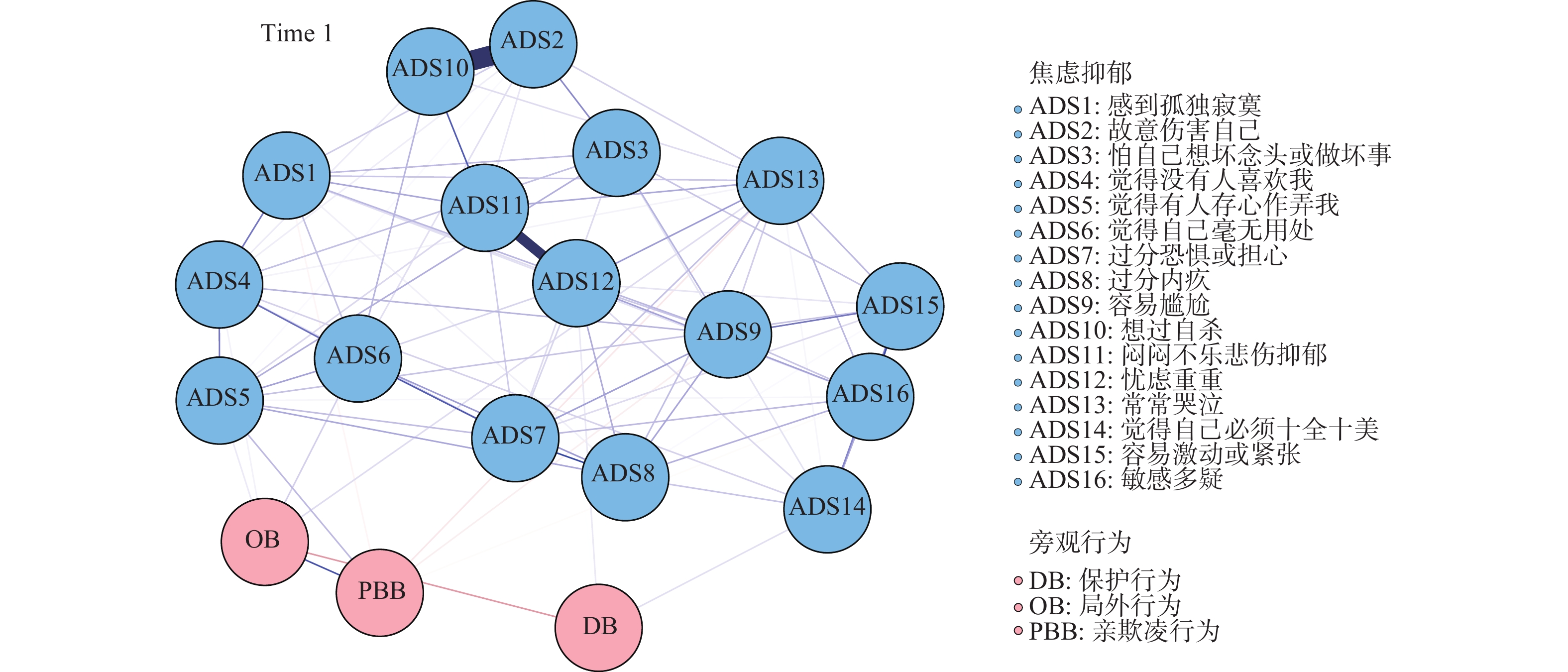
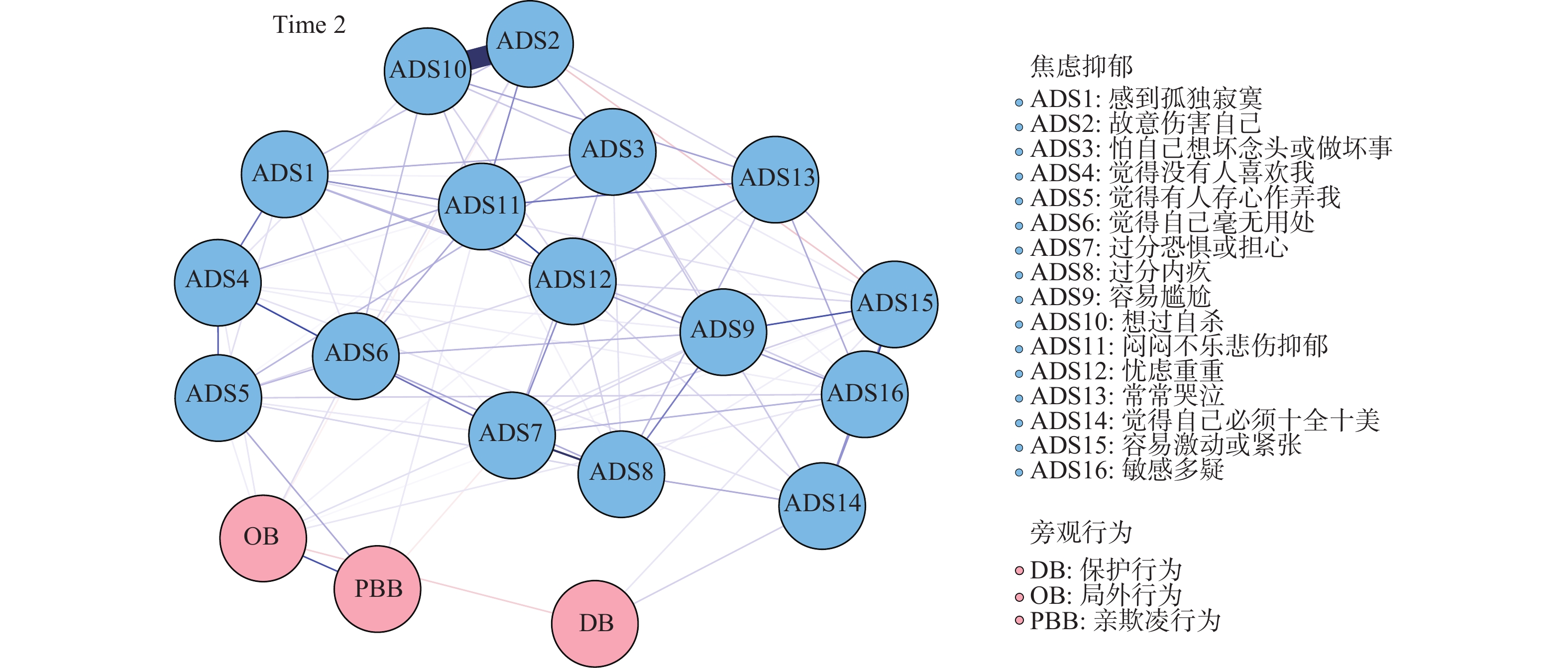
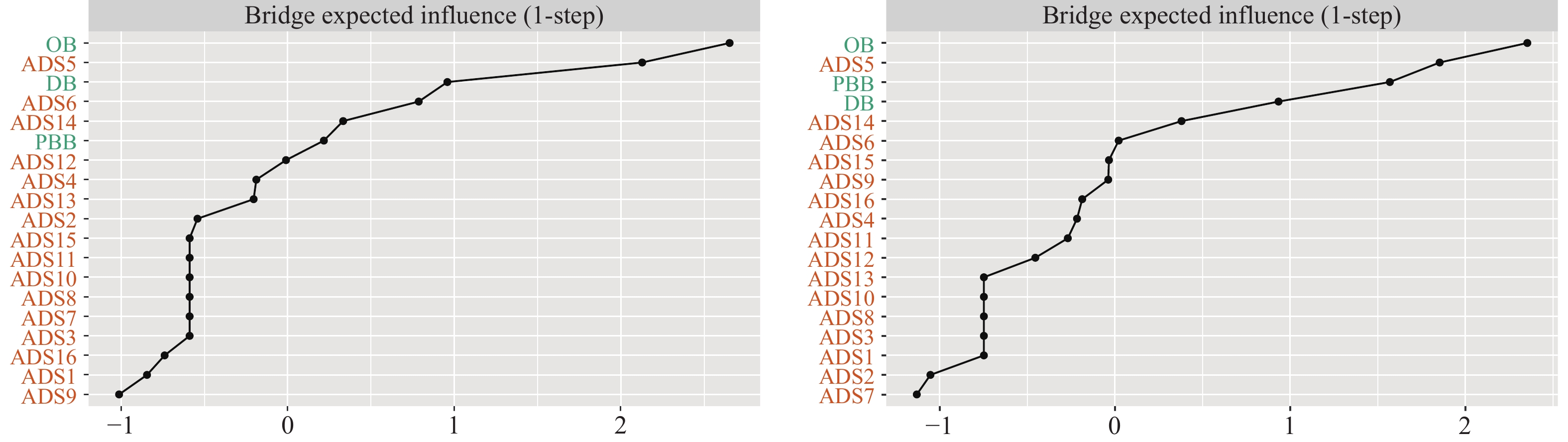
| 节点 | 节点 | p | d(T2−T1) | |
| 焦虑抑郁 | ADS4 | ADS6 | 0.04 | −0.11 |
| ADS1 | ADS8 | 0.02 | −0.02 | |
| ADS6 | ADS9 | 0.02 | 0.09 | |
| ADS3 | ADS10 | 0.03 | 0.07 | |
| ADS2 | ADS11 | 0.03 | 0.14 | |
| ADS6 | ADS11 | 0.03 | 0.11 | |
| ADS11 | ADS12 | 0.05 | −0.09 | |
| ADS5 | ADS15 | 0.01 | −0.07 | |
| ADS9 | ADS13 | 0.05 | −0.02 | |
| 旁观行为−焦虑抑郁 | DB | ADS12 | 0.04 | −0.02 |
| 节点 | 节点 | p | d(T2−T1) | |
| 焦虑抑郁 | ADS4 | ADS6 | 0.04 | −0.11 |
| ADS1 | ADS8 | 0.02 | −0.02 | |
| ADS6 | ADS9 | 0.02 | 0.09 | |
| ADS3 | ADS10 | 0.03 | 0.07 | |
| ADS2 | ADS11 | 0.03 | 0.14 | |
| ADS6 | ADS11 | 0.03 | 0.11 | |
| ADS11 | ADS12 | 0.05 | −0.09 | |
| ADS5 | ADS15 | 0.01 | −0.07 | |
| ADS9 | ADS13 | 0.05 | −0.02 | |
| 旁观行为−焦虑抑郁 | DB | ADS12 | 0.04 | −0.02 |
|
陈嘉慧, 任萍, 吕沐华, 李添. 童年晚期抑郁症状网络的演化及症状间的纵向关系. 心理科学, 2024, 47 (6): 1381- 1391.
|
|
|
储怡佳. (2023). 青少年亲欺凌旁观行为的发展轨迹及其前因与后果变量分析(硕士学位论文). 赣南师范大学, 赣州.
|
|
|
纪林芹, 陈亮, 徐夫真, 赵守盈, 张文新. 童年中晚期同伴侵害对儿童心理社会适应影响的纵向分析. 心理学报, 2011, 43 (10): 1151- 1162.
|
|
|
王大涛, 刘艳艳, 周建华. 同伴侵害对青少年内外化问题的影响: 有调节的中介模型. 心理与行为研究, 2023, 21 (5): 651- 657.
DOI |
|
|
王孟成, 张新彤, 吕昌嵩, 黎志华. 男性服刑人员抑郁焦虑症状网络结构及其与父母养育方式的关系. 中国临床心理学杂志, 2021, 29 (3): 496- 500.
|
|
|
杨晓霞, 陈亮, 曹衍淼, 毕馨文, 陈光辉, 张文新. 青少年早期同伴侵害的亚类别及其稳定性: 个体定向的分析. 心理发展与教育, 2020, 36 (2): 146- 156.
|
|
|
喻承甫, 张卫, 曾毅茵, 叶婷, 李月明, 王姝君. 青少年感恩与问题行为的关系: 学校联结的中介作用. 心理发展与教育, 2011, 27 (4): 425- 433.
|
|
|
张伟霞, 席敏, 阴甜甜, 王成, 司书宾. 基于网络分析的抑郁症产生与演变预测. 心理科学进展, 2023, 31 (11): 2129- 2141.
|
|
|
Bandura, A. Moral disengagement in the perpetration of inhumanities. Personality and Social Psychology Review, 1999, 3 (3): 193- 209.
DOI |
|
|
Beard, C., Millner, A. J., Forgeard, M. J. C., Fried, E. I., Hsu, K. J., Treadway, M. T., … Björgvinsson, T. Network analysis of depression and anxiety symptom relationships in a psychiatric sample. Psychological Medicine, 2016, 46 (16): 3359- 3369.
DOI |
|
|
Bekkhus, M., McVarnock, A., Coplan, R. J., Ulset, V., & Kraft, B. Developmental changes in the structure of shyness and internalizing symptoms from early to middle childhood: A network analysis. Child Development, 2023, 94 (4): 1078- 1086.
DOI |
|
|
Borkovec, T. D., Lyonfields, J. D., Wiser, S. L., & Deihl, L. The role of worrisome thinking in the suppression of cardiovascular response to phobic imagery. Behaviour Research and Therapy, 1993, 31 (3): 321- 324.
DOI |
|
|
Copeland, W. E., Shanahan, L., Costello, E. J., & Angold, A. Childhood and adolescent psychiatric disorders as predictors of young adult disorders. Archives of General Psychiatry, 2009, 66 (7): 764- 772.
DOI |
|
|
Copeland, W. E., Wolke, D., Angold, A., & Costello, E. J. Adult psychiatric outcomes of bullying and being bullied by peers in childhood and adolescence. JAMA Psychiatry, 2013, 70 (4): 419- 426.
DOI |
|
|
Craig, W. M., & Pepler, D. J. Observations of bullying and victimization in the school yard. Canadian Journal of School Psychology, 1998, 13 (2): 41- 59.
DOI |
|
|
D’Augelli, A. R., Pilkington, N. W., & Hershberger, S. L. Incidence and mental health impact of sexual orientation victimization of lesbian, gay, and bisexual youths in high school. School Psychology Quarterly, 2002, 17 (2): 148- 167.
DOI |
|
|
Dablander, F., & Hinne, M. Node centrality measures are a poor substitute for causal inference. Scientific Reports, 2019, 9 (1): 6846.
DOI |
|
|
Demaray, M. K., Malecki, C. K., Ryoo, J. H., & Summers, K. H. Deconstructing bullying roles: A longitudinal latent profile analysis of bullying participant behaviors for students in grades 4 through 12. Journal of School Psychology, 2021, 86, 32- 48.
DOI |
|
|
Doumas, D. M., & Midgett, A. The association between witnessing cyberbullying and depressive symptoms and social anxiety among elementary school students. Psychology in the Schools, 2021, 58 (3): 622- 637.
DOI |
|
|
Epskamp, S., Borsboom, D., & Fried, E. I. Estimating psychological networks and their accuracy: A tutorial paper. Behavior Research Methods, 2018, 50 (1): 195- 212.
DOI |
|
|
Festinger, L. (1957). A theory of cognitive dissonance. Palo Alto, CA: Stanford University Press.
|
|
|
Forbes, M. K., Wright, A. G. C., Markon, K. E., & Krueger, R. F. Evidence that psychopathology symptom networks have limited replicability. Journal of Abnormal Psychology, 2017, 126 (7): 969- 988.
DOI |
|
|
Georgiades, K., Lewinsohn, P. M., Monroe, S. M., & Seeley, J. R. Major depressive disorder in adolescence: The role of subthreshold symptoms. Journal of the American Academy of Child & Adolescent Psychiatry, 2006, 45 (8): 936- 944.
|
|
|
Haslbeck, J. M. B., & Fried, E. I. How predictable are symptoms in psychopathological networks? A reanalysis of 18 published datasets. Psychological Medicine, 2017, 47 (16): 2767- 2776.
DOI |
|
|
Kline, P. (2015). A handbook of test construction (psychology revivals): Introduction to psychometric design. London: Routledge.
|
|
|
McElroy, E., Fearon, P., Belsky, J., Fonagy, P., & Patalay, P. Networks of depression and anxiety symptoms across development. Journal of the American Academy of Child & Adolescent Psychiatry, 2018, 57 (12): 964- 973.
|
|
|
Midgett, A., & Doumas, D. M. Witnessing bullying at school: The association between being a bystander and anxiety and depressive symptoms. School Mental Health, 2019, 11 (3): 454- 463.
DOI |
|
|
Midgett, A., Doumas, D. M., & Trull, R. Evaluation of a bystander bullying intervention program for elementary school students. Professional School Counselor, 2018, 20 (1): 172- 183.
|
|
|
Midgett, A., Moody, S. J., Reilly, B., & Lyter, S. The phenomenological experience of student-advocates trained as defenders to stop school bullying. The Journal of Humanistic Counseling, 2017, 56 (1): 53- 71.
DOI |
|
|
Mills, N., Pajares, F., & Herron, C. A reevaluation of the role of anxiety: Self-efficacy, anxiety, and their relation to reading and listening proficiency. Foreign Language Annals, 2006, 39 (2): 276- 295.
DOI |
|
|
Panumaporn, J., Hongsanguansri, S., Atsariyasing, W., & Kiatrungrit, K. Bystanders’ behaviours and associated factors in cyberbullying. General Psychiatry, 2020, 33 (3): e100187.
DOI |
|
|
Raposa, E. B., Laws, H. B., & Ansell, E. B. Prosocial behavior mitigates the negative effects of stress in everyday life. Clinical Psychological Science, 2016, 4 (4): 691- 698.
DOI |
|
|
Ren, X. R. Artificial intelligence and depression: How AI powered chatbots in virtual reality games may reduce anxiety and depression levels. Journal of Artificial Intelligence Practice, 2020, 3 (1): 48- 58.
|
|
|
Rivers, I., Poteat, V. P., Noret, N., & Ashurst, N. Observing bullying at school: The mental health implications of witness status. School Psychology Quarterly, 2009, 24 (4): 211- 223.
DOI |
|
|
Salmivalli, C., Kärnä, A., & Poskiparta, E. Counteracting bullying in Finland: The KiVa program and its effects on different forms of being bullied. International Journal of Behavioral Development, 2011, 35 (5): 405- 411.
DOI |
|
|
Salmivalli, C., Lagerspetz, K., Björkqvist, K., Österman, K., & Kaukiainen, A. Bullying as a group process: Participant roles and their relations to social status within the group. Aggressive Behavior, 1996, 22 (1): 1- 15.
|
|
|
Troop-Gordon, W., Frosch, C. A., Wienke Totura, C. M., Bailey, A. N., Jackson, J. D., & Dvorak, R. D. Predicting the development of pro-bullying bystander behavior: A short-term longitudinal analysis. Journal of School Psychology, 2019, 77, 77- 89.
DOI |
|
|
van Borkulo, C. D., van Bork, R., Boschloo, L., Kossakowski, J. J., Tio, P., Schoevers, R. A., ... Waldorp, L. J. Comparing network structures on three aspects: A permutation test. Psychological Methods, 2023, 28 (6): 1273- 1285.
DOI |
|
|
Williford, A. P., Brisson, D., Bender, K. A., Jenson, J. M., & Forrest-Bank, S. Patterns of aggressive behavior and peer victimization from childhood to early adolescence: A latent class analysis. Journal of Youth and Adolescence, 2011, 40 (6): 644- 655.
DOI |
|
|
Xie, H., & Ngai, S. S. Y. Participant roles of peer bystanders in school bullying situations: Evidence from Wuhan, China. Children and Youth Services Review, 2020, 110, 104762.
DOI |
|
|
Yun, H. Y. New approaches to defender and outsider roles in school bullying. Child Development, 2020, 91 (4): e814- e832.
|
| Viewed | ||||||
|
Full text |
|
|||||
|
Abstract |
|
|||||
