
Studies of Psychology and Behavior ›› 2025, Vol. 23 ›› Issue (5): 685-694.DOI: 10.12139/j.1672-0628.2025.05.014
• ? • Previous Articles Next Articles
Yaojie GAO1,2, Yunxiao QI1,2, Yuanqiu MA1,2, Tuo LIU*,1,2,3( )
)
Received:2024-12-30
Online:2025-09-20
Published:2025-09-20
Contact:
Tuo LIU
高垚杰1,2, 齐运晓1,2, 马苑秋1,2, 刘拓*,1,2,3()
通讯作者:
刘拓
基金资助:Yaojie GAO, Yunxiao QI, Yuanqiu MA, Tuo LIU. Exploration of Adaptive Item Bank Development for Emotional Stability Based on ChatGPT[J]. Studies of Psychology and Behavior, 2025, 23(5): 685-694.
高垚杰, 齐运晓, 马苑秋, 刘拓. 基于ChatGPT的情绪稳定性自适应题库开发的探索[J]. 心理与行为研究, 2025, 23(5): 685-694.
Add to citation manager EndNote|Ris|BibTeX
URL: https://psybeh.tjnu.edu.cn/EN/10.12139/j.1672-0628.2025.05.014
| 模型 | AIC | BIC | Loglik |
| 经典题库 | |||
| GRM | 47240.97 | 48167.08 | −23398.48 |
| GPCM | 47820.24 | 48746.35 | −23688.12 |
| GPT题库 | |||
| GRM | 74640.70 | 76242.64 | −36936.35 |
| GPCM | 75556.12 | 77158.05 | −37394.06 |
| 总题库 | |||
| GRM | 122730.8 | 125258.8 | −60759.38 |
| GPCM | 124201.5 | 126729.6 | −61494.76 |
| 模型 | AIC | BIC | Loglik |
| 经典题库 | |||
| GRM | 47240.97 | 48167.08 | −23398.48 |
| GPCM | 47820.24 | 48746.35 | −23688.12 |
| GPT题库 | |||
| GRM | 74640.70 | 76242.64 | −36936.35 |
| GPCM | 75556.12 | 77158.05 | −37394.06 |
| 总题库 | |||
| GRM | 122730.8 | 125258.8 | −60759.38 |
| GPCM | 124201.5 | 126729.6 | −61494.76 |
| 题库 | 终止规则 | M题数 | SD题数 | MSE(θ) | MMR | r真值 |
| 经典题库 | 全部 | 42 | 0.15 | 0.98 | 0.986*** | |
| SE(θ)≤0.447 | 2.60 | 0.88 | 0.41 | 0.83 | 0.900*** | |
| SE(θ)≤0.387 | 3.77 | 1.73 | 0.36 | 0.87 | 0.929*** | |
| SE(θ)≤0.316 | 5.87 | 3.23 | 0.30 | 0.91 | 0.950*** | |
| SE(θ)≤0.224 | 12.90 | 4.77 | 0.22 | 0.95 | 0.978*** | |
| GPT题库 | 全部 | 75 | 0.09 | 0.99 | 0.992*** | |
| SE(θ)≤0.447 | 2.40 | 1.06 | 0.40 | 0.84 | 0.921*** | |
| SE(θ)≤0.387 | 3.06 | 1.18 | 0.36 | 0.87 | 0.930*** | |
| SE(θ)≤0.316 | 4.90 | 3.76 | 0.30 | 0.91 | 0.953*** | |
| SE(θ)≤0.224 | 10.11 | 6.94 | 0.22 | 0.95 | 0.976*** | |
| GPT 题库(42) | 全部 | 42 | 0.13 | 0.98 | 0.996*** | |
| SE(θ)≤0.447 | 2.48 | 0.86 | 0.40 | 0.84 | 0.994*** | |
| SE(θ)≤0.387 | 3.35 | 1.75 | 0.36 | 0.87 | 0.995*** | |
| SE(θ)≤0.316 | 5.15 | 3.05 | 0.30 | 0.91 | 0.996*** | |
| SE(θ)≤0.224 | 10.51 | 4.12 | 0.22 | 0.95 | 0.996*** | |
| 总题库 | 全部 | 117 | 0.08 | 0.99 | ||
| SE(θ)≤0.447 | 2.42 | 0.96 | 0.39 | 0.84 | 0.916*** | |
| SE(θ)≤0.387 | 3.15 | 1.39 | 0.36 | 0.87 | 0.932*** | |
| SE(θ)≤0.316 | 4.79 | 3.30 | 0.30 | 0.91 | 0.948*** | |
| SE(θ)≤0.224 | 10.14 | 8.38 | 0.22 | 0.95 | 0.971*** |
| 题库 | 终止规则 | M题数 | SD题数 | MSE(θ) | MMR | r真值 |
| 经典题库 | 全部 | 42 | 0.15 | 0.98 | 0.986*** | |
| SE(θ)≤0.447 | 2.60 | 0.88 | 0.41 | 0.83 | 0.900*** | |
| SE(θ)≤0.387 | 3.77 | 1.73 | 0.36 | 0.87 | 0.929*** | |
| SE(θ)≤0.316 | 5.87 | 3.23 | 0.30 | 0.91 | 0.950*** | |
| SE(θ)≤0.224 | 12.90 | 4.77 | 0.22 | 0.95 | 0.978*** | |
| GPT题库 | 全部 | 75 | 0.09 | 0.99 | 0.992*** | |
| SE(θ)≤0.447 | 2.40 | 1.06 | 0.40 | 0.84 | 0.921*** | |
| SE(θ)≤0.387 | 3.06 | 1.18 | 0.36 | 0.87 | 0.930*** | |
| SE(θ)≤0.316 | 4.90 | 3.76 | 0.30 | 0.91 | 0.953*** | |
| SE(θ)≤0.224 | 10.11 | 6.94 | 0.22 | 0.95 | 0.976*** | |
| GPT 题库(42) | 全部 | 42 | 0.13 | 0.98 | 0.996*** | |
| SE(θ)≤0.447 | 2.48 | 0.86 | 0.40 | 0.84 | 0.994*** | |
| SE(θ)≤0.387 | 3.35 | 1.75 | 0.36 | 0.87 | 0.995*** | |
| SE(θ)≤0.316 | 5.15 | 3.05 | 0.30 | 0.91 | 0.996*** | |
| SE(θ)≤0.224 | 10.51 | 4.12 | 0.22 | 0.95 | 0.996*** | |
| 总题库 | 全部 | 117 | 0.08 | 0.99 | ||
| SE(θ)≤0.447 | 2.42 | 0.96 | 0.39 | 0.84 | 0.916*** | |
| SE(θ)≤0.387 | 3.15 | 1.39 | 0.36 | 0.87 | 0.932*** | |
| SE(θ)≤0.316 | 4.79 | 3.30 | 0.30 | 0.91 | 0.948*** | |
| SE(θ)≤0.224 | 10.14 | 8.38 | 0.22 | 0.95 | 0.971*** |
| SECBF-PI-B=0.34 | SEBFI-2=0.27 | SETIPI=0.46 | SEBFAS=0.21 | |
| 传统测验题数 | 8 | 12 | 2 | 20 |
| 经典题库题数 | 5.07 | 8.44 | 2.51 | 15.13 |
| GPT题库题数 | 4.18 | 6.86 | 2.27 | 11.63 |
| GPT题库(42)题数 | 4.42 | 7.12 | 2.37 | 11.97 |
| 总题库题数 | 4.20 | 7.08 | 2.27 | 11.52 |
| SECBF-PI-B=0.34 | SEBFI-2=0.27 | SETIPI=0.46 | SEBFAS=0.21 | |
| 传统测验题数 | 8 | 12 | 2 | 20 |
| 经典题库题数 | 5.07 | 8.44 | 2.51 | 15.13 |
| GPT题库题数 | 4.18 | 6.86 | 2.27 | 11.63 |
| GPT题库(42)题数 | 4.42 | 7.12 | 2.37 | 11.97 |
| 总题库题数 | 4.20 | 7.08 | 2.27 | 11.52 |
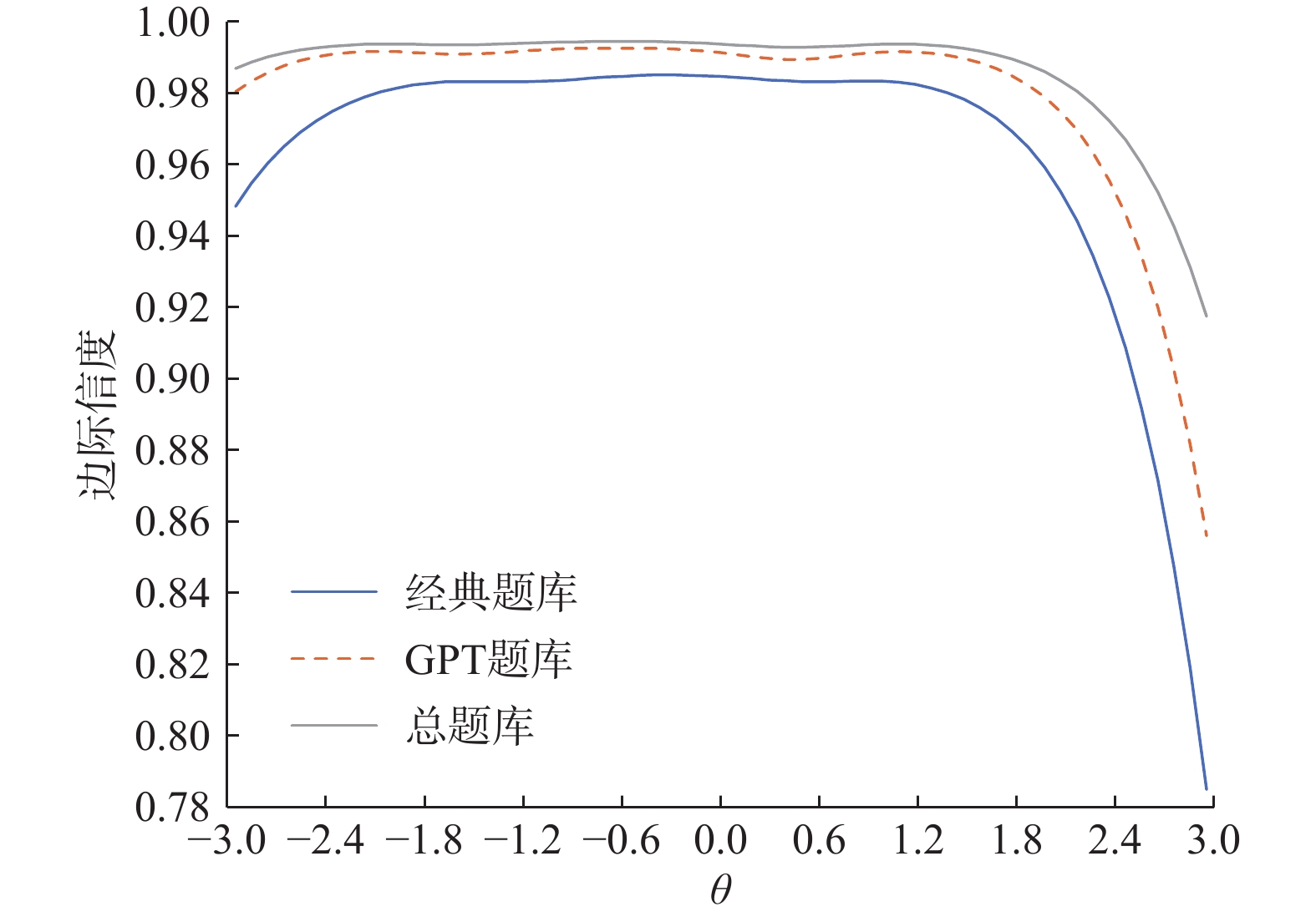
| 来源 | 测验长度 | Mθ (SDθ) | 测量误差 | 边际信度 | |||||
| M(SD) | t | Cohen’s d | M(SD) | t | Cohen’s d | ||||
| CBF-PI-B | 8 | −0.08 (0.87) | 0.34 (0.03) | 0.88 (0.03) | |||||
| 经典题库 | 8 | −0.03 (0.98) | 0.27 (0.03) | 48.06*** | 2.20 | 0.93 (0.02) | 41.97*** | 1.92 | |
| GPT题库 | 8 | −0.06 (0.98) | 0.24 (0.03) | 72.67*** | 3.32 | 0.94 (0.02) | 61.99*** | 2.83 | |
| GPT题库(42) | 8 | −0.06 (0.95) | 0.24 (0.03) | 70.63*** | 3.23 | 0.94 (0.02) | 59.16*** | 2.70 | |
| 总题库 | 8 | −0.06 (0.99) | 0.23 (0.03) | 68.15*** | 3.11 | 0.94 (0.02) | 57.68*** | 2.64 | |
| BFI-2 | 12 | −0.06 (0.98) | 0.27 (0.02) | 0.93 (0.02) | |||||
| 经典题库 | 12 | −0.05 (0.99) | 0.23 (0.03) | 43.73*** | 2.00 | 0.95 (0.01) | 39.20*** | 1.79 | |
| GPT题库 | 12 | −0.06 (1.00) | 0.20 (0.03) | 65.97*** | 3.01 | 0.96 (0.02) | 57.61*** | 2.63 | |
| GPT题库(42) | 12 | −0.06 (0.97) | 0.20 (0.03) | 74.32*** | 3.40 | 0.96 (0.01) | 66.13*** | 3.02 | |
| 总题库 | 12 | −0.07 (0.98) | 0.19 (0.03) | 70.91*** | 3.24 | 0.96 (0.01) | 61.47*** | 2.81 | |
| TIPI | 2 | −0.08 (0.87) | 0.46 (0.05) | 0.79 (0.05) | |||||
| 经典题库 | 2 | −0.06 (0.92) | 0.46 (0.05) | –1.27 | –0.06 | 0.78 (0.05) | –1.29 | –0.06 | |
| GPT题库 | 2 | −0.03 (0.94) | 0.43 (0.05) | 10.78*** | 0.49 | 0.81 (0.05) | 9.87*** | 0.45 | |
| GPT题库(42) | 2 | −0.05 (0.82) | 0.43 (0.03) | 10.41*** | 0.48 | 0.81 (0.03) | 10.19*** | 0.47 | |
| 总题库 | 2 | −0.08 (0.89) | 0.42 (0.05) | 13.43*** | 0.61 | 0.82 (0.05) | 12.34*** | 0.56 | |
| BFAS | 20 | −0.05 (1.00) | 0.21 (0.03) | 0.95 (0.02) | |||||
| 经典题库 | 20 | −0.06 (0.99) | 0.19 (0.02) | 41.10*** | 1.88 | 0.97 (0.01) | 29.91*** | 1.37 | |
| GPT题库 | 20 | −0.06 (1.01) | 0.16 (0.03) | 72.31*** | 3.30 | 0.97 (0.01) | 51.91*** | 2.37 | |
| GPT题库(42) | 20 | −0.06 (0.99) | 0.17 (0.03) | 77.45*** | 3.54 | 0.97 (0.01) | 52.34*** | 2.39 | |
| 总题库 | 20 | −0.06 (1.01) | 0.16 (0.02) | 78.38*** | 3.58 | 0.97 (0.01) | 48.12*** | 2.20 | |
| 来源 | 测验长度 | Mθ (SDθ) | 测量误差 | 边际信度 | |||||
| M(SD) | t | Cohen’s d | M(SD) | t | Cohen’s d | ||||
| CBF-PI-B | 8 | −0.08 (0.87) | 0.34 (0.03) | 0.88 (0.03) | |||||
| 经典题库 | 8 | −0.03 (0.98) | 0.27 (0.03) | 48.06*** | 2.20 | 0.93 (0.02) | 41.97*** | 1.92 | |
| GPT题库 | 8 | −0.06 (0.98) | 0.24 (0.03) | 72.67*** | 3.32 | 0.94 (0.02) | 61.99*** | 2.83 | |
| GPT题库(42) | 8 | −0.06 (0.95) | 0.24 (0.03) | 70.63*** | 3.23 | 0.94 (0.02) | 59.16*** | 2.70 | |
| 总题库 | 8 | −0.06 (0.99) | 0.23 (0.03) | 68.15*** | 3.11 | 0.94 (0.02) | 57.68*** | 2.64 | |
| BFI-2 | 12 | −0.06 (0.98) | 0.27 (0.02) | 0.93 (0.02) | |||||
| 经典题库 | 12 | −0.05 (0.99) | 0.23 (0.03) | 43.73*** | 2.00 | 0.95 (0.01) | 39.20*** | 1.79 | |
| GPT题库 | 12 | −0.06 (1.00) | 0.20 (0.03) | 65.97*** | 3.01 | 0.96 (0.02) | 57.61*** | 2.63 | |
| GPT题库(42) | 12 | −0.06 (0.97) | 0.20 (0.03) | 74.32*** | 3.40 | 0.96 (0.01) | 66.13*** | 3.02 | |
| 总题库 | 12 | −0.07 (0.98) | 0.19 (0.03) | 70.91*** | 3.24 | 0.96 (0.01) | 61.47*** | 2.81 | |
| TIPI | 2 | −0.08 (0.87) | 0.46 (0.05) | 0.79 (0.05) | |||||
| 经典题库 | 2 | −0.06 (0.92) | 0.46 (0.05) | –1.27 | –0.06 | 0.78 (0.05) | –1.29 | –0.06 | |
| GPT题库 | 2 | −0.03 (0.94) | 0.43 (0.05) | 10.78*** | 0.49 | 0.81 (0.05) | 9.87*** | 0.45 | |
| GPT题库(42) | 2 | −0.05 (0.82) | 0.43 (0.03) | 10.41*** | 0.48 | 0.81 (0.03) | 10.19*** | 0.47 | |
| 总题库 | 2 | −0.08 (0.89) | 0.42 (0.05) | 13.43*** | 0.61 | 0.82 (0.05) | 12.34*** | 0.56 | |
| BFAS | 20 | −0.05 (1.00) | 0.21 (0.03) | 0.95 (0.02) | |||||
| 经典题库 | 20 | −0.06 (0.99) | 0.19 (0.02) | 41.10*** | 1.88 | 0.97 (0.01) | 29.91*** | 1.37 | |
| GPT题库 | 20 | −0.06 (1.01) | 0.16 (0.03) | 72.31*** | 3.30 | 0.97 (0.01) | 51.91*** | 2.37 | |
| GPT题库(42) | 20 | −0.06 (0.99) | 0.17 (0.03) | 77.45*** | 3.54 | 0.97 (0.01) | 52.34*** | 2.39 | |
| 总题库 | 20 | −0.06 (1.01) | 0.16 (0.02) | 78.38*** | 3.58 | 0.97 (0.01) | 48.12*** | 2.20 | |
| 来源 | 测验长度 | 边际信度 | |||
| M(SD) | MR增加百分比(%) | t | Cohen’s d | ||
| 样本2 CBF-PI-B | 8 | 0.88 (0.03) | |||
| 经典题库 | 8 | 0.93 (0.02) | 5.39 | 37.48*** | 1.87 |
| GPT题库 | 8 | 0.94 (0.02) | 7.12 | 50.83*** | 2.54 |
| 总题库 | 8 | 0.94 (0.02) | 7.13 | 50.66*** | 2.53 |
| 样本3 BFI-2 | 12 | 0.93 (0.01) | |||
| 经典题库 | 12 | 0.95 (0.01) | 1.77 | 20.16*** | 1.21 |
| GPT题库 | 12 | 0.96 (0.02) | 2.98 | 31.23*** | 1.88 |
| 总题库 | 12 | 0.96 (0.01) | 3.13 | 36.58*** | 2.20 |
| 来源 | 测验长度 | 边际信度 | |||
| M(SD) | MR增加百分比(%) | t | Cohen’s d | ||
| 样本2 CBF-PI-B | 8 | 0.88 (0.03) | |||
| 经典题库 | 8 | 0.93 (0.02) | 5.39 | 37.48*** | 1.87 |
| GPT题库 | 8 | 0.94 (0.02) | 7.12 | 50.83*** | 2.54 |
| 总题库 | 8 | 0.94 (0.02) | 7.13 | 50.66*** | 2.53 |
| 样本3 BFI-2 | 12 | 0.93 (0.01) | |||
| 经典题库 | 12 | 0.95 (0.01) | 1.77 | 20.16*** | 1.21 |
| GPT题库 | 12 | 0.96 (0.02) | 2.98 | 31.23*** | 1.88 |
| 总题库 | 12 | 0.96 (0.01) | 3.13 | 36.58*** | 2.20 |
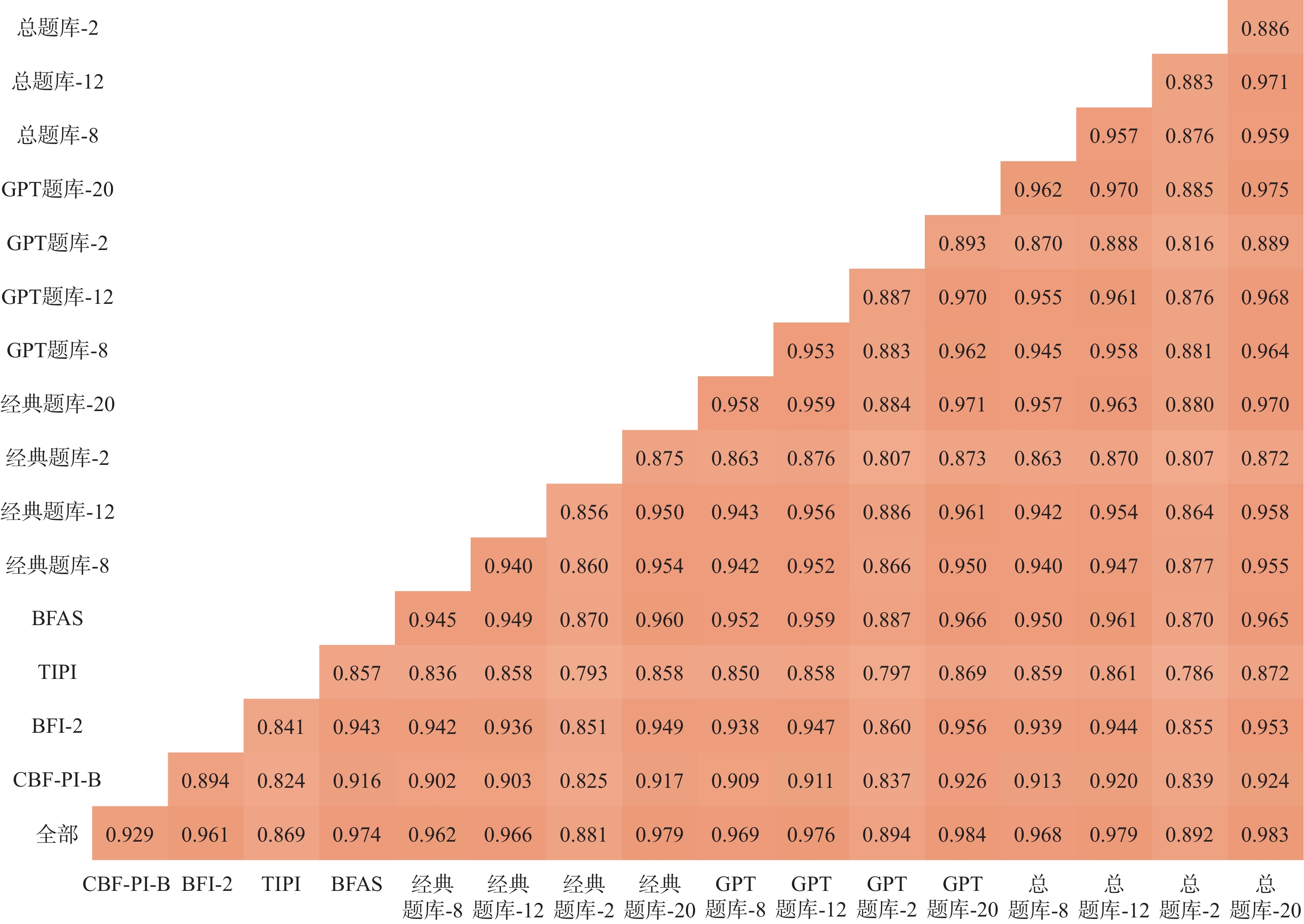
| 题库 | CBF-PI-B | BFI-2 | TIPI | BFAS |
| 经典题库 | 0.832*** [0.804, 0.858] | 0.913*** [0.896, 0.929] | 0.860*** [0.831, 0.885] | 0.914*** [0.893, 0.930] |
| GPT题库 | 0.831*** [0.800, 0.857] | 0.917*** [0.900, 0.933] | 0.861*** [0.834, 0.886] | 0.918*** [0.898, 0.934] |
| 总题库 | 0.836*** [0.807, 0.862] | 0.921*** [0.906, 0.935] | 0.862*** [0.835, 0.885] | 0.919*** [0.899, 0.935] |
| 题库 | CBF-PI-B | BFI-2 | TIPI | BFAS |
| 经典题库 | 0.832*** [0.804, 0.858] | 0.913*** [0.896, 0.929] | 0.860*** [0.831, 0.885] | 0.914*** [0.893, 0.930] |
| GPT题库 | 0.831*** [0.800, 0.857] | 0.917*** [0.900, 0.933] | 0.861*** [0.834, 0.886] | 0.918*** [0.898, 0.934] |
| 总题库 | 0.836*** [0.807, 0.862] | 0.921*** [0.906, 0.935] | 0.862*** [0.835, 0.885] | 0.919*** [0.899, 0.935] |
| 题目来源 | 主观幸福感 | 抑郁 |
| GPT题库 | 0.711*** [0.646, 0.774] | −0.647*** [−0.732, −0.552] |
| CBF-PI-15 | 0.533*** [0.438, 0.608] | −0.646*** [−0.710, −0.573] |
| BFI-2 | 0.658*** [0.573, 0.728] | −0.716*** [−0.780, −0.648] |
| 题目来源 | 主观幸福感 | 抑郁 |
| GPT题库 | 0.711*** [0.646, 0.774] | −0.647*** [−0.732, −0.552] |
| CBF-PI-15 | 0.533*** [0.438, 0.608] | −0.646*** [−0.710, −0.573] |
| BFI-2 | 0.658*** [0.573, 0.728] | −0.716*** [−0.780, −0.648] |
|
王孟成, 戴晓阳, 姚树桥. 中国大五人格问卷的初步编制Ⅲ: 简式版的制定及信效度检验. 中国临床心理学杂志, 2011, 19 (4): 454- 457.
|
|
|
Akaike, H. Stochastic theory of minimal realization. IEEE Transactions on Automatic Control, 1974, 19 (6): 667- 674.
DOI |
|
|
Bolukbasi, T., Chang, K. W., Zou, J., Saligrama, V., & Kalai, A. (2016). Man is to computer programmer as woman is to homemaker? Debiasing word embeddings. In Proceedings of the 30th International Conference on Neural Information Processing Systems (pp. 4349–4357). Barcelona, Spain: Curran Associates Inc.
|
|
|
Choi, S. W., Gibbons, L. E., & Crane, P. K. Lordif: An R package for detecting differential item functioning using iterative hybrid ordinal logistic regression/item response theory and Monte Carlo simulations. Journal of Statistical Software, 2011, 39 (8): 1- 30.
|
|
|
DeYoung, C. G., Quilty, L. C., & Peterson, J. B. Between facets and domains: 10 aspects of the Big Five. Journal of Personality and Social Psychology, 2007, 93 (5): 880- 896.
DOI |
|
|
Diener, E., Emmons, R. A., Larsen, R. J., & Griffin, S. The Satisfaction with Life Scale. Journal of PERSonality Assessment, 1985, 49 (1): 71- 75.
DOI |
|
|
Fliege, H., Becker, J., Walter, O. B., Bjorner, J. B., Klapp, B. F., & Rose, M. Development of a computer-adaptive test for depression (D-CAT). Quality of Life Research, 2005, 14 (10): 2277- 2291.
DOI |
|
|
Garg, N., Schiebinger, L., Jurafsky, D., & Zou, J. Word embeddings quantify 100 years of gender and ethnic stereotypes. Proceedings of the National Academy of Sciences of the United States of America, 2018, 115 (16): E3635- E3644.
|
|
|
Gierl, M. J., & Haladyna, T. M. (Eds.). (2013). Automatic item generation: Theory and practice. New York: Routledge.
|
|
|
Goldberg, Y. (2017). Neural network methods for natural language processing. Cham, Switzerland: Springer.
|
|
|
Gosling, S. D., Rentfrow, P. J., & Swann, Jr. W. B. A very brief measure of the Big-Five personality domains. Journal of Research in Personality, 2003, 37 (6): 504- 528.
DOI |
|
|
Götz, F. M., Maertens, R., Loomba, S., & van Der Linden, S. Let the algorithm speak: How to use neural networks for automatic item generation in psychological scale development. Psychological Methods, 2024, 29 (3): 494- 518.
DOI |
|
|
Hambleton, R. K., Swaminathan, H., & Rogers, H. J. (1991). Fundamentals of item response theory. Thousand Oaks, CA: Sage Publications, Inc.
|
|
|
Hernandez, I., & Nie, W. W. The AI‐IP: Minimizing the guesswork of personality scale item development through artificial intelligence. Personnel Psychology, 2023, 76 (4): 1011- 1035.
DOI |
|
|
Hommel, B. E., Wollang, F. J. M., Kotova, V., Zacher, H., & Schmukle, S. C. Transformer-based deep neural language modeling for construct-specific automatic item generation. Psychometrika, 2022, 87 (2): 749- 772.
DOI |
|
|
Kendler, K. S., Gardner, C. O., & Prescott, C. A. Toward a comprehensive developmental model for major depression in women. American Journal of Psychiatry, 2002, 159 (7): 1133- 1145.
DOI |
|
|
Lee, P., Fyffe, S., Son, M., Jia, Z. H., & Yao, Z. Y. A paradigm shift from “human writing” to “machine generation” in personality test development: An application of state-of-the-art natural language processing. Journal of Business and Psychology, 2023, 38 (1): 163- 190.
DOI |
|
|
Liu, X. R., Lu, H., Zhou, Z., Chao, M., & Liu, T. Development of a computerized adaptive test for problematic mobile phone use. Frontiers in Psychology, 2022, 13, 892387.
DOI |
|
|
May, S., Littlewood, C., & Bishop, A. Reliability of procedures used in the physical examination of non-specific low back pain: A systematic review. Australian Journal of Physiotherapy, 2006, 52 (2): 91- 102.
DOI |
|
|
Muraki, E. A generalized partial credit model: Application of an EM algorithm. Applied Psychological Measurement, 1992, 16 (2): 159- 176.
DOI |
|
|
Norton, P. J. (2007). Depression Anxiety and Stress Scales (DASS-21): Psychometric analysis across four racial groups. Anxiety, Stress, and Coping, 20(3), 253–265.
|
|
|
Polit, D. F., Beck, C. T., & Owen, S. V. Is the CVI an acceptable indicator of content validity? Appraisal and recommendations. Research in Nursing & Health, 2007, 30 (4): 459- 467.
|
|
|
Reckase, M. D. Unifactor latent trait models applied to multifactor tests: Results and implications. Journal of Educational Statistics, 1979, 4 (3): 207- 230.
DOI |
|
|
Reeve, B. B., Hays, R. D., Bjorner, J. B., Cook, K. F., Crane, P. K., Teresi, J. A., .. PROMIS Cooperative Group. (2007). Psychometric evaluation and calibration of health-related quality of life item banks: Plans for the Patient-Reported Outcomes Measurement Information System (PROMIS). Medical Care, 45(5 Suppl. 1), S22–S31.
|
|
|
Samejima, F. Estimation of latent ability using a response pattern of graded scores. Psychometrika, 1969, 34 (S1): 1- 97.
DOI |
|
|
Schwarz, G. Estimating the dimension of a model. The Annals of Statistics, 1978, 6 (2): 461- 464.
|
|
|
Vaswani, A., Shazeer, N., Parmar, N., Uszkoreit, J., Jones, L., Gomez, A. N., .. Polosukhin, I. (2017). Attention is all you need. In Proceedings of the 31st International Conference on Neural Information Processing Systems (pp. 6000-6010). Long Beach, CA: Curran Associates Inc.
|
|
|
von Davier, M. Automated item generation with recurrent neural networks. Psychometrika, 2018, 83 (4): 847- 857.
DOI |
|
|
Wainer, H., Dorans, N. J., Flaugher, R., Green, B. F., & Mislevy, R. J. (2000). Computerized adaptive testing: A primer (2nd ed.). New York: Routledge.
|
|
|
Widiger, T. A., & Oltmanns, J. R. Neuroticism is a fundamental domain of personality with enormous public health implications. World Psychiatry, 2017, 16 (2): 144- 145.
DOI |
|
|
Womick, J., & King, L. A. (2020). Personality and well-being. In B. J. Carducci & C. Nave. (Eds.), The wiley-blackwell encyclopedia of personality and individual differences: Vol. IV: Clinical, applied, and cross-cultural research (pp. 371–376). Hoboken, NJ: John Wiley & Sons.
|
|
|
Xu, L. L., Jin, R. Y., Huang, F. F., Zhou, Y. H., Li, Z. L., & Zhang, M. Q. Development of computerized adaptive testing for emotion regulation. Frontiers in Psychology, 2020, 11, 561358.
DOI |
|
|
Zhang, B., Li, Y. M., Li, J., Luo, J., Ye, Y. H., Yin, L., ... John, O. P. The Big Five Inventory-2 in China: A comprehensive psychometric evaluation in four diverse samples. Assessment, 2022, 29 (6): 1262- 1284.
DOI |
|
|
Zhang, X. T., Wang, M. C., He, L. N., Jie, L., & Deng, J. X. The development and psychometric evaluation of the Chinese Big Five Personality Inventory-15. PLoS One, 2019, 14 (8): e0221621.
DOI |
| Viewed | ||||||
|
Full text |
|
|||||
|
Abstract |
|
|||||
