
Studies of Psychology and Behavior ›› 2026, Vol. 24 ›› Issue (2): 265-272.DOI: 10.12139/j.1672-0628.2026.02.016
• ? • Previous Articles Next Articles
Xu KONG, Sicheng XIONG, Chengwei ZENG, Bin ZHANG*( )
)
Received:2025-05-15
Online:2026-03-20
Published:2026-03-20
Contact:
Bin ZHANG
孔旭, 熊思成, 曾成伟, 张斌*()
通讯作者:
张斌
基金资助:Xu KONG, Sicheng XIONG, Chengwei ZENG, Bin ZHANG. The Impact of Social Anxiety on Adolescents’ Mobile Phone Dependency: The Longitudinal Moderating Role of Self-Control[J]. Studies of Psychology and Behavior, 2026, 24(2): 265-272.
孔旭, 熊思成, 曾成伟, 张斌. 社交焦虑对青少年手机依赖的影响:自我控制的纵向调节作用[J]. 心理与行为研究, 2026, 24(2): 265-272.
Add to citation manager EndNote|Ris|BibTeX
URL: https://psybeh.tjnu.edu.cn/EN/10.12139/j.1672-0628.2026.02.016
| 变量 | 1 | 2 | 3 | 4 | 5 | 6 | 7 | 8 | 9 | 10 |
| 1.性别 | ||||||||||
| 2.社交焦虑T1 | 0.21** | |||||||||
| 3.社交焦虑T2 | 0.16** | 0.57** | ||||||||
| 4.社交焦虑T3 | 0.15** | 0.60** | 0.59** | |||||||
| 5.手机依赖T1 | 0.19** | 0.32** | 0.29** | 0.28** | ||||||
| 6.手机依赖T2 | 0.11** | 0.30** | 0.33** | 0.27** | 0.62** | |||||
| 7.手机依赖T3 | 0.18** | 0.28** | 0.30** | 0.34** | 0.56** | 0.64** | ||||
| 8.自我控制T1 | –0.14** | –0.36** | –0.31** | –0.30** | –0.59** | –0.47** | –0.44** | |||
| 9.自我控制T2 | –0.08* | –0.27** | –0.31** | –0.26** | –0.45** | –0.59** | –0.44** | 0.60** | ||
| 10.自我控制T3 | –0.15** | –0.32** | –0.29** | –0.38** | –0.48** | –0.47** | –0.58** | 0.57** | 0.59** | |
| M | 2.50 | 2.55 | 2.61 | 2.65 | 2.80 | 2.95 | 3.09 | 3.03 | 2.94 | |
| SD | 0.68 | 0.65 | 0.68 | 1.09 | 1.11 | 1.24 | 0.74 | 0.72 | 0.74 |
| 变量 | 1 | 2 | 3 | 4 | 5 | 6 | 7 | 8 | 9 | 10 |
| 1.性别 | ||||||||||
| 2.社交焦虑T1 | 0.21** | |||||||||
| 3.社交焦虑T2 | 0.16** | 0.57** | ||||||||
| 4.社交焦虑T3 | 0.15** | 0.60** | 0.59** | |||||||
| 5.手机依赖T1 | 0.19** | 0.32** | 0.29** | 0.28** | ||||||
| 6.手机依赖T2 | 0.11** | 0.30** | 0.33** | 0.27** | 0.62** | |||||
| 7.手机依赖T3 | 0.18** | 0.28** | 0.30** | 0.34** | 0.56** | 0.64** | ||||
| 8.自我控制T1 | –0.14** | –0.36** | –0.31** | –0.30** | –0.59** | –0.47** | –0.44** | |||
| 9.自我控制T2 | –0.08* | –0.27** | –0.31** | –0.26** | –0.45** | –0.59** | –0.44** | 0.60** | ||
| 10.自我控制T3 | –0.15** | –0.32** | –0.29** | –0.38** | –0.48** | –0.47** | –0.58** | 0.57** | 0.59** | |
| M | 2.50 | 2.55 | 2.61 | 2.65 | 2.80 | 2.95 | 3.09 | 3.03 | 2.94 | |
| SD | 0.68 | 0.65 | 0.68 | 1.09 | 1.11 | 1.24 | 0.74 | 0.72 | 0.74 |
| 变量 | χ2 | df | CFI | TLI | RMSEA(90%CI) | 均值 | 协相关 | |
| 截距 | 斜率 | |||||||
| 社交焦虑 | 0.01 | 1 | 1.00 | 1.01 | 0.00[0.00, 0.03] | 2.50*** | 0.06*** | 0.028 |
| 手机依赖 | 0.07 | 1 | 1.00 | 1.01 | 0.00[0.00, 0.06] | 2.65*** | 0.15*** | –0.001 |
| 自我控制 | 0.19 | 1 | 1.00 | 1.00 | 0.00[0.00, 0.07] | 3.09*** | –0.07*** | –0.004 |
| 变量 | χ2 | df | CFI | TLI | RMSEA(90%CI) | 均值 | 协相关 | |
| 截距 | 斜率 | |||||||
| 社交焦虑 | 0.01 | 1 | 1.00 | 1.01 | 0.00[0.00, 0.03] | 2.50*** | 0.06*** | 0.028 |
| 手机依赖 | 0.07 | 1 | 1.00 | 1.01 | 0.00[0.00, 0.06] | 2.65*** | 0.15*** | –0.001 |
| 自我控制 | 0.19 | 1 | 1.00 | 1.00 | 0.00[0.00, 0.07] | 3.09*** | –0.07*** | –0.004 |
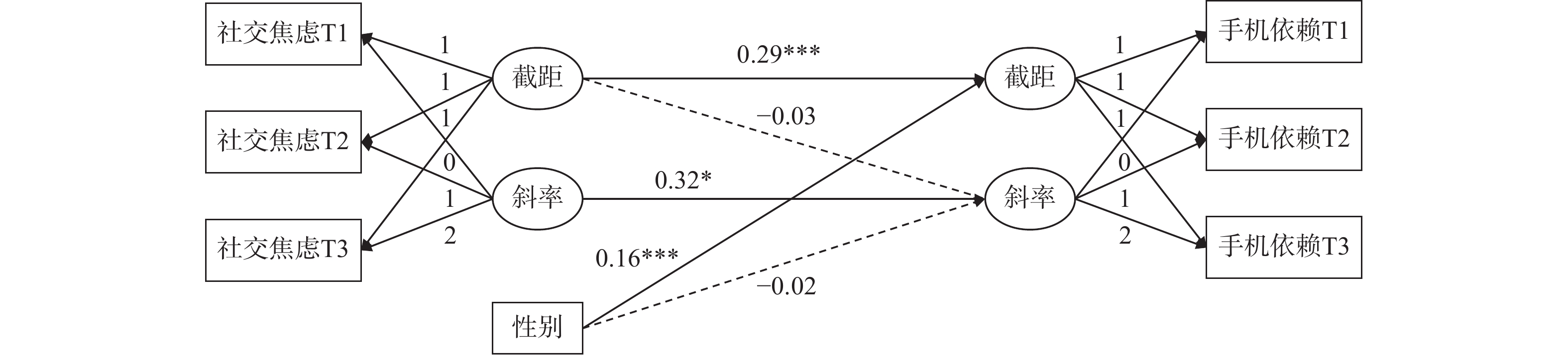
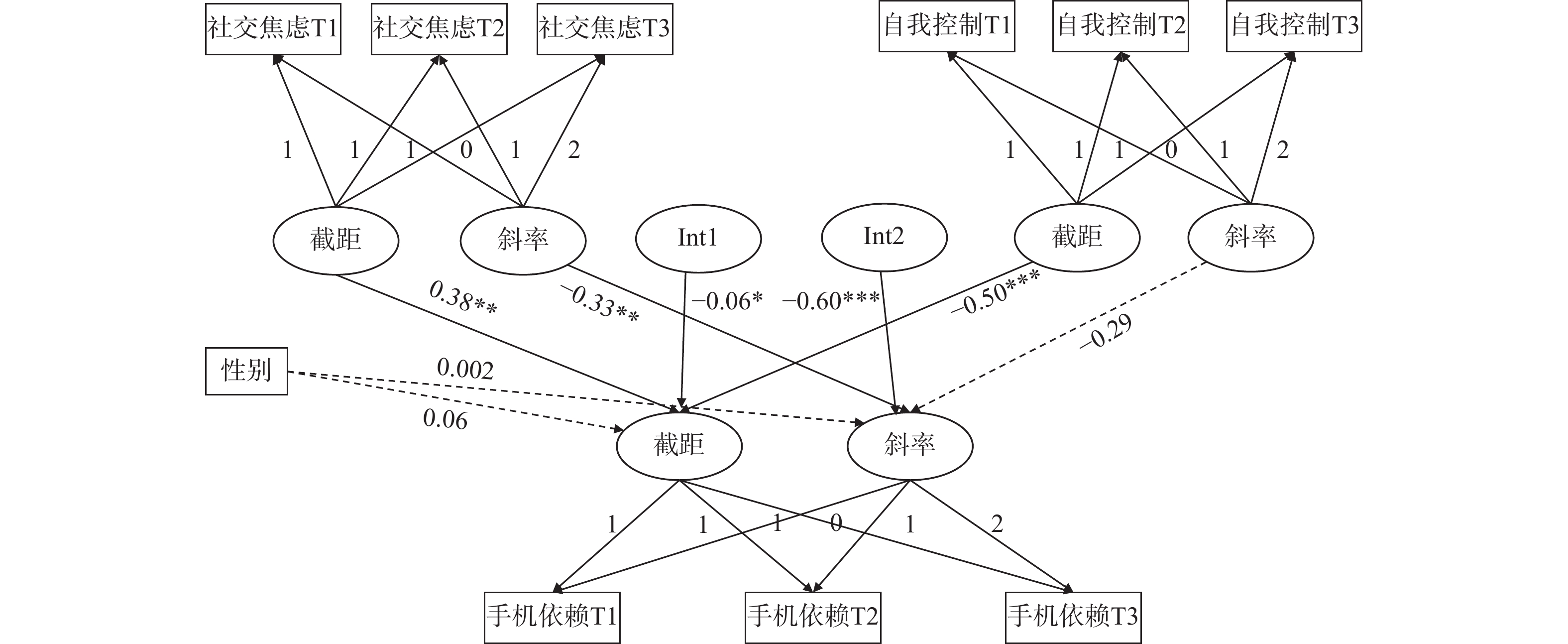
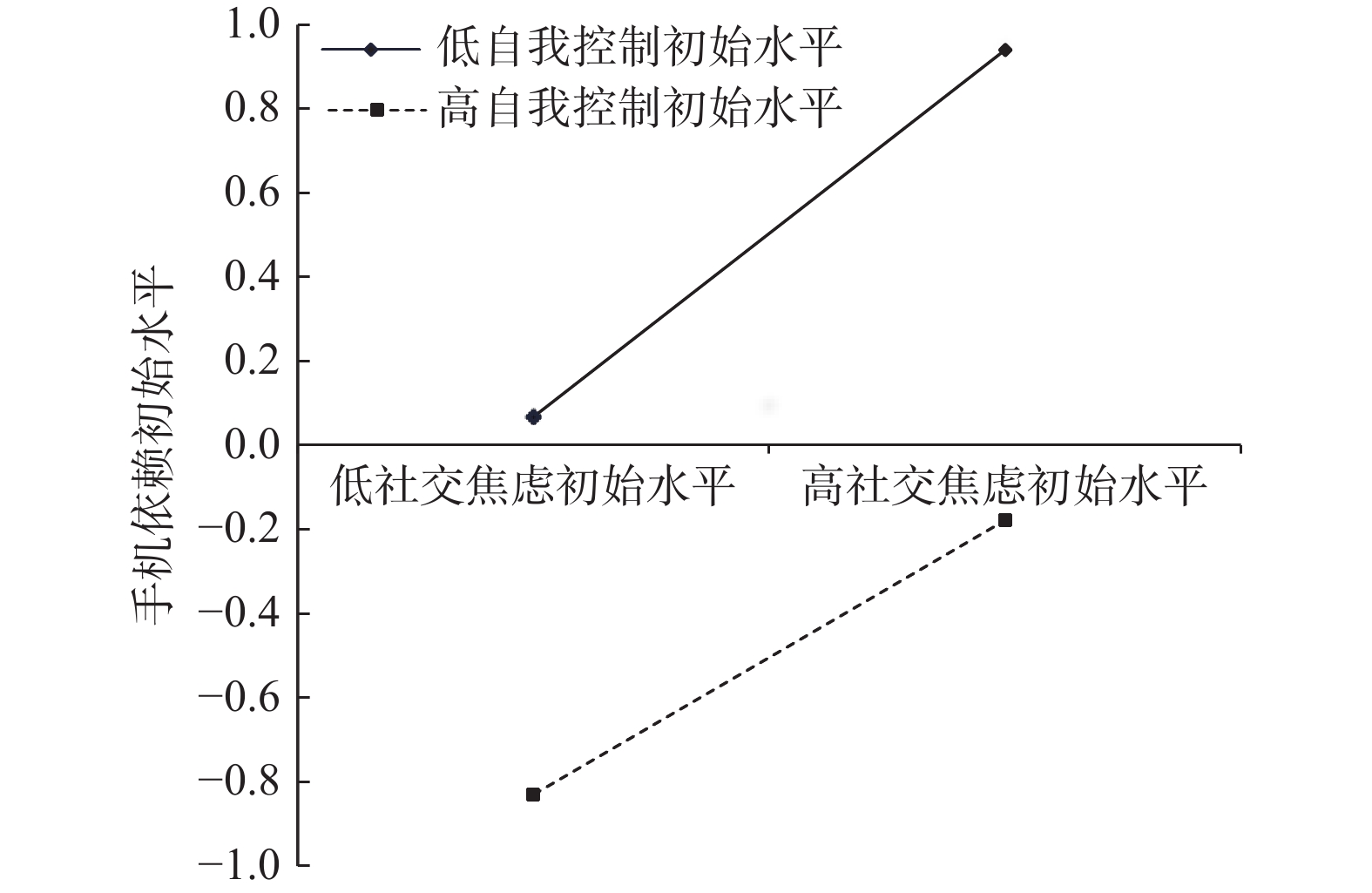
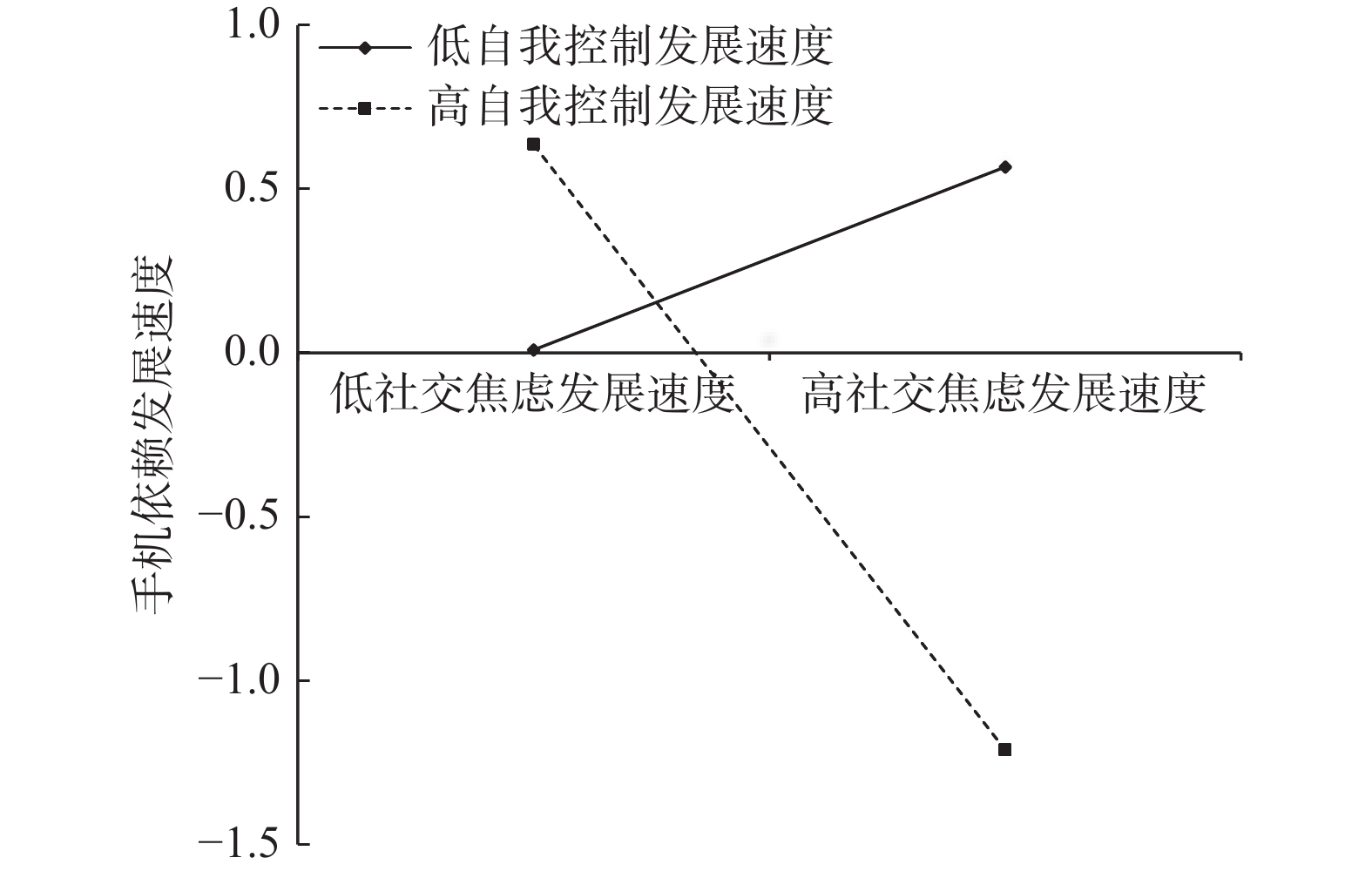
|
方杰, 温忠麟. 纵向数据的调节效应分析. 心理科学进展, 2022, 30 (11): 2461- 2472.
|
|
|
葛文婷. (2024). 高中生成长型思维对社交焦虑的影响: 核心自我评价的中介作用及干预(硕士学位论文). 广西民族大学, 南宁.
|
|
|
关元, 何嘉梅. 自我控制: 内涵、理论及展望. 心理技术与应用, 2018, 6 (2): 118- 128.
DOI |
|
|
郭晓薇. 大学生社交焦虑成因的研究. 心理学探新, 2000, 20 (1): 55- 58.
DOI |
|
|
黄凤, 郭锋, 丁倩, 洪建中. 社交焦虑对大学生手机成瘾的影响: 认知失败和情绪调节自我效能感的作用. 中国临床心理学杂志, 2021, 29 (1): 56- 59,13.
|
|
|
蒋舒阳, 刘儒德, 冯毛, 洪伟, 金芳凯. 自尊与中学生问题性手机使用: 社交焦虑和逃避动机的中介作用. 心理科学, 2024, 47 (4): 940- 946.
DOI |
|
|
罗涛, 程李梅, 秦立霞, 肖水源. 简式自我控制量表中文版的信效度检验. 中国临床心理学杂志, 2021, 29 (1): 83- 86.
DOI |
|
|
潘朝霞, 张大均, 潘彦谷, 胡天强. 中学生自尊和评价恐惧在心理素质与社交焦虑中的中介作用. 中国心理卫生杂志, 2018, 32 (8): 676- 681.
DOI |
|
|
汪向东, 王希林, 马弘. (1999). 心理卫生评定量表手册(增订版) (pp. 490–493). 北京: 中国心理卫生杂志社.
|
|
|
魏忠凤. 自我控制与大学生学业拖延的关系: 手机成瘾与学习投入的链式中介作用. 中国临床心理学杂志, 2023, 31 (5): 1248- 1252.
|
|
|
项明强, 王梓蓉, 马奔. 智能手机依赖量表中文版在青少年中的信效度检验. 中国临床心理学杂志, 2019, 27 (5): 959- 964.
DOI |
|
|
熊思成, 张斌, 姜永志, 蒋怀滨, 陈芸. 手机成瘾流行率及其影响因素的元分析. 心理与行为研究, 2021, 19 (6): 802- 808.
DOI |
|
|
徐扬, 刘海燕, 刘慧敏. 大学生社交焦虑和手机成瘾的关系: 科技侵扰和负面评价恐惧的并行中介作用. 中国健康心理学杂志, 2024, 32 (6): 926- 933.
|
|
|
于晓琪, 李哲能, 方圆, 董妍. 青少年智能手机问题性使用与焦虑的交叉滞后分析. 心理科学, 2021, 44 (4): 866- 872.
|
|
|
曾奕欣, 张斌, 熊思成, 龙专, 张安琪, 曾成伟, … 杨莹. 手机依赖对初中生社交焦虑发展的影响: 身体羞耻的纵向中介作用. 心理科学, 2024, 47 (2): 316- 324.
DOI |
|
|
中国互联网络信息中心. (2023). 第5次全国未成年人互联网使用情况调查报告. 2025-01-20取自https://cnnic.cn/NMediaFile/2023/1225/MAIN1703484375296SPBHV29S0V.pdf
|
|
|
Allemand, M., Job, V., & Mroczek, D. K. Self-control development in adolescence predicts love and work in adulthood. Journal of Personality and Social Psychology, 2019, 117 (3): 621- 634.
DOI |
|
|
Baumeister, R. F., & Vohs, K. D. Self-regulation, ego depletion, and motivation. Social and Personality Psychology Compass, 2007, 1 (1): 115- 128.
|
|
|
Busch, P. A., & McCarthy, S. Antecedents and consequences of problematic smartphone use: A systematic literature review of an emerging research area. Computers in Human Behavior, 2021, 114, 106414.
DOI |
|
|
Casey, B. J., Duhoux, S., & Cohen, M. M. Adolescence: What do transmission, transition, and translation have to do with it?. Neuron, 2010, 67 (5): 749- 760.
DOI |
|
|
Choe, C., & Yu, S. (2022). Longitudinal cross-lagged analysis between mobile phone dependence, friendships, and depressive symptoms among Korean adolescents. Cyberpsychology, Behavior and Social Networking, 25(7), 450–457.
|
|
|
Danneel, S., Geukens, F., Maes, M., Bastin, M., Bijttebier, P., Colpin, H., … Goossens, L. Loneliness, social anxiety symptoms, and depressive symptoms in adolescence: Longitudinal distinctiveness and correlated change. Journal of Youth and Adolescence, 2020, 49 (11): 2246- 2264.
DOI |
|
|
De Freitas, B. H. B. M., Gaíva, M. A. M., Bernardino, F. B. S., & Diogo, P. M. J. Smartphone addiction in adolescents, part 2: Scoping review—prevalence and associated factors. Trends in Psychology, 2021, 29 (1): 12- 30.
DOI |
|
|
De Lijster, J. M., Dieleman, G. C., Utens, E. M. W. J., Dierckx, B., Wierenga, M., Verhulst, F. C., & Legerstee, J. S. Social and academic functioning in adolescents with anxiety disorders: A systematic review. Journal of Affective Disorders, 2018, 230, 108- 117.
DOI |
|
|
Denaro, C. M., Hartley, A. A., Couperus, J. W., Bukach, C. M., & Reed, C. L. Procrastination and anxiety aspects of self-control predict individual differences in the mismatch negativity (MMN). International Journal of Psychophysiology, 2025, 214, 113202.
DOI |
|
|
Gao, L. F., Zhao, W., Caselli, G., Zhang, Y. H., Wang, X. M., Zhang, Y. W., & Chen, H. D. Weak and interfered self-control fails to block problematic mobile phone use: The role of craving and desire thinking. Journal of Psychiatric Research, 2024, 179, 191- 198.
DOI |
|
|
Hagger, M. S., Wood, C., Stiff, C., & Chatzisarantis, N. L. D. Ego depletion and the strength model of self-control: A meta-analysis. Psychological Bulletin, 2010, 136 (4): 495- 525.
DOI |
|
|
Hofmann, W., Friese, M., & Strack, F. Impulse and self-control from a dual-systems perspective. Perspectives on Psychological Science, 2009, 4 (2): 162- 176.
DOI |
|
|
İnal, Ö., & Serel Arslan, S. Investigating the effect of smartphone addiction on musculoskeletal system problems and cognitive flexibility in university students. Work, 2021, 68 (1): 107- 113.
DOI |
|
|
Jin Jeong, Y., Suh, B., & Gweon, G. Is smartphone addiction different from Internet addiction? Comparison of addiction-risk factors among adolescents. Behaviour & Information Technology, 2020, 39 (5): 578- 593.
DOI |
|
|
Kardefelt-Winther, D. A conceptual and methodological critique of internet addiction research: Towards a model of compensatory internet use. Computers in Human Behavior, 2014, 31, 351- 354.
DOI |
|
|
Kong, F. C., Qin, J. K., Huang, B., Zhang, H. B., & Lei, L. The effect of social anxiety on mobile phone dependence among Chinese adolescents: A moderated mediation model. Children and Youth Services Review, 2020, 108, 104517.
DOI |
|
|
Luo, J., Cai, G. Q., Zu, X. F., Huang, Q. M., & Cao, Q. Mobile phone addiction and negative emotions: An empirical study among adolescents in Jiangxi Province. Frontiers in Psychiatry, 2025, 16, 1541605.
DOI |
|
|
Mei, S. L., Hu, Y. Y., Wu, X. G., Cao, R. L., Kong, Y. X., Zhang, L. W., … Li, L. Health risks of mobile phone addiction among college students in China. International Journal of Mental Health and Addiction, 2023, 21 (4): 2650- 2665.
DOI |
|
|
Moffitt, T. E., Arseneault, L., Belsky, D., Dickson, N., Hancox, R. J., Harrington, H., … Caspi, A. A gradient of childhood self-control predicts health, wealth, and public safety. Proceedings of the National Academy of Sciences of the United States of America, 2011, 108 (7): 2693- 2698.
DOI |
|
|
Ng-Knight, T., Shelton, K. H., Riglin, L., McManus, I. C., Frederickson, N., & Rice, F. A longitudinal study of self-control at the transition to secondary school: Considering the role of pubertal status and parenting. Journal of Adolescence, 2016, 50, 44- 55.
DOI |
|
|
Peng, Y., Zhou, H. L., Zhang, B., Mao, H. L., Hu, R. T., & Jiang, H. B. Perceived stress and mobile phone addiction among college students during the 2019 coronavirus disease: The mediating roles of rumination and the moderating role of self-control. Personality and Individual Differences, 2022, 185, 111222.
DOI |
|
|
Saunders, T., Driskell, J. E., Johnston, J. H., & Salas, E. The effect of stress inoculation training on anxiety and performance. Journal of Occupational Health Psychology, 1996, 1 (2): 170- 186.
DOI |
|
|
Shen, X. W., Wang, C. G., Chen, C. Y., Wang, Y. F., Wang, Z. N., Zheng, Y. P., & Liu, H. Y. Stress and internet addiction: Mediated by anxiety and moderated by self-control. Psychology Research and Behavior Management, 2023, 16, 1975- 1986.
DOI |
|
|
Singer, J. D., & Willett, J. B. (2003). Applied longitudinal data analysis: Modeling change and event occurrence (pp. 644). New York: Oxford University Press.
|
|
|
Su, D., Zhang, J. H., Ma, Y. Y., & Geng, Z. Self-control, academic anxiety, and mobile phone addiction: The moderating role of being an only child. Frontiers in Psychology, 2025, 16, 1587279.
DOI |
|
|
Wang, L. X., Dou, K., Li, J. B., Zhang, M. C., & Guan, J. Y. The association between interparental conflict and problematic internet use among Chinese adolescents: Testing a moderated mediation model. Computers in Human Behavior, 2021, 122, 106832.
DOI |
|
|
Wang, P. C., Zhao, M., Wang, X. C., Xie, X. C., Wang, Y. H., & Lei, L. Peer relationship and adolescent smartphone addiction: The mediating role of self-esteem and the moderating role of the need to belong. Journal of Behavioral Addictions, 2017, 6 (4): 708- 717.
DOI |
|
|
Wei, X. Y., Ren, L., Jiang, H. B., Liu, C., Wang, H. X., Geng, J. Y., … Lei, L. Does adolescents’ social anxiety trigger problematic smartphone use, or vice versa? A comparison between problematic and unproblematic smartphone users. Computers in Human Behavior, 2023, 140, 107602.
DOI |
|
|
Wills, T. A., Ainette, M. G., Stoolmiller, M., Gibbons, F. X., & Shinar, O. Good self-control as a buffering agent for adolescent substance use: An investigation in early adolescence with time-varying covariates. Psychology of Addictive Behaviors, 2008, 22 (4): 459- 471.
DOI |
|
|
Zhang, H., Chen, C. J., Zhang, L. Y., Xue, S., & Tang, W. J. The association between the deviation from balanced time perspective on adolescent pandemic mobile phone addiction: The moderating role of self-control and the mediating role of psychological distress. Frontiers in Psychology, 2024, 14, 1298256.
DOI |
|
|
Zhou, H., Dang, L., Lam, L. W., Zhang, M. X., & Wu, A. M. S. A cross-lagged panel model for testing the bidirectional relationship between depression and smartphone addiction and the influences of maladaptive metacognition on them in Chinese adolescents. Addictive Behaviors, 2021, 120, 106978.
DOI |
| Viewed | ||||||
|
Full text |
|
|||||
|
Abstract |
|
|||||
