
Studies of Psychology and Behavior ›› 2026, Vol. 24 ›› Issue (2): 258-264.DOI: 10.12139/j.1672-0628.2026.02.015
• ? • Previous Articles Next Articles
Yilin ZHANG1,2, Gengfeng Niu1,2, Xuqing BAI1,2, Sufei XIN*,3( ), Xiaojun SUN*,1,2()
Received:2025-03-19
Online:2026-03-20
Published:2026-03-20
Contact:
Sufei XIN, Xiaojun SUN
张一林1,2, 牛更枫1,2, 白旭青1,2, 辛素飞*,3(), 孙晓军*,1,2()
通讯作者:
辛素飞, 孙晓军
基金资助:Yilin ZHANG, Gengfeng Niu, Xuqing BAI, Sufei XIN, Xiaojun SUN. The Bidirectional Relationship Between Perceived Chronic Social Adversity and Social Media Addiction Among Adolescents: The Role of Sense of Control[J]. Studies of Psychology and Behavior, 2026, 24(2): 258-264.
张一林, 牛更枫, 白旭青, 辛素飞, 孙晓军. 社会逆境感知与青少年社交媒体成瘾的双向关系:控制感的作用[J]. 心理与行为研究, 2026, 24(2): 258-264.
Add to citation manager EndNote|Ris|BibTeX
URL: https://psybeh.tjnu.edu.cn/EN/10.12139/j.1672-0628.2026.02.015
| 变量 | 1 | 2 | 3 | 4 | 5 | 6 |
| T1社会逆境感知 | ||||||
| T1控制感 | −0.59*** | |||||
| T1社交媒体成瘾 | 0.38*** | −0.44*** | ||||
| T2社会逆境感知 | 0.52*** | −0.43*** | 0.34*** | |||
| T2控制感 | −0.52*** | 0.63*** | −0.37*** | −0.52*** | ||
| T2社交媒体成瘾 | 0.32*** | −0.38*** | 0.68*** | 0.43*** | −0.45*** | |
| M | 1.63 | 4.63 | 2.03 | 1.61 | 4.66 | 2.00 |
| SD | 0.70 | 0.99 | 0.83 | 0.74 | 1.01 | 0.89 |
| 变量 | 1 | 2 | 3 | 4 | 5 | 6 |
| T1社会逆境感知 | ||||||
| T1控制感 | −0.59*** | |||||
| T1社交媒体成瘾 | 0.38*** | −0.44*** | ||||
| T2社会逆境感知 | 0.52*** | −0.43*** | 0.34*** | |||
| T2控制感 | −0.52*** | 0.63*** | −0.37*** | −0.52*** | ||
| T2社交媒体成瘾 | 0.32*** | −0.38*** | 0.68*** | 0.43*** | −0.45*** | |
| M | 1.63 | 4.63 | 2.03 | 1.61 | 4.66 | 2.00 |
| SD | 0.70 | 0.99 | 0.83 | 0.74 | 1.01 | 0.89 |
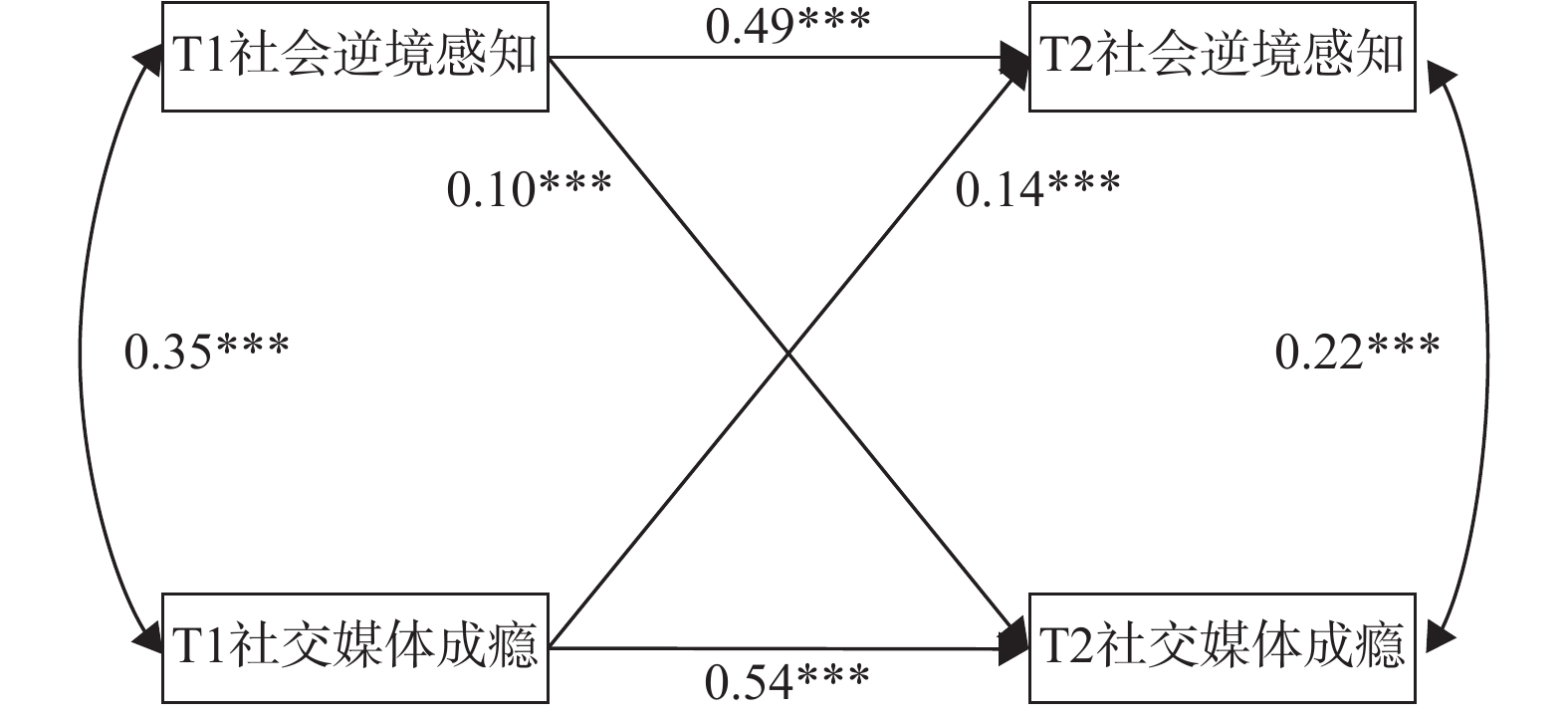
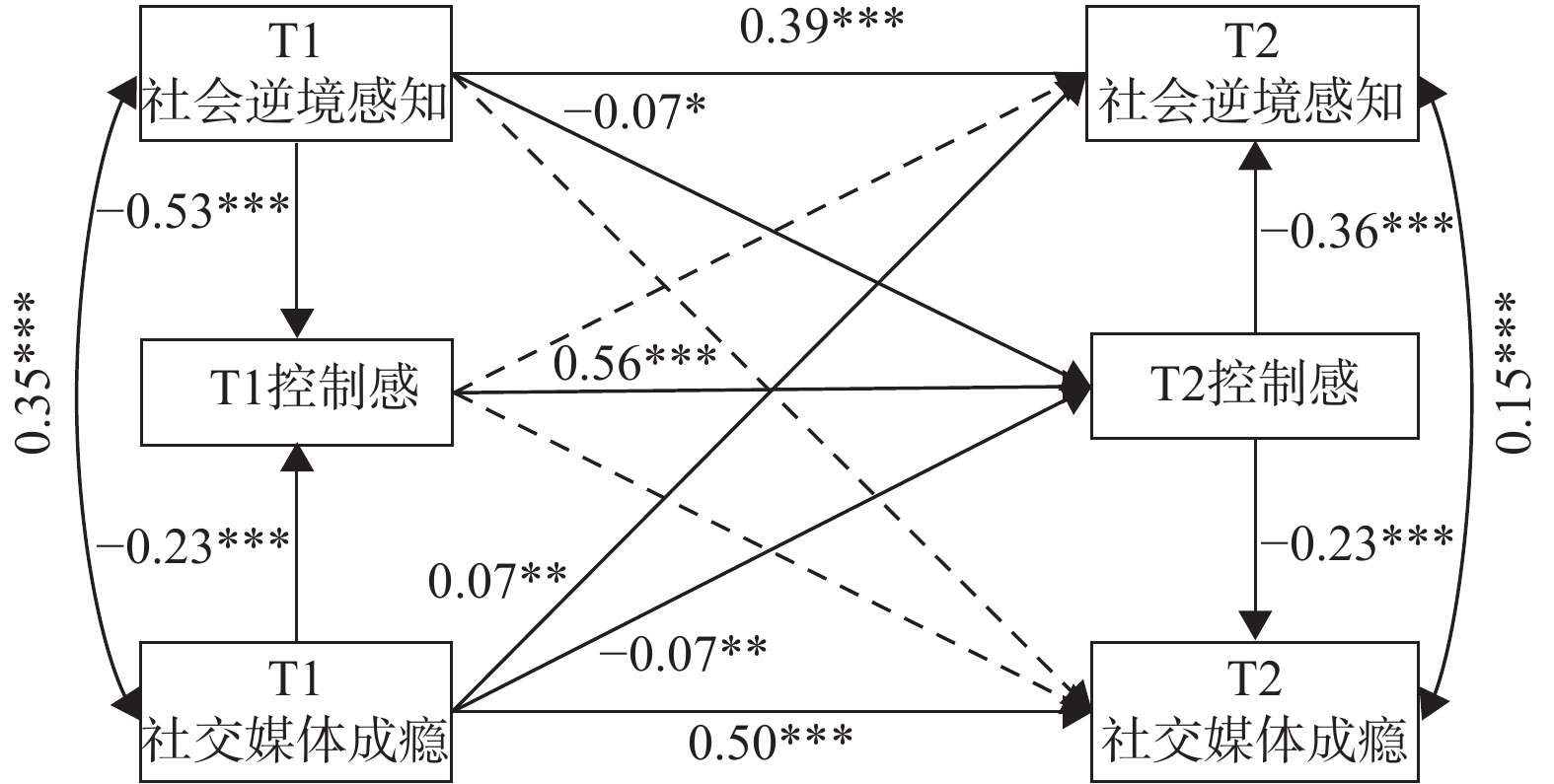
| 路径 | 效应值 | 效果量(%) | 95%置信区间 | |
| 下限 | 上限 | |||
| T1逆境→T1控制→T2控制→T2成瘾 | 0.07 | 66.34 | 0.05 | 0.09 |
| T1成瘾→T1控制→T2控制→T2逆境 | 0.05 | 35.07 | 0.03 | 0.06 |
| 路径 | 效应值 | 效果量(%) | 95%置信区间 | |
| 下限 | 上限 | |||
| T1逆境→T1控制→T2控制→T2成瘾 | 0.07 | 66.34 | 0.05 | 0.09 |
| T1成瘾→T1控制→T2控制→T2逆境 | 0.05 | 35.07 | 0.03 | 0.06 |
|
白洁, 郭永玉, 杨沈龙. 人在丧失控制感后会如何?——来自补偿性控制理论的揭示. 中国临床心理学杂志, 2017, 25 (5): 982- 985, 981.
|
|
|
邓林园, 杨梦茜, 杨雨萌, 周楠, 李蓓蕾. 父母自主支持、父母心理控制和青少年网络成瘾的关系: 一项交叉滞后研究. 心理与行为研究, 2022, 20 (2): 190- 196, 254.
DOI |
|
|
窦凯, 黎彦余, 王林欣, 聂衍刚. 错失恐惧还是社交回避? 同伴排斥对粤澳青少年问题性社交媒体使用的影响. 心理科学, 2023, 46 (5): 1081- 1089.
DOI |
|
|
方勇, 季为民, 沈杰. (2024).中国未成年人互联网运用报告(2024). 北京: 社会科学文献出版社.
|
|
|
侯娟, 朱英格, 方晓义. 手机成瘾与抑郁: 社交焦虑和负性情绪信息注意偏向的多重中介作用. 心理学报, 2021, 53 (4): 362- 373.
|
|
|
金童林, 乌云特娜, 张璐, 杨雪, 贾彦茹, 杨宏. 社会逆境感知对大学生攻击行为的影响: 反刍思维与领悟社会支持的作用. 心理发展与教育, 2020, 36 (4): 414- 421.
|
|
|
李静. (2012). 不同社会阶层对贫富差距的归因倾向研究(博士学位论文). 华中师范大学, 武汉.
|
|
|
刘致宏, 张野, 王凯, 许晴. 校园排斥与青少年问题性社交媒体使用的关系: 基于潜调节结构方程模型. 心理与行为研究, 2023, 21 (4): 533- 540.
|
|
|
马娟, 吴晓靓, 闫艳, 盖笑松, 周茹. 留守经历对初中生心理繁荣的影响: 控制感的补偿作用和调节作用. 心理与行为研究, 2025, 23 (3): 377- 383.
DOI |
|
|
田雨, 丁洪君, 郭宗新. 大学新生负性生活事件与手机成瘾的双向关系: 领悟社会支持的作用. 心理发展与教育, 2025, 41 (4): 579- 588.
|
|
|
王甦平, 蔡泳, 朱睿, 李思聪, 刘心怡, 龚睿婕. 青少年社交网络成瘾评估量表初步编制和信效度检验. 中华全科医学, 2022, 20 (2): 324- 326.
|
|
|
王永丽, 曾盼盼, 李玉华. 面向儿童青少年的心理健康服务现状和启示——基于对美国、芬兰等12国经验的文献分析. 心理与行为研究, 2025, 23 (2): 226- 232.
|
|
|
徐荣华, 丁毅, 张跃, 郭永玉. 系统合理信念维护心理健康: 缓和作用与拓展. 心理科学进展, 2024, 32 (2): 386- 397.
DOI |
|
|
张静秋. (2018). 慢性社会困境感知、个体负性本质化与创伤性症状的关系(博士学位论文). 西南大学, 重庆.
|
|
|
赵立, 白莎. 数媒时代焦虑、抑郁与社会比较的关系. 心理科学进展, 2025, 33 (1): 92- 106.
|
|
|
周浩, 龙立荣. 共同方法偏差的统计检验与控制方法. 心理科学进展, 2004, 12 (6): 942- 950.
|
|
|
周姿言, 胡潇, 张一林, 苏瑞琳, 辛素飞, 盛靓. 负性生活事件与初中生网络成瘾的关系: 社交焦虑和无聊倾向的作用. 心理发展与教育, 2025, 41 (1): 109- 116.
|
|
|
Alimoradi, Z., Broström, A., Potenza, M. N., Lin, C. Y., & Pakpour, A. H. Associations between behavioral addictions and mental health concerns During the COVID-19 pandemic: A systematic review and meta-analysis. Current Addiction Reports, 2024, 11 (3): 565- 587.
DOI |
|
|
Andreassen, C. S., Pallesen, S., & Griffiths, M. D. The relationship between addictive use of social media, narcissism, and self-esteem: Findings from a large national survey. Addictive Behaviors, 2017, 64, 287- 293.
DOI |
|
|
Baumeister, R. F., Vohs, K. D., & Tice, D. M. The strength model of self-control. Current Directions in Psychological Science, 2007, 16 (6): 351- 355.
DOI |
|
|
Boer, M., Stevens, G. W. J. M., Finkenauer, C., De Looze, M. E., & van Den Eijnden, R. J. J. M. Social media use intensity, social media use problems, and mental health among adolescents: Investigating directionality and mediating processes. Computers in Human Behavior, 2021, 116, 106645.
DOI |
|
|
Brailovskaia, J., & Margraf, J. Positive mental health and mindfulness as protective factors against addictive social media use during the COVID-19 outbreak. PLoS One, 2022, 17 (11): e0277631.
DOI |
|
|
Brand, M., Wegmann, E., Stark, R., Müller, A., Wölfling, K., Robbins, T. W., & Potenza, M. N. The interaction of person-affect-cognition-execution (I-PACE) model for addictive behaviors: Update, generalization to addictive behaviors beyond internet-use disorders, and specification of the process character of addictive behaviors. Neuroscience & Biobehavioral Reviews, 2019, 104, 1- 10.
DOI |
|
|
Craparo, G. Post-stress traumatic disorder a provocative proposal. Clinical Neuropsychiatry, 2016, 13 (4-5): 77- 81.
|
|
|
Davis, R. A. A cognitive-behavioral model of pathological internet use. Computers in Human Behavior, 2001, 17 (2): 187- 195.
DOI |
|
|
Dhir, A., Yossatorn, Y., Kaur, P., & Chen, S. F. Online social media fatigue and psychological wellbeing—A study of compulsive use, fear of missing out, fatigue, anxiety and depression. International Journal of Information Management, 2018, 40, 141- 152.
DOI |
|
|
Ding, C., Zhang, J. Q., & Yang, D. A pathway to psychological difficulty: Perceived chronic social adversity and its symptomatic reactions. Frontiers in Psychology, 2018, 9, 615.
DOI |
|
|
Gao, W., Liu, Z. P. & Li, J. Y. How does social presence influence SNS addiction? A belongingness theory perspective. Computers in Human Behavior, 2017, 77, 347- 355.
DOI |
|
|
Griffiths, M. D. Social networking addiction: Emerging themes and issues. Journal of Addiction Research & Therapy, 2013, 4 (5): 1000e118.
DOI |
|
|
Hobfoll, S. E., Freedy, J., Lane, C., & Geller, P. Conservation of social resources: Social support resource theory. Journal of Personality and Social Psychology, 1990, 7 (4): 465- 478.
DOI |
|
|
Jin, T., & Zhu, X. X. Perceived chronic social adversity, perceived social support, and depression among Chinese college students: Mediating role of self-esteem. American Journal of Applied Psychology, 2022, 11 (1): 1- 8.
DOI |
|
|
Kardefelt-Winther, D. A conceptual and methodological critique of internet addiction research: Towards a model of compensatory internet use. Computers in Human Behavior, 2014, 31, 351- 354.
DOI |
|
|
Kircaburun, K., Pontes, H. M., Stavropoulos, V., & Griffiths, M. D. A brief psychological overview of disordered gaming. Current Opinion in Psychology, 2020, 36, 38- 43.
DOI |
|
|
Kurten, S., Ghai, S., Odgers, C., Kievit, R. A., & Orben, A. Deprivation’s role in adolescent social media use and its links to life satisfaction. Computers in Human Behavior, 2025, 165, 108541.
DOI |
|
|
Li, W. Q., & Peng, H. X. The impact of strain, constraints, and morality on different cyberbullying roles: A partial test of Agnew’s general strain theory. Frontiers in Psychology, 2022, 13, 980669.
DOI |
|
|
Meng, K. S., & Leung, L. Factors influencing TikTok engagement behaviors in China: An examination of gratifications sought, narcissism, and the big five personality traits. Telecommunications Policy, 2021, 45 (7): 102172.
DOI |
|
|
Sala, A., Porcaro, L., & Gómez, E. Social media use and adolescents’ mental health and well-being: An umbrella review. Computers in Human Behavior Reports, 2024, 14, 100404.
DOI |
|
|
Salari, N., Hosseinian-Far, A., Jalali, R., Vaisi-Raygani, A., Rasoulpoor, S., Mohammadi, M., ... Khaledi-Paveh, B. Prevalence of stress, anxiety, depression among the general population during the COVID-19 pandemic: A systematic review and meta-analysis. Globalization and Health, 2020, 16 (1): 57.
DOI |
|
|
Seligman, M. E. P. Learned helplessness. Annual Review of Medicine, 1972, 23, 407- 412.
DOI |
|
|
Tian, Y., Li, W., Guo, J. L., Yue, W., Chen, P. P., & Li, Y. F. Longitudinal associations among cumulative ecological risk, maladaptive cognitions and smartphone addiction in Chinese university freshmen: A two-wave study. Computers in Human Behavior, 2023, 149, 107921.
DOI |
|
|
Turel, O., & Qahri-Saremi, H. Problematic use of social networking sites: Antecedents and consequence from a dual-system theory perspective. Journal of Management Information Systems, 2016, 33 (4): 1087- 1116.
DOI |
|
|
Wang, C., Lee, M. K. O. & Hua, Z. S. A theory of social media dependence: Evidence from microblog users. Decision Support Systems, 2015, 69, 40- 49.
DOI |
|
|
Xue, J., Huang, H., Guo, Z. Y., Chen, J., & Feng, W. T. Adverse childhood experiences and short-form video addiction: A serial mediation model of resilience and life satisfaction. Computers in Human Behavior, 2025, 162, 108449.
DOI |
|
|
Yan, W. S., Li, Y. H., & Sui, N. The relationship between recent stressful life events, personality traits, perceived family functioning and internet addiction among college students. Stress and Health, 2014, 30 (1): 3- 11.
DOI |
|
|
Yang, S. Q., Liu, Y. & Wei, J. Social capital on mobile SNS addiction: A perspective from online and offline channel integrations. Internet Research, 2016, 26 (4): 982- 1000.
DOI |
|
|
Young, K. S. Internet addiction: The emergence of a new clinical disorder. CyberPsychology & Behavior, 1998, 1 (3): 237- 244.
DOI |
|
|
Zahrai, K., Veer, E., Ballantine, P. W., De Vries, H. P., & Prayag, G. Either you control social media or social media controls you: Understanding the impact of self-control on excessive social media use from the dual-system perspective. Journal of Consumer Affairs, 2022, 56 (2): 806- 848.
DOI |
|
|
Zhang, J. Q., Ding, C., Tang, Y. L., Zhang, C. Y., & Yang, D. A measure of perceived chronic social adversity: Development and validation. Frontiers in Psychology, 2017, 8, 2168.
DOI |
|
|
Zhang, Y. H., Liao, H. P., Gu, J. J., & Wang, J. L. Anxiety and depression related to childhood maltreatment in teenagers: Comparing multiple individual risk model, cumulative risk model and latent profile analysis. Child Abuse & Neglect, 2022, 128, 105630.
DOI |
|
|
Zhou, Z. Y., Jin, X. L. & Fang, Y. L. Moderating role of gender in the relationships between perceived benefits and satisfaction in social virtual world continuance. Decision Support Systems, 2014, 65, 69- 79.
DOI |
| Viewed | ||||||
|
Full text |
|
|||||
|
Abstract |
|
|||||
