
心理与行为研究 ›› 2024, Vol. 22 ›› Issue (6): 814-821.DOI: 10.12139/j.1672-0628.2024.06.013
于文勃1, 亓鹤潼1, 王天琳2, 梁丹丹*,1,3( )
)
收稿日期:2024-09-29
出版日期:2024-11-20
发布日期:2024-11-20
通讯作者:
梁丹丹
基金资助:
Wenbo YU1, Hetong QI1, Tianlin WANG2, Dandan LIANG*,1,3()
Received:2024-09-29
Online:2024-11-20
Published:2024-11-20
Contact:
Dandan LIANG
摘要:
统计学习能力常作为自变量预测个体语言能力的发展,但以组间差异为目标所编制的实验任务普遍信度不高,难以满足心理测量学的要求。为探究统计学习能力的测量方案,本研究使用混合长度的目标结构合成学习材料,在测验任务中对比了二选一的迫选任务和熟悉度评分任务;同时设计了听觉语音和视觉图形两种材料模态。信度指标计算了测验的内部一致性系数和分半信度。结果发现混合长度目标结构编制的实验任务的信度普遍高于以往使用等长度目标结构的任务;同时,视觉模态下的信度要高于听觉模态;前者迫选任务的信度也要高于熟悉度评分任务。综上,本研究推荐在视觉模态下,使用混合长度的目标结构合成学习材料、以迫选任务来考察被试的统计学习能力。
于文勃, 亓鹤潼, 王天琳, 梁丹丹. 统计学习能力测量的信度研究:基于模态、材料特征和测试任务的证据[J]. 心理与行为研究, 2024, 22(6): 814-821.
Wenbo YU, Hetong QI, Tianlin WANG, Dandan LIANG. Assessing the Reliability of Statistical Learning Measures: Effects of Modality, Material, and Task[J]. Studies of Psychology and Behavior, 2024, 22(6): 814-821.

图1 语音统计学习材料示意图
| 作者 | 模态 | 试次数 | 样本量 | α系数 | 分半信度 | 重测信度 |
| Siegelman & Frost, 2015 | 视觉 | 32 | 76 | 0.58 | ||
| Siegelman et al., 2017 | 视觉 | 42 | 62 | 0.88 | 0.72~0.90 | |
| Siegelman, Bogaerts, Kronenfeld, & Frost, 2018 | 语音 | 42 | 55 | 0.42 | ||
| Siegelman, Bogaerts, Kronenfeld, & Frost, 2018 | 视觉 | 36 | 200 | 0.84 | ||
| Siegelman, Bogaerts, Kronenfeld, & Frost, 2018 | 视觉 | 36 | 200 | 0.78 | ||
| Siegelman, Bogaerts, Kronenfeld, & Frost, 2018 | 语音 | 36 | 200 | 0.54 | ||
| Siegelman, Bogaerts, Kronenfeld, & Frost, 2018 | 语音 | 36 | 200 | 0.59 | ||
| Tong et al., 2019 | 视觉 | 32 | 35 | 0.56 | ||
| Arnon, 2020 | 语音 | 25 | 52 | 0.57 | 0.18~0.63 | 0.61 |
| Arnon, 2020 | 视觉 | 25 | 52 | 0.83 | 0.55~0.83 | 0.45 |
| Kidd et al., 2020 | 语音 | 32 | 37 | −0.04 | ||
| Kidd et al., 2020 | 语音 | 32 | 37 | −0.05 | ||
| van Witteloostuijn et al., 2021 | 视觉 | 24 | 50 | 0.50~0.80 | ||
| van Witteloostuijn et al., 2021 | 视觉 | 16 | 50 | 0.67~0.85 |
表1 部分统计学习实验的信度
| 作者 | 模态 | 试次数 | 样本量 | α系数 | 分半信度 | 重测信度 |
| Siegelman & Frost, 2015 | 视觉 | 32 | 76 | 0.58 | ||
| Siegelman et al., 2017 | 视觉 | 42 | 62 | 0.88 | 0.72~0.90 | |
| Siegelman, Bogaerts, Kronenfeld, & Frost, 2018 | 语音 | 42 | 55 | 0.42 | ||
| Siegelman, Bogaerts, Kronenfeld, & Frost, 2018 | 视觉 | 36 | 200 | 0.84 | ||
| Siegelman, Bogaerts, Kronenfeld, & Frost, 2018 | 视觉 | 36 | 200 | 0.78 | ||
| Siegelman, Bogaerts, Kronenfeld, & Frost, 2018 | 语音 | 36 | 200 | 0.54 | ||
| Siegelman, Bogaerts, Kronenfeld, & Frost, 2018 | 语音 | 36 | 200 | 0.59 | ||
| Tong et al., 2019 | 视觉 | 32 | 35 | 0.56 | ||
| Arnon, 2020 | 语音 | 25 | 52 | 0.57 | 0.18~0.63 | 0.61 |
| Arnon, 2020 | 视觉 | 25 | 52 | 0.83 | 0.55~0.83 | 0.45 |
| Kidd et al., 2020 | 语音 | 32 | 37 | −0.04 | ||
| Kidd et al., 2020 | 语音 | 32 | 37 | −0.05 | ||
| van Witteloostuijn et al., 2021 | 视觉 | 24 | 50 | 0.50~0.80 | ||
| van Witteloostuijn et al., 2021 | 视觉 | 16 | 50 | 0.67~0.85 |
| 学习材料版本 | 目标词 | 跨界词 | 非词 |
| 语音学习材料A | nueruote | tediafo | nuemeilai |
| diafolai | lainueruo | diasete | |
| remei | meirou | refo | |
| rouse | sere | rouruo | |
| 语音学习材料B | tediafo | diafolai | terouruo |
| lainueruo | nueruote | lairefo | |
| meirou | rouse | meinue | |
| sere | remei | sedia |
表2 语音音节任务的三类词材料
| 学习材料版本 | 目标词 | 跨界词 | 非词 |
| 语音学习材料A | nueruote | tediafo | nuemeilai |
| diafolai | lainueruo | diasete | |
| remei | meirou | refo | |
| rouse | sere | rouruo | |
| 语音学习材料B | tediafo | diafolai | terouruo |
| lainueruo | nueruote | lairefo | |
| meirou | rouse | meinue | |
| sere | remei | sedia |
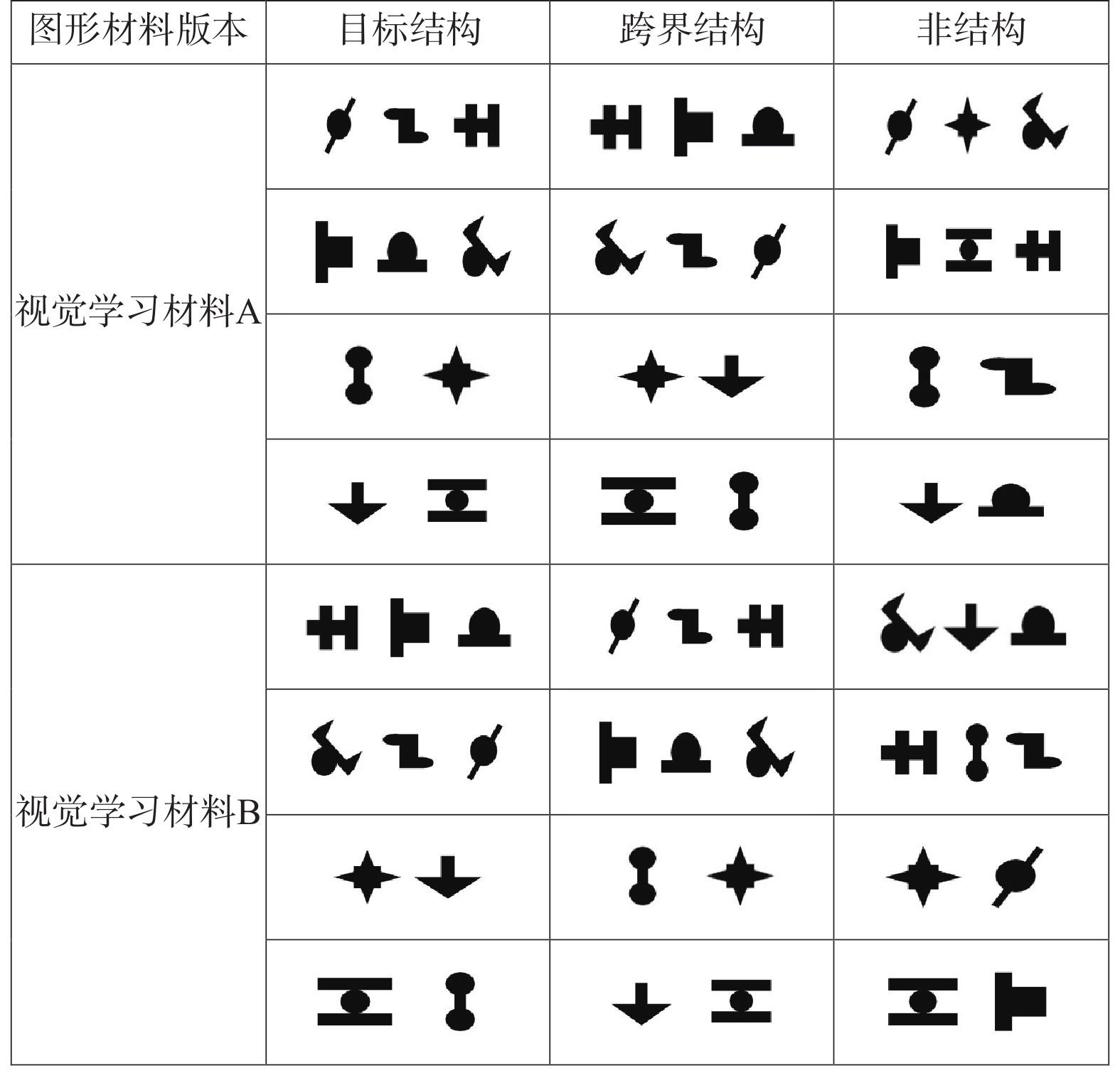
图2 视觉图形任务的三类图形材料

图3 实验流程图
| 模态 | 听觉语音模态 | 视觉图形模态 | ||||||||
| 测试任务 | 熟悉度评分任务 | 迫选任务 | 熟悉度评分任务 | 迫选任务 | ||||||
| 对照材料 | A | B | A | B | A | B | A | B | ||
| α系数 | 0.66 | 0.75 | 0.65 | 0.68 | 0.72 | 0.74 | 0.86 | 0.74 | ||
| 分半信度 | 0.41~0.82 | 0.59~0.91 | 0.20~0.90 | 0.33~0.89 | 0.56~0.86 | 0.40~0.88 | 0.59~0.97 | 0.38~0.94 | ||
表3 Cronbach’s α系数和分半信度结果
| 模态 | 听觉语音模态 | 视觉图形模态 | ||||||||
| 测试任务 | 熟悉度评分任务 | 迫选任务 | 熟悉度评分任务 | 迫选任务 | ||||||
| 对照材料 | A | B | A | B | A | B | A | B | ||
| α系数 | 0.66 | 0.75 | 0.65 | 0.68 | 0.72 | 0.74 | 0.86 | 0.74 | ||
| 分半信度 | 0.41~0.82 | 0.59~0.91 | 0.20~0.90 | 0.33~0.89 | 0.56~0.86 | 0.40~0.88 | 0.59~0.97 | 0.38~0.94 | ||
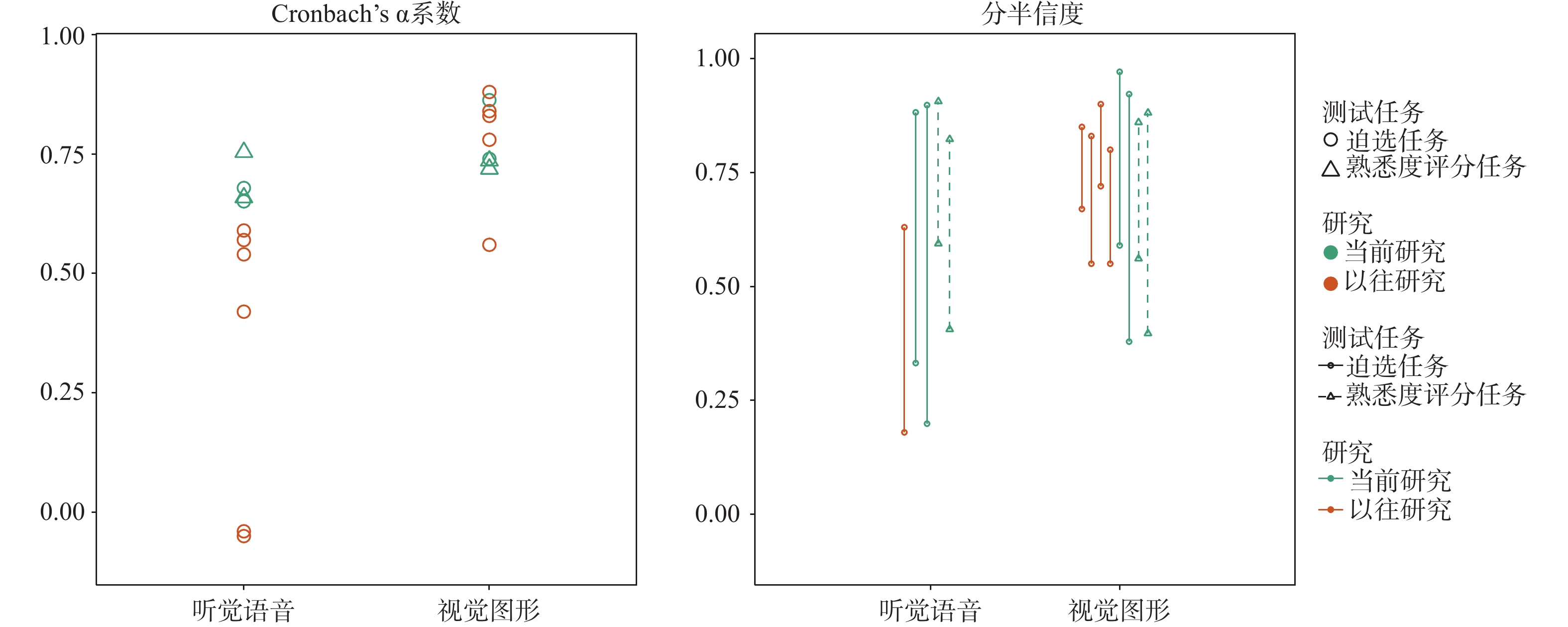
图4 统计学习能力测验信度汇总
|
徐贵平, 范若琳, 金花. 统计学习的认知神经机制及其与语言的关系. 心理科学进展, 2020, 28 (9): 1525- 1538.
|
|
|
于文勃, 王璐, 程幸悦, 王天琳, 张晶晶, 梁丹丹. 语言经验对概率词切分的影响. 心理科学进展, 2021, 29 (5): 787- 795.
|
|
|
于文勃, 王璐, 瞿邢芳, 王天琳, 张晶晶, 梁丹丹. 转换概率和词长期待对语音统计学习的影响. 心理学报, 2021, 53 (6): 565- 574.
|
|
|
Arnon, I. Do current statistical learning tasks capture stable individual differences in children? An investigation of task reliability across modality. Behavior Research Methods, 2020, 52 (1): 68- 81.
DOI |
|
|
Batterink, L. J., Reber, P. J., Neville, H. J., & Paller, K. A. Implicit and explicit contributions to statistical learning. Journal of Memory and Language, 2015, 83, 62- 78.
DOI |
|
|
Bogaerts, L., Frost, R., & Christiansen, M. H. Integrating statistical learning into cognitive science. Journal of Memory and Language, 2020, 115, 104167.
DOI |
|
|
Bogaerts, L., Siegelman, N., & Frost, R. Splitting the variance of statistical learning performance: A parametric investigation of exposure duration and transitional probabilities. Psychonomic Bulletin & Review, 2016, 23 (4): 1250- 1256.
|
|
|
Elazar, A., Alhama, R. G., Bogaerts, L., Siegelman, N., Baus, C., & Frost, R. When the “Tabula” is anything but “Rasa”: What determines performance in the auditory statistical learning task. Cognitive Science, 2022, 46 (2): e13102.
DOI |
|
|
Erickson, L. C., Kaschak, M. P., Thiessen, E. D., & Berry, C. A. S. Individual differences in statistical learning: Conceptual and measurement issues. Collabra, 2016, 2 (1): 14.
DOI |
|
|
Estes, K. G., Evans, J. L., Alibali, M. W., & Saffran, J. R. Can infants map meaning to newly segmented words? Statistical segmentation and word learning. Psychological Science, 2007, 18 (3): 254- 260.
DOI |
|
|
Estes, K. G., Gluck, S. C. W., & Bastos, C. Flexibility in statistical word segmentation: Finding words in foreign speech. Language Learning and Development, 2015, 11 (3): 252- 269.
DOI |
|
|
Frost, R., Armstrong, B. C., & Christiansen, M. H. Statistical learning research: A critical review and possible new directions. Psychological Bulletin, 2019, 145 (12): 1128- 1153.
DOI |
|
|
Gabay, Y., Thiessen, E. D., & Holt, L. L. (2015). Impaired statistical learning in developmental dyslexia. Journal of Speech, Language, and Hearing Research, 58(3), 934–945.
|
|
|
Hedge, C., Powell, G., & Sumner, P. The reliability paradox: Why robust cognitive tasks do not produce reliable individual differences. Behavior Research Methods, 2018, 50 (3): 1166- 1186.
DOI |
|
|
Hoch, L., Tyler, M. D., & Tillmann, B. Regularity of unit length boosts statistical learning in verbal and nonverbal artificial languages. Psychonomic Bulletin & Review, 2013, 20 (1): 142- 147.
|
|
|
Isbilen, E. S., & Christiansen, M. H. Statistical learning of language: A meta-analysis into 25 years of research. Cognitive Science, 2022, 46 (9): e13198.
DOI |
|
|
Isbilen, E. S., McCauley, S. M., & Christiansen, M. H. Individual differences in artificial and natural language statistical learning. Cognition, 2022, 225, 105123.
DOI |
|
|
Isbilen, E. S., McCauley, S. M., Kidd, E., & Christiansen, M. H. Statistically induced chunking recall: A memory-based approach to statistical learning. Cognitive Science, 2020, 44 (7): e12848.
DOI |
|
|
Kidd, E., & Arciuli, J. Individual differences in statistical learning predict children’s comprehension of syntax. Child Development, 2016, 87 (1): 184- 193.
DOI |
|
|
Kidd, E., Arciuli, J., Christiansen, M. H., Isbilen, E. S., Revius, K., & Smithson, M. Measuring children’s auditory statistical learning via serial recall. Journal of Experimental Child Psychology, 2020, 200, 104964.
DOI |
|
|
Lammertink, I., Boersma, P., Rispens, J., & Wijnen, F. Visual statistical learning in children with and without DLD and its relation to literacy in children with DLD. Reading and Writing, 2020, 33 (6): 1557- 1589.
DOI |
|
|
Lee, S. M. K., Cui, Y. M. N., & Tong, S. X. Toward a model of statistical learning and reading: Evidence from a meta-analysis. Review of Educational Research, 2022, 92 (4): 651- 691.
DOI |
|
|
Newport, E. L. Statistical language learning: Computational, maturational, and linguistic constraints. Language and Cognition, 2016, 8 (3): 447- 461.
DOI |
|
|
Nunnally, J. C., & Bernstein, I. H. (1994). Psychometric theory (3rd ed.). New York: McGraw-Hill.
|
|
|
Ordin, M., & Polyanskaya, L. The role of metacognition in recognition of the content of statistical learning. Psychonomic Bulletin & Review, 2021, 28 (1): 333- 340.
|
|
|
Perruchet, P. What mechanisms underlie implicit statistical learning? Transitional probabilities versus chunks in language learning. Topics in Cognitive Science, 2019, 11 (3): 520- 535.
DOI |
|
|
Qi, Z. H., Sanchez Araujo, Y., Georgan, W. C., Gabrieli, J. D. E., & Arciuli, J. Hearing matters more than seeing: A cross-modality study of statistical learning and reading ability. Scientific Studies of Reading, 2019, 23 (1): 101- 115.
DOI |
|
|
Saffran, J. R., Aslin, R. N., & Newport, E. L. Statistical learning by 8-month-old infants. Science, 1996, 274 (5294): 1926- 1928.
DOI |
|
|
Saffran, J. R., Johnson, E. K., Aslin, R. N., & Newport, E. L. Statistical learning of tone sequences by human infants and adults. Cognition, 1999, 70 (1): 27- 52.
DOI |
|
|
Saffran, J. R., & Kirkham, N. Z. Infant statistical learning. Annual Review of Psychology, 2018, 69 (1): 181- 203.
DOI |
|
|
Siegelman, N. Statistical learning abilities and their relation to language. Language and Linguistics Compass, 2020, 14 (3): e12365.
DOI |
|
|
Siegelman, N., Bogaerts, L., Elazar, A., Arciuli, J., & Frost, R. Linguistic entrenchment: Prior knowledge impacts statistical learning performance. Cognition, 2018, 177, 198- 213.
DOI |
|
|
Siegelman, N., Bogaerts, L., & Frost, R. Measuring individual differences in statistical learning: Current pitfalls and possible solutions. Behavior Research Methods, 2017, 49 (2): 418- 432.
DOI |
|
|
Siegelman, N., Bogaerts, L., Kronenfeld, O., & Frost, R. (2018). Redefining “Learning” in statistical learning: What does an online measure reveal about the assimilation of visual regularities? Cognitive Science, 42(Suppl.3), 692–727.
|
|
|
Siegelman, N., & Frost, R. (2015). Statistical learning as an individual ability: Theoretical perspectives and empirical evidence. Journal of Memory and Language, 81, 105–120.
|
|
|
Tong, X. H., Leung, W. W. S., & Tong, X. L. Visual statistical learning and orthographic awareness in Chinese children with and without developmental dyslexia. Research in Developmental Disabilities, 2019, 92, 103443.
DOI |
|
|
van Witteloostuijn, M., Boersma, P., Wijnen, F., & Rispens, J. (2021). The contribution of individual differences in statistical learning to reading and spelling performance in children with and without dyslexia. Dyslexia, 27(2), 168–186.
|
|
|
von Koss Torkildsen, J., Arciuli, J., & Wie, O. B. Individual differences in statistical learning predict children’s reading ability in a semi-transparent orthography. Learning and Individual Differences, 2019, 69, 60- 68.
DOI |
| [1] | 刘泽琪, 李玉华, 高艳, 刘佳欣, 苏萌萌. 小学生家庭读写环境量表的编制及信效度检验[J]. 心理与行为研究, 2026, 24(1): 113-121. |
| [2] | 赵晓婷, 刘海东, 李莉, 张李斌, 张光珍, 张云运. 3~6岁幼儿社会领域发展群体性评估工具的编制[J]. 心理与行为研究, 2025, 23(5): 653-661. |
| [3] | 廖文莉, 钟霜, 樊倩, 徐华春. 积极与消极冒险行为问卷在中国大学生群体中的修订[J]. 心理与行为研究, 2024, 22(6): 839-846. |
| [4] | 牛宏伟, 郝嘉佳, 白学军. 大学生失败心态量表的编制及信效度检验[J]. 心理与行为研究, 2024, 22(3): 379-386. |
| [5] | 赵守盈, 任蓉蓉, 陈维, 牟帮军. 7~8年级学生数字推理能力测验的编制及信效度验证[J]. 心理与行为研究, 2024, 22(3): 387-394. |
| [6] | 周曌, 季顺鑫, 刘拓. 简版和极简版问题性手机使用量表的开发[J]. 心理与行为研究, 2023, 21(6): 846-853. |
| [7] | 杨海波, 张馨予. 十项网络游戏障碍测验简体中文版的修订及其诊断能力评估[J]. 心理与行为研究, 2023, 21(5): 658-666. |
| [8] | 李红霞, 徐艳丽, 方怡泉, 郭凯玥, 司继伟. 简版数学焦虑量表在中国小学儿童群体中的修订及信效度检验[J]. 心理与行为研究, 2022, 20(6): 850-857. |
| [9] | 刘文, 孟祥蕊, 车翰博, 张嘉琪, 沈漪. 小学生创造性人格教师评定问卷的编制及信效度检验[J]. 心理与行为研究, 2020, 18(5): 624-630. |
| [10] | 王战旗, 张兴利. 创造力成就问卷的中文修订[J]. 心理与行为研究, 2020, 18(3): 390-397. |
| [11] | 张丽娜, 路海东. 高中生感知到的课堂教学方式量表的编制[J]. 心理与行为研究, 2019, 17(6): 773-779. |
| [12] | 郝嘉佳, 陈英和, 刘拓, 白学军. 儿童青少年一般思维能力测验的编制和初步应用[J]. 心理与行为研究, 2019, 17(5): 620-626. |
| [13] | 戴斌荣. 农村儿童社会适应问卷的编制[J]. 心理与行为研究, 2019, 17(4): 504-511. |
| [14] | 马惠霞, 刘慧芳, 翟永芳, 李桂芳. 《青少年自我意识情绪测验》的修订及信度效度验证[J]. 心理与行为研究, 2019, 17(2): 240-245. |
| [15] | 杨宏博, 赵轩. 基于多元概化理论的中小学教师资格考试质量分析——以《综合素质》(中学)科目为例[J]. 心理与行为研究, 2019, 17(2): 253-258. |
| 阅读次数 | ||||||
|
全文 |
|
|||||
|
摘要 |
|
|||||
