
心理与行为研究 ›› 2026, Vol. 24 ›› Issue (1): 51-59.DOI: 10.12139/j.1672-0628.2026.01.006
丁晓茜*,1( ), 刘华语2
收稿日期:2025-01-06
出版日期:2026-01-20
发布日期:2026-01-20
通讯作者:
丁晓茜
基金资助:
Xiaoqian DING*,1(), Huayu LIU2
Received:2025-01-06
Online:2026-01-20
Published:2026-01-20
Contact:
Xiaoqian DING
摘要:
遭到社会排斥后,个体是选择“持续交往”还是“避而不见”?现有研究尚未达成共识。为解释上述分歧的产生机制,本研究通过两个递进研究探讨消极完美主义的调节作用及其注意偏向的中介路径。研究1发现消极完美主义强化社会排斥对社会退缩行为的正向影响;研究2进一步发现在高消极完美主义群体中,对接受性情绪面孔注意偏向在社会排斥和社会退缩行为间起中介作用。该研究既厘清了特质−情境交互作用,又揭示了注意加工的动态过程,为解释分歧提供了新的整合框架。
丁晓茜, 刘华语. 社会排斥影响个体社交行为的双路径机制:消极完美主义与注意偏向的作用[J]. 心理与行为研究, 2026, 24(1): 51-59.
Xiaoqian DING, Huayu LIU. The Dual-Path Mechanisms of Social Exclusion on Individuals’ Social Behaviors: The Roles of Negative Perfectionism and Attentional Bias[J]. Studies of Psychology and Behavior, 2026, 24(1): 51-59.
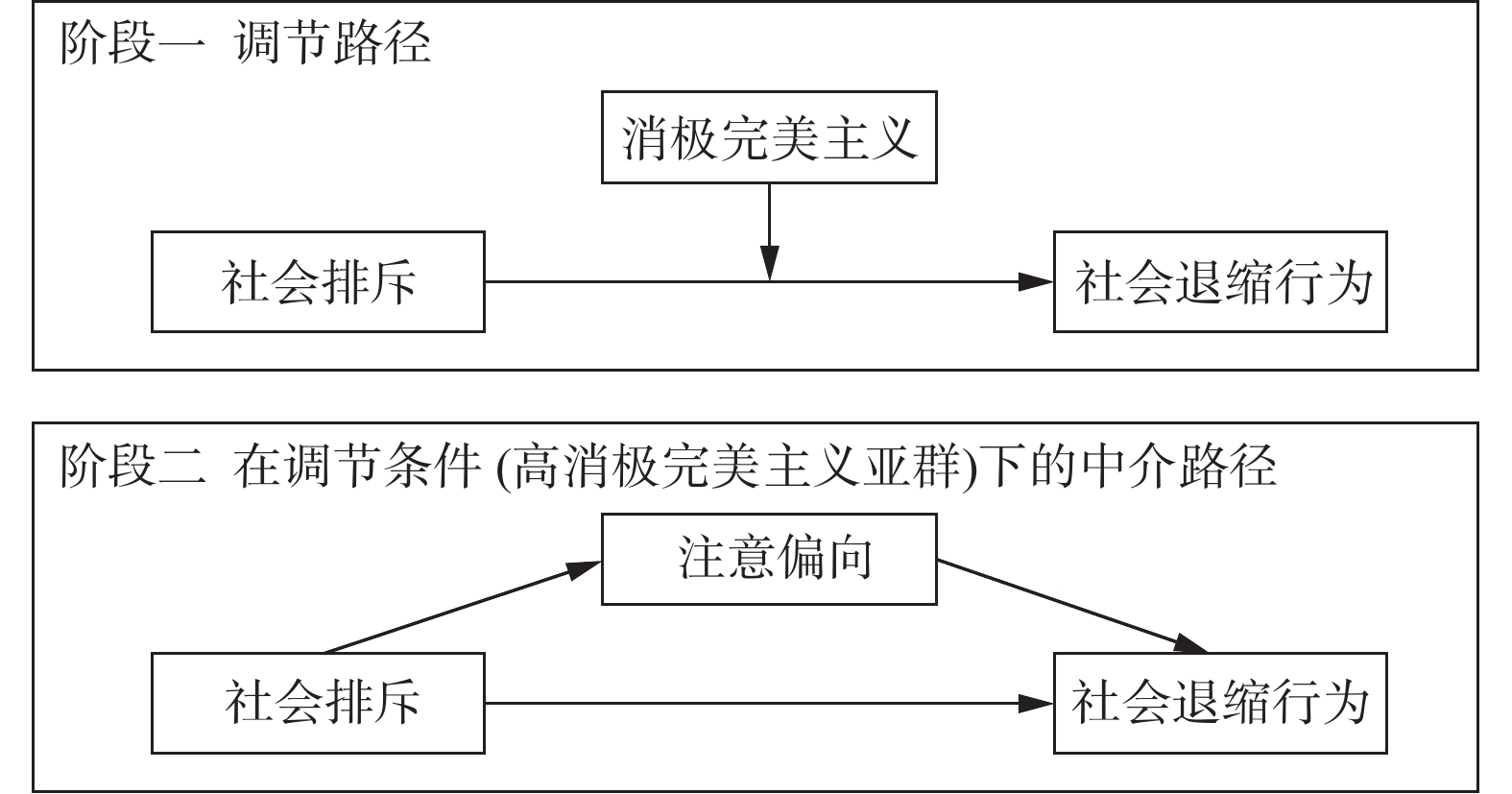
图1 假设模型
| 情境类型 | 消极完美主义程度 | 独自一人游戏 | 和同组人游戏 | 和新组人游戏 |
| 社会排斥 | 高消极完美主义 | 3.91±1.04 | 1.61±0.75 | 3.42±1.06 |
| 低消极完美主义 | 2.03±1.02 | 1.91±0.72 | 3.82±0.98 | |
| 社会接纳 | 高消极完美主义 | 1.52±0.62 | 3.91±1.04 | 3.55±1.12 |
| 低消极完美主义 | 1.48±0.62 | 4.03±0.85 | 4.03±0.64 |
表1 社会退缩行为的描述性统计(M±SD)
| 情境类型 | 消极完美主义程度 | 独自一人游戏 | 和同组人游戏 | 和新组人游戏 |
| 社会排斥 | 高消极完美主义 | 3.91±1.04 | 1.61±0.75 | 3.42±1.06 |
| 低消极完美主义 | 2.03±1.02 | 1.91±0.72 | 3.82±0.98 | |
| 社会接纳 | 高消极完美主义 | 1.52±0.62 | 3.91±1.04 | 3.55±1.12 |
| 低消极完美主义 | 1.48±0.62 | 4.03±0.85 | 4.03±0.64 |
| 变异来源 | 因变量 | F | df | p | |
| 情境类型 | 独自一人游戏 | 98.98 | 1 | <0.001 | 0.44 |
| 和同组人游戏 | 223.94 | 1 | <0.001 | 0.64 | |
| 和新组人游戏 | 0.98 | 1 | 0.325 | 0.01 | |
| 消极完美主义程度 | 独自一人游戏 | 41.75 | 1 | <0.001 | 0.25 |
| 和同组人游戏 | 2.06 | 1 | 0.154 | 0.02 | |
| 和新组人游戏 | 6.79 | 1 | 0.010 | 0.01 | |
| 情境类型×消极完美主义程度 | 独自一人游戏 | 39.14 | 1 | <0.001 | 0.23 |
| 和同组人游戏 | 0.39 | 1 | 0.540 | 0.00 | |
| 和新组人游戏 | 0.07 | 1 | 0.788 | 0.00 |
表2 社会退缩行为的多元方差分析结果
| 变异来源 | 因变量 | F | df | p | |
| 情境类型 | 独自一人游戏 | 98.98 | 1 | <0.001 | 0.44 |
| 和同组人游戏 | 223.94 | 1 | <0.001 | 0.64 | |
| 和新组人游戏 | 0.98 | 1 | 0.325 | 0.01 | |
| 消极完美主义程度 | 独自一人游戏 | 41.75 | 1 | <0.001 | 0.25 |
| 和同组人游戏 | 2.06 | 1 | 0.154 | 0.02 | |
| 和新组人游戏 | 6.79 | 1 | 0.010 | 0.01 | |
| 情境类型×消极完美主义程度 | 独自一人游戏 | 39.14 | 1 | <0.001 | 0.23 |
| 和同组人游戏 | 0.39 | 1 | 0.540 | 0.00 | |
| 和新组人游戏 | 0.07 | 1 | 0.788 | 0.00 |
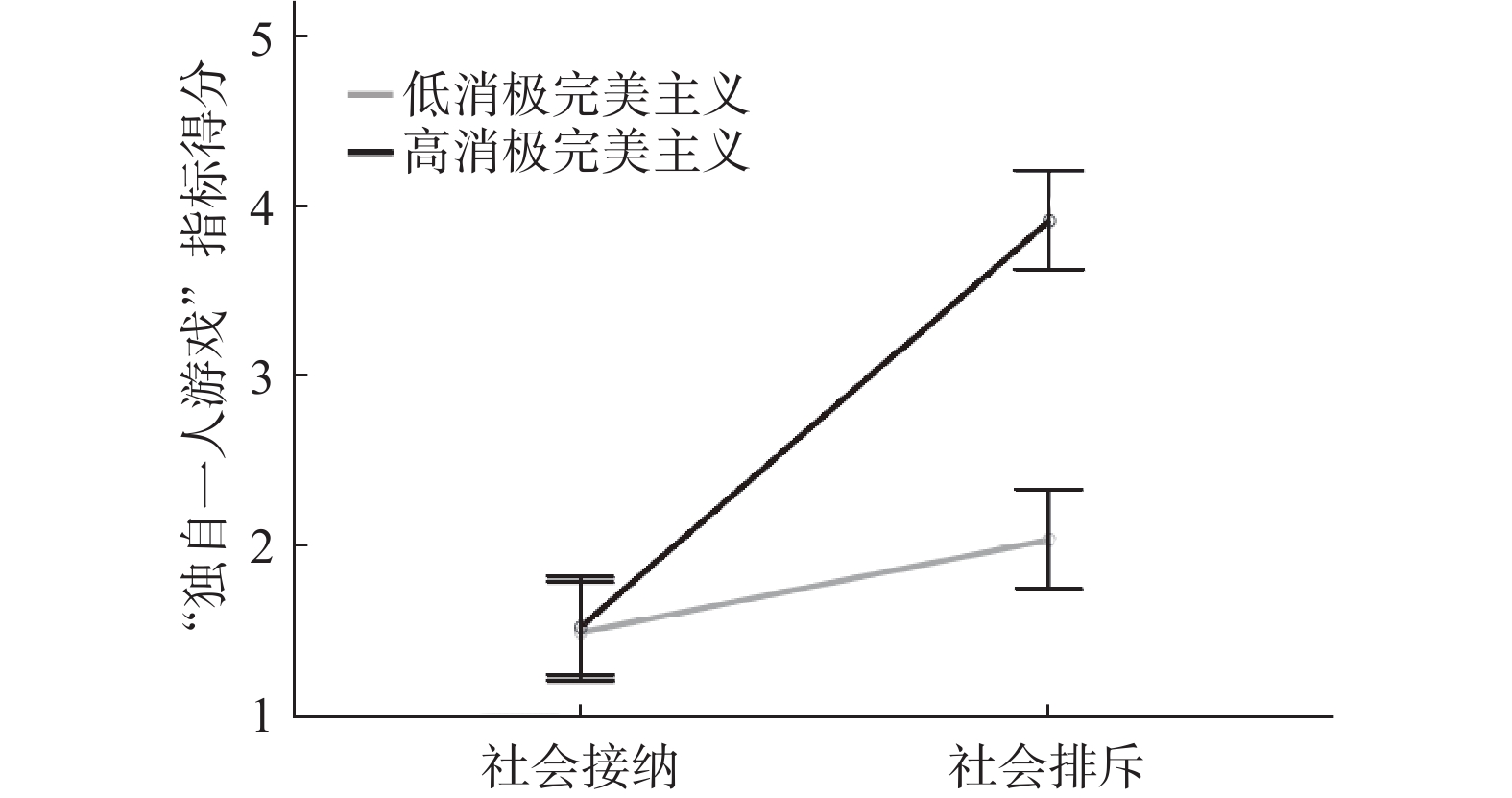
图2 不同情境类型下高、低消极完美主义者在社会退缩行为上的得分差异 注:“独自一人游戏”指标得分代表社会退缩行为的程度。
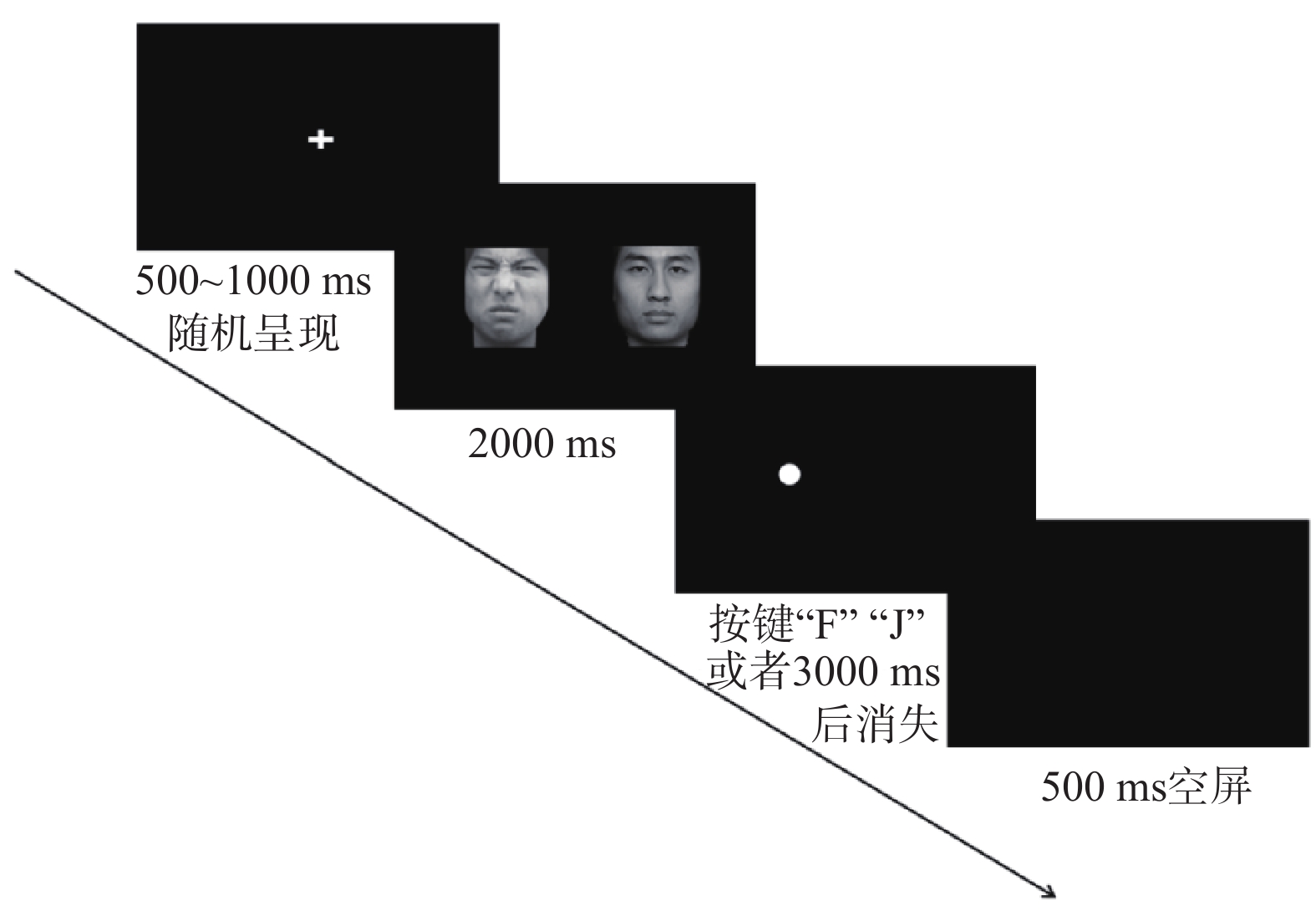
图3 点探测任务流程
| 变量 | 1 | 2 | 3 | 4 | 5 | 6 | 7 | 8 | 9 |
| 1. SE | |||||||||
| 2. aBI | −0.28* | ||||||||
| 3. rBI | 0.30** | −0.04 | |||||||
| 4. TaAB | −0.00 | −0.03 | 0.03 | ||||||
| 5. TrAB | 0.07 | −0.08 | 0.14 | 0.11 | |||||
| 6. DaAB | −0.28* | 0.14 | −0.21 | −0.12 | −0.23* | ||||
| 7. DrAB | 0.26* | −0.11 | 0.04 | 0.20 | 0.31** | −0.37** | |||
| 8. TTaAB | −0.47** | 0.26* | −0.31** | −0.02 | −0.30** | 0.80** | −0.31** | ||
| 9. TTrAB | 0.45** | −0.20 | 0.21 | 0.17 | 0.31** | −0.41** | 0.75** | −0.45** | |
| 10. SW | 0.86** | −0.44** | 0.28* | −0.07 | 0.14 | −0.34** | 0.27* | −0.55** | 0.43** |
表3 各变量的相关分析结果
| 变量 | 1 | 2 | 3 | 4 | 5 | 6 | 7 | 8 | 9 |
| 1. SE | |||||||||
| 2. aBI | −0.28* | ||||||||
| 3. rBI | 0.30** | −0.04 | |||||||
| 4. TaAB | −0.00 | −0.03 | 0.03 | ||||||
| 5. TrAB | 0.07 | −0.08 | 0.14 | 0.11 | |||||
| 6. DaAB | −0.28* | 0.14 | −0.21 | −0.12 | −0.23* | ||||
| 7. DrAB | 0.26* | −0.11 | 0.04 | 0.20 | 0.31** | −0.37** | |||
| 8. TTaAB | −0.47** | 0.26* | −0.31** | −0.02 | −0.30** | 0.80** | −0.31** | ||
| 9. TTrAB | 0.45** | −0.20 | 0.21 | 0.17 | 0.31** | −0.41** | 0.75** | −0.45** | |
| 10. SW | 0.86** | −0.44** | 0.28* | −0.07 | 0.14 | −0.34** | 0.27* | −0.55** | 0.43** |
| 中介变量 | β | SE | 95%CI | |
| LLCI | ULCI | |||
| 接受性情绪面孔注意偏向 | −0.21 | 0.08 | −0.37 | −0.06 |
| 拒绝性情绪面孔注意偏向 | −0.01 | 0.04 | −0.03 | 0.02 |
| 接受性情绪面孔首次注视时间 | −0.06 | 0.04 | −0.04 | 0.00 |
| 拒绝性情绪面孔首次注视时间 | −0.03 | 0.04 | −0.04 | 0.03 |
| 接受性情绪面孔总注视时间 | −0.12 | 0.05 | −0.22 | −0.02 |
| 拒绝性情绪面孔总注视时间 | −0.05 | 0.06 | −0.05 | 0.02 |
表4 注意偏向的中介效应检验
| 中介变量 | β | SE | 95%CI | |
| LLCI | ULCI | |||
| 接受性情绪面孔注意偏向 | −0.21 | 0.08 | −0.37 | −0.06 |
| 拒绝性情绪面孔注意偏向 | −0.01 | 0.04 | −0.03 | 0.02 |
| 接受性情绪面孔首次注视时间 | −0.06 | 0.04 | −0.04 | 0.00 |
| 拒绝性情绪面孔首次注视时间 | −0.03 | 0.04 | −0.04 | 0.03 |
| 接受性情绪面孔总注视时间 | −0.12 | 0.05 | −0.22 | −0.02 |
| 拒绝性情绪面孔总注视时间 | −0.05 | 0.06 | −0.05 | 0.02 |
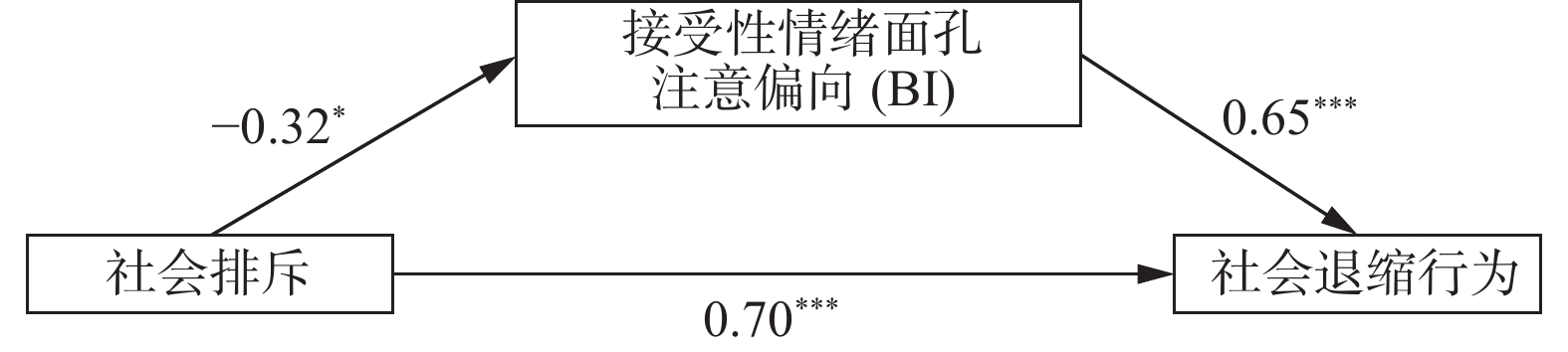
图4 接受性情绪面孔注意偏向(BI)在社会排斥和社会退缩行为间的中介作用路径图
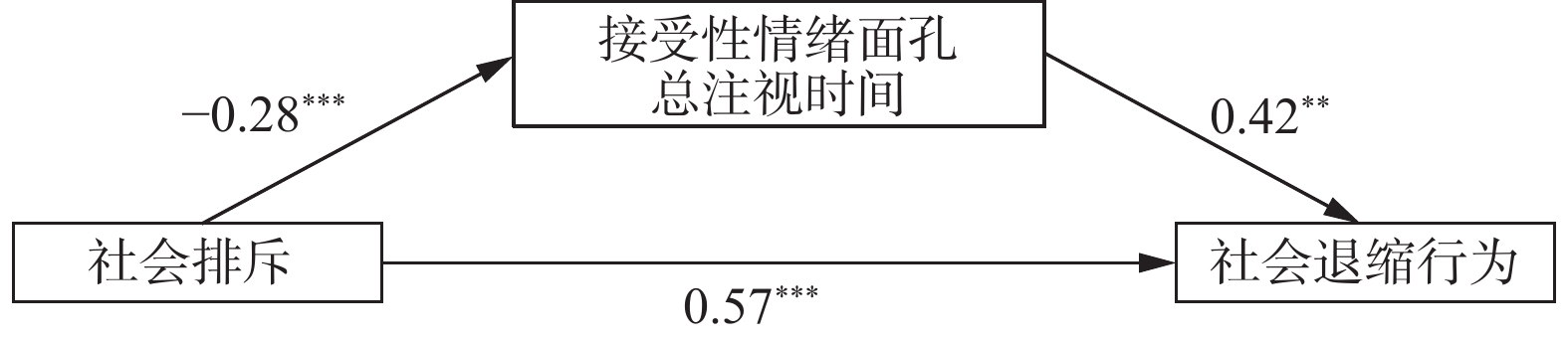
图5 接受性情绪面孔总注视时间在社会排斥和社会退缩行为间的中介作用路径图
|
杜建政, 夏冰丽. 心理学视野中的社会排斥. 心理科学进展, 2008, 16 (6): 981- 986.
|
|
|
李晓白, 朱棋, 刘嘉. 行为遗传学: 解决面孔特异性问题争论的新思路. 心理科学进展, 2009, 17 (2): 284- 293.
|
|
|
张妮, 刘文, 刘方, 郭鑫. 8~12岁儿童抑郁与认知重评的关系: 悲伤面孔注意偏向的中介作用. 心理学报, 2022, 54 (1): 25- 39.
|
|
|
訾非, 周晓林, 刘兴华, 潘苗苗. 完美主义者对不完美图形的注意偏好研究. 心理科学, 2011, 34 (3): 532- 537.
DOI |
|
|
訾非, 周旭. 中文Frost多维度完美主义问卷的信效度检验. 中国临床心理学杂志, 2006, 14 (6): 560- 565.
DOI |
|
|
Abdollahi, A., Carlbring, P., Vaez, E., & Ghahfarokhi, S. A. Perfectionism and test anxiety among high-school students: The moderating role of academic hardiness. Current Psychology, 2018, 37 (3): 632- 639.
DOI |
|
|
Affrunti, N. W., & Woodruff-Borden, J. Perfectionism in pediatric anxiety and depressive disorders. Clinical Child and Family Psychology Review, 2014, 17 (3): 299- 317.
DOI |
|
|
Bar-Haim, Y., Holoshitz, Y., Eldar, S., Frenkel, T. I., Muller, D., Charney, D. S., ... Wald, I. Life-threatening danger and suppression of attention bias to threat. American Journal of Psychiatry, 2010, 167 (6): 694- 698.
DOI |
|
|
Beck, A. T., & Clark, D. A. An information processing model of anxiety: Automatic and strategic processes. Behaviour Research and Therapy, 1997, 35 (1): 49- 58.
DOI |
|
|
Böckler, A., Hömke, P., & Sebanz, N. Invisible man: Exclusion from shared attention affects gaze behavior and self-reports. Social Psychological and Personality Science, 2014, 5 (2): 140- 148.
DOI |
|
|
Bowker, J. C., & Raja, R. Social withdrawal subtypes during early adolescence in India. Journal of Abnormal Child Psychology, 2011, 39 (2): 201- 212.
DOI |
|
|
Chen, L., Zeng, S. Y., & Su, Y. X. The influence of social exclusion on adolescents’ social withdrawal behavior: The moderating role of connectedness to nature. Journal of Environmental Psychology, 2023, 87, 101951.
DOI |
|
|
Chen, S. Book Review: Perfectionism: A relational approach to conceptualization, assessment, and treatment by P. L., Hewitt, G. L., Flett, & S. F. Mikail. Journal of Psychoeducational Assessment, 2019, 37 (2): 244- 245.
DOI |
|
|
DeWall, C. N., Maner, J. K., & Rouby, D. A. Social exclusion and early-stage interpersonal perception: Selective attention to signs of acceptance. Journal of Personality and Social Psychology, 2009, 96 (4): 729- 741.
DOI |
|
|
Dimaggio, G., Lysaker, P. H., Calarco, T., Pedone, R., Marsigli, N., Riccardi, I., ... Paviglianiti, A. Perfectionism and personality disorders as predictors of symptoms and interpersonal problems. American Journal of Psychotherapy, 2015, 69 (3): 317- 330.
DOI |
|
|
Downey, G., & Feldman, S. Implications of rejection sensitivity for intimate relationships. Journal of Personality and Social Psychology, 1996, 70 (6): 1327- 1343.
DOI |
|
|
Frost, R. O., Marten, P., Lahart, C., & Rosenblate, R. The dimensions of perfectionism. Cognitive Therapy and Research, 1990, 14 (5): 449- 468.
DOI |
|
|
Garner, M., Mogg, K., & Bradley, B. P. Orienting and maintenance of gaze to facial expressions in social anxiety. Journal of Abnormal Psychology, 2006, 115 (4): 760- 770.
DOI |
|
|
Horney, K. Neurosis and human growth: The struggle toward self-realization. Journal of the American Medical Association, 1950, 145 (2): 124.
DOI |
|
|
Koster, E. H. W., Crombez, G., Verschuere, B., van Damme, S., & Wiersema, J. R. Components of attentional bias to threat in high trait anxiety: Facilitated engagement, impaired disengagement, and attentional avoidance. Behaviour Research and Therapy, 2006, 44 (12): 1757- 1771.
DOI |
|
|
Oliva, V., Fanelli, G., Kasper, S., Zohar, J., Souery, D., Montgomery, S., ... Serretti, A. Social withdrawal as a trans-diagnostic predictor of short-term remission: A meta-analysis of five clinical cohorts. International Clinical Psychopharmacology, 2022, 37 (2): 38- 45.
DOI |
|
|
Parker, W. D. An empirical typology of perfectionism in academically talented children. American Educational Research Journal, 1997, 34 (3): 545- 562.
DOI |
|
|
Ren, D. N., & Evans, A. M. Leaving the loners alone: Dispositional preference for solitude evokes ostracism. Personality and Social Psychology Bulletin, 2020, 47 (8): 1294- 1308.
DOI |
|
|
Ren, D. N., Wesselmann, E., & Williams, K. D. Evidence for another response to ostracism: Solitude seeking. Social Psychological and Personality Science, 2016, 7 (3): 204- 212.
DOI |
|
|
Rubin, K. H., Coplan, R. J., & Bowker, J. C. Social withdrawal in childhood. Annual Review of Psychology, 2009, 60, 141- 171.
DOI |
|
|
Stoeber, J. Multidimensional perfectionism and the DSM-5 personality traits. Personality and Individual Differences, 2014, 64, 115- 120.
DOI |
|
|
Stoeber, J., Noland, A. B., Mawenu, T. W. N., Henderson, T. M., & Kent, D. N. P. Perfectionism, social disconnection, and interpersonal hostility: Not all perfectionists don’t play nicely with others. Personality and Individual Differences, 2017, 119, 112- 117.
DOI |
|
|
Susa, G., Piticǎ, I, Benga, O., & Miclea, M. The self regulatory effect of attentional control in modulating the relationship between attentional biases toward threat and anxiety symptoms in children. Cognition & Emotion, 2012, 26 (6): 1069- 1083.
DOI |
|
|
Tonta, K. E., Howell, J., Boyes, M., Mcevoy, P., & Hasking, P. An experimental investigation of biased attention in non-suicidal self-injury: The effects of perfectionism and emotional valence on attentional engagement and disengagement. Journal of Behavior Therapy and Experimental Psychiatry, 2023, 81, 101856.
DOI |
|
|
Tonta, K. E., Howell, J. A., Hasking, P. A., Boyes, M. E., & Clarke, P. J. F. Attention biases in perfectionism: Biased disengagement of attention from emotionally negative stimuli. Journal of Behavior Therapy and Experimental Psychiatry, 2019, 64, 72- 79.
DOI |
|
|
Troller-Renfree, S., McDermott, J. M., Nelson, C. A., Zeanah, C. H, & Fox, N. A. The effects of early foster care intervention on attention biases in previously institutionalized children in Romania. Developmental Science, 2015, 18 (5): 713- 722.
DOI |
|
|
White, L. K., Degnan, K. A., Henderson, H. A., Pérez-Edgar, K., Walker, O. L., Shechner, T., ... Fox, N. A. Developmental relations among behavioral inhibition, anxiety, and attention biases to threat and positive information. Child Development, 2017, 88 (1): 141- 155.
DOI |
|
|
Williams, K. D. (2009). Ostracism: A temporal need-threat model. In M. P. Zanna (Ed.), Advances in experimental social psychology (Vol. 41, pp. 275–314), Amsterdam: Elsevier.
|
|
|
Williams, K. D., Cheung, C. K., & Choi, W. Cyberostracism: Effects of being ignored over the internet. Journal of Personality and Social Psychology, 2000, 79 (5): 748- 762.
DOI |
|
|
Wood, K. R., Coplan, R. J., Hipson, W. E., & Bowker, J. C. Normative beliefs about social withdrawal in adolescence. Journal of Research on Adolescence, 2021, 32 (1): 372- 381.
DOI |
|
|
Zadro, L., Williams, K. D., & Richardson, R. How low can you go? Ostracism by a computer is sufficient to lower self-reported levels of belonging, control, self-esteem, and meaningful existence. Journal of Experimental Social Psychology, 2004, 40 (4): 560- 567.
DOI |
| [1] | 王娅珂, 张雨轩, 冯琳琳, 卡明芳, 梁菲菲. 小学三到五年级儿童阅读眼动模式的发展及其与阅读理解的关系[J]. 心理与行为研究, 2026, 24(2): 161-169. |
| [2] | 张野, 刘致宏, 赵丽云. 青少年网络社会排斥、敌意归因偏向与网络偏差行为的关系:一项纵向研究[J]. 心理与行为研究, 2026, 24(1): 60-68. |
| [3] | 王怀勇, 徐田田, 叶青. 过程追踪视角下焦虑情绪对延迟选择的影响及机制:任务框架的调节作用[J]. 心理与行为研究, 2026, 24(1): 122-129. |
| [4] | 王旭瑛, 邵杨, 阴晓娟, 金晓康, 金花. 恐惧诉求下希望类健康错误信息的更正:来自行为和眼动的证据[J]. 心理与行为研究, 2025, 23(6): 813-821. |
| [5] | 李文静, 孙雯, 朱海迪. 流行背景音乐对休闲阅读的影响:来自眼动的证据[J]. 心理与行为研究, 2025, 23(4): 448-455. |
| [6] | 代晨辉, 赵小军, 石常秀, 李明臻, 赵尧瑶. 社会排斥对人际信任的影响:基于情景观和特质观的双重分析视角[J]. 心理与行为研究, 2025, 23(3): 384-390. |
| [7] | 杜宇菲, 张志超, 张慢慢, 臧传丽. 语义优先于世界知识参与句子理解过程:来自眼动的证据[J]. 心理与行为研究, 2025, 23(2): 153-160. |
| [8] | 卢林鑫, 刘在花, 杨爽, 蒋政凯, 党韦强, 谭婧, 班永飞, 孙霁, 蔺秀云. 社会排斥与先天轻度肢残青少年抑郁特征的关联性:基于生成性模型与反映性模型的纵向分析[J]. 心理与行为研究, 2025, 23(2): 216-225. |
| [9] | 张丽华, 杨博, 刘欣. 社会排斥对不同类型自恋者敌意解释偏向的影响[J]. 心理与行为研究, 2025, 23(2): 257-264. |
| [10] | 王永胜, 韩洋, 李馨, 何立媛. 词间空格在维吾尔族大学生不同文本呈现方向的汉语句子阅读中的促进作用[J]. 心理与行为研究, 2025, 23(1): 41-48. |
| [11] | 陈相文, 王泷歌, 胡惠兰, 张志超, 王梦思, 汪强, 张慢慢. 中文阅读词频效应个体差异的脑结构基础:基于眼动指标的分析[J]. 心理与行为研究, 2024, 22(6): 721-729. |
| [12] | 赵光, 陈佳欢, 李林璇, 张吉超, 吴镕涛. 背景线索效应的动态眼动模式:基于隐马尔可夫模型[J]. 心理与行为研究, 2024, 22(5): 594-601. |
| [13] | 贾宇晴, 高彤琪, 闫国利. 一年级小学生汉语默读和朗读差异的眼动研究[J]. 心理与行为研究, 2024, 22(5): 633-641. |
| [14] | 周广东, 刘爽, 俞美硕. 反应性和主动性攻击儿童情绪面孔的注意差异[J]. 心理与行为研究, 2024, 22(5): 642-649. |
| [15] | 常敏, 张阔, 孙悦, 李莎, 王敬欣. 汉语阅读中的语义相似度效应:语义预测的证据[J]. 心理与行为研究, 2024, 22(4): 442-449. |
| 阅读次数 | ||||||
|
全文 |
|
|||||
|
摘要 |
|
|||||
