
心理与行为研究 ›› 2026, Vol. 24 ›› Issue (2): 161-169.DOI: 10.12139/j.1672-0628.2026.02.003
王娅珂1,2, 张雨轩1,2, 冯琳琳1,2, 卡明芳1,2, 梁菲菲*,1,2,3( )
)
收稿日期:2025-05-27
出版日期:2026-03-20
发布日期:2026-03-20
通讯作者:
梁菲菲
基金资助:
Yake WANG1,2, Yuxuan ZHANG1,2, Linlin FENG1,2, Mingfang KA1,2, Feifei LIANG*,1,2,3()
Received:2025-05-27
Online:2026-03-20
Published:2026-03-20
Contact:
Feifei LIANG
摘要:
基于眼动追踪技术,考察小学生阅读眼动模式的发展特点,以及阅读理解水平是否与阅读认知策略相关。记录291名三至五年级儿童篇章阅读的眼动轨迹及阅读理解成绩,并依据阅读理解成绩将儿童分为高、低理解组。结果发现:(1)三、四年级儿童的阅读眼动模式相对稳定,五年级表现出显著发展,表明四到五年级是儿童阅读眼动模式发展的敏感期。(2)高理解组儿童采用更谨慎的阅读认知策略,通过降低阅读速度、增加回视行为以保证理解质量。研究表明,儿童在小学阶段习得“高准确度倾向”的阅读认知策略。
王娅珂, 张雨轩, 冯琳琳, 卡明芳, 梁菲菲. 小学三到五年级儿童阅读眼动模式的发展及其与阅读理解的关系[J]. 心理与行为研究, 2026, 24(2): 161-169.
Yake WANG, Yuxuan ZHANG, Linlin FENG, Mingfang KA, Feifei LIANG. Developmental Trajectories of Eye Movement in Reading Among Third- to Fifth-Grade Children and Their Relationship with Reading Comprehension[J]. Studies of Psychology and Behavior, 2026, 24(2): 161-169.
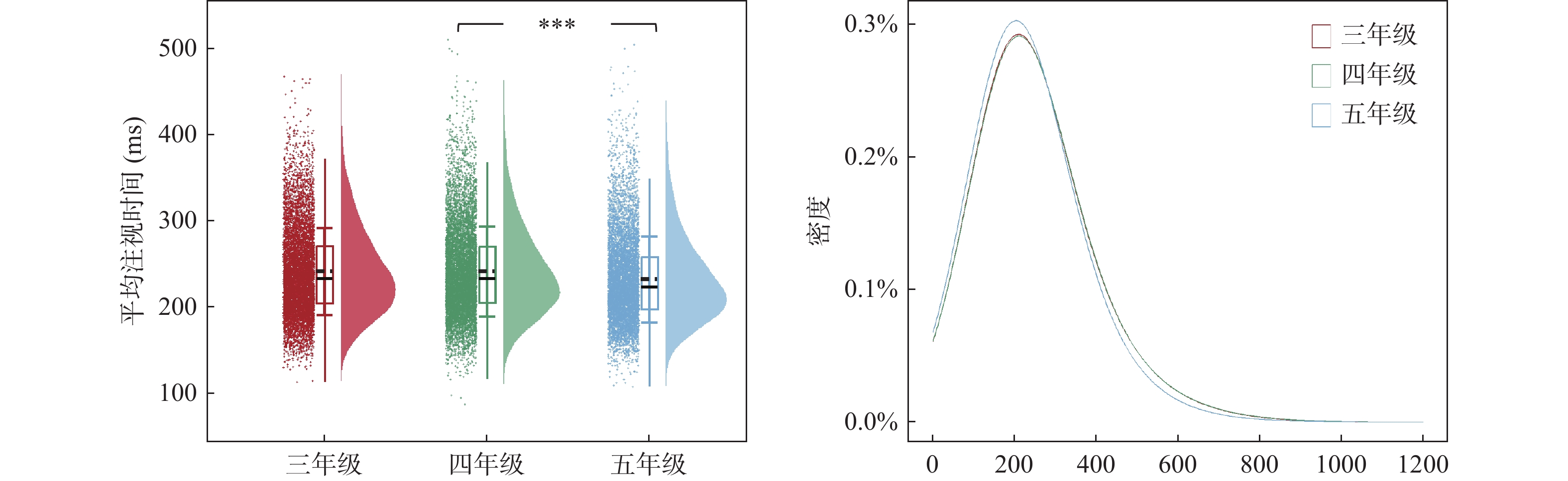
图1 各年级儿童的平均注视时间和注视时间分布 注:图1左箱型图中的黑实线代表中位数,黑虚线代表平均值,以下同。
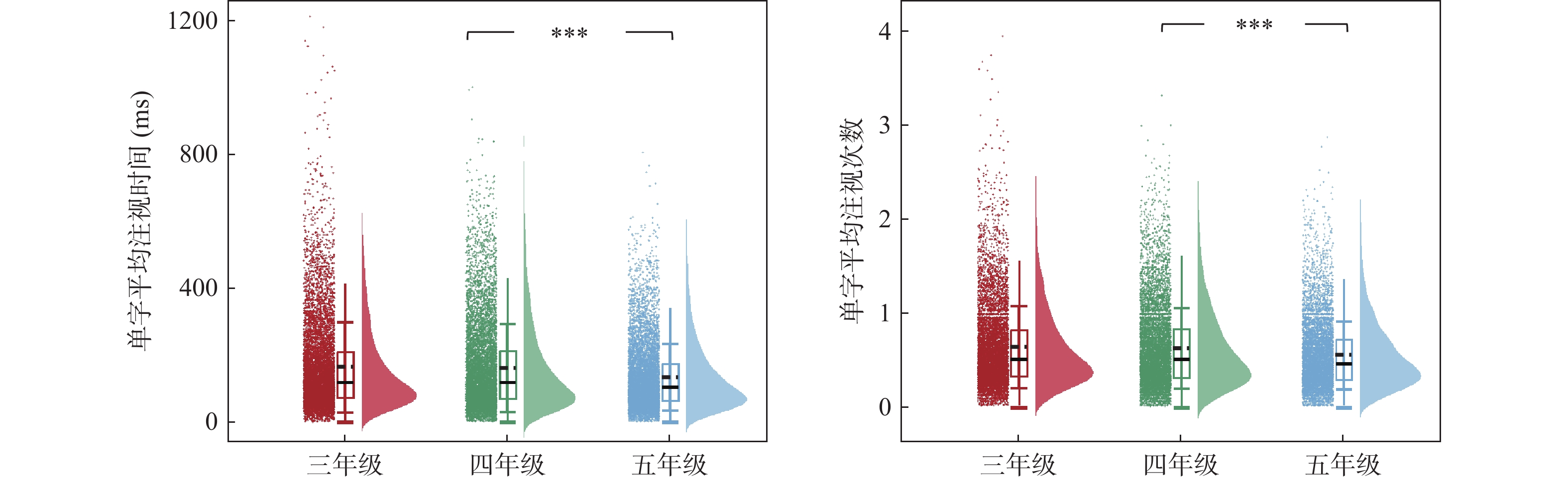
图2 各年级儿童的单字平均注视时间和单字平均注视次数
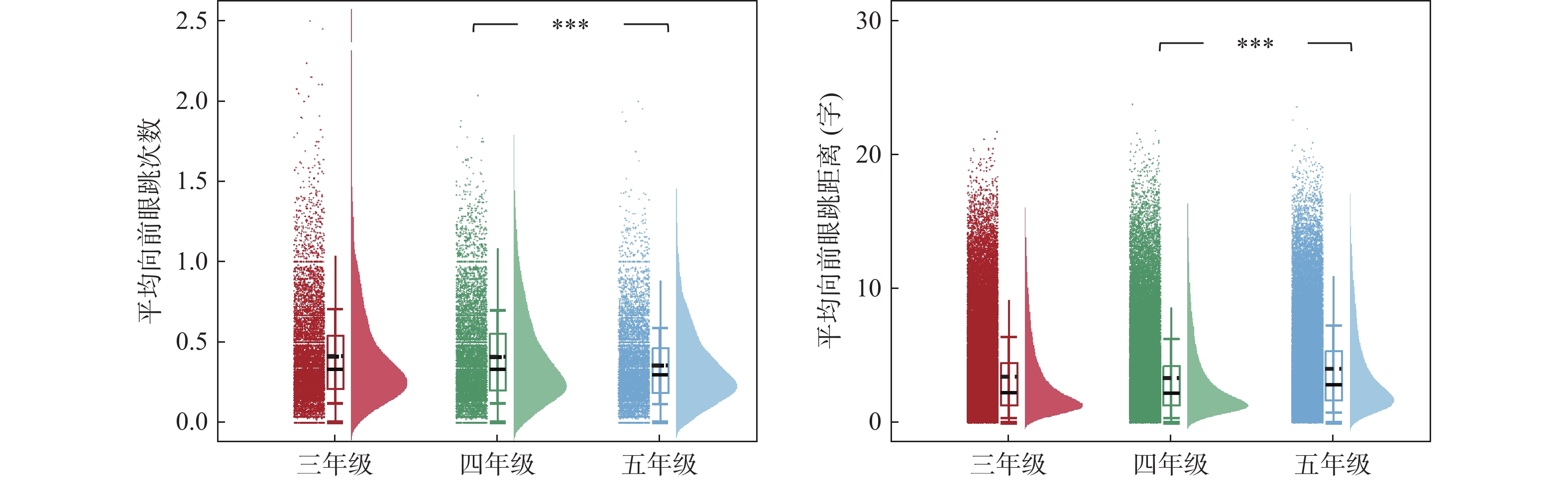
图3 各年级儿童的平均向前眼跳次数和平均向前眼跳距离
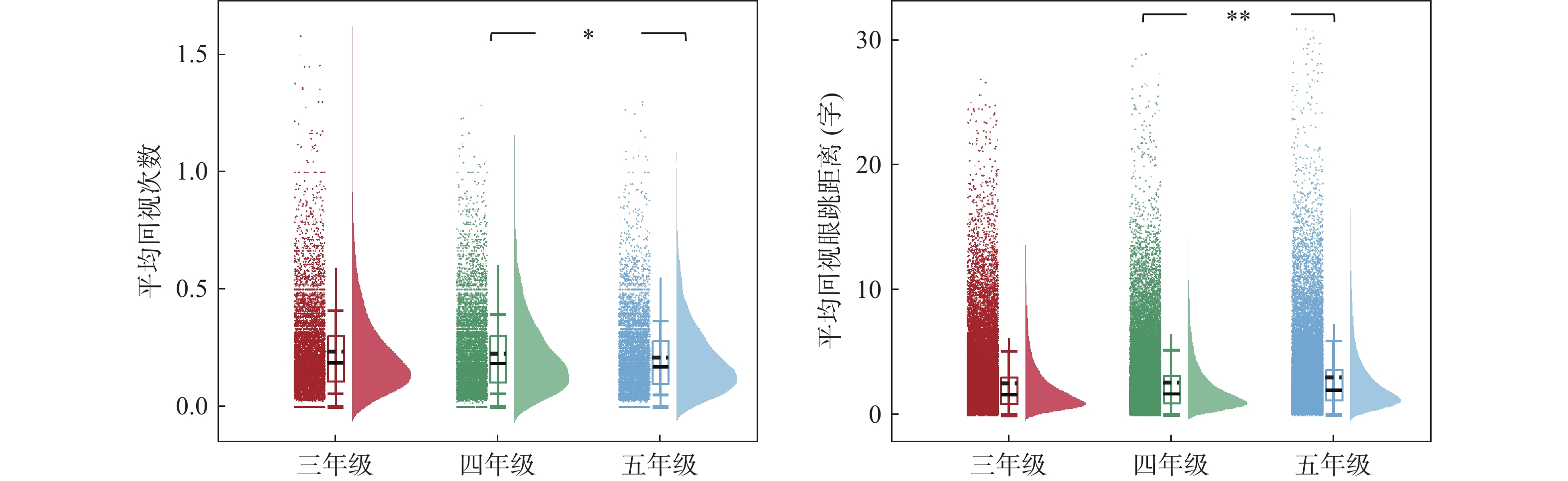
图4 各年级儿童的平均回视次数和平均回视眼跳距离
| 变量 | b | SE | t | 95%CI | |
| 平均注视时间 | 截距 | 5.45 | 0.01 | 615.10*** | [5.44, 5.47] |
| 三年级vs.四年级 | 0.01 | 0.02 | 0.33 | [–0.03, 0.04] | |
| 四年级vs.五年级 | –0.06 | 0.01 | –4.18*** | [–0.08, –0.03] | |
| 单字平均注视时间 | 截距 | 4.73 | 0.04 | 124.22*** | [4.66, 4.80] |
| 三年级vs.四年级 | –0.02 | 0.07 | –0.38 | [–0.15, 0.10] | |
| 四年级vs.五年级 | –0.19 | 0.05 | –3.93*** | [–0.29, –0.10] | |
| 单字平均注视次数 | 截距 | 0.61 | 0.02 | 31.30*** | [0.57, 0.65] |
| 三年级vs.四年级 | –0.01 | 0.04 | –0.32 | [–0.08, 0.06] | |
| 四年级vs.五年级 | –0.09 | 0.03 | –3.36*** | [–0.14, –0.04] | |
| 平均向前眼跳次数 | 截距 | 0.39 | 0.01 | 28.06*** | [0.36, 0.41] |
| 三年级vs.四年级 | –0.01 | 0.02 | –0.28 | [–0.05, 0.04] | |
| 四年级vs.五年级 | –0.06 | 0.02 | –3.73*** | [–0.10, –0.03] | |
| 平均向前眼跳距离 | 截距 | 4.11 | 0.08 | 48.55 | [3.94, 4.28] |
| 三年级vs.四年级 | –0.01 | 0.17 | –0.07 | [–0.35, 0.33] | |
| 四年级vs.五年级 | 0.47 | 0.09 | 5.05*** | [0.29, 0.66] | |
| 平均回视次数 | 截距 | 0.22 | 0.01 | 33.08*** | [0.21, 0.23] |
| 三年级vs.四年级 | –0.01 | 0.01 | –0.43 | [–0.03, 0.02] | |
| 四年级vs.五年级 | –0.02 | 0.01 | –2.14* | [–0.04, –0.002] | |
| 平均回视眼跳距离 | 截距 | 2.93 | 0.06 | 47.87*** | [2.81, 3.05] |
| 三年级vs.四年级 | 0.14 | 0.12 | 1.18 | [–0.09, 0.38] | |
| 四年级vs.五年级 | 0.30 | 0.10 | 3.04** | [0.11, 0.49] |
表1 各年级儿童模型分析结果
| 变量 | b | SE | t | 95%CI | |
| 平均注视时间 | 截距 | 5.45 | 0.01 | 615.10*** | [5.44, 5.47] |
| 三年级vs.四年级 | 0.01 | 0.02 | 0.33 | [–0.03, 0.04] | |
| 四年级vs.五年级 | –0.06 | 0.01 | –4.18*** | [–0.08, –0.03] | |
| 单字平均注视时间 | 截距 | 4.73 | 0.04 | 124.22*** | [4.66, 4.80] |
| 三年级vs.四年级 | –0.02 | 0.07 | –0.38 | [–0.15, 0.10] | |
| 四年级vs.五年级 | –0.19 | 0.05 | –3.93*** | [–0.29, –0.10] | |
| 单字平均注视次数 | 截距 | 0.61 | 0.02 | 31.30*** | [0.57, 0.65] |
| 三年级vs.四年级 | –0.01 | 0.04 | –0.32 | [–0.08, 0.06] | |
| 四年级vs.五年级 | –0.09 | 0.03 | –3.36*** | [–0.14, –0.04] | |
| 平均向前眼跳次数 | 截距 | 0.39 | 0.01 | 28.06*** | [0.36, 0.41] |
| 三年级vs.四年级 | –0.01 | 0.02 | –0.28 | [–0.05, 0.04] | |
| 四年级vs.五年级 | –0.06 | 0.02 | –3.73*** | [–0.10, –0.03] | |
| 平均向前眼跳距离 | 截距 | 4.11 | 0.08 | 48.55 | [3.94, 4.28] |
| 三年级vs.四年级 | –0.01 | 0.17 | –0.07 | [–0.35, 0.33] | |
| 四年级vs.五年级 | 0.47 | 0.09 | 5.05*** | [0.29, 0.66] | |
| 平均回视次数 | 截距 | 0.22 | 0.01 | 33.08*** | [0.21, 0.23] |
| 三年级vs.四年级 | –0.01 | 0.01 | –0.43 | [–0.03, 0.02] | |
| 四年级vs.五年级 | –0.02 | 0.01 | –2.14* | [–0.04, –0.002] | |
| 平均回视眼跳距离 | 截距 | 2.93 | 0.06 | 47.87*** | [2.81, 3.05] |
| 三年级vs.四年级 | 0.14 | 0.12 | 1.18 | [–0.09, 0.38] | |
| 四年级vs.五年级 | 0.30 | 0.10 | 3.04** | [0.11, 0.49] |
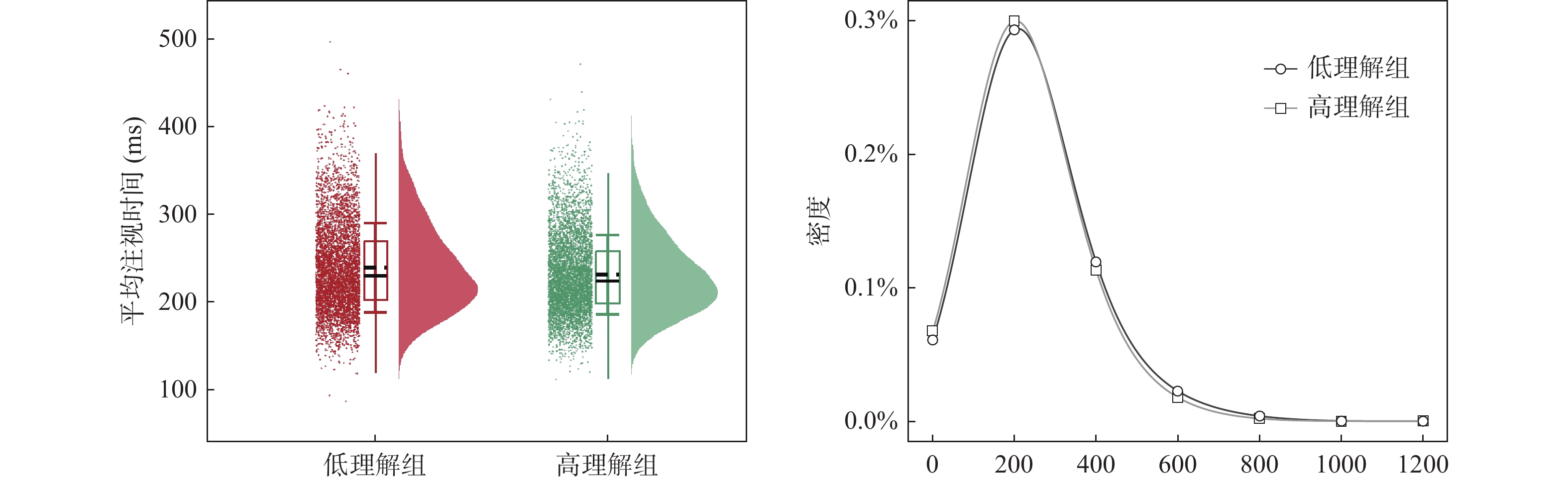
图5 高、低理解组儿童的平均注视时间和注视时间分布
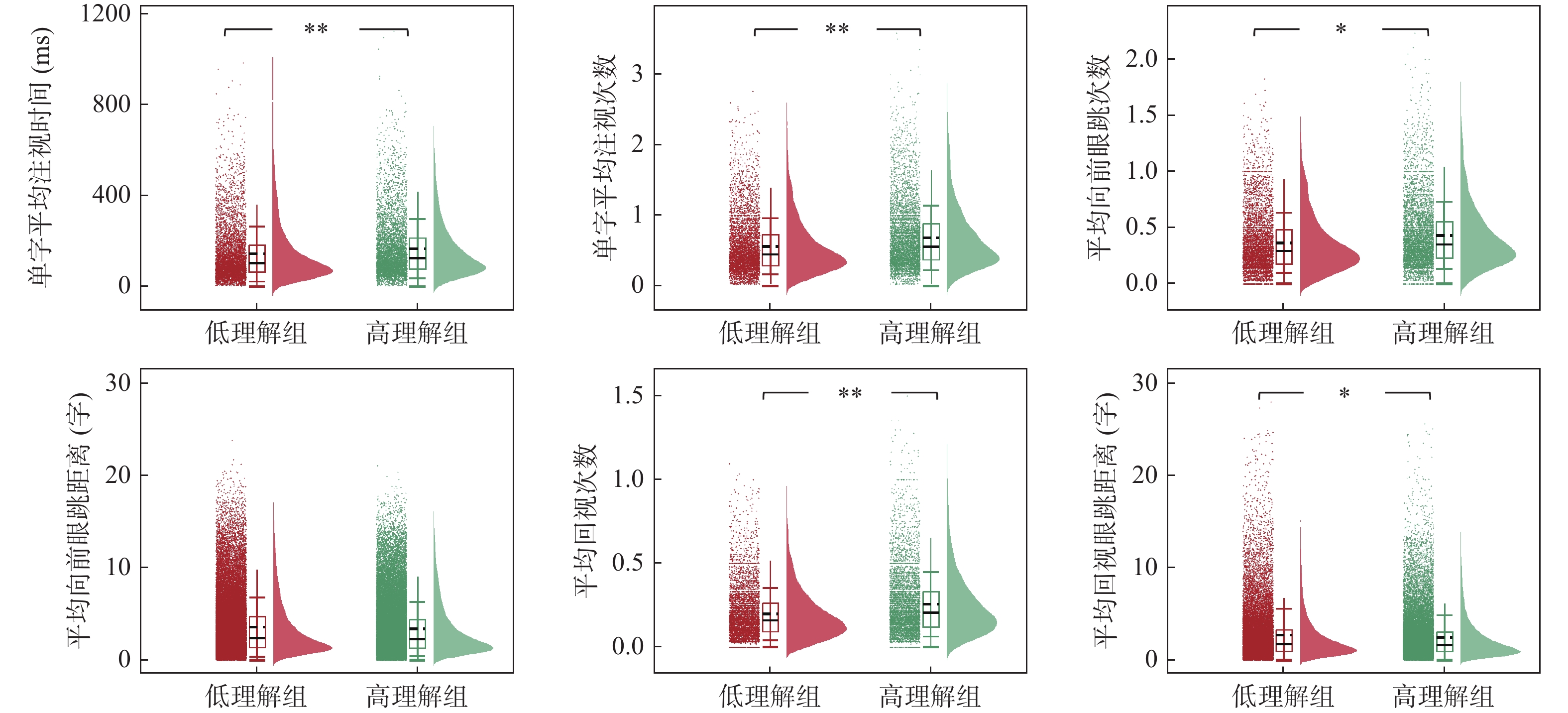
图6 高、低理解组儿童眼动模式比较
| 变量 | b | SE | t | 95%CI | |
| 平均注视时间 | 截距 | 5.44 | 0.01 | 461.81*** | [5.42, 5.47] |
| 高vs.低 | –0.02 | 0.02 | –1.04 | [–0.07, 0.02] | |
| 单字平均注视时间 | 截距 | 4.74 | 0.05 | 94.62*** | [4.64, 4.84] |
| 高vs.低 | 0.23 | 0.09 | 2.62** | [0.06, 0.39] | |
| 单字平均注视次数 | 截距 | 0.62 | 0.03 | 22.06*** | [0.57, 0.68] |
| 高vs.低 | 0.14 | 0.05 | 2.72** | [0.04, 0.24] | |
| 平均向前眼跳次数 | 截距 | 0.40 | 0.02 | 20.57*** | [0.36, 0.43] |
| 高vs.低 | 0.07 | 0.03 | 2.24* | [0.01, 0.14] | |
| 平均向前眼跳距离 | 截距 | 4.05 | 0.12 | 33.40*** | [3.81, 4.29] |
| 高vs.低 | –0.34 | 0.23 | –1.44 | [–0.80, 0.12] | |
| 平均回视次数 | 截距 | 0.23 | 0.01 | 22.40*** | [0.21, 0.25] |
| 高vs.低 | 0.06 | 0.02 | 3.35** | [0.03, 0.10] | |
| 平均回视眼跳距离 | 截距 | 2.82 | 0.08 | 36.30*** | [2.67, 2.98] |
| 高vs.低 | –0.28 | 0.14 | –1.97* | [–0.56, –0.001] |
表2 高、低理解组儿童模型分析结果
| 变量 | b | SE | t | 95%CI | |
| 平均注视时间 | 截距 | 5.44 | 0.01 | 461.81*** | [5.42, 5.47] |
| 高vs.低 | –0.02 | 0.02 | –1.04 | [–0.07, 0.02] | |
| 单字平均注视时间 | 截距 | 4.74 | 0.05 | 94.62*** | [4.64, 4.84] |
| 高vs.低 | 0.23 | 0.09 | 2.62** | [0.06, 0.39] | |
| 单字平均注视次数 | 截距 | 0.62 | 0.03 | 22.06*** | [0.57, 0.68] |
| 高vs.低 | 0.14 | 0.05 | 2.72** | [0.04, 0.24] | |
| 平均向前眼跳次数 | 截距 | 0.40 | 0.02 | 20.57*** | [0.36, 0.43] |
| 高vs.低 | 0.07 | 0.03 | 2.24* | [0.01, 0.14] | |
| 平均向前眼跳距离 | 截距 | 4.05 | 0.12 | 33.40*** | [3.81, 4.29] |
| 高vs.低 | –0.34 | 0.23 | –1.44 | [–0.80, 0.12] | |
| 平均回视次数 | 截距 | 0.23 | 0.01 | 22.40*** | [0.21, 0.25] |
| 高vs.低 | 0.06 | 0.02 | 3.35** | [0.03, 0.10] | |
| 平均回视眼跳距离 | 截距 | 2.82 | 0.08 | 36.30*** | [2.67, 2.98] |
| 高vs.低 | –0.28 | 0.14 | –1.97* | [–0.56, –0.001] |
|
程亚华, 冯瑶, 李宜逊, 马嘉琪, 沈岚岚, 张文建, … 冯秋迪. 小学儿童口语词汇知识的发展轨迹及其对阅读能力的预测: 一个潜变量增长模型. 心理学报, 2023, 55 (7): 1074- 1086.
|
|
|
梁菲菲, 王永胜, 杨文, 白学军. 阅读水平调节儿童阅读眼动注视模式的发展: 基于9~11岁儿童的证据. 心理学报, 2017, 49 (4): 450- 459.
DOI |
|
|
巫金根, 李赛男, 袁小源, 王永胜, 闫国利. 小学生中文阅读知觉广度发展的阶段性: 从对称至不对称. 心理科学, 2025, 48 (2): 382- 392.
DOI |
|
|
向颖, 贺斐, 冯琳琳, 龙梦灵, 白学军, 梁菲菲. 中文阅读伴随词汇学习: 高效与低效组的认知加工策略比较. 心理学报, 2025, 57 (9): 1512- 1528.
DOI |
|
|
闫国利. (2020). 学生汉语阅读加工机制及阅读效率促进的眼动研究. 北京: 科学出版社.
|
|
|
闫国利, 巫金根, 臧传丽, 白学军. 阅读知觉广度眼动研究述评. 心理学探新, 2010, 30 (2): 23- 28.
DOI |
|
|
闫国利, 熊建萍, 臧传丽, 余莉莉, 崔磊, 白学军. 阅读研究中的主要眼动指标评述. 心理科学进展, 2013, 21 (4): 589- 605.
|
|
|
Bicknell, K., & Levy, R. (2011). Why readers regress to previous words: A statistical analysis. In Proceedings of the 33rd annual meeting of the cognitive science conference (pp. 931–936). Boston: Cognitive Science Society.
|
|
|
Cain, K., & Oakhill, J. (2007). Children’s comprehension problems in oral and written language: A cognitive perspective. New York: Guilford Press.
|
|
|
Chambrè, S. J., Ehri, L. C., & Ness, M. Phonological decoding enhances orthographic facilitation of vocabulary learning in first graders. Reading and Writing, 2020, 33 (5): 1133- 1162.
DOI |
|
|
Ehri, L. C. Learning to read words: Theory, findings, and issues. Scientific Studies of Reading, 2005, 9 (2): 167- 188.
DOI |
|
|
Eskenazi, M. A., Swischuk, N. K., Folk, J. R., & Abraham, A. N. (2018). Uninformative contexts support word learning for high-skill spellers. Journal of Experimental Psychology: Learning, Memory, and Cognition, 44(12), 2019–2025.
|
|
|
Feng, G., Miller, K., Shu, H., & Zhang, H. C. Orthography and the development of reading processes: An eye-movement study of Chinese and English. Child Development, 2009, 80 (3): 720- 735.
DOI |
|
|
Ferreira, F., Bailey, K. G. D., & Ferraro, V. Good-enough representations in language comprehension. Current Directions in Psychological Science, 2002, 11 (1): 11- 15.
DOI |
|
|
Häikiö, T., Bertram, R., Hyönä, J., & Niemi, P. Development of the letter identity span in reading: Evidence from the eye movement moving window paradigm. Journal of Experimental Child Psychology, 2009, 102 (2): 167- 181.
DOI |
|
|
Huestegge, L., Radach, R., Corbic, D., & Huestegge, S. M. Oculomotor and linguistic determinants of reading development: A longitudinal study. Vision Research, 2009, 49 (24): 2948- 2959.
DOI |
|
|
Inhoff, A. W., Gregg, J., & Radach, R. Eye movement programming and reading accuracy. Quarterly Journal of Experimental Psychology, 2018, 71 (1): 3- 10.
DOI |
|
|
Joseph, H. S. S. L., Liversedge, S. P., Blythe, H. I., White, S. J., & Rayner, K. Word length and landing position effects during reading in children and adults. Vision Research, 2009, 49 (16): 2078- 2086.
DOI |
|
|
Kintsch, W. (1998). Comprehension: A paradigm for cognition. New York: Cambridge University Press.
|
|
|
Kuperman, V., Matsuki, K., & Van Dyke, J. A. (2018). Contributions of reader- and text-level characteristics to eye-movement patterns during passage reading. Journal of Experimental Psychology: Learning, Memory, and Cognition, 44(11), 1687–1713.
|
|
|
Liang, F. F., Blythe, H. I., Zang, C. L., Bai, X. J., Yan, G. L., & Liversedge, S. P. Positional character frequency and word spacing facilitate the acquisition of novel words during Chinese children’s reading. Journal of Cognitive Psychology, 2015, 27 (5): 594- 608.
DOI |
|
|
Liversedge, S. P., Drieghe, D., Li, X., Yan, G. L., Bai, X. J., & Hyönä, J. Universality in eye movements and reading: A trilingual investigation. Cognition, 2016, 147, 1- 20.
DOI |
|
|
Parshina, O., Sekerina, I. A., Lopukhina, A., & von der Malsburg, T. Monolingual and bilingual reading processes in Russian: An exploratory scanpath analysis. Reading Research Quarterly, 2022, 57 (2): 469- 492.
DOI |
|
|
Perfetti, C. Reading ability: Lexical quality to comprehension. Scientific Studies of Reading, 2007, 11 (4): 357- 383.
DOI |
|
|
R Core Team. (2024). R: A language and environment for statistical computing. Vienna: R Foundation for Statistical Computing.
|
|
|
Rayner, K. Eye movements in reading and information processing: 20 years of research. Psychological Bulletin, 1998, 124 (3): 372- 422.
DOI |
|
|
Rayner, K. Eye movements in reading: Models and data. Journal of Eye Movement Research, 2008, 2 (5): 1- 10.
DOI |
|
|
Rayner, K. The 35th Sir Frederick Bartlett Lecture: Eye movements and attention in reading, scene perception, and visual search. Quarterly Journal of Experimental Psychology, 2009, 62 (8): 1457- 1506.
DOI |
|
|
Reichle, E. D., Liversedge, S. P., Drieghe, D., Blythe, H. I., Joseph, H. S. S. L., White, S. J., & Rayner, K. Using E-Z Reader to examine the concurrent development of eye-movement control and reading skill. Developmental Review, 2013, 33 (2): 110- 149.
DOI |
|
|
Taylor, J. N., & Perfetti, C. A. Eye movements reveal readers’ lexical quality and reading experience. Reading and Writing, 2016, 29 (6): 1069- 1103.
DOI |
|
|
Yan, G. L., Tian, H. J., Bai, X. J., & Rayner, K. The effect of word and character frequency on the eye movements of Chinese readers. British Journal of Psychology, 2006, 97 (2): 259- 268.
DOI |
|
|
Yan, M., Pan, J. E., & Kliegl, R. Eye movement control in Chinese reading: A cross-sectional study. Developmental Psychology, 2019, 55 (11): 2275- 2285.
DOI |
| [1] | 丁晓茜, 刘华语. 社会排斥影响个体社交行为的双路径机制:消极完美主义与注意偏向的作用[J]. 心理与行为研究, 2026, 24(1): 51-59. |
| [2] | 刘泽琪, 李玉华, 高艳, 刘佳欣, 苏萌萌. 小学生家庭读写环境量表的编制及信效度检验[J]. 心理与行为研究, 2026, 24(1): 113-121. |
| [3] | 王怀勇, 徐田田, 叶青. 过程追踪视角下焦虑情绪对延迟选择的影响及机制:任务框架的调节作用[J]. 心理与行为研究, 2026, 24(1): 122-129. |
| [4] | 崔佳歆, 左钰涵, 冯佳佳, 崔占玲. 表意文字和表音文字具有共同的认知基础:来自形状知觉的证据[J]. 心理与行为研究, 2025, 23(6): 766-773. |
| [5] | 王旭瑛, 邵杨, 阴晓娟, 金晓康, 金花. 恐惧诉求下希望类健康错误信息的更正:来自行为和眼动的证据[J]. 心理与行为研究, 2025, 23(6): 813-821. |
| [6] | 李文静, 孙雯, 朱海迪. 流行背景音乐对休闲阅读的影响:来自眼动的证据[J]. 心理与行为研究, 2025, 23(4): 448-455. |
| [7] | 杜宇菲, 张志超, 张慢慢, 臧传丽. 语义优先于世界知识参与句子理解过程:来自眼动的证据[J]. 心理与行为研究, 2025, 23(2): 153-160. |
| [8] | 王永胜, 韩洋, 李馨, 何立媛. 词间空格在维吾尔族大学生不同文本呈现方向的汉语句子阅读中的促进作用[J]. 心理与行为研究, 2025, 23(1): 41-48. |
| [9] | 吴旻, 李双妍, 宋文琦, 郑天鹏. “双减”背景下小学生睡眠质量的潜在转变及情绪的影响[J]. 心理与行为研究, 2025, 23(1): 49-57. |
| [10] | 陈相文, 王泷歌, 胡惠兰, 张志超, 王梦思, 汪强, 张慢慢. 中文阅读词频效应个体差异的脑结构基础:基于眼动指标的分析[J]. 心理与行为研究, 2024, 22(6): 721-729. |
| [11] | 赵光, 陈佳欢, 李林璇, 张吉超, 吴镕涛. 背景线索效应的动态眼动模式:基于隐马尔可夫模型[J]. 心理与行为研究, 2024, 22(5): 594-601. |
| [12] | 贾宇晴, 高彤琪, 闫国利. 一年级小学生汉语默读和朗读差异的眼动研究[J]. 心理与行为研究, 2024, 22(5): 633-641. |
| [13] | 周广东, 刘爽, 俞美硕. 反应性和主动性攻击儿童情绪面孔的注意差异[J]. 心理与行为研究, 2024, 22(5): 642-649. |
| [14] | 常敏, 张阔, 孙悦, 李莎, 王敬欣. 汉语阅读中的语义相似度效应:语义预测的证据[J]. 心理与行为研究, 2024, 22(4): 442-449. |
| [15] | 王永胜, 张娜, 杜小普, 郭紫璐, 李馨. 语素意识在汉语二语学习者阅读过程中的作用[J]. 心理与行为研究, 2024, 22(4): 450-456. |
| 阅读次数 | ||||||
|
全文 |
|
|||||
|
摘要 |
|
|||||
