
心理与行为研究 ›› 2026, Vol. 24 ›› Issue (3): 375-383.DOI: 10.12139/j.1672-0628.2026.03.012
翟宏堃1, 周详*,2( ), 付江洪2, 李坤钊2, 崔虞馨3, 魏晓薇3
收稿日期:2025-11-27
出版日期:2026-05-20
发布日期:2026-05-20
通讯作者:
周详
基金资助:
Hongkun ZHAI1, Xiang ZHOU*,2(), Jianghong FU2, Kunzhao LI2, Yuxin CUI3, Xiaowei WEI3
Received:2025-11-27
Online:2026-05-20
Published:2026-05-20
Contact:
Xiang ZHOU
摘要:
人智协同已成为数智时代创新的新常态,与之适配的人智协同创新素养亦成为重要研究议题。本研究采用质性和量化研究方法,探究人智协同创新素养的结构与测量。研究1采用质性方法,对16名AI行业一线从业人员以及具有丰富人−AI协同创新经验的人员进行半结构化访谈,访谈围绕人智协同创新过程中需要的素养展开。结果发现,人智协同创新素养由知识、技能、态度、价值观、伦理五个范畴构成。研究2采用量化方法,在研究1基础上编制了人智协同创新素养量表,对共计3432名被试进行施测。结果发现,人智协同创新素养量表包括知识和技能、态度和价值观、伦理3个维度;量表具有良好的内部结构与信效度,符合心理测量学要求,可作为测量人智协同创新素养的有效工具。
中图分类号:
翟宏堃, 周详, 付江洪, 李坤钊, 崔虞馨, 魏晓薇. 面向数智时代的新素养:人智协同创新素养的结构与测量[J]. 心理与行为研究, 2026, 24(3): 375-383.
Hongkun ZHAI, Xiang ZHOU, Jianghong FU, Kunzhao LI, Yuxin CUI, Xiaowei WEI. New Literacy for the Digital Intelligence Era: The Structure and Measurement of Human-AI Collaborative Creativity Literacy[J]. Studies of Psychology and Behavior, 2026, 24(3): 375-383.
| 选择编码 | 主轴编码(括号中为参考点数量) |
| 知识 | AI技术基础知识(61)、AI技术局限性知识(43)、专业知识(51)、文化适配知识(7) |
| 技能 | AI工具操作能力(28)、AI交互优化能力(47)、AI成果评估能力(56)、AI成果实践能力(36)、信息检索能力(17)、 自身创新能力(24)、问题拆解能力(24)、经验积累能力(19)、反思能力(50) |
| 态度 | 主动探索态度(26)、积极开放态度(41)、审慎态度(44)、合作包容态度(15)、技术期待态度(19)、客观公正态度(22) |
| 价值观 | 人类主导创新(47)、AI促进人类进步(50)、AI价值正向导向(37)、AI带来经济价值(8)、AI辅助创新(55)、AI技术普惠(8) |
| 伦理 | 隐私与版权伦理(37)、行业伦理规范(23)、人机关系伦理(50)、AI开发伦理(9)、AI创作伦理(25)、 AI技术滥用伦理(14)、责任归属伦理(24)、技术公平伦理(9) |
表1 人智协同创新素养的成分与内容
| 选择编码 | 主轴编码(括号中为参考点数量) |
| 知识 | AI技术基础知识(61)、AI技术局限性知识(43)、专业知识(51)、文化适配知识(7) |
| 技能 | AI工具操作能力(28)、AI交互优化能力(47)、AI成果评估能力(56)、AI成果实践能力(36)、信息检索能力(17)、 自身创新能力(24)、问题拆解能力(24)、经验积累能力(19)、反思能力(50) |
| 态度 | 主动探索态度(26)、积极开放态度(41)、审慎态度(44)、合作包容态度(15)、技术期待态度(19)、客观公正态度(22) |
| 价值观 | 人类主导创新(47)、AI促进人类进步(50)、AI价值正向导向(37)、AI带来经济价值(8)、AI辅助创新(55)、AI技术普惠(8) |
| 伦理 | 隐私与版权伦理(37)、行业伦理规范(23)、人机关系伦理(50)、AI开发伦理(9)、AI创作伦理(25)、 AI技术滥用伦理(14)、责任归属伦理(24)、技术公平伦理(9) |
| 样本1 | 样本2 | 样本3 | 样本4 | 样本5 | |
| 性别 | |||||
| 男性 | 294 | 519 | 198 | 403 | 47 |
| 女性 | 393 | 719 | 225 | 484 | 150 |
| 职业 | |||||
| 在校学生 | 632 | 1189 | 113 | 417 | 197 |
| 非学生 | 55 | 49 | 310 | 470 | 0 |
| 学历 | |||||
| 专科及以下 | 143 | 41 | 31 | 187 | 0 |
| 本科 | 381 | 993 | 274 | 455 | 197 |
| 硕士及以上 | 163 | 204 | 118 | 245 | 0 |
| 年龄(M±SD)(岁) | 23.81±2.93 | 20.58±2.29 | 25.97±2.45 | 25.47±2.56 | 20.84±0.75 |
表2 被试的人口学信息
| 样本1 | 样本2 | 样本3 | 样本4 | 样本5 | |
| 性别 | |||||
| 男性 | 294 | 519 | 198 | 403 | 47 |
| 女性 | 393 | 719 | 225 | 484 | 150 |
| 职业 | |||||
| 在校学生 | 632 | 1189 | 113 | 417 | 197 |
| 非学生 | 55 | 49 | 310 | 470 | 0 |
| 学历 | |||||
| 专科及以下 | 143 | 41 | 31 | 187 | 0 |
| 本科 | 381 | 993 | 274 | 455 | 197 |
| 硕士及以上 | 163 | 204 | 118 | 245 | 0 |
| 年龄(M±SD)(岁) | 23.81±2.93 | 20.58±2.29 | 25.97±2.45 | 25.47±2.56 | 20.84±0.75 |
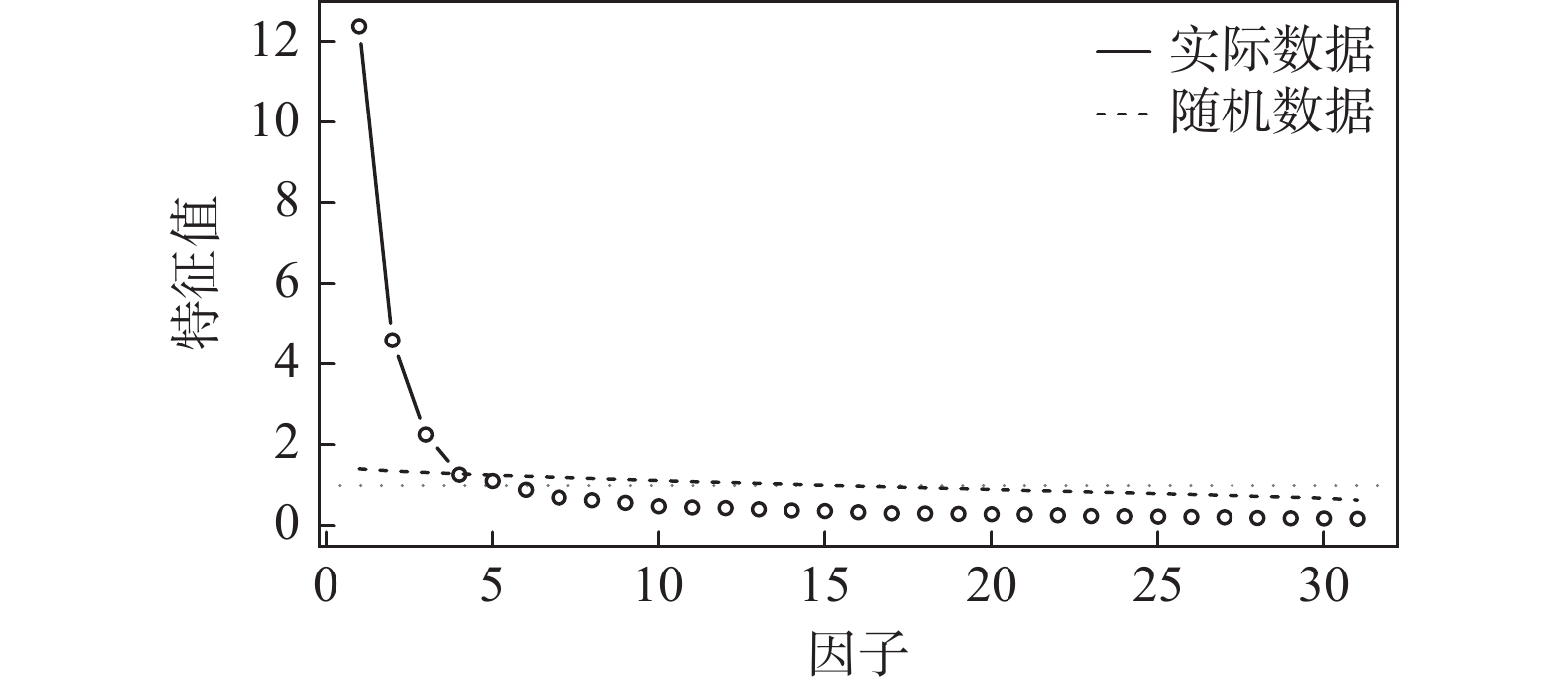
图1 人智协同创新素养量表的碎石图与平行分析结果
| 条目 | 知识和技能 | 态度和价值观 | 伦理 | 共同度 |
| 15.我自身具备足够的创新能力,能引导AI产出我想要的效果。 | 0.85 | 0.11 | −0.28 | 0.81 |
| 11.我能够从多维度评估AI成果(评估成果的创新性/可实施性/真实性等)。 | 0.84 | −0.15 | 0.06 | 0.73 |
| 8.我能够清晰、准确地向AI描述我的目标需求。 | 0.83 | −0.06 | 0.07 | 0.70 |
| 9.我能够根据AI的表现与反馈,灵活地调整我使用AI的策略。 | 0.81 | −0.13 | 0.09 | 0.68 |
| 18.我会总结与AI交互的经验,以便下次更好地使用AI。 | 0.80 | −0.13 | 0.19 | 0.69 |
| 16.我能够将目标需求拆解为AI可执行的子问题。 | 0.79 | −0.09 | 0.08 | 0.64 |
| 13.我能够将AI生成的知识整合到自己的专业知识体系中。 | 0.79 | −0.11 | 0.21 | 0.68 |
| 14.我能够从AI提供的多个方案中选择最优解。 | 0.75 | −0.07 | 0.25 | 0.63 |
| 10.我能够在AI成果中加入自己的想法,进行二次创作。 | 0.75 | −0.19 | 0.24 | 0.66 |
| 5.在使用AI完成创新任务之前,我已掌握相关领域的专业知识。 | 0.73 | 0.09 | −0.21 | 0.59 |
| 6.我能够熟练地操作AI工具。 | 0.72 | 0.23 | −0.16 | 0.60 |
| 17.我能全程掌控和AI的合作过程,确保按我的目标推进。 | 0.71 | 0.24 | −0.16 | 0.59 |
| 7.我能够根据任务类型选择最合适的AI工具。 | 0.69 | 0.18 | −0.16 | 0.53 |
| 4.我能够运用专业知识判断AI生成内容的准确性。 | 0.69 | 0.07 | −0.10 | 0.49 |
| 12.我能把AI给出的方案用到实际工作或学习中。 | 0.64 | 0.13 | 0.24 | 0.48 |
| 31.我将AI视作我的合作伙伴。 | 0.07 | 0.83 | −0.17 | 0.72 |
| 24.AI可以降低创新试错成本。 | −0.12 | 0.82 | 0.00 | 0.69 |
| 20.AI可以拓展创新思路。 | −0.16 | 0.80 | 0.18 | 0.70 |
| 29.我认为AI能够帮助我完成任务。 | −0.09 | 0.78 | −0.09 | 0.62 |
| 22.AI可以从多角度给出建议。 | −0.13 | 0.72 | 0.30 | 0.63 |
| 26.我享受与AI合作解决问题的过程。 | 0.22 | 0.71 | −0.21 | 0.60 |
| 32.我认为AI最终成果是我和AI一起付出了努力的结果。 | 0.16 | 0.71 | −0.22 | 0.58 |
| 21.AI能提供海量的知识资料。 | −0.07 | 0.64 | 0.29 | 0.50 |
| 23.AI可以激发灵感。 | 0.11 | 0.64 | 0.15 | 0.44 |
| 19.AI可以帮助突破个体思维局限。 | 0.13 | 0.61 | 0.26 | 0.46 |
| 36.使用者应验证AI提供信息的真实性。 | 0.09 | −0.09 | 0.82 | 0.69 |
| 40.应建立对违规使用AI者的惩罚机制。 | 0.07 | 0.06 | 0.82 | 0.68 |
| 35.使用者应避免使用存在版权争议的AI工具。 | 0.08 | −0.09 | 0.80 | 0.65 |
| 34.训练AI时应标注AI训练数据集的来源,且不使用未授权数据。 | −0.06 | 0.12 | 0.79 | 0.64 |
| 38.专业领域的AI成果应用必须经人类专家终审。 | 0.06 | −0.07 | 0.79 | 0.63 |
| 37.AI决策过程需要透明,具有可解释性。 | −0.13 | 0.29 | 0.65 | 0.52 |
| 方差抽取 | 8.92 | 5.76 | 4.57 | |
| 方差抽取(%) | 28.79 | 18.57 | 14.75 | |
| 累积抽取(%) | 28.79 | 47.36 | 62.11 |
表3 人智协同创新素养量表的载荷矩阵
| 条目 | 知识和技能 | 态度和价值观 | 伦理 | 共同度 |
| 15.我自身具备足够的创新能力,能引导AI产出我想要的效果。 | 0.85 | 0.11 | −0.28 | 0.81 |
| 11.我能够从多维度评估AI成果(评估成果的创新性/可实施性/真实性等)。 | 0.84 | −0.15 | 0.06 | 0.73 |
| 8.我能够清晰、准确地向AI描述我的目标需求。 | 0.83 | −0.06 | 0.07 | 0.70 |
| 9.我能够根据AI的表现与反馈,灵活地调整我使用AI的策略。 | 0.81 | −0.13 | 0.09 | 0.68 |
| 18.我会总结与AI交互的经验,以便下次更好地使用AI。 | 0.80 | −0.13 | 0.19 | 0.69 |
| 16.我能够将目标需求拆解为AI可执行的子问题。 | 0.79 | −0.09 | 0.08 | 0.64 |
| 13.我能够将AI生成的知识整合到自己的专业知识体系中。 | 0.79 | −0.11 | 0.21 | 0.68 |
| 14.我能够从AI提供的多个方案中选择最优解。 | 0.75 | −0.07 | 0.25 | 0.63 |
| 10.我能够在AI成果中加入自己的想法,进行二次创作。 | 0.75 | −0.19 | 0.24 | 0.66 |
| 5.在使用AI完成创新任务之前,我已掌握相关领域的专业知识。 | 0.73 | 0.09 | −0.21 | 0.59 |
| 6.我能够熟练地操作AI工具。 | 0.72 | 0.23 | −0.16 | 0.60 |
| 17.我能全程掌控和AI的合作过程,确保按我的目标推进。 | 0.71 | 0.24 | −0.16 | 0.59 |
| 7.我能够根据任务类型选择最合适的AI工具。 | 0.69 | 0.18 | −0.16 | 0.53 |
| 4.我能够运用专业知识判断AI生成内容的准确性。 | 0.69 | 0.07 | −0.10 | 0.49 |
| 12.我能把AI给出的方案用到实际工作或学习中。 | 0.64 | 0.13 | 0.24 | 0.48 |
| 31.我将AI视作我的合作伙伴。 | 0.07 | 0.83 | −0.17 | 0.72 |
| 24.AI可以降低创新试错成本。 | −0.12 | 0.82 | 0.00 | 0.69 |
| 20.AI可以拓展创新思路。 | −0.16 | 0.80 | 0.18 | 0.70 |
| 29.我认为AI能够帮助我完成任务。 | −0.09 | 0.78 | −0.09 | 0.62 |
| 22.AI可以从多角度给出建议。 | −0.13 | 0.72 | 0.30 | 0.63 |
| 26.我享受与AI合作解决问题的过程。 | 0.22 | 0.71 | −0.21 | 0.60 |
| 32.我认为AI最终成果是我和AI一起付出了努力的结果。 | 0.16 | 0.71 | −0.22 | 0.58 |
| 21.AI能提供海量的知识资料。 | −0.07 | 0.64 | 0.29 | 0.50 |
| 23.AI可以激发灵感。 | 0.11 | 0.64 | 0.15 | 0.44 |
| 19.AI可以帮助突破个体思维局限。 | 0.13 | 0.61 | 0.26 | 0.46 |
| 36.使用者应验证AI提供信息的真实性。 | 0.09 | −0.09 | 0.82 | 0.69 |
| 40.应建立对违规使用AI者的惩罚机制。 | 0.07 | 0.06 | 0.82 | 0.68 |
| 35.使用者应避免使用存在版权争议的AI工具。 | 0.08 | −0.09 | 0.80 | 0.65 |
| 34.训练AI时应标注AI训练数据集的来源,且不使用未授权数据。 | −0.06 | 0.12 | 0.79 | 0.64 |
| 38.专业领域的AI成果应用必须经人类专家终审。 | 0.06 | −0.07 | 0.79 | 0.63 |
| 37.AI决策过程需要透明,具有可解释性。 | −0.13 | 0.29 | 0.65 | 0.52 |
| 方差抽取 | 8.92 | 5.76 | 4.57 | |
| 方差抽取(%) | 28.79 | 18.57 | 14.75 | |
| 累积抽取(%) | 28.79 | 47.36 | 62.11 |
| 模型 | χ2 | df | RMSEA [90%CI] | CFI | IFI | TLI | SRMR |
| 3因子斜交模型 | 1767.71 | 431 | 0.050 [0.048, 0.052] | 0.91 | 0.91 | 0.90 | 0.05 |
| 3因子直交模型 | 2523.02 | 434 | 0.062 [0.060, 0.065] | 0.85 | 0.85 | 0.84 | 0.17 |
| 单因子模型 | 4953.24 | 434 | 0.092 [0.089, 0.094] | 0.68 | 0.68 | 0.66 | 0.09 |
表4 人智协同创新素养量表验证性因子分析的结果
| 模型 | χ2 | df | RMSEA [90%CI] | CFI | IFI | TLI | SRMR |
| 3因子斜交模型 | 1767.71 | 431 | 0.050 [0.048, 0.052] | 0.91 | 0.91 | 0.90 | 0.05 |
| 3因子直交模型 | 2523.02 | 434 | 0.062 [0.060, 0.065] | 0.85 | 0.85 | 0.84 | 0.17 |
| 单因子模型 | 4953.24 | 434 | 0.092 [0.089, 0.094] | 0.68 | 0.68 | 0.66 | 0.09 |
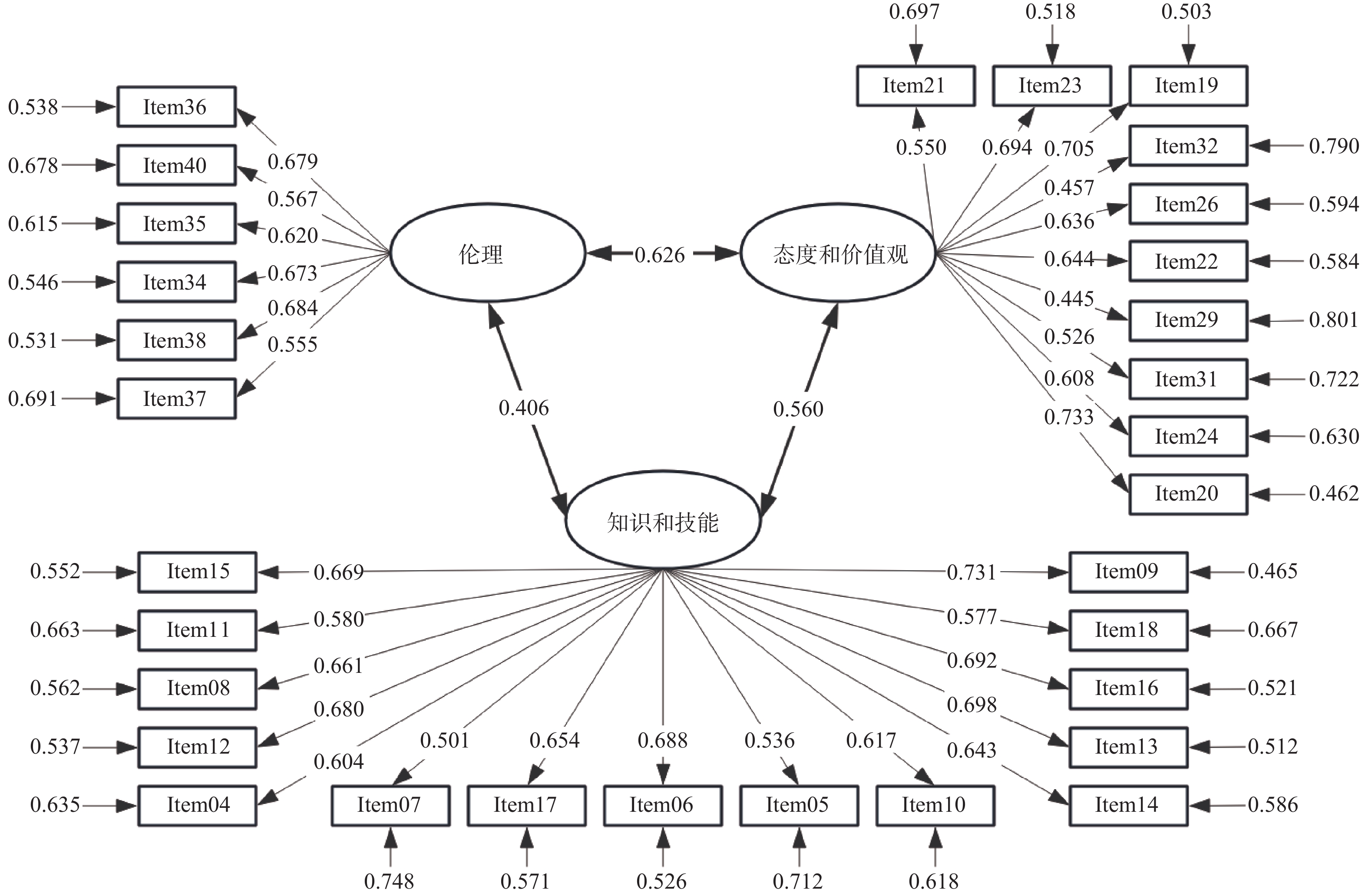
图2 人智协同创新素养量表的结构模型与标准化路径系数
| 总量表 | 知识和技能 | 态度和价值观 | 伦理 | |
| 内部一致性信度 | 0.92*** | 0.91*** | 0.85*** | 0.79*** |
| 合成信度 | 0.93*** | 0.91*** | 0.85*** | 0.80*** |
| 重测信度 | 0.80*** | 0.75*** | 0.70*** | 0.71*** |
表5 人智协同创新素养量表的信度
| 总量表 | 知识和技能 | 态度和价值观 | 伦理 | |
| 内部一致性信度 | 0.92*** | 0.91*** | 0.85*** | 0.79*** |
| 合成信度 | 0.93*** | 0.91*** | 0.85*** | 0.80*** |
| 重测信度 | 0.80*** | 0.75*** | 0.70*** | 0.71*** |
| 量表总分 | 1 | 2 | 3 | |
| 1.知识和技能 | 0.87*** | 0.57 [0.52, 0.63] | 0.40 [0.34, 0.45] | |
| 2.态度和价值观 | 0.81*** | 0.50*** | 0.63 [0.57, 0.68] | |
| 3.伦理 | 0.64*** | 0.32*** | 0.51*** |
表6 人智协同创新素养量表的结构效度
| 量表总分 | 1 | 2 | 3 | |
| 1.知识和技能 | 0.87*** | 0.57 [0.52, 0.63] | 0.40 [0.34, 0.45] | |
| 2.态度和价值观 | 0.81*** | 0.50*** | 0.63 [0.57, 0.68] | |
| 3.伦理 | 0.64*** | 0.32*** | 0.51*** |
| 知识和技能 | 态度和价值观 | 伦理 | 量表总分 | |
| 数字素养 | 0.54*** | 0.51*** | 0.49*** | 0.64*** |
| 创新自我效能感 | 0.49*** | 0.34*** | 0.19*** | 0.46*** |
| 人机合作创新意愿 | 0.52*** | 0.59*** | 0.42*** | 0.64*** |
表7 人智协同创新素养量表的效标关联效度
| 知识和技能 | 态度和价值观 | 伦理 | 量表总分 | |
| 数字素养 | 0.54*** | 0.51*** | 0.49*** | 0.64*** |
| 创新自我效能感 | 0.49*** | 0.34*** | 0.19*** | 0.46*** |
| 人机合作创新意愿 | 0.52*** | 0.59*** | 0.42*** | 0.64*** |
| 模型 | χ2 | df | RMSEA | CFI | TLI | ΔRMSEA | ΔCFI | ΔTLI |
| 形态等值 | 2049.85 | 862 | 0.06 | 0.86 | 0.85 | |||
| 载荷等值 | 2106.78 | 890 | 0.06 | 0.86 | 0.85 | 0.000 | −0.003 | 0.002 |
| 截距等值 | 2242.85 | 918 | 0.06 | 0.85 | 0.84 | 0.001 | −0.010 | −0.009 |
表8 人智协同创新素养量表的跨群体测量等值性检验
| 模型 | χ2 | df | RMSEA | CFI | TLI | ΔRMSEA | ΔCFI | ΔTLI |
| 形态等值 | 2049.85 | 862 | 0.06 | 0.86 | 0.85 | |||
| 载荷等值 | 2106.78 | 890 | 0.06 | 0.86 | 0.85 | 0.000 | −0.003 | 0.002 |
| 截距等值 | 2242.85 | 918 | 0.06 | 0.85 | 0.84 | 0.001 | −0.010 | −0.009 |
|
白博仁, 周详, 张婧婧, 崔虞馨. 人工智能自恋提升人机合作创新意愿及其机制. 心理与行为研究, 2024, 22 (1): 137- 144.
|
|
|
蔡迎春, 张静蓓, 虞晨琳, 王健. 数智时代的人工智能素养: 内涵、框架与实施路径. 中国图书馆学报, 2024, 50 (4): 71- 84.
|
|
|
陈向明. (2000). 质的研究方法与社会科学研究. 北京: 教育科学出版社.
|
|
|
崔虞馨. (2024). 人工智能创造者身份信息对创造力评价的影响及其机制(博士学位论文). 南开大学, 天津.
|
|
|
顾远东, 彭纪生. 创新自我效能感对员工创新行为的影响机制研究. 科研管理, 2011, 32 (9): 63- 73.
|
|
|
郭亚军, 寇旭颍, 冯思倩, 刘坤锋, 徐瑞朝. 人工智能素养: 内涵剖析与评估标准构建. 图书馆论坛, 2025, 45 (2): 42- 50.
|
|
|
李楠, 刘申奥, 吉久明. 连续统视域下高校学生智能素养评价体系构建. 情报理论与实践, 2025, 48 (1): 150- 159.
|
|
|
梁钦, 吴涵, 沙星雨, 陆程程. 中国大学生数字素养现状、问题与对策——基于全国29,425名学生的样本数据. 电化教育研究, 2025, 46 (4): 73- 78, 85.
DOI |
|
|
谭秀娟, 鹿子佳, 聂永飞, 白学军. 大学生电信网络受骗易感性量表的编制. 心理与行为研究, 2025, 23 (2): 280- 288.
|
|
|
吴明隆. (2018). 问卷统计分析实务——SPSS操作与应用. 重庆: 重庆大学出版社.
|
|
|
薛璐璐, 冯加根, 杨海波, 方平, 杨卓. 中小学教师资格考试认同问卷的编制及应用. 心理与行为研究, 2024, 22 (6): 822- 829.
|
|
|
杨鸿武, 张笛, 郭威彤. STEM背景下人工智能素养框架的研究. 电化教育研究, 2022, 43 (4): 26- 32.
|
|
|
杨梦真, 王景辉. 从信息素养到人工智能素养: 高校图书馆素养教育的演进. 图书馆学刊, 2024, 46 (8): 29- 32.
DOI |
|
|
张银荣, 杨刚, 徐佳艳, 曾群芳, 陈际焕. 人工智能素养模型构建及其实施路径. 现代教育技术, 2022, 32 (3): 42- 50.
|
|
|
赵必华, 顾海根. 心理量表编制中的若干问题及题解. 心理科学, 2010, 33 (6): 1467- 1469.
|
|
|
钟晓钰, 李铭尧, 李凌艳. 问卷调查中被试不认真作答的控制与识别. 心理科学进展, 2021, 29 (2): 225- 237.
|
|
|
Adler, P. A., & Adler, P. Review: Learning from strangers: The art and method of qualitative interview studies. Contemporary Sociology, 1995, 24 (3): 420.
DOI |
|
|
Binkley, M., Erstad, O., Herman, J., Raizen, S., Ripley, M., Miller-Ricci, M., & Rumble, M. (2012). Defining twenty-first century skills. In P. Griffin, B. McGaw, & E. Care (Eds.), Assessment and teaching of 21st century skills (pp. 17–66). Dordrecht, Netherlands: Springer.
|
|
|
Carmeli, A., & Schaubroeck, J. The influence of leaders’ and other referents’ normative expectations on individual involvement in creative work. The Leadership Quarterly, 2007, 18 (1): 35- 48.
DOI |
|
|
Cetindamar, D., Kitto, K., Wu, M. J., Zhang, Y., Abedin, B., & Knight, S. Explicating AI literacy of employees at digital workplaces. IEEE Transactions on Engineering Management, 2024, 71, 810- 823.
DOI |
|
|
Chiu, T. K. F., Ahmad, Z., Ismailov, M., & Sanusi, I. T. What are artificial intelligence literacy and competency? A comprehensive framework to support them. Computers and Education Open, 2024, 6, 100171.
DOI |
|
|
Davies, A., Veličković, P., Buesing, L., Blackwell, S., Zheng, D., Tomašev, N., ... Kohli, P. Advancing mathematics by guiding human intuition with AI. Nature, 2021, 600 (7887): 70- 74.
DOI |
|
|
Del Giudice, M. (2022). The square-root scree plot: A simple improvement to a classic display. Retrieved July 20, 2025, from https://openpsych.net/paper/69/
|
|
|
Greiff, S., Wüstenberg, S., Csapó, B., Demetriou, A., Hautamäki, J., Graesser, A. C., & Martin, R. Domain-general problem solving skills and education in the 21st century. Educational Research Review, 2014, 13, 74- 83.
DOI |
|
|
Hair, J. F., Hult, G. T. M., Ringle, C. M., & Sarstedt, M. (2017). A primer on partial least squares structural equation modeling (PLS-SEM) (2nd ed.). Los Angeles: Sage.
|
|
|
Hong, J. W., Peng, Q. Y., & Williams, D. Are you ready for artificial Mozart and Skrillex? An experiment testing expectancy violation theory and AI music. New Media & Society, 2021, 23 (7): 1920- 1935.
DOI |
|
|
Horn, J. L. A rationale and test for the number of factors in factor analysis. Psychometrika, 1965, 30 (2): 179- 185.
DOI |
|
|
International Technology Education Association (ITEA). (2007). Standards for technological literacy: Content for the study of technology (3rd ed.). Reston, VA: International Technology Education Association.
|
|
|
Laupichler, M. C., Aster, A., Schirch, J. & Raupach, T. Artificial intelligence literacy in higher and adult education: A scoping literature review. Computers and Education: Artificial Intelligence, 2022, 3, 100101.
DOI |
|
|
Levy, Y. (2006). Assessing the value of E-Learning systems. Hershey, PA: IGI Global Scientific Publishing.
|
|
|
Long, D., & Magerko, B. (2020). What is AI literacy? Competencies and design considerations. In Proceedings of the 2020 CHI conference on human factors in computing systems (pp. 1–16). Honolulu, HI: Association for Computing Machinery.
|
|
|
Ng, D. T. K., Leung, J. K. L., Chu, K. W. S. & Qiao, M. S. AI literacy: Definition, teaching, evaluation and ethical issues. Proceedings of the Association for Information Science and Technology, 2021, 58 (1): 504- 509.
DOI |
|
|
Rafner, J., Beaty, R. E., Kaufman, J. C., Lubart, T., & Sherson, J. Creativity in the age of generative AI. Nature Human Behaviour, 2023, 7 (11): 1836- 1838.
DOI |
|
|
Reddy, P., Chaudhary, K., & Hussein, S. A digital literacy model to narrow the digital literacy skills gap. Heliyon, 2023, 9 (4): e14878.
DOI |
|
|
UNESCO. (2021). International forum on AI and education: Ensuring AI as a common good to transform education. Paris: UNESCO.
|
|
|
Vinchon, F., Lubart, T., Bartolotta, S., Gironnay, V., Botella, M., Bourgeois-Bougrine, S., ... Gaggioli, A. Artificial intelligence & creativity: A manifesto for collaboration. The Journal of Creative Behavior, 2023, 57 (4): 472- 484.
DOI |
|
|
Zhu, Q., Huang, Y., Zhou, D. L., Zhao, L. Y., Guo, L. L., Yang, R. Y., ... Luo, Y. Automated synthesis of oxygen-producing catalysts from Martian meteorites by a robotic AI chemist. Nature Synthesis, 2024, 3 (3): 319- 328.
DOI |
| [1] | 高永金, 钱璟烨, 高结, 马晓琳, 蒋珊珊. 高中生综合幸福感量表的编制[J]. 心理与行为研究, 2026, 24(3): 425-432. |
| [2] | 范维情, 贡喆. 公费师范生身份认同量表的编制及信效度检验[J]. 心理与行为研究, 2026, 24(2): 273-280. |
| [3] | 刘泽琪, 李玉华, 高艳, 刘佳欣, 苏萌萌. 小学生家庭读写环境量表的编制及信效度检验[J]. 心理与行为研究, 2026, 24(1): 113-121. |
| [4] | 刘晓雯, 张晶, 吴建华, 刘景泰, 陈晴晴, 叶木旺. 民众机器人态度量表的编制及应用研究[J]. 心理与行为研究, 2025, 23(5): 695-705. |
| [5] | 谭秀娟, 鹿子佳, 聂永飞, 白学军. 大学生电信网络受骗易感性量表的编制[J]. 心理与行为研究, 2025, 23(2): 280-288. |
| [6] | 李琳, 皋伟. 小学生研究素养的量表编制与潜在剖面分析[J]. 心理与行为研究, 2024, 22(6): 830-838. |
| [7] | 庞卉, 金晓楠, 姜媛, 方平. 民众社会风险感知量表的编制[J]. 心理与行为研究, 2023, 21(4): 440-445. |
| [8] | 方平, 易子健, 姜媛, 庞卉. 民众社会适应量表的编制[J]. 心理与行为研究, 2023, 21(4): 433-439. |
| [9] | 何明影, 张献英, 李玲玉, 杨丽珠. 3~6岁幼儿羞耻发展教师评定量表的编制[J]. 心理与行为研究, 2023, 21(2): 231-237. |
| [10] | 孙锦露, 刘海骅. 青少年校园欺凌行为量表编制[J]. 心理与行为研究, 2022, 20(2): 255-260. |
| [11] | 郭颖, 樊富珉, 张英俊, 刘宇. 团体咨询师胜任力量表的编制[J]. 心理与行为研究, 2021, 19(6): 809-815. |
| [12] | 王艳丽, 陈红. 城市社区居民获得感量表的编制[J]. 心理与行为研究, 2021, 19(5): 665-670. |
| [13] | 白学军, 都旭, 牛宏伟, 郝嘉佳. 耐挫心理结构的探索:基于大学生群体的测量[J]. 心理与行为研究, 2020, 18(5): 638-644. |
| [14] | 曾天德,朱淑英,陈明. 未成年人心理社会能力量表编制[J]. 心理与行为研究, 2015, 13(1): 76-80. |
| [15] | 梁宝勇;程诚. 心理健康素质测评系统·中国成年人心理弹性量表的编制[J]. , 2012, 10(4): 269-277. |
| 阅读次数 | ||||||
|
全文 |
|
|||||
|
摘要 |
|
|||||
