
心理与行为研究 ›› 2023, Vol. 21 ›› Issue (1): 58-64.DOI: 10.12139/j.1672-0628.2023.01.009
谢云天1,*( ), 孟凡斐1,2
收稿日期:2022-01-21
出版日期:2023-01-20
发布日期:2023-01-20
通讯作者:
谢云天
基金资助:
Yuntian XIE1,*(), Fanfei MENG1,2
Received:2022-01-21
Online:2023-01-20
Published:2023-01-20
Contact:
Yuntian XIE
摘要:
采用问卷法对101名初中生在两年半间数学元认知的发展状况进行5次测试。利用潜类别增长模型等探讨初中生数学元认知的发展轨迹,并考察性别对数学元认知的影响。结果发现:(1) 初中生数学元认知及各成分在初二表现出下降趋势。(2) 初中生数学元认知的发展表现出三种类型,即高−缓慢下降组(32.67%)、中−显著下降组(54.46%)以及低−缓慢下降组(12.87%)。(3) 与女生相比,男生有着更多的数学元认知知识和更高的数学元认知初始水平,且与低−缓慢下降组相比,男生比女生更有可能属于高−缓慢下降组。
中图分类号:
谢云天, 孟凡斐. 初中生数学元认知的发展轨迹:两年半追踪研究[J]. 心理与行为研究, 2023, 21(1): 58-64.
Yuntian XIE, Fanfei MENG. Developmental Trajectories of Mathematics Metacognition Among Junior High School Students: A Two-and-a-half-year Longitudinal Study[J]. Studies of Psychology and Behavior, 2023, 21(1): 58-64.
| T1 | T2 | T3 | T4 | T5 | |
| 男生 | 67(60.36%) | 65(59.63%) | 65(60.19%) | 63(60.00%) | 59(58.42%) |
| 女生 | 44(39.64%) | 44(40.37%) | 43(39.81%) | 42(40.00%) | 42(41.58%) |
| 总体 | 111 | 109 | 108 | 105 | 101 |
表1 五个测试时间点被试人数的变化
| T1 | T2 | T3 | T4 | T5 | |
| 男生 | 67(60.36%) | 65(59.63%) | 65(60.19%) | 63(60.00%) | 59(58.42%) |
| 女生 | 44(39.64%) | 44(40.37%) | 43(39.81%) | 42(40.00%) | 42(41.58%) |
| 总体 | 111 | 109 | 108 | 105 | 101 |
| M±SD | 1 | 2 | 3 | 4 | 5 | |
| 1.MM1 | 3.00±0.54 | |||||
| 2.MM2 | 3.00±0.53 | 0.48*** | ||||
| 3.MM3 | 2.85±0.51 | 0.58*** | 0.62** | |||
| 4.MM4 | 2.73±0.61 | 0.60*** | 0.62*** | 0.61*** | ||
| 5.MM5 | 2.93±0.60 | 0.49*** | 0.45*** | 0.54*** | 0.55*** | |
| 6.性别 | 0.58±0.50 | 0.15 | 0.17 | 0.17 | 0.11 | 0.20* |
表2 主要变量描述统计和相关矩阵
| M±SD | 1 | 2 | 3 | 4 | 5 | |
| 1.MM1 | 3.00±0.54 | |||||
| 2.MM2 | 3.00±0.53 | 0.48*** | ||||
| 3.MM3 | 2.85±0.51 | 0.58*** | 0.62** | |||
| 4.MM4 | 2.73±0.61 | 0.60*** | 0.62*** | 0.61*** | ||
| 5.MM5 | 2.93±0.60 | 0.49*** | 0.45*** | 0.54*** | 0.55*** | |
| 6.性别 | 0.58±0.50 | 0.15 | 0.17 | 0.17 | 0.11 | 0.20* |
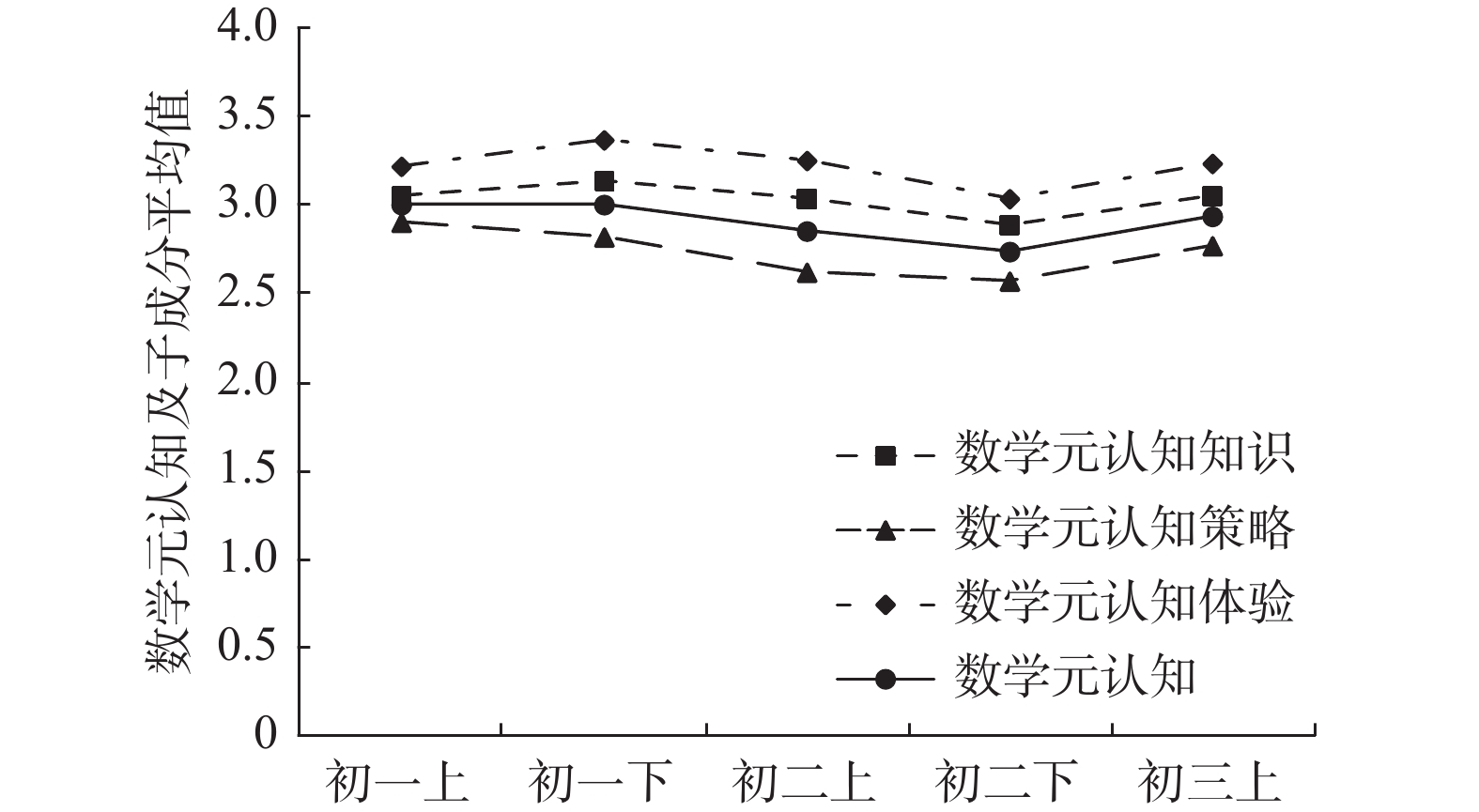
图1 初中生数学元认知在五个测试时间点的变化
| 模型 | AIC | BIC | aBIC | Entropy | LMR-LRT(p) | BLRT(p) | 类别概率 |
| 1 | 859.62 | 877.92 | 855.82 | 1 | |||
| 2 | 741.51 | 767.66 | 736.08 | 0.75 | 0.72 | <0.001 | 0.6436/0.3564 |
| 3 | 664.86 | 698.86 | 657.80 | 0.87 | <0.01 | <0.001 | 0.3267/0.5446/0.1287 |
| 4 | 665.68 | 707.52 | 656.99 | 0.86 | 0.22 | 0.27 | 0.5347/0.3168/0.1188/0.0297 |
| 5 | 670.17 | 719.86 | 659.85 | 0.78 | 0.72 | 1.00 | 0.0297/0.4753/0.0990/0.3168/0.0792 |
表3 初中生数学元认知LCGM和LGMM的模型拟合信息
| 模型 | AIC | BIC | aBIC | Entropy | LMR-LRT(p) | BLRT(p) | 类别概率 |
| 1 | 859.62 | 877.92 | 855.82 | 1 | |||
| 2 | 741.51 | 767.66 | 736.08 | 0.75 | 0.72 | <0.001 | 0.6436/0.3564 |
| 3 | 664.86 | 698.86 | 657.80 | 0.87 | <0.01 | <0.001 | 0.3267/0.5446/0.1287 |
| 4 | 665.68 | 707.52 | 656.99 | 0.86 | 0.22 | 0.27 | 0.5347/0.3168/0.1188/0.0297 |
| 5 | 670.17 | 719.86 | 659.85 | 0.78 | 0.72 | 1.00 | 0.0297/0.4753/0.0990/0.3168/0.0792 |
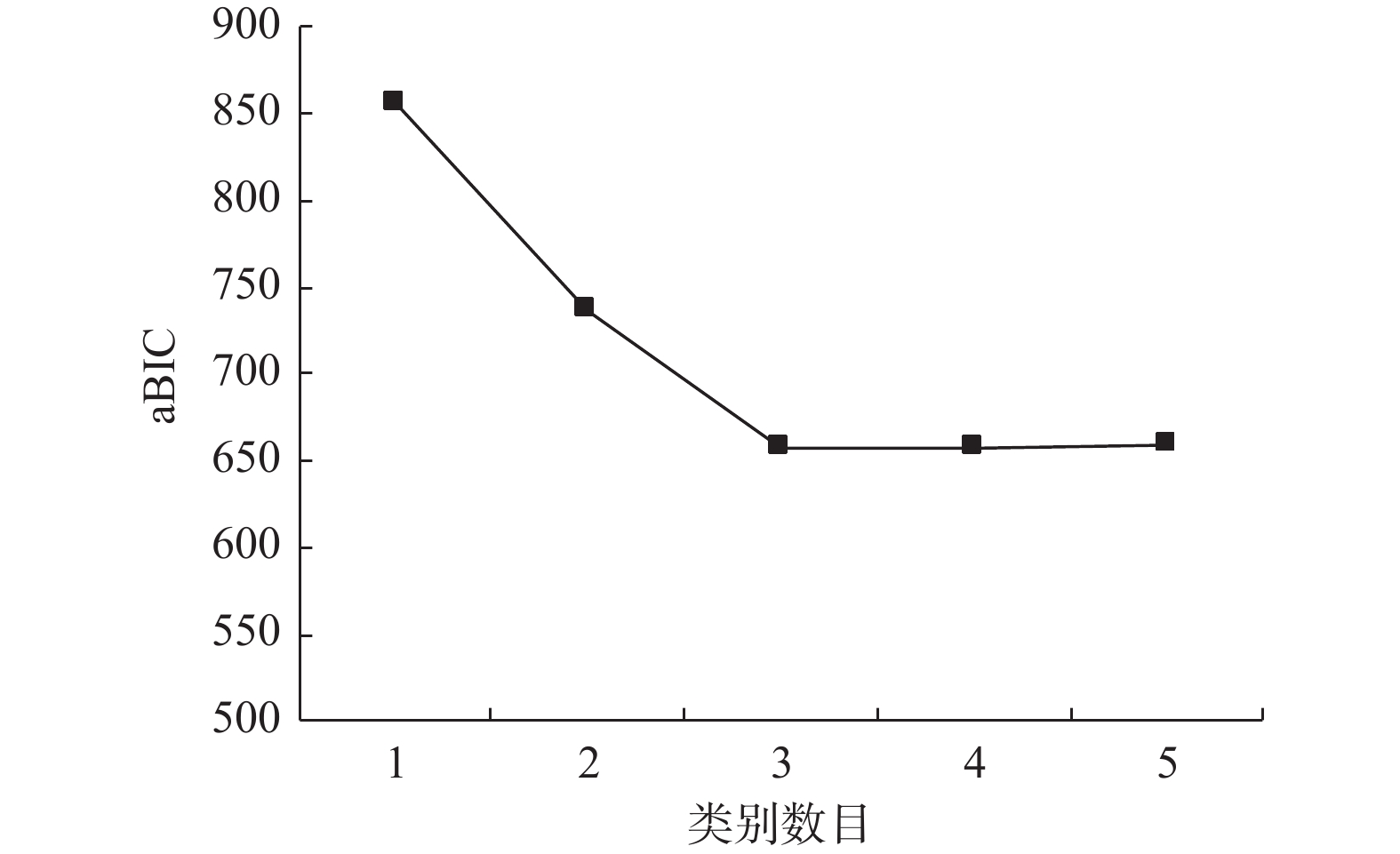
图2 aBIC值陡坡图
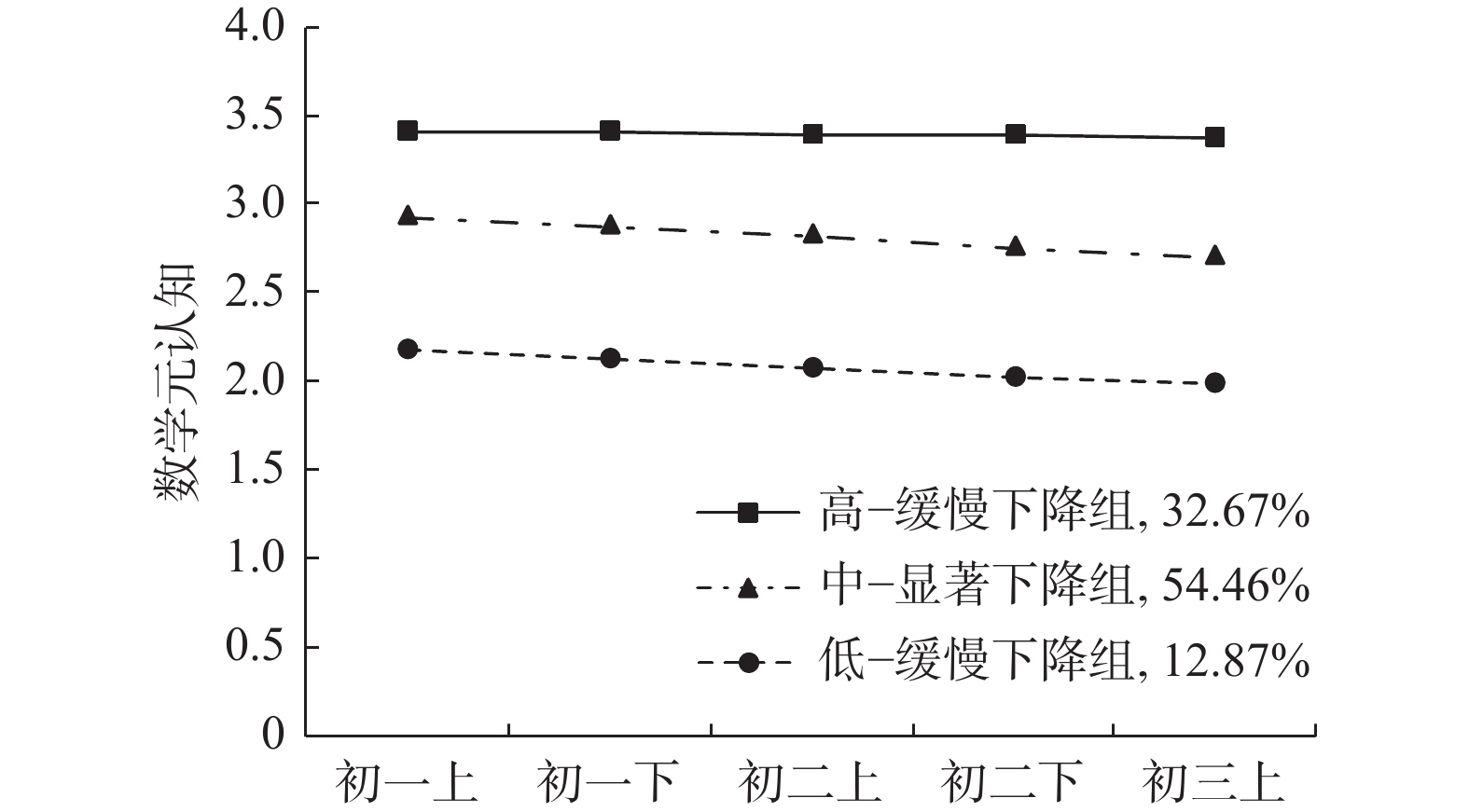
图3 初中生数学元认知的三类别发展轨迹
| C1 | C2 | ||||||
| B | OR | 95%CI | B | OR | 95%CI | ||
| 男生 | 0.87△ | 2.39 | [−0.03, 1.97] | −0.26 | 0.77 | [−1.68, 1.09] | |
| χ2(df) | 4.44(2) | ||||||
表4 数学元认知潜在类别对性别的logistic回归
| C1 | C2 | ||||||
| B | OR | 95%CI | B | OR | 95%CI | ||
| 男生 | 0.87△ | 2.39 | [−0.03, 1.97] | −0.26 | 0.77 | [−1.68, 1.09] | |
| χ2(df) | 4.44(2) | ||||||
| 陈英和, 韩瑽瑽 儿童青少年元认知的发展特点及作用的心理机制. 心理科学, 2012, 35 (3): 537- 543. | |
|
程向阳 数学元认知差异的相关研究及启示. 中国特殊教育, 2008, (10): 93- 96.
DOI |
|
| 范文贵, 李伟华 西方数学学习性别差异研究述评. 比较教育研究, 2008, 30 (9): 77- 82. | |
|
郭雯婧, 边玉芳 初二学生感知到的社会支持与学习成绩的关系——学业自我概念的中介作用. 心理科学, 2013, 36 (3): 627- 631.
DOI |
|
| 欧慧谋, 唐剑岚 国内数学元认知的研究与思考. 课程·教材·教法 , 2012, 32 (5): 58- 61. | |
| 申继亮, 陈英和. (2014). 中国教育心理测评手册. 北京: 高等教育出版社. | |
| 史滋福, 谢云天 数学焦虑对初中生概率推理的影响——一个有调节的中介模型. 数学教育学报, 2020, 29 (4): 13- 19. | |
|
唐剑岚, 周莹, 汤服成 数学问题解决中的元认知问卷量表的设计. 数学教育学报, 2005, 14 (4): 44- 48.
DOI |
|
| 吴先超 青少年元认知控制跨时间准确性及一致性发展研究. 教育研究与实验, 2019, (4): 75- 80. | |
| 薛笑然, 黄碧娟, 李红霞, 赵晓萌, 司继伟 小学儿童数学态度与数学成就的纵向联系: 学业拖延和数学元认知的作用. 心理发展与教育, 2022, 38 (4): 520- 529. | |
| 朱智贤. (2018). 儿童心理学(第6版). 北京: 人民教育出版社. | |
|
Annevirta, T., & Vauras, M. Metacognitive knowledge in primary grades: A longitudinal study. European Journal of Psychology of Education, 2001, 16 (2): 257- 282.
DOI |
|
|
Anthonysamy, L. The use of metacognitive strategies for undisrupted online learning: Preparing university students in the age of pandemic. Education and Information Technologies, 2021, 26 (6): 6881- 6899.
DOI |
|
|
Baker, D. P., & Jones, D. P. Creating gender equality: Cross-national gender stratification and mathematical performance. Sociology of Education, 1993, 66, 91- 103.
DOI |
|
| Bevan, R. Boys, girls and mathematics: Beginning to learn from the gender debate. Mathematics in School, 2001, 30 (4): 2- 6. | |
|
Borkowski, J. G. Metacognition: Theory or chapter heading. Learning and Individual Differences, 1996, 8 (4): 391- 402.
DOI |
|
| Callan, G. L., Marchant, G. J., Finch, W. H., & German, R. L. Metacognition, strategies, achievement, and demographics: Relationships across countries. Educational Sciences: Theory & Practice, 2016, 16 (5): 1485- 1502. | |
|
Collins, D. W., & Kimura, D. A large sex difference on a two-dimensional mental rotation task. Behavioral Neuroscience, 1997, 111 (4): 845- 849.
DOI |
|
|
Cromley, J. G., & Kunze, A. J. Metacognition in education: Translational research. Translational Issues in Psychological Science, 2020, 6 (1): 15- 20.
DOI |
|
|
De Boer, H., Donker, A. S., Kostons, D. D. N. M., & van Der Werf, G. P. C. Long-term effects of metacognitive strategy instruction on student academic performance: A meta-analysis. Educational Research Review, 2018, 24, 98- 115.
DOI |
|
|
Desoete, A., & De Craene, B. Metacognition and mathematics education: An overview. ZDM—Mathematics Education, 2019, 51 (4): 565- 575.
DOI |
|
|
Else-Quest, N. M., Hyde, J. S., & Linn, M. C. Cross-national patterns of gender differences in mathematics: A meta-analysis. Psychological Bulletin, 2010, 136 (1): 103- 127.
DOI |
|
| Flavell, J. H. (1976). Metacognitive aspects of problem solving. In L. B. Resnick (Ed.), The nature of intelligence (pp. 231–236). Hillsdale, NJ: Lawrence Erlbaum. | |
|
Flavell, J. H. Metacognition and cognitive monitoring: A new area of cognitive-developmental inquiry. American Psychologist, 1979, 34 (10): 906- 911.
DOI |
|
|
Gómez-Ortiz, O., Roldán, R., Ortega-Ruiz, R., & García-López, L. J. Social anxiety and psychosocial adjustment in adolescents: Relation with peer victimization, self-esteem and emotion regulation. Child Indicators Research, 2018, 11 (6): 1719- 1736.
DOI |
|
|
Heyes, C., Bang, D., Shea, N., Frith, C. D., & Fleming, S. M. Knowing ourselves together: The cultural origins of metacognition. Trends in Cognitive Sciences, 2020, 24 (5): 349- 362.
DOI |
|
|
Hoffman, B., & Spatariu, A. The influence of self-efficacy and metacognitive prompting on math problem-solving efficiency. Contemporary Educational Psychology, 2008, 33 (4): 875- 893.
DOI |
|
|
Hyde, J. S. Gender similarities and differences. Annual Review of Psychology, 2014, 65, 373- 398.
DOI |
|
|
Ku, K. Y. L., & Ho, I. T. Metacognitive strategies that enhance critical thinking. Metacognition and Learning, 2010, 5 (3): 251- 267.
DOI |
|
|
Kuhn, D. Metacognitive development. Current Directions in Psychological Science, 2000, 9 (5): 178- 181.
DOI |
|
|
Lenroot, R. K., & Giedd, J. N. Sex differences in the adolescent brain. Brain and Cognition, 2010, 72 (1): 46- 55.
DOI |
|
|
Mok, Y. F., Fan, R. M. T., & Pang, N. S. K. Developmental patterns of school students’ motivational- and cognitive-metacognitive competencies. Educational Studies, 2007, 33 (1): 81- 98.
DOI |
|
|
Morales, J., Lau, H., & Fleming, S. M. Domain-general and domain-specific patterns of activity supporting metacognition in human prefrontal cortex. Journal of Neuroscience, 2018, 38 (14): 3534- 3546.
DOI |
|
| Nelson, T. O. Metamemory: A theoretical framework and new findings. Psychology of Learning and Motivation, 1990, 26, 125- 173. | |
| Özdemir, A., Utkualp, N., & Palloş, A. Physical and psychosocial effects of the changes in adolescence period. International Journal of Caring Sciences, 2016, 9 (2): 717- 723. | |
|
Perry, J., Lundie, D., & Golder, G. Metacognition in schools: What does the literature suggest about the effectiveness of teaching metacognition in schools. Educational Review, 2019, 71 (4): 483- 500.
DOI |
|
|
Pintrich, P. R. The role of metacognitive knowledge in learning, teaching, and assessing. Theory into Practice, 2002, 41 (4): 219- 225.
DOI |
|
|
Reilly, D., Neumann, D. L., & Andrews, G. Investigating gender differences in mathematics and science: Results from the 2011 trends in mathematics and science survey. Research in Science Education, 2019, 49 (1): 25- 50.
DOI |
|
|
Roebers, C. M., & Spiess, M. The development of metacognitive monitoring and control in second graders: A short-term longitudinal study. Journal of Cognition and Development, 2017, 18 (1): 110- 128.
DOI |
|
|
Sapta, A., Hamid, A., & Syahputra, E. Assistance of parents in the learning at home. Journal of Physics: Conference Series, 2018, 1114, 012020.
DOI |
|
| Siagian, M. V., Saragih, S., & Sinaga, B. Development of learning materials oriented on problem-based learning model to improve students’ mathematical problem solving ability and metacognition ability. International Electronic Journal of Mathematics Education, 2019, 14 (2): 331- 340. | |
|
van Der Stel, M., & Veenman, M. V. J. Metacognitive skills and intellectual ability of young adolescents: A longitudinal study from a developmental perspective. European Journal of Psychology of Education, 2014, 29 (1): 117- 137.
DOI |
|
|
Wang, M. T., Binning, K. R., Del Toro, J., Qin, X., & Zepeda, C. D. Skill, thrill, and will: The role of metacognition, interest, and self-control in predicting student engagement in mathematics learning over time. Child Development, 2021, 92 (4): 1369- 1387.
DOI |
| [1] | 曾子豪, 何震, 袁言云, 赵纤, 印利红, 谭嵘, 常梦梦, 胡义秋. HPA轴系统多基因−亲子关系交互对青少年抑郁发展影响及性别差异[J]. 心理与行为研究, 2026, 24(1): 78-86. |
| [2] | 张誉瀚, 丁凤琴. 敬畏与初中生亲社会行为的关系:生命意义的中介作用[J]. 心理与行为研究, 2026, 24(1): 130-137. |
| [3] | 金慧, 张雪, 王跃鹏, 孟维杰. 学校道德氛围对初中生作弊行为意向的影响:道德推脱的中介作用[J]. 心理与行为研究, 2026, 24(1): 138-144. |
| [4] | 吴鹏, 唐汇苓, 王杨春子. 师生关系与高中生未来教育规划发展趋势的关系:一项追踪研究[J]. 心理与行为研究, 2025, 23(4): 544-550. |
| [5] | 张庆吉, 郭丰波, 涂叶满, 卿再花, 宋凤. 劳动价值观对青少年心理健康潜在类别及其转换的影响:双因素模型视角[J]. 心理与行为研究, 2025, 23(4): 569-576. |
| [6] | 曾欣悦, 刘衍玲, 王旭. 人际关系对初中生心理素质的影响:自尊的纵向中介作用[J]. 心理与行为研究, 2025, 23(2): 273-279. |
| [7] | 胡义秋, 何震, 曾子豪, 赵纤, 常梦梦. 初中生身体监控与抑郁症状的纵向关系研究:主观幸福感的中介作用[J]. 心理与行为研究, 2025, 23(1): 58-65. |
| [8] | 林丹华, 曹娟, 申子姣, 张月. 初中生受侵害与攻击类型的转变模式:近墨者黑?[J]. 心理与行为研究, 2024, 22(3): 320-328. |
| [9] | 刘仁洁, 夏凌翔, 赵永萍. 大学生网络欺凌受害潜在类别的发展特点及性别因素的作用[J]. 心理与行为研究, 2023, 21(6): 784-791. |
| [10] | 张斌, 张安琪, 邱致燕, 曾奕欣, 曾成伟, 熊思成, 张淑君, 王亚楠. 青少年早期限制性饮食的发展轨迹:基于潜变量混合增长模型的分析[J]. 心理与行为研究, 2023, 21(5): 621-628. |
| [11] | 易芳, 熊小娇, 滕召军, 叶宝娟, 廖丽萍, 颜茹娜, 李玉华. 积极同伴压力与初中生病理性互联网使用的关系:希望和意向性自我调节的中介作用[J]. 心理与行为研究, 2023, 21(5): 637-643. |
| [12] | 王钟潍, 任沿静, 陈晓晨. 不同类型亲子间教育期望差异对初中生学业成绩的影响[J]. 心理与行为研究, 2023, 21(4): 496-502. |
| [13] | 盖笑松, 吴晓靓, 顾婷玉, 张婵, 马媛春. 初中生家庭社会经济地位、积极品质对中考成绩的预测作用[J]. 心理与行为研究, 2022, 20(3): 368-374. |
| [14] | 王军利, 文彦茹, 林艺, 侯莉敏. 学前儿童情绪表达规则认知发展特征及其影响因素:一项追踪研究[J]. 心理与行为研究, 2021, 19(6): 764-770. |
| [15] | 游志麒, 周宗奎. 儿童社交自我知觉的发展及其与孤独感和安静退缩的关系[J]. 心理与行为研究, 2021, 19(4): 473-479. |
| 阅读次数 | ||||||
|
全文 |
|
|||||
|
摘要 |
|
|||||
