
心理与行为研究 ›› 2023, Vol. 21 ›› Issue (3): 352-358.DOI: 10.12139/j.1672-0628.2023.03.009
何然1, 陈福美1,*( ), 罗芮2, 赵云燕3, 李昭仪1, 罗玉晗4
收稿日期:2022-08-13
出版日期:2023-05-20
发布日期:2023-05-20
通讯作者:
陈福美
基金资助:
Ran HE1, Fumei CHEN1,*(), Rui LUO2, Yunyan ZHAO3, Zhaoyi LI1, Yuhan LUO4
Received:2022-08-13
Online:2023-05-20
Published:2023-05-20
Contact:
Fumei CHEN
摘要:
为探讨二孩家庭中父母婚姻冲突与青少年主观幸福感的关系,同时分析同胞关系和基本心理需要满足在其中的中介效应,基于家庭系统理论和自我决定理论,本研究采用问卷调查法对907名来自二孩家庭的青少年进行了测查。结果发现:(1)父母婚姻冲突与二孩家庭青少年的主观幸福感显著负相关;(2)父母婚姻冲突与二孩家庭青少年主观幸福感的关系被“同胞温暖”“同胞敌意”两条路径部分中介;(3)父母婚姻冲突与二孩家庭青少年主观幸福感的关系还被“同胞温暖−基本心理需要满足”这一链式路径部分中介。研究揭示了父母婚姻冲突是如何影响二孩家庭青少年主观幸福感的,对二孩家庭教养具有重要意义。
中图分类号:
何然, 陈福美, 罗芮, 赵云燕, 李昭仪, 罗玉晗. 父母婚姻冲突与青少年主观幸福感的关系:一个链式中介模型[J]. 心理与行为研究, 2023, 21(3): 352-358.
Ran HE, Fumei CHEN, Rui LUO, Yunyan ZHAO, Zhaoyi LI, Yuhan LUO. The Relationship Between Interparental Conflict and Adolescents’ Subjective Well-Being: A Chain Mediation Model[J]. Studies of Psychology and Behavior, 2023, 21(3): 352-358.
| 变量 | M | SD | 1 | 2 | 3 | 4 | 5 | 6 | 7 |
| 1.家庭主观社会经济地位 | 5.99 | 1.80 | |||||||
| 2.性别 | |||||||||
| 3.出生顺序 | |||||||||
| 4.父母婚姻冲突 | 1.79 | 0.73 | −0.13** | −0.01 | −0.04 | ||||
| 5.主观幸福感 | 11.93 | 2.74 | 0.05 | 0.05 | −0.01 | −0.20** | |||
| 6.基本心理需要满足 | 5.01 | 1.27 | 0.14** | 0.01 | −0.03 | −0.32** | 0.42** | ||
| 7.同胞温暖 | 3.83 | 0.73 | 0.12** | 0.09* | −0.08* | −0.23** | 0.44** | 0.41** | |
| 8.同胞敌意 | 1.68 | 0.63 | −0.04 | 0.04 | −0.08* | 0.38** | −0.27** | −0.34** | −0.38** |
表1 各变量的描述性统计及相关分析(n=907)
| 变量 | M | SD | 1 | 2 | 3 | 4 | 5 | 6 | 7 |
| 1.家庭主观社会经济地位 | 5.99 | 1.80 | |||||||
| 2.性别 | |||||||||
| 3.出生顺序 | |||||||||
| 4.父母婚姻冲突 | 1.79 | 0.73 | −0.13** | −0.01 | −0.04 | ||||
| 5.主观幸福感 | 11.93 | 2.74 | 0.05 | 0.05 | −0.01 | −0.20** | |||
| 6.基本心理需要满足 | 5.01 | 1.27 | 0.14** | 0.01 | −0.03 | −0.32** | 0.42** | ||
| 7.同胞温暖 | 3.83 | 0.73 | 0.12** | 0.09* | −0.08* | −0.23** | 0.44** | 0.41** | |
| 8.同胞敌意 | 1.68 | 0.63 | −0.04 | 0.04 | −0.08* | 0.38** | −0.27** | −0.34** | −0.38** |
| 路径 | 估计值 | SE | 95%置信区间 | |
| 父母婚姻冲突→主观幸福感 | −0.17 | 0.04 | [−0.24, −0.10] | |
| 父母婚姻冲突→同胞温暖→主观幸福感 | −0.04 | 0.01 | [−0.07, −0.02] | |
| 父母婚姻冲突→同胞敌意→主观幸福感 | −0.05 | 0.02 | [−0.08, −0.02] | |
| 父母婚姻冲突→同胞温暖→基本心理需要满足→主观幸福感 | −0.02 | 0.01 | [−0.03, −0.01] |
表2 同胞关系、基本心理需要满足在父母婚姻冲突与青少年主观幸福感间的显著路径
| 路径 | 估计值 | SE | 95%置信区间 | |
| 父母婚姻冲突→主观幸福感 | −0.17 | 0.04 | [−0.24, −0.10] | |
| 父母婚姻冲突→同胞温暖→主观幸福感 | −0.04 | 0.01 | [−0.07, −0.02] | |
| 父母婚姻冲突→同胞敌意→主观幸福感 | −0.05 | 0.02 | [−0.08, −0.02] | |
| 父母婚姻冲突→同胞温暖→基本心理需要满足→主观幸福感 | −0.02 | 0.01 | [−0.03, −0.01] |
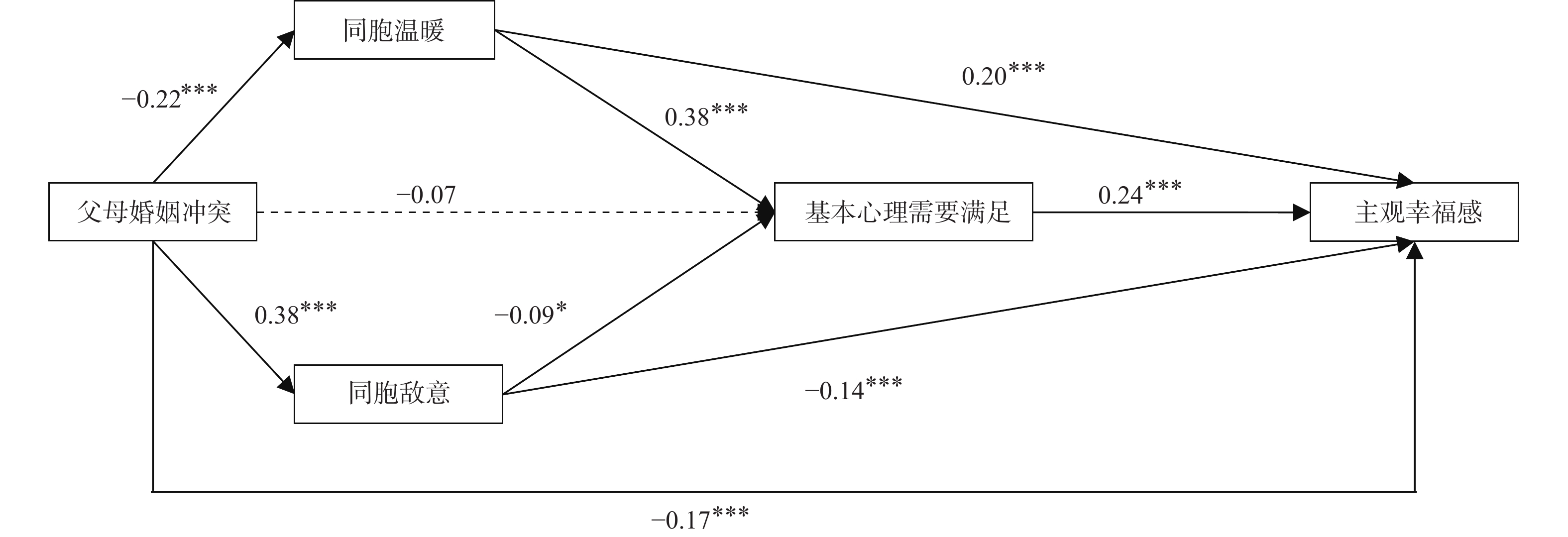
图1 中介作用标准化路径
| 陈斌斌, 赵语, 韩雯, 王逸辰, 吴嘉雯, 岳新宇, 吴英挺. 手足之情: 同胞关系的类型、影响因素及对儿童发展的作用机制. 心理科学进展, 2017, 25 (12): 2168- 2178. | |
| 董奇, 林崇德. (2011). 中国6~15岁儿童青少年心理发育数据库手册. 北京: 科学出版社. | |
|
杜健, 加藤和生, 小林美绪. 自我决定理论基本心理需要满足量表中文版在大学生中的信效度检验. 中国健康心理学杂志, 2020, 28 (2): 218- 221.
DOI |
|
|
郭海英, 朱婉灵, 朱倩, 朱茂玲, 左培颖, 林丹华. 亲子沟通与农村青少年幸福感的关系: 基本心理需要满足的中介作用. 心理发展与教育, 2014, 30 (2): 129- 136.
DOI |
|
|
刘田田, 李燕, 李有嘉, 姜新苗. 父母协同教养与学前儿童社会行为的关系: 亲子关系和同胞关系的链式中介作用. 心理发展与教育, 2021, 37 (5): 638- 647.
DOI |
|
| 屈国梁, 曹晓君. 同胞冲突及其解决: 家庭子系统的影响. 心理科学进展, 2021, 29 (2): 286- 295. | |
| 王学思, 李静雅, 王美芳. 父母婚姻冲突对儿童发展的影响及其机制. 心理科学进展, 2021, 29 (5): 875- 884. | |
|
温忠麟, 叶宝娟. 中介效应分析: 方法和模型发展. 心理科学进展, 2014, 22 (5): 731- 745.
DOI |
|
|
熊红星, 张璟, 叶宝娟, 郑雪, 孙配贞. 共同方法变异的影响及其统计控制途径的模型分析. 心理科学进展, 2012, 20 (5): 757- 769.
DOI |
|
| 张毅. (2020). 人口总量增速放缓 城镇化水平继续提升. 2022-11-14 取自http://www.ce.cn/xwzx/gnsz/gdxw/202001/19/t20200119_34154542.shtml | |
| 周浩, 龙立荣. 共同方法偏差的统计检验与控制方法. 心理科学进展, 2004, 12 (6): 942- 950. | |
|
Andersen, S. L., & Teicher, M. H.. Stress, sensitive periods and maturational events in adolescent depression. Trends in Neurosciences, 2008, 31 (4): 183- 191.
DOI |
|
|
Barberis, N., Verrastro, V., Costa, S., & Gugliandolo, M. C.. Sibling relationships and social development in youth and emerging adults: A self-determination theory approach. Journal of Family Issues, 2022, 43 (9): 2398- 2419.
DOI |
|
|
Boer, F., Westenberg, P. M., McHale, S. M., Updegraff, K. A., & Stocker, C. M.. The factorial structure of the Sibling Relationship Inventory (SRI) in American and Dutch samples. Journal of Social and Personal Relationships, 1997, 14 (6): 851- 859.
DOI |
|
|
Bortes, C., Ragnarsson, S., Strandh, M., & Petersen, S.. The bidirectional relationship between subjective well-being and academic achievement in adolescence. Journal of Youth and Adolescence, 2021, 50 (5): 992- 1002.
DOI |
|
| Bowes, L., Wolke, D., Joinson, C., Lereya, S. T., & Lewis, G. (2014). Sibling bullying and risk of depression, anxiety, and self-harm: A prospective cohort study. Pediatrics, 134(4), E1032–E1039. | |
|
Buist, K. L., Deković, M., & Prinzie, P.. Sibling relationship quality and psychopathology of children and adolescents: A meta-analysis. Clinical Psychology Review, 2013, 33 (1): 97- 106.
DOI |
|
|
Campbell, A.. Subjective measures of well-being. American Psychologist, 1976, 31 (2): 117- 124.
DOI |
|
|
Chen, F. F.. Sensitivity of goodness of fit indexes to lack of measurement invariance. Structural Equation Modeling: A Multidisciplinary Journal, 2007, 14 (3): 464- 504.
DOI |
|
|
Church, A. T., Katigbak, M. S., Locke, K. D., Zhang, H. S., Shen, J. L., de Jesús Vargas-Flores, J., ... Ching, C. M.. Need satisfaction and well-being: Testing self-determination theory in eight cultures. Journal of Cross-Cultural Psychology, 2013, 44 (4): 507- 534.
DOI |
|
| Cicirelli, V. G. (1985). Sibling relationships throughout the life cycle. In L. L. Abate (Ed.), Handbook of family psychology and therapy (Vol. 1, pp. 177–214). Homewood, IL: Dorsey Press. | |
| Cordeiro, P., Paixão, P., Lens, W., Lacante, M., & Sheldon, K. (2016). Factor structure and dimensionality of the balanced measure of psychological needs among Portuguese high school students. Relations to well-being and ill-being. Learning and Individual Differences, 47, 51–60. | |
|
Cox, M. J.. Family systems and sibling relationships. Child Development Perspectives, 2010, 4 (2): 95- 96.
DOI |
|
| Deci, E. L., & Ryan, R. M. (1985). The General Causality Orientations Scale: Self-determination in personality. Journal of Research in Personality, 19(2), 109–134. | |
|
Deci, E. L., & Ryan, R. M.. The “what” and “why” of goal pursuits: Human needs and the self-determination of behavior. Psychological Inquiry, 2000, 11 (4): 227- 268.
DOI |
|
| Deci, E. L., & Ryan, R. M. (2014). Autonomy and need satisfaction in close relationships: Relationships motivation theory. In N. Weinstein (Ed.), Human motivation and interpersonal relationships (pp. 53–73). Dordrecht, Netherlands: Springer. | |
| Dinisman, T., Andresen, S., Montserrat, C., Strózik, D., & Strózik, T. (2017). Family structure and family relationship from the child well-being perspective: Findings from comparative analysis. Children and Youth Services Review, 80, 105–115. | |
| Fosco, G. M., & Feinberg, M. E. (2015). Cascading effects of interparental conflict in adolescence: Linking threat appraisals, self-efficacy, and adjustment. Development and Psychopathology, 27(1), 239–252. | |
|
Fosco, G. M., & Lydon-Staley, D. M.. A within-family examination of interparental conflict, cognitive appraisals, and adolescent mood and well-being. Child Development, 2019, 90 (4): e421- e436.
DOI |
|
|
Gao, Q. F., Zheng, H. Y., Sun, R. M., & Lu, S. H.. Parent-adolescent relationships, peer relationships, and adolescent mobile phone addiction: The mediating role of psychological needs satisfaction. Addictive Behaviors, 2022, 129, 107260.
DOI |
|
|
Grych, J. H., & Fincham, F. D.. Marital conflict and children’s adjustment: A cognitive-contextual framework. Psychological Bulletin, 1990, 108 (2): 267- 290.
DOI |
|
|
Haught, H. M., Rose, J., Geers, A., & Brown, J. A.. Subjective social status and well-being: The role of referent abstraction. The Journal of Social Psychology, 2015, 155 (4): 356- 369.
DOI |
|
|
Hunter, J. P., & Csikszentmihalyi, M.. The positive psychology of interested adolescents. Journal of Youth and Adolescence, 2003, 32 (1): 27- 35.
DOI |
|
|
James, S. L., Nelson, D. A., Jorgensen-Wells, M. A., & Calder, D.. Marital quality over the life course and child well-being from childhood to early adolescence. Development and Psychopathology, 2022, 34 (4): 1492- 1505.
DOI |
|
| Jensen, A. C., Whiteman, S. D., Loeser, M. K., & Bernard, J. M. B. (2018). Sibling influences. In R. J. R. Levesque (Ed.), Encyclopedia of adolescence (2nd ed., pp. 3589–3595). Cham, Switzerland: Springer. | |
| Jouriles, E. N., McDonald, R., & Kouros, C. D. (2016). Interparental conflict and child adjustment. In D. Cicchetti (Ed.), Developmental psychopathology: Risk, resilience, and intervention (pp. 608–659). New York: John Wiley & Sons. | |
| Kocayoruk, E. (2012). The perception of parents and well-being of adolescents: Link with basic psychological need satisfaction. Procedia - Social and Behavioral Sciences, 46, 3624–3628. | |
|
Lam, C. B., McHale, S. M., Lam, C. S., Chung, K. K. H., & Cheung, R. Y. M.. Sibling relationship qualities and peer and academic adjustment: A multi-informant longitudinal study of Chinese families. Journal of Family Psychology, 2021, 35 (5): 584- 594.
DOI |
|
| Lee, J. M., & Lee, Y. H.. The effects of perceived parental conflict, maternal behavior, and social support on children’s subjective well-being: A structural equative modeling analysis. The Korean Journal of Developmental Psychology, 2007, 20 (4): 33- 58. | |
| Little, R. J., & Rubin, D. B. (2019). Statistical analysis with missing data (Vol. 793). New York: John Wiley & Sons. | |
|
McCoy, J. K., Brody, G. H., & Stoneman, Z.. A longitudinal analysis of sibling relationships as mediators of the link between family processes and youths’ best friendships. Family Relations, 1994, 43 (4): 400- 408.
DOI |
|
|
Oliva, A., & Arranz, E.. Sibling relationships during adolescence. European Journal of Developmental Psychology, 2005, 2 (3): 253- 270.
DOI |
|
|
Patton, G. C., Sawyer, S. M., Santelli, J. S., Ross, D. A., Afifi, R., Allen, N. B., ... Viner, R. M.. Our future: A Lancet commission on adolescent health and wellbeing . Lancet, 2016, 387 (10036): 2423- 2478.
DOI |
|
|
Ruff, S. C., Durtschi, J. A., & Day, R. D.. Family subsystems predicting adolescents’ perceptions of sibling relationship quality over time. Journal of Marital and Family Therapy, 2018, 44 (3): 527- 542.
DOI |
|
|
Ryan, R. M., & Deci, E. L.. Self-determination theory and the facilitation of intrinsic motivation, social development, and well-being. American Psychologist, 2000, 55 (1): 68- 78.
DOI |
|
| Ryan, R. M., & Deci, E. L. (2017). Self-determination theory: Basic psychological needs in motivation, development, and wellness. New York: Guilford Publications. | |
|
Schmidt, A., Neubauer, A. B., Dirk, J., & Schmiedek, F.. The bright and the dark side of peer relationships: Differential effects of relatedness satisfaction and frustration at school on affective well-being in children’s daily lives. Developmental Psychology, 2020, 56 (8): 1532- 1546.
DOI |
|
|
Sheldon, K. M., & Niemiec, C. P.. It’s not just the amount that counts: Balanced need satisfaction also affects well-being. Journal of Personality and Social Psychology, 2006, 91 (2): 331- 341.
DOI |
|
|
Shepherd, D., Goedeke, S., Landon, J., Taylor, S., & Williams, J.. The impact of sibling relationships on later-life psychological and subjective well-being. Journal of Adult Development, 2021, 28 (1): 76- 86.
DOI |
|
| Simões, F., & Alarcão, M. (2014). Promoting well-being in school-based mentoring through basic psychological needs support: Does it really count? Journal of Happiness Studies, 15(2), 407–424. | |
|
Tucker, C. J., Holt, M., & Wiesen-Martin, D.. Inter-parental conflict and sibling warmth during adolescence: Associations with female depression in emerging adulthood. Psychological Reports, 2013, 112 (1): 243- 251.
DOI |
|
|
van der Kaap-Deeder, J., Vansteenkiste, M., Soenens, B., & Mabbe, E.. Children’s daily well-being: The role of mothers’, teachers’, and siblings’ autonomy support and psychological control. Developmental Psychology, 2017, 53 (2): 237- 251.
DOI |
|
|
Waid, J.. Sibling foster care, placement stability, and well-being: A theoretical and conceptual framework. Journal of Family Social Work, 2014, 17 (3): 283- 297.
DOI |
|
| Whiteman, S. D., Jensen, A. C., & Maggs, J. L. (2014). Similarities and differences in adolescent siblings’ alcohol-related attitudes, use, and delinquency: Evidence for convergent and divergent influence processes. Journal of Youth and Adolescence, 43(5), 687–697. | |
|
Zhao, Y. Y., Chen, F. M., Yuan, C. Y., Luo, R., Ma, X. Y., & Zhang, C.. Parental favoritism and mobile phone addiction in Chinese adolescents: The role of sibling relationship and gender difference. Children and Youth Services Review, 2021, 120, 105766.
DOI |
|
|
Zhen, S. J., Liu, J. J., Qiu, B. Y., Fu, L. Y., Hu, J. P., & Su, B. Y.. Interparental conflict and early adulthood depression: Maternal care and psychological needs satisfaction as mediators. International Journal of Environmental Research and Public Health, 2022, 19 (3): 1402.
DOI |
| [1] | 王惠惠, 唐慎佩, 赵双祐, 黄向圆, 兰松. 内在自我与外界眼光:自我评价与反射性评价一致性对青少年心理健康问题的影响[J]. 心理与行为研究, 2026, 24(2): 187-194. |
| [2] | 樊雪戎, 段依凡, 邢晓沛. 温暖的亲子感知差异与青少年内化问题的关系:基于二项式回归的响应面分析[J]. 心理与行为研究, 2026, 24(2): 195-203. |
| [3] | 张一林, 牛更枫, 白旭青, 辛素飞, 孙晓军. 社会逆境感知与青少年社交媒体成瘾的双向关系:控制感的作用[J]. 心理与行为研究, 2026, 24(2): 258-264. |
| [4] | 曾子豪, 何震, 袁言云, 赵纤, 印利红, 谭嵘, 常梦梦, 胡义秋. HPA轴系统多基因−亲子关系交互对青少年抑郁发展影响及性别差异[J]. 心理与行为研究, 2026, 24(1): 78-86. |
| [5] | 杨昕珠, 王腾飞, 郑晓龙. 青少年社会情感能力与学业倦怠的双向预测作用:一项交叉滞后研究[J]. 心理与行为研究, 2025, 23(6): 789-797. |
| [6] | 谷莉, 黄晓彤, 梁广华, 蔡頠, 郭丰波. 核心自我评价与青少年自伤行为的关系:有调节的中介模型[J]. 心理与行为研究, 2025, 23(6): 798-805. |
| [7] | 张春妹, 骆玉冰, 温冬雪, 郑航. 青少年逆反心理与偏差行为的关系:偏差同伴联系和偏差群体同一性的链式中介作用[J]. 心理与行为研究, 2025, 23(5): 645-652. |
| [8] | 邬钟灵, 赵书敏, 闫俊男, 陈亮. 二胎家庭中亲子关系与幼儿合作的关系:同胞关系与幼儿性别的作用[J]. 心理与行为研究, 2025, 23(4): 479-486. |
| [9] | 刘鑫, 刘衍玲, 曾晋逸. 心理需要挫折与青少年抑郁症状的纵向联系:心理素质的调节作用[J]. 心理与行为研究, 2025, 23(4): 496-503. |
| [10] | 鲍振宙, 刘花, 于明申. 青少年校园欺凌旁观行为与焦虑抑郁症状的关系:基于纵向网络分析法[J]. 心理与行为研究, 2025, 23(4): 504-512. |
| [11] | 刘佳, 高培晋, 李楠, 孙敏, 白学军. 社会变化程度感知对青少年社会公平感的影响[J]. 心理与行为研究, 2025, 23(4): 551-559. |
| [12] | 张庆吉, 郭丰波, 涂叶满, 卿再花, 宋凤. 劳动价值观对青少年心理健康潜在类别及其转换的影响:双因素模型视角[J]. 心理与行为研究, 2025, 23(4): 569-576. |
| [13] | 张阔, 李珮瑜, 赵晋娥, 贾绪计. 二分还是多重?青少年成长型思维动机框架的异质性及其与学业适应的关系[J]. 心理与行为研究, 2025, 23(3): 346-353. |
| [14] | 钞淼, 张宇, 谢启慧, 刘拓. 情感忽视对农村青少年短视频成瘾的纵向影响:负性情绪中介及留守差异[J]. 心理与行为研究, 2025, 23(3): 361-368. |
| [15] | 王锦, 杨晓凡, 刘晓金, 徐紫陌. 中学生的未来自我连续性对主观幸福感的作用:价值冲突的中介模型[J]. 心理与行为研究, 2025, 23(2): 201-207. |
| 阅读次数 | ||||||
|
全文 |
|
|||||
|
摘要 |
|
|||||
