
心理与行为研究 ›› 2024, Vol. 22 ›› Issue (6): 769-776.DOI: 10.12139/j.1672-0628.2024.06.007
谢瑞波, 姚鸿清*( ), 丁菀, 陈妍伶, 李伟健
收稿日期:2024-08-12
出版日期:2024-11-20
发布日期:2024-11-20
通讯作者:
姚鸿清
基金资助:
Ruibo XIE, Hongqing YAO*(), Wan DING, Yanling CHEN, Weijian LI
Received:2024-08-12
Online:2024-11-20
Published:2024-11-20
Contact:
Hongqing YAO
摘要:
采用追踪研究对“双减”后1507名初中生进行考察,探索父母自主支持和心理控制与学习投入的关系及其潜在机制。结果发现:(1)父母自主支持能够正向预测初中生学习投入。(2)初中阶段,父子亲合能够负向预测母子亲合。(3)母子亲合和父子亲合在父母自主支持和心理控制之间起中介作用:一是母子亲合的单独中介作用;二是父子亲合的单独中介作用;三是父子亲合和母子亲合的链式中介作用。研究结果拓展了相关理论,对青少年家庭教育具有启示意义。
谢瑞波, 姚鸿清, 丁菀, 陈妍伶, 李伟健. 父母自主支持、心理控制与青少年学习投入的关系:亲子亲合的作用[J]. 心理与行为研究, 2024, 22(6): 769-776.
Ruibo XIE, Hongqing YAO, Wan DING, Yanling CHEN, Weijian LI. The Impact of Parental Autonomy Support and Psychological Control on Adolescents’ Academic Engagement: The Role of Parent-Child Cohesion[J]. Studies of Psychology and Behavior, 2024, 22(6): 769-776.
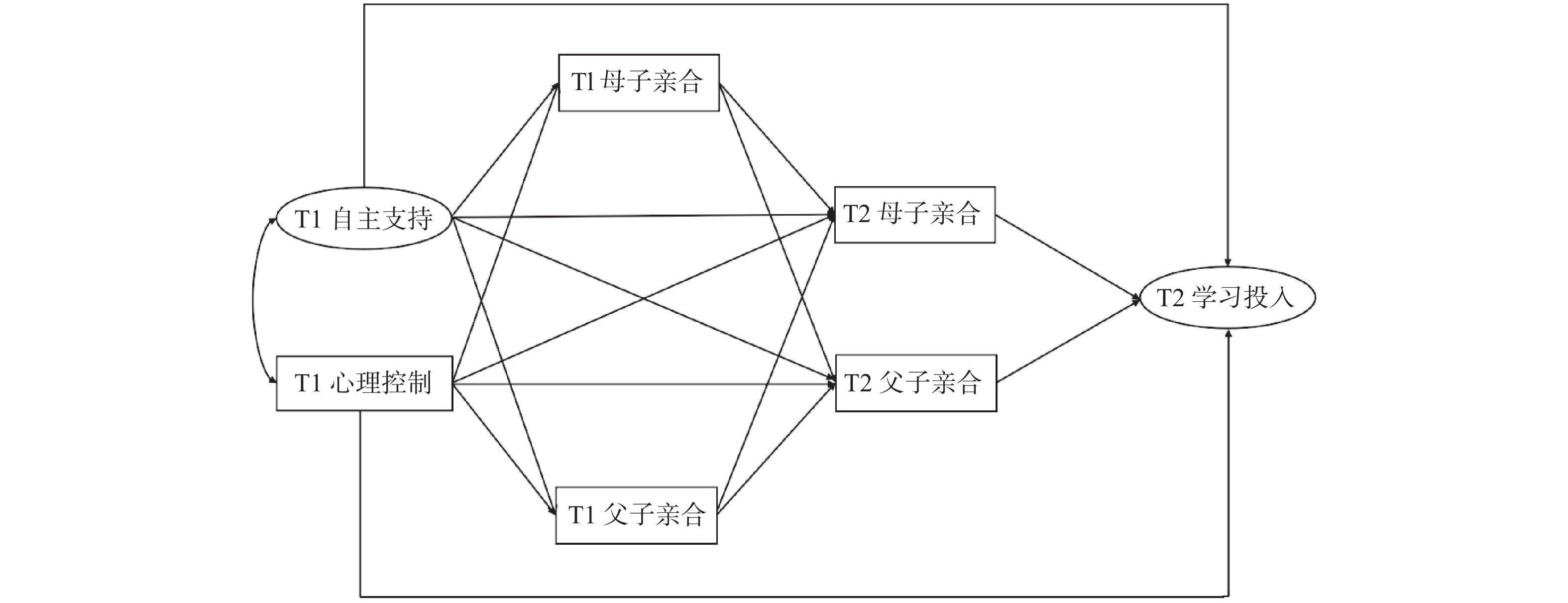
图1 假设模型
| M±SD | 1 | 2 | 3 | 4 | 5 | 6 | 7 | 8 | 9 | 10 | 11 | |
| 1. T1 自主选择 | 3.73±0.77 | |||||||||||
| 2. T1 交换意见 | 3.70±0.82 | 0.91*** | ||||||||||
| 3. T1 父母心理控制 | 2.49±0.97 | −0.31*** | −0.31*** | |||||||||
| 4. T1 母子亲合 | 3.81±0.72 | 0.44*** | 0.47*** | −0.20*** | ||||||||
| 5. T1 父子亲合 | 3.65±0.77 | 0.42*** | 0.44*** | −0.18*** | 0.77*** | |||||||
| 6. T2 母子亲合 | 3.51±0.59 | 0.31*** | 0.34*** | −0.26*** | 0.32*** | 0.22*** | ||||||
| 7. T2 父子亲合 | 3.42±0.64 | 0.32*** | 0.34*** | −0.24*** | 0.25*** | 0.29*** | 0.72*** | |||||
| 8. T2 行为投入 | 3.56±0.75 | 0.25*** | 0.28*** | −0.19*** | 0.23*** | 0.22*** | 0.48*** | 0.50*** | ||||
| 9. T2 情感投入 | 3.62±0.78 | 0.30*** | 0.32*** | −0.19*** | 0.26*** | 0.23*** | 0.52*** | 0.52*** | 0.92*** | |||
| 10. T2 认知投入 | 3.60±0.79 | 0.30*** | 0.32*** | −0.18*** | 0.25*** | 0.50*** | 0.51*** | 0.86*** | 0.91*** | |||
| 11. 年级 | 0.00 | −0.01 | 0.08** | −0.11*** | −0.08** | −0.06* | −0.02 | 0.01 | 0.01 | 0.01 | ||
| 12. 性别 | −0.07* | −0.07* | −0.08* | 0.00 | −0.04 | 0.06* | −0.03 | 0.01 | −0.01 | −0.03 | 0.02 |
表1 描述性统计和相关系数
| M±SD | 1 | 2 | 3 | 4 | 5 | 6 | 7 | 8 | 9 | 10 | 11 | |
| 1. T1 自主选择 | 3.73±0.77 | |||||||||||
| 2. T1 交换意见 | 3.70±0.82 | 0.91*** | ||||||||||
| 3. T1 父母心理控制 | 2.49±0.97 | −0.31*** | −0.31*** | |||||||||
| 4. T1 母子亲合 | 3.81±0.72 | 0.44*** | 0.47*** | −0.20*** | ||||||||
| 5. T1 父子亲合 | 3.65±0.77 | 0.42*** | 0.44*** | −0.18*** | 0.77*** | |||||||
| 6. T2 母子亲合 | 3.51±0.59 | 0.31*** | 0.34*** | −0.26*** | 0.32*** | 0.22*** | ||||||
| 7. T2 父子亲合 | 3.42±0.64 | 0.32*** | 0.34*** | −0.24*** | 0.25*** | 0.29*** | 0.72*** | |||||
| 8. T2 行为投入 | 3.56±0.75 | 0.25*** | 0.28*** | −0.19*** | 0.23*** | 0.22*** | 0.48*** | 0.50*** | ||||
| 9. T2 情感投入 | 3.62±0.78 | 0.30*** | 0.32*** | −0.19*** | 0.26*** | 0.23*** | 0.52*** | 0.52*** | 0.92*** | |||
| 10. T2 认知投入 | 3.60±0.79 | 0.30*** | 0.32*** | −0.18*** | 0.25*** | 0.50*** | 0.51*** | 0.86*** | 0.91*** | |||
| 11. 年级 | 0.00 | −0.01 | 0.08** | −0.11*** | −0.08** | −0.06* | −0.02 | 0.01 | 0.01 | 0.01 | ||
| 12. 性别 | −0.07* | −0.07* | −0.08* | 0.00 | −0.04 | 0.06* | −0.03 | 0.01 | −0.01 | −0.03 | 0.02 |
| 路径 | 效应值 | 95%CI | |
| 下限 | 上限 | ||
| T1自主支持→T2母子亲合→T2学习投入 | 0.06*** | 0.035 | 0.079 |
| T1自主支持→T2父子亲合→T2学习投入 | 0.07*** | 0.042 | 0.088 |
| T1自主支持→T1父子亲合→T2母子亲合→T2学习投入 | −0.01* | −0.022 | −0.003 |
| T1心理控制→T2母子亲合→T2学习投入 | −0.04*** | −0.061 | −0.025 |
| T1心理控制→T2父子亲合→T2学习投入 | 0.04*** | −0.058 | −0.021 |
表2 中介效应检验(显著路径)
| 路径 | 效应值 | 95%CI | |
| 下限 | 上限 | ||
| T1自主支持→T2母子亲合→T2学习投入 | 0.06*** | 0.035 | 0.079 |
| T1自主支持→T2父子亲合→T2学习投入 | 0.07*** | 0.042 | 0.088 |
| T1自主支持→T1父子亲合→T2母子亲合→T2学习投入 | −0.01* | −0.022 | −0.003 |
| T1心理控制→T2母子亲合→T2学习投入 | −0.04*** | −0.061 | −0.025 |
| T1心理控制→T2父子亲合→T2学习投入 | 0.04*** | −0.058 | −0.021 |
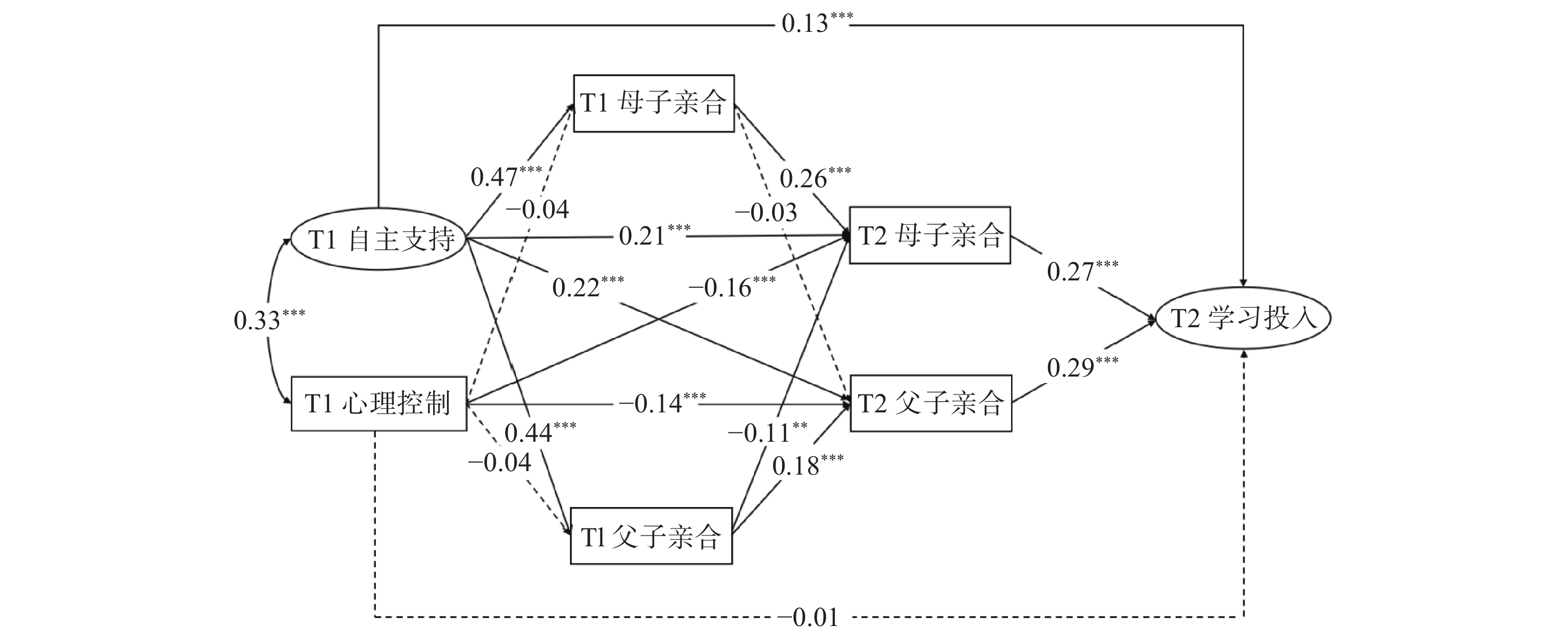
图2 多重中介模型
|
陈欣银. 中国社会变迁与人的发展: 多元建构观点和相关研究. 心理学报, 2024, 56 (7): 977- 993.
|
|
|
何筱荷, 侯金芹, 陈祉妍. 父母婚姻质量对小学生家庭作业努力影响的追踪研究: 亲子亲合的中介作用. 心理与行为研究, 2021, 19 (1): 45- 51.
|
|
|
李凤堂. 中学生自主学习能力培养策略探究. 天津市教科院学报, 2013, (6): 66- 69.
DOI |
|
|
刘小先, 龚少英, 周治金, 封晓伟, 于全磊. 父母自主支持、心理控制与初中生创意自我效能的关系: 学业情绪的中介作用. 心理发展与教育, 2020, 36 (1): 45- 53.
|
|
|
庞维国. 中学生自主学习的教学指导模式研究. 心理科学, 2003, 26 (2): 285- 288.
DOI |
|
|
唐芹, 方晓义, 胡伟, 陈海德, 吴梦希, 王帆. 父母和教师自主支持与高中生发展的关系. 心理发展与教育, 2013, 29 (6): 604- 615.
|
|
|
王美萍, 张文新. 青少年期亲子冲突与亲子亲合的发展特征. 心理科学, 2007, 30 (5): 1196- 1198.
DOI |
|
|
王树青, 张文新, 陈会昌. 中学生自我同一性的发展与父母教养方式、亲子沟通的关系. 心理与行为研究, 2006, 4 (2): 126- 132.
|
|
|
王英芊, 邹泓, 侯珂, 王明珠, 汤玉龙, 潘斌. 亲子依恋、同伴依恋与青少年消极情感的关系: 有调节的中介模型. 心理发展与教育, 2016, 32 (2): 226- 235.
|
|
|
吴重涵, 贺小茜, 刘莎莎. 现代教育制度中的家庭教育——解读《家庭教育促进法》的时代特性. 教育发展研究, 2022, 42 (10): 33- 40.
DOI |
|
|
吴伟, 谢瑞波, 丁菀, 王蝶, 李伟健. 父母心理控制与童年中期儿童问题行为的纵向关系: 父子依恋和母子依恋的中介作用. 心理科学, 2022, 45 (2): 364- 371.
|
|
|
武俐, 郭元祥. 父母自主支持与高中生学习投入: 意向性自我调节和学校联结的作用. 心理与行为研究, 2024, 22 (1): 64- 70.
DOI |
|
|
赵凤青, 程贝贝, 李奕萱, 刘志斌, 刘兵, 张宝山. 核心家庭父亲协同教养对青少年抑郁的影响: 父子依恋和母子依恋的中介作用. 心理发展与教育, 2022, 38 (1): 109- 117.
|
|
|
周爱保, 胡砚冰, 刘锦涛, 鲁小勇, 王有丽, 周滢鑫. 青少年社交焦虑与学习投入的关系: 意向性自我调节的解释作用及其年龄差异. 心理发展与教育, 2022, 38 (1): 54- 63.
|
|
|
周浩, 龙立荣. 共同方法偏差的统计检验与控制方法. 心理科学进展, 2004, 12 (6): 942- 950.
DOI |
|
|
Ainsworth, M. S., & Bowlby, J. An ethological approach to personality development. American Psychologist, 1991, 46 (4): 333- 341.
DOI |
|
|
Barber, B. K., Xia, M. Z., Olsen, J. A., McNeely, C. A., & Bose, K. Feeling disrespected by parents: Refining the measurement and understanding of psychological control. Journal of Adolescence, 2012, 35 (2): 273- 287.
DOI |
|
|
Bögels, S., & Phares, V. Fathers’ role in the etiology, prevention and treatment of child anxiety: A review and new model. Clinical Psychology Review, 2008, 28 (4): 539- 558.
DOI |
|
|
Bowen, M. D. M. The use of family theory in clinical practice. Comprehensive Psychiatry, 1966, 7 (5): 345- 374.
DOI |
|
|
Brauer, J. R. Cultivating conformists or raising rebels? Connecting parental control and autonomy support to adolescent delinquency. Journal of Research on Adolescence, 2017, 27 (2): 452- 470.
DOI |
|
|
Bureau, J. F., Deneault, A. A., Yurkowski, K., Martin, J., Quan, J., Sezlik, S., & Guérin-Marion, C. The interaction of child-father attachment and child-mother attachment in the prediction of observed coparenting. Psychology of Men & Masculinities, 2021, 22 (3): 512- 520.
|
|
|
Chen, J. H., Huebner, E. S., & Tian, L. L. Longitudinal relations between hope and academic achievement in elementary school students: Behavioral engagement as a mediator. Learning and Individual Differences, 2020, 78, 101824.
DOI |
|
|
Chen, X. Y., & Tse, H. C. H. Social functioning and adjustment in Canadian-born children with Chinese and European backgrounds. Developmental Psychology, 2008, 44 (4): 1184- 1189.
DOI |
|
|
Fousiani, K., Van Petegem, S., Soenens, B., Vansteenkiste, M., & Chen, B. W. Does parental autonomy support relate to adolescent autonomy? An in-depth examination of a seemingly simple question. Journal of Adolescent Research, 2014, 29 (3): 299- 330.
DOI |
|
|
Hazan, C., & Shaver, P. R. Attachment as an organizational framework for research on close relationships. Psychological Inquiry, 1994, 5 (1): 1- 22.
DOI |
|
|
Irfan, S., & Zulkefly, N. S. Parent-peer attachment, negative automatic thoughts and psychological problems among Pakistani adolescents: A moderated mediation model. Current Psychology, 2023, 42 (3): 1979- 1995.
DOI |
|
|
Jacobvitz, D., Aviles, A. I., Aquino, G. A., Tian, Z. Y., Zhang, S. Q., & Hazen, N. Fathers’ sensitivity in infancy and externalizing problems in middle childhood: The role of coparenting. Frontiers in Psychology, 2022, 13, 805188.
DOI |
|
|
Jiang, R. Y., Fan, R. M., Zhang, Y., & Li, Y. X. Understanding the serial mediating effects of career adaptability and career decision-making self-efficacy between parental autonomy support and academic engagement in Chinese secondary vocational students. Frontiers in Psychology, 2022, 13, 953550.
DOI |
|
|
Kerns, K. A., & Brumariu, L. E. Is insecure parent-child attachment a risk factor for the development of anxiety in childhood or adolescence. Child Development Perspectives, 2014, 8 (1): 12- 17.
DOI |
|
|
King, A. A., Russon, J. M., Mensinger, J. L., & Jin, B. R. Parental psychological control, attachment insecurity and body shame: How relational factors impact disordered eating. Journal of Child and Family Studies, 2022, 31 (9): 2545- 2555.
DOI |
|
|
Lam, S. F., Jimerson, S., Kikas, E., Cefai, C., Veiga, F. H., Nelson, B., ... Zollneritsch, J. Do girls and boys perceive themselves as equally engaged in school? The results of an international study from 12 countries. Journal of School Psychology, 2012, 50 (1): 77- 94.
DOI |
|
|
Li, J. Y., Sun, Z. X., Wang, X. Y., Li, W. J., Ding, W., & Xie, R. B. Parental involvement and Chinese children’s learning engagement: Promotion and arousal. Learning and Individual Differences, 2023, 106, 102325.
DOI |
|
|
LoBraico, E. J., Brinberg, M., Ram, N., & Fosco, G. M. Exploring processes in day-to-day parent-adolescent conflict and angry mood: Evidence for circular causality. Family Process, 2020, 59 (4): 1706- 1721.
DOI |
|
|
Mammadov, S., & Schroeder, K. A meta-analytic review of the relationships between autonomy support and positive learning outcomes. Contemporary Educational Psychology, 2023, 75, 102235.
DOI |
|
|
Marbell, K. N., & Grolnick, W. S. Correlates of parental control and autonomy support in an interdependent culture: A look at Ghana. Motivation and Emotion, 2013, 37 (1): 79- 92.
DOI |
|
|
Ramchandani, P. G., Domoney, J., Sethna, V., Psychogiou, L., Vlachos, H., & Murray, L. Do early father-infant interactions predict the onset of externalising behaviours in young children? Findings from a longitudinal cohort study. Journal of Child Psychology and Psychiatry, 2013, 54 (1): 56- 64.
DOI |
|
|
Ryan, R. M., & Deci, E. L. Self-determination theory and the facilitation of intrinsic motivation, social development, and well-being. American Psychologist, 2000, 55 (1): 68- 78.
DOI |
|
|
Schaufeli, W. B., Martínez, I. M., Pinto, A. M., Salanova, M., & Bakker, A. B. Burnout and engagement in university students: A cross-national study. Journal of Cross-Cultural Psychology, 2002, 33 (5): 464- 481.
DOI |
|
|
Shek, D. T. L. Perceived parental control and parent-child relational qualities in Chinese adolescents in Hong Kong. Sex Roles, 2005, 53 (9–10): 635- 646.
DOI |
|
|
Shek, D. T. L., Zhu, X. Q., & Dou, D. Y. Influence of family processes on internet addiction among late adolescents in Hong Kong. Frontiers in Psychiatry, 2019, 10, 113.
DOI |
|
|
Soenens, B., Vansteenkiste, M., Lens, W., Luyckx, K., Goossens, L., Beyers, W., & Ryan, R. M. Conceptualizing parental autonomy support: Adolescent perceptions of promotion of independence versus promotion of volitional functioning. Developmental Psychology, 2007, 43 (3): 633- 646.
DOI |
|
|
Szalai, T. D., Czeglédi, E., Vargha, A., & Grezsa, F. Parental attachment and body satisfaction in adolescents. Journal of Child and Family Studies, 2017, 26 (4): 1007- 1017.
DOI |
|
|
Thompson, L., & Walker, A. J. Gender in families: Women and men in marriage, work, and parenthood. Journal of Marriage and the Family, 1989, 51 (4): 845- 871.
DOI |
|
|
Vrolijk, P., Van Lissa, C. J., Branje, S. J. T., Meeus, W. H. J., & Keizer, R. Longitudinal linkages between father and mother autonomy support and adolescent problem behaviors: Between-family differences and within-family effects. Journal of Youth and Adolescence, 2020, 49 (11): 2372- 2387.
DOI |
|
|
Wang, Q., Pomerantz, E. M., & Chen, H. C. The role of parents’ control in early adolescents’ psychological functioning: A longitudinal investigation in the United States and China. Child Development, 2007, 78 (5): 1592- 1610.
DOI |
|
|
Wong, T. K., Konishi, C., & Cho, S. B. Paternal and maternal attachment: A multifaceted perspective on adolescents’ friendship. Journal of Child and Family Studies, 2020, 29 (1): 217- 226.
DOI |
|
|
Xu, J. J., Chen, X. Y., Liu, S. H., Weng, X. F., Zhang, H. Y., Yi, Z. N., ... Gao, M. Y. Parental autonomy support and psychological control and children’s biobehavioral functioning: Historical cohort differences in urban China. Child Development, 2024, 95 (6): 2166- 2177.
DOI |
|
|
Zhao, J. X., Liu, X., & Wang, M. F. Parent-child cohesion, friend companionship and left-behind children’s emotional adaptation in rural China. Child Abuse & Neglect, 2015, 48, 190- 199.
|
|
|
Zhou, H. Y., Liu, J. Y., & Deng, C. P. Trajectories of perceived parental psychological control and the longitudinal associations with Chinese adolescents’ school adjustment across high school years. Journal of Youth and Adolescence, 2024, 53 (9): 2060- 2079.
DOI |
| [1] | 谢开圣, 陈欣欣, 袁丹, 黄伟康, 方杰. 父母心理控制对中职生恶意创造力的影响:愤怒反刍的中介作用和心理韧性的调节作用[J]. 心理与行为研究, 2026, 24(1): 87-94. |
| [2] | 韩嘉桐, 关文军, 刘菁菁. 父母心理控制对中小学生短视频成瘾的影响:自主感和逆反心理的链式中介作用[J]. 心理与行为研究, 2026, 24(1): 95-102. |
| [3] | 谷莉, 黄晓彤, 梁广华, 蔡頠, 郭丰波. 核心自我评价与青少年自伤行为的关系:有调节的中介模型[J]. 心理与行为研究, 2025, 23(6): 798-805. |
| [4] | 曾萱萱, 余俐珍, 王小桃. 父母自恋与幼儿身体攻击行为的关系:父母身体攻击行为和子女教育心理控制源的中介作用[J]. 心理与行为研究, 2025, 23(4): 513-519. |
| [5] | 彭艳红, 安晓斌, 李志勇, 吴明证. 职业认同、学习投入与师范生教育实践能力的关系—基于变量中心和个体中心的分析[J]. 心理与行为研究, 2025, 23(4): 536-543. |
| [6] | 徐金凤, 吴添昊, 程毓可, 于冲, 关文军. 歧视知觉如何影响特殊儿童的家庭功能?孤独感和亲子亲合的作用机制[J]. 心理与行为研究, 2024, 22(6): 799-805. |
| [7] | 张野, 刘致宏, 申婷, 赵雨露. 父母心理控制、校园排斥与初中生内化问题的动态关系:交叉滞后研究[J]. 心理与行为研究, 2024, 22(5): 658-665. |
| [8] | 赵新宇, 乔晓光, 邢晓沛. 父母自主支持、10~12岁儿童的同伴关系与执行功能的动态互动关系:一个发展级联模型[J]. 心理与行为研究, 2024, 22(1): 55-63. |
| [9] | 武俐, 郭元祥. 父母自主支持与高中生学习投入:意向性自我调节和学校联结的作用[J]. 心理与行为研究, 2024, 22(1): 64-70. |
| [10] | 张野, 刘致宏, 鞠萍, 杨硕, 于涛. 感知校园氛围与初中生网络欺凌行为的关系:越轨同伴交往的中介和亲子亲合的调节作用[J]. 心理与行为研究, 2023, 21(6): 792-798. |
| [11] | 李甜甜, 顾吉有. 父母心理控制与儿童学业焦虑的关系:未来取向和父母学业参与的作用[J]. 心理与行为研究, 2023, 21(3): 359-366. |
| [12] | 高斌, 谭莉华, 张丹丹, 黎明新, 蔡艳香. 网络社会支持与高中生网络学习投入:有调节的中介模型[J]. 心理与行为研究, 2023, 21(3): 403-409. |
| [13] | 谭丽苹, 李晴, 郭成. 师生关系对留守儿童学习投入的影响:有调节的中介模型[J]. 心理与行为研究, 2022, 20(6): 782-789. |
| [14] | 李嘉欣, 雒瑞帆, 封洪敏, 司继伟. 初中生感知到的同伴支持与数学学习投入—基于变量为中心和个体为中心的分析[J]. 心理与行为研究, 2022, 20(5): 629-636. |
| [15] | 鲍旭辉, 黄杰, 李娜, 李健军, 李亚红. 主动性人格对学习投入的影响:领悟社会支持和积极情绪的链式中介作用[J]. 心理与行为研究, 2022, 20(4): 508-514. |
| 阅读次数 | ||||||
|
全文 |
|
|||||
|
摘要 |
|
|||||
