
心理与行为研究 ›› 2026, Vol. 24 ›› Issue (1): 122-129.DOI: 10.12139/j.1672-0628.2026.01.014
王怀勇*,1( ), 徐田田1, 叶青2
收稿日期:2024-03-19
出版日期:2026-01-20
发布日期:2026-01-20
通讯作者:
王怀勇
基金资助:
Huaiyong WANG*,1(), Tiantian XU1, Qing YE2
Received:2024-03-19
Online:2026-01-20
Published:2026-01-20
Contact:
Huaiyong WANG
摘要:
从过程追踪视角出发,运用眼动技术通过3个系列实验逐步深入探讨焦虑情绪对延迟选择的影响,及信息加工时间与任务框架在其中的中介和调节作用。结果发现:(1)焦虑影响延迟选择,即焦虑情绪组被试比非焦虑情绪组被试更倾向做出延迟选择;(2)信息加工时间在焦虑对延迟选择的影响中起部分中介作用;(3)任务框架分别调节焦虑对信息加工时间与延迟选择的影响,即在积极框架下,有焦虑情绪的被试加工时间更长、更倾向延迟选择,而在消极框架下两组被试的延迟选择偏好无显著差异;(4)任务框架调节信息加工时间在焦虑与延迟选择关系中的中介作用,表现为有调节的中介,即在积极框架下,有焦虑情绪的被试加工时间更长而使其更倾向延迟选择,在消极框架下两组被试加工时间与延迟选择偏好无显著差异,中介效应不显著。研究结果对理解焦虑情绪如何及何时影响延迟选择,以及如何依据不同任务框架调节个体的焦虑水平进而灵活做出延迟或即时决策均有一定启示。
王怀勇, 徐田田, 叶青. 过程追踪视角下焦虑情绪对延迟选择的影响及机制:任务框架的调节作用[J]. 心理与行为研究, 2026, 24(1): 122-129.
Huaiyong WANG, Tiantian XU, Qing YE. Mechanism Underlying the Impact of Anxiety on Choice Deferral from the Perspective of Process-Tracing: The Moderating Role of Task Framing[J]. Studies of Psychology and Behavior, 2026, 24(1): 122-129.
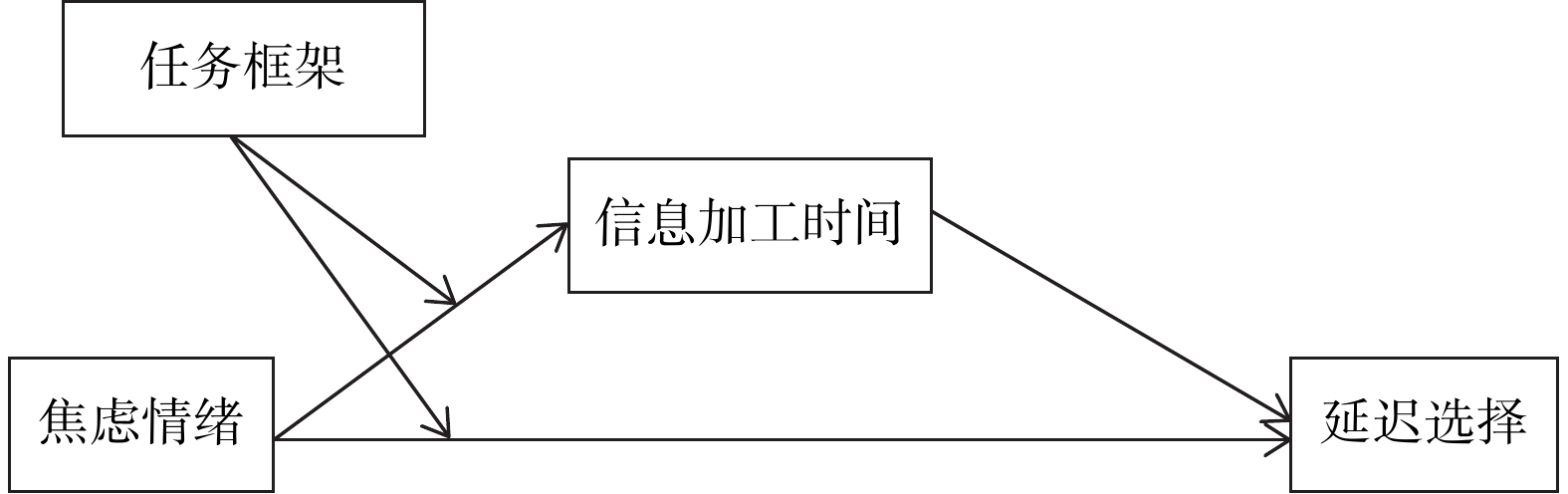
图1 焦虑情绪对延迟选择影响的有调节的中介模型
| 自评情绪 | 焦虑组(n=50) | 非焦虑组(n=49) | t | p | |||
| 诱发前 | 诱发后 | 诱发前 | 诱发后 | ||||
| 特质焦虑 | 45.24±10.12 | 44.96±11.24 | 0.13 | 0.896 | |||
| 紧张感 | 3.66±2.11 | 5.76±2.19 | 3.55±2.00 | 2.63±1.78 | 7.79 | <0.001 | |
| 压力感 | 4.34±2.24 | 5.26±1.98 | 4.47±2.49 | 2.69±1.61 | 7.05 | <0.001 | |
| 平静感 | 6.18±1.97 | 4.54±1.99 | 6.49±2.00 | 7.22±1.39 | −7.79 | <0.001 | |
| 轻松感 | 5.64±1.94 | 4.56±1.92 | 6.00±2.20 | 7.16±1.48 | −7.56 | <0.001 | |
表1 实验1焦虑诱发前后焦虑组和非焦虑组的自评情绪
| 自评情绪 | 焦虑组(n=50) | 非焦虑组(n=49) | t | p | |||
| 诱发前 | 诱发后 | 诱发前 | 诱发后 | ||||
| 特质焦虑 | 45.24±10.12 | 44.96±11.24 | 0.13 | 0.896 | |||
| 紧张感 | 3.66±2.11 | 5.76±2.19 | 3.55±2.00 | 2.63±1.78 | 7.79 | <0.001 | |
| 压力感 | 4.34±2.24 | 5.26±1.98 | 4.47±2.49 | 2.69±1.61 | 7.05 | <0.001 | |
| 平静感 | 6.18±1.97 | 4.54±1.99 | 6.49±2.00 | 7.22±1.39 | −7.79 | <0.001 | |
| 轻松感 | 5.64±1.94 | 4.56±1.92 | 6.00±2.20 | 7.16±1.48 | −7.56 | <0.001 | |

图2 实验流程图
| 自评情绪 | 焦虑组(n=39) | 非焦虑组(n=38) | t | p | |||
| 诱发前 | 诱发后 | 诱发前 | 诱发后 | ||||
| 特质焦虑 | 49.21±4.53 | 47.74±4.55 | 1.42 | 0.160 | |||
| 紧张感 | 2.69±1.91 | 6.15±2.18 | 2.13±1.38 | 1.66±1.26 | 11.11 | <0.001 | |
| 压力感 | 2.90±1.92 | 6.00±2.30 | 2.55±1.84 | 1.97±1.46 | 9.18 | <0.001 | |
| 平静感 | 6.92±2.10 | 3.54±2.27 | 7.05±2.23 | 7.76±1.81 | −9.02 | <0.001 | |
| 轻松感 | 6.67±2.04 | 3.44±2.15 | 6.79±2.37 | 7.39±2.26 | −7.88 | <0.001 | |
表2 实验2焦虑诱发前后焦虑组和非焦虑组的自评情绪
| 自评情绪 | 焦虑组(n=39) | 非焦虑组(n=38) | t | p | |||
| 诱发前 | 诱发后 | 诱发前 | 诱发后 | ||||
| 特质焦虑 | 49.21±4.53 | 47.74±4.55 | 1.42 | 0.160 | |||
| 紧张感 | 2.69±1.91 | 6.15±2.18 | 2.13±1.38 | 1.66±1.26 | 11.11 | <0.001 | |
| 压力感 | 2.90±1.92 | 6.00±2.30 | 2.55±1.84 | 1.97±1.46 | 9.18 | <0.001 | |
| 平静感 | 6.92±2.10 | 3.54±2.27 | 7.05±2.23 | 7.76±1.81 | −9.02 | <0.001 | |
| 轻松感 | 6.67±2.04 | 3.44±2.15 | 6.79±2.37 | 7.39±2.26 | −7.88 | <0.001 | |
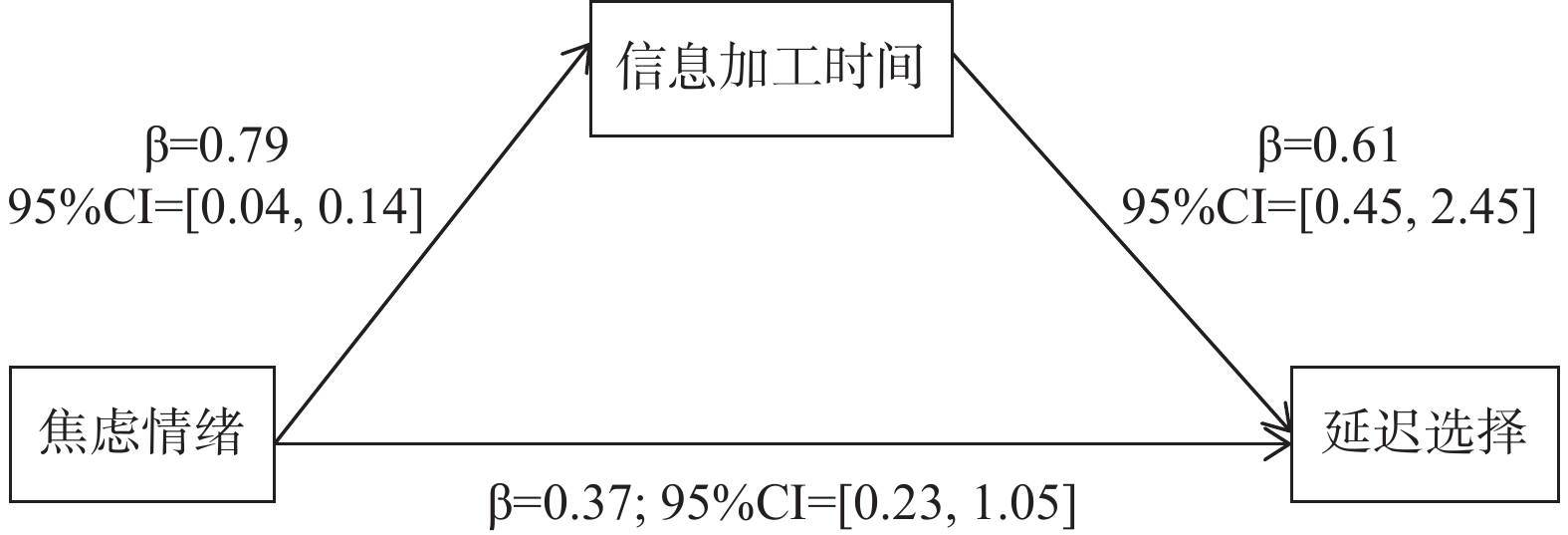
图3 信息加工时间的中介作用
| 自评情绪 | 焦虑组(n=66) | 非焦虑组(n=67) | t | p | |||
| 诱发前 | 诱发后 | 诱发前 | 诱发后 | ||||
| 特质焦虑 | 43.08±11.85 | 41.76±10.19 | 0.69 | 0.494 | |||
| 紧张感 | 2.45±1.66 | 6.17±2.12 | 2.61±1.60 | 1.82±1.25 | 14.38 | <0.001 | |
| 压力感 | 2.67±1.95 | 5.58±2.34 | 2.93±1.97 | 2.07±1.56 | 11.02 | <0.001 | |
| 平静感 | 7.08±2.03 | 3.58±2.18 | 6.91±1.98 | 7.84±1.61 | −12.81 | <0.001 | |
| 轻松感 | 6.91±1.98 | 3.50±2.13 | 6.73±2.14 | 7.70±1.88 | −12.08 | <0.001 | |
表3 实验3焦虑诱发前后焦虑组和非焦虑组的自评情绪
| 自评情绪 | 焦虑组(n=66) | 非焦虑组(n=67) | t | p | |||
| 诱发前 | 诱发后 | 诱发前 | 诱发后 | ||||
| 特质焦虑 | 43.08±11.85 | 41.76±10.19 | 0.69 | 0.494 | |||
| 紧张感 | 2.45±1.66 | 6.17±2.12 | 2.61±1.60 | 1.82±1.25 | 14.38 | <0.001 | |
| 压力感 | 2.67±1.95 | 5.58±2.34 | 2.93±1.97 | 2.07±1.56 | 11.02 | <0.001 | |
| 平静感 | 7.08±2.03 | 3.58±2.18 | 6.91±1.98 | 7.84±1.61 | −12.81 | <0.001 | |
| 轻松感 | 6.91±1.98 | 3.50±2.13 | 6.73±2.14 | 7.70±1.88 | −12.08 | <0.001 | |
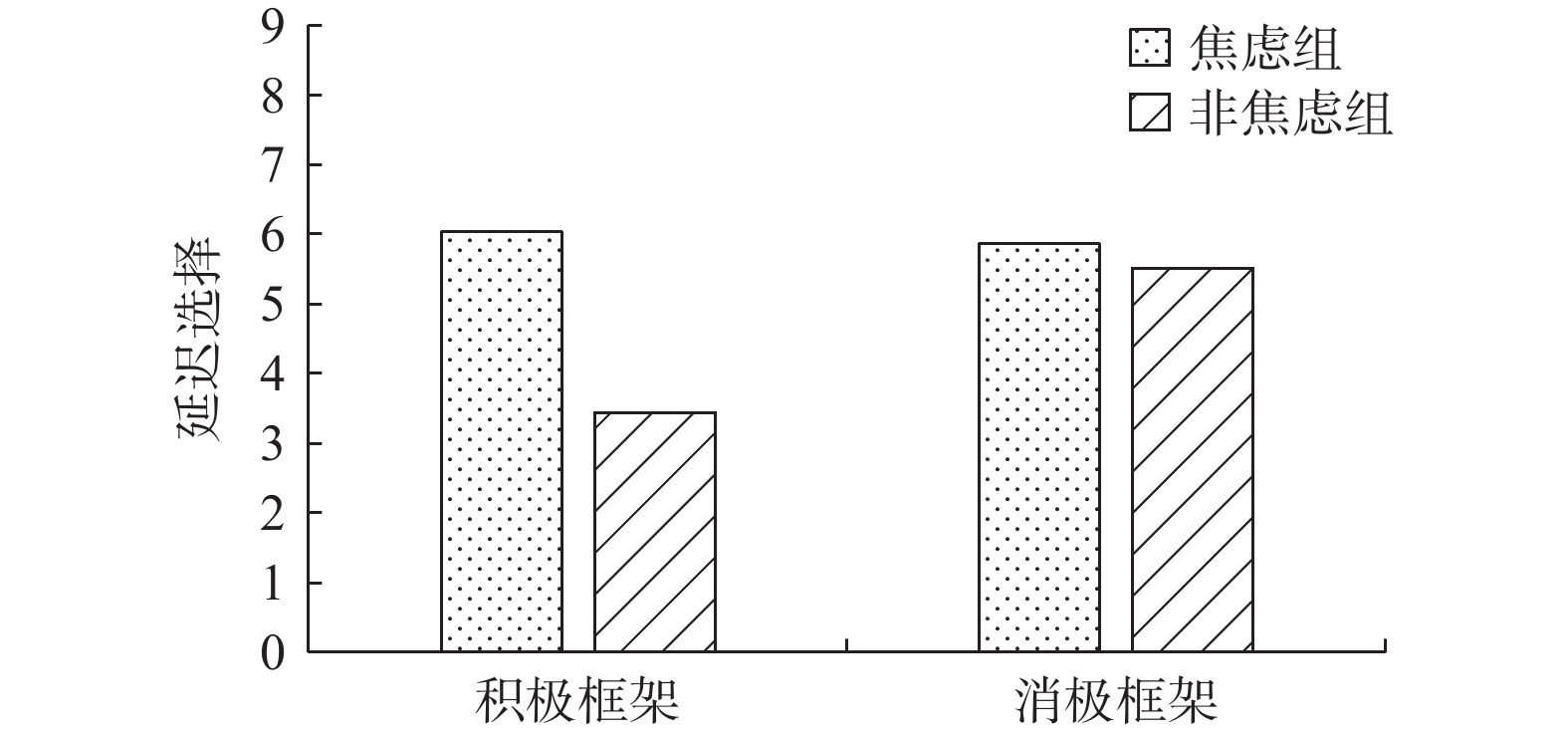
图4 任务框架对焦虑与延迟选择关系的调节作用
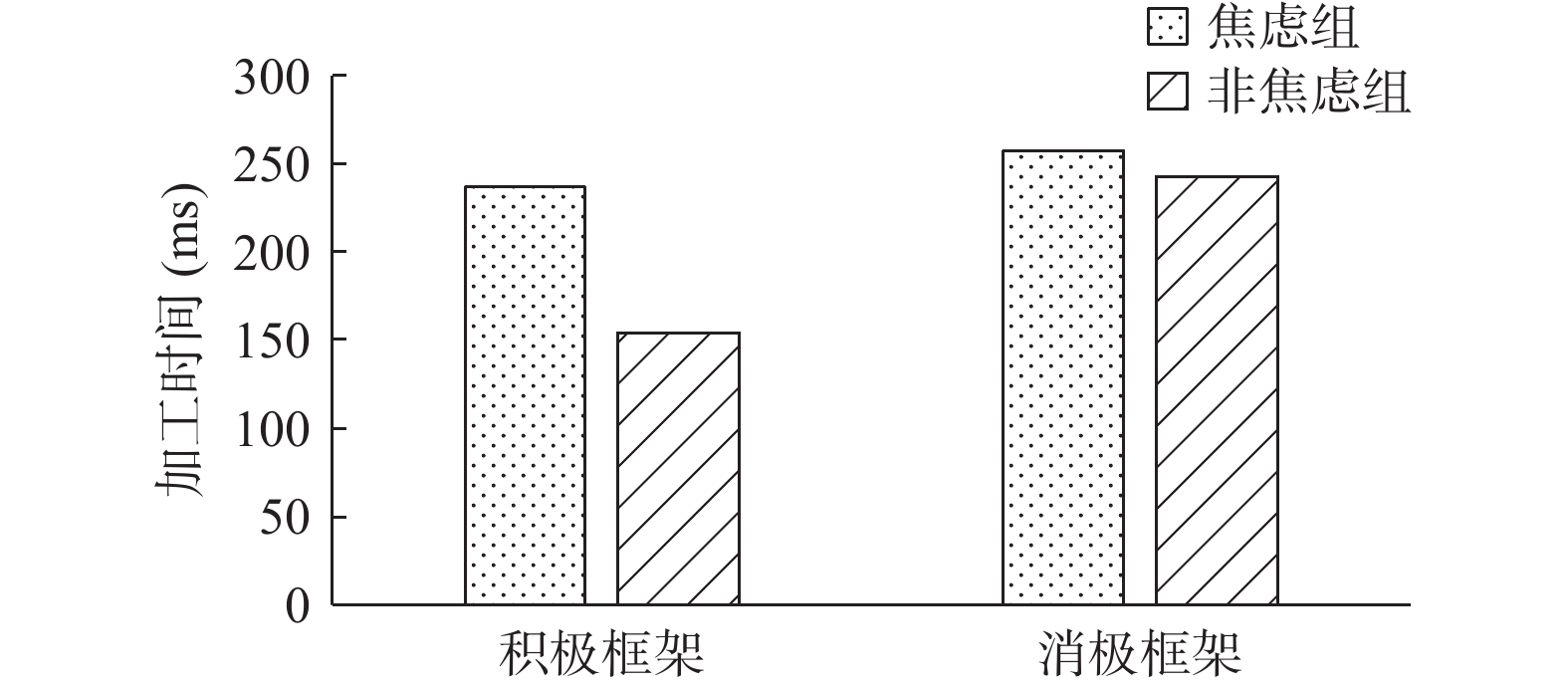
图5 任务框架对焦虑与信息加工时间关系的调节作用
| 任务框架 | 效应值 | Boot标准误 | Boot CI下限 | Boot CI上限 |
| 积极框架 | 0.86 | 0.22 | 0.50 | 1.34 |
| 消极框架 | 0.15 | 0.26 | −0.34 | 0.70 |
| 有调节的中介效应 | −0.71 | 0.30 | −1.32 | −0.16 |
表4 有调节的中介效应分析
| 任务框架 | 效应值 | Boot标准误 | Boot CI下限 | Boot CI上限 |
| 积极框架 | 0.86 | 0.22 | 0.50 | 1.34 |
| 消极框架 | 0.15 | 0.26 | −0.34 | 0.70 |
| 有调节的中介效应 | −0.71 | 0.30 | −1.32 | −0.16 |
|
黄敏学, 王薇. 移动购物更快吗? 决策场景与思维模式的相容性. 心理学报, 2019, 51 (5): 612- 624.
|
|
|
李晓明, 蒋松源. 权力对延迟选择的影响. 心理科学进展, 2019, 27 (3): 447- 452.
|
|
|
李晓明, 谢佳. 偶然情绪对延迟选择的影响机制. 心理学报, 2012, 44 (12): 1641- 1650.
|
|
|
林让, 杨宜苗, 夏春玉. 选择超载: 形成路径及边界条件. 财经问题研究, 2020 (9): 105- 113.
DOI |
|
|
杨骏. 风险偏好、信息完整性对职业决策信息加工的影响. 心理科学, 2013, 36 (6): 1435- 1440.
DOI |
|
|
杨昭宁, 顾子贝, 王杜娟, 谭旭运, 王晓明. 愤怒和悲伤情绪对助人决策的影响: 人际责任归因的作用. 心理学报, 2017, 49 (3): 393- 403.
DOI |
|
|
余雯, 闫巩固, 黄志华. 决策中的过程追踪技术: 介绍与展望. 心理科学进展, 2013, 21 (4): 606- 614.
|
|
|
乐为, 韩笑, 尹洪娟. 属性框架下产品感知质量差异测量: 基于眼动追踪技术. 管理工程学报, 2018, 32 (4): 88- 94.
DOI |
|
|
张艳梅, 杜秀芳, 王修欣. 焦虑、建议者善意程度对个体建议采纳的影响. 心理科学, 2015, 38 (5): 1155- 1161.
DOI |
|
|
张予贺, 金艳, 郑希付, 闫柯, 周晌昀. 状态焦虑对条件恐惧习得和消退的影响. 心理学报, 2014, 46 (3): 396- 404.
DOI |
|
|
Anderson, C. J. The psychology of doing nothing: Forms of decision avoidance result from reason and emotion. Psychological Bulletin, 2003, 129 (1): 139- 167.
DOI |
|
|
Arbona, C., Fan, W. H., Phang, A., Olvera, N., & Dios, M. Intolerance of uncertainty, anxiety, and career indecision: A mediation model. Journal of Career Assessment, 2021, 29 (4): 699- 716.
DOI |
|
|
Bensi, L., & Giusberti, F. Trait anxiety and reasoning under uncertainty. Personality and Individual Differences, 2007, 43 (4): 827- 838.
DOI |
|
|
Bishop, S. J., & Gagne, C. Anxiety, depression, and decision making: A computational perspective. Annual Review of Neuroscience, 2018, 41 (1): 371- 388.
DOI |
|
|
De Vries, M., Holland, R. W., & Witteman, C. L. M. Fitting decisions: Mood and intuitive versus deliberative decision strategies. Cognition and Emotion, 2008, 22 (5): 931- 943.
DOI |
|
|
Diener, E., Larsen, R. J., & Emmons, R. A. Person×Situation interactions: Choice of situations and congruence response models. Journal of Personality and Social Psychology, 1984, 47 (3): 580- 592.
DOI |
|
|
Etkin, J., & Ghosh, A. P. When being in a positive mood increases choice deferral. Journal of Consumer Research, 2018, 45 (1): 208- 225.
DOI |
|
|
Eysenck, M. W., & Calvo, M. G. Anxiety and performance: The processing efficiency theory. Cognition and Emotion, 1992, 6 (6): 409- 434.
DOI |
|
|
Garg, N., Inman, J. J., & Mittal, V. Emotion effects on choice deferral: The moderating role of outcome and process accountability. European Journal of Marketing, 2017, 51 (9–10): 1631- 1649.
|
|
|
Gasper, K. Do you see what I see? Affect and visual information processing. Cognition and Emotion, 2004, 18 (3): 405- 421.
DOI |
|
|
Gino, F., Brooks, A. W., & Schweitzer, M. E. Anxiety, advice, and the ability to discern: Feeling anxious motivates individuals to seek and use advice. Journal of Personality and Social Psychology, 2012, 102 (3): 497- 512.
DOI |
|
|
Goette, L., Bendahan, S., Thoresen, J., Hollis, F., & Sandi, C. Stress pulls us apart: Anxiety leads to differences in competitive confidence under stress. Psychoneuroendocrinology, 2015, 54, 115- 123.
DOI |
|
|
Hadavi, S. & Farhadpoor, M. R. Relationship between information processing styles and information seeking behavior, with information anxiety as a moderator variable. Library and Information Science Research E-Journal, 2021, 31 (2): 119- 129.
DOI |
|
|
Hu, X. Y., Turel, O., Chen, W. T., Shi, J., & He, Q. H. The effect of trait-state anxiety on choice overload: The mediating role of choice difficulty. Decision, 2023, 50 (2): 143- 152.
DOI |
|
|
Krijnen, J. M. T., Zeelenberg, M., & Breugelmans, S. M. Decision importance as a cue for deferral. Judgment and Decision Making, 2015, 10 (5): 407- 415.
DOI |
|
|
Kuo, F. Y., Hsu, C. W., & Day, R. F. An exploratory study of cognitive effort involved in decision under Framing—An application of the eye-tracking technology. Decision Support Systems, 2009, 48 (1): 81- 91.
DOI |
|
|
Kuvaas, B., & Selart, M. Effects of attribute framing on cognitive processing and evaluation. Organizational Behavior and Human Decision Processes, 2004, 95 (2): 198- 207.
DOI |
|
|
Larasati, A., & Yeh, M. Y. Does more attractive choice always decrease choice deferral? The moderating effect of ideal point. International Journal of Hospitality Management, 2016, 54, 43- 51.
DOI |
|
|
Lewicka, M., Czapinski, J., & Peeters, G. Positive-negative asymmetry or ‘When the heart needs a reason’. European Journal of Social Psychology, 1992, 22 (5): 425- 434.
DOI |
|
|
Li, X. M., Ye, Q. L., & Yang, G. Q. The lack of dominance and choice deferral: Choosing to defer to cope with the feeling of being out of control. The Journal of Social Psychology, 2017, 157 (6): 754- 765.
DOI |
|
|
Liu, Y., Polman, E., Liu, Y. F., & Jiao, J. L. Choosing for others and its relation to information search. Organizational Behavior and Human Decision Processes, 2018, 147, 65- 75.
DOI |
|
|
Luce, M. F., Bettman, J. R., & Payne, J. W. (1997). Choice processing in emotionally difficult decisions. Journal of Experimental Psychology: Learning, Memory, and Cognition, 23(2), 384–405.
|
|
|
Mishra, S., & Fiddick, L. Beyond gains and losses: The effect of need on risky choice in framed decisions. Journal of Personality and Social Psychology, 2012, 102 (6): 1136- 1147.
DOI |
|
|
Nagpal, A., Khare, A., Chowdhury, T., Labrecque, L. I., & Pandit, A. The impact of the amount of available information on decision delay: The role of common features. Marketing Letters, 2011, 22 (4): 405- 421.
DOI |
|
|
Nieuwenhuys, A., Pijpers, J. R., Oudejans, R. R. D., & Bakker, F. C. The influence of anxiety on visual attention in climbing. Journal of Sport and Exercise Psychology, 2008, 30 (2): 171- 185.
DOI |
|
|
Park, K., Woo, S., Park, K., Kyea, J., & Yang, E. The mediation effects of career exploration on the relationship between trait anxiety and career indecision. Journal of Career Development, 2017, 44 (5): 440- 452.
DOI |
|
|
Sarason, I. G. Stress, anxiety, and cognitive interference: Reactions to tests. Journal of Personality and Social Psychology, 1984, 46 (4): 929- 938.
DOI |
|
|
Schulte-Mecklenbeck, M., Johnson, J. G., Böckenholt, U., Goldstein, D. G., Russo, J. E., Sullivan, N. J., & Willemsen, M. C. Process-tracing methods in decision making: On growing up in the 70s. Current Directions in Psychological Science, 2017, 26 (5): 442- 450.
DOI |
|
|
Schwarz, N. (2002). Feelings as information: Moods influence judgments and processing strategies. In T. Gilovich, D. Griffin, & D. Kahneman (Eds.), Heuristics and biases: The psychology of intuitive judgment (pp. 534–547). Cambridge, United Kingdom: Cambridge University Press.
|
|
|
Spielberger, C, D. (1983). State-Trait Anxiety Inventory for adults. Menlo Park, CA: MindGarden.
|
|
|
Thomas, M. F., Binder, A., & Matthes, J. The agony of partner choice: The effect of excessive partner availability on fear of being single, self-esteem, and partner choice overload. Computers in Human Behavior, 2022, 126, 106977.
DOI |
|
|
Tobias, M. R., & Ito, T. A. Anxiety increases sensitivity to errors and negative feedback over time. Biological Psychology, 2021, 162, 108092.
DOI |
|
|
Wu, Y., van Dijk, E., & Li, H. Acute stress amplifies experienced and anticipated regret in counterfactual decision-making. Stress, 2021, 24 (4): 359- 369.
DOI |
| [1] | 王娅珂, 张雨轩, 冯琳琳, 卡明芳, 梁菲菲. 小学三到五年级儿童阅读眼动模式的发展及其与阅读理解的关系[J]. 心理与行为研究, 2026, 24(2): 161-169. |
| [2] | 丁晓茜, 刘华语. 社会排斥影响个体社交行为的双路径机制:消极完美主义与注意偏向的作用[J]. 心理与行为研究, 2026, 24(1): 51-59. |
| [3] | 王旭瑛, 邵杨, 阴晓娟, 金晓康, 金花. 恐惧诉求下希望类健康错误信息的更正:来自行为和眼动的证据[J]. 心理与行为研究, 2025, 23(6): 813-821. |
| [4] | 李文静, 孙雯, 朱海迪. 流行背景音乐对休闲阅读的影响:来自眼动的证据[J]. 心理与行为研究, 2025, 23(4): 448-455. |
| [5] | 杜宇菲, 张志超, 张慢慢, 臧传丽. 语义优先于世界知识参与句子理解过程:来自眼动的证据[J]. 心理与行为研究, 2025, 23(2): 153-160. |
| [6] | 王永胜, 韩洋, 李馨, 何立媛. 词间空格在维吾尔族大学生不同文本呈现方向的汉语句子阅读中的促进作用[J]. 心理与行为研究, 2025, 23(1): 41-48. |
| [7] | 陈相文, 王泷歌, 胡惠兰, 张志超, 王梦思, 汪强, 张慢慢. 中文阅读词频效应个体差异的脑结构基础:基于眼动指标的分析[J]. 心理与行为研究, 2024, 22(6): 721-729. |
| [8] | 赵光, 陈佳欢, 李林璇, 张吉超, 吴镕涛. 背景线索效应的动态眼动模式:基于隐马尔可夫模型[J]. 心理与行为研究, 2024, 22(5): 594-601. |
| [9] | 贾宇晴, 高彤琪, 闫国利. 一年级小学生汉语默读和朗读差异的眼动研究[J]. 心理与行为研究, 2024, 22(5): 633-641. |
| [10] | 周广东, 刘爽, 俞美硕. 反应性和主动性攻击儿童情绪面孔的注意差异[J]. 心理与行为研究, 2024, 22(5): 642-649. |
| [11] | 常敏, 张阔, 孙悦, 李莎, 王敬欣. 汉语阅读中的语义相似度效应:语义预测的证据[J]. 心理与行为研究, 2024, 22(4): 442-449. |
| [12] | 王永胜, 张娜, 杜小普, 郭紫璐, 李馨. 语素意识在汉语二语学习者阅读过程中的作用[J]. 心理与行为研究, 2024, 22(4): 450-456. |
| [13] | 严晨毓, 徐琴美, 刘涛, 成梦婷, 马洒, 葛雨箐. 婴儿能否感知音乐情绪?来自预期违背范式的证据[J]. 心理与行为研究, 2024, 22(4): 494-500. |
| [14] | 张锦坤, 赖廷明, 昝晓琪, 李莎, 连坤予, 张俐娟. 多媒体学习中的不流畅效应:线索与流畅性的平衡[J]. 心理与行为研究, 2024, 22(4): 545-552. |
| [15] | 张文, 阚超, 郭丽敏, 刘知和, 刘阳. 排球运动员接扣球知觉预测认知加工特征研究:来自眼动和fNIRS的关联证据[J]. 心理与行为研究, 2024, 22(4): 562-569. |
| 阅读次数 | ||||||
|
全文 |
|
|||||
|
摘要 |
|
|||||
