
心理与行为研究 ›› 2026, Vol. 24 ›› Issue (1): 130-137.DOI: 10.12139/j.1672-0628.2026.01.015
张誉瀚1,2, 丁凤琴*,1( )
)
收稿日期:2024-07-22
出版日期:2026-01-20
发布日期:2026-01-20
通讯作者:
丁凤琴
基金资助:
Yuhan ZHANG1,2, Fengqin DING*,1()
Received:2024-07-22
Online:2026-01-20
Published:2026-01-20
Contact:
Fengqin DING
摘要:
为探讨初中生敬畏与亲社会行为的关系及作用机制,对800余名初中生进行问卷调查、实验操纵及教育干预,结果表明:(1)生命意义在初中生特质敬畏与亲社会行为的关系中起中介作用;(2)生命意义在初中生状态敬畏与亲社会行为的关系中起中介作用;(3)生命意义在初中生敬畏干预与亲社会行为的关系中起中介作用。该结果对于揭示影响初中生的亲社会行为的因素,寻找初中生亲社会行为的提升路径具有重要的参考价值。
张誉瀚, 丁凤琴. 敬畏与初中生亲社会行为的关系:生命意义的中介作用[J]. 心理与行为研究, 2026, 24(1): 130-137.
Yuhan ZHANG, Fengqin DING. Awe and Prosocial Behavior in Junior High School Students: The Mediating Role of Meaning in Life[J]. Studies of Psychology and Behavior, 2026, 24(1): 130-137.
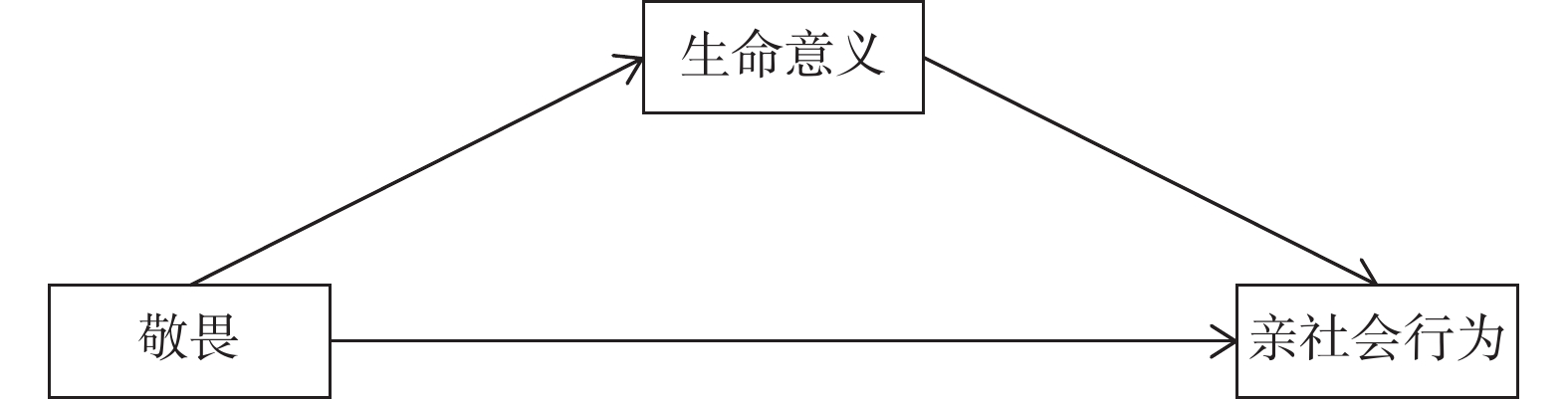
图1 中介模型
| 变量 | M | SD | 1 | 2 | 3 | 4 | 5 |
| 1.性别 | |||||||
| 2.是否独生 | 0.09* | ||||||
| 3.年级 | 0.07 | 0.16** | |||||
| 4.特质敬畏 | 4.15 | 0.46 | −0.02 | −0.11* | −0.11* | ||
| 5.生命意义 | 5.28 | 1.06 | −0.16** | −0.03 | −0.17*** | 0.50*** | |
| 6.亲社会行为 | 3.83 | 0.58 | −0.08 | −0.06 | −0.18*** | 0.49*** | 0.49*** |
表1 描述性统计和相关分析结果表(n=476)
| 变量 | M | SD | 1 | 2 | 3 | 4 | 5 |
| 1.性别 | |||||||
| 2.是否独生 | 0.09* | ||||||
| 3.年级 | 0.07 | 0.16** | |||||
| 4.特质敬畏 | 4.15 | 0.46 | −0.02 | −0.11* | −0.11* | ||
| 5.生命意义 | 5.28 | 1.06 | −0.16** | −0.03 | −0.17*** | 0.50*** | |
| 6.亲社会行为 | 3.83 | 0.58 | −0.08 | −0.06 | −0.18*** | 0.49*** | 0.49*** |
| 结果变量 | 预测变量 | R | R2 | F | 回归系数 | t |
| 生命意义 | 0.54 | 0.29 | 49.34 | |||
| 性别 | −0.17 | −4.26 | ||||
| 是否独生 | 0.06 | 1.58 | ||||
| 年级 | −0.12 | −2.97*** | ||||
| 特质敬畏 | 0.50 | 12.78*** | ||||
| 亲社会行为 | 0.57 | 0.33 | 46.25 | |||
| 性别 | −0.03 | −0.74 | ||||
| 是否独生 | −0.01 | 0.08 | ||||
| 年级 | −0.08 | −2.18* | ||||
| 特质敬畏 | 0.33 | 7.41*** | ||||
| 生命意义 | 0.31 | 6.85*** |
表2 变量间的回归分析
| 结果变量 | 预测变量 | R | R2 | F | 回归系数 | t |
| 生命意义 | 0.54 | 0.29 | 49.34 | |||
| 性别 | −0.17 | −4.26 | ||||
| 是否独生 | 0.06 | 1.58 | ||||
| 年级 | −0.12 | −2.97*** | ||||
| 特质敬畏 | 0.50 | 12.78*** | ||||
| 亲社会行为 | 0.57 | 0.33 | 46.25 | |||
| 性别 | −0.03 | −0.74 | ||||
| 是否独生 | −0.01 | 0.08 | ||||
| 年级 | −0.08 | −2.18* | ||||
| 特质敬畏 | 0.33 | 7.41*** | ||||
| 生命意义 | 0.31 | 6.85*** |
| 效应量名称 | Effect | Boot SE | Boot LLCI | Boot ULCI |
| 总效应量 | 0.67 | 0.06 | 0.56 | 0.77 |
| 直接效应量 | 0.45 | 0.06 | 0.33 | 0.57 |
| 间接效应量 | 0.22 | 0.04 | 0.14 | 0.29 |
表3 中介效应显著性的检验分析
| 效应量名称 | Effect | Boot SE | Boot LLCI | Boot ULCI |
| 总效应量 | 0.67 | 0.06 | 0.56 | 0.77 |
| 直接效应量 | 0.45 | 0.06 | 0.33 | 0.57 |
| 间接效应量 | 0.22 | 0.04 | 0.14 | 0.29 |
| 积极组 (n=76) | 消极组 (n=78) | 控制组 (n=85) | F | η2 | |
| 积极敬畏情绪 | 3.96(0.42)bc | 3.22(0.41)ac | 1.27(0.40)ab | 1176.73*** | 0.91 |
| 消极敬畏情绪 | 3.14(0.48)bc | 3.78(0.38)ac | 1.25(0.16)ab | 1106.11*** | 0.90 |
| 无关情绪 | 1.14(0.19) | 1.13(0.21) | 1.15(0.20) | 0.32 | 0.003 |
表4 敬畏情绪启动有效性检验[M(SD)]
| 积极组 (n=76) | 消极组 (n=78) | 控制组 (n=85) | F | η2 | |
| 积极敬畏情绪 | 3.96(0.42)bc | 3.22(0.41)ac | 1.27(0.40)ab | 1176.73*** | 0.91 |
| 消极敬畏情绪 | 3.14(0.48)bc | 3.78(0.38)ac | 1.25(0.16)ab | 1106.11*** | 0.90 |
| 无关情绪 | 1.14(0.19) | 1.13(0.21) | 1.15(0.20) | 0.32 | 0.003 |
| 积极组(n=76) | 消极组(n=78) | 控制组(n=85) | F | η2 | |
| 捐助时间 | 65.58(22.91)c | 60.05(22.72)c | 50.24(27.93)ab | 7.99*** | 0.06 |
| 捐助金钱 | 84.34(22.05)c | 82.71(23.95)c | 67.25(31.23)ab | 10.60*** | 0.08 |
表5 状态敬畏对亲社会行为的影响[M(SD)]
| 积极组(n=76) | 消极组(n=78) | 控制组(n=85) | F | η2 | |
| 捐助时间 | 65.58(22.91)c | 60.05(22.72)c | 50.24(27.93)ab | 7.99*** | 0.06 |
| 捐助金钱 | 84.34(22.05)c | 82.71(23.95)c | 67.25(31.23)ab | 10.60*** | 0.08 |
| 积极组(n=76) | 消极组(n=78) | 控制组(n=85) | F | η2 | |
| 生命意义 | 5.23(0.90)c | 5.15(0.92)c | 4.72(1.17)ab | 6.08** | 0.03 |
表6 状态敬畏对生命意义的影响[M(SD)]
| 积极组(n=76) | 消极组(n=78) | 控制组(n=85) | F | η2 | |
| 生命意义 | 5.23(0.90)c | 5.15(0.92)c | 4.72(1.17)ab | 6.08** | 0.03 |
| 中介效应路径 | 估计值 | 95%的Bootstrap置信区间 | |
| Boot LLCI | Boot ULCI | ||
| 以控制组为参照: | |||
| 积极敬畏→生命意义→捐助时间 | 4.35 | 1.49 | 7.94 |
| 积极敬畏→捐助时间 | 10.92 | 3.46 | 18.39 |
| 消极敬畏→生命意义→捐助时间 | 4.61 | 1.60 | 8.32 |
| 消极敬畏→捐助时间 | 6.81 | −0.78 | 14.40 |
| 积极敬畏→生命意义→捐助金钱 | 5.20 | 1.95 | 9.08 |
| 积极敬畏→捐助金钱 | 11.91 | 4.09 | 19.73 |
| 消极敬畏→生命意义→捐助金钱 | 5.52 | 2.16 | 9.38 |
| 消极敬畏→捐助金钱 | 10.76 | 2.81 | 18.72 |
表7 不同效价状态敬畏对亲社会行为的中介效应分析
| 中介效应路径 | 估计值 | 95%的Bootstrap置信区间 | |
| Boot LLCI | Boot ULCI | ||
| 以控制组为参照: | |||
| 积极敬畏→生命意义→捐助时间 | 4.35 | 1.49 | 7.94 |
| 积极敬畏→捐助时间 | 10.92 | 3.46 | 18.39 |
| 消极敬畏→生命意义→捐助时间 | 4.61 | 1.60 | 8.32 |
| 消极敬畏→捐助时间 | 6.81 | −0.78 | 14.40 |
| 积极敬畏→生命意义→捐助金钱 | 5.20 | 1.95 | 9.08 |
| 积极敬畏→捐助金钱 | 11.91 | 4.09 | 19.73 |
| 消极敬畏→生命意义→捐助金钱 | 5.52 | 2.16 | 9.38 |
| 消极敬畏→捐助金钱 | 10.76 | 2.81 | 18.72 |
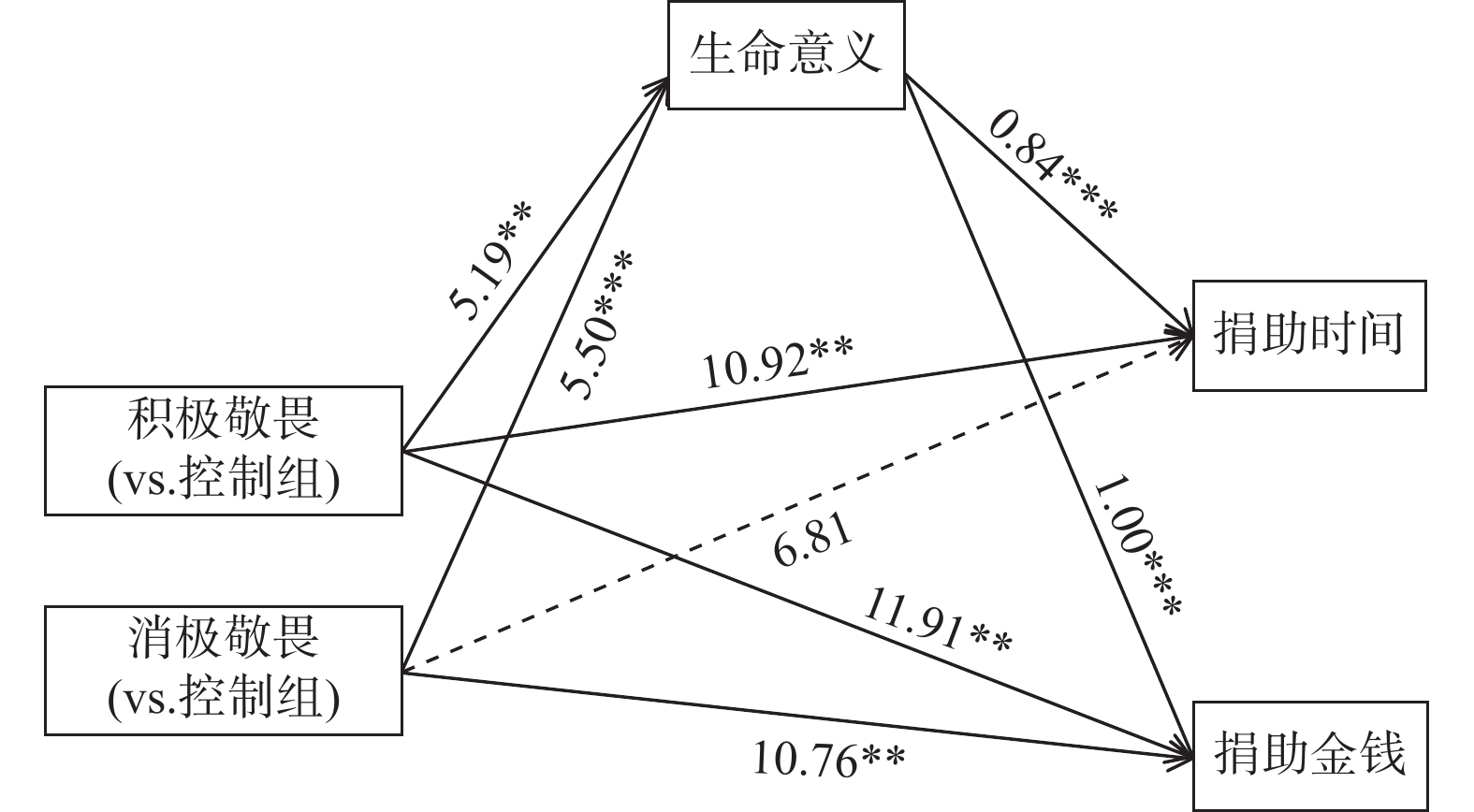
图2 不同效价敬畏对亲社会行为的影响及生命意义的中介作用 注:图中系数为非标准化系数,以下同。
| 干预组(n=43) | 对照组(n=46) | ||||
| 前测 | 后测 | 前测 | 后测 | ||
| 生命意义 | 4.43±0.71 | 5.34±0.50 | 4.32±0.73 | 4.40±0.72 | |
| 亲社会行为 | 3.86±0.77 | 5.07±0.70 | 3.80±1.04 | 3.74±0.97 | |
表8 不同处理条件对生命意义与亲社会行为影响[M(SD)]
| 干预组(n=43) | 对照组(n=46) | ||||
| 前测 | 后测 | 前测 | 后测 | ||
| 生命意义 | 4.43±0.71 | 5.34±0.50 | 4.32±0.73 | 4.40±0.72 | |
| 亲社会行为 | 3.86±0.77 | 5.07±0.70 | 3.80±1.04 | 3.74±0.97 | |
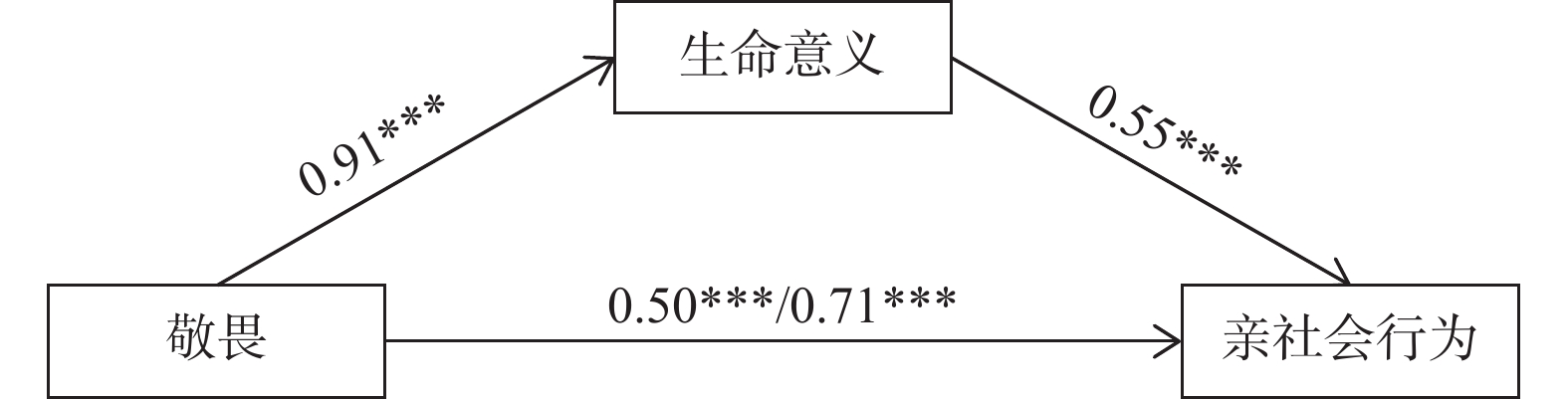
图3 敬畏干预对亲社会行为的影响及生命意义的中介作用
|
常保瑞, 黄江喜, 林培钿, 方建东. 关爱自己, 更关爱他人: 自我同情的“利他”机制. 心理发展与教育, 2024, 40 (3): 324- 334.
DOI |
|
|
党晶, 刘济良. 教育场域中青少年敬畏生命的缺失及重塑. 中国教育学刊, 2019 (6): 94- 100.
|
|
|
董蕊, 彭凯平, 喻丰. 积极情绪之敬畏. 心理科学进展, 2013, 21 (11): 1996- 2005.
|
|
|
李晓明, 孟员, 阳芷晴, 刘小丹. 敬畏对青少年攻击行为的影响: 同伴关系的调节作用. 心理发展与教育, 2025, 41 (1): 117- 125.
|
|
|
林荣茂, 陈艳萍, 肖惠文, 沈逸琳, 何晓雁. 青少年价值观与敬畏感的关系. 宁波大学学报(教育科学版), 2021, 43 (3): 125- 132.
DOI |
|
|
林荣茂, 余巧华, 胡添祥, 张九妹, 叶玉珊, 连榕. 敬畏感与亲社会行为关系的三水平和结构方程模型元分析. 心理学报, 2025, 57 (4): 631- 651.
DOI |
|
|
刘群, 赵峰, 张姝玥. 相生相成: 拥有生命意义与亲社会行为相互关系的纵向研究. 心理科学, 2020, 43 (6): 1438- 1445.
DOI |
|
|
罗利, 杨东, 陈圣栋, 高伟, 陈永强, 袁加锦. 特质敬畏对亲社会倾向的正向预测: 自我超越和共情的多重中介作用. 心理与行为研究, 2022, 20 (3): 390- 396.
DOI |
|
|
寇彧, 洪慧芳, 谭晨, 李磊. 青少年亲社会倾向量表的修订. 心理发展与教育, 2007, 23 (1): 112- 117.
DOI |
|
|
王国芳, 田淑萍, 胥子健, 陈嘉晔, 杨敏齐. 敬畏与助人的关系: 自我-他人重叠的中介作用. 心理发展与教育, 2024, 40 (4): 499- 509.
DOI |
|
|
王文超, 伍新春, 田雨馨, 周宵. 青少年创伤后应激障碍和创伤后成长对亲社会行为的影响: 生命意义的中介作用. 心理发展与教育, 2018, 34 (1): 112- 119.
DOI |
|
|
王鑫强. 生命意义感量表中文修订版在中学生群体中的信效度. 中国临床心理学杂志, 2013, 21 (5): 764- 767, 763.
DOI |
|
|
王阳, 温忠麟. 基于两水平被试内设计的中介效应分析方法. 心理科学, 2018, 41 (5): 1233- 1239.
DOI |
|
|
王中杰, 刘华山. 校园欺负中的欺负/受欺负者和旁观者群体研究综述. 心理发展与教育, 2004, 20 (1): 92- 96.
DOI |
|
|
于俊如. 敬畏感: 一个关于道德教育价值的话题. 中国青年研究, 2005 (8): 78- 80.
DOI |
|
|
赵欢欢, 许燕, 张和云. 中国人敬畏特质的心理结构研究. 心理学探新, 2019, 39 (4): 345- 351.
|
|
|
赵娜, 马敏, 辛自强. 生命意义感获取的心理机制及其影响因素. 心理科学进展, 2017, 25 (6): 1003- 1011.
DOI |
|
|
赵小红, 童薇, 陈桃林, 吴冬梅, 张蕾, 陈正举, 唐小蓉. 敬畏的心理模型及其认知神经机制. 心理科学进展, 2021, 29 (3): 520- 530.
|
|
|
周凌霄, 李姗殷, 彭凯平, 王阳, 管芳. 敬畏体验量表的中文版修订. 中国临床心理学杂志, 2022, 30 (5): 1138- 1142, 1148.
DOI |
|
|
Allen, B. P., & Potkay, C. R. On the arbitrary distinction between states and traits. Journal of Personality and Social Psychology, 1981, 41 (5): 916- 928.
|
|
|
Bai, Y., Maruskin, L. A., Chen, S., Gordon, A. M., Stellar, J. E., McNeil, G. D., ... Keltner, D. Awe, the diminished self, and collective engagement: Universals and cultural variations in the small self. Journal of Personality and Social Psychology, 2017, 113 (2): 185- 209.
DOI |
|
|
Bailey, E., & Wojdynski, B. W. Effects of “meaningful” entertainment on altruistic behavior: Investigating potential mediators. Journal of Broadcasting & Electronic Media, 2015, 59 (4): 603- 619.
DOI |
|
|
Baumeister, R. F., Vohs, K. D., Aaker, J. L., & Garbinsky, E. N. Some key differences between a happy life and a meaningful life. The Journal of Positive Psychology, 2013, 8 (6): 505- 516.
DOI |
|
|
Eisenberg, N., & Miller, P. A. The relation of empathy to prosocial and related behaviors. Psychological Bulletin, 1987, 101 (1): 91- 119.
DOI |
|
|
Fredrickson, B. L., & Joiner, T. Positive emotions trigger upward spirals toward emotional well-being. Psychological Science, 2002, 13 (2): 172- 175.
DOI |
|
|
Gordon, A. M., Stellar, J. E., Anderson, C. L., McNeil, G. D., Loew, D., & Keltner, D. The dark side of the sublime: Distinguishing a threat-based variant of awe. Journal of Personality and Social Psychology, 2017, 113 (2): 310- 328.
DOI |
|
|
Guan, F., Chen, J., Chen, O. T., Liu, L. H., & Zha, Y. Z. Awe and prosocial tendency. Current Psychology, 2019, 38 (4): 1033- 1041.
DOI |
|
|
Halstead, J. M., & Halstead, A. O. Awe, tragedy and the human condition. International Journal of Children’s Spirituality, 2004, 9 (2): 163- 175.
DOI |
|
|
Hayes, A. F., & Preacher, K. J. Statistical mediation analysis with a multicategorical independent variable. British Journal of Mathematical and Statistical Psychology, 2014, 67 (3): 451- 470.
DOI |
|
|
Jiang, L. B., Yin, J., Mei, D. M., Zhu, H., & Zhou, X. Y. Awe weakens the desire for money. Journal of Pacific Rim Psychology, 2018, 12, e4.
DOI |
|
|
Joye, Y., & Bolderdijk, J. W. An exploratory study into the effects of extraordinary nature on emotions, mood, and prosociality. Frontiers in Psychology, 2015, 5, 1577.
DOI |
|
|
Keltner, D., & Haidt, J. Approaching awe, a moral, spiritual, and aesthetic emotion. Cognition and Emotion, 2003, 17 (2): 297- 314.
DOI |
|
|
Keltner, D., Sauter, D., Tracy, J. L., Wetchler, E., & Cowen, A. S. How emotions, relationships, and culture constitute each other: Advances in social functionalist theory. Cognition and Emotion, 2022, 36 (3): 388- 401.
DOI |
|
|
King, L. A., & Hicks, J. A. The science of meaning in life. Annual Review of Psychology, 2021, 72, 561- 584.
DOI |
|
|
Luo, L., Zou, R., Yang, D., & Yuan, J. J. Awe experience triggered by fighting against COVID-19 promotes prosociality through increased feeling of connectedness and empathy. The Journal of Positive Psychology, 2023, 18 (6): 866- 882.
DOI |
|
|
Mischel, W., & Shoda, Y. A cognitive-affective system theory of personality: Reconceptualizing situations, dispositions, dynamics, and invariance in personality structure. Psychological Review, 1995, 102 (2): 246- 268.
DOI |
|
|
Montoya, A. K., & Hayes, A. F. Two-condition within-participant statistical mediation analysis: A path-analytic framework. Psychological Methods, 2017, 22 (1): 6- 27.
DOI |
|
|
Nelson, L. D., & Norton, M. I. From student to superhero: Situational primes shape future helping. Journal of Experimental Social Psychology, 2005, 41 (4): 423- 430.
DOI |
|
|
Park, C. L. Making sense of the meaning literature: An integrative review of meaning making and its effects on adjustment to stressful life events. Psychological Bulletin, 2010, 136 (2): 257- 301.
DOI |
|
|
Park, C. L., & Folkman, S. Meaning in the context of stress and coping. Review of General Psychology, 1997, 1 (2): 115- 144.
DOI |
|
|
Piff, P. K., Dietze, P., Feinberg, M., Stancato, D. M., & Keltner, D. Awe, the small self, and prosocial behavior. Journal of Personality and Social Psychology, 2015, 108 (6): 883- 899.
|
|
|
Rauthmann, J. F. (2021). Capturing interactions, correlations, fits, and transactions: A person-environment relations model. In J. F. Rauthmann (Ed.), The handbook of personality dynamics and processes (pp. 427–522). Amsterdam: Elsevier.
|
|
|
Rudd, M., Vohs, K. D., & Aaker, J. Awe expands people’s perception of time, alters decision making, and enhances well-being. Psychological Science, 2012, 23 (10): 1130- 1136.
DOI |
|
|
Ryan, R. M., & Deci, E. L. (2017). Self-determination theory: Basic psychological needs in motivation, development, and wellness. New York: The Guilford Press.
|
|
|
Shiota, M. N., Keltner, D., & John, O. P. Positive emotion dispositions differentially associated with Big Five personality and attachment style. The Journal of Positive Psychology, 2006, 1 (2): 61- 71.
DOI |
|
|
Shiota, M. N., Keltner, D., & Mossman, A. The nature of awe: Elicitors, appraisals, and effects on self-concept. Cognition and Emotion, 2007, 21 (5): 944- 963.
DOI |
|
|
Yang, Y., Yang, Z. Y., Bao, T. X., Liu, Y. Z., & Passmore, H. A. Elicited awe decreases aggression. Journal of Pacific Rim Psychology, 2016, 10, e11.
DOI |
| [1] | 卢林鑫, 刘在花, 刘红萍, 蔺秀云, 周瀚翔, 班永飞, 孙霁, 李小青, 张依晴, 黄海珍. 特校跨文化敏感性氛围与视障学生亲社会行为:双文化认同整合的多层贝叶斯中介模型[J]. 心理与行为研究, 2026, 24(2): 170-177. |
| [2] | 金慧, 张雪, 王跃鹏, 孟维杰. 学校道德氛围对初中生作弊行为意向的影响:道德推脱的中介作用[J]. 心理与行为研究, 2026, 24(1): 138-144. |
| [3] | 王海擎. 社区矫正对象歧视知觉与社会退缩的关系:一个链式中介模型[J]. 心理与行为研究, 2025, 23(5): 706-713. |
| [4] | 张璐, 乌云特娜. 社会临场感对大学生网络亲社会行为的影响:基于I3模型的视角[J]. 心理与行为研究, 2025, 23(4): 528-535. |
| [5] | 庞溢序, 彭梓轩, 李佳, 宋怡萱, 余萌. 利他的魔力:高社交焦虑大学生利己/利他行为对风险决策的影响[J]. 心理与行为研究, 2025, 23(4): 560-568. |
| [6] | 于永菊, 何敏. 高校大学生生命意义感的演变模式及其与抑郁症状的关联[J]. 心理与行为研究, 2025, 23(3): 354-360. |
| [7] | 曾欣悦, 刘衍玲, 王旭. 人际关系对初中生心理素质的影响:自尊的纵向中介作用[J]. 心理与行为研究, 2025, 23(2): 273-279. |
| [8] | 王笑笑, 王伊萌, 汪凤炎. 敬畏与智慧推理:正负效价的分离机制[J]. 心理与行为研究, 2025, 23(1): 17-24. |
| [9] | 胡义秋, 何震, 曾子豪, 赵纤, 常梦梦. 初中生身体监控与抑郁症状的纵向关系研究:主观幸福感的中介作用[J]. 心理与行为研究, 2025, 23(1): 58-65. |
| [10] | 罗鹤旋, 朱海东, 邱鑫. 家庭社会经济地位与青少年亲社会行为的关系:链式中介效应及独生状况差异[J]. 心理与行为研究, 2025, 23(1): 130-137. |
| [11] | 孙姗, 陈翩, 杨阳, 黄奥迪, 王美萍. 父母冲突与青少年早期攻击行为:情绪不安全感和自我控制的链式中介作用[J]. 心理与行为研究, 2024, 22(6): 784-790. |
| [12] | 张丽晴, 裘璐, 王年馨, 刘方, 袁博, 刘文. 童年社会经济地位与初中生亲社会行为:亲子依恋回避与情绪调节策略的中介作用[J]. 心理与行为研究, 2024, 22(4): 516-522. |
| [13] | 林丹华, 曹娟, 申子姣, 张月. 初中生受侵害与攻击类型的转变模式:近墨者黑?[J]. 心理与行为研究, 2024, 22(3): 320-328. |
| [14] | 胡永时, 赵怡霖, 张镇. 老年人独处能力与生命意义感:基本心理需求的中介和家庭亲密度的调节作用[J]. 心理与行为研究, 2024, 22(3): 425-432. |
| [15] | 吴旻, 谢燕, 李妍. 母亲温暖和父亲温暖教养的一致性与农村儿童亲社会行为:心理资本的中介作用[J]. 心理与行为研究, 2024, 22(2): 251-257, 273. |
| 阅读次数 | ||||||
|
全文 |
|
|||||
|
摘要 |
|
|||||
