
心理与行为研究 ›› 2026, Vol. 24 ›› Issue (2): 273-280.DOI: 10.12139/j.1672-0628.2026.02.017
范维情1,2, 贡喆*,1,2( )
)
收稿日期:2024-12-11
出版日期:2026-03-20
发布日期:2026-03-20
通讯作者:
贡喆
基金资助:
Weiqing FAN1,2, Zhe GONG*,1,2()
Received:2024-12-11
Online:2026-03-20
Published:2026-03-20
Contact:
Zhe GONG
摘要:
编制公费师范生身份认同量表并检验其信效度。通过访谈并结合国内外相关测量工具编制初始量表,对在校公费师范生进行施测。基于项目分析、探索性因素分析、验证性因素分析修订初始量表,最终正式量表包含学生、教师和履约者3个维度。对正式量表进行信度检验,结果发现量表具有较高的内部一致性信度、分半信度和重测信度。基于多组验证性因素分析检验测量不变性,结果发现量表的性别不变性在形态等值、单位等值、尺度等值以及误差方差等值上均得到支持。该量表达到心理测量学要求,可以作为评估公费师范生身份认同的有效工具。
范维情, 贡喆. 公费师范生身份认同量表的编制及信效度检验[J]. 心理与行为研究, 2026, 24(2): 273-280.
Weiqing FAN, Zhe GONG. Development and Psychometric Evaluation of the Government-Funded Normal University Students’ Identity Scale[J]. Studies of Psychology and Behavior, 2026, 24(2): 273-280.
| 条目 | 学生 | 教师 | 履约者 |
| S5当听到别人叫我大学生时,我会很开心 | 0.80 | ||
| S1我倾向于用大学生这个身份进行自我介绍 | 0.62 | ||
| S4我对自己的大学生身份很满意 | 0.76 | ||
| S8我总想着做些什么以符合大学生这个身份 | 0.45 | ||
| S2作为大学生,我知道应该如何学习和生活 | 0.41 | ||
| T6我一直梦想着成为一名教师 | 0.77 | ||
| T4如果今后能成为一名教师,我会很开心 | 0.76 | ||
| T5如果能被别人称呼为教师,我会觉得很自豪 | 0.72 | ||
| T7我经常主动参加与教师技能训练相关的活动 | 0.50 | ||
| T1教师是一个很受人尊重的职业 | 0.48 | ||
| P1签订公费师范生协议意味着我需要履行相应的合约义务 | 0.76 | ||
| P8我会按照签订的公费师范生协议履行相应的义务 | 0.73 | ||
| P2我知道公费师范生协议中包含哪些需要履行的合约义务 | 0.76 | ||
| P9我会主动寻找信息资源来确保我能够有效地履行公费师范生协议 | 0.68 | ||
| P4我很乐意履行公费师范生协议中所要求的合约义务 | 0.72 | ||
| 因子特征值 | 2.41 | 2.65 | 3.11 |
| 解释变异量(%) | 5.48 | 10.79 | 38.16 |
表1 探索性因素分析各条目因子载荷
| 条目 | 学生 | 教师 | 履约者 |
| S5当听到别人叫我大学生时,我会很开心 | 0.80 | ||
| S1我倾向于用大学生这个身份进行自我介绍 | 0.62 | ||
| S4我对自己的大学生身份很满意 | 0.76 | ||
| S8我总想着做些什么以符合大学生这个身份 | 0.45 | ||
| S2作为大学生,我知道应该如何学习和生活 | 0.41 | ||
| T6我一直梦想着成为一名教师 | 0.77 | ||
| T4如果今后能成为一名教师,我会很开心 | 0.76 | ||
| T5如果能被别人称呼为教师,我会觉得很自豪 | 0.72 | ||
| T7我经常主动参加与教师技能训练相关的活动 | 0.50 | ||
| T1教师是一个很受人尊重的职业 | 0.48 | ||
| P1签订公费师范生协议意味着我需要履行相应的合约义务 | 0.76 | ||
| P8我会按照签订的公费师范生协议履行相应的义务 | 0.73 | ||
| P2我知道公费师范生协议中包含哪些需要履行的合约义务 | 0.76 | ||
| P9我会主动寻找信息资源来确保我能够有效地履行公费师范生协议 | 0.68 | ||
| P4我很乐意履行公费师范生协议中所要求的合约义务 | 0.72 | ||
| 因子特征值 | 2.41 | 2.65 | 3.11 |
| 解释变异量(%) | 5.48 | 10.79 | 38.16 |
| 模型 | χ2 | df | χ2/df | CFI | TLI | RMSEA | SRMR |
| 单因子模型 | 1010.15 | 90 | 11.22 | 0.66 | 0.60 | 0.15 | 0.10 |
| 两因子模型一 | 703.30 | 89 | 7.90 | 0.77 | 0.73 | 0.12 | 0.08 |
| 两因子模型二 | 600.36 | 89 | 6.75 | 0.81 | 0.78 | 0.11 | 0.08 |
| 两因子模型三 | 728.61 | 89 | 8.19 | 0.76 | 0.72 | 0.12 | 0.10 |
| 三因子模型 | 253.06 | 87 | 2.91 | 0.94 | 0.93 | 0.06 | 0.05 |
表2 验证性因素分析模型拟合指数(n=518)
| 模型 | χ2 | df | χ2/df | CFI | TLI | RMSEA | SRMR |
| 单因子模型 | 1010.15 | 90 | 11.22 | 0.66 | 0.60 | 0.15 | 0.10 |
| 两因子模型一 | 703.30 | 89 | 7.90 | 0.77 | 0.73 | 0.12 | 0.08 |
| 两因子模型二 | 600.36 | 89 | 6.75 | 0.81 | 0.78 | 0.11 | 0.08 |
| 两因子模型三 | 728.61 | 89 | 8.19 | 0.76 | 0.72 | 0.12 | 0.10 |
| 三因子模型 | 253.06 | 87 | 2.91 | 0.94 | 0.93 | 0.06 | 0.05 |
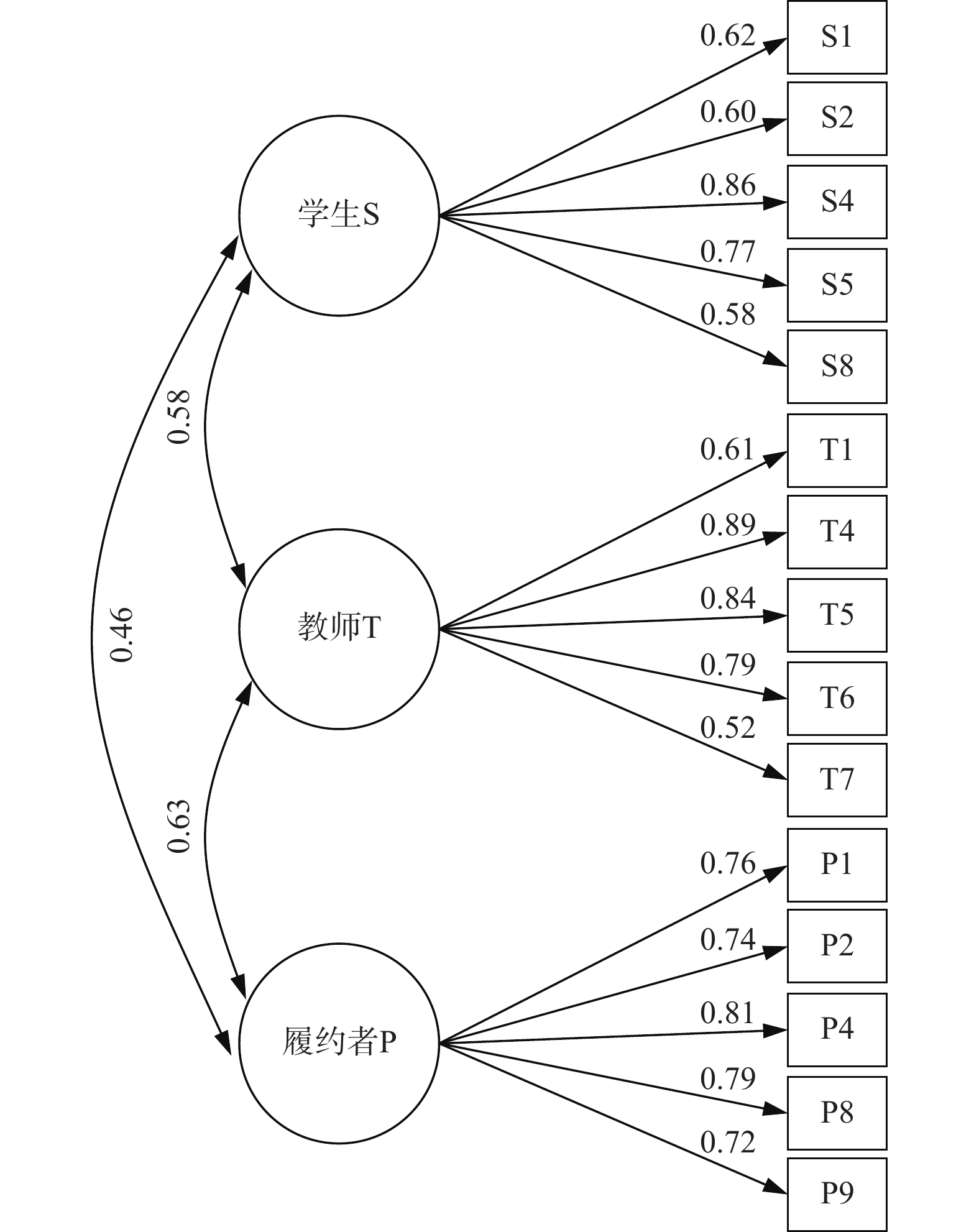
图1 三因子结构模型图
| M | SD | 1 | 2 | 3 | 4 | 5 | |
| 1.总量表 | 3.88 | 0.55 | |||||
| 2.学生 | 3.61 | 0.68 | 0.80*** | ||||
| 3.教师 | 3.75 | 0.74 | 0.87*** | 0.55*** | |||
| 4.履约者 | 4.26 | 0.61 | 0.77*** | 0.40*** | 0.53*** | ||
| 5.集体身份 | 3.92 | 0.73 | 0.58*** | 0.47*** | 0.48*** | 0.48*** | |
| 6.自尊 | 2.96 | 0.48 | 0.39*** | 0.29*** | 0.36*** | 0.31*** | 0.31*** |
表3 公费师范生身份认同量表与效标量表的相关系数(n=518)
| M | SD | 1 | 2 | 3 | 4 | 5 | |
| 1.总量表 | 3.88 | 0.55 | |||||
| 2.学生 | 3.61 | 0.68 | 0.80*** | ||||
| 3.教师 | 3.75 | 0.74 | 0.87*** | 0.55*** | |||
| 4.履约者 | 4.26 | 0.61 | 0.77*** | 0.40*** | 0.53*** | ||
| 5.集体身份 | 3.92 | 0.73 | 0.58*** | 0.47*** | 0.48*** | 0.48*** | |
| 6.自尊 | 2.96 | 0.48 | 0.39*** | 0.29*** | 0.36*** | 0.31*** | 0.31*** |
| 总量表 | 学生 | 教师 | 履约者 | |
| 内部一致性信度 | 0.89 | 0.81 | 0.84 | 0.88 |
| 分半信度 | 0.70 | 0.78 | 0.78 | 0.81 |
| 重测信度 | 0.67 | 0.63 | 0.71 | 0.50 |
表4 公费师范生身份认同量表的信度分析
| 总量表 | 学生 | 教师 | 履约者 | |
| 内部一致性信度 | 0.89 | 0.81 | 0.84 | 0.88 |
| 分半信度 | 0.70 | 0.78 | 0.78 | 0.81 |
| 重测信度 | 0.67 | 0.63 | 0.71 | 0.50 |
| 模型 | χ2 | df | CFI | RMSEA | ΔCFI | ΔRMSEA |
| 形态等值 | 395.46 | 174 | 0.92 | 0.07 | ||
| 弱(单位)等值 | 411.67 | 186 | 0.92 | 0.07 | <0.01 | <0.015 |
| 强(尺度)等值 | 438.30 | 198 | 0.92 | 0.07 | <0.01 | <0.015 |
| 误差方差等值 | 416.80 | 213 | 0.91 | 0.07 | <0.01 | <0.015 |
表5 公费师范生身份认同量表的跨性别等值性检验(n=518)
| 模型 | χ2 | df | CFI | RMSEA | ΔCFI | ΔRMSEA |
| 形态等值 | 395.46 | 174 | 0.92 | 0.07 | ||
| 弱(单位)等值 | 411.67 | 186 | 0.92 | 0.07 | <0.01 | <0.015 |
| 强(尺度)等值 | 438.30 | 198 | 0.92 | 0.07 | <0.01 | <0.015 |
| 误差方差等值 | 416.80 | 213 | 0.91 | 0.07 | <0.01 | <0.015 |
|
蔡贞, 汪玉兰, 毕重增. 农民工农民身份认同的结构与测量. 西南农业大学学报(社会科学版), 2012, 10 (4): 78- 81.
|
|
|
陈菁, 马勇军, 初环海, 李荣. 省属公费师范生违约行为研究——基于对山东省高校公费师范生的扎根理论分析. 山东高等教育, 2023, 11 (1): 64- 70.
|
|
|
胡月琴, 甘怡群. 青少年心理韧性量表的编制和效度验证. 心理学报, 2008, 40 (8): 902- 912.
|
|
|
黄俊官. 地方公费师范生身份认同的危机及对策. 郑州师范教育, 2022, 11 (6): 5- 8.
|
|
|
季益富, 于欣. 自尊量表. 中国心理卫生杂志, 1999 (增刊): 318- 320.
DOI |
|
|
李芳霞. 新建本科院校免费师范生学习动机研究——以宁夏师范学院为例. 佳木斯职业学院学报, 2016 (10): 208- 209, 390.
|
|
|
李广, 秦一铭, 柳欣源. 我国师范生公费教育: 成就、挑战与愿景. 教育研究, 2024, 45 (8): 34- 45.
|
|
|
林一钢, 冯虹. 师范生教师身份认同的实证研究. 教育发展研究, 2013, 33 (10): 78- 82.
|
|
|
吕催芳, 周永红, 王亚丽. 残障人获得感量表的编制及信效度检验. 中国临床心理学杂志, 2024, 32 (1): 117- 121.
|
|
|
吕乐. 六年制公费师范生新生心理健康水平分析. 湖南第一师范学院学报, 2018, 18 (2): 38- 40.
|
|
|
覃小琼, 孙蕾, 吴琼. 免费师范生学习动机特点的访谈研究. 心理研究, 2010, 3 (2): 93- 96.
|
|
|
曲正伟. 教师的“身份”与“身份认同”. 教育发展研究, 2007 (7): 34- 38.
|
|
|
王清涛. 公费师范生违约风险及其治理——基于不完全契约理论的分析. 教育发展研究, 2019, 39 (15): 119- 124.
|
|
|
吴丹. (2024-06-16). 加强研究生层次中小学教师培养. 人民日报, p4.
|
|
|
吴明隆. (2010). 问卷统计分析实务———SPSS 操作与应用. 重庆: 重庆大学出版社.
|
|
|
薛佳. 伦理、契约与身份: 西方责任政治分析的三重视角. 云南社会科学, 2021 (3): 18- 25.
|
|
|
袁璐, 黄任之, 杨天霞, 周红宇. 免费师范生自伤行为与焦虑抑郁情绪的相关分析. 四川精神卫生, 2014, 27 (1): 25- 27.
|
|
|
张淑华, 李海莹, 刘芳. 身份认同研究综述. 心理研究, 2012, 5 (1): 21- 27.
|
|
|
张莹瑞, 佐斌. 社会认同理论及其发展. 心理科学进展, 2006, 14 (3): 475- 480.
|
|
|
张源源, 薛芳芳. “前补偿”抑或“后激励”?——乡村振兴背景下定向师范生违约问题研究. 华东师范大学学报(教育科学版), 2022, 40 (6): 44- 56.
|
|
|
Abrams. D., & Hogg, M. A. (1988). Social identifications: A social psychology of intergroup relations and group processes. London: Routledge.
|
|
|
Bazargan-Forward, S. The identity-enactment account of associative duties. Philosophical Studies, 2019, 176 (9): 2351- 2370.
DOI |
|
|
Brewer, M. B., & Gardner, W. Who is this “We”? Levels of collective identity and self representations. Journal of Personality and Social Psychology, 1996, 71 (1): 83- 93.
DOI |
|
|
Burke, P. J., & Tully, J. C. The measurement of role identity. Social Forces, 1977, 55 (4): 881- 897.
DOI |
|
|
Carpenter, S., & Karakitapoglu-Aygün, Z. Importance and descriptiveness of self-aspects: A cross-cultural comparison. Cross-Cultural Research, 2005, 39 (3): 293- 321.
DOI |
|
|
Charng, H. W., Piliavin, J. A., & Callero, P. L. Role identity and reasoned action in the prediction of repeated behavior. Social Psychology Quarterly, 1988, 51 (4): 303- 317.
DOI |
|
|
Cheek, N. N., & Cheek, J. M. Aspects of identity: From the inner-outer metaphor to a tetrapartite model of the self. Self and Identity, 2018, 17 (4): 467- 482.
DOI |
|
|
Cramer, P. Development of identity: Gender makes a difference. Journal of Research in Personality, 2000, 34 (1): 42- 72.
DOI |
|
|
Fielding, K. S., McDonald, R., & Louis, W. R. Theory of planned behaviour, identity and intentions to engage in environmental activism. Journal of Environmental Psychology, 2008, 28 (4): 318- 326.
DOI |
|
|
Foote, N. N. Identification as the basis for a theory of motivation. American Sociological Review, 1951, 26 (1): 14- 21.
DOI |
|
|
Fugate, M., Kinicki, A. J., & Ashforth, B. E. Employability: A psycho-social construct, its dimensions, and applications. Journal of Vocational Behavior, 2004, 65 (1): 14- 38.
DOI |
|
|
Hogg, M. A., & Turner, J. C. Intergroup behaviour, self-stereotyping and the salience of social categories. British Journal of Social Psychology, 1987, 26 (4): 325- 340.
DOI |
|
|
Holland, J. L., Johnston, J. A., & Asama, N. F. The Vocational Identity Scale: A diagnostic and treatment tool. Journal of Career Assessment, 1993, 1 (1): 1- 12.
DOI |
|
|
Kowalski, M. G. Substantial freedom as identity of rights and duties. Proceedings of the Hegel Society of America, 2007, 18, 253- 275.
DOI |
|
|
Li, C. H. Confirmatory factor analysis with ordinal data: Comparing robust maximum likelihood and diagonally weighted least squares. Behavior Research Methods, 2016, 48 (3): 936- 949.
DOI |
|
|
Meade, A. W., & Bauer, D. J. Power and precision in confirmatory factor analytic tests of measurement invariance. Structural Equation Modeling: A Multidisciplinary Journal, 2007, 14 (4): 611- 635.
DOI |
|
|
Nash, K., & Wakefield, R. L. The role of identity in green IT attitude and intention. Journal of Computer Information Systems, 2022, 62 (5): 998- 1008.
DOI |
|
|
Netemeyer, R. G., Johnston, M. W., & Burton, S. Analysis of role conflict and role ambiguity in a structural equations framework. Journal of Applied Psychology, 1990, 75 (2): 148- 157.
DOI |
|
|
Reitzes, D. C., & Burke, P. J. College student identity: Measurement and implications. The Pacific Sociological Review, 1980, 23 (1): 45- 66.
DOI |
|
|
Rise, J., Sheeran, P., & Hukkelberg, S. The role of self-identity in the theory of planned behavior: A meta-analysis. Journal of Applied Social Psychology, 2010, 40 (5): 1085- 1105.
|
|
|
Sheeran, P. Intention-behavior relations: A conceptual and empirical review. European Review of Social Psychology, 2002, 12 (1): 1- 36.
|
|
|
Simon, B., & Klandermans, B. Politicized collective identity: A social psychological analysis. American Psychologist, 2001, 56 (4): 319- 331.
DOI |
|
|
Stets, J. E., & Burke, P. J. Identity theory and social identity theory. Social Psychology Quarterly, 2000, 63 (3): 224- 237.
DOI |
|
|
Tajel, H. (1978). Differentiation between social groups: Studies in the social psychology of intergroup relations. New York: Academic Press.
|
|
|
Thoits, P. A. Multiple identities and psychological well-being: A reformulation and test of the social isolation hypothesis. American Sociological Review, 1983, 48 (2): 174- 187.
DOI |
|
|
Vandiver, B. J., Cross, W. E., Jr., Worrell, F. C., & Fhagen-Smith, P. E. Validating the cross racial identity scale. Journal of Counseling Psychology, 2002, 49 (1): 71- 85.
DOI |
|
|
Wolstenholme, E., Carfora, V., Catellani, P., Poortinga, W., & Whitmarsh, L. Explaining intention to reduce red and processed meat in the UK and Italy using the theory of planned behaviour, meat-eater identity, and the Transtheoretical model. Appetite, 2021, 166, 105467.
DOI |
| [1] | 刘泽琪, 李玉华, 高艳, 刘佳欣, 苏萌萌. 小学生家庭读写环境量表的编制及信效度检验[J]. 心理与行为研究, 2026, 24(1): 113-121. |
| [2] | 刘晓雯, 张晶, 吴建华, 刘景泰, 陈晴晴, 叶木旺. 民众机器人态度量表的编制及应用研究[J]. 心理与行为研究, 2025, 23(5): 695-705. |
| [3] | 李琳, 皋伟. 小学生研究素养的量表编制与潜在剖面分析[J]. 心理与行为研究, 2024, 22(6): 830-838. |
| [4] | 庞卉, 金晓楠, 姜媛, 方平. 民众社会风险感知量表的编制[J]. 心理与行为研究, 2023, 21(4): 440-445. |
| [5] | 方平, 易子健, 姜媛, 庞卉. 民众社会适应量表的编制[J]. 心理与行为研究, 2023, 21(4): 433-439. |
| [6] | 何明影, 张献英, 李玲玉, 杨丽珠. 3~6岁幼儿羞耻发展教师评定量表的编制[J]. 心理与行为研究, 2023, 21(2): 231-237. |
| [7] | 孙锦露, 刘海骅. 青少年校园欺凌行为量表编制[J]. 心理与行为研究, 2022, 20(2): 255-260. |
| [8] | 郭颖, 樊富珉, 张英俊, 刘宇. 团体咨询师胜任力量表的编制[J]. 心理与行为研究, 2021, 19(6): 809-815. |
| [9] | 王艳丽, 陈红. 城市社区居民获得感量表的编制[J]. 心理与行为研究, 2021, 19(5): 665-670. |
| [10] | 张淑华, 范洋洋. 新生代农民工身份认同对内隐群际攻击性的影响:内隐集体自尊的调节作用[J]. 心理与行为研究, 2018, 16(3): 371-377. |
| [11] | 张淑华,王海雯, 刘芳. 新生代农民工身份认同分化的认知基础——社会比较策略视角*[J]. 心理与行为研究, 2017, 15(2): 258-263. |
| [12] | 曾天德,朱淑英,陈明. 未成年人心理社会能力量表编制[J]. 心理与行为研究, 2015, 13(1): 76-80. |
| [13] | 梁宝勇;程诚. 心理健康素质测评系统·中国成年人心理弹性量表的编制[J]. , 2012, 10(4): 269-277. |
| [14] | 程诚;闫国利;梁宝勇. 模糊容忍性量表的编制[J]. , 2012, 10(3): 231-235. |
| 阅读次数 | ||||||
|
全文 |
|
|||||
|
摘要 |
|
|||||
