
Studies of Psychology and Behavior ›› 2025, Vol. 23 ›› Issue (3): 346-353.DOI: 10.12139/j.1672-0628.2025.03.008
• ? • Previous Articles Next Articles
Kuo ZHANG1, Peiyu LI1,2, Jin’e ZHAO1, Xuji JIA*,3( )
)
Received:2023-10-23
Online:2025-05-20
Published:2025-05-20
Contact:
Xuji JIA
张阔1, 李珮瑜1,2, 赵晋娥1, 贾绪计*,3()
通讯作者:
贾绪计
基金资助:Kuo ZHANG, Peiyu LI, Jin’e ZHAO, Xuji JIA. Dichotomous or Multiple? The Heterogeneity of Motivational Frameworks of Growth Mindset Among Chinese Adolescents and Its Effect on Academic Adaptation[J]. Studies of Psychology and Behavior, 2025, 23(3): 346-353.
张阔, 李珮瑜, 赵晋娥, 贾绪计. 二分还是多重?青少年成长型思维动机框架的异质性及其与学业适应的关系[J]. 心理与行为研究, 2025, 23(3): 346-353.
Add to citation manager EndNote|Ris|BibTeX
URL: https://psybeh.tjnu.edu.cn/EN/10.12139/j.1672-0628.2025.03.008
| 样本来源 | 类别 | Log-likelihood | AIC | BIC | aBIC | Entropy | LMR-LRT(p) | BLRT(p) |
| 样本1 (n=1878) | 1 | −14028.67 | 28077.33 | 28132.71 | 28100.94 | |||
| 2 | −13384.44 | 26800.88 | 26889.49 | 26838.66 | 0.71 | <0.001 | <0.001 | |
| 3 | −12896.97 | 25837.93 | 25959.77 | 25889.87 | 0.84 | <0.001 | <0.001 | |
| 4 | −12388.88 | 24833.75 | 24988.81 | 24899.86 | 0.86 | <0.001 | <0.001 | |
| 5 | −12249.17 | 24566.35 | 24754.64 | 24646.62 | 0.84 | <0.001 | <0.001 | |
| 样本2 (n=1061) | 1 | −7858.65 | 15737.30 | 15786.97 | 15755.21 | |||
| 2 | −7413.94 | 14859.88 | 14939.35 | 14888.53 | 0.77 | <0.001 | <0.001 | |
| 3 | −7200.29 | 14444.58 | 14553.86 | 14483.98 | 0.76 | <0.001 | <0.001 | |
| 4 | −7015.22 | 14086.44 | 14225.51 | 14136.58 | 0.83 | 0.02 | <0.001 | |
| 5 | −6939.10 | 13946.20 | 14115.08 | 14007.09 | 0.82 | 0.12 | <0.001 |
| 样本来源 | 类别 | Log-likelihood | AIC | BIC | aBIC | Entropy | LMR-LRT(p) | BLRT(p) |
| 样本1 (n=1878) | 1 | −14028.67 | 28077.33 | 28132.71 | 28100.94 | |||
| 2 | −13384.44 | 26800.88 | 26889.49 | 26838.66 | 0.71 | <0.001 | <0.001 | |
| 3 | −12896.97 | 25837.93 | 25959.77 | 25889.87 | 0.84 | <0.001 | <0.001 | |
| 4 | −12388.88 | 24833.75 | 24988.81 | 24899.86 | 0.86 | <0.001 | <0.001 | |
| 5 | −12249.17 | 24566.35 | 24754.64 | 24646.62 | 0.84 | <0.001 | <0.001 | |
| 样本2 (n=1061) | 1 | −7858.65 | 15737.30 | 15786.97 | 15755.21 | |||
| 2 | −7413.94 | 14859.88 | 14939.35 | 14888.53 | 0.77 | <0.001 | <0.001 | |
| 3 | −7200.29 | 14444.58 | 14553.86 | 14483.98 | 0.76 | <0.001 | <0.001 | |
| 4 | −7015.22 | 14086.44 | 14225.51 | 14136.58 | 0.83 | 0.02 | <0.001 | |
| 5 | −6939.10 | 13946.20 | 14115.08 | 14007.09 | 0.82 | 0.12 | <0.001 |
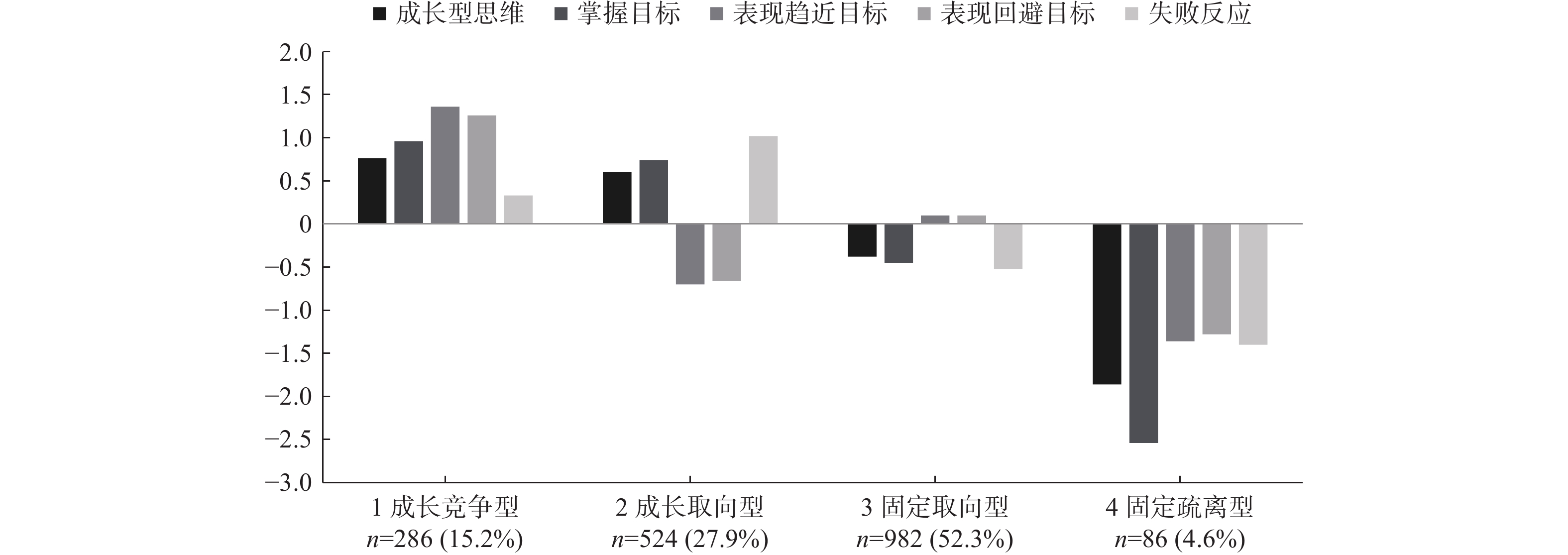
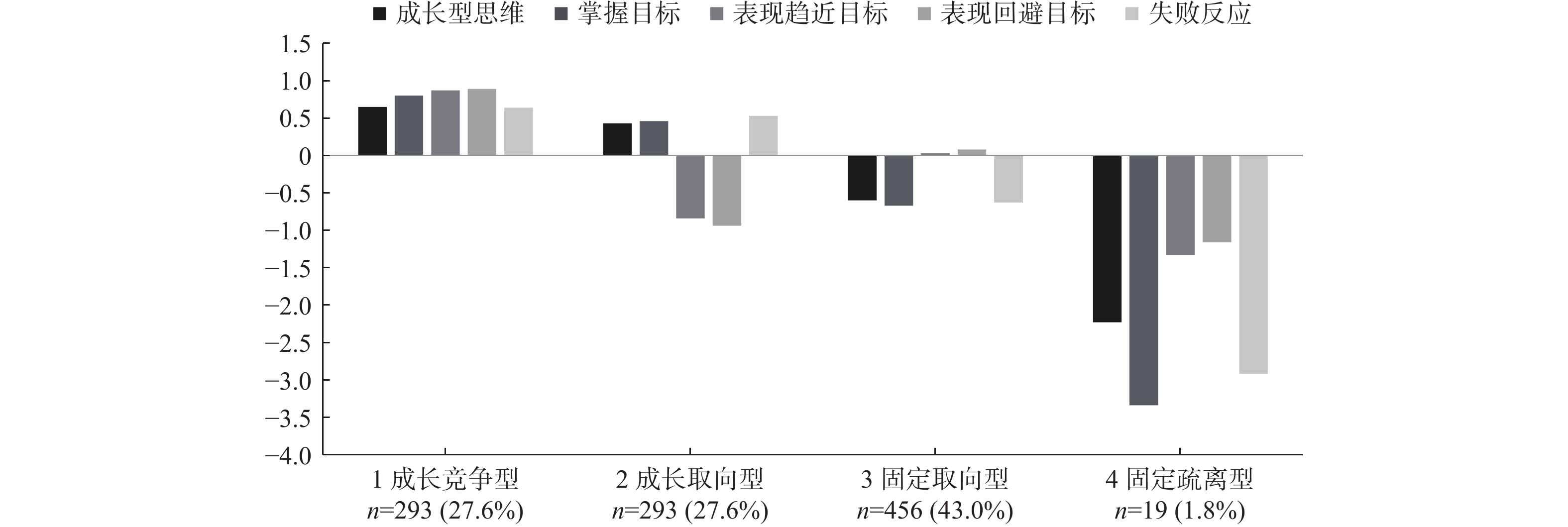
| 学业自我效能 | 学习投入 | 学业成绩 | |
| 1成长竞争型 | 3.84±0.88 | 3.63±0.85 | 3.45±1.06 |
| 2成长取向型 | 3.69±0.84 | 3.57±0.78 | 3.48±0.95 |
| 3固定取向型 | 2.98±0.75 | 2.86±0.76 | 2.77±0.97 |
| 4固定疏离型 | 1.78±0.82 | 1.74±0.92 | 1.93±0.92 |
| F | 237.52*** | 217.34*** | 111.77*** |
| 组间比较 | 组1>组2>组3>组4 | 组1,组2>组3>组4 | 组2,组1>组3>组4 |
| 学业自我效能 | 学习投入 | 学业成绩 | |
| 1成长竞争型 | 3.84±0.88 | 3.63±0.85 | 3.45±1.06 |
| 2成长取向型 | 3.69±0.84 | 3.57±0.78 | 3.48±0.95 |
| 3固定取向型 | 2.98±0.75 | 2.86±0.76 | 2.77±0.97 |
| 4固定疏离型 | 1.78±0.82 | 1.74±0.92 | 1.93±0.92 |
| F | 237.52*** | 217.34*** | 111.77*** |
| 组间比较 | 组1>组2>组3>组4 | 组1,组2>组3>组4 | 组2,组1>组3>组4 |
| 学习倦怠 | 考试焦虑 | 学业自我妨碍 | |
| 1成长竞争型 | 1.91±0.68 | 1.89±0.73 | 1.96±1.08 |
| 2成长取向型 | 1.84±0.56 | 1.70±0.58 | 1.57±0.71 |
| 3固定取向型 | 2.64±0.55 | 2.09±0.61 | 2.45±0.82 |
| 4固定疏离型 | 3.09±1.08 | 2.14±0.96 | 2.47±1.47 |
| F | 153.28*** | 24.29*** | 58.87*** |
| 组间比较 | 组4>组3>组1,组2 | 组4,组3>组1>组2 | 组4,组3>组1>组2 |
| 学习倦怠 | 考试焦虑 | 学业自我妨碍 | |
| 1成长竞争型 | 1.91±0.68 | 1.89±0.73 | 1.96±1.08 |
| 2成长取向型 | 1.84±0.56 | 1.70±0.58 | 1.57±0.71 |
| 3固定取向型 | 2.64±0.55 | 2.09±0.61 | 2.45±0.82 |
| 4固定疏离型 | 3.09±1.08 | 2.14±0.96 | 2.47±1.47 |
| F | 153.28*** | 24.29*** | 58.87*** |
| 组间比较 | 组4>组3>组1,组2 | 组4,组3>组1>组2 | 组4,组3>组1>组2 |
|
方来坛, 时勘, 张风华. 中文版学习投入量表的信效度研究. 中国临床心理学杂志, 2008, 16 (6): 618- 620.
|
|
|
胡俏, 戴春林. 中学生学习倦怠结构研究. 心理科学, 2007, 30 (1): 162- 164, 195.
DOI |
|
|
唐卫海, 马嘉翊, 刘希平, 李海南. 元认知和自我效能感与数学学习成绩的关系. 天津师范大学学报(社会科学版), 2025, (1): 107- 118.
|
|
|
王才康. 考试焦虑量表(TAI)的信度和效度研究. 中国临床心理学杂志, 2003, 11 (1): 69- 70.
DOI |
|
|
文超, 张卫, 李董平, 喻承甫, 代维祝. 初中生感恩与学业成就的关系: 学习投入的中介作用. 心理发展与教育, 2010, 26 (6): 598- 605.
|
|
|
徐鑫锫, 莫玲菲, 刘明, 邓赐平. 高一学生成就目标特征模式及学业适应: 基于潜在剖面分析. 心理发展与教育, 2022, 38 (1): 81- 89.
|
|
|
Bai, B., & Wang, J. The role of growth mindset, self-efficacy and intrinsic value in self-regulated learning and English language learning achievements. Language Teaching Research, 2023, 27 (1): 207- 228.
DOI |
|
|
Blackwell, L. S., Trzesniewski, K. H., & Dweck, C. S. Implicit theories of intelligence predict achievement across an adolescent transition: A longitudinal study and an intervention. Child Development, 2007, 78 (1): 246- 263.
DOI |
|
|
Burnette, J. L., O’Boyle, E. H., van Epps, E. M., Pollack, J. M., & Finkel, E. J. Mind-sets matter: A meta-analytic review of implicit theories and self-regulation. Psychological Bulletin, 2013, 139 (3): 655- 701.
DOI |
|
|
Chen, W. W., & Wong, Y. L. Chinese mindset: Theories of intelligence, goal orientation and academic achievement in Hong Kong students. Educational Psychology, 2015, 35 (6): 714- 725.
DOI |
|
|
Dweck, C. S. (1999). Self-theories: Their role in motivation, personality, and development. New York: Psychology Press.
|
|
|
Dweck, C. S. (2006). Mindset: The new psychology of success. New York: Random House.
|
|
|
Dweck, C. S., & Leggett, E. L. A social-cognitive approach to motivation and personality. Psychological Review, 1988, 95 (2): 256- 273.
DOI |
|
|
Dweck, C. S., & Molden, D. C. (2017). Mindsets: Their impact on competence motivation and acquisition. In A. J. Elliot, C. S. Dweck, & D. S. Yeager (Eds.), Handbook of competence and motivation: Theory and application (2nd ed., pp. 135–154). New York: The Guilford Press.
|
|
|
Dweck, C. S., & Yeager, D. S. Mindsets: A view from two eras. Perspectives on Psychological Science, 2019, 14 (3): 481- 496.
DOI |
|
|
Giel, L. I. S., Noordzij, G., Noordegraaf-Eelens, L., & Denktaş, S. (2020). Fear of failure: A polynomial regression analysis of the joint impact of the perceived learning environment and personal achievement goal orientation. Anxiety, Stress, & Coping, 33(2), 123–139.
|
|
|
Hecht, C. A., Yeager, D. S., Dweck, C. S., & Murphy, M. C. Beliefs, affordances, and adolescent development: Lessons from a decade of growth mindset interventions. Advances in Child Development and Behavior, 2021, 61, 169- 197.
|
|
|
Lee, H. Y., Jamieson, J. P., Miu, A. S., Josephs, R. A., & Yeager, D. S. An entity theory of intelligence predicts higher cortisol levels when high school grades are declining. Child Development, 2019, 90 (6): e849- e867.
|
|
|
Lee, W. O. (1996). The cultural context for Chinese learners: Conceptions of learning in the Confucian tradition. In D. A. Watkind & J. B. Biggs (Eds.), The Chinese learners: Cultural, psychological and contextual influences. Hong Kong: CERC & ACER.
|
|
|
Midgley, C., Kaplan, A., Middleton, M., Maehr, M. L., Urdan, T., Anderman, L. H., … Roeser, R. The development and validation of scales assessing students’ achievement goal orientations. Contemporary Educational Psychology, 1998, 23 (2): 113- 131.
DOI |
|
|
Midgley, C., Maehr, M. L., Hruda, L. Z., Anderman, E., Anderman, L., Freeman, K. E., … Urdan, T. (2000). Manual for the patterns of adaptive learning scales (p. 19). Ann Arbor: University of Michigan.
|
|
|
Niemivirta, M., Pulkka, A. T., Tapola, A., & Tuominen, H. (2019). Achievement goal orientations: A person-oriented approach. In K. A. Renninger & S. E. Hidi (Eds.), The Cambridge handbook of motivation and learning (pp. 566–616). Cambridge: Cambridge University Press.
|
|
|
Park, D., Gunderson, E. A., Tsukayama, E., Levine, S. C., & Beilock, S. L. Young children’s motivational frameworks and math achievement: Relation to teacher-reported instructional practices, but not teacher theory of intelligence. Journal of Educational Psychology, 2016, 108 (3): 300- 313.
DOI |
|
|
Tang, X., Wang, M. T., Guo, J. S., & Salmela-Aro, K. Building grit: The longitudinal pathways between mindset, commitment, grit, and academic outcomes. Journal of Youth and Adolescence, 2019, 48 (5): 850- 863.
DOI |
|
|
Xie, Y. J., Cao, D. P., Sun, T., & Yang, L. B. The effects of academic adaptability on academic burnout, immersion in learning, and academic performance among Chinese medical students: A cross-sectional study. BMC Medical Education, 2019, 19 (1): 211.
DOI |
|
|
Yeager, D. S., Carroll, J. M., Buontempo, J., Cimpian, A., Woody, S., Crosnoe, R., ... Dweck, C. S. Teacher mindsets help explain where a growth-mindset intervention does and doesn’t work. Psychological Science, 2022, 33 (1): 18- 32.
DOI |
|
|
Yeager, D. S., & Dweck, C. S. What can be learned from growth mindset controversies. American Psychologist, 2020, 75 (9): 1269- 1284.
DOI |
|
|
Yeager, D. S., Hanselman, P., Walton, G. M., Murray, J. S., Crosnoe, R., Muller, C., … Dweck, C. S. A national experiment reveals where a growth mindset improves achievement. Nature, 2019, 573 (7774): 364- 369.
DOI |
|
|
Yu, J. L., & McLellan, R. Same mindset, different goals and motivational frameworks: Profiles of mindset-based meaning systems. Contemporary Educational Psychology, 2020, 62, 101901.
DOI |
| Viewed | ||||||
|
Full text |
|
|||||
|
Abstract |
|
|||||
