
Studies of Psychology and Behavior ›› 2024, Vol. 22 ›› Issue (5): 585-593.DOI: 10.12139/j.1672-0628.2024.05.002
• ? • Previous Articles Next Articles
Xin LI*,1,2,3( ), Mengling LONG2,4, Feifei LIANG1,2,3, Yongsheng WANG1,2,3
Received:2024-01-08
Online:2024-09-20
Published:2024-09-20
Contact:
Xin LI
李馨*,1,2,3(), 龙梦灵2,4, 梁菲菲1,2,3, 王永胜1,2,3
通讯作者:
李馨
基金资助:Xin LI, Mengling LONG, Feifei LIANG, Yongsheng WANG. The Role of Character Positional Probability During Chinese Reading: Evidence from Eye Movements of Uyghur Readers[J]. Studies of Psychology and Behavior, 2024, 22(5): 585-593.
李馨, 龙梦灵, 梁菲菲, 王永胜. 词素位置概率信息在汉语阅读中的作用:基于维语大学生的眼动证据[J]. 心理与行为研究, 2024, 22(5): 585-593.
Add to citation manager EndNote|Ris|BibTeX
URL: https://psybeh.tjnu.edu.cn/EN/10.12139/j.1672-0628.2024.05.002
| 指标 | 汉语 | 维语 |
| 累计使用年数 | 14.10±2.94 | 19.38±1.99 |
| 沉浸率 | 0.70±0.11 | 0.85±0.08 |
| 主导度 | 0.61±0.13 | 0.40±0.11 |
| 熟练度 | 0.75±0.13 | 0.68±0.19 |
| 流畅性(字/3分钟) | 415.3±74.2 |
| 指标 | 汉语 | 维语 |
| 累计使用年数 | 14.10±2.94 | 19.38±1.99 |
| 沉浸率 | 0.70±0.11 | 0.85±0.08 |
| 主导度 | 0.61±0.13 | 0.40±0.11 |
| 熟练度 | 0.75±0.13 | 0.68±0.19 |
| 流畅性(字/3分钟) | 415.3±74.2 |
| 信息类型 | 目标词类型 | ||
| 首高尾高(HH词) | 首低尾低(LL词) | ||
| 首字 | 词首概率 | 0.94±0.04 | 0.10±0.03 |
| 构词力 | 23.75±9.76 | 23.88±10.89 | |
| 笔画数 | 7.00±2.56 | 7.31±2.44 | |
| 字频(次/百万字) | 12.61±14.43 | 12.56±13.55 | |
| 尾字 | 词尾概率 | 0.94±0.04 | 0.12±0.04 |
| 构词力 | 26.19±11.11 | 24.50±9.43 | |
| 笔画数 | 9.69±2.30 | 9.00±2.53 | |
| 字频(次/百万字) | 7.23±11.16 | 7.76±11.10 | |
| 整词 | 构词力 | 49.94±15.62 | 48.38±10.38 |
| 笔画数 | 16.69±3.84 | 16.31±3.50 | |
| 信息类型 | 目标词类型 | ||
| 首高尾高(HH词) | 首低尾低(LL词) | ||
| 首字 | 词首概率 | 0.94±0.04 | 0.10±0.03 |
| 构词力 | 23.75±9.76 | 23.88±10.89 | |
| 笔画数 | 7.00±2.56 | 7.31±2.44 | |
| 字频(次/百万字) | 12.61±14.43 | 12.56±13.55 | |
| 尾字 | 词尾概率 | 0.94±0.04 | 0.12±0.04 |
| 构词力 | 26.19±11.11 | 24.50±9.43 | |
| 笔画数 | 9.69±2.30 | 9.00±2.53 | |
| 字频(次/百万字) | 7.23±11.16 | 7.76±11.10 | |
| 整词 | 构词力 | 49.94±15.62 | 48.38±10.38 |
| 笔画数 | 16.69±3.84 | 16.31±3.50 | |
| 句子编号 | 实验句 |
| 1 | 园艺师花重金购入牵堡打造精品观光园,吸引了众多旅客。 |
| 2 | 任凭风吹雨打,悬崖峭壁上那株牵堡依然坚韧不拔地长在那里。 |
| 3 | 多雨潮湿的草地和覆盖腐殖质的岩石变成牵堡迅速生长的温床。 |
| 4 | 仔细观察可以发现牵堡内部的花蕊仿佛是一只展翅欲飞的鸽子。 |
| 5 | 云南有一种特产就是选用牵堡成熟后的花朵和茎叶作为馅料。 |
| 6 | 如果想美化室内环境,可以在花盆里种一些牵堡摆在客厅里。 |
| 语义类别选择题 | 请选择:“牵堡”属于以下哪个类别?体育项目 植物 厨具 文具 |
| 句子编号 | 实验句 |
| 1 | 园艺师花重金购入牵堡打造精品观光园,吸引了众多旅客。 |
| 2 | 任凭风吹雨打,悬崖峭壁上那株牵堡依然坚韧不拔地长在那里。 |
| 3 | 多雨潮湿的草地和覆盖腐殖质的岩石变成牵堡迅速生长的温床。 |
| 4 | 仔细观察可以发现牵堡内部的花蕊仿佛是一只展翅欲飞的鸽子。 |
| 5 | 云南有一种特产就是选用牵堡成熟后的花朵和茎叶作为馅料。 |
| 6 | 如果想美化室内环境,可以在花盆里种一些牵堡摆在客厅里。 |
| 语义类别选择题 | 请选择:“牵堡”属于以下哪个类别?体育项目 植物 厨具 文具 |
| 眼动指标 | 目标词 | 学习次数 | |||||
| 1 | 2 | 3 | 4 | 5 | 6 | ||
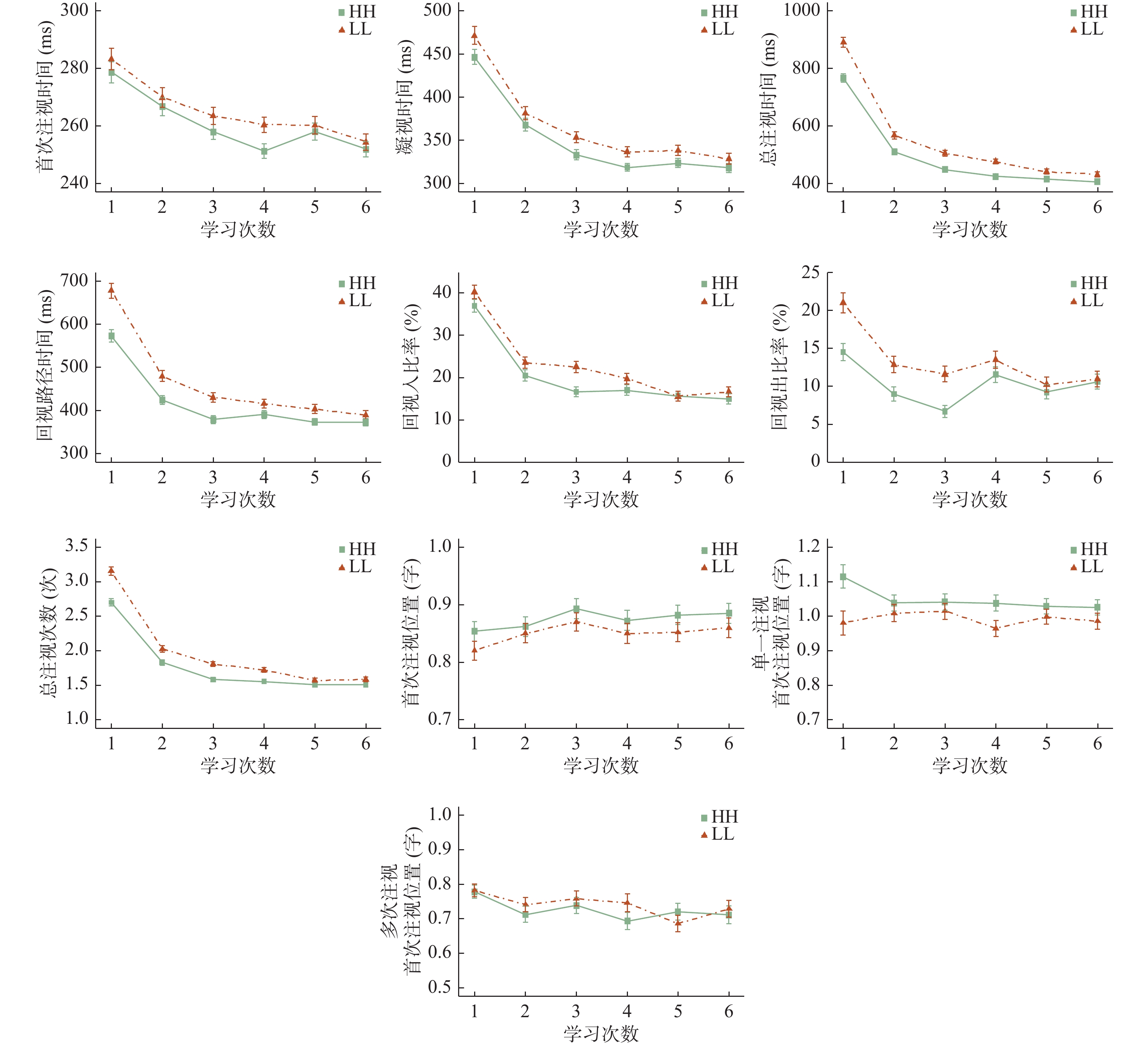
| 首次注视时间(ms) | HH | 279±109 | 267±95 | 258±81 | 251±77 | 258±92 | 252±83 |
| LL | 283±117 | 269±105 | 263±94 | 260±84 | 260±90 | 254±89 | |
| 凝视时间(ms) | HH | 446±274 | 368±228 | 333±182 | 319±150 | 323±168 | 318±167 |
| LL | 471±321 | 381±244 | 353±195 | 337±183 | 338±183 | 329±181 | |
| 总注视时间(ms) | HH | 766±470 | 509±339 | 447±286 | 423±274 | 414±242 | 406±273 |
| LL | 890±566 | 567±388 | 505±321 | 476±316 | 440±278 | 431±273 | |
| 回视路径时间(ms) | HH | 573±437 | 425±323 | 379±269 | 390±290 | 374±239 | 373±245 |
| LL | 678±546 | 479±387 | 430±333 | 416±294 | 403±319 | 389±300 | |
| 回视入比率 | HH | 0.37±0.48 | 0.20±0.40 | 0.17±0.37 | 0.17±0.38 | 0.16±0.36 | 0.15±0.36 |
| LL | 0.40±0.49 | 0.24±0.42 | 0.23±0.42 | 0.20±0.40 | 0.16±0.36 | 0.17±0.37 | |
| 回视出比率 | HH | 0.15±0.35 | 0.09±0.29 | 0.07±0.25 | 0.12±0.32 | 0.09±0.29 | 0.11±0.31 |
| LL | 0.21±0.41 | 0.13±0.33 | 0.12±0.32 | 0.13±0.34 | 0.10±0.30 | 0.11±0.31 | |
| 总注视次数 | HH | 2.70±1.79 | 1.83±1.29 | 1.59±1.04 | 1.56±1.02 | 1.51±0.93 | 1.51±0.99 |
| LL | 3.16±2.11 | 2.03±1.47 | 1.81±1.20 | 1.72±1.17 | 1.58±1.07 | 1.59±1.07 | |
| 首次注视位置 | HH | 0.85±0.52 | 0.86±0.53 | 0.89±0.54 | 0.87±0.54 | 0.88±0.53 | 0.88±0.54 |
| LL | 0.82±0.51 | 0.85±0.52 | 0.87±0.51 | 0.85±0.54 | 0.85±0.52 | 0.86±0.53 | |
| 单一注视 首次注视位置 | HH | 1.12±0.48 | 1.04±0.48 | 1.04±0.52 | 1.04±0.50 | 1.03±0.51 | 1.03±0.50 |
| LL | 0.98±0.47 | 1.01±0.49 | 1.02±0.47 | 0.97±0.50 | 1.00±0.49 | 0.99±0.51 | |
| 多次注视 首次注视位置 | HH | 0.78±0.51 | 0.71±0.52 | 0.74±0.51 | 0.69±0.52 | 0.72±0.51 | 0.71±0.53 |
| LL | 0.78±0.51 | 0.74±0.51 | 0.76±0.51 | 0.75±0.56 | 0.69±0.50 | 0.73±0.53 | |
| 眼动指标 | 目标词 | 学习次数 | |||||
| 1 | 2 | 3 | 4 | 5 | 6 | ||
| 首次注视时间(ms) | HH | 279±109 | 267±95 | 258±81 | 251±77 | 258±92 | 252±83 |
| LL | 283±117 | 269±105 | 263±94 | 260±84 | 260±90 | 254±89 | |
| 凝视时间(ms) | HH | 446±274 | 368±228 | 333±182 | 319±150 | 323±168 | 318±167 |
| LL | 471±321 | 381±244 | 353±195 | 337±183 | 338±183 | 329±181 | |
| 总注视时间(ms) | HH | 766±470 | 509±339 | 447±286 | 423±274 | 414±242 | 406±273 |
| LL | 890±566 | 567±388 | 505±321 | 476±316 | 440±278 | 431±273 | |
| 回视路径时间(ms) | HH | 573±437 | 425±323 | 379±269 | 390±290 | 374±239 | 373±245 |
| LL | 678±546 | 479±387 | 430±333 | 416±294 | 403±319 | 389±300 | |
| 回视入比率 | HH | 0.37±0.48 | 0.20±0.40 | 0.17±0.37 | 0.17±0.38 | 0.16±0.36 | 0.15±0.36 |
| LL | 0.40±0.49 | 0.24±0.42 | 0.23±0.42 | 0.20±0.40 | 0.16±0.36 | 0.17±0.37 | |
| 回视出比率 | HH | 0.15±0.35 | 0.09±0.29 | 0.07±0.25 | 0.12±0.32 | 0.09±0.29 | 0.11±0.31 |
| LL | 0.21±0.41 | 0.13±0.33 | 0.12±0.32 | 0.13±0.34 | 0.10±0.30 | 0.11±0.31 | |
| 总注视次数 | HH | 2.70±1.79 | 1.83±1.29 | 1.59±1.04 | 1.56±1.02 | 1.51±0.93 | 1.51±0.99 |
| LL | 3.16±2.11 | 2.03±1.47 | 1.81±1.20 | 1.72±1.17 | 1.58±1.07 | 1.59±1.07 | |
| 首次注视位置 | HH | 0.85±0.52 | 0.86±0.53 | 0.89±0.54 | 0.87±0.54 | 0.88±0.53 | 0.88±0.54 |
| LL | 0.82±0.51 | 0.85±0.52 | 0.87±0.51 | 0.85±0.54 | 0.85±0.52 | 0.86±0.53 | |
| 单一注视 首次注视位置 | HH | 1.12±0.48 | 1.04±0.48 | 1.04±0.52 | 1.04±0.50 | 1.03±0.51 | 1.03±0.50 |
| LL | 0.98±0.47 | 1.01±0.49 | 1.02±0.47 | 0.97±0.50 | 1.00±0.49 | 0.99±0.51 | |
| 多次注视 首次注视位置 | HH | 0.78±0.51 | 0.71±0.52 | 0.74±0.51 | 0.69±0.52 | 0.72±0.51 | 0.71±0.53 |
| LL | 0.78±0.51 | 0.74±0.51 | 0.76±0.51 | 0.75±0.56 | 0.69±0.50 | 0.73±0.53 | |
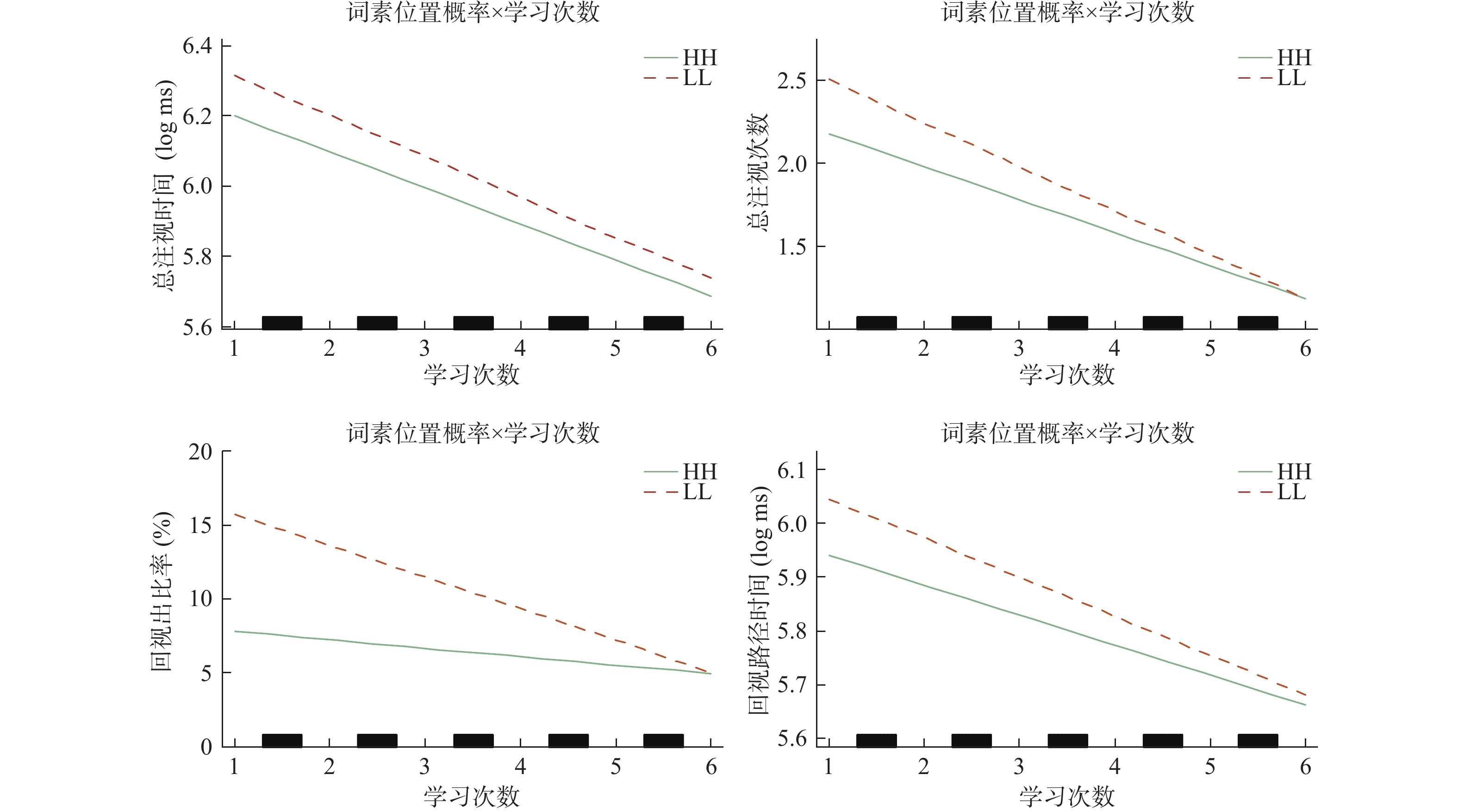
| 眼动指标 | b | SE | t | 95%CI | |
| 首次注视时间 | 截距 | 5.56 | 0.02 | 296.10 | [5.52, 5.60] |
| 词素位置概率 | 0.01 | 0.01 | 0.85 | [−0.02, 0.04] | |
| 学习次数 | −0.02 | 0.002 | −6.61 | [−0.02, −0.01] | |
| 词素位置概率×学习次数 | −0.0002 | 0.004 | −0.04 | [−0.01, 0.01] | |
| 凝视时间 | 截距 | 5.89 | 0.03 | 191.49 | [5.83, 5.95] |
| 词素位置概率 | 0.03 | 0.02 | 1.59 | [−0.01, 0.07] | |
| 学习次数 | −0.05 | 0.005 | −10.73 | [−0.06, −0.04] | |
| 词素位置概率×学习次数 | 0.0001 | 0.01 | 0.01 | [−0.01, 0.01] | |
| 总注视时间 | 截距 | 6.42 | 0.05 | 118.39 | [6.31, 6.53] |
| 词素位置概率 | 0.13 | 0.03 | 4.90 | [0.08, 0.19] | |
| 学习次数 | −0.11 | 0.01 | −10.27 | [−0.13, −0.09] | |
| 词素位置概率×学习次数 | −0.01 | 0.01 | −1.84 | [−0.03, 0.00] | |
| 回视路径时间 | 截距 | 5.86 | 0.03 | 205.40 | [5.81, 5.92] |
| 词素位置概率 | 0.07 | 0.01 | 5.85 | [0.05, 0.09] | |
| 学习次数 | −0.06 | 0.01 | −7.63 | [−0.08, −0.05] | |
| 词素位置概率×学习次数 | −0.02 | 0.01 | −2.41 | [−0.03, 0.00] | |
| 回视入比率 | 截距 | −0.62 | 0.13 | −4.82 | [−0.88, −0.37] |
| 词素位置概率 | 0.24 | 0.10 | 2.37 | [0.04, 0.44] | |
| 学习次数 | −0.24 | 0.03 | −8.43 | [−0.29, −0.18] | |
| 词素位置概率×学习次数 | −0.02 | 0.03 | −0.67 | [−0.07, 0.04] | |
| 回视出比率 | 截距 | −2.27 | 0.10 | −22.80 | [−2.46, −2.07] |
| 词素位置概率 | 0.31 | 0.06 | 5.12 | [0.19, 0.42] | |
| 学习次数 | −0.09 | 0.03 | −2.87 | [−0.15, −0.03] | |
| 词素位置概率×学习次数 | −0.10 | 0.03 | −2.92 | [−0.17, −0.03] | |
| 总注视次数 | 截距 | 1.88 | 0.06 | 29.49 | [1.76, 2.01] |
| 词素位置概率 | 0.20 | 0.02 | 9.89 | [0.16, 0.24] | |
| 学习次数 | −0.23 | 0.03 | −9.04 | [−0.28, −0.18] | |
| 词素位置概率×学习次数 | −0.06 | 0.01 | −5.57 | [−0.09, −0.04] | |
| 首次注视位置 | 截距 | 0.87 | 0.01 | 64.99 | [0.85, 0.90] |
| 词素位置概率 | −0.03 | 0.01 | −2.57 | [−0.05, −0.01] | |
| 学习次数 | 0.01 | 0.004 | 1.43 | [0.00, 0.01] | |
| 词素位置概率×学习次数 | −0.0005 | 0.01 | −0.01 | [−0.01, 0.01] | |
| 单一注视 首次注视位置 | 截距 | 1.02 | 0.01 | 128.45 | [1.00, 1.03] |
| 词素位置概率 | −0.05 | 0.02 | −3.10 | [−0.08, −0.02] | |
| 学习次数 | −0.01 | 0.005 | −1.43 | [−0.02, 0.00] | |
| 词素位置概率×学习次数 | 0.01 | 0.01 | 0.84 | [−0.01, 0.02] | |
| 多次注视 首次注视位置 | 截距 | 0.76 | 0.02 | 41.34 | [0.72, 0.79] |
| 词素位置概率 | 0.01 | 0.01 | 0.90 | [−0.01, 0.04] | |
| 学习次数 | −0.01 | 0.004 | −2.56 | [−0.02, 0.00] | |
| 词素位置概率×学习次数 | −0.0006 | 0.01 | −0.01 | [−0.01, 0.01] |
| 眼动指标 | b | SE | t | 95%CI | |
| 首次注视时间 | 截距 | 5.56 | 0.02 | 296.10 | [5.52, 5.60] |
| 词素位置概率 | 0.01 | 0.01 | 0.85 | [−0.02, 0.04] | |
| 学习次数 | −0.02 | 0.002 | −6.61 | [−0.02, −0.01] | |
| 词素位置概率×学习次数 | −0.0002 | 0.004 | −0.04 | [−0.01, 0.01] | |
| 凝视时间 | 截距 | 5.89 | 0.03 | 191.49 | [5.83, 5.95] |
| 词素位置概率 | 0.03 | 0.02 | 1.59 | [−0.01, 0.07] | |
| 学习次数 | −0.05 | 0.005 | −10.73 | [−0.06, −0.04] | |
| 词素位置概率×学习次数 | 0.0001 | 0.01 | 0.01 | [−0.01, 0.01] | |
| 总注视时间 | 截距 | 6.42 | 0.05 | 118.39 | [6.31, 6.53] |
| 词素位置概率 | 0.13 | 0.03 | 4.90 | [0.08, 0.19] | |
| 学习次数 | −0.11 | 0.01 | −10.27 | [−0.13, −0.09] | |
| 词素位置概率×学习次数 | −0.01 | 0.01 | −1.84 | [−0.03, 0.00] | |
| 回视路径时间 | 截距 | 5.86 | 0.03 | 205.40 | [5.81, 5.92] |
| 词素位置概率 | 0.07 | 0.01 | 5.85 | [0.05, 0.09] | |
| 学习次数 | −0.06 | 0.01 | −7.63 | [−0.08, −0.05] | |
| 词素位置概率×学习次数 | −0.02 | 0.01 | −2.41 | [−0.03, 0.00] | |
| 回视入比率 | 截距 | −0.62 | 0.13 | −4.82 | [−0.88, −0.37] |
| 词素位置概率 | 0.24 | 0.10 | 2.37 | [0.04, 0.44] | |
| 学习次数 | −0.24 | 0.03 | −8.43 | [−0.29, −0.18] | |
| 词素位置概率×学习次数 | −0.02 | 0.03 | −0.67 | [−0.07, 0.04] | |
| 回视出比率 | 截距 | −2.27 | 0.10 | −22.80 | [−2.46, −2.07] |
| 词素位置概率 | 0.31 | 0.06 | 5.12 | [0.19, 0.42] | |
| 学习次数 | −0.09 | 0.03 | −2.87 | [−0.15, −0.03] | |
| 词素位置概率×学习次数 | −0.10 | 0.03 | −2.92 | [−0.17, −0.03] | |
| 总注视次数 | 截距 | 1.88 | 0.06 | 29.49 | [1.76, 2.01] |
| 词素位置概率 | 0.20 | 0.02 | 9.89 | [0.16, 0.24] | |
| 学习次数 | −0.23 | 0.03 | −9.04 | [−0.28, −0.18] | |
| 词素位置概率×学习次数 | −0.06 | 0.01 | −5.57 | [−0.09, −0.04] | |
| 首次注视位置 | 截距 | 0.87 | 0.01 | 64.99 | [0.85, 0.90] |
| 词素位置概率 | −0.03 | 0.01 | −2.57 | [−0.05, −0.01] | |
| 学习次数 | 0.01 | 0.004 | 1.43 | [0.00, 0.01] | |
| 词素位置概率×学习次数 | −0.0005 | 0.01 | −0.01 | [−0.01, 0.01] | |
| 单一注视 首次注视位置 | 截距 | 1.02 | 0.01 | 128.45 | [1.00, 1.03] |
| 词素位置概率 | −0.05 | 0.02 | −3.10 | [−0.08, −0.02] | |
| 学习次数 | −0.01 | 0.005 | −1.43 | [−0.02, 0.00] | |
| 词素位置概率×学习次数 | 0.01 | 0.01 | 0.84 | [−0.01, 0.02] | |
| 多次注视 首次注视位置 | 截距 | 0.76 | 0.02 | 41.34 | [0.72, 0.79] |
| 词素位置概率 | 0.01 | 0.01 | 0.90 | [−0.01, 0.04] | |
| 学习次数 | −0.01 | 0.004 | −2.56 | [−0.02, 0.00] | |
| 词素位置概率×学习次数 | −0.0006 | 0.01 | −0.01 | [−0.01, 0.01] |
|
曹海波, 兰泽波, 高峰, 于海涛, 李鹏, 王敬欣. 词素位置概率在中文阅读中的作用: 词汇判断和眼动研究. 心理学报, 2023, 55 (2): 159- 176.
|
|
|
曹海波, 任亮, 韩丹, 贾东立, 王敬欣. 词素位置概率在中文重叠歧义词识别中的作用. 心理与行为研究, 2022, 20 (6): 732- 738.
DOI |
|
|
李馨. (2018). 双语阅读中的眼动研究. 天津: 天津社会科学出版社.
|
|
|
连坤予, 马杰, 魏玲, 张书帏, 白学军. 汉语朗读中词素位置概率线索作用的发展研究. 心理与行为研究, 2021, 19 (2): 179- 185.
|
|
|
梁菲菲. (2022). 儿童阅读心理学. 北京: 北京师范大学出版社.
|
|
|
梁菲菲, 冯琳琳, 刘瑛, 李馨, 白学军. 阅读伴随词汇学习的词切分: 首、尾词素位置概率的不同作用. 心理学报, 2024, 56 (3): 281- 294.
|
|
|
梁菲菲, 冯琳琳, 刘瑛, 王昶浩, 王洁. 词素位置概率信息在中文双字词识别中的作用: 词汇语境多样性的调节. 心理与行为研究, 2023, 21 (6): 736- 743.
DOI |
|
|
梁菲菲, 王永胜, 张慢慢, 闫国利, 白学军. 新词词素熟悉性影响视觉词切分线索在新词学习中的促进作用. 心理科学, 2016, 39 (2): 258- 264.
|
|
|
梁菲菲, 向颖, 龙梦灵. 首词素位置概率信息未参与汉语阅读的词切分: 基于副中央凹加工的证据. 心理与行为研究, 2022, 20 (3): 318- 324.
DOI |
|
|
杨群, 张积家, 范丛慧. 维吾尔族与汉族的大学生在汉语歧义词消解中的语境促进效应及反应抑制效应. 心理学报, 2021, 53 (7): 746- 757.
|
|
|
Barr, D. J., Levy, R., Scheepers, C., & Tily, H. J. Random effects structure for confirmatory hypothesis testing: Keep it maximal. Journal of Memory and Language, 2013, 68 (3): 255- 278.
DOI |
|
|
Cai, Q., & Brysbaert, M. SUBTLEX-CH: Chinese word and character frequencies based on film subtitles. PLoS One, 2010, 5 (6): e10729.
DOI |
|
|
Chu, M. M. K., & Leung, M. T. Reading strategy of Hong Kong school-aged children: The development of word-level and character-level processing. Applied Psycholinguistics, 2005, 26 (4): 505- 520.
DOI |
|
|
Han, Y., Wang, Y. S., Liang, F. F., Li, X., Ma, J., & Bai, X. J. (2024). Phonological decoding does not affect incidental Chinese novel word learning in Uyghur readers: Evidence from eye movements. Reading and Writing. Advance online publication. https://link.springer.com/article/10.1007/s11145-024-10535-6
|
|
|
Harm, M. W., & Seidenberg, M. S. Phonology, reading acquisition, and dyslexia: Insights from connectionist models. Psychological Review, 1999, 106 (3): 491- 528.
DOI |
|
|
Joseph, H. S. S. L., Wonnacott, E., Forbes, P., & Nation, K. Becoming a written word: Eye movements reveal order of acquisition effects following incidental exposure to new words during silent reading. Cognition, 2014, 133 (1): 238- 248.
DOI |
|
|
Kasisopa, B., Reilly, R. G., Luksaneeyanawin, S., & Burnham, D. Eye movements while reading an unspaced writing system: The case of Thai. Vision Research, 2013, 86, 71- 80.
DOI |
|
|
Kasisopa, B., Reilly, R. G., Luksaneeyanawin, S., & Burnham, D. Child readers’ eye movements in reading Thai. Vision Research, 2016, 123, 8- 19.
DOI |
|
|
Li, P., Zhang, F., Yu, A. Y., & Zhao, X. W. Language History Questionnaire (LHQ3): An enhanced tool for assessing multilingual experience. Bilingualism: Language and Cognition, 2020, 23, 938- 944.
DOI |
|
|
Li, X. S., & Pollatsek, A. An integrated model of word processing and eye-movement control during Chinese reading. Psychological Review, 2020, 127 (6): 1139- 1162.
DOI |
|
|
Li, X. S., Rayner, K., & Cave, K. R. On the segmentation of Chinese words during reading. Cognitive Psychology, 2009, 58 (4): 525- 552.
DOI |
|
|
Liang, F. F., Blythe, H. I., Bai, X. J., Yan, G. L., Li, X., Zang, C. L., & Liversedge, S. P. The role of character positional frequency on Chinese word learning during natural reading. PLoS One, 2017, 12 (11): e0187656.
DOI |
|
|
Liang, F. F., Blythe, H. I., Zang, C. L., Bai, X. J., Yan, G. L., & Liversedge, S. P. Positional character frequency and word spacing facilitate the acquisition of novel words during Chinese children’s reading. Journal of Cognitive Psychology, 2015, 27 (5): 594- 608.
DOI |
|
|
Liang, F. F., Gao, Q., Li, X., Wang, Y. S., Bai, X. J., & Liversedge, S. P. (2023). The importance of the positional probability of word final (but not word initial) characters for word segmentation and identification in children and adults’ natural Chinese reading. Journal of Experimental Psychology: Learning, Memory, and Cognition, 49(1), 98–115.
|
|
|
Liu, N. N., Wang, X., Yan, G. L., Paterson, K. B., & Pagán, A. Eye movements of developing Chinese readers: Effects of word frequency and predictability. Scientific Studies of Reading, 2021, 25 (3): 234- 250.
DOI |
|
|
Meteyard, L., & Davies, R. A. I. Best practice guidance for linear mixed-effects models in psychological science. Journal of Memory and Language, 2020, 112, 104092.
DOI |
|
|
R Development Core Team. (2014). R: A Language and Environment for Statistical Computing. R Foundation for Statistical Computing. Vienna, Austria: R Foundation for Statistical Computing.
|
|
|
Rayner, K. Eye movements and attention in reading, scene perception, and visual search. Quarterly Journal of Experimental Psychology, 2009, 62 (8): 1457- 1506.
DOI |
|
|
Rayner, K., Li, X. S., Juhasz, B. J., & Yan, G. L. The effect of word predictability on the eye movements of Chinese readers. Psychonomic Bulletin & Review, 2005, 12 (6): 1089- 1093.
|
|
|
Yan, M., Zhou, W., Shu, H., & Kliegl, R. (2015). Perceptual span depends on font size during the reading of Chinese sentences. Journal of Experimental Psychology: Learning, Memory, and Cognition, 41(1), 209–219.
|
|
|
Yen, M. H., Radach, R., Tzeng, O. J. L., & Tsai, J. L. Usage of statistical cues for word boundary in reading Chinese sentences. Reading and Writing, 2012, 25 (5): 1007- 1029.
DOI |
|
|
Zang, C. L., Liversedge, S. P., Bai, X. J., & Yan, G. L. (2011). Eye movements during Chinese reading. In S. P. Liversedge, I. Gilchrist, & S. Everling (Eds.), The Oxford handbook of eye movements (pp. 962–978). Oxford: Oxford University Press.
|
| [1] | Shuangshuang WANG, Zhichao ZHANG, Manman ZHANG, Chuanli ZANG, Guoli YAN. Are the Literal Meanings of Constituents Activated in Chinese Idioms’ Processing? Evidence from the Semantic Preview Effect [J]. Studies of Psychology and Behavior, 2025, 23(6): 759-765. |
| [2] | Yufei DU, Zhichao ZHANG, Manman ZHANG, Chuanli ZANG. Semantics Takes Precedence over World Knowledge in Sentence Comprehension: Evidence from Eye Movements [J]. Studies of Psychology and Behavior, 2025, 23(2): 153-160. |
| [3] | Yongsheng WANG, Yang HAN, Xin LI, Liyuan HE. The Promotion of Inter-Word Space in Chinese Sentence Reading of Uyghur College Students with Different Text Presentation Directions [J]. Studies of Psychology and Behavior, 2025, 23(1): 41-48. |
| [4] | Xiangwen CHEN, Longge WANG, Huilan HU, Zhichao ZHANG, Mengsi WANG, Qiang WANG, Manman ZHANG. The Neural Structural Basis of Individual Differences in Word Frequency Effect on Eye Movement Measures During Chinese Reading [J]. Studies of Psychology and Behavior, 2024, 22(6): 721-729. |
| [5] | Min CHANG, Kuo ZHANG, Yue SUN, Sha LI, Jingxin WANG. Semantic Similarity Effects in Chinese Reading: Evidence for Semantic Prediction [J]. Studies of Psychology and Behavior, 2024, 22(4): 442-449. |
| [6] | Tongwen HU, Kuo ZHANG, Yuru CHENG, Jingxin WANG. The Emotion Word Type Effect in Chinese Reading not Moderated by Valence: Evidence from Eye-Tracking [J]. Studies of Psychology and Behavior, 2024, 22(2): 197-203. |
| [7] | Ruqi CHEN, Yaqian BAO, Linjieqiong HUANG, Xingshan LI. An Introduction to the Chinese Reading Model (CRM) [J]. Studies of Psychology and Behavior, 2023, 21(6): 725-735. |
| [8] | Feifei LIANG, Linlin FENG, Ying LIU, Changhao WANG, Jie WANG. The Role of Character Positional Probability in Chinese Two-Word Identification: Moderation of Lexical Contextual Diversity [J]. Studies of Psychology and Behavior, 2023, 21(6): 736-743. |
| [9] | Zijia LU, Zhichao ZHANG, Ying FU, Manman ZHANG, Chuanli ZANG, Xuejun BAI. Repeating Words Cannot Help Chinese Readers to Obtain Word Class Information from Parafoveal Words [J]. Studies of Psychology and Behavior, 2023, 21(5): 577-584. |
| [10] | Lijuan ZHANG, Fengjun ZHANG, Sainan ZHAO, Jingxin WANG. The Predominant Role of Preview Plausibility on Semantic Preview Benefit of Two-Character Words in Chinese Reading: An Eye Movement Study [J]. Studies of Psychology and Behavior, 2023, 21(1): 12-19. |
| [11] | Haibo CAO, Liang REN, Dan HAN, Dongli JIA, Jingxin WANG. The Role of Character Positional Frequency of Word Segmentation of Overlapping Ambiguous Strings in Chinese [J]. Studies of Psychology and Behavior, 2022, 20(6): 732-738. |
| [12] | ZHANG Manman, HU Huilan, BIAN Han, LI Fang, ZHANG Zhichao, ZANG Chuanli. Word Frequency Effects in Fast and Slow Readers During Skilled Chinese Reading [J]. Studies of Psychology and Behavior, 2022, 20(3): 304-310. |
| [13] | WANG Yongsheng, HE Liyuan, LI Xin, BAI Xuejun. The Role of the First Character Frequency in Low-Frequency Two-Character Words in Parafoveal Processing in Chinese Reading [J]. Studies of Psychology and Behavior, 2022, 20(3): 311-317. |
| [14] | LIANG Feifei, XIANG Ying, LONG Mengling. Initial Character Positional Probability Does Not Influence Word Segmentation in Chinese Reading: Evidence from Parafoveal Processing [J]. Studies of Psychology and Behavior, 2022, 20(3): 318-324. |
| [15] | HE Liyuan, ZHAO Xing, BAI Yu, LIU Nina. Multi-Word Unit Processing for Chinese Older Readers: Evidence from Eye Movements [J]. Studies of Psychology and Behavior, 2022, 20(2): 160-166. |
| Viewed | ||||||
|
Full text |
|
|||||
|
Abstract |
|
|||||
