
Studies of Psychology and Behavior ›› 2025, Vol. 23 ›› Issue (4): 464-471.DOI: 10.12139/j.1672-0628.2025.04.005
• ? • Previous Articles Next Articles
Xinyi ZHANG1,2, Wenxin TANG2, Yitong HUANG2, Mengxue ZHANG2, Bixuan WEN2, Wei LIU*,2( )
)
Received:2024-08-14
Online:2025-07-20
Published:2025-07-20
Contact:
Wei LIU
张昕怡1,2, 汤文芯2, 黄亦彤2, 张梦雪2, 温碧璇2, 刘威*,2()
通讯作者:
刘威
基金资助:Xinyi ZHANG, Wenxin TANG, Yitong HUANG, Mengxue ZHANG, Bixuan WEN, Wei LIU. Arousing National Crisis Awareness and National Pride Selectively Enhancing Subsequent Memory Encoding[J]. Studies of Psychology and Behavior, 2025, 23(4): 464-471.
张昕怡, 汤文芯, 黄亦彤, 张梦雪, 温碧璇, 刘威. 唤醒民族危机感与自豪感选择性增强后续记忆编码[J]. 心理与行为研究, 2025, 23(4): 464-471.
Add to citation manager EndNote|Ris|BibTeX
URL: https://psybeh.tjnu.edu.cn/EN/10.12139/j.1672-0628.2025.04.005
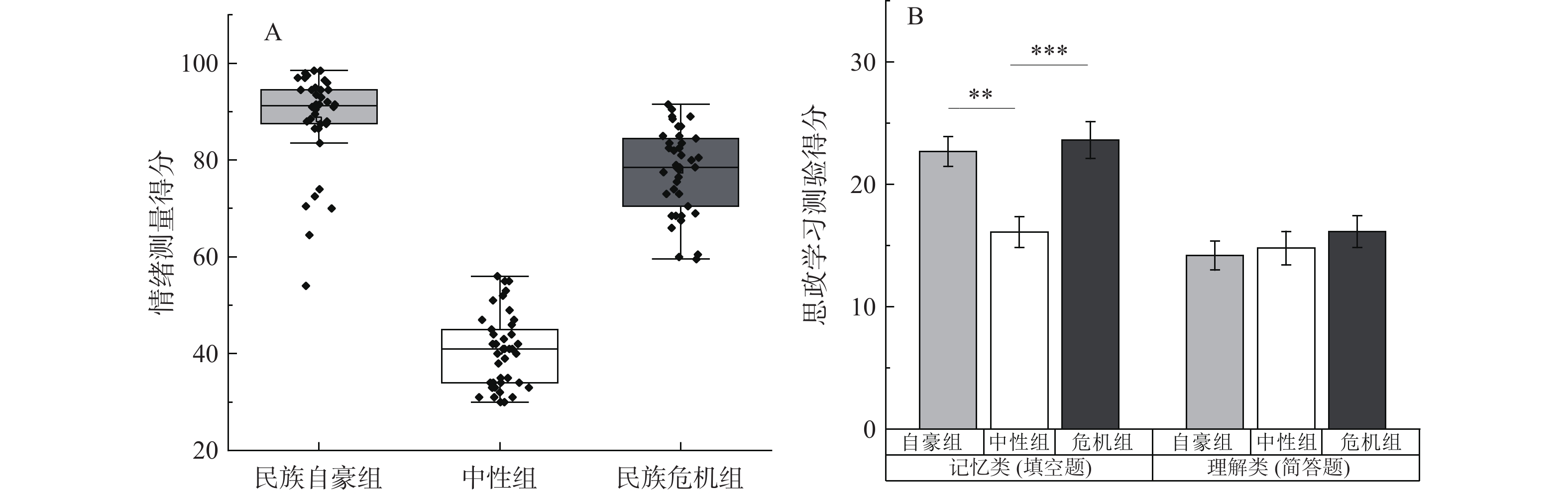
| 情绪唤醒类型 | 记忆类 (填空题) | 理解类 (简答题) | n |
| 民族自豪感 | 22.68±7.41 | 14.18±7.21 | 38 |
| 中性情绪 | 16.10±7.96 | 14.79±8.59 | 40 |
| 民族危机感 | 23.62±9.42 | 16.14±8.05 | 39 |
| 情绪唤醒类型 | 记忆类 (填空题) | 理解类 (简答题) | n |
| 民族自豪感 | 22.68±7.41 | 14.18±7.21 | 38 |
| 中性情绪 | 16.10±7.96 | 14.79±8.59 | 40 |
| 民族危机感 | 23.62±9.42 | 16.14±8.05 | 39 |
| 情绪唤醒类型 | M±SD | n |
| 民族自豪感 | 5.46±1.48 | 38 |
| 中性情绪 | 5.32±1.64 | 40 |
| 民族危机感 | 5.56±1.29 | 39 |
| 情绪唤醒类型 | M±SD | n |
| 民族自豪感 | 5.46±1.48 | 38 |
| 中性情绪 | 5.32±1.64 | 40 |
| 民族危机感 | 5.56±1.29 | 39 |
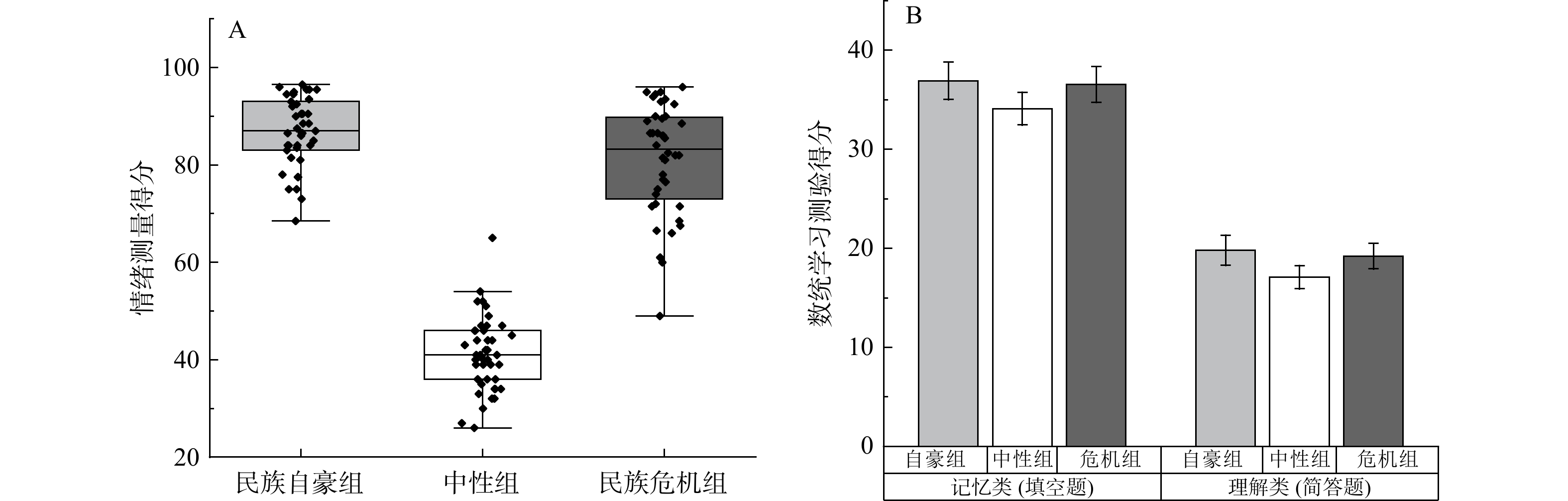
| 情绪唤醒类型 | 记忆类 (填空题) | 理解类 (简答题) | n |
| 民族自豪感 | 36.91±11.92 | 19.81±9.67 | 40 |
| 中性情绪 | 34.11±10.74 | 17.07±7.58 | 42 |
| 民族危机感 | 36.55±11.78 | 19.20±8.31 | 42 |
| 情绪唤醒类型 | 记忆类 (填空题) | 理解类 (简答题) | n |
| 民族自豪感 | 36.91±11.92 | 19.81±9.67 | 40 |
| 中性情绪 | 34.11±10.74 | 17.07±7.58 | 42 |
| 民族危机感 | 36.55±11.78 | 19.20±8.31 | 42 |
| 情绪唤醒类型 | M±SD | n |
| 民族自豪感 | 7.30±1.40 | 40 |
| 中性情绪 | 7.33±1.60 | 42 |
| 民族危机感 | 7.83±1.38 | 42 |
| 情绪唤醒类型 | M±SD | n |
| 民族自豪感 | 7.30±1.40 | 40 |
| 中性情绪 | 7.33±1.60 | 42 |
| 民族危机感 | 7.83±1.38 | 42 |
|
黄丽, 杨廷忠, 季忠民. 正性负性情绪量表的中国人群适用性研究. 中国心理卫生杂志, 2003, 17 (1): 54- 56.
DOI |
|
|
黄殷, 寇彧. 群体独特性对群际偏差的影响. 心理科学进展, 2013, 21 (4): 732- 739.
|
|
|
李雪冰, 罗跃嘉. 情绪和记忆的相互作用. 心理科学进展, 2007, 15 (1): 3- 7.
DOI |
|
|
汪子健. (2021). 大学生国家认同感的现状及影响因素研究——以武汉7所部属高校为例(硕士学位论文). 武汉理工大学.
|
|
|
谢慧, 林轩怡, 胡婉柔, 胡晓晴. 情绪调节促进负性社会反馈的遗忘: 来自行为和脑电的证据. 心理学报, 2023, 55 (6): 905- 919.
|
|
|
杨红升, 黄希庭. 中国人的群体参照记忆效应. 心理学报, 2007, 39 (2): 235- 241.
|
|
|
张静, 陈巍, 丁峻. 社会认知的双重机制: 来自神经科学的证据. 中南大学学报(社会科学版), 2010, 16 (1): 23- 27.
DOI |
|
|
张莹瑞, 佐斌. 青少年中华民族认同、国家自豪感与内群体偏好的关系. 中国健康心理学杂志, 2012, 20 (1): 86- 88.
|
|
|
张智琦, 朱睿达, 刘超. 国家自豪感对亲社会行为的影响: 群体类型和忠诚度的调节作用. 科学通报, 2020, 65 (19): 1956- 1966.
|
|
|
Bower, G. H., Gilligan, S. G., & Monteiro, K. P. Selectivity of learning caused by affective states. Journal of Experimental Psychology: General, 1981, 110 (4): 451- 473.
DOI |
|
|
Cohen, B. H. (2011). 心理统计学 (高定国等 译, 第3版). 上海: 华东师范大学出版社.
|
|
|
Ford, J. H., Daley, R., Maybury, J., Stedman, C., Swiatek, J., van Boxtel, R., ... Kensinger, E. Limited carry-over effects of socioemotional manipulations on subsequent unrelated memory tasks. PLoS One, 2024, 19 (10): e0309193.
DOI |
|
|
Fredrickson, B. L. The broaden-and-build theory of positive emotions. Philosophical Transactions of the Royal Society of London Series B: Biological Sciences, 2004, 359 (1449): 1367- 1377.
DOI |
|
|
Humphreys, G. W., & Sui, J. The salient self: Social saliency effects based on self-bias. Journal of Cognitive Psychology, 2015, 27 (2): 129- 140.
DOI |
|
|
Isen, A. M., Daubman, K. A., & Nowicki, G. P. Positive affect facilitates creative problem solving. Journal of Personality and Social Psychology, 1987, 52 (6): 1122- 1131.
DOI |
|
|
Jung, N., Wranke, C., Hamburger, K., & Knauff, M. How emotions affect logical reasoning: Evidence from experiments with mood-manipulated participants, spider phobics, and people with exam anxiety. Frontiers in Psychology, 2014, 5, 570.
|
|
|
Kensinger, E. A., & Corkin, S. Memory enhancement for emotional words: Are emotional words more vividly remembered than neutral words. Memory & Cognition, 2003, 31 (8): 1169- 1180.
|
|
|
Kensinger, E. A., Garoff-Eaton, R. J., & Schacter, D. L. How negative emotion enhances the visual specificity of a memory. Journal of Cognitive Neuroscience, 2007, 19 (11): 1872- 1887.
DOI |
|
|
Klein, S. B., & Kihlstrom, J. F. Elaboration, organization, and the self-reference effect in memory. Journal of Experimental Psychology: General, 1986, 115 (1): 26- 38.
DOI |
|
|
LaBar, K. S., & Cabeza, R. Cognitive neuroscience of emotional memory. Nature Reviews Neuroscience, 2006, 7 (1): 54- 64.
DOI |
|
|
Mackie, D. M., Devos, T., & Smith, E. R. Intergroup emotions: Explaining offensive action tendencies in an intergroup context. Journal of Personality and Social Psychology, 2000, 79 (4): 602- 616.
DOI |
|
|
Matt, G. E., Vázquez, C., & Keith Campbell, W. Mood-congruent recall of affectively toned stimuli: A meta-analytic review. Clinical Psychology Review, 1992, 12 (2): 227- 255.
DOI |
|
|
Mayer, J. D., McCormick, L. J., & Strong, S. E. Mood-congruent memory and natural mood: New evidence. Personality and Social Psychology Bulletin, 1995, 21 (7): 736- 746.
DOI |
|
|
McGaugh, J. L. Memory: A century of consolidation. Science, 2000, 287 (5451): 248- 251.
DOI |
|
|
McGaugh, J. L., & Roozendaal, B. Role of adrenal stress hormones in forming lasting memories in the brain. Current Opinion in Neurobiology, 2002, 12 (2): 205- 210.
DOI |
|
|
Mecklenbräuker, S., & Hager, W. Effects of mood on memory: Experimental tests of a mood-state-dependent retrieval hypothesis and of a mood-congruity hypothesis. Psychological Research, 1984, 46 (4): 355- 376.
DOI |
|
|
Ochsner, K. N. Are affective events richly recollected or simply familiar? The experience and process of recognizing feelings past. Journal of Experimental Psychology: General, 2000, 129 (2): 242- 261.
DOI |
|
|
Perrig, W. J., & Perrig, P. Mood and memory: Mood-congruity effects in absence of mood. Memory & Cognition, 1988, 16 (2): 102- 109.
|
|
|
Phelps, E. A. Human emotion and memory: Interactions of the amygdala and hippocampal complex. Current Opinion in Neurobiology, 2004, 14 (2): 198- 202.
DOI |
|
|
Phelps, E. A., & Sharot, T. How (and why) emotion enhances the subjective sense of recollection. Current Directions in Psychological Science, 2008, 17 (2): 147- 152.
DOI |
|
|
Rimmele, U., Lackovic, S. F., Tobe, R. H., Leventhal, B. L., & Phelps, E. A. Beta-adrenergic blockade at memory encoding, but not retrieval, decreases the subjective sense of recollection. Journal of Cognitive Neuroscience, 2016, 28 (6): 895- 907.
DOI |
|
|
Rinck, M., Glowalla, U., & Schneider, K. Mood-congruent and mood-incongruent learning. Memory & Cognition, 1992, 20 (1): 29- 39.
|
|
|
Rogers, T. B., Kuiper, N. A., & Kirker, W. S. Self-reference and the encoding of personal information. Journal of Personality and Social Psychology, 1977, 35 (9): 677- 688.
DOI |
|
|
Rudolph, U., & Tscharaktschiew, N. An attributional analysis of moral emotions: Naïve scientists and everyday judges. Emotion Review, 2014, 6 (4): 344- 352.
DOI |
|
|
Schmidt, S. R., & Schmidt, C. R. The emotional carryover effect in memory for words. Memory, 2016, 24 (7): 916- 938.
DOI |
|
|
Schupp, H. T., Stockburger, J., Codispoti, M., Junghöfer, M., Weike, A. I., & Hamm, A. O. Selective visual attention to emotion. Journal of Neuroscience, 2007, 27 (5): 1082- 1089.
DOI |
|
|
Seli, P., Wammes, J. D., Risko, E. F., & Smilek, D. On the relation between motivation and retention in educational contexts: The role of intentional and unintentional mind wandering. Psychonomic Bulletin & Review, 2016, 23, 1280- 1287.
|
|
|
Sequeira, H., Hot, P., Silvert, L., & Delplanque, S. Electrical autonomic correlates of emotion. International Journal of Psychophysiology, 2009, 71 (1): 50- 56.
DOI |
|
|
Sharot, T., & Yonelinas, A. P. Differential time-dependent effects of emotion on recollective experience and memory for contextual information. Cognition, 2008, 106 (1): 538- 547.
DOI |
|
|
Smith, T. W., & Kim, S. National pride in comparative perspective: 1995/96 and 2003/04. International Journal of Public Opinion Research, 2006, 18 (1): 127- 136.
DOI |
|
|
Symons, C. S., & Johnson, B. T. The self-reference effect in memory: A meta-analysis. Psychological Bulletin, 1997, 121 (3): 371- 394.
DOI |
|
|
Tajfel, H., & Turner, J. C. (2004). The social identity theory of intergroup behavior. In J. T. Jost & J. Sidanius (Eds.), Political psychology: Key readings (pp. 276–293). New York: Psychology Press.
|
|
|
Tambini, A., Rimmele, U., Phelps, E. A., & Davachi, L. Emotional brain states carry over and enhance future memory formation. Nature Neuroscience, 2017, 20 (2): 271- 278.
DOI |
|
|
Tyng, C. M., Amin, H. U., Saad, M. N. M., & Malik, A. S. The influences of emotion on learning and memory. Frontiers in Psychology, 2017, 8, 1454.
DOI |
|
|
Um, E. R., Plass, J. L., Hayward, E. O., & Homer, B. D. Emotional design in multimedia learning. Journal of Educational Psychology, 2012, 104 (2): 485- 498.
DOI |
|
|
Vuilleumier, P. How brains beware: neural mechanisms of emotional attention. Trends in Cognitive Sciences, 2005, 9 (12): 585- 594.
DOI |
|
|
Yin, S. H., Bi, T. Y., Chen, A. T., & Egner, T. Ventromedial prefrontal cortex drives the prioritization of self-associated stimuli in working memory. Journal of Neuroscience, 2021, 41 (9): 2012- 2023.
DOI |
|
|
Yin, S. H., Sui, J., Chiu, Y. C., Chen, A. T., & Egner, T. Automatic prioritization of self-referential stimuli in working memory. Psychological Science, 2019, 30 (3): 415- 423.
DOI |
| [1] | Wang Kejing, Kang Cheng, Wang Zhenhong, Du Lin. The Cognitive and Neural Mechanisms Underlying the Enhancing Effects of Emotional Memory Encoding [J]. Studies of Psychology and Behavior, 2013, 11(2): 282-288. |
| Viewed | ||||||
|
Full text |
|
|||||
|
Abstract |
|
|||||
