
Studies of Psychology and Behavior ›› 2024, Vol. 22 ›› Issue (2): 258-265.DOI: 10.12139/j.1672-0628.2024.02.015
• ? • Previous Articles Next Articles
Jingjing CUI1,2, Yang WANG1, Xiao LI3, Haibo YANG*,1( )
)
Received:2023-09-24
Online:2024-03-20
Published:2024-03-20
Contact:
Haibo YANG
崔晶晶1,2, 汪洋1, 李笑3, 杨海波*,1()
通讯作者:
杨海波
基金资助:Jingjing CUI, Yang WANG, Xiao LI, Haibo YANG. Specificity of Impaired Attentional Inhibition of Problematic Social Media User Among College Students[J]. Studies of Psychology and Behavior, 2024, 22(2): 258-265.
崔晶晶, 汪洋, 李笑, 杨海波. 问题性社交媒体使用大学生注意抑制受损的特异性[J]. 心理与行为研究, 2024, 22(2): 258-265.
Add to citation manager EndNote|Ris|BibTeX
URL: https://psybeh.tjnu.edu.cn/EN/10.12139/j.1672-0628.2024.02.015
| 问题性使用组 (n=37) | 健康使用组 (n=30) | t/χ2 | p | |
| 男性人数/女性人数 | 10/27 | 8/22 | <0.01 | 0.974 |
| 年龄(M±SD) | 19.14±0.79 | 19.27±1.01 | −0.60 | 0.552 |
| BSMAS得分(M±SD) | 25.11±2.87 | 8.20±1.99 | 28.43 | <0.001 |
| 问题性使用组 (n=37) | 健康使用组 (n=30) | t/χ2 | p | |
| 男性人数/女性人数 | 10/27 | 8/22 | <0.01 | 0.974 |
| 年龄(M±SD) | 19.14±0.79 | 19.27±1.01 | −0.60 | 0.552 |
| BSMAS得分(M±SD) | 25.11±2.87 | 8.20±1.99 | 28.43 | <0.001 |
| 被试类型 | 信息类型 | 中断频率 | 眼跳平均速度(°/s) |
| 社交 | 0.29 (0.01) | 186.40 (4.24) | |
| 问题性使用组 | 非社交 | 0.29 (0.01) | 170.51 (3.49) |
| 中性 | 0.27 (0.01) | 182.97 (4.29) | |
| 社交 | 0.21 (0.01) | 184.68 (4.56) | |
| 健康使用组 | 非社交 | 0.19 (0.01) | 194.47 (5.55) |
| 中性 | 0.24 (0.01) | 183.15 (4.61) |
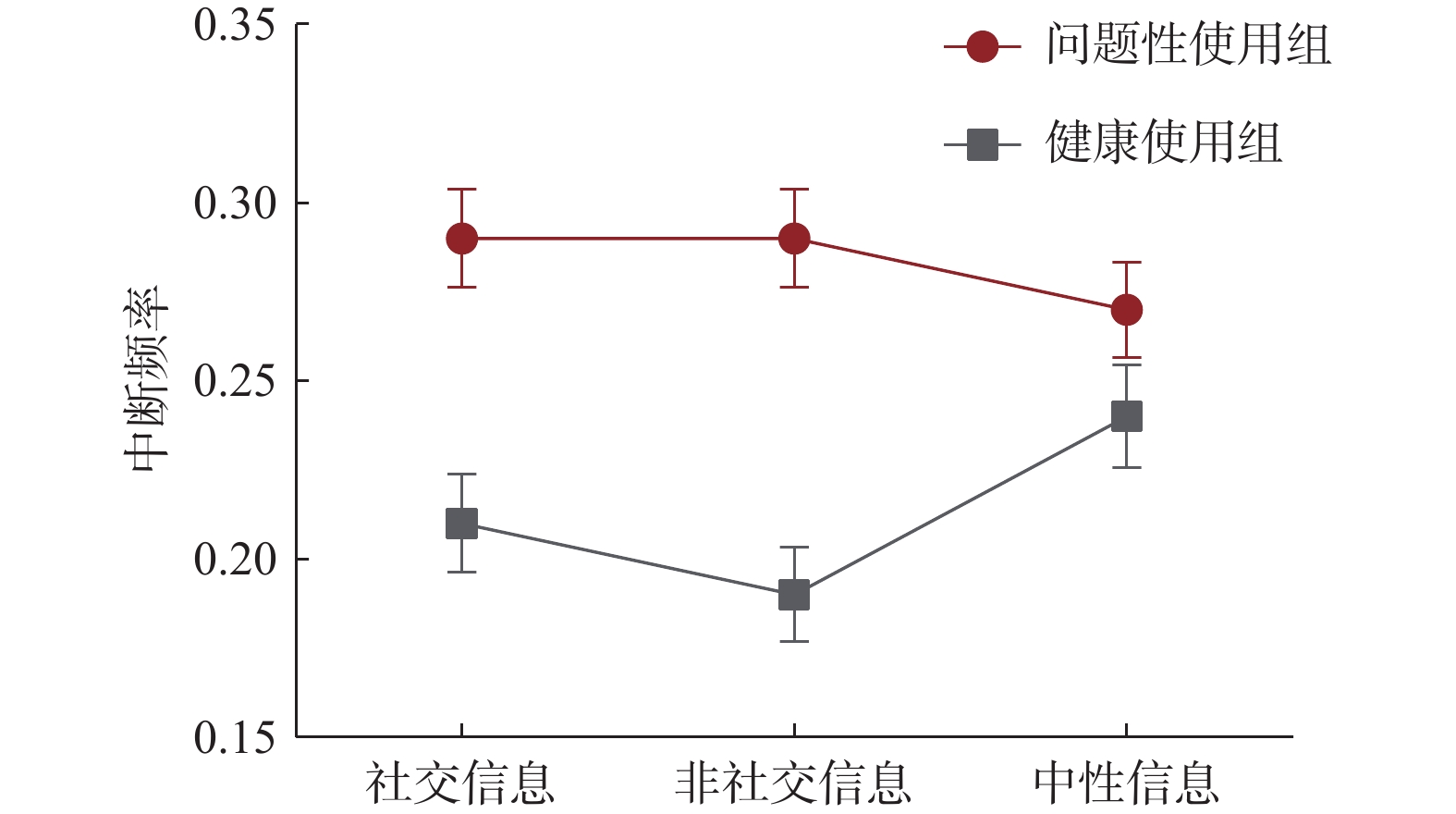
| 被试类型 | 信息类型 | 中断频率 | 眼跳平均速度(°/s) |
| 社交 | 0.29 (0.01) | 186.40 (4.24) | |
| 问题性使用组 | 非社交 | 0.29 (0.01) | 170.51 (3.49) |
| 中性 | 0.27 (0.01) | 182.97 (4.29) | |
| 社交 | 0.21 (0.01) | 184.68 (4.56) | |
| 健康使用组 | 非社交 | 0.19 (0.01) | 194.47 (5.55) |
| 中性 | 0.24 (0.01) | 183.15 (4.61) |
| 变量 | b | SE | z/t | p | 95%CI |
| 中断频率 | |||||
| 截距 | −1.41 | 0.15 | −9.28 | <0.001 | [−1.70, −1.11] |
| 被试类型 | 0.53 | 0.30 | 1.76 | 0.078 | [−0.06, 1.11] |
| 社交−非社交 | 0.05 | 0.10 | 0.50 | 0.620 | [−0.15, 0.24] |
| 社交−中性 | −0.05 | 0.10 | −0.55 | 0.584 | [−0.25, 0.14] |
| 非社交−中性 | −0.10 | 0.10 | −1.04 | 0.298 | [−0.30, 0.09] |
| 被试类型× 社交−非社交 | −0.09 | 0.17 | −0.53 | 0.595 | [−0.42, 0.24] |
| 被试类型× 社交−中性 | 0.39 | 0.17 | 2.34 | 0.019 | [0.06, 0.71] |
| 被试类型× 非社交−中性 | 0.48 | 0.17 | 2.86 | 0.004 | [0.15, 0.80] |
| 眼跳平均速度 | |||||
| 截距 | 182.37 | 3.83 | 47.68 | <0.001 | [174.88, 189.87] |
| 被试类型 | −8.80 | 5.96 | −1.48 | 0.147 | [−20.48, 2.88] |
| 社交−非社交 | 2.36 | 6.10 | 0.39 | 0.700 | [−9.60, 14.31] |
| 社交−中性 | 3.41 | 6.05 | 0.56 | 0.574 | [−8.45, 15.27] |
| 非社交−中性 | 1.06 | 6.26 | 0.17 | 0.866 | [−11.22, 13.34] |
| 被试类型× 社交−非社交 | 24.71 | 7.95 | 3.11 | 0.002 | [9.13, 40.28] |
| 被试类型× 社交−中性 | 2.83 | 7.65 | 0.37 | 0.712 | [−12.17, 17.83] |
| 被试类型× 非社交−中性 | −21.88 | 7.92 | −2.76 | 0.006 | [−37.40, −6.36] |
| 变量 | b | SE | z/t | p | 95%CI |
| 中断频率 | |||||
| 截距 | −1.41 | 0.15 | −9.28 | <0.001 | [−1.70, −1.11] |
| 被试类型 | 0.53 | 0.30 | 1.76 | 0.078 | [−0.06, 1.11] |
| 社交−非社交 | 0.05 | 0.10 | 0.50 | 0.620 | [−0.15, 0.24] |
| 社交−中性 | −0.05 | 0.10 | −0.55 | 0.584 | [−0.25, 0.14] |
| 非社交−中性 | −0.10 | 0.10 | −1.04 | 0.298 | [−0.30, 0.09] |
| 被试类型× 社交−非社交 | −0.09 | 0.17 | −0.53 | 0.595 | [−0.42, 0.24] |
| 被试类型× 社交−中性 | 0.39 | 0.17 | 2.34 | 0.019 | [0.06, 0.71] |
| 被试类型× 非社交−中性 | 0.48 | 0.17 | 2.86 | 0.004 | [0.15, 0.80] |
| 眼跳平均速度 | |||||
| 截距 | 182.37 | 3.83 | 47.68 | <0.001 | [174.88, 189.87] |
| 被试类型 | −8.80 | 5.96 | −1.48 | 0.147 | [−20.48, 2.88] |
| 社交−非社交 | 2.36 | 6.10 | 0.39 | 0.700 | [−9.60, 14.31] |
| 社交−中性 | 3.41 | 6.05 | 0.56 | 0.574 | [−8.45, 15.27] |
| 非社交−中性 | 1.06 | 6.26 | 0.17 | 0.866 | [−11.22, 13.34] |
| 被试类型× 社交−非社交 | 24.71 | 7.95 | 3.11 | 0.002 | [9.13, 40.28] |
| 被试类型× 社交−中性 | 2.83 | 7.65 | 0.37 | 0.712 | [−12.17, 17.83] |
| 被试类型× 非社交−中性 | −21.88 | 7.92 | −2.76 | 0.006 | [−37.40, −6.36] |

|
白学军, 刘娟, 臧传丽, 张慢慢, 郭晓峰, 闫国利. 中文阅读过程中的副中央凹预视效应. 心理科学进展, 2011, 19 (12): 1721- 1729.
|
|
|
贺金波, 聂余峰, 周宗奎, 柴瑶. 网络游戏成瘾与海洛因成瘾存在相同的神经机制吗?——基于MRI的证据. 心理科学进展, 2017, 25 (8): 1327- 1336.
|
|
|
刘勤学, 张聚媛, 林悦. 大学生智能手机成瘾与抑制控制能力的关系: 手机位置和认知负荷的调节作用. 心理发展与教育, 2021, 37 (2): 257- 265.
|
|
|
Andreassen, C. S., Billieux, J., Griffiths, M. D., Kuss, D. J., Demetrovics, Z., Mazzoni, E., & Pallesen, S. The relationship between addictive use of social media and video games and symptoms of psychiatric disorders: A large-scale cross-sectional study. Psychology of Addictive Behaviors, 2016, 30 (2): 252- 262.
DOI |
|
|
Andreassen, C. S., & Pallesen, S. Social network site addiction—An overview. Current Pharmaceutical Design, 2014, 20 (25): 4053- 4061.
DOI |
|
|
Arness, D. C., & Ollis, T. A mixed-methods study of problematic social media use, attention dysregulation, and social media use motives. Current Psychology, 2023, 42 (28): 24379- 24398.
DOI |
|
|
Aydın, O., Obuća, F., Boz, C., & Ünal-Aydın, P. Associations between executive functions and problematic social networking sites use. Journal of Clinical and Experimental Neuropsychology, 2020, 42 (6): 634- 645.
DOI |
|
|
Bates, D., Mächler, M., Bolker, B. M., & Walker, S. C. Fitting linear mixed-effects models using lme4. Journal of Statistical Software, 2015, 67 (1): 1- 48.
|
|
|
Botvinick, M. M., Braver, T. S., Barch, D. M., Carter, C. S., & Cohen, J. D. Conflict monitoring and cognitive control. Psychological Review, 2001, 108 (3): 624- 652.
DOI |
|
|
Brand, M. Can Internet use become addictive. Science, 2022, 376 (6595): 798- 799.
DOI |
|
|
Brand, M., Wegmann, E., Stark, R., Müller, A., Wölfling, K., Robbins, T. W., & Potenza, M. N. The interaction of person-affect-cognition-execution (I-PACE) model for addictive behaviors: Update, generalization to addictive behaviors beyond internet-use disorders, and specification of the process character of addictive behaviors. Neuroscience & Biobehavioral Reviews, 2019, 104, 1- 10.
|
|
|
Brand, M., Young, K. S., Laier, C., Wölfling, K., & Potenza, M. N. Integrating psychological and neurobiological considerations regarding the development and maintenance of specific internet-use disorders: An interaction of person-affect-cognition-execution (I-PACE) model. Neuroscience & Biobehavioral Reviews, 2016, 71, 252- 266.
|
|
|
Chen, J. W., Liang, Y. S., Mai, C. M., Zhong, X. Y., & Qu, C. General deficit in inhibitory control of excessive smartphone users: Evidence from an event-related potential study. Frontiers in Psychology, 2016, 7, 511.
|
|
|
Clauss, K., Bardeen, J. R., Gordon, R. D., & Daniel, T. A. Increasing cognitive load attenuates the moderating effect of attentional inhibition on the relationship between posttraumatic stress symptoms and threat-related attention bias variability. Journal of Anxiety Disorders, 2021, 81, 102416.
DOI |
|
|
Di Stasi, L. L., Catena, A., Cañas, J. J., Macknik, S. L., & Martinez-Conde, S. Saccadic velocity as an arousal index in naturalistic tasks. Neuroscience & Biobehavioral Reviews, 2013, 37 (5): 968- 975.
|
|
|
Dong, G. H., Lin, X., Hu, Y. B., Xie, C. M., & Du, X. X. Imbalanced functional link between executive control network and reward network explain the online-game seeking behaviors in internet gaming disorder. Scientific Reports, 2015, 5 (1): 9197.
DOI |
|
|
Field, M., Munafò, M. R., & Franken, I. H. A. A meta-analytic investigation of the relationship between attentional bias and subjective craving in substance abuse. Psychological Bulletin, 2009, 135 (4): 589- 607.
DOI |
|
|
Gao, L. F., Zhang, J. F., Xie, H. P., Nie, Y. F., Zhao, Q. B., & Zhou, Z. K. Effect of the mobile phone-related background on inhibitory control of problematic mobile phone use: An event-related potentials study. Addictive Behaviors, 2020, 108, 106363.
DOI |
|
|
Kim, M., Lee, T. H., Choi, J. S., Kwak, Y. B., Hwang, W. J., Kim, T., … Kwon, J. S. Dysfunctional attentional bias and inhibitory control during anti-saccade task in patients with internet gaming disorder: An eye tracking study. Progress in Neuro-Psychopharmacology and Biological Psychiatry, 2019, 95, 109717.
DOI |
|
|
Leung, H., Pakpour, A. H., Strong, C., Lin, Y. C., Tsai, M. C., Griffiths, M. D., … Chen, I. H. Measurement invariance across young adults from Hong Kong and Taiwan among three internet-related addiction scales: Bergen Social Media Addiction Scale (BSMAS), Smartphone Application-Based Addiction Scale (SABAS), and Internet Gaming Disorder Scale-Short Form (IGDS-SF9) (study part A). Addictive Behaviors, 2020, 101, 105969.
DOI |
|
|
Luo, T., Qin, L. X., Cheng, L. M., Wang, S., Zhu, Z. J., Xu, J. B., … Liao, Y. H. Determination the cut-off point for the Bergen Social Media Addiction (BSMAS): Diagnostic contribution of the six criteria of the components model of addiction for social media disorder. Journal of Behavioral Addictions, 2021, 10 (2): 281- 290.
DOI |
|
|
Maza, M. T., Fox, K. A., Kwon, S. J., Flannery, J. E., Lindquist, K. A., Prinstein, M. J., & Telzer, E. H. Association of habitual checking behaviors on social media with longitudinal functional brain development. JAMA Pediatrics, 2023, 177 (2): 160- 167.
DOI |
|
|
Müller, S. M., Wegmann, E., Arias, M. G., Brotóns, E. B., Giráldez, C. M., & Brand, M. Deficits in executive functions but not in decision making under risk in individuals with problematic social-network use. Comprehensive Psychiatry, 2021, 106, 152228.
DOI |
|
|
Nikolaidou, M., Fraser, D. S., & Hinvest, N. Attentional bias in internet users with problematic use of social networking sites. Journal of Behavioral Addictions, 2019, 8 (4): 733- 742.
DOI |
|
|
R Development Core Team. (2020). R: A language and environment for statistical computing. Vienna, Austria: R Foundation for Statistical Computing.
|
|
|
Robinson, T. E., & Berridge, K. C. The incentive sensitization theory of addiction: Some current issues. Philosophical Transactions of the Royal Society B: Biological Sciences, 2008, 363 (1507): 3137- 3146.
DOI |
|
|
Sedaghat-Nejad, E., Herzfeld, D. J., & Shadmehr, R. Reward prediction error modulates saccade vigor. The Journal of Neuroscience, 2019, 39 (25): 5010- 5017.
DOI |
|
|
Wegmann, E., & Brand, M. Cognitive correlates in gaming disorder and social networks use disorder: A comparison. Current Addiction Reports, 2020, 7 (3): 356- 364.
DOI |
|
|
Wegmann, E., & Brand, M. Affective and cognitive processes involved in behavioral addictions. Addictive Behaviors, 2021, 118, 106885.
DOI |
|
|
Wilcockson, T. D. W., Pothos, E. M., Osborne, A. M., & Crawford, T. J. Top-down and bottom-up attentional biases for smoking-related stimuli: Comparing dependent and non-dependent smokers. Addictive Behaviors, 2021, 118, 106886.
DOI |
|
|
Xie, J. Q., Rost, D. H., Wang, F. X., Wang, J. L., & Monk, R. L. The association between excessive social media use and distraction: An eye movement tracking study. Information & Management, 2021, 58 (2): 103415.
|
|
|
Zilverstand, A., Huang, A. S., Alia-Klein, N., & Goldstein, R. Z. Neuroimaging impaired response inhibition and salience attribution in human drug addiction: A systematic review. Neuron, 2018, 98 (5): 886- 903.
DOI |
| [1] | Yake WANG, Yuxuan ZHANG, Linlin FENG, Mingfang KA, Feifei LIANG. Developmental Trajectories of Eye Movement in Reading Among Third- to Fifth-Grade Children and Their Relationship with Reading Comprehension [J]. Studies of Psychology and Behavior, 2026, 24(2): 161-169. |
| [2] | Xiaoqian DING, Huayu LIU. The Dual-Path Mechanisms of Social Exclusion on Individuals’ Social Behaviors: The Roles of Negative Perfectionism and Attentional Bias [J]. Studies of Psychology and Behavior, 2026, 24(1): 51-59. |
| [3] | Wenjing LI, Wen SUN, Haidi ZHU. The Influence of Popular Background Music on Leisure Reading: Evidence from Eye Movements [J]. Studies of Psychology and Behavior, 2025, 23(4): 448-455. |
| [4] | Yufei DU, Zhichao ZHANG, Manman ZHANG, Chuanli ZANG. Semantics Takes Precedence over World Knowledge in Sentence Comprehension: Evidence from Eye Movements [J]. Studies of Psychology and Behavior, 2025, 23(2): 153-160. |
| [5] | Yongsheng WANG, Yang HAN, Xin LI, Liyuan HE. The Promotion of Inter-Word Space in Chinese Sentence Reading of Uyghur College Students with Different Text Presentation Directions [J]. Studies of Psychology and Behavior, 2025, 23(1): 41-48. |
| [6] | Xiangwen CHEN, Longge WANG, Huilan HU, Zhichao ZHANG, Mengsi WANG, Qiang WANG, Manman ZHANG. The Neural Structural Basis of Individual Differences in Word Frequency Effect on Eye Movement Measures During Chinese Reading [J]. Studies of Psychology and Behavior, 2024, 22(6): 721-729. |
| [7] | Guang ZHAO, Jiahuan CHEN, Linxuan LI, Jichao ZHANG, Rongtao WU. The Dynamic Eye Movement Patterns in Contextual Cueing Effect: Evidence from the Hidden Markov Model [J]. Studies of Psychology and Behavior, 2024, 22(5): 594-601. |
| [8] | Yuqing JIA, Tongqi GAO, Guoli YAN. Eye Movements in Silent and Oral Sentence Reading Among Chinese First Graders [J]. Studies of Psychology and Behavior, 2024, 22(5): 633-641. |
| [9] | Yongsheng WANG, Na ZHANG, Xiaopu DU, Zilu GUO, Xin LI. The Role of Morphological Awareness in Reading of Chinese Second Language Learners [J]. Studies of Psychology and Behavior, 2024, 22(4): 450-456. |
| [10] | Jinkun ZHANG, Tingming LAI, Xiaoqi ZAN, Sha LI, Kunyu LIAN, Lijuan ZHANG. The Disfluency Effect in Multimedia Learning: Balancing Cues and Fluency [J]. Studies of Psychology and Behavior, 2024, 22(4): 545-552. |
| [11] | Wen ZHANG, Chao KAN, Limin GUO, Zhihe LIU, Yang LIU. A Study on the Cognitive Processing Characteristics of Perceptual Anticipation in Volleyball Players’ Reception of Smashes: Correlated Evidence from Eye Movements and fNIRS [J]. Studies of Psychology and Behavior, 2024, 22(4): 562-569. |
| [12] | Yingchao WANG, Sainan LI, Ziming SONG, Guoli YAN. The Influence of Reading Mode on Word Frequency Effect in Chinese Sentence Reading [J]. Studies of Psychology and Behavior, 2024, 22(2): 183-188, 226. |
| [13] | Ruqi CHEN, Yaqian BAO, Linjieqiong HUANG, Xingshan LI. An Introduction to the Chinese Reading Model (CRM) [J]. Studies of Psychology and Behavior, 2023, 21(6): 725-735. |
| [14] | Miao YU, Wendi WANG, Xiaoxiao CHEN. Prosodic Constraints in Chinese “N de V” Construction [J]. Studies of Psychology and Behavior, 2023, 21(6): 744-750. |
| [15] | Jinglei YAN, Miaomiao FU, Bei HUANG, Shuailei LIAN. Problematic Social Media Use and Subjective Well-Being: The Chain Mediating Role of Technology Conflict and Fatigue [J]. Studies of Psychology and Behavior, 2023, 21(6): 824-831. |
| Viewed | ||||||
|
Full text |
|
|||||
|
Abstract |
|
|||||
