
Studies of Psychology and Behavior ›› 2026, Vol. 24 ›› Issue (3): 335-342.DOI: 10.12139/j.1672-0628.2026.03.007
• ? • Previous Articles Next Articles
Haiyan ZHAO1,2, Yan MA1, Aibao ZHOU*,2( )
)
Received:2025-05-07
Online:2026-05-20
Published:2026-05-20
Contact:
Aibao ZHOU
赵海燕1,2, 马燕1, 周爱保*,2()
通讯作者:
周爱保
基金资助:CLC Number:
Haiyan ZHAO, Yan MA, Aibao ZHOU. Developmental Trajectories of Adolescent Resilience and the Role of Gender: A Dynamic Developmental Approach[J]. Studies of Psychology and Behavior, 2026, 24(3): 335-342.
赵海燕, 马燕, 周爱保. 青少年心理复原力的发展趋势及性别的作用:基于动态发展视角[J]. 心理与行为研究, 2026, 24(3): 335-342.
Add to citation manager EndNote|Ris|BibTeX
URL: https://psybeh.tjnu.edu.cn/EN/10.12139/j.1672-0628.2026.03.007
| 变量 | 测量工具 | 题项数 | 计分方式 | Α(T0/T1/T2/T3) | 结构效度 |
| 父母婚姻冲突 | 儿童对婚姻冲突的感知量表−冲突频率、冲突强度和冲突解决 ( | 13 | 1~4点 | 0.91/0.95/0.96/0.95 | χ2/df=11.84, CFI=0.96, TLI=0.94, RMSEA=0.08 |
| 亲子关系 | 亲子亲密度量表 ( | 9 | 1~5点 (反向计分) | 0.88/0.91/0.92/0.92 | χ2/df=18.25, CFI=0.94, TLI=0.93, RMSEA=0.09 |
| 消极教养方式 | 简式父母教养方式问卷−消极教养方式维度 ( | 12 | 1~4点 | 0.87/0.91/0.91/0.91 | χ2/df=8.70, CFI=0.95, TLI=0.93, RMSEA=0.07 |
| 学校联结 | 积极青少年发展量表−学校联结子量表 ( | 6 | 1~5点 (反向计分) | 0.86/0.86/0.85/0.86 | χ2/df=12.64, CFI=0.93, TLI=0.90, RMSEA=0.08 |
| 师生冲突 | 师生关系问卷−冲突性维度 ( | 6 | 1~5点 | 0.80/0.82/0.84/0.83 | χ2/df=10.36, CFI=0.98, TLI=0.95, RMSEA=0.07 |
| 同伴拒绝 | 领悟社会支持量表−朋友支持分量表 ( | 4 | 1~7点 | 0.81/0.84/0.84/0.84 | χ2/df=7.33, CFI=0.99, TLI=0.98, RMSEA=0.06 |
| 学业压力 | 学习的付出−回馈失衡评价量表 ( | 12 | 0~3点 | 0.88/0.92/0.91/0.91 | χ2/df=10.33, CFI=0.94, TLI=0.93, RMSEA=0.07 |
| 社会逆境 | 社会逆境感知问卷 ( | 10 | 1~5点 | 0.88/0.90/0.90/0.90 | χ2/df=15.84, CFI=0.95, TLI=0.92, RMSEA=0.09 |
| 童年不良经历 | 儿童期不良经历问卷 ( | 14 | 是/否 | 0.80/0.82/0.82/0.80 | χ2/df=6.66, CFI=0.91, TLI=0.90, RMSEA=0.06 |
| 心理症状 | 简易症状自评量表 ( | 18 | 0~4点 | 0.94/0.94/0.95/0.95 | χ2/df=12.64, CFI=0.92, TLI=0.91, RMSEA=0.08 |
| 非自杀性自伤行为 | 青少年非自杀性自伤行为评定问卷−行为问卷 ( | 12 | 0~4点 | 0.92/0.94/0.91/0.94 | χ2/df=13.54, CFI=0.90, TLI=0.89, RMSEA=0.05 |
| 变量 | 测量工具 | 题项数 | 计分方式 | Α(T0/T1/T2/T3) | 结构效度 |
| 父母婚姻冲突 | 儿童对婚姻冲突的感知量表−冲突频率、冲突强度和冲突解决 ( | 13 | 1~4点 | 0.91/0.95/0.96/0.95 | χ2/df=11.84, CFI=0.96, TLI=0.94, RMSEA=0.08 |
| 亲子关系 | 亲子亲密度量表 ( | 9 | 1~5点 (反向计分) | 0.88/0.91/0.92/0.92 | χ2/df=18.25, CFI=0.94, TLI=0.93, RMSEA=0.09 |
| 消极教养方式 | 简式父母教养方式问卷−消极教养方式维度 ( | 12 | 1~4点 | 0.87/0.91/0.91/0.91 | χ2/df=8.70, CFI=0.95, TLI=0.93, RMSEA=0.07 |
| 学校联结 | 积极青少年发展量表−学校联结子量表 ( | 6 | 1~5点 (反向计分) | 0.86/0.86/0.85/0.86 | χ2/df=12.64, CFI=0.93, TLI=0.90, RMSEA=0.08 |
| 师生冲突 | 师生关系问卷−冲突性维度 ( | 6 | 1~5点 | 0.80/0.82/0.84/0.83 | χ2/df=10.36, CFI=0.98, TLI=0.95, RMSEA=0.07 |
| 同伴拒绝 | 领悟社会支持量表−朋友支持分量表 ( | 4 | 1~7点 | 0.81/0.84/0.84/0.84 | χ2/df=7.33, CFI=0.99, TLI=0.98, RMSEA=0.06 |
| 学业压力 | 学习的付出−回馈失衡评价量表 ( | 12 | 0~3点 | 0.88/0.92/0.91/0.91 | χ2/df=10.33, CFI=0.94, TLI=0.93, RMSEA=0.07 |
| 社会逆境 | 社会逆境感知问卷 ( | 10 | 1~5点 | 0.88/0.90/0.90/0.90 | χ2/df=15.84, CFI=0.95, TLI=0.92, RMSEA=0.09 |
| 童年不良经历 | 儿童期不良经历问卷 ( | 14 | 是/否 | 0.80/0.82/0.82/0.80 | χ2/df=6.66, CFI=0.91, TLI=0.90, RMSEA=0.06 |
| 心理症状 | 简易症状自评量表 ( | 18 | 0~4点 | 0.94/0.94/0.95/0.95 | χ2/df=12.64, CFI=0.92, TLI=0.91, RMSEA=0.08 |
| 非自杀性自伤行为 | 青少年非自杀性自伤行为评定问卷−行为问卷 ( | 12 | 0~4点 | 0.92/0.94/0.91/0.94 | χ2/df=13.54, CFI=0.90, TLI=0.89, RMSEA=0.05 |
| 变量 | 1 | 2 | 3 | 4 | 5 | 6 |
| 1.心理复原力T1 | ||||||
| 2.心理复原力T2 | 0.43** | |||||
| 3.心理复原力T3 | 0.34** | 0.42** | ||||
| 4.年级 | −0.10** | −0.12** | −0.17** | |||
| 5.性别 | −0.02 | −0.05* | −0.08** | 0.03 | ||
| 6.独生子女身份 | −0.04 | −0.05 | −0.02 | 0.21** | −0.08** | |
| 7.家庭结构类型 | 0.01 | 0.03 | 0.01 | 0.01 | 0.05 | 0.17** |
| M | 1.93 | 2.10 | 2.52 | |||
| SD | 0.67 | 0.72 | 0.90 |
| 变量 | 1 | 2 | 3 | 4 | 5 | 6 |
| 1.心理复原力T1 | ||||||
| 2.心理复原力T2 | 0.43** | |||||
| 3.心理复原力T3 | 0.34** | 0.42** | ||||
| 4.年级 | −0.10** | −0.12** | −0.17** | |||
| 5.性别 | −0.02 | −0.05* | −0.08** | 0.03 | ||
| 6.独生子女身份 | −0.04 | −0.05 | −0.02 | 0.21** | −0.08** | |
| 7.家庭结构类型 | 0.01 | 0.03 | 0.01 | 0.01 | 0.05 | 0.17** |
| M | 1.93 | 2.10 | 2.52 | |||
| SD | 0.67 | 0.72 | 0.90 |
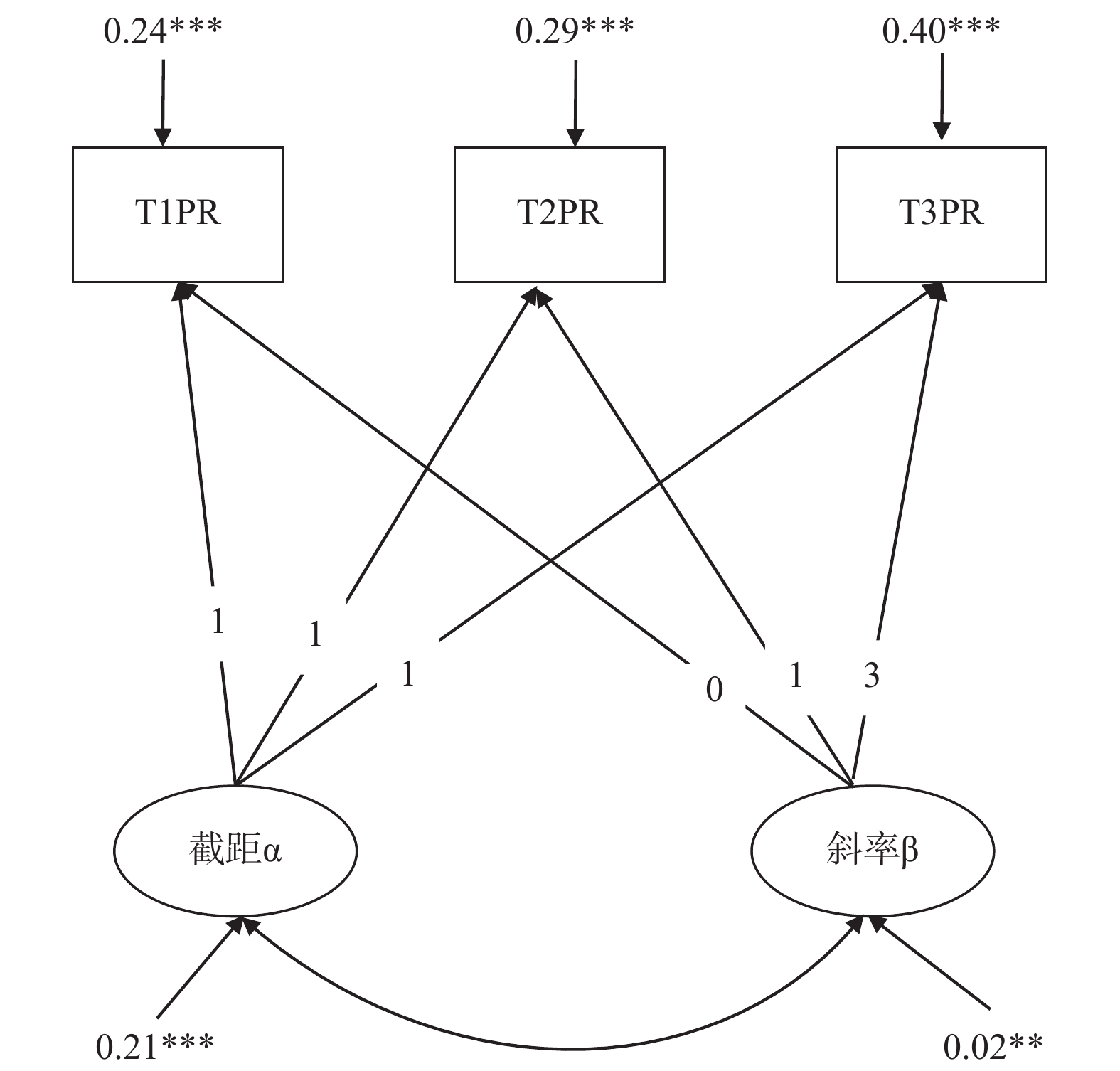
| 变量 | 截距 | 斜率 | |||
| β | SE | β | SE | ||
| 年级 | −0.14*** | 0.03 | −0.19*** | 0.05 | |
| 性别 | −0.04 | 0.03 | −0.11* | 0.05 | |
| 独生子女身份 | −0.06 | 0.04 | 0.06 | 0.05 | |
| 家庭结构类型 | 0.03 | 0.03 | 0.01 | 0.05 | |
| 变量 | 截距 | 斜率 | |||
| β | SE | β | SE | ||
| 年级 | −0.14*** | 0.03 | −0.19*** | 0.05 | |
| 性别 | −0.04 | 0.03 | −0.11* | 0.05 | |
| 独生子女身份 | −0.06 | 0.04 | 0.06 | 0.05 | |
| 家庭结构类型 | 0.03 | 0.03 | 0.01 | 0.05 | |
|
陈程, 陈方方, 刘晓宇, 杨一飞, 吴明飞. 大学生神经质与抑郁的关系: 人际关系敏感和性别的作用. 中国健康心理学杂志, 2020, 28 (7): 1095- 1100.
DOI |
|
|
陈子循, 李金文, 王雨萌, 刘霞. 累积环境风险与大学生自伤的关系: 情绪调节策略的作用. 心理发展与教育, 2023, 39 (1): 109- 120.
DOI |
|
|
池丽萍, 辛自强. 儿童对婚姻冲突的感知量表修订. 中国心理卫生杂志, 2003, 17 (8): 554- 556.
DOI |
|
|
楚克群, 王志卉, 马超超, 宋国萍. 学习的付出-回馈失衡评价量表的修订. 中国心理卫生杂志, 2015, 29 (11): 848- 851.
|
|
|
蒋奖, 鲁峥嵘, 蒋苾菁, 许燕. 简式父母教养方式问卷中文版的初步修订. 心理发展与教育, 2010, 26 (1): 94- 99.
|
|
|
李国强, 陈杰, 王旭红, 谢四元. 348例9~16岁城乡结合部青少年家庭社会资本与心理弹性关系. 中国健康心理学杂志, 2018, 26 (5): 753- 756.
|
|
|
马文燕, 高朋, 黄大炜, 邹维兴. 留守青少年疏离感对心理韧性的影响: 领悟社会支持和自尊的链式中介作用. 中国健康心理学杂志, 2022, 30 (1): 148- 152.
|
|
|
生笑笑, 李静雅, 牛骅, 王美芳. 父母严厉管教与青少年外化问题行为的关系: 青春发育时相与性别的调节作用. 中国临床心理学杂志, 2019, 27 (6): 1199- 1204, 1209.
DOI |
|
|
万宇辉, 刘婉, 郝加虎, 陶芳标. 青少年非自杀性自伤行为评定问卷的编制及其信效度评价. 中国学校卫生, 2018, 39 (2): 170- 173.
|
|
|
王艳荣, 林萍珍, 曹枫林. 中文儿童期不良经历问卷修订版的效度与信度. 中国心理卫生杂志, 2018, 32 (9): 760- 764.
|
|
|
王玉龙, 王丹云, 舒梓玥, 贺娟. 父母粗暴养育对早期青少年自杀意念的影响: 心理韧性的纵向调节作用. 中国临床心理学杂志, 2024, 32 (3): 549- 554.
|
|
|
张峰, 张永水, 孙厚才. 农民工随迁子女一般自我效能感与主观幸福感的关系: 心理韧性的中介作用. 中国特殊教育, 2016, (2): 63- 68.
DOI |
|
|
张锦涛, 刘勤学, 邓林园, 方晓义, 刘朝莹, 兰菁. 青少年亲子关系与网络成瘾: 孤独感的中介作用. 心理发展与教育, 2011, 27 (6): 641- 647.
DOI |
|
|
邹泓, 屈智勇, 叶苑. 中小学生的师生关系与其学校适应. 心理发展与教育, 2007, 23 (4): 77- 82.
|
|
|
Alessandri, G., Eisenberg, N., Vecchione, M., Caprara, G. V., & Milioni, M. Ego-resiliency development from late adolescence to emerging adulthood: A ten-year longitudinal study. Journal of Adolescence, 2016, 50 (1): 91- 102.
DOI |
|
|
Bergeman, C. S., & Nelson, N. A. Building a dynamic adaptational process theory of resilience (ADAPTOR): Stress exposure, reserve capacity, adaptation, and consequence. American Psychologist, 2024, 79 (8): 1063- 1075.
DOI |
|
|
Borsboom, D. A network theory of mental disorders. World Psychiatry, 2017, 16 (1): 5- 13.
DOI |
|
|
Cajada, L., Stephenson, Z., & Bishopp, D. Exploring the psychometric properties of the Resilience Scale. Adversity and Resilience Science, 2023, 4 (3): 245- 257.
DOI |
|
|
Chai, X. Y., Wang, J., Li, X. Y., Liu, W., Zhao, G. X., & Lin, D. H. Development and validation of the Chinese Positive Youth Development Scale. Applied Developmental Science, 2022, 26 (1): 127- 140.
DOI |
|
|
Derogatis, L. R. (2001). Brief Symptom Inventory (BSI) 18: Administration, scoring and procedure manual. Minneapolis, MN: Pearson.
|
|
|
Dutcher, J. M., & Creswell, J. D. The role of brain reward pathways in stress resilience and health. Neuroscience & Biobehavioral Reviews, 2018, 95, 559- 567.
DOI |
|
|
Eagly, A. H., & Wood, W. (2012). Social role theory. In P. A. M. Van Lange, A. W. Kruglanski, & E. T. Higgins (Eds.), Handbook of theories of social psychology (pp. 458–476). Thousand Oaks, CA: Sage Publications Ltd.
|
|
|
Eshel, Y., & Majdoob, H. Posttraumatic recovery to distress symptoms ratio: A mediator of the links between gender, exposure to fire, economic condition, and three indices of resilience to fire disaster. Community Mental Health Journal, 2014, 50 (8): 997- 1003.
DOI |
|
|
Happer, K., Brown, E. J., & Sharma-Patel, K. Children’s resilience and trauma-specific cognitive behavioral therapy: Comparing resilience as an outcome, a trait, and a process. Child Abuse & Neglect, 2017, 73, 30- 41.
DOI |
|
|
Heiman, T. Examination of the salutogenic model, support resources, coping style, and stressors among Israeli university students. The Journal of Psychology, 2004, 138 (6): 505- 520.
DOI |
|
|
Heller, A. S., Cohen, A. O., Dreyfuss, M. F. W., & Casey, B. J. Changes in cortico-subcortical and subcortico-subcortical connectivity impact cognitive control to emotional cues across development. Social Cognitive and Affective Neuroscience, 2016, 11 (12): 1910- 1918.
DOI |
|
|
Hu, T. Q., Zhang, D. J., & Wang, J. L. A meta-analysis of the trait resilience and mental health. Personality and Individual Differences, 2015, 76, 18- 27.
DOI |
|
|
Kairyte, A., Truskauskaite, I., Daniunaite, I., Gelezelyte, O., & Zelviene, P. Resilience trajectories and links with childhood maltreatment in adolescence: A latent growth modeling approach. Child and Adolescent Psychiatry and Mental Health, 2023, 17 (1): 10.
DOI |
|
|
Kalisch, R., Müller, M. B., & Tüscher, O. A conceptual framework for the neurobiological study of resilience. Behavioral and Brain Sciences, 2015, 38, e92.
DOI |
|
|
Köber, G., Pooseh, S., Engen, H., Chmitorz, A., Kampa, M., Schick, A., … Binder, H. Individualizing deep dynamic models for psychological resilience data. Scientific Reports, 2022, 12 (1): 8061.
DOI |
|
|
Lighthall, N. R., Sakaki, M., Vasunilashorn, S., Nga, L., Somayajula, S., Chen, E. Y., ... Mather, M. Gender differences in reward-related decision processing under stress. Social Cognitive and Affective Neuroscience, 2012, 7 (4): 476- 484.
DOI |
|
|
Lightsey, O. R., Jr, & Smith IV, B. N. Resilience, generalized self-efficacy, and mindfulness as moderators of the relationship between stress and well-being. Journal of Cognitive Psychotherapy, 2024, 38 (1): 3- 23.
DOI |
|
|
Malhi, G. S., Das, P., Bell, E., Mattingly, G., & Mannie, Z. Modelling resilience in adolescence and adversity: A novel framework to inform research and practice. Translational Psychiatry, 2019, 9 (1): 316.
DOI |
|
|
Matud, M. P. Gender differences in stress and coping styles. Personality and Individual Differences, 2004, 37 (7): 1401- 1415.
DOI |
|
|
McEwen, B. S. Glucocorticoids, depression, and mood disorders: Structural remodeling in the brain. Metabolism, 2005, 54 (5): 20- 23.
DOI |
|
|
Notebaert, L., Clarke, P. J. F., Meeten, F., Todd, J., & van Bockstaele, B. (2025). Cognitive flexibility and resilience measured through a residual approach. Anxiety, Stress, & Coping, 38(1), 125–139.
|
|
|
Paus, T., Keshavan, M., & Giedd, J. N. Why do many psychiatric disorders emerge during adolescence. Nature Reviews Neuroscience, 2008, 9 (12): 947- 957.
DOI |
|
|
Petri-Romão, P., Mediavilla, R., Restrepo-Henao, A., Puhlmann, L. M., Zerban, M., Ahrens, K. F., … Kalisch, R. Positive appraisal style predicts long-term stress resilience and mediates the effect of a pro-resilience intervention. Nature Communications, 2025, 16 (1): 10269.
DOI |
|
|
Renk, K., & Creasey, G. The relationship of gender, gender identity, and coping strategies in late adolescents. Journal of Adolescence, 2003, 26 (2): 159- 168.
DOI |
|
|
Romeo, R. D. Perspectives on stress resilience and adolescent neurobehavioral function. Neurobiology of Stress, 2015, 1, 128- 133.
DOI |
|
|
Sowell, E. R., Thompson, P. M., Welcome, S. E., Henkenius, A. L., Toga, A. W., & Peterson, B. S. Cortical abnormalities in children and adolescents with attention-deficit hyperactivity disorder. The Lancet, 2003, 362 (9397): 1699- 1707.
DOI |
|
|
Thakkar, K. N., McCleery, A., Minor, K. S., Lee, J., Humpston, C. S., Chopik, W. J., ... Park, S. Moving from risk to resilience in psychosis research. Nature Reviews Psychology, 2023, 2 (9): 537- 555.
DOI |
|
|
Tusaie, K., Puskar, K., & Sereika, S. M. A predictive and moderating model of psychosocial resilience in adolescents. Journal of Nursing Scholarship, 2007, 39 (1): 54- 60.
DOI |
|
|
Wang, P. C., Li, R. H., & Chen, Y. H. (2025). Longitudinal trajectories of psychological resilience and cognitive impairment among older adults: Evidence from a national cohort study. The Journals of Gerontology. Series B, Psychological Sciences and Social Sciences, 80(6), gbaf035.
|
|
|
Wang, S., Yang, C., Zhao, Y. J., Lai, H., Zhang, L., & Gong, Q. Y. Sex-linked neurofunctional basis of psychological resilience in late adolescence: A resting-state functional magnetic resonance imaging study. European Child & Adolescent Psychiatry, 2020, 29 (8): 1075- 1087.
DOI |
|
|
Yalcin-Siedentopf, N., Pichler, T., Welte, A. S., Hoertnagl, C. M., Klasen, C. C., Kemmler, G., ... Hofer, A. Sex matters: Stress perception and the relevance of resilience and perceived social support in emerging adults. Archives of Women’s Mental Health, 2021, 24 (3): 403- 411.
DOI |
|
|
Zhang, J. Q., Ding, C., Tang, Y., Zhang, C. Y., & Yang, D. A measure of perceived chronic social adversity: Development and validation. Frontiers in Psychology, 2017, 8, 2168.
DOI |
|
|
Zimet, G. D., Dahlem, N. W., Zimet, S. G., & Farley, G. K. The multidimensional scale of perceived social support. Journal of Personality Assessment, 1988, 52 (1): 30- 41.
DOI |
|
|
Zimmerman, M. A. Resiliency theory: A strengths-based approach to research and practice for adolescent health. Health Education & Behavior, 2013, 40 (4): 381- 383.
DOI |
| Viewed | ||||||
|
Full text |
|
|||||
|
Abstract |
|
|||||
