
心理与行为研究 ›› 2025, Vol. 23 ›› Issue (3): 338-345.DOI: 10.12139/j.1672-0628.2025.03.007
万娇娇1, 李玲2, 纪莉莉3, 赵俊峰*,4( )
)
收稿日期:2024-09-18
出版日期:2025-05-20
发布日期:2025-05-20
通讯作者:
赵俊峰
基金资助:
Jiaojiao WAN1, Ling LI2, Lili JI3, Junfeng ZHAO*,4()
Received:2024-09-18
Online:2025-05-20
Published:2025-05-20
Contact:
Junfeng ZHAO
摘要:
考察学业比较与中学生学习内生动机的关系及学段、性别差异。研究采用社会比较倾向量表和学习动机量表对2330名中学生进行间隔6个月的两阶段纵向追踪问卷调查,并采用二元交叉滞后回归分析法对数据进行分析。结果发现:(1)学业比较与中学生学习内生动机的即时性相关和继时性相关显著;(2)学习内生动机可以显著正向预测上行比较;下行比较与学习内生动机呈显著负向相互预测关系;(3)相较于高中生,学业比较与学习内生动机间的关系在初中生中更为显著;相较于男生,两者的关系在女生中更为显著。
万娇娇, 李玲, 纪莉莉, 赵俊峰. “见贤思齐”还是“自惭形秽”?学业比较与中学生学习内生动机的纵向追踪研究[J]. 心理与行为研究, 2025, 23(3): 338-345.
Jiaojiao WAN, Ling LI, Lili JI, Junfeng ZHAO. Do We Strive to Emulate the Best or Feel Ashamed of Ourselves? A Longitudinal Study on Academic Comparison and Learning Intrinsic Motivation Among Middle School Students[J]. Studies of Psychology and Behavior, 2025, 23(3): 338-345.
| M±SD | 1 | 2 | 3 | 4 | 5 | 6 | |
| 1.上行比较T1 | 3.23±0.83 | ||||||
| 2.下行比较T1 | 2.14±0.85 | 0.07* | |||||
| 3.学习内生动机T1 | 3.64±0.49 | 0.32*** | −0.14*** | ||||
| 4.上行比较T2 | 3.16±0.86 | 0.40*** | 0.13* | 0.16*** | |||
| 5.下行比较T2 | 2.27±0.89 | 0.09* | 0.40*** | −0.10*** | 0.17*** | ||
| 6.学习内生动机T2 | 3.50±0.61 | 0.16*** | −0.13*** | 0.40*** | 0.36*** | −0.13*** | |
| 7.学习成绩 | 2.76±1.27 | −0.17*** | 0.15*** | −0.19*** | −0.14*** | 0.18*** | −0.17*** |
表1 两次测量中学生学业比较与学习内生动机的平均值、标准差及相关矩阵
| M±SD | 1 | 2 | 3 | 4 | 5 | 6 | |
| 1.上行比较T1 | 3.23±0.83 | ||||||
| 2.下行比较T1 | 2.14±0.85 | 0.07* | |||||
| 3.学习内生动机T1 | 3.64±0.49 | 0.32*** | −0.14*** | ||||
| 4.上行比较T2 | 3.16±0.86 | 0.40*** | 0.13* | 0.16*** | |||
| 5.下行比较T2 | 2.27±0.89 | 0.09* | 0.40*** | −0.10*** | 0.17*** | ||
| 6.学习内生动机T2 | 3.50±0.61 | 0.16*** | −0.13*** | 0.40*** | 0.36*** | −0.13*** | |
| 7.学习成绩 | 2.76±1.27 | −0.17*** | 0.15*** | −0.19*** | −0.14*** | 0.18*** | −0.17*** |
| 变量 | 模型 | χ2 | df | CFI | TLI | RMSEA | SRMR | 模型比较 | ΔCFI | ΔTLI |
| 上行比较 | M1 | 493.788 | 47 | 0.930 | 0.901 | 0.082 | 0.036 | |||
| M2 | 511.034 | 52 | 0.928 | 0.908 | 0.079 | 0.040 | M2 vs. M1 | 0.002 | 0.007 | |
| M3 | 532.824 | 57 | 0.925 | 0.913 | 0.077 | 0.041 | M3 vs. M2 | 0.003 | 0.005 | |
| M4 | 619.790 | 63 | 0.912 | 0.908 | 0.079 | 0.053 | M4 vs. M3 | 0.013 | 0.005 | |
| 下行比较 | M1 | 238.106 | 47 | 0.981 | 0.973 | 0.054 | 0.023 | |||
| M2 | 248.240 | 52 | 0.980 | 0.975 | 0.052 | 0.026 | M2 vs. M1 | 0.001 | 0.002 | |
| M3 | 268.962 | 57 | 0.979 | 0.975 | 0.051 | 0.027 | M3 vs. M2 | 0.001 | 0.000 | |
| M4 | 338.786 | 63 | 0.972 | 0.971 | 0.056 | 0.032 | M4 vs. M3 | 0.002 | 0.004 | |
| 学习内生动机 | M1 | 2130.922 | 335 | 0.804 | 0.779 | 0.062 | 0.059 | |||
| M2 | 2265.656 | 348 | 0.801 | 0.773 | 0.063 | 0.064 | M2 vs. M1 | 0.003 | 0.005 | |
| M3 | 2643.352 | 361 | 0.751 | 0.740 | 0.067 | 0.072 | M3 vs. M2 | 0.040 | 0.004 | |
| M4 | 2752.116 | 375 | 0.741 | 0.739 | 0.067 | 0.077 | M4 vs. M3 | 0.010 | 0.001 |
表2 各量表在两个时间点的纵向测量不变性检验
| 变量 | 模型 | χ2 | df | CFI | TLI | RMSEA | SRMR | 模型比较 | ΔCFI | ΔTLI |
| 上行比较 | M1 | 493.788 | 47 | 0.930 | 0.901 | 0.082 | 0.036 | |||
| M2 | 511.034 | 52 | 0.928 | 0.908 | 0.079 | 0.040 | M2 vs. M1 | 0.002 | 0.007 | |
| M3 | 532.824 | 57 | 0.925 | 0.913 | 0.077 | 0.041 | M3 vs. M2 | 0.003 | 0.005 | |
| M4 | 619.790 | 63 | 0.912 | 0.908 | 0.079 | 0.053 | M4 vs. M3 | 0.013 | 0.005 | |
| 下行比较 | M1 | 238.106 | 47 | 0.981 | 0.973 | 0.054 | 0.023 | |||
| M2 | 248.240 | 52 | 0.980 | 0.975 | 0.052 | 0.026 | M2 vs. M1 | 0.001 | 0.002 | |
| M3 | 268.962 | 57 | 0.979 | 0.975 | 0.051 | 0.027 | M3 vs. M2 | 0.001 | 0.000 | |
| M4 | 338.786 | 63 | 0.972 | 0.971 | 0.056 | 0.032 | M4 vs. M3 | 0.002 | 0.004 | |
| 学习内生动机 | M1 | 2130.922 | 335 | 0.804 | 0.779 | 0.062 | 0.059 | |||
| M2 | 2265.656 | 348 | 0.801 | 0.773 | 0.063 | 0.064 | M2 vs. M1 | 0.003 | 0.005 | |
| M3 | 2643.352 | 361 | 0.751 | 0.740 | 0.067 | 0.072 | M3 vs. M2 | 0.040 | 0.004 | |
| M4 | 2752.116 | 375 | 0.741 | 0.739 | 0.067 | 0.077 | M4 vs. M3 | 0.010 | 0.001 |
| 模型拟合指数 | 模型比较 | ||||||||||
| χ2 | df | CFI | TLI | RMSEA | SRMR | Δχ2 | Δdf | p | |||
| M1 | 117.307 | 18 | 0.959 | 0.918 | 0.061 | 0.045 | |||||
| M2 | 110.510 | 16 | 0.961 | 0.913 | 0.063 | 0.044 | M2 vs. M1 | 6.796 | 2 | 0.033 | |
| M3 | 106.920 | 16 | 0.963 | 0.916 | 0.062 | 0.044 | M3 vs. M1 | 10.387 | 2 | 0.006 | |
| M4 | 99.492 | 15 | 0.965 | 0.920 | 0.064 | 0.042 | M4 vs. M1 | 17.815 | 3 | 0.001 | |
| M4 vs. M2 | 11.018 | 1 | 0.004 | ||||||||
| M4 vs. M3 | 7.428 | 1 | 0.024 | ||||||||
表3 中学生学业比较与学习内生动机的交叉滞后模型比较
| 模型拟合指数 | 模型比较 | ||||||||||
| χ2 | df | CFI | TLI | RMSEA | SRMR | Δχ2 | Δdf | p | |||
| M1 | 117.307 | 18 | 0.959 | 0.918 | 0.061 | 0.045 | |||||
| M2 | 110.510 | 16 | 0.961 | 0.913 | 0.063 | 0.044 | M2 vs. M1 | 6.796 | 2 | 0.033 | |
| M3 | 106.920 | 16 | 0.963 | 0.916 | 0.062 | 0.044 | M3 vs. M1 | 10.387 | 2 | 0.006 | |
| M4 | 99.492 | 15 | 0.965 | 0.920 | 0.064 | 0.042 | M4 vs. M1 | 17.815 | 3 | 0.001 | |
| M4 vs. M2 | 11.018 | 1 | 0.004 | ||||||||
| M4 vs. M3 | 7.428 | 1 | 0.024 | ||||||||
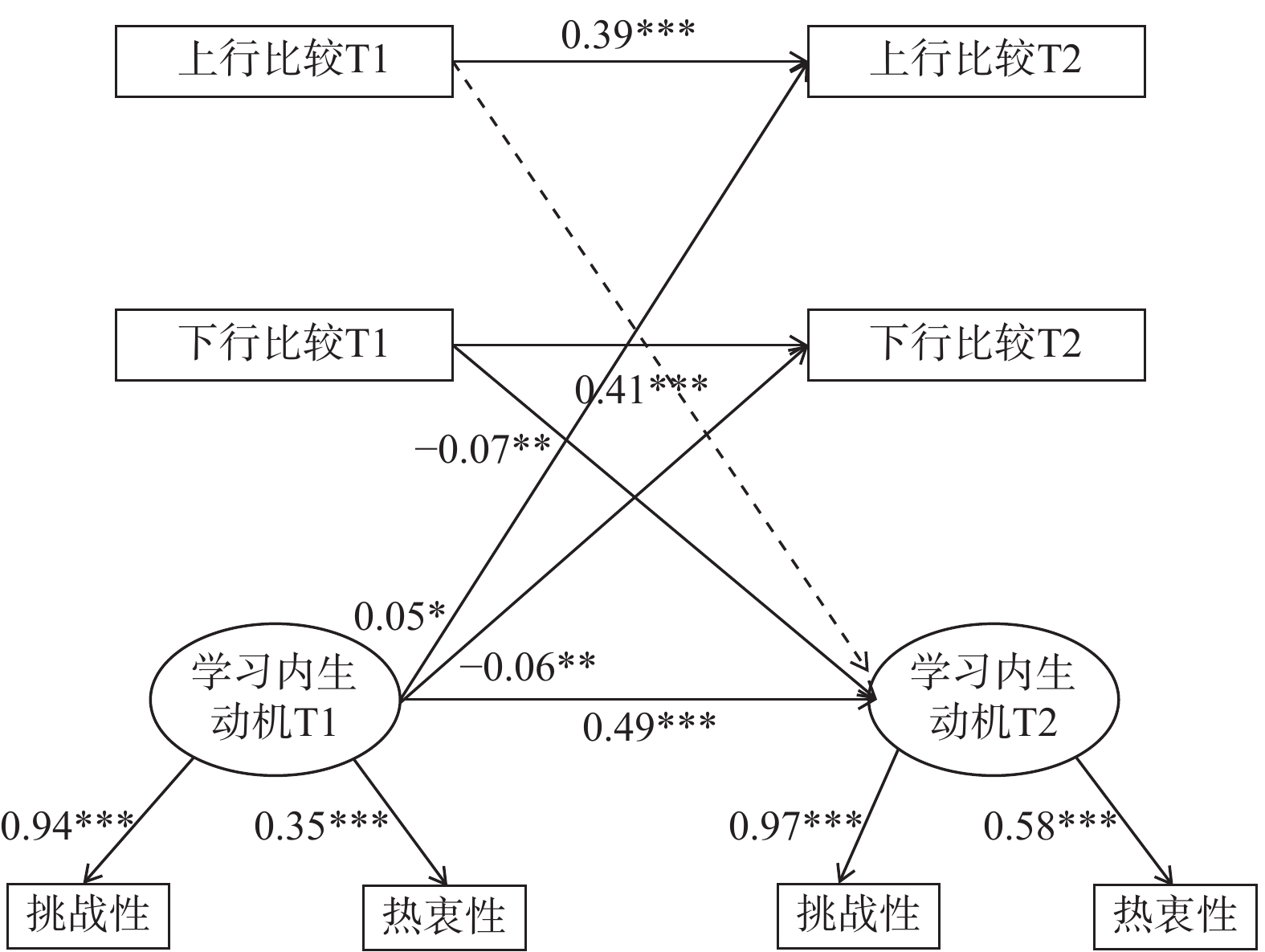
图1 学业比较与学习内生动机的交叉滞后模型 注:路径系数均为标准化系数,仅显示显著的路径系数,虚线表示预测路径不显著;为更清晰呈现交叉滞后关系,图中省去同一时间点变量间的相互关系、残差项及控制变量,以下同。
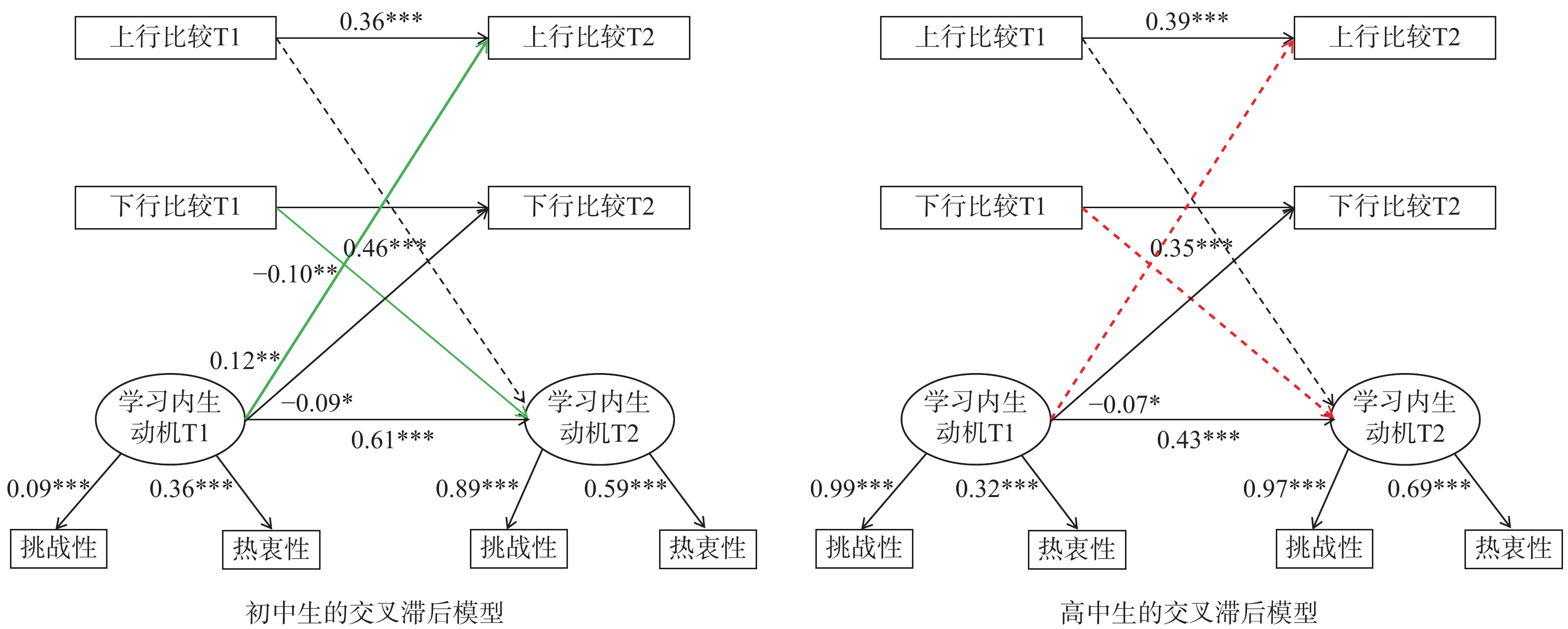
图2 上、下行比较与学习内生动机的关系在不同学段上的差异 注:图中红绿色线表示在该路径上存在显著差异,以下同。
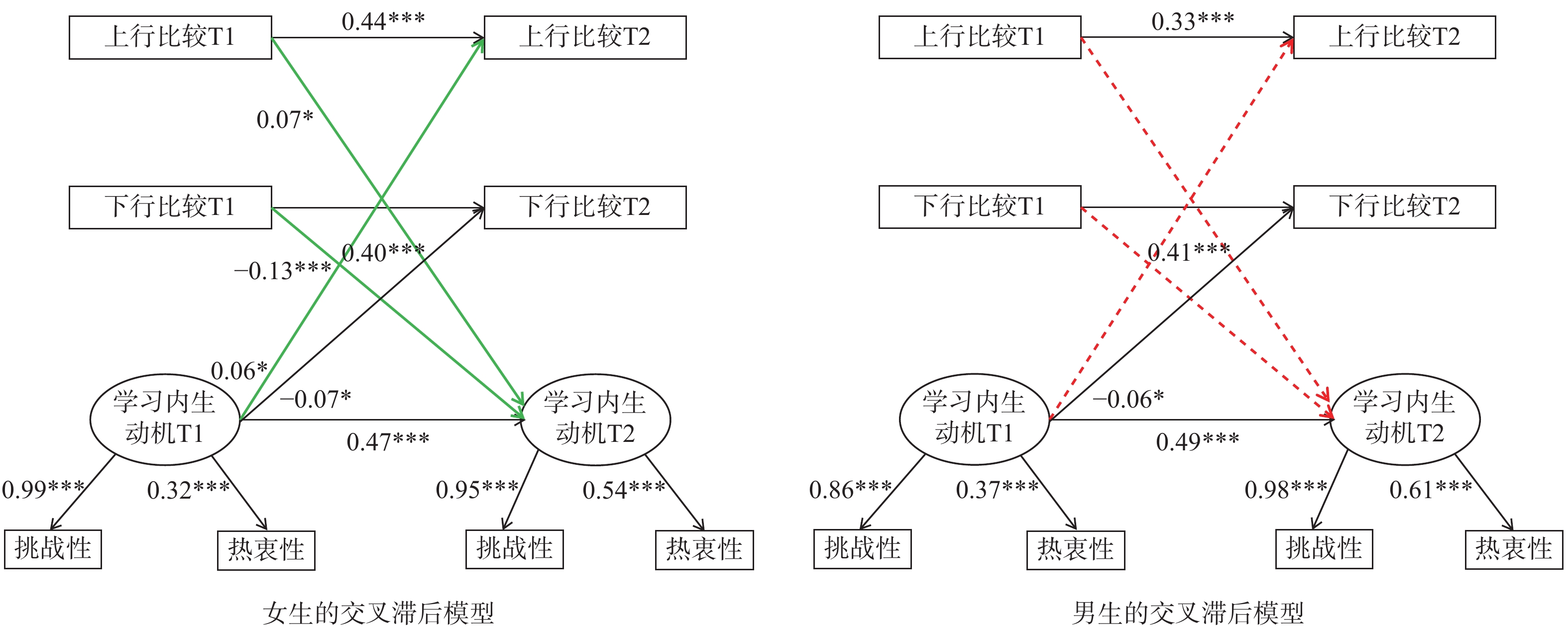
图3 上、下行比较与学习内生动机的关系在不同性别上的差异
|
白学军, 刘旭, 刘志军. 初中生社会比较在成就目标与学业自我效能感之间的中介效应. 心理科学, 2013, 36 (6): 1413- 1420.
|
|
|
池丽萍, 辛自强. 大学生学习动机的测量及其与自我效能感的关系. 心理发展与教育, 2006, 22 (2): 64- 70.
DOI |
|
|
宫秀双, 张红红. “别人家的孩子” vs. 平庸的自己: 社会比较对独特性寻求行为的影响. 心理学报, 2020, 52 (5): 645- 658.
|
|
|
郭成. (2006). 青少年学业自我研究(博士学位论文). 西南大学, 重庆.
|
|
|
李晶, 张杰, 朱莉琪. 中学生自我评价的发展及其与学业成绩的关系. 心理科学, 2011, 34 (3): 619- 624.
|
|
|
李振兴, 郭成, 邓欢, 毛俊, 邹文谦, 王芳. 维度比较: 个体内不同领域的比较. 心理科学进展, 2016, 24 (4): 603- 611.
|
|
|
刘在花. 学业压力对中学生学习投入的影响: 学业韧性的调节作用. 中国特殊教育, 2016, (12): 68- 76.
DOI |
|
|
王雷萍, 赵怡霖, 张镇. 中老年人社交媒体使用与正/负向情绪: 上行和下行社会比较的中介作用. 心理学探新, 2024, 44 (2): 134- 141.
|
|
|
邢淑芬, 俞国良. 社会比较: 对比效应还是同化效应. 心理科学进展, 2006, 14 (6): 944- 949.
DOI |
|
|
徐晓飞. (2005). 中学生学业社会比较对学业压力应对策略的影响(硕士学位论文). 西南师范大学, 重庆.
|
|
|
杨春, 路海东. 不同形式的评估反馈对大学生的学习动机和学习成绩的影响. 心理与行为研究, 2015, 13 (2): 237- 241.
|
|
|
易芳, 郭雅洁, 俞宗火, 徐霜雪. 中小学生学业成绩主要影响因素的元分析. 心理学探新, 2017, 37 (2): 140- 148.
|
|
|
Amabile, T. M., Hill, K. G., Hennessey, B. A., & Tighe, E. M. The work preference inventory: Assessing intrinsic and extrinsic motivational orientations. Journal of Personality and Social Psychology, 1994, 66 (5): 950- 967.
DOI |
|
|
Calvo-Salguero, A., García-Martínez, J. M. Á., & Monteoliva, A. Differences between and within genders in gender role orientation according to age and level of education. Sex Roles, 2008, 58 (7): 535- 548.
|
|
|
Chen, C. H., & Chiu, C. H. Employing intergroup competition in multitouch design-based learning to foster student engagement, learning achievement, and creativity. Computers & Education, 2016, 103, 99- 113.
|
|
|
Conti, R., Collins, M. A., & Picariello, M. L. The impact of competition on intrinsic motivation and creativity: Considering gender, gender segregation and gender role orientation. Personality and Individual Differences, 2001, 31 (8): 1273- 1289.
DOI |
|
|
Deci, E. L., & Ryan, R. M. The general causality orientations scale: Self-determination in personality. Journal of Research in Personality, 1985, 19 (2): 109- 134.
DOI |
|
|
Deci, E. L., & Ryan, R. M. The “what” and “why” of goal pursuits: Human needs and the self-determination of behavior. Psychological Inquiry, 2000, 11 (4): 227- 268.
DOI |
|
|
Downes, P. E. (2015). Social contexts and motivation: The role of upward and downward comparisons (Unpublished doctoral dissertation). University of Iowa.
|
|
|
Eisenberg, N., Martin, C. L., & Fabes, R. A. (1996). Gender development and gender effects. In D. C. Berliner & R. C. Calfee (Eds.), Handbook of educational psychology (pp. 358–396). New York: Macmillan Library Reference USA.
|
|
|
Gerber, J. P., Wheeler, L., & Suls, J. A social comparison theory meta-analysis 60+ years on. Psychological Bulletin, 2018, 144 (2): 177- 197.
DOI |
|
|
Gibbons, F. X., & Buunk, B. P. Individual differences in social comparison: Development of a scale of social comparison orientation. Journal of Personality and Social Psychology, 1999, 76 (1): 129- 142.
DOI |
|
|
Gottfried, A. E. Academic intrinsic motivation in elementary and junior high school students. Journal of Educational Psychology, 1985, 77 (6): 631- 645.
DOI |
|
|
Hackman, J. R., & Oldham, G. R. Motivation through the design of work: Test of a theory. Organizational Behavior and Human Performance, 1976, 16 (2): 250- 279.
DOI |
|
|
Kruglanski, A. W., & Mayseless, O. Motivational effects in the social comparison of opinions. Journal of Personality and Social Psychology, 1987, 53 (5): 834- 842.
DOI |
|
|
Lepper, M. R., Corpus, J. H., & Iyengar, S. S. Intrinsic and extrinsic motivational orientations in the classroom: Age differences and academic correlates. Journal of Educational Psychology, 2005, 97 (2): 184- 196.
DOI |
|
|
Lockwood, P., & Kunda, Z. Superstars and me: Predicting the impact of role models on the self. Journal of Personality and Social Psychology, 1997, 73 (1): 91- 103.
DOI |
|
|
Mercer, M., & Gulseren, D. B. When negative feedback harms: A systematic review of the unintended consequences of negative feedback on psychological, attitudinal, and behavioral responses. Studies in Higher Education, 2024, 49 (4): 654- 669.
DOI |
|
|
Nie, Y. G., Li, J. B., Dou, K., & Situ, Q. M. The associations between self-consciousness and internalizing/externalizing problems among Chinese adolescents. Journal of Adolescence, 2014, 37 (5): 505- 514.
DOI |
|
|
Pat-El, R., Tillema, H., & van Koppen, S. W. M. Effects of formative feedback on intrinsic motivation: Examining ethnic differences. Learning and Individual Differences, 2012, 22 (4): 449- 454.
DOI |
|
|
Rhodes, G. Self-enhancement and self-protection motivation: From the laboratory to an evolutionary context. Journal of Cultural and Evolutionary Psychology, 2004, 2 (1–2): 81- 92.
|
|
|
Tesser, A., & Campbell, J. Self-evaluation maintenance and the perception of friends and strangers. Journal of Personality, 1982, 50 (3): 261- 279.
DOI |
|
|
Vallerand, R. J. Deci and Ryan’s self-determination theory: A view from the hierarchical model of intrinsic and extrinsic motivation. Psychological Inquiry, 2000, 11 (4): 312- 318.
|
|
|
van Lier, P. A. C., Vitaro, F., Barker, E. D., Brendgen, M., Tremblay, R. E., & Boivin, M. Peer victimization, poor academic achievement, and the link between childhood externalizing and internalizing problems. Child Development, 2012, 83 (5): 1775- 1788.
DOI |
|
|
Wert, S. R., & Salovey, P. A social comparison account of gossip. Review of General Psychology, 2004, 8 (2): 122- 137.
DOI |
|
|
Wheeler, L. (2000). Individual differences in social comparison. In J. Suls & L. Wheeler (Eds.), Handbook of social comparison: Theory and research (pp. 141–158). Boston: Springer.
|
|
|
Wills, T. A. Downward comparison principles in social psychology. Psychological Bulletin, 1981, 90 (2): 245- 271.
DOI |
|
|
Yen, J. C., Wang, J. Y., & Chen, I. J. Gender differences in mobile game-based learning to promote intrinsic motivation. Recent Researches in Computer Science, 2011, 15, 279- 284.
|
| [1] | 于永菊, 何敏. 高校大学生生命意义感的演变模式及其与抑郁症状的关联[J]. 心理与行为研究, 2025, 23(3): 354-360. |
| [2] | 卢林鑫, 刘在花, 杨爽, 蒋政凯, 党韦强, 谭婧, 班永飞, 孙霁, 蔺秀云. 社会排斥与先天轻度肢残青少年抑郁特征的关联性:基于生成性模型与反映性模型的纵向分析[J]. 心理与行为研究, 2025, 23(2): 216-225. |
| [3] | 赵黎明, 韩蒙蒙, 贾津津. 中学生社交焦虑与攻击性的关系:言语流畅性的中介作用和情绪智力的调节作用[J]. 心理与行为研究, 2025, 23(2): 265-272. |
| [4] | 姚雨佳, 林慧慧, 徐舵. 青少年特质焦虑与情绪调节灵活性、痛苦忍受性之间的关系:一项交叉滞后分析[J]. 心理与行为研究, 2024, 22(6): 761-768. |
| [5] | 张野, 刘致宏, 申婷, 赵雨露. 父母心理控制、校园排斥与初中生内化问题的动态关系:交叉滞后研究[J]. 心理与行为研究, 2024, 22(5): 658-665. |
| [6] | 杨华耕, 孙芳, 李欢欢. 基于潜在剖面分析的多重家庭因素与中学生网络游戏成瘾的关系:非适应性认知的中介作用[J]. 心理与行为研究, 2024, 22(3): 329-337. |
| [7] | 黄林辉, 陈圆圆, 朱键军, 张卫. 青春前期消极同伴关系与冲动性:三次重复测量的交叉滞后面板模型[J]. 心理与行为研究, 2024, 22(3): 354-362. |
| [8] | 杨卓, 贾榕, 林瑶, 张宝山, 毕研玲. 完美主义与中学生学业倦怠的纵向关系及自我宽容的中介作用[J]. 心理与行为研究, 2024, 22(3): 363-371. |
| [9] | 赵新宇, 乔晓光, 邢晓沛. 父母自主支持、10~12岁儿童的同伴关系与执行功能的动态互动关系:一个发展级联模型[J]. 心理与行为研究, 2024, 22(1): 55-63. |
| [10] | 王江洋, 王蒙歌. 拒绝敏感性与留守中学生病理性网络使用:生命意义感和自我污名的中介作用[J]. 心理与行为研究, 2022, 20(2): 219-225. |
| [11] | 李飞飞, 缴润凯, 刘丹, 尹航. 幼儿教师感恩特质与职业使命感的交叉滞后分析[J]. 心理与行为研究, 2021, 19(6): 824-830. |
| [12] | 万娇娇, 纪莉莉, 吴丽娜, 张亚飞, 刘改改, 谷璜, 赵俊峰. 农村留守初中生亲子亲合与安全感的关系:一项交叉滞后研究[J]. 心理与行为研究, 2021, 19(4): 500-506. |
| [13] | 马玲玲, 余鸿燕, 范为桥, 孟小. 父母教养方式与随迁儿童问题行为关系的交叉滞后分析[J]. 心理与行为研究, 2021, 19(3): 334-340. |
| [14] | 孙芳, 李欢欢, 包佳敏, 甄子昂, 宋巍, 蒋松源. 教师支持、同伴支持与中学生心理危机的关系:歧视知觉的中介作用[J]. 心理与行为研究, 2021, 19(2): 209-215. |
| [15] | 姚文玉, 张雯, 刘影, 张思敏, 丁雪辰, 徐刚敏. 儿童抑郁水平与学业成绩的发展轨迹:基于平行潜变量增长模型[J]. 心理与行为研究, 2021, 19(2): 223-229. |
| 阅读次数 | ||||||
|
全文 |
|
|||||
|
摘要 |
|
|||||
