
心理与行为研究 ›› 2023, Vol. 21 ›› Issue (3): 336-343.DOI: 10.12139/j.1672-0628.2023.03.007
张思敏1, 董亓易如1, 陈飞2, 阿尔升•海达别克1, 丁雪辰1,3,4,*( ), 朱仲敏3
收稿日期:2022-06-18
出版日期:2023-05-20
发布日期:2023-05-20
通讯作者:
丁雪辰
基金资助:
Simin ZHANG1, Qiyiru DONG1, Fei CHEN2, Aersheng HAIDABIEKE1, Xuechen DING1,3,4,*(), Zhongmin ZHU3
Received:2022-06-18
Online:2023-05-20
Published:2023-05-20
Contact:
Xuechen DING
摘要:
为探讨儿童社交自我知觉和情绪适应问题的关系,本研究构建了一个有调节的中介模型。采用自我报告的方式对上海地区4~6年级共575名被试进行测查,结果显示:(1)社交自我知觉可以负向预测抑郁和社交焦虑;(2)回避应对策略在社交自我知觉与抑郁和社交焦虑的关系中起部分中介作用;(3)社交敏感性调节了社交自我知觉通过回避应对策略影响抑郁和社交焦虑的前半路径,社交自我知觉对回避应对策略的预测作用仅在高社交敏感性儿童身上显著。研究结果不仅可以为低社交自我知觉个体的情绪适应问题提供新的解释,还在引导个体心理干预方面具有启示意义。
中图分类号:
张思敏, 董亓易如, 陈飞, 阿尔升•海达别克, 丁雪辰, 朱仲敏. 儿童社交自我知觉与情绪适应问题的关系:回避应对策略和社交敏感性的作用[J]. 心理与行为研究, 2023, 21(3): 336-343.
Simin ZHANG, Qiyiru DONG, Fei CHEN, Aersheng HAIDABIEKE, Xuechen DING, Zhongmin ZHU. Relations Between Self-Perceived Social Competence and Emotional Problems in Chinese Children: Role of Avoidant Coping Strategy and Social Sensitivity[J]. Studies of Psychology and Behavior, 2023, 21(3): 336-343.
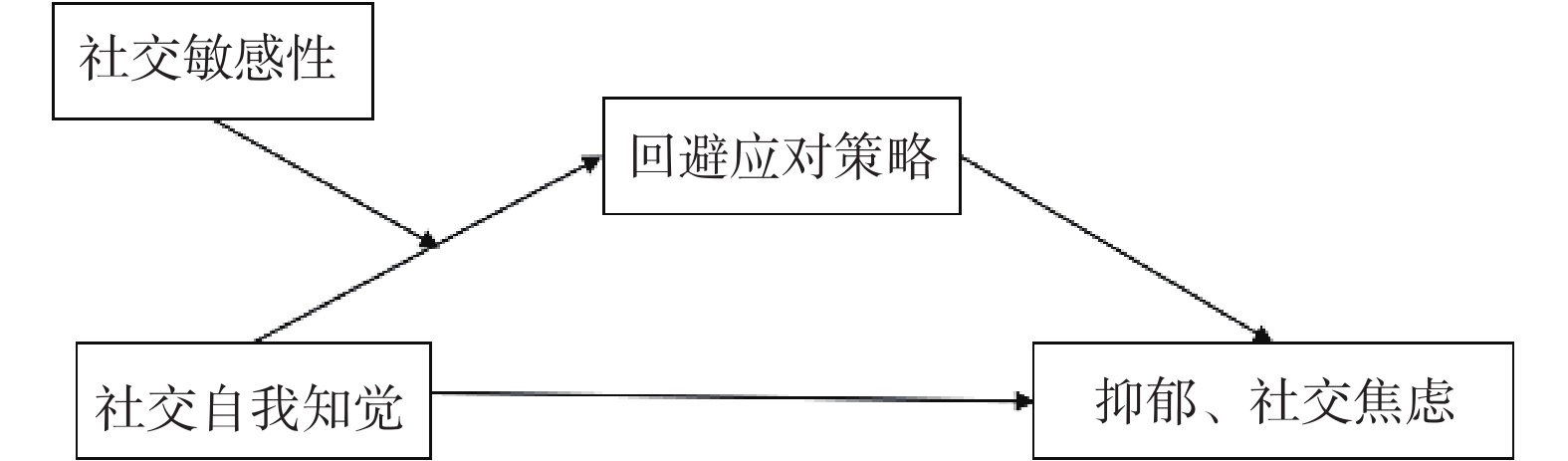
图1 假设模型
| 变量 | M | SD | 1 | 2 | 3 | 4 |
| 1.社交自我知觉 | 3.89 | 0.78 | ||||
| 2.社交敏感性 | 2.93 | 0.94 | −0.03 | |||
| 3.回避应对策略 | 2.41 | 0.71 | −0.18*** | 0.21*** | ||
| 4.抑郁 | 1.39 | 0.31 | −0.54*** | 0.09* | 0.34*** | |
| 5.社交焦虑 | 2.40 | 0.80 | −0.28*** | 0.46*** | 0.40*** | 0.37*** |
表1 描述性统计及相关系数
| 变量 | M | SD | 1 | 2 | 3 | 4 |
| 1.社交自我知觉 | 3.89 | 0.78 | ||||
| 2.社交敏感性 | 2.93 | 0.94 | −0.03 | |||
| 3.回避应对策略 | 2.41 | 0.71 | −0.18*** | 0.21*** | ||
| 4.抑郁 | 1.39 | 0.31 | −0.54*** | 0.09* | 0.34*** | |
| 5.社交焦虑 | 2.40 | 0.80 | −0.28*** | 0.46*** | 0.40*** | 0.37*** |
| 中介路径 | 中介效应值 | 95%CI |
| 社交自我知觉→回避应对策略→抑郁 | −0.04 | [−0.07, −0.02] |
| 社交自我知觉→回避应对策略→社交焦虑 | −0.06 | [−0.11, −0.03] |
表2 各中介效应值及95%的置信区间
| 中介路径 | 中介效应值 | 95%CI |
| 社交自我知觉→回避应对策略→抑郁 | −0.04 | [−0.07, −0.02] |
| 社交自我知觉→回避应对策略→社交焦虑 | −0.06 | [−0.11, −0.03] |
| 因变量:回避应对策略 | 因变量:抑郁 | ||||||
| β | t | 95%CI | β | t | 95%CI | ||
| 性别 | −0.05 | −1.28 | [−0.27, 0.06] | −0.05 | −1.42 | [−0.23, 0.04] | |
| 年龄 | 0.14 | −3.43*** | [−0.16, −0.04] | −0.04 | −0.17 | [−0.08, 0.02] | |
| 社交自我知觉 | −0.15 | −3.53*** | [−0.23, −0.07] | −0.48 | −13.66*** | [−0.55,−0.41] | |
| 社交敏感性 | 0.20 | 4.88*** | [0.12, 0.28] | ||||
| 交互项 | −0.09 | −2.46* | [−0.16, −0.02] | ||||
| 回避应对策略 | 0.25 | 7.28*** | [0.18, 0.32] | ||||
| F | 12.14*** | 74.15*** | |||||
| R2 | 0.10 | 0.36 | |||||
表3 社交自我知觉预测抑郁:有调节的中介检验
| 因变量:回避应对策略 | 因变量:抑郁 | ||||||
| β | t | 95%CI | β | t | 95%CI | ||
| 性别 | −0.05 | −1.28 | [−0.27, 0.06] | −0.05 | −1.42 | [−0.23, 0.04] | |
| 年龄 | 0.14 | −3.43*** | [−0.16, −0.04] | −0.04 | −0.17 | [−0.08, 0.02] | |
| 社交自我知觉 | −0.15 | −3.53*** | [−0.23, −0.07] | −0.48 | −13.66*** | [−0.55,−0.41] | |
| 社交敏感性 | 0.20 | 4.88*** | [0.12, 0.28] | ||||
| 交互项 | −0.09 | −2.46* | [−0.16, −0.02] | ||||
| 回避应对策略 | 0.25 | 7.28*** | [0.18, 0.32] | ||||
| F | 12.14*** | 74.15*** | |||||
| R2 | 0.10 | 0.36 | |||||
| 因变量:回避应对策略 | 因变量:社交焦虑 | ||||||
| β | t | 95%CI | β | t | 95%CI | ||
| 性别 | −0.05 | −1.28 | [−0.27, 0.06] | 0.19 | 4.75*** | [0.23, 0.52] | |
| 年龄 | 0.14 | −3.43*** | [−0.16, −0.04] | −0.01 | −0.30 | [−0.05, 0.06] | |
| 社交自我知觉 | −0.15 | −3.53*** | [−0.23, −0.07] | −0.24 | −6.17*** | [−0.32, −0.16] | |
| 社交敏感性 | 0.20 | 4.88*** | [0.12, 0.28] | ||||
| 交互项 | −0.09 | −2.46* | [−0.16, −0.02] | ||||
| 回避应对策略 | 0.38 | 10.07*** | [0.30, 0.45] | ||||
| F | 12.14*** | 43.14*** | |||||
| R2 | 0.10 | 0.24 | |||||
表4 社交自我知觉预测社交焦虑:有调节的中介检验
| 因变量:回避应对策略 | 因变量:社交焦虑 | ||||||
| β | t | 95%CI | β | t | 95%CI | ||
| 性别 | −0.05 | −1.28 | [−0.27, 0.06] | 0.19 | 4.75*** | [0.23, 0.52] | |
| 年龄 | 0.14 | −3.43*** | [−0.16, −0.04] | −0.01 | −0.30 | [−0.05, 0.06] | |
| 社交自我知觉 | −0.15 | −3.53*** | [−0.23, −0.07] | −0.24 | −6.17*** | [−0.32, −0.16] | |
| 社交敏感性 | 0.20 | 4.88*** | [0.12, 0.28] | ||||
| 交互项 | −0.09 | −2.46* | [−0.16, −0.02] | ||||
| 回避应对策略 | 0.38 | 10.07*** | [0.30, 0.45] | ||||
| F | 12.14*** | 43.14*** | |||||
| R2 | 0.10 | 0.24 | |||||
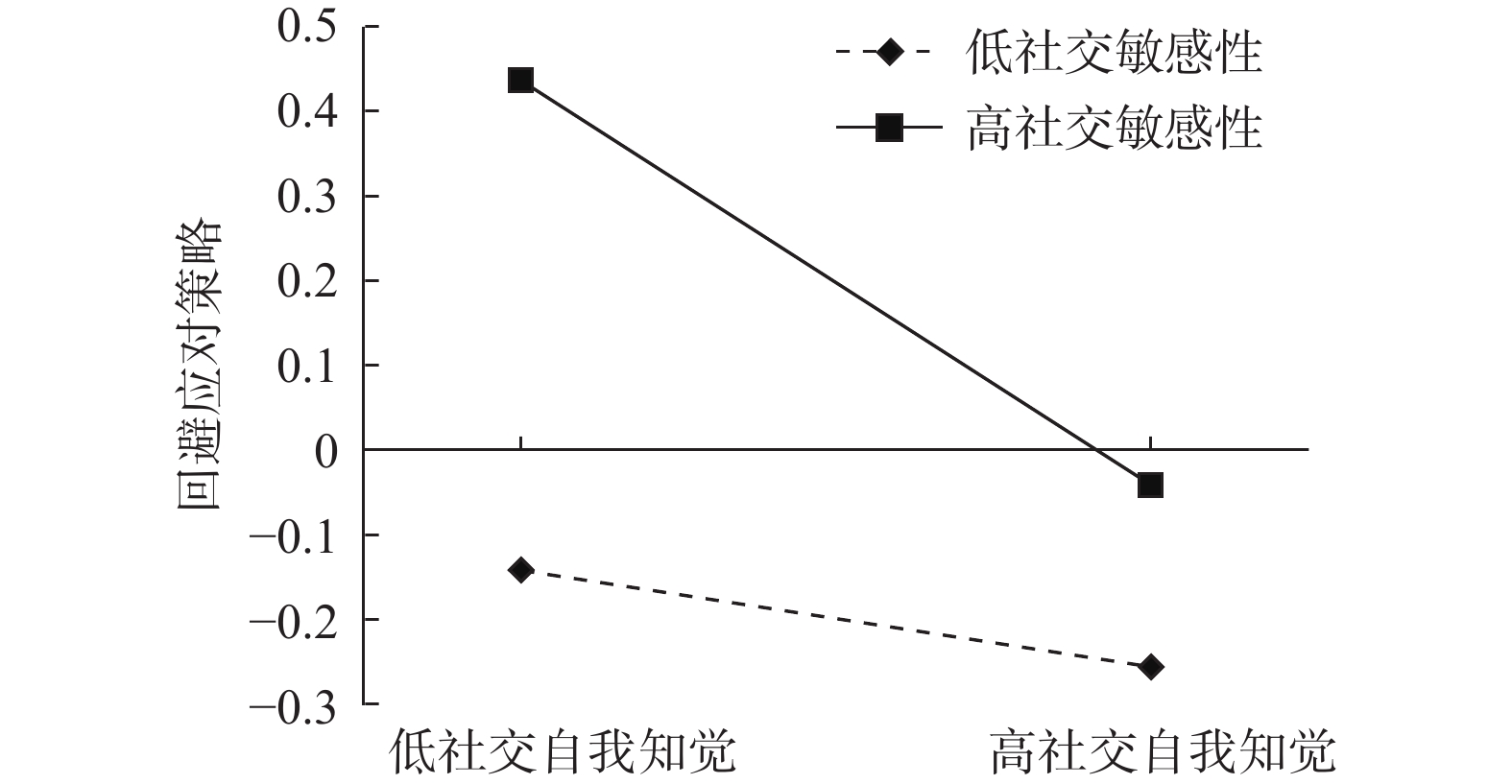
图2 社交敏感性在社交自我知觉与回避应对策略关系中的调节作用
| 程刚, 肖友琴. 社交焦虑障碍的性别差异及其生物学解释. 中国健康心理学杂志, 2015, 23 (2): 307- 312. | |
| 丁雪辰, 邓欣媚, 桑标, 李丹. 青少年早期社交回避与同伴关系问题: 有调节的中介模型. 心理发展与教育, 2018, 34 (2): 137- 145. | |
| 丁雪辰, 刘俊升, 李丹, 桑标. Harter儿童自我知觉量表的信效度检验. 中国临床心理学杂志, 2014, 22 (2): 251- 255. | |
| 丁雪辰, 周同, 张润竹, 周楠. 儿童社交回避行为: 成因、测量方式及适应功能. 心理科学, 2019, 42 (3): 604- 611. | |
| 方平, 马焱, 朱文龙, 姜媛. 自尊研究的现状与问题. 心理科学进展, 2016, 24 (9): 1427- 1434. | |
| 龚务, 陈旭. 留守儿童家庭教养方式与社交焦虑的关系研究. 四川教育学院学报, 2010, 26 (11): 11- 15. | |
| 胡兴蕾, 余思, 刘勤学, 张微. 青少年网络被欺负与自杀意念的关系: 自尊和情绪应对方式的链式中介作用. 心理发展与教育, 2019, 35 (3): 368- 375. | |
| 李海江, 杨娟, 袁祥勇, 覃义贵, 张庆林. 低自尊个体对拒绝性信息的注意偏向. 心理科学进展, 2012, 20 (10): 1604- 1613. | |
| 李昳, 陆桂芝, 李勇. 自我关注与社交焦虑: 负面评价恐惧的中介与关系型自我构念的调节. 心理科学, 2018, 41 (5): 1261- 1267. | |
| 刘广增, 张大均, 罗世兰, 房立艳. (2018). 8–12岁儿童孤独感及其与父母情感温暖、问题行为的关系. 中国临床心理学杂志, 26(3), 586–589, 594. | |
| 陆林. 守护儿童青少年心理健康, 我们在行动. 科技导报, 2021, 39 (18): 1. | |
| 彭顺, 牛更枫, 汪夏, 张红坡, 胡祥恩. 父母自主支持对青少年积极情绪适应的影响: 基本心理需要满足的中介与调节作用模型. 心理发展与教育, 2021, 37 (2): 240- 248. | |
| 王晖, 熊昱可, 刘霞. 亲子关系和朋友支持对流动儿童情绪和行为适应的保护作用. 心理发展与教育, 2018, 34 (5): 614- 624. | |
| 温忠麟, 叶宝娟. 有调节的中介模型检验方法: 竞争还是替补?. 心理学报, 2014, 46 (5): 714- 726. | |
| 吴桐, 杨柠溪, 蔡丽, 张妍, 桑志芹. (2021). 自悯对社交焦虑的影响: 自尊和评价恐惧的中介作用. 中国临床心理学杂志, 29(1), 169–172, 78. | |
| 姚文玉, 张雯, 刘影, 张思敏, 丁雪辰, 徐刚敏. 儿童抑郁水平与学业成绩的发展轨迹: 基于平行潜变量增长模型. 心理与行为研究, 2021, 19 (2): 223- 229. | |
|
叶一舵, 申艳娥. 应对及应对方式研究综述. 心理科学, 2002, 25 (6): 755- 756.
DOI |
|
| 俞大维, 李旭. 儿童抑郁量表(CDI)在中国儿童中的初步运用. 中国心理卫生杂志, 2000, 14 (4): 225- 227. | |
| 袁晓娇, 方晓义, 刘杨, 蔺秀云. 流动儿童压力应对方式与抑郁感、社交焦虑的关系: 一项追踪研究. 心理发展与教育, 2012, 28 (3): 283- 291. | |
| 张丽华, 张旭. 认知加工偏向视野下的自尊研究. 心理学探新, 2009, 29 (5): 42- 45. | |
| 张雯, 周同, 丁雪辰, 周楠. 儿童拒绝敏感性与自我知觉的关系: 一项交叉滞后研究. 心理发展与教育, 2020, 36 (6): 649- 658. | |
| 郑沁怡, 丁雪辰, 刘影, 万旋傲, 桑标. 儿童社交自我知觉与抑郁感的关系: 拒绝敏感性的中介作用与情绪调节能力的调节作用. 中国临床心理学杂志, 2019, 27 (5): 894- 899. | |
| 周宗奎, 曹敏, 田媛, 黄淳, 杨秀娟, 宋友志. 初中生亲子关系与抑郁: 自尊和情绪弹性的中介作用. 心理发展与教育, 2021, 37 (6): 864- 872. | |
| 祖静, 张向葵, 左恩玲, 丁相玲. 大学生自尊与手机依赖的关系: 应对方式的多重中介作用. 中国特殊教育, 2016, (10): 85- 90. | |
| Arslan, G.. Psychological maltreatment, coping strategies, and mental health problems: A brief and effective measure of psychological maltreatment in adolescents. Child Abuse & Neglect, 2017, 68, 96- 106. | |
| Beck, A. T. (1976). Cognitive therapy and the emotional disorders. New York: International Universities Press. | |
|
Causey, D. L., & Dubow, E. F.. Development of a self-report coping measure for elementary school children. Journal of Clinical Child Psychology, 1992, 21 (1): 47- 59.
DOI |
|
|
Chen, X. Y., Fu, R., Liu, J. S., Wang, L., Zarbatany, L., & Ellis, W.. Social sensitivity and social, school, and psychological adjustment among children across contexts. Developmental Psychology, 2018, 54 (6): 1124- 1134.
DOI |
|
|
Chen, X. Y., Liu, J. S., Ellis, W., & Zarbatany, L.. Social sensitivity and adjustment in Chinese and Canadian children. Child Development, 2016, 87 (4): 1115- 1129.
DOI |
|
| Clark, D. M., & Wells, A. (1995). A cognitive model of social phobia. In R. G. Heimberg, M. R. Liebowitz, D. A. Hope, & F. R. Schneier (Eds.), Social phobia: Diagnosis, assessment, and treatment (pp. 69–93). New York: The Guilford Press. | |
|
Copeland, W. E., Wolke, D., Shanahan, L., & Costello, E. J.. Adult functional outcomes of common childhood psychiatric problems: A prospective, longitudinal study. JAMA Psychiatry, 2015, 72 (9): 892- 899.
DOI |
|
|
Crick, N. R., & Dodge, K. A.. A review and reformulation of social information-processing mechanisms in children’s social adjustment. Psychological Bulletin, 1994, 115 (1): 74- 101.
DOI |
|
|
Cummings, C. M., Caporino, N. E., & Kendall, P. C.. Comorbidity of anxiety and depression in children and adolescents: 20 years after. Psychological Bulletin, 2014, 140 (3): 816- 845.
DOI |
|
|
Ding, X. C., Chen, X. Y., Fu, R., Li, D., & Liu, J. S.. Relations of shyness and unsociability with adjustment in migrant and non-migrant children in urban China. Journal of Abnormal Child Psychology, 2020, 48 (2): 289- 300.
DOI |
|
|
Ding, X. C., Fu, R., Ooi, L. L., Coplan, R. J., Zheng, Q. Y., & Deng, X. M.. Relations between different components of rejection sensitivity and adjustment in Chinese children. Journal of Applied Developmental Psychology, 2020, 67, 101119.
DOI |
|
|
Ding, X. C., Ooi, L. L., Coplan, R. J., Zhang, W., & Yao, W. Y.. Longitudinal relations between rejection sensitivity and adjustment in Chinese children: Moderating effect of emotion regulation. The Journal of Genetic Psychology, 2021, 182 (6): 422- 434.
DOI |
|
|
Gao, D., Liu, J. S., Bullock, A., Li, D., & Chen, X. Y.. Transactional models linking maternal authoritative parenting, child self-esteem, and approach coping strategies. Journal of Applied Developmental Psychology, 2021, 73, 101262.
DOI |
|
| Harter, S. (1985). Manual for the self-perception profile for children. Denver, CO: University of Denver Press. | |
| Hayes, A. F. (2013). Introduction to mediation, moderation, and conditional process analysis: A regression-based approach. New York: The Guilford Press. | |
| Henderson, L., & Zimbardo, P. G. (2001). Shyness as a clinical condition: The Stanford model. In W. R. Crozier & L. E. Alden (Eds.), International handbook of social anxiety: Concepts, research and interventions relating to the self and shyness (pp. 431–447). New York: John Wiley & Sons Ltd. | |
| In-Albon, T., Meyer, A. H., Metzke, C. W., & Steinhausen, H. C.. A cross-lag panel analysis of low self-esteem as a predictor of adolescent internalizing symptoms in a prospective longitudinal study. Child Psychiatry & Human Development, 2017, 48 (3): 411- 422. | |
|
Kingsbury, M., Coplan, R. J., & Rose-Krasnor, L.. Shy but getting by? An examination of the complex links among shyness, coping, and socioemotional functioning in childhood. Social Development, 2013, 22 (1): 126- 145.
DOI |
|
| Kovacs, M.. The Children’s Depression, Inventory (CDI). Psychopharmacology Bulletin, 1985, 21 (4): 995- 998. | |
|
La Greca, A. M., & Stone, W. L.. Social Anxiety Scale for Children-Revised: Factor structure and concurrent validity. Journal of Clinical Child Psychology, 1993, 22 (1): 17- 27.
DOI |
|
| Lee, A., Hankin, B. L., & Mermelstein, R. J.. Perceived social competence, negative social interactions, and negative cognitive style predict depressive symptoms during adolescence. Journal of Clinical Child & Adolescent Psychology, 2010, 39 (5): 603- 615. | |
|
Li, D., Xu, X. P., Liu, J. S., Dai, Y., & Chen, X. Y.. Cybervictimization and adjustment in late childhood: Moderating effects of social sensitivity. Journal of Applied Developmental Psychology, 2021, 73, 101258.
DOI |
|
|
Liu, X. S., Fu, R., Li, D., Liu, J. S., & Chen, X. Y.. Self- and group- orientations and adjustment in urban and rural Chinese children. Journal of Cross-Cultural Psychology, 2018, 49 (9): 1440- 1456.
DOI |
|
|
O’Donnell, E. H., Moreau, M., Cardemil, E. V., & Pollastri, A.. Interparental conflict, parenting, and childhood depression in a diverse urban population: The role of general cognitive style. Journal of Youth and Adolescence, 2010, 39 (1): 12- 22.
DOI |
|
|
Roth, S., & Cohen, L. J.. Approach, avoidance, and coping with stress. American Psychologist, 1986, 41 (7): 813- 819.
DOI |
|
|
Rubin, K. H., Root, A. K., & Bowker, J.. Parents, peers, and social withdrawal in childhood: A relationship perspective. New Directions for Child and Adolescent Development, 2010, 2010 (127): 79- 94.
DOI |
|
| Silbereisen, R. K., & Chen, X. Y. (2010). Social change and human development: Concept and results. Los Angeles: Sage. | |
|
Somerville, L. H.. The teenage brain: Sensitivity to social evaluation. Current Directions in Psychological Science, 2013, 22 (2): 121- 127.
DOI |
|
|
Storch, E. A., Masia-Warner, C., Crisp, H., & Klein, R. G.. Peer victimization and social anxiety in adolescence: A prospective study. Aggressive Behavior, 2005, 31 (5): 437- 452.
DOI |
|
|
Westenberg, P. M., Drewes, M. J., Goedhart, A. W., Siebelink, B. M., & Treffers, P. D. A.. A developmental analysis of self-reported fears in late childhood through mid-adolescence: Social-evaluative fears on the rise. Journal of Child Psychology and Psychiatry, 2004, 45 (3): 481- 495.
DOI |
| [1] | 孔旭, 熊思成, 曾成伟, 张斌. 社交焦虑对青少年手机依赖的影响:自我控制的纵向调节作用[J]. 心理与行为研究, 2026, 24(2): 265-272. |
| [2] | 王伊萌, 程昊. 个人成长主动性与大学生心理健康:智慧的路径分析[J]. 心理与行为研究, 2026, 24(1): 40-50. |
| [3] | 赵纤, 黎志华. 童年累积创伤对成年早期抑郁症状的影响:压力知觉的中介机制[J]. 心理与行为研究, 2026, 24(1): 69-77. |
| [4] | 曾子豪, 何震, 袁言云, 赵纤, 印利红, 谭嵘, 常梦梦, 胡义秋. HPA轴系统多基因−亲子关系交互对青少年抑郁发展影响及性别差异[J]. 心理与行为研究, 2026, 24(1): 78-86. |
| [5] | 刘鑫, 刘衍玲, 曾晋逸. 心理需要挫折与青少年抑郁症状的纵向联系:心理素质的调节作用[J]. 心理与行为研究, 2025, 23(4): 496-503. |
| [6] | 鲍振宙, 刘花, 于明申. 青少年校园欺凌旁观行为与焦虑抑郁症状的关系:基于纵向网络分析法[J]. 心理与行为研究, 2025, 23(4): 504-512. |
| [7] | 庞溢序, 彭梓轩, 李佳, 宋怡萱, 余萌. 利他的魔力:高社交焦虑大学生利己/利他行为对风险决策的影响[J]. 心理与行为研究, 2025, 23(4): 560-568. |
| [8] | 王峥, 侯友, 韩洋, 杨邵峰, 陈丽霞. 执行意图编码促进抑郁症患者前瞻记忆的意图执行[J]. 心理与行为研究, 2025, 23(3): 322-329. |
| [9] | 于永菊, 何敏. 高校大学生生命意义感的演变模式及其与抑郁症状的关联[J]. 心理与行为研究, 2025, 23(3): 354-360. |
| [10] | 卢林鑫, 刘在花, 杨爽, 蒋政凯, 党韦强, 谭婧, 班永飞, 孙霁, 蔺秀云. 社会排斥与先天轻度肢残青少年抑郁特征的关联性:基于生成性模型与反映性模型的纵向分析[J]. 心理与行为研究, 2025, 23(2): 216-225. |
| [11] | 赵黎明, 韩蒙蒙, 贾津津. 中学生社交焦虑与攻击性的关系:言语流畅性的中介作用和情绪智力的调节作用[J]. 心理与行为研究, 2025, 23(2): 265-272. |
| [12] | 胡义秋, 何震, 曾子豪, 赵纤, 常梦梦. 初中生身体监控与抑郁症状的纵向关系研究:主观幸福感的中介作用[J]. 心理与行为研究, 2025, 23(1): 58-65. |
| [13] | 陈建新, 方紫梦, 黄蓉, 叶宝仪, 杨伟平, 魏柳青. 具身情绪对抑郁倾向个体创造性思维的影响[J]. 心理与行为研究, 2024, 22(5): 602-608. |
| [14] | 肖皓月, 张杉, 郝海平, 吕厚超. 高中生网络成瘾与未来时间洞察力的纵向关系:抑郁的中介作用[J]. 心理与行为研究, 2024, 22(5): 673-681. |
| [15] | 关文军, 吴添昊, 程毓可, 多强. 孤独症儿童父母负面评价恐惧和社交焦虑的关系:一个有调节的中介效应模型[J]. 心理与行为研究, 2024, 22(3): 418-424. |
| 阅读次数 | ||||||
|
全文 |
|
|||||
|
摘要 |
|
|||||
