
心理与行为研究 ›› 2025, Vol. 23 ›› Issue (4): 560-568.DOI: 10.12139/j.1672-0628.2025.04.017
庞溢序1, 彭梓轩1, 李佳1, 宋怡萱2, 余萌*,2( )
)
收稿日期:2024-12-23
出版日期:2025-07-20
发布日期:2025-07-20
通讯作者:
余萌
基金资助:
Yixu PANG1, Zixuan PENG1, Jia LI1, Yixuan SONG2, Meng YU*,2()
Received:2024-12-23
Online:2025-07-20
Published:2025-07-20
Contact:
Meng YU
摘要:
为探讨利己/利他不同情景是否会影响高社交焦虑个体的风险决策行为,本研究招募了90名大学生,通过使用改编的气球模拟决策范式、演讲任务和视频唤起情绪,考察不同社交焦虑水平(高、低)的大学生在不同情景(利己、利他)下,面对风险决策时的状态焦虑水平和做出的决策行为。结果发现,高社交焦虑个体的状态焦虑水平高于低社交焦虑个体。相较于对照组,高社交焦虑个体在利己情景下表现出风险回避,但在利他情景下减少了风险回避行为。研究结果验证了利他行为可以减少社交焦虑个体的风险回避行为,但并非通过降低状态焦虑水平。
庞溢序, 彭梓轩, 李佳, 宋怡萱, 余萌. 利他的魔力:高社交焦虑大学生利己/利他行为对风险决策的影响[J]. 心理与行为研究, 2025, 23(4): 560-568.
Yixu PANG, Zixuan PENG, Jia LI, Yixuan SONG, Meng YU. The Magic of Altruism: The Effect of Self-Interest/Altruistic Behaviour on Risk Decision-Making in College Students with High Social Anxiety[J]. Studies of Psychology and Behavior, 2025, 23(4): 560-568.
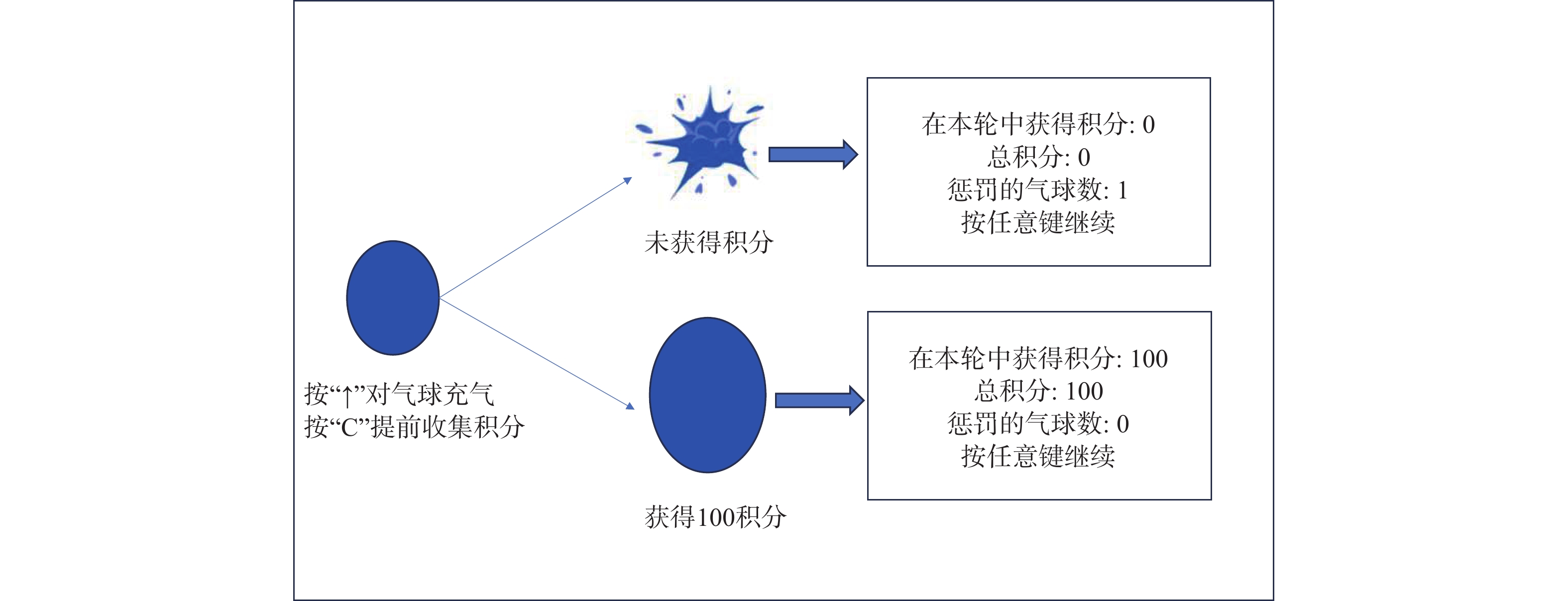
图1 研究范式流程图
| M±SD | 量表 | t | df | p | |
| 社交焦虑水平 | 高: 30.64±9.21 低: 27.36±8.80 | BDI-Ⅱ | 1.68 | 87 | 0.097 |
| 高: 22.74±4.73 低: 23.97±4.13 | 9-SRA | 1.27 | 88 | 0.207 | |
| 高: 23.56±4.74 低: 24.44±4.17 | BSSS | 0.94 | 88 | 0.364 | |
| 高: 43.80±6.17 低: 43.44±5.08 | S-UPPS-P | 0.28 | 88 | 0.777 | |
| 高: 47.85±9.86 低: 35.03±7.47 | SPIN | 6.63 | 88 | <0.001 | |
| 情景 | 己: 29.20±8.52 他: 29.44±4.66 | BDI-Ⅱ | 0.11 | 87 | 0.911 |
| 己: 22.58±4.66 他: 23.88±4.32 | 9-SRA | 1.38 | 88 | 0.170 | |
| 己: 22.47±4.06 他: 23.56±4.92 | BSSS | 1.17 | 88 | 0.246 | |
| 己: 44.33±4.76 他: 42.98±6.54 | S-UPPS-P | 1.12 | 88 | 0.264 | |
| 己: 42.13±10.84 他: 43.81±11.14 | SPIN | 0.51 | 88 | 0.613 |
表1 各组的匹配情况
| M±SD | 量表 | t | df | p | |
| 社交焦虑水平 | 高: 30.64±9.21 低: 27.36±8.80 | BDI-Ⅱ | 1.68 | 87 | 0.097 |
| 高: 22.74±4.73 低: 23.97±4.13 | 9-SRA | 1.27 | 88 | 0.207 | |
| 高: 23.56±4.74 低: 24.44±4.17 | BSSS | 0.94 | 88 | 0.364 | |
| 高: 43.80±6.17 低: 43.44±5.08 | S-UPPS-P | 0.28 | 88 | 0.777 | |
| 高: 47.85±9.86 低: 35.03±7.47 | SPIN | 6.63 | 88 | <0.001 | |
| 情景 | 己: 29.20±8.52 他: 29.44±4.66 | BDI-Ⅱ | 0.11 | 87 | 0.911 |
| 己: 22.58±4.66 他: 23.88±4.32 | 9-SRA | 1.38 | 88 | 0.170 | |
| 己: 22.47±4.06 他: 23.56±4.92 | BSSS | 1.17 | 88 | 0.246 | |
| 己: 44.33±4.76 他: 42.98±6.54 | S-UPPS-P | 1.12 | 88 | 0.264 | |
| 己: 42.13±10.84 他: 43.81±11.14 | SPIN | 0.51 | 88 | 0.613 |
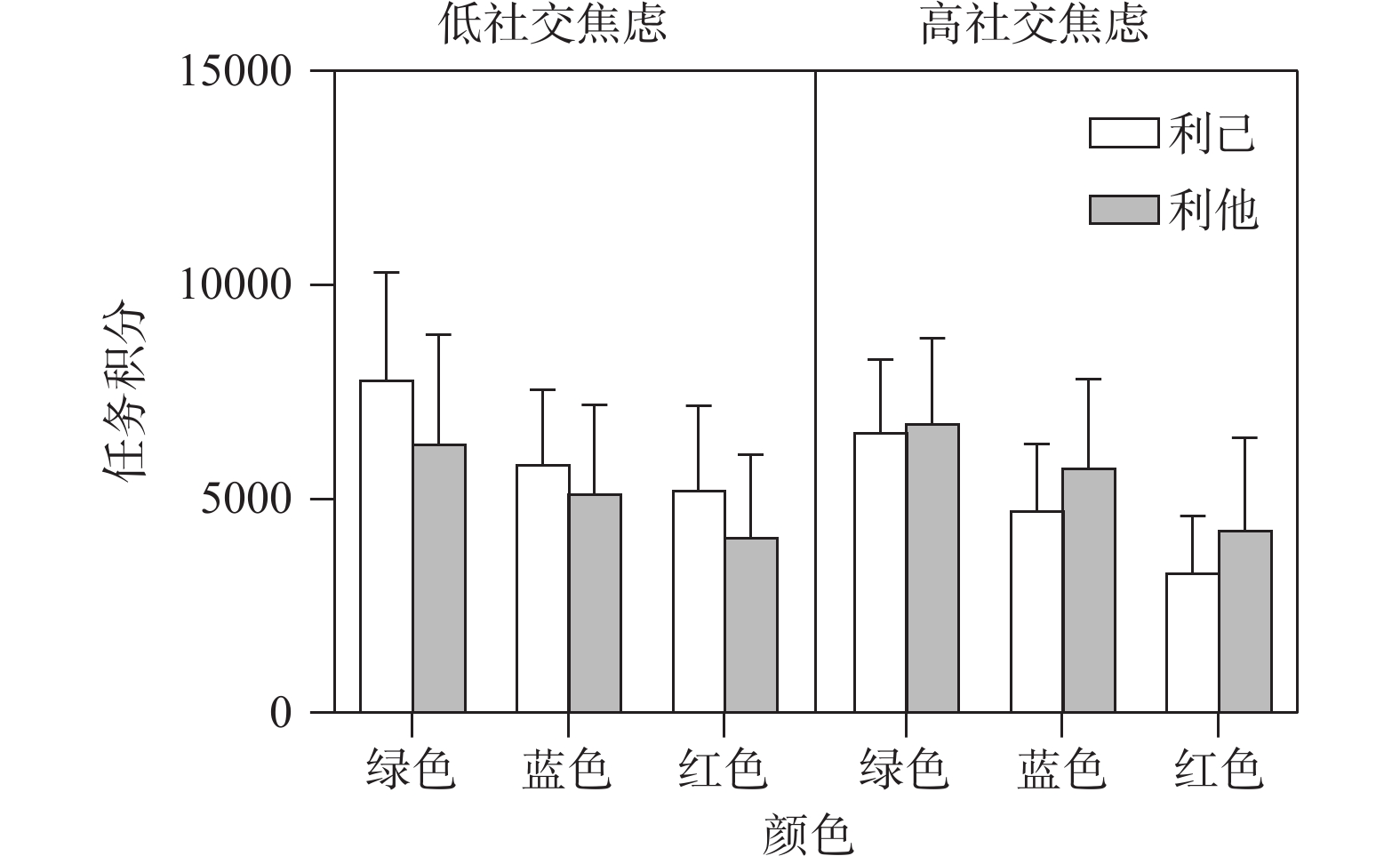
图2 不同颜色气球的风险决策行为比较
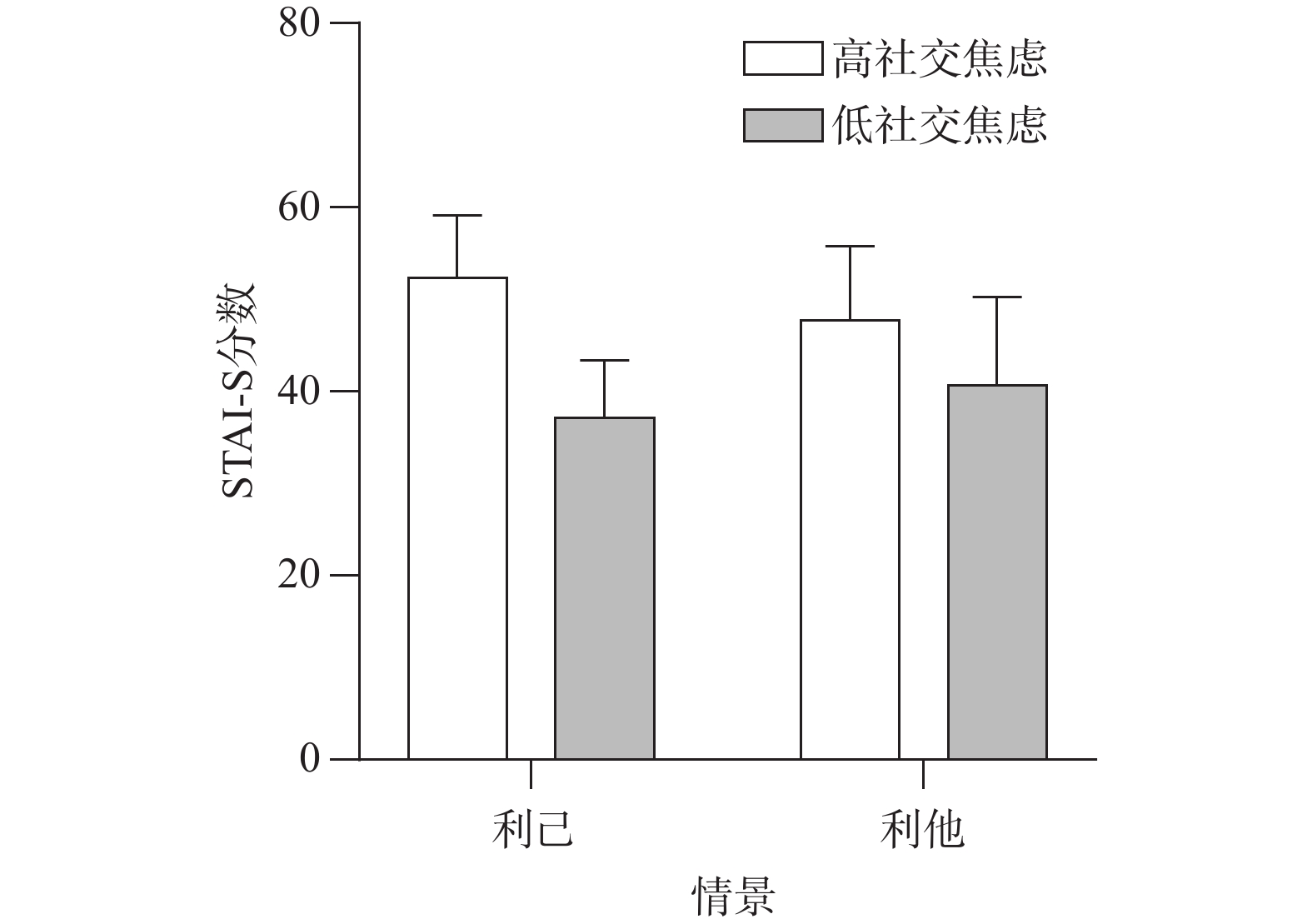
图3 不同社交焦虑水平个体在不同情景下的STAI-S分数
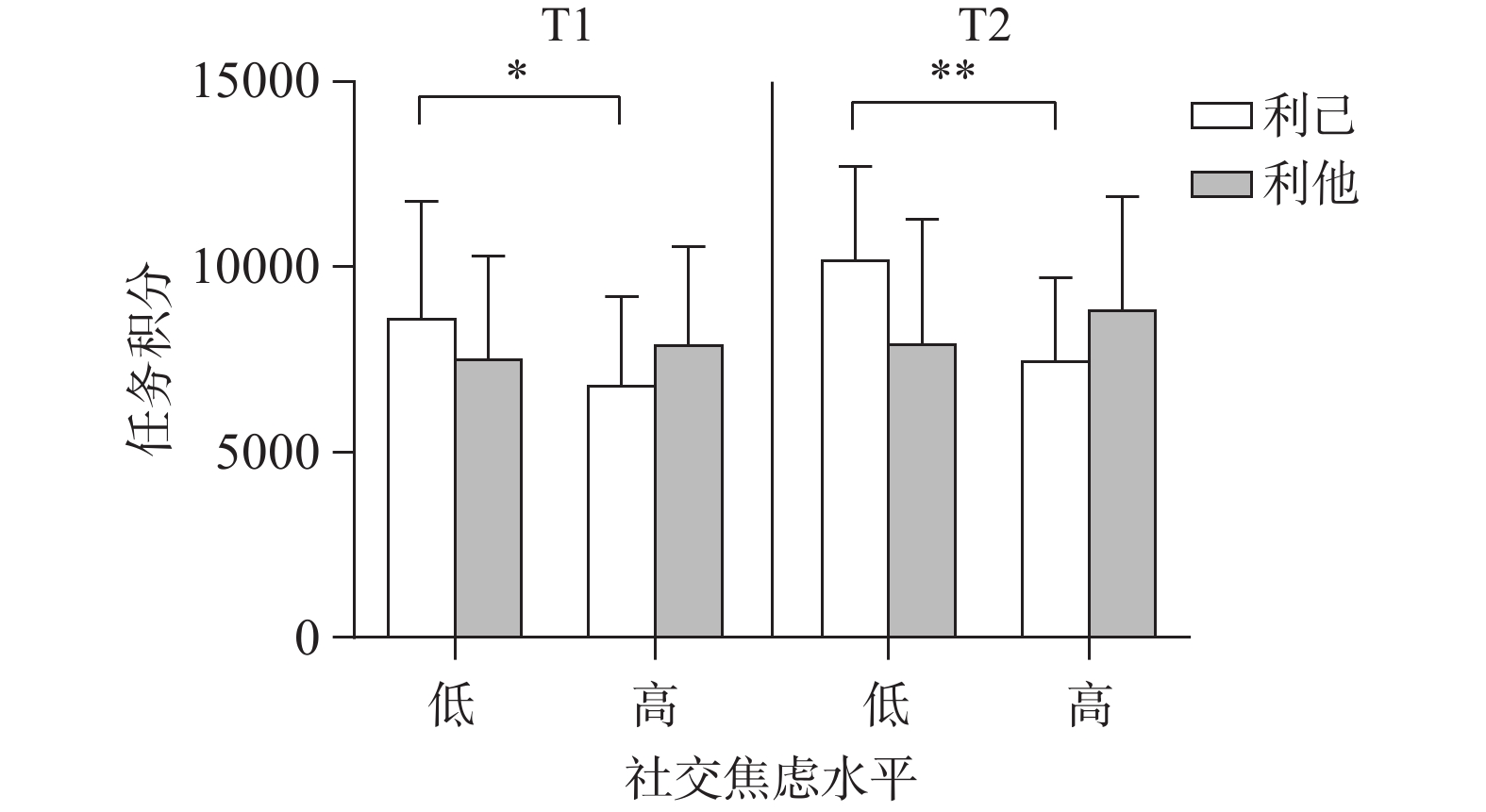
图4 不同社交焦虑水平个体在不同情景下的两次任务积分 注:*p<0.05,**p<0.01。
|
李文利, 钱铭怡. 状态特质焦虑量表中国大学生常模修订. 北京大学学报(自然科学版), 1995, 31 (1): 108- 112.
|
|
|
王振, 苑成梅, 黄佳, 李则挚, 陈珏, 张海音, … 肖泽萍. 贝克抑郁量表第2版中文版在抑郁症患者中的信效度. 中国心理卫生杂志, 2011, 25 (6): 476- 480.
DOI |
|
|
肖融, 吴薇莉, 张伟. 中文版社交恐怖症量表的信度和效度检验. 华西医学, 2007, 22 (3): 477- 479.
|
|
|
薛朝霞, 胡勇娟, 王晶, 黄雷晶, 刘威, 孙锋丹. 简式UPPS-P冲动行为量表在大学生中的信度效度检测. 中国临床心理学杂志, 2017, 25 (4): 662- 666.
|
|
|
Acland, E. L., Colasante, T., & Malti, T. Respiratory sinus arrhythmia and prosociality in childhood: Evidence for a quadratic effect. Developmental Psychobiology, 2019, 61 (8): 1146- 1156.
DOI |
|
|
Aknin, L. B., Dunn, E. W., Proulx, J., Lok, I., & Norton, M. I. Does spending money on others promote happiness?: A registered replication report. Journal of Personality and Social Psychology, 2020, 119 (2): e15- e26.
DOI |
|
|
American Psychiatric Association. (2022). Diagnostic and statistical manual of mental disorders (5th ed.). Washington, D.C.: American Psychiatric Association Publishing.
|
|
|
Balsamo, M., Romanelli, R., Innamorati, M., Ciccarese, G., Carlucci, L., & Saggino, A. The state-trait anxiety inventory: Shadows and lights on its construct validity. Journal of Psychopathology and Behavioral Assessment, 2013, 35 (4): 475- 486.
DOI |
|
|
Batson, C. D. Prosocial motivation: Is it ever truly altruistic. Advances in Experimental Social Psychology, 1987, 20, 65- 122.
|
|
|
Beck, A. T., Steer, R. A., & Brown, G. K. (1996). BDI-II, Beck Depression Inventory: Manual (2nd ed.). San Antonio, TX: The Psychological Corporation.
|
|
|
Bennett, R. Individual characteristics and the arousal of mixed emotions: Consequences for the effectiveness of charity fundraising advertisements. International Journal of Nonprofit and Voluntary Sector Marketing, 2015, 20 (2): 188- 209.
DOI |
|
|
Bică, A. Peer pressure: Conformity outweighs reciprocity in social anxiety. Current Psychology, 2023, 42 (21): 18142- 18149.
DOI |
|
|
Bornovalova, M. A., Cashman-Rolls, A., O’Donnell, J. M., Ettinger, K., Richards, J. B., deWit, H., & Lejuez, C. W. Risk taking differences on a behavioral task as a function of potential reward/loss magnitude and individual differences in impulsivity and sensation seeking. Pharmacology Biochemistry and Behavior, 2009, 93 (3): 258- 262.
DOI |
|
|
Cañigueral, R., & Hamilton, A. F. D. C. Being watched: Effects of an audience on eye gaze and prosocial behaviour. Acta Psychologica, 2019, 195, 50- 63.
DOI |
|
|
Charpentier, C. J., Aylward, J., Roiser, J. P., & Robinson, O. J. Enhanced risk aversion, but not loss aversion, in unmedicated pathological anxiety. Biological Psychiatry, 2017, 81 (12): 1014- 1022.
DOI |
|
|
Chen, X. G., Li, F., Nydegger, L., Gong, J., Ren, Y. J., Dinaj-Koci, V., … Stanton, B. Brief Sensation Seeking Scale for Chinese—Cultural adaptation and psychometric assessment. Personality and Individual Differences, 2013, 54 (5): 604- 609.
DOI |
|
|
Connor, K. M., Davidson, J. R. T., Churchill, L. E., Sherwood, A., Weisler, R. H., & Foa, E. Psychometric properties of the Social Phobia Inventory (SPIN): New self-rating scale. The British Journal of Psychiatry, 2000, 176 (4): 379- 386.
DOI |
|
|
Connor, K. M., Kobak, K. A., Churchill, L. E., Katzelnick, D., & Davidson, J. R. T. Mini-SPIN: A brief screening assessment for generalized social anxiety disorder. Depression and Anxiety, 2001, 14 (2): 137- 140.
DOI |
|
|
Cyders, M. A., Littlefield, A. K., Coffey, S., & Karyadi, K. A. Examination of a short English version of the UPPS-P Impulsive Behavior Scale. Addictive Behaviors, 2014, 39 (9): 1372- 1376.
DOI |
|
|
de Waal, F. B. M. Putting the altruism back into altruism: The evolution of empathy. Annual Review of Psychology, 2008, 59, 279- 300.
DOI |
|
|
Dunn, E. W., Aknin, L. B., & Norton, M. I. Prosocial spending and happiness: Using money to benefit others pays off. Current Directions in Psychological Science, 2014, 23 (1): 41- 47.
DOI |
|
|
Dys, S. P., Burrows, C. A., Usher, L. V., Almas, A. N., Degnan, K. A., Fox, N. A., & Henderson, H. A. Encouraging a peer in need: The impacts of social anxiety and peer familiarity. Social Development, 2023, 32 (2): 618- 632.
DOI |
|
|
Dyson, R., & Renk, K. Freshmen adaptation to university life: Depressive symptoms, stress, and coping. Journal of Clinical Psychology, 2006, 62 (10): 1231- 1244.
DOI |
|
|
Eisenberg, N. Emotion, regulation, and moral development. Annual Review of Psychology, 2000, 51, 665- 697.
DOI |
|
|
Eisenberg, N., Fabes, R. A., Miller, P. A., Fultz, J., Shell, R., Mathy, R. M., & Reno, R. R. Relation of sympathy and personal distress to prosocial behavior: A multimethod study. Journal of Personality and Social Psychology, 1989, 57 (1): 55- 66.
DOI |
|
|
Elemo, A. S., & Türküm, A. S. The Liebowitz Social Anxiety Scale (LSAS): Psychometric properties of the Amharic version in Ethiopian university student sample. International Journal of Mental Health and Addiction, 2022, 20 (3): 1709- 1721.
DOI |
|
|
Eshel, N., & Roiser, J. P. Reward and punishment processing in depression. Biological Psychiatry, 2010, 68 (2): 118- 124.
DOI |
|
|
Faber, N. S., & Häusser, J. A. Why stress and hunger both increase and decrease prosocial behaviour. Current Opinion in Psychology, 2022, 44, 49- 57.
DOI |
|
|
Grant, A. M., & Sonnentag, S. Doing good buffers against feeling bad: Prosocial impact compensates for negative task and self-evaluations. Organizational Behavior and Human Decision Processes, 2010, 111 (1): 13- 22.
DOI |
|
|
Heimberg, R. G., Hofmann, S. G., Liebowitz, M. R., Schneier, F. R., Smits, J. A. J., Stein, M. B., … Craske, M. G. Social anxiety disorder in DSM-5. Depression and Anxiety, 2014, 31 (6): 472- 479.
DOI |
|
|
Hengen, K. M., & Alpers, G. W. What’s the risk? Fearful individuals generally overestimate negative outcomes and they dread outcomes of specific events. Frontiers in Psychology, 2019, 10, 1676.
DOI |
|
|
Hengen, K. M., & Alpers, G. W. Better safe than wealthy: Dysfunctional risk avoidance in spider-fearful individuals. Journal of Anxiety Disorders, 2021a, 79, 102383.
DOI |
|
|
Hengen, K. M., & Alpers, G. W. Stress makes the difference: Social stress and social anxiety in decision-making under uncertainty. Frontiers in Psychology, 2021b, 12, 578293.
DOI |
|
|
Hoffman, M. L. (2000). Empathy and moral development: Implications for caring and justice. Cambridge: Cambridge University Press.
|
|
|
Hofmann, S. G. Cognitive factors that maintain social anxiety disorder: A comprehensive model and its treatment implications. Cognitive Behaviour Therapy, 2007, 36 (4): 193- 209.
DOI |
|
|
Inagaki, T. K., & Eisenberger, N. I. Giving support to others reduces sympathetic nervous system-related responses to stress. Psychophysiology, 2016, 53 (4): 427- 435.
DOI |
|
|
Karvay, Y., Imbriano, G., Jin, J. W., Mohanty, A., & Jarcho, J. M. They’re watching you: The impact of social evaluation and anxiety on threat-related perceptual decision-making. Psychological Research, 2022, 86 (4): 1174- 1183.
DOI |
|
|
Kashdan, T. B., Goodman, F. R., Machell, K. A., Kleiman, E. M., Monfort, S. S., Ciarrochi, J., & Nezlek, J. B. A contextual approach to experiential avoidance and social anxiety: Evidence from an experimental interaction and daily interactions of people with social anxiety disorder. Emotion, 2014, 14 (4): 769- 781.
DOI |
|
|
Kessler, R. C., Berglund, P., Demler, O., Jin, R., Merikangas, K. R., & Walters, E. E. Lifetime prevalence and age-of-onset distributions of DSM-IV disorders in the National Comorbidity Survey Replication. Archives of General Psychiatry, 2005, 62 (6): 593- 602.
DOI |
|
|
Knowles, K. A., & Olatunji, B. O. Specificity of trait anxiety in anxiety and depression: Meta-analysis of the State-Trait Anxiety Inventory. Clinical Psychology Review, 2020, 82, 101928.
DOI |
|
|
Lanser, I., & Eisenberger, N. I. Prosocial behavior reliably reduces loneliness: An investigation across two studies. Emotion, 2023, 23 (6): 1781- 1790.
DOI |
|
|
Lauriola, M., & Levin, I. P. Personality traits and risky decision-making in a controlled experimental task: An exploratory study. Personality and Individual Differences, 2001, 31 (2): 215- 226.
DOI |
|
|
Lejuez, C. W., Aklin, W. M., Zvolensky, M. J., & Pedulla, C. M. Evaluation of the Balloon Analogue Risk Task (BART) as a predictor of adolescent real-world risk-taking behaviours. Journal of Adolescence, 2003, 26 (4): 475- 479.
DOI |
|
|
Lejuez, C. W., Read, J. P., Kahler, C. W., Richards, J. B., Ramsey, S. E., Stuart, G. L., … Brown, R. A. Evaluation of a behavioral measure of risk taking: The Balloon Analogue Risk Task (BART). Journal of Experimental Psychology: Applied, 2002, 8 (2): 75- 84.
DOI |
|
|
Loewenstein, G. F., Weber, E. U., Hsee, C. K., & Welch, N. Risk as feelings. Psychological Bulletin, 2001, 127 (2): 267- 286.
DOI |
|
|
Lorian, C. N., & Grisham, J. R. The safety bias: Risk-avoidance and social anxiety pathology. Behaviour Change, 2010, 27 (1): 29- 41.
DOI |
|
|
Manzur, E., & Olavarrieta, S. The 9-SRA Scale: A simplified 9-items version of the SRA scale to assess altruism. Sustainability, 2021, 13 (13): 6999.
DOI |
|
|
Meng, T. T., He, Y. Q., Zhang, Q., Yu, F. F., Zhao, L. S., Zhang, S. J., … Liu, J. B. Analysis of features of social anxiety and exploring the relationship between childhood major adverse experiences and social anxiety in early adulthood among Chinese college students. Journal of Affective Disorders, 2021, 292, 614- 622.
DOI |
|
|
Mou, Q. X., Zhuang, J., Gao, Y. X., Zhong, Y. Q., Lu, Q. Y., Gao, F., & Zhao, M. M. The relationship between social anxiety and academic engagement among Chinese college students: A serial mediation model. Journal of Affective Disorders, 2022, 311, 247- 253.
DOI |
|
|
Pittig, A., & Scherbaum, S. Costly avoidance in anxious individuals: Elevated threat avoidance in anxious individuals under high, but not low competing rewards. Journal of Behavior Therapy and Experimental Psychiatry, 2020, 66, 101524.
DOI |
|
|
Rosen, J. B., & Schulkin, J. From normal fear to pathological anxiety. Psychological Review, 1998, 105 (2): 325- 350.
DOI |
|
|
Salari, N., Heidarian, P., Hassanabadi, M., Babajani, F., Abdoli, N., Aminian, M., & Mohammadi, M. Global prevalence of social anxiety disorder in children, adolescents and youth: A systematic review and meta-analysis. Journal of Prevention, 2024, 45 (5): 795- 813.
DOI |
|
|
Schuhmacher, N., Collard, J., & Kärtner, J. The Differential role of parenting, peers, and temperament for explaining interindividual differences in 18-months-olds’ comforting and helping. Infant Behavior and Development, 2017, 46, 124- 134.
DOI |
|
|
Taylor, C. T., Rosenfield, D., Dowd, S. M., Dutcher, C. D., Hofmann, S. G., Otto, M. W., … Smits, J. A. J. What good are positive emotions for treatment? A replication test of whether trait positive emotionality predicts response to exposure therapy for social anxiety disorder. Behaviour Research and Therapy, 2023, 171, 104436.
DOI |
|
|
Taylor, C. T., Tsai, T. C., & Smith, T. R. Examining the link between positive affectivity and anxiety reactivity to social stress in individuals with and without social anxiety disorder. Journal of Anxiety Disorders, 2020, 74, 102264.
DOI |
|
|
Varma, M. M., Chen, D., Lin, X., Aknin, L. B., & Hu, X. Prosocial behavior promotes positive emotion during the COVID-19 pandemic. Emotion, 2023, 23 (2): 538- 553.
DOI |
|
|
von Dawans, B., Strojny, J., & Domes, G. The effects of acute stress and stress hormones on social cognition and behavior: Current state of research and future directions. Neuroscience & Biobehavioral Reviews, 2021, 121, 75- 88.
|
|
|
von Dawans, B., Trueg, A., Kirschbaum, C., Fischbacher, U., & Heinrichs, M. Acute social and physical stress interact to influence social behavior: The role of social anxiety. PLoS One, 2018, 13 (10): e0204665.
DOI |
|
|
Wang, Y. L., Ge, J. Q., Zhang, H. Q., Wang, H. X., & Xie, X. F. Altruistic behaviors relieve physical pain. Proceedings of the National Academy of Sciences of the United States of America, 2020, 117 (2): 950- 958.
|
|
|
Yu, M., & Wang, J. P. Interpretation bias and adolescent social anxiety: The mediating effect of pre- and post-event rumination. Cognitive Therapy and Research, 2024, 48 (5): 880- 894.
DOI |
|
|
Zaatri, S., Aderka, I. M., & Hertz, U. Blend in or stand out: Social anxiety levels shape information-sharing strategies. Proceedings of the Royal Society B: Biological Sciences, 2022, 289 (1975): 20220476.
DOI |
| [1] | 张璐, 乌云特娜. 社会临场感对大学生网络亲社会行为的影响:基于I3模型的视角[J]. 心理与行为研究, 2025, 23(4): 528-535. |
| [2] | 于永菊, 何敏. 高校大学生生命意义感的演变模式及其与抑郁症状的关联[J]. 心理与行为研究, 2025, 23(3): 354-360. |
| [3] | 赵永耀, 张野, 薛培培, 张小南, 魏梦慧. 网络欺凌情境中受害者反应对旁观者建设性干预意愿的影响:状态共情的调节作用[J]. 心理与行为研究, 2025, 23(2): 241-248. |
| [4] | 赵黎明, 韩蒙蒙, 贾津津. 中学生社交焦虑与攻击性的关系:言语流畅性的中介作用和情绪智力的调节作用[J]. 心理与行为研究, 2025, 23(2): 265-272. |
| [5] | 王永胜, 韩洋, 李馨, 何立媛. 词间空格在维吾尔族大学生不同文本呈现方向的汉语句子阅读中的促进作用[J]. 心理与行为研究, 2025, 23(1): 41-48. |
| [6] | 罗鹤旋, 朱海东, 邱鑫. 家庭社会经济地位与青少年亲社会行为的关系:链式中介效应及独生状况差异[J]. 心理与行为研究, 2025, 23(1): 130-137. |
| [7] | 张丽晴, 裘璐, 王年馨, 刘方, 袁博, 刘文. 童年社会经济地位与初中生亲社会行为:亲子依恋回避与情绪调节策略的中介作用[J]. 心理与行为研究, 2024, 22(4): 516-522. |
| [8] | 牛宏伟, 郝嘉佳, 白学军. 大学生失败心态量表的编制及信效度检验[J]. 心理与行为研究, 2024, 22(3): 379-386. |
| [9] | 关文军, 吴添昊, 程毓可, 多强. 孤独症儿童父母负面评价恐惧和社交焦虑的关系:一个有调节的中介效应模型[J]. 心理与行为研究, 2024, 22(3): 418-424. |
| [10] | 吴旻, 谢燕, 李妍. 母亲温暖和父亲温暖教养的一致性与农村儿童亲社会行为:心理资本的中介作用[J]. 心理与行为研究, 2024, 22(2): 251-257, 273. |
| [11] | 史滋福, 陈火红, 张艺瀚, 管锦亮, 夏笔奇, 靳紫阳. 父母直升机教养对大学生主观幸福感的影响:自我控制和抑郁的链式中介作用[J]. 心理与行为研究, 2024, 22(1): 116-122. |
| [12] | 巩彦斌, 杨海波. 体育锻炼与大学生智能手机成瘾的关系:创新行为和心理健康的链式中介作用[J]. 心理与行为研究, 2023, 21(6): 770-775. |
| [13] | 刘仁洁, 夏凌翔, 赵永萍. 大学生网络欺凌受害潜在类别的发展特点及性别因素的作用[J]. 心理与行为研究, 2023, 21(6): 784-791. |
| [14] | 占友龙, 江雪芬, 刘长林, 刘旭, 谭千保. 大学生自我担当对道德困境下亲社会行为意愿的影响:自我效能感和预期自豪的链式中介作用[J]. 心理与行为研究, 2023, 21(6): 839-845. |
| [15] | 田可心, 阴山燕, 武亦文, 胡文彬. 积极共情与高中生亲社会行为的关系:自我建构的中介与社会比较的调节作用[J]. 心理与行为研究, 2023, 21(5): 712-719. |
| 阅读次数 | ||||||
|
全文 |
|
|||||
|
摘要 |
|
|||||
