
心理与行为研究 ›› 2024, Vol. 22 ›› Issue (6): 761-768.DOI: 10.12139/j.1672-0628.2024.06.006
姚雨佳1, 林慧慧1, 徐舵*,2( )
)
收稿日期:2024-08-13
出版日期:2024-11-20
发布日期:2024-11-20
通讯作者:
徐舵
基金资助:
Yujia YAO1, Huihui LIN1, Duo XU*,2()
Received:2024-08-13
Online:2024-11-20
Published:2024-11-20
Contact:
Duo XU
摘要:
以往研究多将情绪调节灵活性与痛苦忍受性作为情绪调节能力进行研究,发现二者能够分别预测特质焦虑。但近年来,不同研究对二者与特质焦虑的关系存在不同看法。因此,本研究对407名青少年进行为期6个月的纵向追踪问卷调查,以探讨青少年特质焦虑与情绪调节灵活性、痛苦忍受性之间的预测关系。结果表明:(1)青少年特质焦虑分别与情绪调节灵活性、痛苦忍受性总分呈显著负相关关系;(2)T1情绪调节灵活性对T2特质焦虑有预测作用,但T1特质焦虑对T2情绪调节灵活性预测作用不显著;(3)T1特质焦虑对T2痛苦忍受性有预测作用,但T1痛苦忍受性对T2特质焦虑预测作用不显著。本研究解释了特质焦虑与情绪调节灵活性、痛苦忍受性之间的关系,对预防和改善青少年焦虑有一定的实践意义。
姚雨佳, 林慧慧, 徐舵. 青少年特质焦虑与情绪调节灵活性、痛苦忍受性之间的关系:一项交叉滞后分析[J]. 心理与行为研究, 2024, 22(6): 761-768.
Yujia YAO, Huihui LIN, Duo XU. The Relationship Between Trait Anxiety, Distress Tolerance and Emotional Regulation Flexibility in Adolescents: A Cross-Lagged Analysis[J]. Studies of Psychology and Behavior, 2024, 22(6): 761-768.
| 变量 | M | SD | 1 | 2 | 3 | 4 | 5 | 6 | 7 |
| 1.T1特质焦虑 | 39.45 | 8.63 | |||||||
| 2.T1痛苦忍受性 | 3.57 | 0.67 | −0.56*** | ||||||
| 3.T1情绪调节灵活性 | 5.10 | 0.97 | −0.57*** | 0.44** | |||||
| 4.T2特质焦虑 | 39.85 | 9.01 | 0.69*** | −0.43*** | −0.46*** | ||||
| 5.T2痛苦忍受性 | 3.57 | 0.60 | −0.46*** | 0.56*** | 0.32*** | −0.55*** | |||
| 6.T2情绪调节灵活性 | 5.01 | 0.99 | −0.41*** | 0.35*** | 0.53*** | −0.55*** | 0.82*** | ||
| 7.年龄 | 13.14 | 0.71 | 0.06 | −0.07 | −0.02 | 0.00 | −0.07 | −0.02 | |
| 8.性别 | 0.46 | 0.50 | −0.08 | −0.06 | −0.08 | 0.10* | −0.06 | −0.03 | 0.02 |
表1 描述统计和相关分析结果(n=407)
| 变量 | M | SD | 1 | 2 | 3 | 4 | 5 | 6 | 7 |
| 1.T1特质焦虑 | 39.45 | 8.63 | |||||||
| 2.T1痛苦忍受性 | 3.57 | 0.67 | −0.56*** | ||||||
| 3.T1情绪调节灵活性 | 5.10 | 0.97 | −0.57*** | 0.44** | |||||
| 4.T2特质焦虑 | 39.85 | 9.01 | 0.69*** | −0.43*** | −0.46*** | ||||
| 5.T2痛苦忍受性 | 3.57 | 0.60 | −0.46*** | 0.56*** | 0.32*** | −0.55*** | |||
| 6.T2情绪调节灵活性 | 5.01 | 0.99 | −0.41*** | 0.35*** | 0.53*** | −0.55*** | 0.82*** | ||
| 7.年龄 | 13.14 | 0.71 | 0.06 | −0.07 | −0.02 | 0.00 | −0.07 | −0.02 | |
| 8.性别 | 0.46 | 0.50 | −0.08 | −0.06 | −0.08 | 0.10* | −0.06 | −0.03 | 0.02 |
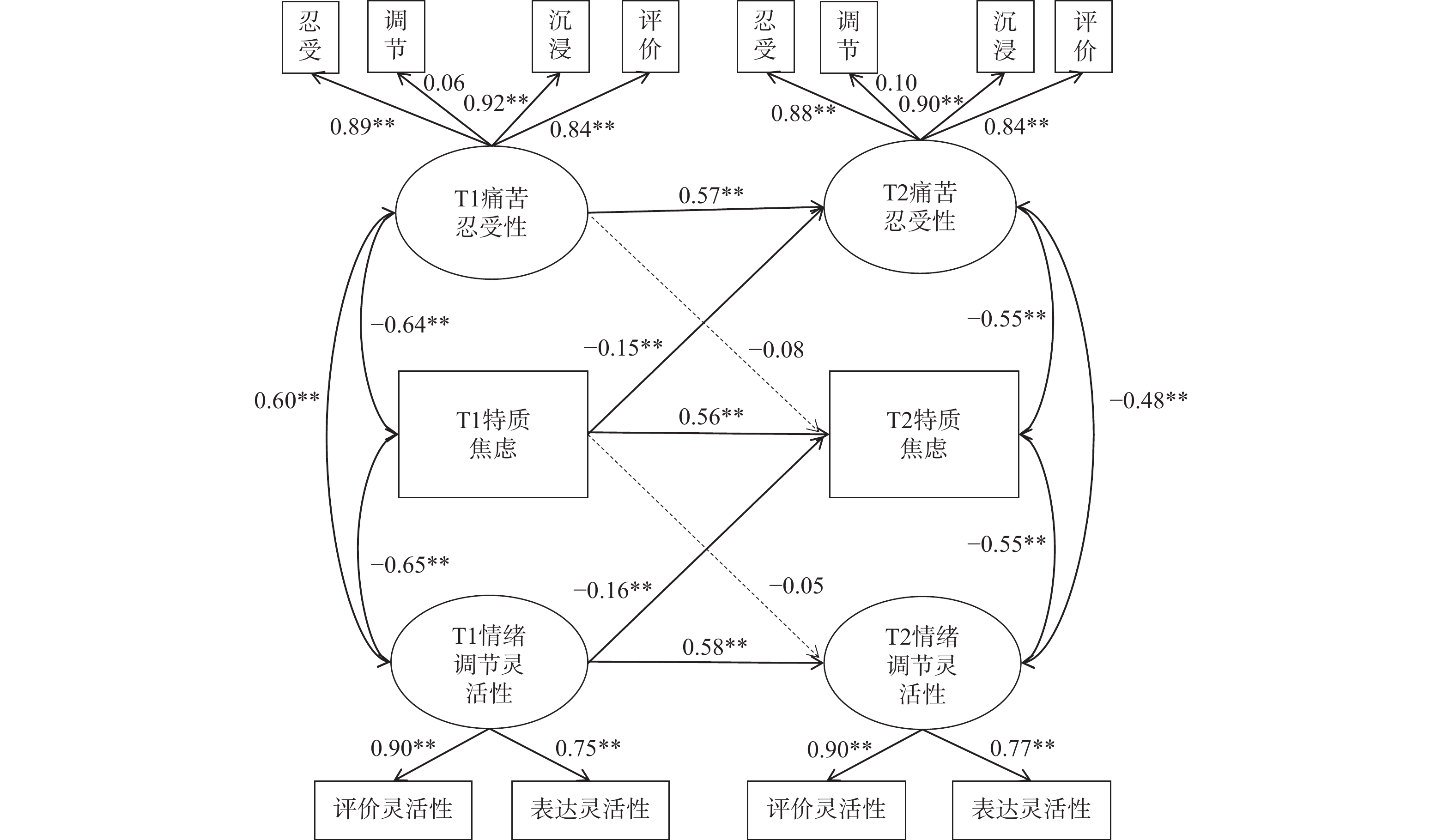
图1 交叉滞后模型分析结果
|
黄敏儿, 唐淦琦, 易晓敏, 孙莎莎. 中庸致和: 情绪调节灵活性的作用. 中国社会心理学评论, 2014, (2): 88- 112.
|
|
|
李文利, 钱铭怡. 状态特质焦虑量表中国大学生常模修订. 北京大学学报(自然科学版), 1995, 31 (1): 108- 112.
|
|
|
孙丽萍, 鞠佳雯, 蒋柳青, 边玉芳. 父母心理控制与青少年焦虑的关系: 一项交叉滞后研究. 心理发展与教育, 2018, 34 (6): 758- 768.
|
|
|
王碧瑶, 张敏强, 张洁婷, 胡俊, 攸佳宁, 梁耀坚. 青少年自我伤害行为的潜在转变分析: 一项纵向研究. 心理科学, 2015, 38 (6): 1368- 1376.
|
|
|
王小琴. (2021). 负性情绪调节灵活性的适应性及其认知神经基础(博士学位论文), 西南大学, 重庆.
|
|
|
杨振华, 焦世元, 董薇, 肖婕, 蔡文鹏, 田彬, 严进. 高、低特质焦虑军校学员的认知情绪调节策略、应对方式和焦虑的现况调查. 第三军医大学学报, 2016, 38 (20): 2215- 2218.
|
|
|
姚雨佳, 宣雨阳, 齐常辉, 桑标. 自动化情绪调节策略对特质焦虑大学生应激反应的影响. 心理科学, 2019, 42 (1): 209- 215.
|
|
|
张禹, 罗禹, 赵守盈, 陈维, 李红. 对威胁刺激的注意偏向: 注意定向加速还是注意解除困难. 心理科学进展, 2014, 22 (7): 1129- 1138.
|
|
|
郑晓华, 李延知. 状态-特质焦虑问卷. 中国心理卫生杂志, 1997, 11 (4): 219- 220.
DOI |
|
|
周浩, 龙立荣. 共同方法偏差的统计检验与控制方法. 心理科学进展, 2004, 12 (6): 942- 950.
DOI |
|
|
Aguirre, P., Michelini, Y., Bravo, A. J., Pautassi, R. M., & Pilatti, A. Association between personality traits and symptoms of depression and anxiety via emotional regulation and distress tolerance. PLoS One, 2024, 19 (7): e0306146.
DOI |
|
|
Allan, N. P., Macatee, R. J., Norr, A. M., & Schmidt, N. B. Direct and interactive effects of distress tolerance and anxiety sensitivity on generalized anxiety and depression. Cognitive Therapy and Research, 2014, 38 (5): 530- 540.
DOI |
|
|
Amstadter, A. Emotion regulation and anxiety disorders. Journal of Anxiety Disorders, 2008, 22 (2): 211- 221.
DOI |
|
|
Bardeen, J. R., Tull, M. T., Dixon-Gordon, K. L., Stevens, E. N., & Gratz, K. L. Attentional control as a moderator of the relationship between difficulties accessing effective emotion regulation strategies and distress tolerance. Journal of Psychopathology and Behavioral Assessment, 2015, 37 (1): 79- 84.
DOI |
|
|
Bonanno, G. A., & Burton, C. L. Regulatory flexibility: An individual differences perspective on coping and emotion regulation. Perspectives on Psychological Science, 2013, 8 (6): 591- 612.
DOI |
|
|
Cheng, C. Assessing coping flexibility in real-life and laboratory settings: A multimethod approach. Journal of Personality and Social Psychology, 2001, 80 (5): 814- 833.
DOI |
|
|
Chowdhury, N., Kevorkian, S., Hawn, S. E., Amstadter, A. B., Dick, D., Kendler, K. S., & Berenz, E. C. Associations between personality and distress tolerance among trauma-exposed young adults. Personality and Individual Differences, 2018, 120, 166- 170.
DOI |
|
|
Conroy, K., Curtiss, J. E., Barthel, A. L., Lubin, R., Wieman, S., Bui, E., … Hofmann, S. G. Emotion regulation flexibility in generalized anxiety disorder. Journal of Psychopathology and Behavioral Assessment, 2020, 42 (1): 93- 100.
DOI |
|
|
Franklin, P., Tsujimoto, K. C., Lewis, M. E., Tekok-Kilic, A., & Frijters, J. C. Sex differences in self-regulatory executive functions are amplified by trait anxiety: The case of students at risk for academic failure. Personality and Individual Differences, 2018, 129, 131- 137.
DOI |
|
|
French, N. J., Eberle, J. W., & Teachman, B. A. (2022). Anxiety sensitivity, distress intolerance, and negative interpretation bias strengthen the relationship between trait anxiety and depersonalization. Anxiety, Stress, & Coping, 35(4), 395–408.
|
|
|
Gallego, A., McHugh, L., Villatte, M., & Lappalainen, R. Examining the relationship between public speaking anxiety, distress tolerance and psychological flexibility. Journal of Contextual Behavioral Science, 2020, 16, 128- 133.
DOI |
|
|
Gilbert, K. E. The neglected role of positive emotion in adolescent psychopathology. Clinical Psychology Review, 2012, 32 (6): 467- 481.
DOI |
|
|
Goodhew, S. C., & Edwards, M. Elevated cognitive failures in trait anxiety. Personality and Individual Differences, 2024, 216, 112418.
DOI |
|
|
Goodman, F. R., Daniel, K. E., Eldesouky, L., Brown, B. A., & Kneeland, E. T. How do people with social anxiety disorder manage daily stressors? Deconstructing emotion regulation flexibility in daily life. Journal of Affective Disorders Reports, 2021, 6, 100210.
DOI |
|
|
Grimm, E., Agrigoroaei, S., Rohleder, N., & Becker, L. Executive functioning as a predictor of physiological and subjective acute stress responses in non-clinical adult populations: A systematic literature review and meta-analysis. Neuroscience & Biobehavioral Reviews, 2021, 131, 1096- 1115.
|
|
|
Gross, J. J., & Thompson, R. A. (2007). Emotion regulation: Conceptual foundations. In J. J. Gross (Ed.), Handbook of emotion regulation (pp. 3–24). New York: Guilford Press.
|
|
|
Gundogdu, D., Finnerty, A. N., Staiano, J., Teso, S., Passerini, A., Pianesi, F., & Lepri, B. Investigating the association between social interactions and personality states dynamics. Royal Society Open Science, 2017, 4 (9): 170194.
DOI |
|
|
Heinrichs, R. W. The duality of human cognition: Operations and intentionality in mental life and illness. Neuroscience & Biobehavioral Reviews, 2020, 108, 139- 148.
|
|
|
Hemi, A., Sopp, M. R., Bonanno, G., Michael, T., McGiffin, J., & Levy-Gigi, E. (2024). Flexibility predicts chronic anxiety and depression during the first year of the COVID-19 pandemic—A longitudinal investigation of mental health trajectories. Psychological Trauma: Theory, Research, Practice, and Policy, 16(6), 961–970.
|
|
|
Hofmann, S. G., Sawyer, A. T., Fang, A., & Asnaani, A. Emotion dysregulation model of mood and anxiety disorders. Depression and Anxiety, 2012, 29 (5): 409- 416.
DOI |
|
|
Kim, M. S. Psychiatric symptoms and emotion regulation strategies among the unemployed people in Korea: A latent profile analysis. PLoS One, 2020, 15 (8): e0236937.
DOI |
|
|
Kraemer K. M., Luberto C. M., & McLeish A. C. (2013). The moderating role of distress tolerance in the association between anxiety sensitivity physical concerns and panic and PTSD-related re-experiencing symptoms. Anxiety, Stress, and Coping, 26(3), 330–342.
|
|
|
Krkovic, K., Clamor, A., & Lincoln, T. M. Emotion regulation as a predictor of the endocrine, autonomic, affective, and symptomatic stress response and recovery. Psychoneuroendocrinology, 2018, 94, 112- 120.
DOI |
|
|
Lee, S. Y., Park, C. L., & Russell, B. S. Does distress tolerance interact with trait anxiety to predict challenge or threat appraisals. Personality and Individual Differences, 2018, 132, 14- 19.
DOI |
|
|
Lilienfeld, S. O. (1996). Anxiety sensitivity is not distinct from trait anxiety. In R.M. Rapee (Ed.), Current Controversies in the Anxiety Disorders (pp. 228–244). New York: Guilford Press.
|
|
|
Mecha, P., Rodriguez‐Morales, M., & Sanchez‐Lopez, A. Components of hot and cold executive functions and their relations to different forms of stress resilience: A systematic review. Stress and Health, 2024, 40 (5): e3439.
DOI |
|
|
Mennin, D. S. Emotion regulation therapy for generalized anxiety disorder. Clinical Psychology & Psychotherapy: An International Journal of Theory & Practice, 2004, 11 (1): 17- 29.
|
|
|
Mennin, D. S., Heimberg, R. G., Turk, C. L., & Fresco, D. M. Applying an emotion regulation framework to integrative approaches to generalized anxiety disorder. Clinical Psychology: Science and Practice, 2002, 9 (1): 85- 90.
DOI |
|
|
Michel, N. M., Rowa, K., Young, L., & McCabe, R. E. Emotional distress tolerance across anxiety disorders. Journal of Anxiety Disorders, 2016, 40, 94- 103.
DOI |
|
|
Miranda, R., Fontes, M., & Marroquín, B. Cognitive content-specificity in future expectancies: Role of hopelessness and intolerance of uncertainty in depression and GAD symptoms. Behaviour Research and Therapy, 2008, 46 (10): 1151- 1159.
DOI |
|
|
Muraven, M., & Baumeister, R. F. Self-regulation and depletion of limited resources: Does self-control resemble a muscle. Psychological Bulletin, 2000, 126 (2): 247- 259.
DOI |
|
|
Nicol, A., Mak, A. S., Murray, K., Walker, I., & Buckmaster, D. The relationships between early maladaptive schemas and youth mental health: A systematic review. Cognitive Therapy and Research, 2020, 44 (4): 715- 751.
DOI |
|
|
Nock, M. K., Wedig, M. M., Holmberg, E. B., & Hooley, J. M. The Emotion Reactivity Scale: Development, evaluation, and relation to self-injurious thoughts and behaviors. Behavior Therapy, 2008, 39 (2): 107- 116.
DOI |
|
|
Ocañez, K. L. S., McHugh, R. K., & Otto, M. W. A meta-analytic review of the association between anxiety sensitivity and pain. Depression and Anxiety, 2010, 27 (8): 760- 767.
DOI |
|
|
Pruessner, L., Barnow, S., Holt, D. V., Joormann, J., & Schulze, K. A cognitive control framework for understanding emotion regulation flexibility. Emotion, 2020, 20 (1): 21- 29.
DOI |
|
|
Puliafico, A. C., & Kendall, P. C. Threat-related attentional bias in anxious youth: A review. Clinical Child and Family Psychology Review, 2006, 9 (3–4): 162- 180.
DOI |
|
|
Rabner, J. C., Ney, J. S., & Kendall, P. C. Cognitive functioning in youth with anxiety disorders: A systematic review. Clinical Child and Family Psychology Review, 2024, 27 (2): 357- 380.
DOI |
|
|
Ranney, R. M., Berenz, E., Rappaport, L. M., Amstadter, A., Dick, D., & Spit for Science Working Group. Anxiety sensitivity and distress tolerance predict changes in internalizing symptoms in individuals exposed to interpersonal trauma. Cognitive Therapy and Research, 2022, 46 (1): 217- 231.
DOI |
|
|
Reitzel, L. R., Smith, N. G., Obasi, E. M., Forney, M., & Leventhal, A. M. Perceived distress tolerance accounts for the covariance between discrimination experiences and anxiety symptoms among sexual minority adults. Journal of Anxiety Disorders, 2017, 48, 22- 27.
DOI |
|
|
Reynolds, A., MacLeod, C., & Grafton, B. The role of expectancies and selective interrogation of information in trait anxiety-linked affect when approaching potentially stressful future events. Behaviour Research and Therapy, 2024, 179, 104568.
DOI |
|
|
Riskind, J. H. Unscrambling the dynamics of danger: Scientific foundations and evidence for the looming vulnerability model and looming cognitive style in anxiety. Cognitive Therapy and Research, 2024, 48 (5): 808- 832.
DOI |
|
|
Sanchez-Lopez, A. How flexible are we in regulating our emotions? A discussion on current conceptual frameworks of emotion regulation flexibility, requirements for future research and potential practical implications. The Spanish Journal of Psychology, 2021, 24, e31.
DOI |
|
|
Shangguan, C. Y., Wang, Y. L., Wang, X., Zhang, L. H., & Zhou, B. P. The more anxious, the less flexible? Association of trait anxiety with expressive flexibility and the mediating role of emotion regulation strategies. Current Psychology, 2024, 43 (32): 26121- 26133.
DOI |
|
|
Sifat, M. S., Ehlke, S. J., Ogunsanya, M., Frank-Pearce, S. G., Boozary, L. K., Alexander, A. C., ... Kendzor, D. E. Greater discrimination frequency and lower distress tolerance are associated with mental health problems among racially privileged and minoritized adults accessing an urban day shelter. Journal of Racial and Ethnic Health Disparities, 2024, 11 (1): 45- 61.
DOI |
|
|
Slee, N., Garnefski, N., Spinhoven, P., & Arensman, E. The influence of cognitive emotion regulation strategies and depression severity on deliberate self-harm. Suicide and Life-Threatening Behavior, 2008, 38 (3): 274- 286.
DOI |
|
|
Soleimani, M. A., Pahlevan Sharif, S., Bahrami, N., Yaghoobzadeh, A., Allen, K. A., & Mohammadi, S. The relationship between anxiety, depression and risk behaviors in adolescents. International Journal of Adolescent Medicine and Health, 2019, 31 (2): 20160148.
|
|
|
Specker, P., & Nickerson, A. (2024). Investigating the effectiveness of instructing emotion regulation flexibility to individuals with low and high anxiety. Anxiety, Stress, & Coping, 37(1), 143–156.
|
|
|
Tull, M. T., & Aldao, A. Editorial overview: New directions in the science of emotion regulation. Current Opinion in Psychology, 2015, 3, iv- x.
DOI |
|
|
Unbrin, A., Khanum, S., Shahzadi, M., & Imtiaz, M. Associates of distress tolerance among adolescents: Role of anger, worry and sadness. Pakistan Journal of Humanities and Social Sciences, 2024, 12 (1): 79- 86.
|
|
|
Veilleux, J. C. The relationship between distress tolerance and cigarette smoking: A systematic review and synthesis. Clinical Psychology Review, 2019, 71, 78- 89.
DOI |
|
|
Veilleux, J. C., Hyde, K. C., & Clift, J. B. When is your distress harder to tolerate? A qualitative analysis of situations in which distress tolerance is impaired and strengthened. Journal of Contextual Behavioral Science, 2022, 23, 85- 91.
DOI |
|
|
Wang, T., Li, M., Xu, S., Liu, B. T., Wu, T., Lu, F., ... Wang, J. Relations between trait anxiety and depression: A mediated moderation model. Journal of Affective Disorders, 2019, 244, 217- 222.
DOI |
|
|
Williams, D. P., Feeling, N. R., Hill, L. K., Spangler, D. P., Koenig, J., & Thayer, J. F. Resting heart rate variability, facets of rumination and trait anxiety: Implications for the perseverative cognition hypothesis. Frontiers in Human Neuroscience, 2017, 11, 520.
DOI |
|
|
You, J. N., & Leung, F. A Chinese adaptation of the distress tolerance scale among adolescents: Factor structure and psychometric properties. Journal of Psychopathology and Behavioral Assessment, 2012, 34 (1): 136- 144.
DOI |
|
|
Zainal, N. H., & Newman, M. G. Executive functioning constructs in anxiety, obsessive-compulsive, post-traumatic stress, and related disorders. Current Psychiatry Reports, 2022, 24 (12): 871- 880.
DOI |
|
|
Zhu, Y. T., & Deng, W. Moderating the link between discrimination and adverse mental health outcomes: Examining the protective effects of cognitive flexibility and emotion regulation. PLoS One, 2023, 18 (10): e0282220.
DOI |
| [1] | 王惠惠, 唐慎佩, 赵双祐, 黄向圆, 兰松. 内在自我与外界眼光:自我评价与反射性评价一致性对青少年心理健康问题的影响[J]. 心理与行为研究, 2026, 24(2): 187-194. |
| [2] | 樊雪戎, 段依凡, 邢晓沛. 温暖的亲子感知差异与青少年内化问题的关系:基于二项式回归的响应面分析[J]. 心理与行为研究, 2026, 24(2): 195-203. |
| [3] | 张一林, 牛更枫, 白旭青, 辛素飞, 孙晓军. 社会逆境感知与青少年社交媒体成瘾的双向关系:控制感的作用[J]. 心理与行为研究, 2026, 24(2): 258-264. |
| [4] | 曾子豪, 何震, 袁言云, 赵纤, 印利红, 谭嵘, 常梦梦, 胡义秋. HPA轴系统多基因−亲子关系交互对青少年抑郁发展影响及性别差异[J]. 心理与行为研究, 2026, 24(1): 78-86. |
| [5] | 杨昕珠, 王腾飞, 郑晓龙. 青少年社会情感能力与学业倦怠的双向预测作用:一项交叉滞后研究[J]. 心理与行为研究, 2025, 23(6): 789-797. |
| [6] | 谷莉, 黄晓彤, 梁广华, 蔡頠, 郭丰波. 核心自我评价与青少年自伤行为的关系:有调节的中介模型[J]. 心理与行为研究, 2025, 23(6): 798-805. |
| [7] | 张春妹, 骆玉冰, 温冬雪, 郑航. 青少年逆反心理与偏差行为的关系:偏差同伴联系和偏差群体同一性的链式中介作用[J]. 心理与行为研究, 2025, 23(5): 645-652. |
| [8] | 刘鑫, 刘衍玲, 曾晋逸. 心理需要挫折与青少年抑郁症状的纵向联系:心理素质的调节作用[J]. 心理与行为研究, 2025, 23(4): 496-503. |
| [9] | 鲍振宙, 刘花, 于明申. 青少年校园欺凌旁观行为与焦虑抑郁症状的关系:基于纵向网络分析法[J]. 心理与行为研究, 2025, 23(4): 504-512. |
| [10] | 刘佳, 高培晋, 李楠, 孙敏, 白学军. 社会变化程度感知对青少年社会公平感的影响[J]. 心理与行为研究, 2025, 23(4): 551-559. |
| [11] | 张庆吉, 郭丰波, 涂叶满, 卿再花, 宋凤. 劳动价值观对青少年心理健康潜在类别及其转换的影响:双因素模型视角[J]. 心理与行为研究, 2025, 23(4): 569-576. |
| [12] | 张阔, 李珮瑜, 赵晋娥, 贾绪计. 二分还是多重?青少年成长型思维动机框架的异质性及其与学业适应的关系[J]. 心理与行为研究, 2025, 23(3): 346-353. |
| [13] | 于永菊, 何敏. 高校大学生生命意义感的演变模式及其与抑郁症状的关联[J]. 心理与行为研究, 2025, 23(3): 354-360. |
| [14] | 钞淼, 张宇, 谢启慧, 刘拓. 情感忽视对农村青少年短视频成瘾的纵向影响:负性情绪中介及留守差异[J]. 心理与行为研究, 2025, 23(3): 361-368. |
| [15] | 王锦, 杨晓凡, 刘晓金, 徐紫陌. 中学生的未来自我连续性对主观幸福感的作用:价值冲突的中介模型[J]. 心理与行为研究, 2025, 23(2): 201-207. |
| 阅读次数 | ||||||
|
全文 |
|
|||||
|
摘要 |
|
|||||
