
心理与行为研究 ›› 2026, Vol. 24 ›› Issue (1): 40-50.DOI: 10.12139/j.1672-0628.2026.01.005
王伊萌1, 程昊*,2( )
)
收稿日期:2024-12-30
出版日期:2026-01-20
发布日期:2026-01-20
通讯作者:
程昊
基金资助:
Yimeng WANG1, Hao CHENG*,2()
Received:2024-12-30
Online:2026-01-20
Published:2026-01-20
Contact:
Hao CHENG
摘要:
个人成长主动性是提升幸福感或缓解抑郁和焦虑的重要因素,智慧作为在成年早期迅速发展的积极品质,可能发挥着潜在作用。研究对1528名成年早期个体进行问卷调查,并运用必要条件分析、网络分析与中介分析系统考察个人成长主动性促进大学生心理健康的机制。结果发现:(1)个人成长主动性是智慧、幸福感、抑郁和焦虑的必要条件;(2)个人成长主动性是大学生心理健康网络的核心;(3)个人成长主动性可通过发展智慧缓解大学生的抑郁和焦虑情绪,但不能间接提升幸福感。这些发现为促进大学生心理健康提供了积极心理学新视角与实践路径。
王伊萌, 程昊. 个人成长主动性与大学生心理健康:智慧的路径分析[J]. 心理与行为研究, 2026, 24(1): 40-50.
Yimeng WANG, Hao CHENG. Personal Growth Initiative and Mental Health Among College Students: A Wisdom-Based Path Analysis[J]. Studies of Psychology and Behavior, 2026, 24(1): 40-50.
| 变量 | M | SD | 1 | 2 | 3 | 4 | 5 | 6 | 7 | 8 | 9 | 10 | 11 | 12 | 13 | 14 | 15 | 16 | 17 | 18 | 19 | 20 | 21 | 22 |
| 1.年龄 | 20.50 | 1.48 | ||||||||||||||||||||||
| 2.性别 | –0.00 | |||||||||||||||||||||||
| 3.社会阶层 | 4.77 | 2.49 | –0.09*** | −0.01 | ||||||||||||||||||||
| 4.计划性 | 4.38 | 0.90 | 0.05 | 0.03 | 0.01 | |||||||||||||||||||
| 5.对改变的准备 | 4.41 | 0.88 | 0.05 | 0.02 | −0.00 | 0.90*** | ||||||||||||||||||
| 6.主动行为 | 4.57 | 0.87 | 0.03 | 0.05 | 0.04 | 0.84*** | 0.81*** | |||||||||||||||||
| 7.利用资源 | 4.51 | 0.86 | 0.03 | 0.06* | −0.00 | 0.78*** | 0.76*** | 0.79*** | ||||||||||||||||
| 8.个人成长主动性 | 4.46 | 0.82 | 0.04 | 0.04 | 0.01 | 0.96*** | 0.94*** | 0.93*** | 0.88*** | |||||||||||||||
| 9.焦虑 | 40.63 | 9.73 | −0.04 | −0.03 | −0.00 | −0.45*** | −0.45*** | −0.46*** | −0.41*** | −0.48*** | ||||||||||||||
| 10.抑郁 | 42.73 | 11.16 | −0.05 | −0.02 | −0.01 | −0.56*** | −0.55*** | −0.56*** | −0.50*** | −0.59*** | 0.81*** | |||||||||||||
| 11.生活满意度 | 3.66 | 0.88 | −0.02 | −0.01 | 0.03 | 0.54*** | 0.51*** | 0.49*** | 0.46*** | 0.54*** | −0.35*** | −0.47*** | ||||||||||||
| 12.主观幸福感 | 4.45 | 1.05 | 0.00 | 0.07** | 0.02 | 0.65*** | 0.63*** | 0.65*** | 0.59*** | 0.68*** | −0.54*** | −0.68*** | 0.67*** | |||||||||||
| 13.一般幸福感 | 4.05 | 0.88 | −0.01 | 0.04 | 0.02 | 0.66*** | 0.63*** | 0.63*** | 0.58*** | 0.67*** | −0.50*** | −0.64*** | 0.90*** | 0.93*** | ||||||||||
| 14.仁爱 | 5.09 | 0.72 | 0.06* | 0.07** | −0.00 | 0.51*** | 0.50*** | 0.56*** | 0.53*** | 0.56*** | −0.44*** | −0.52*** | 0.29*** | 0.45*** | 0.41*** | |||||||||
| 15.公正 | 4.61 | 0.70 | 0.01 | 0.03 | −0.00 | 0.48*** | 0.48*** | 0.49*** | 0.45*** | 0.51*** | −0.40*** | −0.46*** | 0.27*** | 0.39*** | 0.37*** | 0.69*** | ||||||||
| 16.节制 | 4.81 | 0.72 | 0.06* | 0.08** | 0.01 | 0.62*** | 0.60*** | 0.66*** | 0.58*** | 0.66*** | −0.49*** | −0.58*** | 0.32*** | 0.51*** | 0.46*** | 0.74*** | 0.72*** | |||||||
| 17.责任 | 4.15 | 0.90 | 0.06* | −0.02 | 0.01 | 0.63*** | 0.60*** | 0.59*** | 0.49*** | 0.63*** | −0.37*** | −0.50*** | 0.49*** | 0.51*** | 0.55*** | 0.49*** | 0.50*** | 0.56*** | ||||||
| 18.诚信 | 4.79 | 0.74 | −0.00 | −0.00 | −0.00 | 0.42*** | 0.43*** | 0.46*** | 0.45*** | 0.47*** | −0.30*** | −0.38*** | 0.23*** | 0.32*** | 0.30*** | 0.73*** | 0.63*** | 0.62*** | 0.45*** | |||||
| 19.辩证思维 | 5.14 | 0.72 | 0.05 | 0.05 | 0.01 | 0.42*** | 0.43*** | 0.47*** | 0.45*** | 0.47*** | −0.40*** | −0.46*** | 0.19*** | 0.34*** | 0.30*** | 0.78*** | 0.66*** | 0.68*** | 0.39*** | 0.72*** | ||||
| 20.反省思维 | 4.58 | 0.75 | 0.07** | −0.00 | −0.01 | 0.56*** | 0.57*** | 0.55*** | 0.51*** | 0.59*** | −0.30*** | −0.39*** | 0.26*** | 0.34*** | 0.33*** | 0.61*** | 0.58*** | 0.62*** | 0.52*** | 0.62*** | 0.62*** | |||
| 21.创新思维 | 4.18 | 0.78 | 0.02 | −0.09*** | −0.02 | 0.49*** | 0.49*** | 0.45*** | 0.42*** | 0.50*** | −0.19*** | −0.31*** | 0.30*** | 0.32*** | 0.34*** | 0.44*** | 0.39*** | 0.41*** | 0.50*** | 0.52*** | 0.44*** | 0.65*** | ||
| 22.批判思维 | 3.82 | 0.62 | 0.03 | −0.08** | −0.02 | 0.37*** | 0.37*** | 0.31*** | 0.28*** | 0.37*** | −0.11*** | −0.19*** | 0.22*** | 0.21*** | 0.24*** | 0.31*** | 0.33*** | 0.29*** | 0.41*** | 0.39*** | 0.32*** | 0.51*** | 0.70*** | |
| 23.智慧 | 4.57 | 0.57 | 0.05 | 0.00 | −0.00 | 0.65*** | 0.65*** | 0.66*** | 0.60*** | 0.69*** | −0.43*** | −0.54*** | 0.37*** | 0.49*** | 0.48*** | 0.83*** | 0.79*** | 0.81*** | 0.70*** | 0.82*** | 0.81*** | 0.83*** | 0.73*** | 0.61*** |
表1 各变量相关系数
| 变量 | M | SD | 1 | 2 | 3 | 4 | 5 | 6 | 7 | 8 | 9 | 10 | 11 | 12 | 13 | 14 | 15 | 16 | 17 | 18 | 19 | 20 | 21 | 22 |
| 1.年龄 | 20.50 | 1.48 | ||||||||||||||||||||||
| 2.性别 | –0.00 | |||||||||||||||||||||||
| 3.社会阶层 | 4.77 | 2.49 | –0.09*** | −0.01 | ||||||||||||||||||||
| 4.计划性 | 4.38 | 0.90 | 0.05 | 0.03 | 0.01 | |||||||||||||||||||
| 5.对改变的准备 | 4.41 | 0.88 | 0.05 | 0.02 | −0.00 | 0.90*** | ||||||||||||||||||
| 6.主动行为 | 4.57 | 0.87 | 0.03 | 0.05 | 0.04 | 0.84*** | 0.81*** | |||||||||||||||||
| 7.利用资源 | 4.51 | 0.86 | 0.03 | 0.06* | −0.00 | 0.78*** | 0.76*** | 0.79*** | ||||||||||||||||
| 8.个人成长主动性 | 4.46 | 0.82 | 0.04 | 0.04 | 0.01 | 0.96*** | 0.94*** | 0.93*** | 0.88*** | |||||||||||||||
| 9.焦虑 | 40.63 | 9.73 | −0.04 | −0.03 | −0.00 | −0.45*** | −0.45*** | −0.46*** | −0.41*** | −0.48*** | ||||||||||||||
| 10.抑郁 | 42.73 | 11.16 | −0.05 | −0.02 | −0.01 | −0.56*** | −0.55*** | −0.56*** | −0.50*** | −0.59*** | 0.81*** | |||||||||||||
| 11.生活满意度 | 3.66 | 0.88 | −0.02 | −0.01 | 0.03 | 0.54*** | 0.51*** | 0.49*** | 0.46*** | 0.54*** | −0.35*** | −0.47*** | ||||||||||||
| 12.主观幸福感 | 4.45 | 1.05 | 0.00 | 0.07** | 0.02 | 0.65*** | 0.63*** | 0.65*** | 0.59*** | 0.68*** | −0.54*** | −0.68*** | 0.67*** | |||||||||||
| 13.一般幸福感 | 4.05 | 0.88 | −0.01 | 0.04 | 0.02 | 0.66*** | 0.63*** | 0.63*** | 0.58*** | 0.67*** | −0.50*** | −0.64*** | 0.90*** | 0.93*** | ||||||||||
| 14.仁爱 | 5.09 | 0.72 | 0.06* | 0.07** | −0.00 | 0.51*** | 0.50*** | 0.56*** | 0.53*** | 0.56*** | −0.44*** | −0.52*** | 0.29*** | 0.45*** | 0.41*** | |||||||||
| 15.公正 | 4.61 | 0.70 | 0.01 | 0.03 | −0.00 | 0.48*** | 0.48*** | 0.49*** | 0.45*** | 0.51*** | −0.40*** | −0.46*** | 0.27*** | 0.39*** | 0.37*** | 0.69*** | ||||||||
| 16.节制 | 4.81 | 0.72 | 0.06* | 0.08** | 0.01 | 0.62*** | 0.60*** | 0.66*** | 0.58*** | 0.66*** | −0.49*** | −0.58*** | 0.32*** | 0.51*** | 0.46*** | 0.74*** | 0.72*** | |||||||
| 17.责任 | 4.15 | 0.90 | 0.06* | −0.02 | 0.01 | 0.63*** | 0.60*** | 0.59*** | 0.49*** | 0.63*** | −0.37*** | −0.50*** | 0.49*** | 0.51*** | 0.55*** | 0.49*** | 0.50*** | 0.56*** | ||||||
| 18.诚信 | 4.79 | 0.74 | −0.00 | −0.00 | −0.00 | 0.42*** | 0.43*** | 0.46*** | 0.45*** | 0.47*** | −0.30*** | −0.38*** | 0.23*** | 0.32*** | 0.30*** | 0.73*** | 0.63*** | 0.62*** | 0.45*** | |||||
| 19.辩证思维 | 5.14 | 0.72 | 0.05 | 0.05 | 0.01 | 0.42*** | 0.43*** | 0.47*** | 0.45*** | 0.47*** | −0.40*** | −0.46*** | 0.19*** | 0.34*** | 0.30*** | 0.78*** | 0.66*** | 0.68*** | 0.39*** | 0.72*** | ||||
| 20.反省思维 | 4.58 | 0.75 | 0.07** | −0.00 | −0.01 | 0.56*** | 0.57*** | 0.55*** | 0.51*** | 0.59*** | −0.30*** | −0.39*** | 0.26*** | 0.34*** | 0.33*** | 0.61*** | 0.58*** | 0.62*** | 0.52*** | 0.62*** | 0.62*** | |||
| 21.创新思维 | 4.18 | 0.78 | 0.02 | −0.09*** | −0.02 | 0.49*** | 0.49*** | 0.45*** | 0.42*** | 0.50*** | −0.19*** | −0.31*** | 0.30*** | 0.32*** | 0.34*** | 0.44*** | 0.39*** | 0.41*** | 0.50*** | 0.52*** | 0.44*** | 0.65*** | ||
| 22.批判思维 | 3.82 | 0.62 | 0.03 | −0.08** | −0.02 | 0.37*** | 0.37*** | 0.31*** | 0.28*** | 0.37*** | −0.11*** | −0.19*** | 0.22*** | 0.21*** | 0.24*** | 0.31*** | 0.33*** | 0.29*** | 0.41*** | 0.39*** | 0.32*** | 0.51*** | 0.70*** | |
| 23.智慧 | 4.57 | 0.57 | 0.05 | 0.00 | −0.00 | 0.65*** | 0.65*** | 0.66*** | 0.60*** | 0.69*** | −0.43*** | −0.54*** | 0.37*** | 0.49*** | 0.48*** | 0.83*** | 0.79*** | 0.81*** | 0.70*** | 0.82*** | 0.81*** | 0.83*** | 0.73*** | 0.61*** |
| 结果变量 | 前因变量 | 效应量 | 上限精确度 | p | ||
| CE-FDH | CR-FDH | CE-FDH | CR-FDH | |||
| 抑郁 | 个人成长主动性 | 0.105 | 0.176 | 99.60 | 0.002 | 0.008 |
| 焦虑 | 0.130 | 0.178 | 99.70 | 0.005 | 0.010 | |
| 一般幸福感 | 0.300 | 0.266 | 99.40 | 0.000 | 0.000 | |
| 智慧 | 个人成长主动性 | 0.186 | 0.194 | 99.30 | 0.000 | 0.000 |
| 抑郁 | 智慧 | 0.047 | 0.026 | 99.70 | 0.002 | 0.002 |
| 焦虑 | 0.075 | 0.065 | 99.70 | 0.005 | 0.004 | |
| 一般幸福感 | 0.199 | 0.173 | 99.60 | 0.000 | 0.000 | |
表2 各变量间必要条件分析(NCA)效应量及显著性
| 结果变量 | 前因变量 | 效应量 | 上限精确度 | p | ||
| CE-FDH | CR-FDH | CE-FDH | CR-FDH | |||
| 抑郁 | 个人成长主动性 | 0.105 | 0.176 | 99.60 | 0.002 | 0.008 |
| 焦虑 | 0.130 | 0.178 | 99.70 | 0.005 | 0.010 | |
| 一般幸福感 | 0.300 | 0.266 | 99.40 | 0.000 | 0.000 | |
| 智慧 | 个人成长主动性 | 0.186 | 0.194 | 99.30 | 0.000 | 0.000 |
| 抑郁 | 智慧 | 0.047 | 0.026 | 99.70 | 0.002 | 0.002 |
| 焦虑 | 0.075 | 0.065 | 99.70 | 0.005 | 0.004 | |
| 一般幸福感 | 0.199 | 0.173 | 99.60 | 0.000 | 0.000 | |

图1 必要条件分析散点图 注:OLS为普通最小二乘回归线,代表自变量与因变量间平均相关关系。
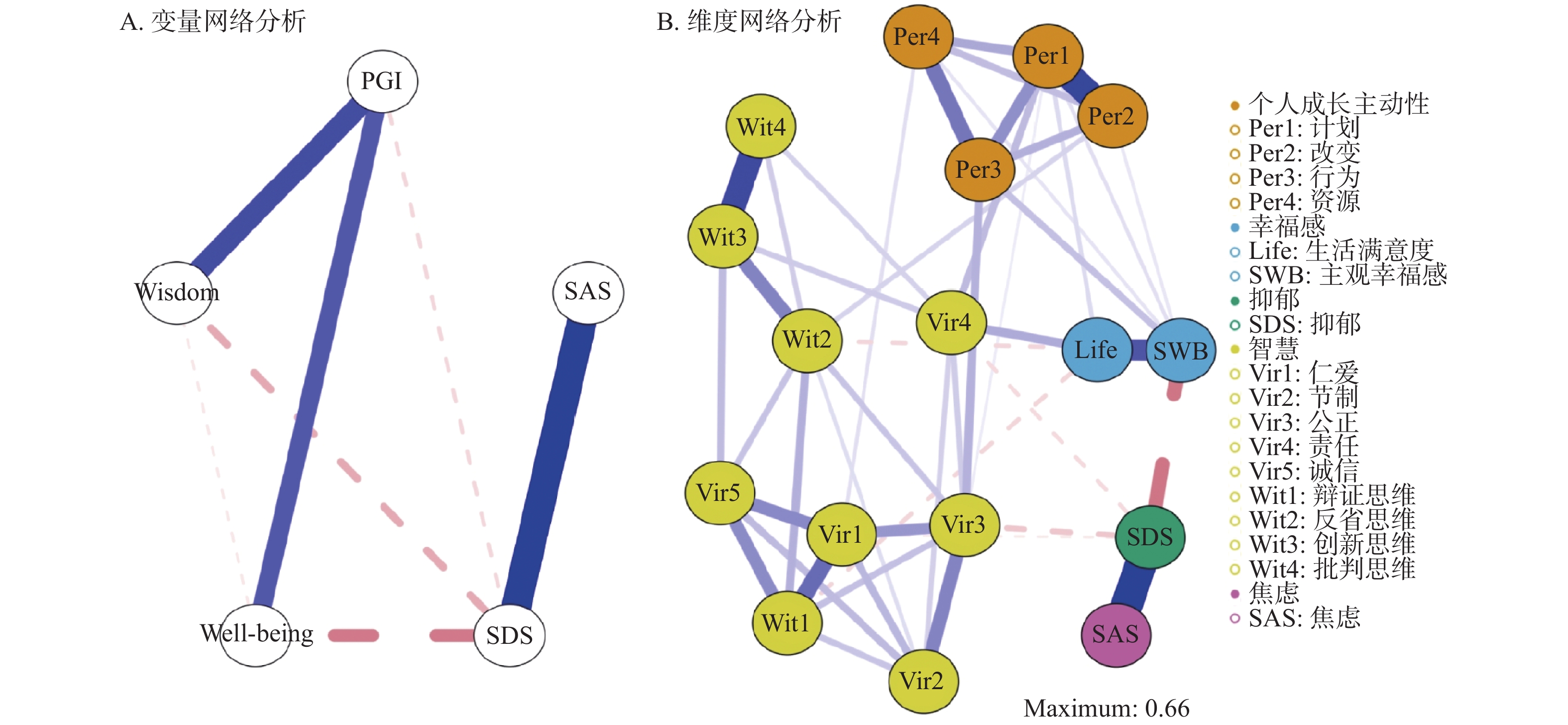
图2 网络分析图 注:well-being为一般幸福感指标;网络分析编码与其对应的变量或维度皆与其他图中相同。
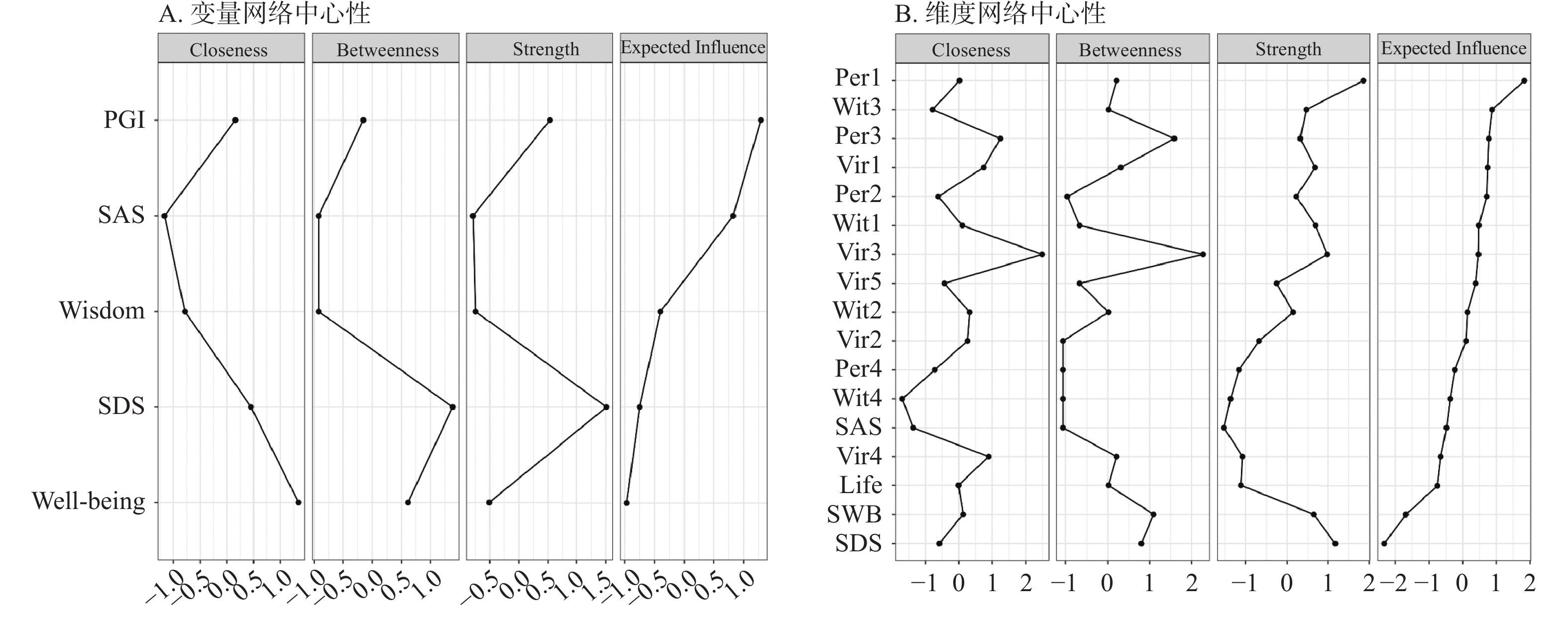
图3 网络中心性指标 注:图A与图B分别展示了变量层面与维度层面的网络中心性指标;closeness表示接近中心性,betweenness表示中介中心性,strength表示强度中心性,expected influence表示期望影响力。
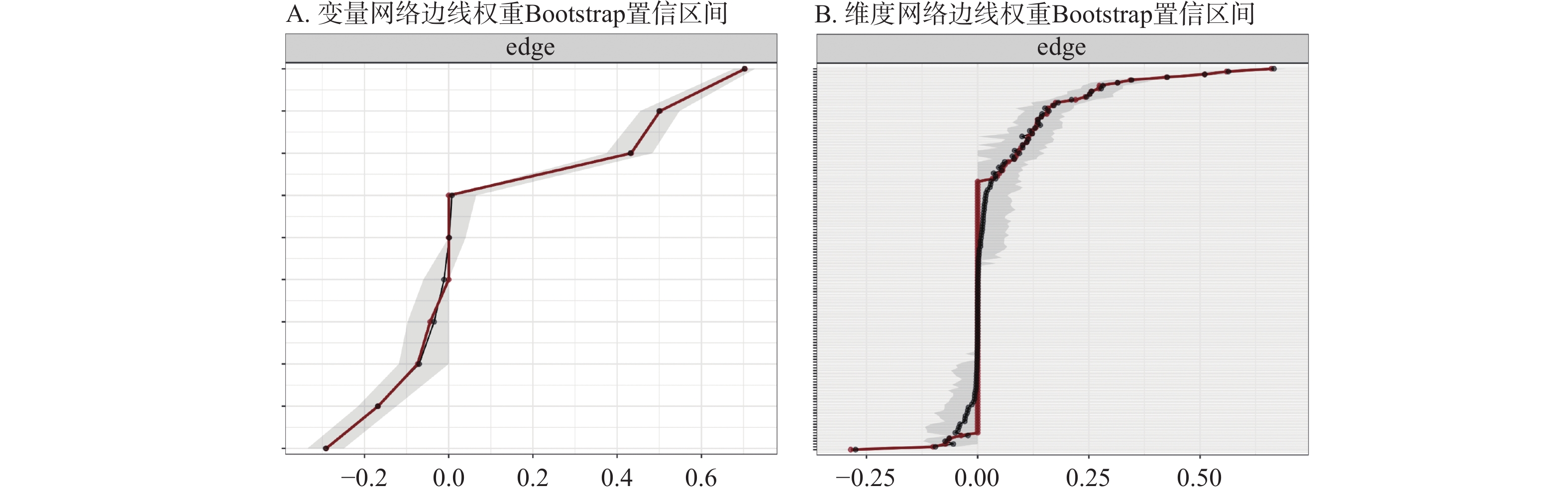
图4 边线权重Bootstrap置信区间 注:图A与图B分别展示了变量与维度层面的网络边权重Bootstrap置信区间;黑线表示原始估计值,红线表示Bootstrap平均估计值,灰色阴影为95%置信区间。
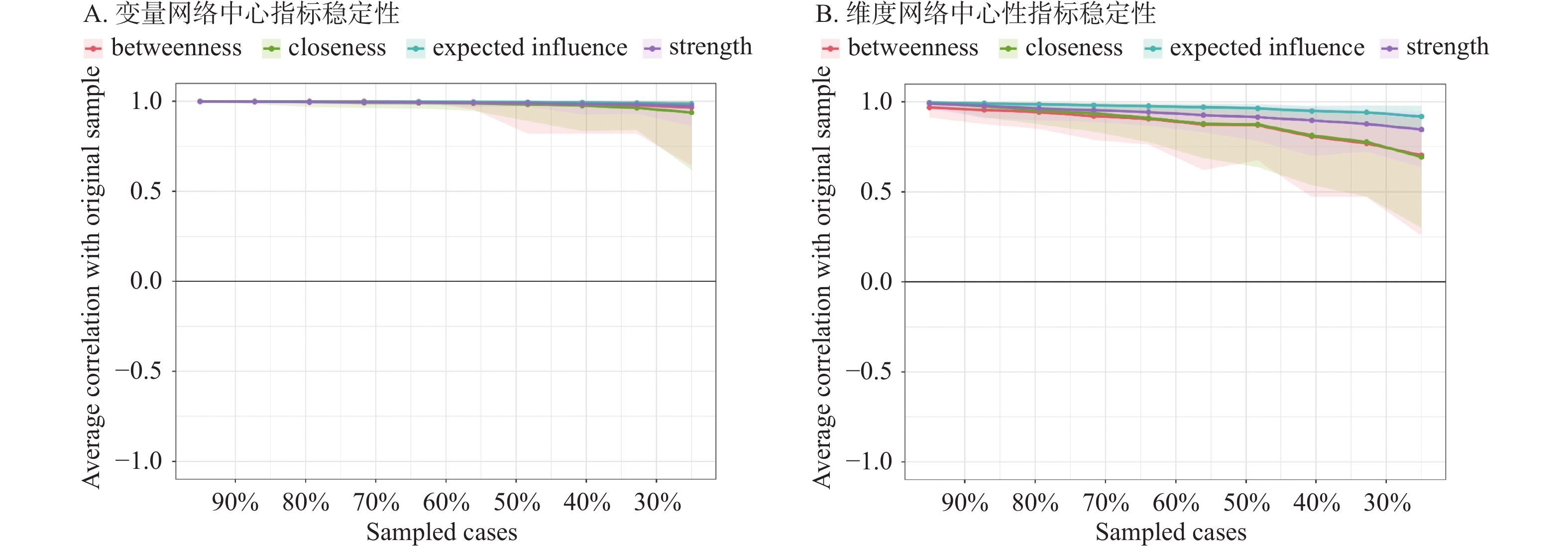
图5 网络中心性指标稳定性 注:图A与图B分别展示了变量层面与维度层面的网络中心性指标稳定性;横轴表示在不同抽样比例下(sampled cases)保留的样本比例,纵轴表示与原始样本的平均相关系数(average correlation with original sample);不同颜色的曲线分别表示四种中心性指标,红色为中介中心性(betweenness),绿色为接近中心性(closeness),蓝色为期望影响力(expected influence),紫色为强度中心性(strength);阴影区域表示95%置信区间。
| 结果变量 | 路径 | b | SE | z | p | 95%CI | R2 |
| 一般幸福感 | 直接效应 | 0.71 | 0.03 | 20.96 | <0.001 | [0.639, 0.774] | 0.46*** |
| 间接效应 | 0.02 | 0.02 | 0.81 | 0.416 | [−0.025, 0.064] | ||
| 总效应 | 0.73 | 0.02 | 32.97 | <0.001 | [0.685, 0.770] | ||
| 抑郁 | 直接效应 | −4.08 | 0.41 | −9.99 | <0.001 | [−4.923, −3.319] | 0.25*** |
| 间接效应 | −1.58 | 0.29 | −5.44 | <0.001 | [−2.159, −1.005] | ||
| 总效应 | −5.67 | 0.28 | −19.95 | <0.001 | [−6.214, −5.092] | ||
| 焦虑 | 直接效应 | −5.50 | 0.45 | −12.36 | <0.001 | [−6.378, −4.633] | 0.38*** |
| 间接效应 | −2.49 | 0.32 | −7.83 | <0.001 | [−3.144, −1.880] | ||
| 总效应 | −7.98 | 0.29 | −27.31 | <0.001 | [−8.571, −7.440] |
表3 中介路径效应
| 结果变量 | 路径 | b | SE | z | p | 95%CI | R2 |
| 一般幸福感 | 直接效应 | 0.71 | 0.03 | 20.96 | <0.001 | [0.639, 0.774] | 0.46*** |
| 间接效应 | 0.02 | 0.02 | 0.81 | 0.416 | [−0.025, 0.064] | ||
| 总效应 | 0.73 | 0.02 | 32.97 | <0.001 | [0.685, 0.770] | ||
| 抑郁 | 直接效应 | −4.08 | 0.41 | −9.99 | <0.001 | [−4.923, −3.319] | 0.25*** |
| 间接效应 | −1.58 | 0.29 | −5.44 | <0.001 | [−2.159, −1.005] | ||
| 总效应 | −5.67 | 0.28 | −19.95 | <0.001 | [−6.214, −5.092] | ||
| 焦虑 | 直接效应 | −5.50 | 0.45 | −12.36 | <0.001 | [−6.378, −4.633] | 0.38*** |
| 间接效应 | −2.49 | 0.32 | −7.83 | <0.001 | [−3.144, −1.880] | ||
| 总效应 | −7.98 | 0.29 | −27.31 | <0.001 | [−8.571, −7.440] |
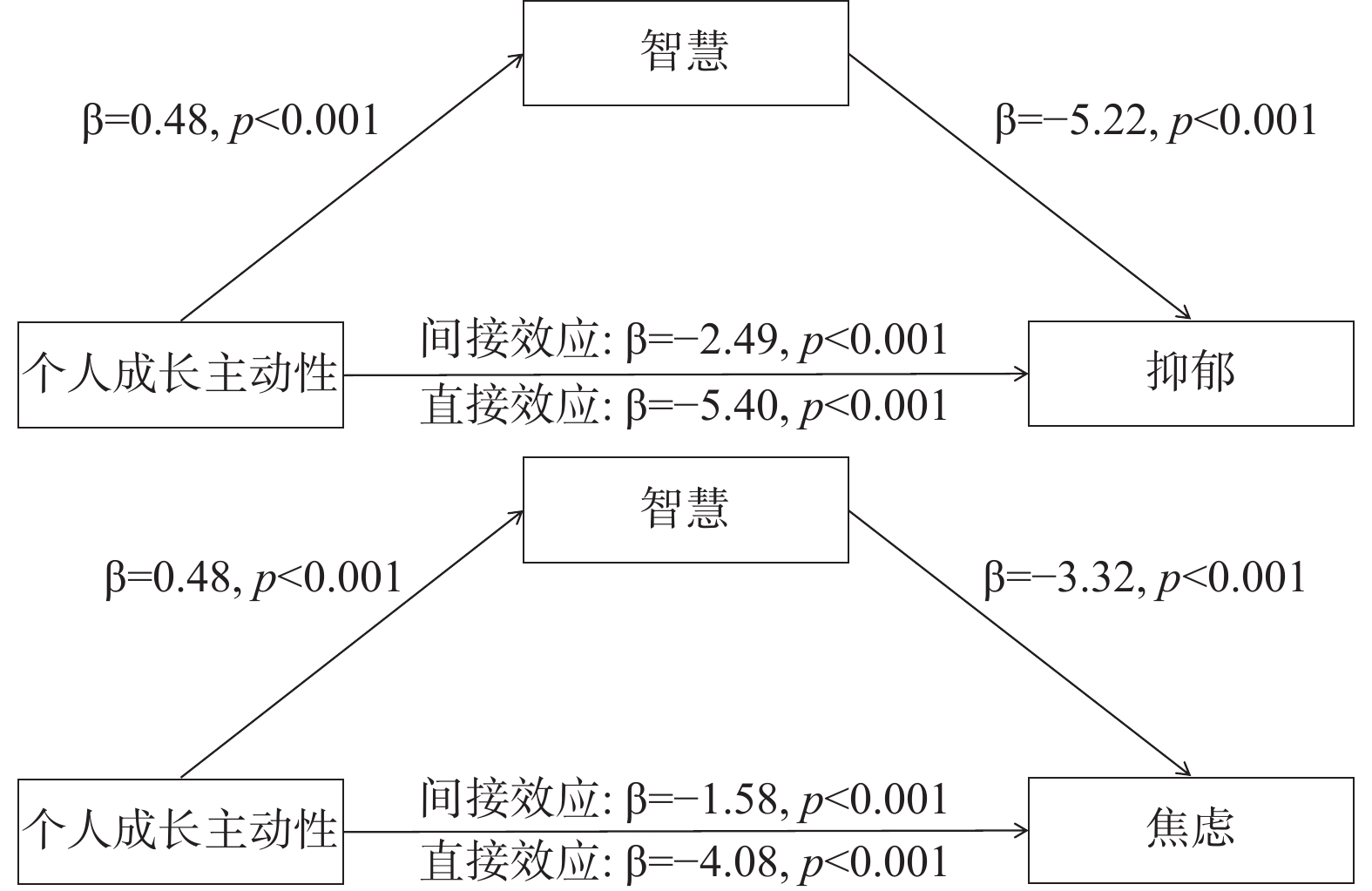
图6 个人成长主动性与大学生抑郁、焦虑的中介路径
|
傅绪荣, 汪凤炎. 整合智慧量表的编制及信效度检验. 心理学探新, 2020, 40 (1): 50- 57.
|
|
|
傅绪荣, 汪凤炎, 魏新东. 智慧问题解决能力的结构与测量. 心理研究, 2021, 14 (4): 305- 314.
|
|
|
傅绪荣, 魏新东, 王予灵, 汪凤炎. 智慧与幸福感的关系: 基于多元幸福取向的视角. 心理科学进展, 2019, 27 (3): 544- 556.
|
|
|
孙灯勇, 王倩, 王梅, 满丛英. 个人成长主动性的概念、测量及影响. 心理科学进展, 2014, 22 (9): 1413- 1422.
|
|
|
汪凤炎, 郑红. (2022). 智慧心理学. 上海: 上海教育出版社.
|
|
|
王宝鑫. 身体社会学视域下“脆皮大学生”现象省思. 中国青年研究, 2024 (11): 88- 94.
|
|
|
王伊萌, 王振东, 汪凤炎. 正念与大学生智慧推理的关系: 个人成长主动性的部分中介作用. 心理科学, 2022, 45 (1): 54- 60.
|
|
|
王伊萌, 王振东, 汪凤炎. “当局者迷”破解之道: 智慧的正念干预研究——个人成长主动性与反思的作用. 心理发展与教育, 2024, 40 (1): 142- 152.
|
|
|
张凯丽, 郑红, 汪凤炎. “一个序曲”与“两个阶段”: 智慧心理学近50年研究历程的写照. 心理科学进展, 2023, 31 (5): 721- 735.
|
|
|
周浩, 龙立荣. 共同方法偏差的统计检验与控制方法. 心理科学进展, 2004, 12 (6): 942- 950.
|
|
|
Adler, N. E., Epel, E. S., Castellazzo, G., & Ickovics, J. R. Relationship of subjective and objective social status with psychological and physiological functioning: Preliminary data in healthy, White women. Health Psychology, 2000, 19 (6): 586- 592.
DOI |
|
|
Ardelt, M. Are older adults wiser than college students? A comparison of two age cohorts. Journal of Adult Development, 2010, 17 (4): 193- 207.
DOI |
|
|
Asif, A., Yasin, H., & Iqrar, L. Personal growth initiative, resilience and psychological wellbeing in young adults of Pakistan. Journal of Asian Development Studies, 2024, 13 (1): 412- 421.
DOI |
|
|
Baltes, P. B., & Staudinger, U. M. Wisdom: A metaheuristic (pragmatic) to orchestrate mind and virtue toward excellence. American Psychologist, 2000, 55 (1): 122- 136.
DOI |
|
|
Bech, P., Gudex, C., & Johansen, K. S. The WHO (Ten) Well-Being Index: Validation in diabetes. Psychotherapy and Psychosomatics, 1996, 65 (4): 183- 190.
DOI |
|
|
Cohen, L., Manion, L., & Morrison, K. (2017). Tests. In Research methods in education (8th ed., pp. 563–585). London: Routledge.
|
|
|
Daniels, L. R., Boehnlein, J., & McCallion, P. Aging, depression, and wisdom: A pilot study of life-review intervention and PTSD treatment with two groups of Vietnam veterans. Journal of Gerontological Social Work, 2015, 58 (4): 420- 436.
DOI |
|
|
de Freitas, C. P. P., Damásio, B. F., Tobo, P. R., Kamei, H. H., & Koller, S. H. Revisión sistemática sobre iniciativa de crecimiento personal. Anales de Psicología/Annals of Psychology, 2016, 32 (3): 770- 782.
|
|
|
Deci, E. L., & Ryan, R. M. The “what” and “why” of goal pursuits: Human needs and the self-determination of behavior. Psychological Inquiry, 2000, 11 (4): 227- 268.
DOI |
|
|
Diener, E., Diener, M., & Diener, C. Factors predicting the subjective well-being of nations. Journal of Personality and Social Psychology, 1995, 69 (5): 851- 864.
DOI |
|
|
Diener, E., Emmons, R. A., Larsen, R. J., & Griffin, S. The satisfaction with life scale. Journal of Personality Assessment, 1985, 49 (1): 71- 75.
DOI |
|
|
Dul, J., van der Laan, E., & Kuik, R. A statistical significance test for necessary condition analysis. Organizational Research Methods, 2020, 23 (2): 385- 395.
DOI |
|
|
Effendy, N., & Widianingtanti, L. T. Peran meaning dan personal growth initiative (PGI) pada pandemi COVID-19 (tatanan dunia baru). Buletin Psikologi, 2020, 28 (2): 166- 181.
DOI |
|
|
Etezadi, S., & Pushkar, D. Why are wise people happier? An explanatory model of wisdom and emotional well-being in older adults. Journal of Happiness Studies, 2013, 14 (3): 929- 950.
DOI |
|
|
Ghaderi, F., Kajbaf, M. B., & Shokrollahi, M. The structural relationship of personality virtues, authentic personality and personal growth initiative with wisdom in students. Research in Psychological Health, 2018, 11 (4): 1- 15.
|
|
|
Grossmann, I., Oakes, H., & Santos, H. C. Wise reasoning benefits from emodiversity, irrespective of emotional intensity. Journal of Experimental Psychology: General, 2019, 148 (5): 805- 823.
DOI |
|
|
Halim, R., Satiadarma, M. P., & Wati, L. The influence of personal growth initiative on student grit during the pandemic. International Journal of Application on Social Science and Humanities, 2023, 1 (1): 595- 605.
DOI |
|
|
Hayes, A. F. (2018). Introduction to mediation, moderation, and conditional process analysis: A regression-based approach (2nd ed.). New York: Guilford Press.
|
|
|
Hinton, P. R., McMurray, I., & Brownlow, C. (2014). SPSS explained (2nd ed., pp. 339–354). London: Routledge.
|
|
|
Kadri, A., Leddy, A., Gracey, F., & Laidlaw, K. Wisdom enhancement and life skills to augment CBT outcomes for depression in later life: A series of N-of-1 trials. Behavioural and Cognitive Psychotherapy, 2022, 50 (5): 508- 527.
DOI |
|
|
Leung, J. P., & Leung, K. Life satisfaction, self-concept, and relationship with parents in adolescence. Journal of Youth and Adolescence, 1992, 21 (6): 653- 665.
DOI |
|
|
Li, J. Exploration of the value of a positive psychology perspective for developing resilience in academic underachievement students in secondary school. BCP Education & Psychology, 2022, 4, 112- 119.
|
|
|
Mathura, R., & Sharma, S. A study of well-being and its positive concomitants. Indian Journal of Positive Psychology, 2014, 5 (4): 534- 539.
|
|
|
Meier-Credner, A., Linden, M. & Muschalla, B. Wisdom-related attitudes in psychosomatic patients and in a convenience sample. Cogent Psychology, 2023, 10 (1): 2227443.
DOI |
|
|
Mousa Almatar, N., Jayawickreme, N., Foote, W. G., Demaske, A., & Jayawickreme, E. Examining associations between personal growth initiative and subjective trajectories of life satisfaction among survivors of ethnopolitical violence in Rwanda and Sri Lanka. Applied Psychology: Health and Well-Being, 2023, 15 (2): 499- 515.
DOI |
|
|
Noor, A. M., Govindasamy, P., & Isa, N. J. M. Personal growth initiative in relation to life satisfaction among university students: Inisiatif pertumbuhan personal dan perkaitannya dengan kepuasan hidup dalam kalangan pelajar universiti. EDUCATUM Journal of Social Sciences, 2020, 6 (2): 42- 49.
DOI |
|
|
Robitschek, C. Personal growth initiative: The construct and its measure. Measurement and Evaluation in Counseling and Development, 1998, 30 (4): 183- 198.
DOI |
|
|
Robitschek, C., Ashton, M. W., Spering, C. C., Geiger, N., Byers, D., Schotts, G. C., & Thoen, M. A. Development and psychometric evaluation of the Personal Growth Initiative Scale-II. Journal of Counseling Psychology, 2012, 59 (2): 274- 287.
DOI |
|
|
Robitschek, C., Cukrowicz, K., Brown, S. L., & Ciavaglia, A. Personal growth initiative as a buffer against suicide ideation severity in psychotherapy outpatients with depressive symptoms. Journal of Clinical Psychology, 2022, 78 (9): 1752- 1763.
DOI |
|
|
Saraswati, P., Amalia, S., & Arwan, A. P. Forming and strengthening factors of personal growth initiatives in life. Jurnal Ilmiah Psikologi Terapan, 2023, 11 (2): 137- 144.
DOI |
|
|
Sharma, M., & Garg, D. Personal growth as a correlate of gratitude, hope and curiosity among college students. Indian Journal of Positive Psychology, 2016, 7 (2): 201- 205.
|
|
|
Soukiazis, E., & Ramos, S. The structure of subjective well-being and its determinants: A micro-data study for Portugal. Social Indicators Research, 2016, 126 (3): 1375- 1399.
DOI |
|
|
Stith, B. R., & Jiang, X. (2023). Personal growth Initiative as a protective factor between the relation of practical stress and life satisfaction. Journal of American College Health, 1–9.
|
|
|
Tang, P. Y., Kostyrka-Allchorne, K., Butura, A. M., Phillips-Owen, J., & Sonuga-Barke, E. Reciprocal developmental pathways between future-related thinking and symptoms of adolescent depression and anxiety: A systematic review and meta-analysis of longitudinal studies. Clinical Psychology Review, 2024, 112, 102465.
DOI |
|
|
Thoen, M. A., & Robitschek, C. Intentional growth training: Developing an intervention to increase personal growth initiative. Applied Psychology: Health and Well-Being, 2013, 5 (2): 149- 170.
DOI |
|
|
Topp, C. W., Østergaard, S. D., Søndergaard, S., & Bech, P. The WHO-5 Well-Being Index: A systematic review of the literature. Psychotherapy and Psychosomatics, 2015, 84 (3): 167- 176.
DOI |
|
|
Weigold, A., Weigold, I. K., Ethridge, E. T., & Chong, Y. K. Translation and validation of the German Personal Growth Initiative Scale-II. The Counseling Psychologist, 2023, 51 (7): 906- 932.
DOI |
|
|
Weigold, I. K., Weigold, A., Dykema, S. A., Drakeford, N. M., & Ethridge, E. T. Personal growth initiative: Relation to coping styles, strategies, and self-efficacy. Journal of Happiness Studies, 2024, 25 (6): 80.
DOI |
|
|
Weigold, I. K., Weigold, A., Ling, S., & Jang, M. College as a growth opportunity: Assessing personal growth initiative and self-determination theory. Journal of Happiness Studies, 2021, 22 (5): 2143- 2163.
DOI |
|
|
Weigold, I. K., Weigold, A., Russell, E. J., Wolfe, G. L., Prowell, J. L., & Martin-Wagar, C. A. Personal growth initiative and mental health: A meta-analysis. Journal of Counseling & Development, 2020, 98 (4): 376- 390.
|
|
|
Zacher, H., McKenna, B., & Rooney, D. Effects of self-reported wisdom on happiness: Not much more than emotional intelligence. Journal of Happiness Studies, 2013, 14 (6): 1697- 1716.
DOI |
|
|
Zung, W. W. K. A Self-Rating Depression Scale. Archives of General Psychiatry, 1965, 12 (1): 63- 70.
DOI |
|
|
Zung, W. W. K. A rating instrument for anxiety disorders. Psychosomatics, 1971, 12 (6): 371- 379.
DOI |
| [1] | 孔旭, 熊思成, 曾成伟, 张斌. 社交焦虑对青少年手机依赖的影响:自我控制的纵向调节作用[J]. 心理与行为研究, 2026, 24(2): 265-272. |
| [2] | 赵纤, 黎志华. 童年累积创伤对成年早期抑郁症状的影响:压力知觉的中介机制[J]. 心理与行为研究, 2026, 24(1): 69-77. |
| [3] | 曾子豪, 何震, 袁言云, 赵纤, 印利红, 谭嵘, 常梦梦, 胡义秋. HPA轴系统多基因−亲子关系交互对青少年抑郁发展影响及性别差异[J]. 心理与行为研究, 2026, 24(1): 78-86. |
| [4] | 王怀勇, 徐田田, 叶青. 过程追踪视角下焦虑情绪对延迟选择的影响及机制:任务框架的调节作用[J]. 心理与行为研究, 2026, 24(1): 122-129. |
| [5] | 郑玉玮, 王潇钰, 张雅茹, 张馨月, 卢红霞. 初中生累积生态风险与自杀意念的关系:积极心理资本和个人成长主动性的链式中介作用[J]. 心理与行为研究, 2025, 23(5): 627-634. |
| [6] | 刘鑫, 刘衍玲, 曾晋逸. 心理需要挫折与青少年抑郁症状的纵向联系:心理素质的调节作用[J]. 心理与行为研究, 2025, 23(4): 496-503. |
| [7] | 鲍振宙, 刘花, 于明申. 青少年校园欺凌旁观行为与焦虑抑郁症状的关系:基于纵向网络分析法[J]. 心理与行为研究, 2025, 23(4): 504-512. |
| [8] | 庞溢序, 彭梓轩, 李佳, 宋怡萱, 余萌. 利他的魔力:高社交焦虑大学生利己/利他行为对风险决策的影响[J]. 心理与行为研究, 2025, 23(4): 560-568. |
| [9] | 王峥, 侯友, 韩洋, 杨邵峰, 陈丽霞. 执行意图编码促进抑郁症患者前瞻记忆的意图执行[J]. 心理与行为研究, 2025, 23(3): 322-329. |
| [10] | 于永菊, 何敏. 高校大学生生命意义感的演变模式及其与抑郁症状的关联[J]. 心理与行为研究, 2025, 23(3): 354-360. |
| [11] | 卢林鑫, 刘在花, 杨爽, 蒋政凯, 党韦强, 谭婧, 班永飞, 孙霁, 蔺秀云. 社会排斥与先天轻度肢残青少年抑郁特征的关联性:基于生成性模型与反映性模型的纵向分析[J]. 心理与行为研究, 2025, 23(2): 216-225. |
| [12] | 赵黎明, 韩蒙蒙, 贾津津. 中学生社交焦虑与攻击性的关系:言语流畅性的中介作用和情绪智力的调节作用[J]. 心理与行为研究, 2025, 23(2): 265-272. |
| [13] | 王笑笑, 王伊萌, 汪凤炎. 敬畏与智慧推理:正负效价的分离机制[J]. 心理与行为研究, 2025, 23(1): 17-24. |
| [14] | 胡义秋, 何震, 曾子豪, 赵纤, 常梦梦. 初中生身体监控与抑郁症状的纵向关系研究:主观幸福感的中介作用[J]. 心理与行为研究, 2025, 23(1): 58-65. |
| [15] | 姚雨佳, 林慧慧, 徐舵. 青少年特质焦虑与情绪调节灵活性、痛苦忍受性之间的关系:一项交叉滞后分析[J]. 心理与行为研究, 2024, 22(6): 761-768. |
| 阅读次数 | ||||||
|
全文 |
|
|||||
|
摘要 |
|
|||||
