
心理与行为研究 ›› 2026, Vol. 24 ›› Issue (1): 60-68.DOI: 10.12139/j.1672-0628.2026.01.007
张野*,1( ), 刘致宏2, 赵丽云1
收稿日期:2025-02-12
出版日期:2026-01-20
发布日期:2026-01-20
通讯作者:
张野
基金资助:
Ye ZHANG*,1(), Zhihong LIU2, Liyun ZHAO1
Received:2025-02-12
Online:2026-01-20
Published:2026-01-20
Contact:
Ye ZHANG
摘要:
采用纵向设计,对辽宁省646名青少年进行连续3次追踪测查,考察青少年网络社会排斥与网络偏差行为的关系及其作用机制。结果表明:(1)前测(Tn)的网络社会排斥显著正向预测后测(Tn+1)的网络偏差行为,而前测的网络偏差行为不能预测后测的网络社会排斥;(2)敌意归因偏向在网络社会排斥与网络偏差行为之间发挥纵向中介作用;(3)敌意归因偏向的中介效应在不同性别的青少年群体中具有显著差异,男生在遭受网络社会排斥后更易激发敌意归因,继而产生网络偏差行为,而这一中介机制在女生群体中不显著。此外,仅在女生群体中存在网络社会排斥与网络偏差行为的双向关系。研究结果不仅揭示了网络偏差行为产生的心理机制,而且对青少年网络偏差行为的精准预防与干预具有启示意义。
张野, 刘致宏, 赵丽云. 青少年网络社会排斥、敌意归因偏向与网络偏差行为的关系:一项纵向研究[J]. 心理与行为研究, 2026, 24(1): 60-68.
Ye ZHANG, Zhihong LIU, Liyun ZHAO. The Associations Among Cyber-Ostracism, Hostile Attribution Bias, and Online Deviant Behaviors in Adolescents: A Longitudinal Study[J]. Studies of Psychology and Behavior, 2026, 24(1): 60-68.
| 变量 | Model | χ2 | df | CFI | TLI | RMSEA | 模型 比较 | ΔRMSEA |
| 网络社会排斥 | M1形态等值 | 501.47 | 282 | 0.955 | 0.944 | 0.035 | ||
| M2弱等值性 | 525.86 | 296 | 0.952 | 0.944 | 0.035 | M2-M1 | 0 | |
| M3强等值性 | 574.38 | 314 | 0.946 | 0.940 | 0.036 | M3-M2 | 0.001 | |
| 敌意归因偏向 | M1形态等值 | 2000.82 | 1022 | 0.915 | 0.906 | 0.039 | ||
| M2弱等值性 | 2061.90 | 1052 | 0.912 | 0.906 | 0.039 | M2-M1 | 0 | |
| M3强等值性 | 2331.75 | 1084 | 0.892 | 0.887 | 0.042 | M3-M2 | 0.003 | |
| 网络偏差行为 | M1形态等值 | 19.25 | 15 | 0.997 | 0.994 | 0.021 | ||
| M2弱等值性 | 24.08 | 19 | 0.997 | 0.994 | 0.020 | M2-M1 | 0.001 | |
| M3强等值性 | 107.80 | 25 | 0.948 | 0.926 | 0.072 | M3-M2 | 0.052 |
表1 网络社会排斥、敌意归因偏向与网络偏差行为的纵向测量等值性检验
| 变量 | Model | χ2 | df | CFI | TLI | RMSEA | 模型 比较 | ΔRMSEA |
| 网络社会排斥 | M1形态等值 | 501.47 | 282 | 0.955 | 0.944 | 0.035 | ||
| M2弱等值性 | 525.86 | 296 | 0.952 | 0.944 | 0.035 | M2-M1 | 0 | |
| M3强等值性 | 574.38 | 314 | 0.946 | 0.940 | 0.036 | M3-M2 | 0.001 | |
| 敌意归因偏向 | M1形态等值 | 2000.82 | 1022 | 0.915 | 0.906 | 0.039 | ||
| M2弱等值性 | 2061.90 | 1052 | 0.912 | 0.906 | 0.039 | M2-M1 | 0 | |
| M3强等值性 | 2331.75 | 1084 | 0.892 | 0.887 | 0.042 | M3-M2 | 0.003 | |
| 网络偏差行为 | M1形态等值 | 19.25 | 15 | 0.997 | 0.994 | 0.021 | ||
| M2弱等值性 | 24.08 | 19 | 0.997 | 0.994 | 0.020 | M2-M1 | 0.001 | |
| M3强等值性 | 107.80 | 25 | 0.948 | 0.926 | 0.072 | M3-M2 | 0.052 |
| M±SD | 1 | 2 | 3 | 4 | 5 | 6 | 7 | 8 | |
| 1.T1网络社会排斥 | 1.63±0.60 | ||||||||
| 2.T2网络社会排斥 | 1.54±0.64 | 0.49*** | |||||||
| 3.T3网络社会排斥 | 1.51±0.77 | 0.31*** | 0.46*** | ||||||
| 4.T1敌意归因偏向 | 2.53±0.84 | 0.32*** | 0.12** | 0.09* | |||||
| 5.T2敌意归因偏向 | 2.30±0.90 | 0.31*** | 0.41*** | 0.26*** | 0.36*** | ||||
| 6.T3敌意归因偏向 | 2.30±1.16 | 0.22*** | 0.23*** | 0.49*** | 0.30*** | 0.41*** | |||
| 7.T1网络偏差行为 | 1.51±0.47 | 0.52*** | 0.29*** | 0.20*** | 0.39*** | 0.16*** | 0.19*** | ||
| 8.T2网络偏差行为 | 1.44±0.51 | 0.34*** | 0.56*** | 0.34*** | 0.19*** | 0.46*** | 0.28*** | 0.44*** | |
| 9.T3网络偏差行为 | 1.44±0.68 | 0.28*** | 0.38*** | 0.68*** | 0.13*** | 0.28*** | 0.50*** | 0.33*** | 0.45*** |
表2 各变量均数、标准差和相关系数(n=646)
| M±SD | 1 | 2 | 3 | 4 | 5 | 6 | 7 | 8 | |
| 1.T1网络社会排斥 | 1.63±0.60 | ||||||||
| 2.T2网络社会排斥 | 1.54±0.64 | 0.49*** | |||||||
| 3.T3网络社会排斥 | 1.51±0.77 | 0.31*** | 0.46*** | ||||||
| 4.T1敌意归因偏向 | 2.53±0.84 | 0.32*** | 0.12** | 0.09* | |||||
| 5.T2敌意归因偏向 | 2.30±0.90 | 0.31*** | 0.41*** | 0.26*** | 0.36*** | ||||
| 6.T3敌意归因偏向 | 2.30±1.16 | 0.22*** | 0.23*** | 0.49*** | 0.30*** | 0.41*** | |||
| 7.T1网络偏差行为 | 1.51±0.47 | 0.52*** | 0.29*** | 0.20*** | 0.39*** | 0.16*** | 0.19*** | ||
| 8.T2网络偏差行为 | 1.44±0.51 | 0.34*** | 0.56*** | 0.34*** | 0.19*** | 0.46*** | 0.28*** | 0.44*** | |
| 9.T3网络偏差行为 | 1.44±0.68 | 0.28*** | 0.38*** | 0.68*** | 0.13*** | 0.28*** | 0.50*** | 0.33*** | 0.45*** |
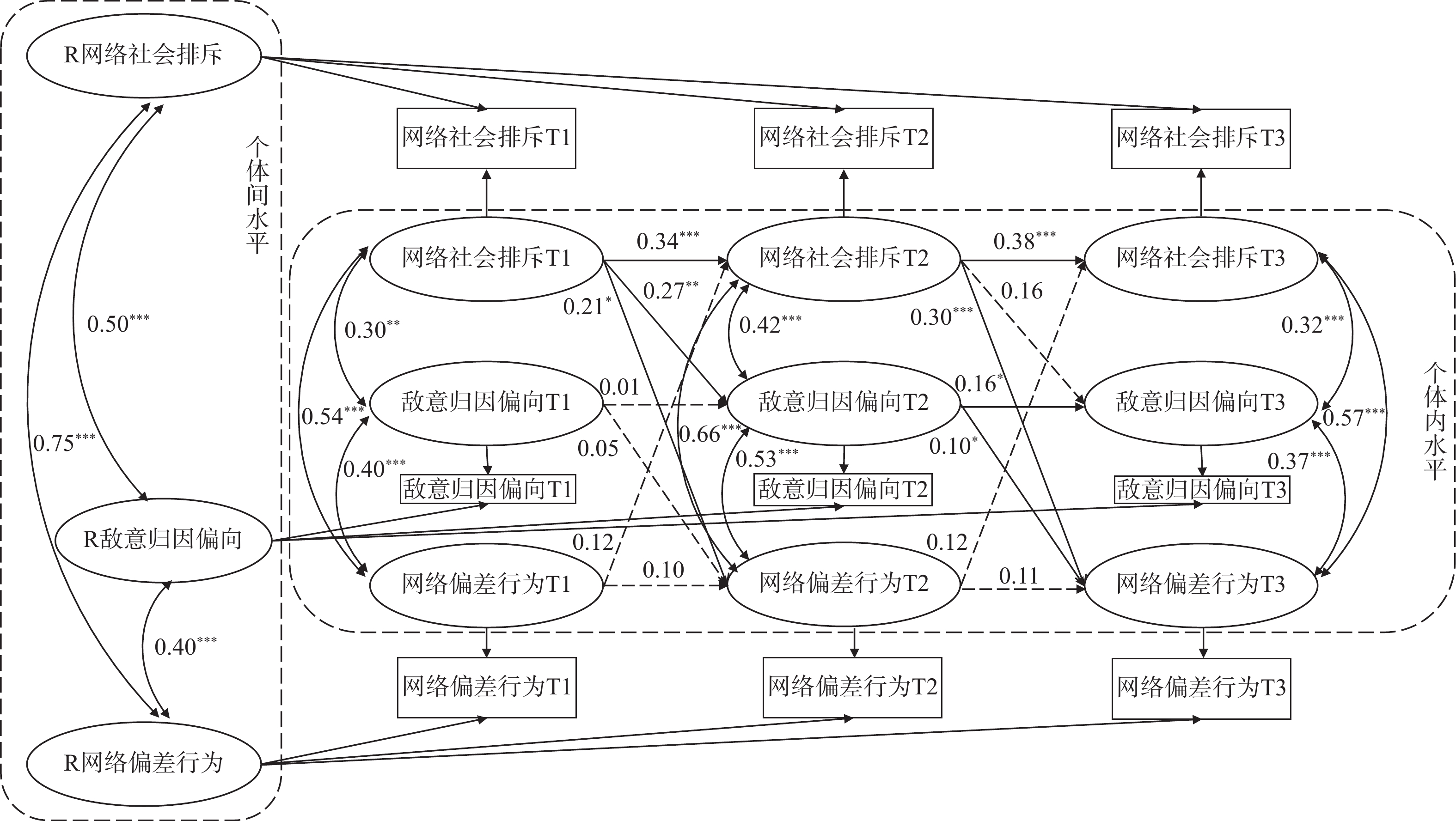
图1 网络社会排斥、敌意归因偏向与网络偏差行为的RI-CLPM 注:路径系数均为标准化系数,虚线为不显著路径,以下同。
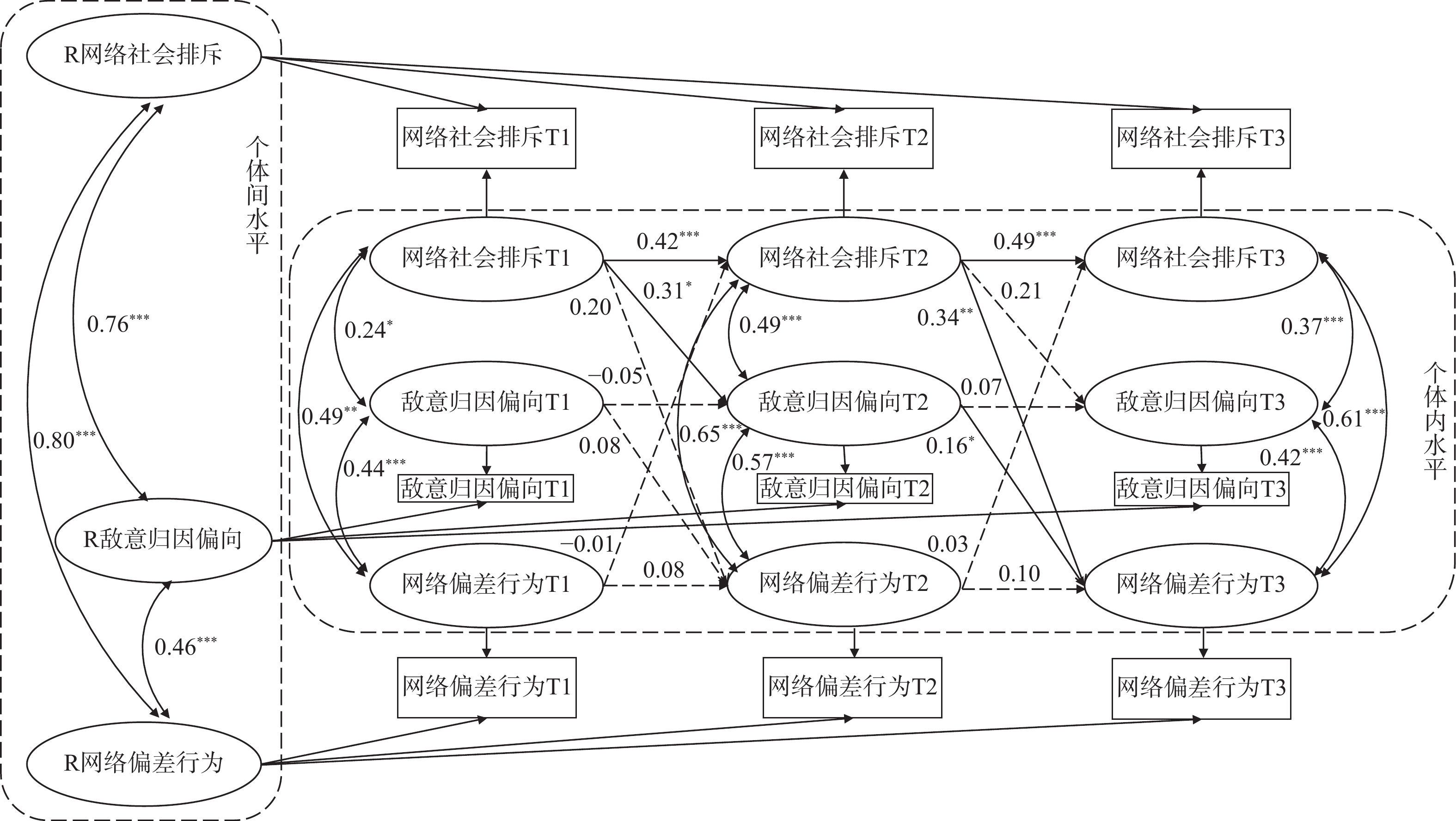
图2 男生组RI-CLPM
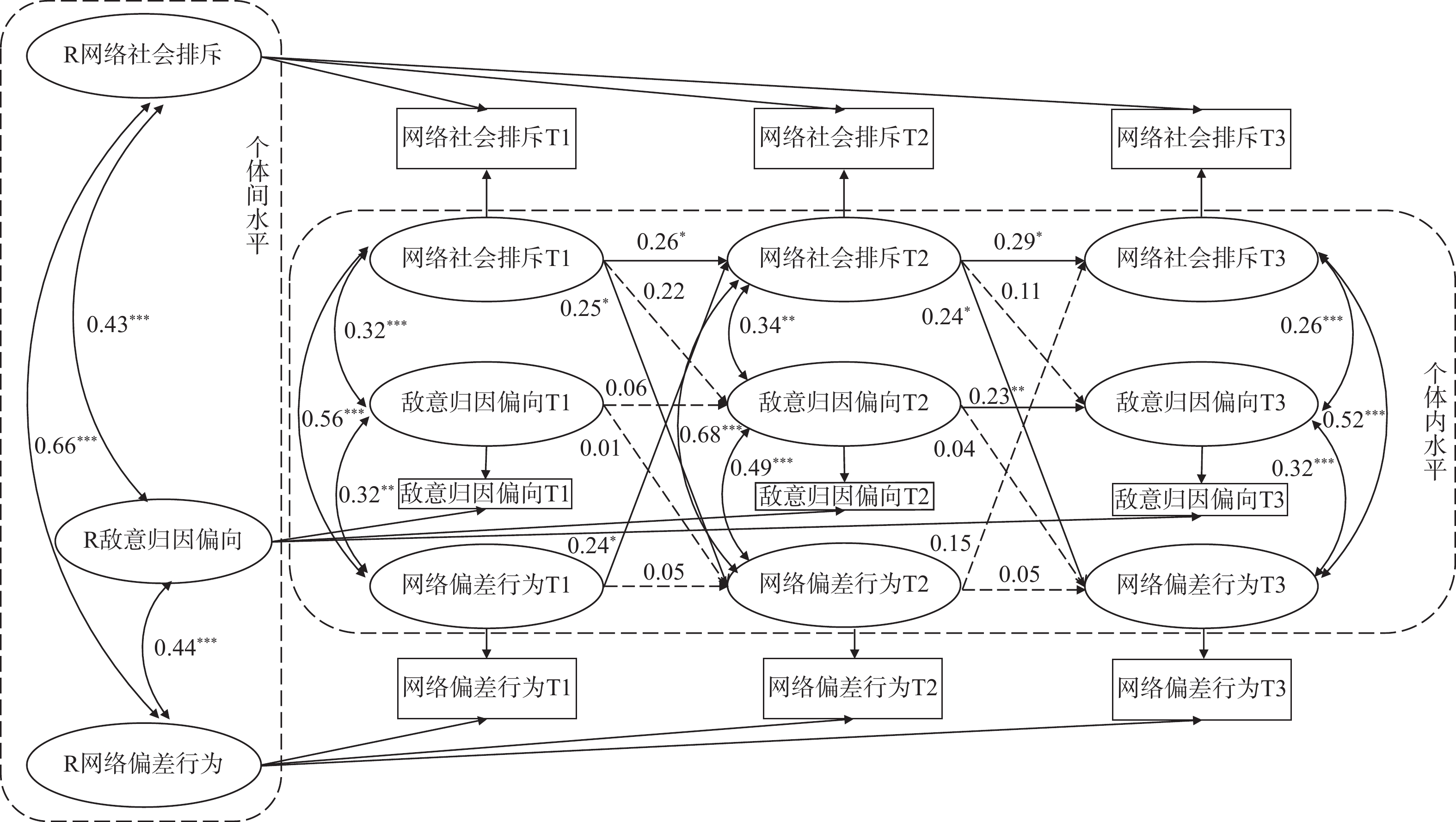
图3 女生组RI-CLPM
|
陈颖, 张野, 韩娜, 王凯. 校园排斥对初中生网络偏差行为的影响: 相对剥夺感与自我控制的序列中介作用. 心理发展与教育, 2023, 39 (6): 887- 894.
|
|
|
雷雳, 李冬梅. 青少年网上偏差行为的研究. 中国信息技术教育, 2008 (10): 4- 11.
|
|
|
李芮, 夏凌翔. 攻击动机对特质愤怒与反应性攻击关系的中介作用: 一项纵向研究. 心理学报, 2021, 53 (7): 788- 797.
|
|
|
彭苏浩, 陶丹, 冷玥, 邓慧华. 社会排斥的心理行为特征及其脑机制. 心理科学进展, 2019, 27 (9): 1656- 1666.
|
|
|
温忠麟, 黄彬彬, 汤丹丹. 问卷数据建模前传. 心理科学, 2018, 41 (1): 204- 210.
|
|
|
张野, 张珊珊, 白冬梅, 刘致宏. 校园人际排斥与青少年自杀意念的关系: 负面评价恐惧与社交焦虑的作用. 心理发展与教育, 2024, 40 (4): 563- 571.
|
|
|
张野, 张珊珊, 苑波. 现实到虚拟: 双情境背景下青少年社会排斥的结构探析. 当代青年研究, 2021 (1): 74- 78.
|
|
|
朱黎君, 叶宝娟, 倪林英. 社会排斥对大学生网络偏差行为的影响: 社交焦虑的中介作用与网络消极情绪体验的调节作用. 中国特殊教育, 2020 (1): 79- 83, 96.
|
|
|
Allen, J. J., Anderson, C. A., & Bushman, B. J. The general aggression model. Current Opinion in Psychology, 2018, 19, 75- 80.
DOI |
|
|
Arslan, G. Social exclusion, social support and psychological wellbeing at school: A study of mediation and moderation effect. Child Indicators Research, 2018, 11 (3): 897- 918.
DOI |
|
|
Birk, M. V., Buttlar, B., Bowey, J. T., Poeller, S., Thomson, S. C., Baumann, N., & Mandryk, R. L. (2016). The effects of social exclusion on play experience and hostile cognitions in digital games. In Proceedings of the 2016 CHI conference on human factors in computing systems (CHI’16) (pp. 3007–3019). San Jose, CA: Association for Computing Machinery.
|
|
|
Chen, F. F. Sensitivity of goodness of fit indexes to lack of measurement invariance. Structural Equation Modeling: A Multidisciplinary Journal, 2007, 14 (3): 464- 504.
DOI |
|
|
Chen, J. K., Chang, C. W., Wang, Z. Y., Wang, L. C., & Wei, H. S. Cyber deviance among adolescents in Taiwan: Prevalence and correlates. Children and Youth Services Review, 2021, 126, 106042.
DOI |
|
|
Crick, N. R., & Dodge, K. A. A review and reformulation of social information-processing mechanisms in children’s social adjustment. Psychological Bulletin, 1994, 115 (1): 74- 101.
DOI |
|
|
DeWall, C. N., Twenge, J. M., Gitter, S. A., & Baumeister, R. F. It’s the thought that counts: The role of hostile cognition in shaping aggressive responses to social exclusion. Journal of Personality and Social Psychology, 2009, 96 (1): 45- 59.
DOI |
|
|
Dillon, K. H., Allan, N. P., Cougle, J. R., & Fincham, F. D. Measuring hostile interpretation bias: The WSAP-Hostility Scale. Assessment, 2016, 23 (6): 707- 719.
DOI |
|
|
Ding, H. M., Zhao, C. J., Huang, F., Zhu, L. Y., Wei, H., & Lei, L. Cyber-Ostracism, depression, and adolescents’ cyberbullying perpetration: A cross-lagged panel analysis. Youth & Society, 2024, 57 (2): 351- 373.
|
|
|
Ding, X. C., Fu, R., Ooi, L. L., Coplan, R. J., Zheng, Q. Y., & Deng, X. M. Relations between different components of rejection sensitivity and adjustment in Chinese children. Journal of Applied Developmental Psychology, 2020, 67, 101119.
DOI |
|
|
Ding, X. F., Liu, B. Z., Zeng, K., Kishimoto, T., & Zhang, M. H. Peer relations and different functions of cyber-aggression: A longitudinal study in Chinese adolescents. Aggressive Behavior, 2022, 48 (2): 152- 162.
DOI |
|
|
Donate, A. P. G., Marques, L. M., Lapenta, O. M., Asthana, M. K., Amodio, D., & Boggio, P. S. Ostracism via virtual chat room—Effects on basic needs, anger and pain. PLoS One, 2017, 12 (9): e0184215.
DOI |
|
|
Dvoryanchikov, N. V., Bovina, I. B., Delibalt, V. V., Dozortseva, E. G., Bogdanovich, N. V., & Rubtsova, O. V. (2020). Deviant online behavior in adolescent and youth circles: In search of a risk assessment model. International Journal of Cognitive Research in Science, Engineering and Education (IJCRSEE), 8(2), 105–119.
|
|
|
Eagly, A. H., & Wood, W. (2012). Social role theory. In P. A. M. van Lange, A. W. Kruglanski, & E. T. Higgins (Eds.), Handbook of theories of social psychology (pp. 458–476). Thousand Oaks, CA: Sage Publications Ltd.
|
|
|
Jenchura, E. C., Gonzales, N. A., Tein, J. Y., & Luecken, L. J. Gender and the interplay of source of support and peer social rejection on internalizing among Mexican American youth. Journal of Youth and Adolescence, 2017, 46 (4): 787- 800.
DOI |
|
|
Klein, J. L., & Cooper, D. T. Deviant cyber-sexual activities in young adults: Exploring prevalence and predictions using in-person sexual activities and social learning theory. Archives of Sexual Behavior, 2019, 48 (2): 619- 630.
DOI |
|
|
Lemerise, E. A., & Arsenio, W. F. An integrated model of emotion processes and cognition in social information processing. Child Development, 2000, 71 (1): 107- 118.
DOI |
|
|
López-Ráez, C., Falla, D., & Romera, E. M. Impact of cyber-ostracism on social anxiety and internet use in university students. Educación XX1, 2025, 28 (1): 87- 102.
|
|
|
Mao, Y. N., Liu, Y., Jiang, C. Y., & Zhang, I. D. Why am I ostracized and how would I react?—A review of workplace ostracism research. Asia Pacific Journal of Management, 2017, 35 (3): 745- 767.
|
|
|
Mattebo, M., Tydén, T., Häggström-Nordin, E., Nilsson, K. W., & Larsson, M. Pornography and sexual experiences among high school students in Sweden. Journal of Developmental & Behavioral Pediatrics, 2014, 35 (3): 179- 188.
|
|
|
Norwalk, K. E., Milojevich, H. M., Dawes, M., Hamm, J. V., & Farmer, T. W. Heterogeneity of social marginalization in early adolescence: Longitudinal associations with behavioral and social adjustment. Journal of Youth and Adolescence, 2021, 50 (11): 2123- 2135.
DOI |
|
|
Ostrov, J. M., Kamper, K. E., Hart, E. J., Godleski, S. A., & Blakely-McClure, S. J. A gender-balanced approach to the study of peer victimization and aggression subtypes in early childhood. Development and Psychopathology, 2014, 26 (3): 575- 587.
DOI |
|
|
Poorani, M., & Arulsamy, S. Analysis of factors affecting hostility among secondary school students. Strad Research, 2020, 7 (8): 470- 478.
|
|
|
Rajchert, J., Zajenkowska, A., Nowakowska, I., Bodecka-Zych, M., & Abramiuk, A. (2022). Hostility bias or sadness bias in excluded individuals: Does anodal transcranial direct current stimulation of right VLPFC vs. left DLPFC have a mitigating effect? Cognitive, Affective, & Behavioral Neuroscience, 22(5), 1063–1077.
|
|
|
Rodkin, P. C., Farmer, T. W., Pearl, R., & van Acker, R. Heterogeneity of popular boys: Antisocial and prosocial configurations. Developmental Psychology, 2000, 36 (1): 14- 24.
DOI |
|
|
Sameroff, A. J., & Mackenzie, M. J. Research strategies for capturing transactional models of development: The limits of the possible. Development and Psychopathology, 2003, 15 (3): 613- 640.
DOI |
|
|
Sullivan, T. N., Farrell, A. D., & Kliewer, W. Peer victimization in early adolescence: Association between physical and relational victimization and drug use, aggression, and delinquent behaviors among urban middle school students. Development and Psychopathology, 2006, 18 (1): 119- 137.
|
|
|
Tseng, W. L., Banny, A. M., Kawabata, Y., Crick, N. R., & Gau, S. S. F. A cross-lagged structural equation model of relational aggression, physical aggression, and peer status in a Chinese culture. Aggressive Behavior, 2013, 39 (4): 301- 315.
DOI |
|
|
Usami, S. On the differences between general cross-lagged panel model and random-intercept cross-lagged panel model: Interpretation of cross-lagged parameters and model choice. Structural Equation Modeling: A Multidisciplinary Journal, 2021, 28 (3): 331- 344.
DOI |
|
|
Virgara, J. L., & Whitten, T. A systematic literature review of the longitudinal risk factors associated with juvenile cyber-deviance. Computers in Human Behavior, 2023, 141, 107613.
DOI |
|
|
Vorderer, P., & Schneider, F. M. (2016). Social media and ostracism. In K. D. Williams & S. A. Nida (Eds.), Ostracism, exclusion, and rejection (pp. 240–257). London: Psychology Press.
|
|
|
Wang, H. X., Wang, X. C., Geng, J. Y., Zeng, P., Gu, X., & Lei, L. Does peer alienation accelerate cyber deviant behaviors of adolescents? The mediating role of core self-evaluation and the moderating role of parent-child relationship and gender. Current Psychology, 2023, 42 (1): 625- 638.
DOI |
|
|
Wei, H., & Liu, M. T. Loving your parents and treating others well: The effect of filial piety on cyberbullying perpetration and its functional mechanism among Chinese graduate students. Journal of Interpersonal Violence, 2022, 37 (11–12): NP8670- NP8695.
DOI |
|
|
Williams, K. D. Ostracism: A temporal need-threat model. Advances in Experimental Social Psychology, 2009, 41, 275- 314.
|
|
|
Wilson, R. E., Gosling, S. D., & Graham, L. T. A review of Facebook research in the social sciences. Perspectives on Psychological Science, 2012, 7 (3): 203- 220.
DOI |
|
|
Yao, Z., & Enright, R. (2022). Developmental cascades of hostile attribution bias, aggressive behavior, and peer victimization in preadolescence. Journal of Aggression, Maltreatment & Trauma, 31(1), 102–120.
|
| [1] | 王丹云, 王玉龙, 唐卓. 青少年运动习惯与自尊、心理韧性的动态关系:基于交叉滞后与随机截距交叉滞后模型的分析[J]. 心理与行为研究, 2026, 24(2): 178-186. |
| [2] | 樊雪戎, 段依凡, 邢晓沛. 温暖的亲子感知差异与青少年内化问题的关系:基于二项式回归的响应面分析[J]. 心理与行为研究, 2026, 24(2): 195-203. |
| [3] | 杨昕珠, 王腾飞, 郑晓龙. 青少年社会情感能力与学业倦怠的双向预测作用:一项交叉滞后研究[J]. 心理与行为研究, 2025, 23(6): 789-797. |
| [4] | 吴一枫, 李欣, 陈慧丽, 丁童, 侯娟. 情同己身,传之于众:新闻的自我相关性提高分享意愿[J]. 心理与行为研究, 2025, 23(2): 249-256. |
| [5] | 张野, 刘致宏, 申婷, 赵雨露. 父母心理控制、校园排斥与初中生内化问题的动态关系:交叉滞后研究[J]. 心理与行为研究, 2024, 22(5): 658-665. |
| [6] | 赵新宇, 乔晓光, 邢晓沛. 父母自主支持、10~12岁儿童的同伴关系与执行功能的动态互动关系:一个发展级联模型[J]. 心理与行为研究, 2024, 22(1): 55-63. |
| [7] | 李祖儿, 侯金芹, 陈祉妍. 严厉管教的代际传递:父母的互倚及子女性别的调节作用[J]. 心理与行为研究, 2024, 22(1): 93-99. |
| [8] | 刘仁洁, 夏凌翔, 赵永萍. 大学生网络欺凌受害潜在类别的发展特点及性别因素的作用[J]. 心理与行为研究, 2023, 21(6): 784-791. |
| [9] | 李文福, 刘燕, 段熙明, 牛四方, 许瑞雪, 慕福芹. 反刍思维量表在不同性别和抑郁症状医学院校新生中的测量等值性[J]. 心理与行为研究, 2023, 21(6): 854-860. |
| [10] | 吴旻, 宋文琦, 鞠佳雯. 父母粗暴养育与儿童睡眠质量的关系:核心自我评价和消极情绪的中介作用[J]. 心理与行为研究, 2023, 21(3): 344-351. |
| [11] | 黄亚娟, 董蕊, 杨震, 康凯月, 许欣. 特质正念与专业运动员心理健康:链式中介作用及性别差异[J]. 心理与行为研究, 2023, 21(2): 273-279. |
| [12] | 岳鹏飞, 胡文丽, 张嘉鑫, 史梦梦. 粗暴养育与中学生学习投入:状态焦虑与性别的作用[J]. 心理与行为研究, 2022, 20(2): 226-232. |
| [13] | 侯娟, 郑心怡, 王秀, 方晓义. 金钱与时间感受启动对择偶标准的影响[J]. 心理与行为研究, 2021, 19(6): 838-844. |
| [14] | 郭庆童, 徐铭雪, 许春艳, 刘秀丽. 大学生宿舍人际关系困扰与手机成瘾的关系:序列中介模型及性别差异[J]. 心理与行为研究, 2021, 19(5): 650-656. |
| [15] | 朱文凤, 夏凌翔. 大学生神经质纵向预测攻击行为的时间路径模型:敌意归因偏向和愤怒沉浸的双向中介作用[J]. 心理与行为研究, 2021, 19(3): 396-402. |
| 阅读次数 | ||||||
|
全文 |
|
|||||
|
摘要 |
|
|||||
