
心理与行为研究 ›› 2026, Vol. 24 ›› Issue (1): 78-86.DOI: 10.12139/j.1672-0628.2026.01.009
曾子豪1,2,3, 何震1, 袁言云1, 赵纤1, 印利红1, 谭嵘1, 常梦梦1, 胡义秋*,1,2,3,4( )
)
收稿日期:2024-12-14
出版日期:2026-01-20
发布日期:2026-01-20
通讯作者:
胡义秋
基金资助:
Zihao ZENG1,2,3, Zhen HE1, Yanyun YUAN1, Xian ZHAO1, Lihong YIN1, Rong TAN1, Mengmeng CHANG1, Yiqiu HU*,1,2,3,4()
Received:2024-12-14
Online:2026-01-20
Published:2026-01-20
Contact:
Yiqiu HU
摘要:
抑郁是青少年常见的心理适应问题,其演变过程受到遗传易感性与家庭关系等因素的共同影响。本研究旨在考察HPA轴相关多基因与亲子互动之间的交互作用,如何影响青少年抑郁的发展路径。本研究采用纵向追踪设计,分三次时间节点收集594名初一年级学生的问卷数据与基因信息。通过潜变量增长模型,对青少年抑郁的起始状态及其变化速率进行分析,着重探讨基因与亲子关系的交互效应以及性别差异。结果表明,青少年抑郁呈现出逐渐上升的线性趋势,亲子关系预测青少年抑郁的初始水平。此外,HPA轴多基因评分与亲子关系之间的交互作用在预测青少年抑郁起始水平时呈现显著影响,但对随时间变化的增长速率不显著。性别差异分析显示,女生更易受到亲子关系和遗传因素的影响,这不仅体现在抑郁初始水平上,也影响其发展速度,结果提示干预措施应特别关注亲子关系和遗传风险的作用。
曾子豪, 何震, 袁言云, 赵纤, 印利红, 谭嵘, 常梦梦, 胡义秋. HPA轴系统多基因−亲子关系交互对青少年抑郁发展影响及性别差异[J]. 心理与行为研究, 2026, 24(1): 78-86.
Zihao ZENG, Zhen HE, Yanyun YUAN, Xian ZHAO, Lihong YIN, Rong TAN, Mengmeng CHANG, Yiqiu HU. The Impact of HPA Axis System Polygenes and Parent-Child Interaction on Adolescent Depression Development and Gender Differences[J]. Studies of Psychology and Behavior, 2026, 24(1): 78-86.
| 基因 | 位点 | 等位基因 | MAF | MAF(1000g-CHBS) | 基因型和分布 | Hardy-Weinberg equilibrium | ||||
| 11 | 12 | 22 | χ2 | p | ||||||
| SKA2 | rs7208505 | G>A | 0.40 | 0.40 | 212(35.7%) | 287(48.3%) | 95(16.0%) | 0.01 | 0.92 | |
| NR3C1 | rs6198 | T>C | 0.0002 | 0.001 | 592(99.7%) | 2(0.03%) | 0(0%) | 0.001 | 0.98 | |
| rs41423247 | G>C | 0.22 | 0.22 | 366(61.6%) | 196(32.0%) | 32(5.4%) | 0.60 | 0.44 | ||
| NR3C2 | rs17581262 | A>G | 0.18 | 0.19 | 400(67.3%) | 175(29.5%) | 19(3.2%) | 0 | ||
| FKBP5 | rs1360780 | C>T | 0.30 | 0.29 | 292(49.2%) | 243(40.9%) | 59(9.9%) | 0.84 | 0.36 | |
| rs9470080 | C>T | 0.35 | 0.34 | 247(41.6%) | 277(46.6%) | 70(11.8%) | 0.29 | 0.59 | ||
表1 SNP数据与Hardy-Weinberg遗传平衡检验
| 基因 | 位点 | 等位基因 | MAF | MAF(1000g-CHBS) | 基因型和分布 | Hardy-Weinberg equilibrium | ||||
| 11 | 12 | 22 | χ2 | p | ||||||
| SKA2 | rs7208505 | G>A | 0.40 | 0.40 | 212(35.7%) | 287(48.3%) | 95(16.0%) | 0.01 | 0.92 | |
| NR3C1 | rs6198 | T>C | 0.0002 | 0.001 | 592(99.7%) | 2(0.03%) | 0(0%) | 0.001 | 0.98 | |
| rs41423247 | G>C | 0.22 | 0.22 | 366(61.6%) | 196(32.0%) | 32(5.4%) | 0.60 | 0.44 | ||
| NR3C2 | rs17581262 | A>G | 0.18 | 0.19 | 400(67.3%) | 175(29.5%) | 19(3.2%) | 0 | ||
| FKBP5 | rs1360780 | C>T | 0.30 | 0.29 | 292(49.2%) | 243(40.9%) | 59(9.9%) | 0.84 | 0.36 | |
| rs9470080 | C>T | 0.35 | 0.34 | 247(41.6%) | 277(46.6%) | 70(11.8%) | 0.29 | 0.59 | ||
| 变量 | 1 | 2 | 3 | 4 | 5 | 6 | 7 | 8 | 9 | 10 |
| T1 抑郁 | ||||||||||
| T2 抑郁 | 0.51** | |||||||||
| T3 抑郁 | 0.43** | 0.58** | ||||||||
| T1 父子关系 | −0.43** | −0.32** | −0.30** | |||||||
| T2 父子关系 | −0.33** | −0.46** | −0.39** | 0.44** | ||||||
| T3 父子关系 | −0.31** | −0.33** | −0.41** | 0.42** | 0.54** | |||||
| T1 母子关系 | −0.43** | −0.32** | −0.30** | 0.98** | 0.44** | 0.42** | ||||
| T2 母子关系 | −0.31** | −0.39** | −0.33** | 0.43** | 0.70** | 0.38** | 0.43* | |||
| T3 母子关系 | −0.30** | −0.29** | −0.36** | 0.40** | 0.36** | 0.72** | 0.40** | 0.53** | ||
| MGPS | −0.02 | −0.01 | −0.02 | 0.06 | 0.06 | 0.03 | 0.07 | 0.08 | 0.06 | |
| M±SD | 7.24±5.56 | 7.54±6.01 | 8.33±6.27 | 30.03±7.35 | 30.76±9.17 | 30.44±9.43 | 31.52±8.25 | 33.38±8.45 | 32.56±8.61 | 4.04±1.66 |
表2 描述统计相关分析结果
| 变量 | 1 | 2 | 3 | 4 | 5 | 6 | 7 | 8 | 9 | 10 |
| T1 抑郁 | ||||||||||
| T2 抑郁 | 0.51** | |||||||||
| T3 抑郁 | 0.43** | 0.58** | ||||||||
| T1 父子关系 | −0.43** | −0.32** | −0.30** | |||||||
| T2 父子关系 | −0.33** | −0.46** | −0.39** | 0.44** | ||||||
| T3 父子关系 | −0.31** | −0.33** | −0.41** | 0.42** | 0.54** | |||||
| T1 母子关系 | −0.43** | −0.32** | −0.30** | 0.98** | 0.44** | 0.42** | ||||
| T2 母子关系 | −0.31** | −0.39** | −0.33** | 0.43** | 0.70** | 0.38** | 0.43* | |||
| T3 母子关系 | −0.30** | −0.29** | −0.36** | 0.40** | 0.36** | 0.72** | 0.40** | 0.53** | ||
| MGPS | −0.02 | −0.01 | −0.02 | 0.06 | 0.06 | 0.03 | 0.07 | 0.08 | 0.06 | |
| M±SD | 7.24±5.56 | 7.54±6.01 | 8.33±6.27 | 30.03±7.35 | 30.76±9.17 | 30.44±9.43 | 31.52±8.25 | 33.38±8.45 | 32.56±8.61 | 4.04±1.66 |
| 预测因素 | 截距 | 斜率 | χ2(df) | CFI | TLI | RMSEA | SRMR |
| Model 1a: 抑郁无条件增长模型 | 7.22(0.22)*** | 0.37(0.09)*** | 9.71(3) | 0.99 | 0.99 | 0.06 | 0.05 |
| Model 1b: 父子关系无条件增长模型 | 30.28(0.29)*** | 0.10(0.12) | 25.49(3) | 0.94 | 0.94 | 0.11 | 0.14 |
| Model 1c: 母子关系无条件增长模型 | 32.17(0.31)*** | 0.24(0.12) | 32.33(3) | 0.91 | 0.91 | 0.13 | 0.05 |
| Model 2: 性别 | 1.36(0.43)*** | −0.06(0.17) | 0.83(2) | 1.00 | 1.00 | 0.01 | 0.01 |
| Model 3: HPA轴MGPS | −0.09(0.13)*** | −0.01(0.05) | 0.84(3) | 1.00 | 1.00 | 0.01 | 0.01 |
| Model 4a: 父子关系 | −0.31(0.03)*** | 0.02(0.01) | 3.20(4) | 1.00 | 1.00 | 0.01 | 0.01 |
| Model 5a: G×E父子模型 | 0.04(0.02)* | 0.01(0.01) | 3.81(5) | 1.00 | 1.00 | 0.01 | 0.01 |
| Model 4b: 母子关系 | −0.26(0.02)*** | 0.02(0.01) | 2.91(4) | 1.00 | 1.00 | 0.01 | 0.01 |
| Model 5b: G×E母子模型 | 0.03(0.02)* | 0.01(0.02) | 3.64(5) | 1.00 | 1.00 | 0.01 | 0.01 |
表3 遗传与环境交互对青少年抑郁发展轨迹的影响
| 预测因素 | 截距 | 斜率 | χ2(df) | CFI | TLI | RMSEA | SRMR |
| Model 1a: 抑郁无条件增长模型 | 7.22(0.22)*** | 0.37(0.09)*** | 9.71(3) | 0.99 | 0.99 | 0.06 | 0.05 |
| Model 1b: 父子关系无条件增长模型 | 30.28(0.29)*** | 0.10(0.12) | 25.49(3) | 0.94 | 0.94 | 0.11 | 0.14 |
| Model 1c: 母子关系无条件增长模型 | 32.17(0.31)*** | 0.24(0.12) | 32.33(3) | 0.91 | 0.91 | 0.13 | 0.05 |
| Model 2: 性别 | 1.36(0.43)*** | −0.06(0.17) | 0.83(2) | 1.00 | 1.00 | 0.01 | 0.01 |
| Model 3: HPA轴MGPS | −0.09(0.13)*** | −0.01(0.05) | 0.84(3) | 1.00 | 1.00 | 0.01 | 0.01 |
| Model 4a: 父子关系 | −0.31(0.03)*** | 0.02(0.01) | 3.20(4) | 1.00 | 1.00 | 0.01 | 0.01 |
| Model 5a: G×E父子模型 | 0.04(0.02)* | 0.01(0.01) | 3.81(5) | 1.00 | 1.00 | 0.01 | 0.01 |
| Model 4b: 母子关系 | −0.26(0.02)*** | 0.02(0.01) | 2.91(4) | 1.00 | 1.00 | 0.01 | 0.01 |
| Model 5b: G×E母子模型 | 0.03(0.02)* | 0.01(0.02) | 3.64(5) | 1.00 | 1.00 | 0.01 | 0.01 |
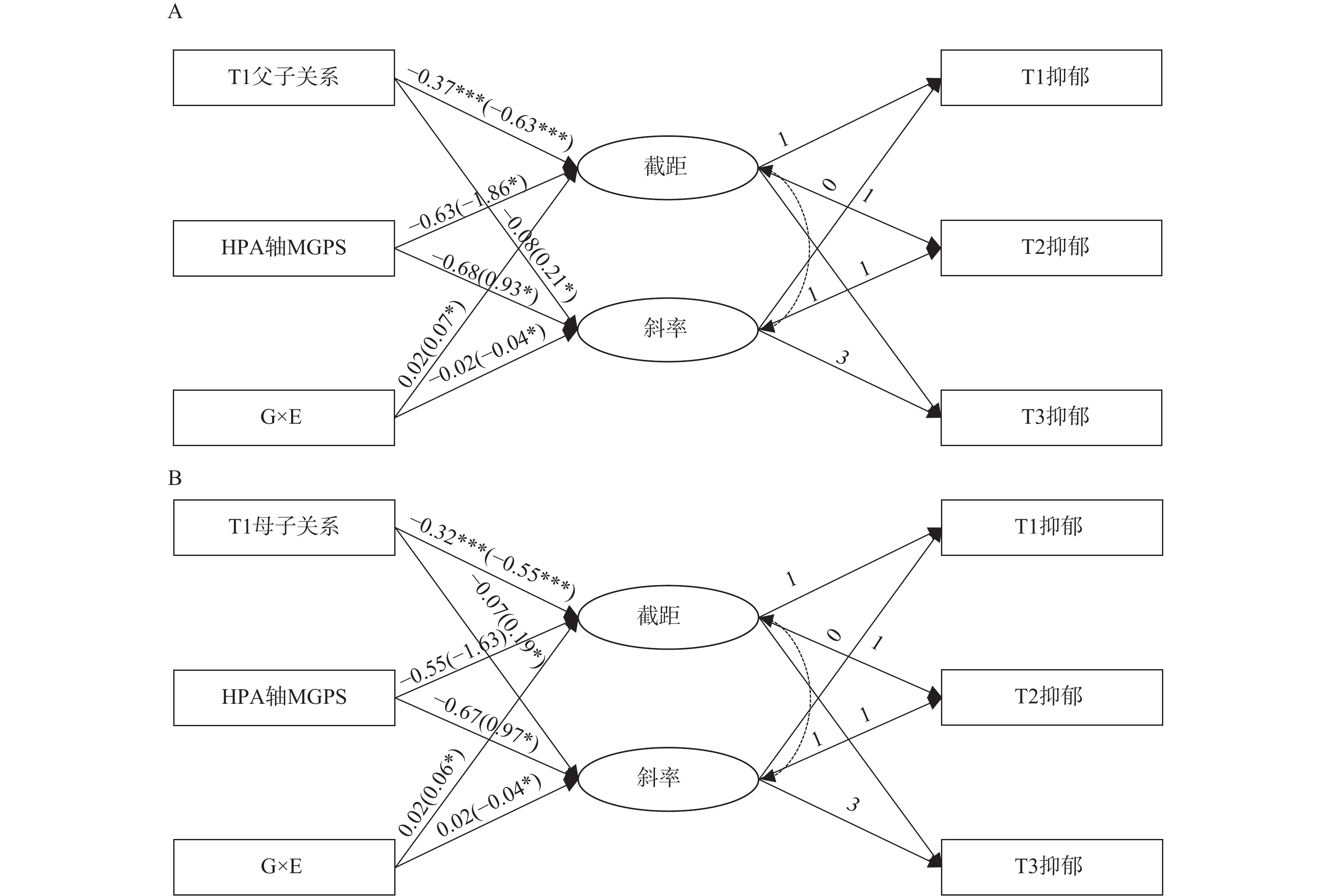
图1 青少年抑郁潜在增长模型 注:图A为父子关系模型,图B为母子关系模型;括号外为男生组估计系数,括号内为女生组估计系数。
| 分组 | 路径 | 系数 | p |
| 低水平HPA轴MGPS | T1父子关系→T1青少年抑郁 | −0.19 | 0.001 |
| T2父子关系→T2青少年抑郁 | −0.19 | <0.001 | |
| T3父子关系→T3青少年抑郁 | −0.17 | 0.14 | |
| 高水平HPA轴MGPS | T1父子关系→T1青少年抑郁 | −0.12 | 0.02 |
| T2父子关系→T2青少年抑郁 | −0.10 | 0.004 | |
| T3父子关系→T3青少年抑郁 | −0.08 | 0.43 | |
| 低水平HPA轴MGPS | T1母子关系→T1青少年抑郁 | −0.16 | 0.01 |
| T2母子关系→T2青少年抑郁 | −0.19 | <0.001 | |
| T3母子关系→T3青少年抑郁 | −0.25 | 0.03 | |
| 高水平HPA轴MGPS | T1母子关系→T1青少年抑郁 | −0.06 | 0.22 |
| T2母子关系→T2青少年抑郁 | −0.06 | 0.10 | |
| T3母子关系→T3青少年抑郁 | −0.08 | 0.45 |
表4 不同HPA轴MGPS水平亲子关系对青少年抑郁的影响
| 分组 | 路径 | 系数 | p |
| 低水平HPA轴MGPS | T1父子关系→T1青少年抑郁 | −0.19 | 0.001 |
| T2父子关系→T2青少年抑郁 | −0.19 | <0.001 | |
| T3父子关系→T3青少年抑郁 | −0.17 | 0.14 | |
| 高水平HPA轴MGPS | T1父子关系→T1青少年抑郁 | −0.12 | 0.02 |
| T2父子关系→T2青少年抑郁 | −0.10 | 0.004 | |
| T3父子关系→T3青少年抑郁 | −0.08 | 0.43 | |
| 低水平HPA轴MGPS | T1母子关系→T1青少年抑郁 | −0.16 | 0.01 |
| T2母子关系→T2青少年抑郁 | −0.19 | <0.001 | |
| T3母子关系→T3青少年抑郁 | −0.25 | 0.03 | |
| 高水平HPA轴MGPS | T1母子关系→T1青少年抑郁 | −0.06 | 0.22 |
| T2母子关系→T2青少年抑郁 | −0.06 | 0.10 | |
| T3母子关系→T3青少年抑郁 | −0.08 | 0.45 |
|
曹衍淼, 方惠慈, 朱欣悦, 纪林芹, 张文新. BDNF基因、同伴关系与青少年早期抑郁: 基于动态发展视角. 心理学报, 2023, 55 (10): 1620- 1636.
|
|
|
傅小兰, 张侃. (2023). 中国国民心理健康发展报告(2021—2022). 北京: 社会科学文献出版社.
|
|
|
谭德琴, 丁菀, 宋省成, 吴伟, 蔺秀云. 代际间的暴力传递——父母虐待对儿童欺负行为的影响: 基于潜变量增长模型的分析. 心理发展与教育, 2025, 41 (3): 410- 419.
DOI |
|
|
万雨霞, 焦丹阳, 张莉, 刘春雨, 王言, 胡晓倩, 王美萍. 父母教养行为与青少年早期抑郁的关系: 多基因与负性生活事件的调节作用. 心理科学, 2023, 46 (1): 203- 211.
|
|
|
辛国刚, 张李斌, 常睿生, 张云运. 青少年早期受欺凌发展轨迹: 抑郁、自尊和学业成就的预测作用. 心理发展与教育, 2023, 39 (4): 568- 579.
DOI |
|
|
曾子豪, 刘双金, 杨琴, 王宏才, 刘承珍, 赵纤, 胡义秋. 童年期创伤后亲子关系对青少年社会适应的影响: HPA轴系统多基因的调节. 心理学报, 2024, 56 (8): 1091- 1109.
|
|
|
Andresen, E. M., Malmgren, J. A., Carter, W. B., & Patrick, D. L. Screening for depression in well older adults: Evaluation of a short form of the CES-D. American Journal of Preventive Medicine, 1994, 10 (2): 77- 84.
|
|
|
Bakermans-Kranenburg, M. J., & van Ijzendoorn, M. H. Differential susceptibility to rearing environment depending on dopamine-related genes: New evidence and a meta-analysis. Development and Psychopathology, 2011, 23 (1): 39- 52.
|
|
|
Banerjee, D., & Rai, M. Social isolation in COVID-19: The impact of loneliness. International Journal of Social Psychiatry, 2020, 66 (6): 525- 527.
|
|
|
Bourne, S. V., Korom, M., & Dozier, M. Consequences of inadequate caregiving for children’s attachment, neurobiological development, and adaptive functioning. Clinical Child and Family Psychology Review, 2022, 25 (1): 166- 181.
|
|
|
Buchanan, C. M., Maccoby, E. E., & Dornbusch, S. M. Caught between parents: Adolescents’ experience in divorced homes. Child Development, 1991, 62 (5): 1008- 1029.
|
|
|
Callaghan, B. L., Gee, D. G., Gabard-Durnam, L., Telzer, E. H., Humphreys, K. L., Goff, B., ... Tottenham, N. Decreased amygdala reactivity to parent cues protects against anxiety following early adversity: An examination across 3 years. Biological Psychiatry: Cognitive Neuroscience and Neuroimaging, 2019, 4 (7): 664- 671.
|
|
|
Dunn, E. C., Uddin, M., Subramanian, S. V., Smoller, J. W., Galea, S., & Koenen, K. C. Research review: Gene-environment interaction research in youth depression—A systematic review with recommendations for future research. Journal of Child Psychology and Psychiatry, 2011, 52 (12): 1223- 1238.
|
|
|
Ellis, B. J., & Boyce, W. T. Biological sensitivity to context. Current Directions in Psychological Science, 2008, 17 (3): 183- 187.
|
|
|
Fancourt, D., Steptoe, A., & Bu, F. F. Trajectories of anxiety and depressive symptoms during enforced isolation due to COVID-19 in England: A longitudinal observational study. The Lancet Psychiatry, 2021, 8 (2): 141- 149.
|
|
|
Gerhard, D. M., Meyer, H. C., & Lee, F. S. An adolescent sensitive period for threat responding: Impacts of stress and sex. Biological Psychiatry, 2021, 89 (7): 651- 658.
|
|
|
Howe, D. (2012). Attachment theory. In M. Gray & S. Webb (Eds.), Social work theories and methods (pp. 75–87). London: Sage Publications.
|
|
|
Ising, M., Maccarrone, G., Brückl, T., Scheuer, S., Hennings, J., Holsboer, F., ... Lucae, S. FKBP5 gene expression predicts antidepressant treatment outcome in depression. International Journal of Molecular Sciences, 2019, 20 (3): 485.
|
|
|
Keijser, R., Åslund, C., Nilsson, K. W., & Olofsdotter, S. Gene-environment interaction: Oxytocin receptor (OXTR) polymorphisms and parenting style as potential predictors for depressive symptoms. Psychiatry Research, 2021, 303, 114057.
|
|
|
Koyama, Y., Nawa, N., Ochi, M., Surkan, P. J., & Fujiwara, T. Joint roles of oxytocin- and dopamine-related genes and childhood parenting experience in maternal supportive social network. Child Psychiatry & Human Development, 2024, 55 (3): 614- 621.
|
|
|
Leadbeater, B., Thompson, K., & Gruppuso, V. Co-occurring trajectories of symptoms of anxiety, depression, and oppositional defiance from adolescence to young adulthood. Journal of Clinical Child & Adolescent Psychology, 2012, 41 (6): 719- 730.
|
|
|
Masten, A. S., & Cicchetti, D. Developmental cascades. Development and Psychopathology, 2010, 22 (3): 491- 495.
|
|
|
McLean, S. A., Rodgers, R. F., Slater, A., Jarman, H. K., Gordon, C. S., & Paxton, S. J. Clinically significant body dissatisfaction: Prevalence and association with depressive symptoms in adolescent boys and girls. European Child & Adolescent Psychiatry, 2022, 31 (12): 1921- 1932.
|
|
|
Nabunya, P., Damulira, C., Byansi, W., Muwanga, J., Bahar, O. S., Namuwonge, F., ... Ssewamala, F. M. Prevalence and correlates of depressive symptoms among high school adolescent girls in southern Uganda. BMC Public Health, 2020, 20 (1): 1792.
|
|
|
Nelemans, S. A., Boks, M., Lin, B. C., Oldehinkel, T., van Lier, P., Branje, S., & Meeus, W. Polygenic risk for major depression interacts with parental criticism in predicting adolescent depressive symptom development. Journal of Youth and Adolescence, 2021, 50 (1): 159- 176.
|
|
|
Normann, C., & Buttenschøn, H. N. Gene-environment interactions between HPA-axis genes and childhood maltreatment in depression: A systematic review. Acta Neuropsychiatrica, 2020, 32 (3): 111- 121.
|
|
|
Orsolini, L., Latini, R., Pompili, M., Serafini, G., Volpe, U., Vellante, F., ... De Berardis, D. Understanding the complex of suicide in depression: From research to clinics. Psychiatry Investigation, 2020, 17 (3): 207- 221.
|
|
|
Pluess, M. Individual differences in environmental sensitivity. Child Development Perspectives, 2015, 9 (3): 138- 143.
|
|
|
Roisman, G. I., Newman, D. A., Fraley, R. C., Haltigan, J. D., Groh, A. M., & Haydon, K. C. Distinguishing differential susceptibility from diathesis-stress: Recommendations for evaluating interaction effects. Development and Psychopathology, 2012, 24 (2): 389- 409.
|
|
|
Scholte, R. H., & van Aken, M. A. (2006). Peer relations in adolescence. In S. Jackson & L. Goossens (Eds.), Handbook of adolescent development (pp. 175–199). London: Psychology Press.
|
|
|
Sellers, R., Harold, G. T., Smith, A. F., Neiderhiser, J. M., Reiss, D., Shaw, D., ... Leve, L. D. Disentangling nature from nurture in examining the interplay between parent-child relationships, ADHD, and early academic attainment. Psychological Medicine, 2021, 51 (4): 645- 652.
|
|
|
Starr, L. R., & Huang, M. HPA-axis multilocus genetic variation moderates associations between environmental stress and depressive symptoms among adolescents. Development and Psychopathology, 2019, 31 (4): 1339- 1352.
|
|
|
Starr, L. R., Stroud, C. B., Shaw, Z. A., & Vrshek-Schallhorn, S. Stress sensitization to depression following childhood adversity: Moderation by HPA axis and serotonergic multilocus profile scores. Development and Psychopathology, 2021, 33 (4): 1264- 1278.
|
|
|
van der Ende, J., Verhulst, F. C., & Tiemeier, H. Multitrait-multimethod analyses of change of internalizing and externalizing problems in adolescence: Predicting internalizing and externalizing DSM disorders in adulthood. Journal of Abnormal Psychology, 2020, 129 (4): 343- 354.
|
|
|
Weavers, B., Heron, J., Thapar, A. K., Stephens, A., Lennon, J., Jones, R. B., ... Rice, F. The antecedents and outcomes of persistent and remitting adolescent depressive symptom trajectories: A longitudinal, population-based English study. The Lancet Psychiatry, 2021, 8 (12): 1053- 1061.
|
|
|
Xu, L. Y., Liu, L. S., Li, Y. F., Liu, L. J., & Huntsinger, C. S. Parent-child relationships and Chinese children’s social adaptations: Gender difference in parent-child dyads. Personal Relationships, 2018, 25 (4): 462- 479.
|
|
|
Zinchuk, M. S., Druzhkova, T. A., Popova, S. B., Zhanina, M. Y., Guekht, A. B., & Gulyaeva, N. V. Early adverse family experiences and elevated adrenocorticotropic hormone predict non-suicidal self-injury in females with non-psychotic mental disorders and suicidal ideation. Biomedicines, 2023, 11 (12): 3181.
|
| [1] | 邬钟灵, 赵书敏, 闫俊男, 陈亮. 二胎家庭中亲子关系与幼儿合作的关系:同胞关系与幼儿性别的作用[J]. 心理与行为研究, 2025, 23(4): 479-486. |
| [2] | 徐慧艳, 王小英. 3~6岁儿童同胞关系的异质性及其影响因素:基于潜在剖面分析[J]. 心理与行为研究, 2024, 22(3): 346-353. |
| [3] | 赵海燕, 周爱保, 迟海霞, 白红敏, 叶长春, 蒋彦妮. 感知父母婚姻冲突、亲子关系与青少年心理危机的关系:认知灵活性的中介作用[J]. 心理与行为研究, 2024, 22(2): 227-233. |
| [4] | 林丽云, 向梦涵, 吴泳桃, 刘学兰. 父母养育倦怠对亲子关系的影响:婚姻质量和共同教养的链式中介作用[J]. 心理与行为研究, 2023, 21(6): 807-814. |
| [5] | 刘仁洁, 夏凌翔, 赵永萍. 大学生网络欺凌受害潜在类别的发展特点及性别因素的作用[J]. 心理与行为研究, 2023, 21(6): 784-791. |
| [6] | 张斌, 张安琪, 邱致燕, 曾奕欣, 曾成伟, 熊思成, 张淑君, 王亚楠. 青少年早期限制性饮食的发展轨迹:基于潜变量混合增长模型的分析[J]. 心理与行为研究, 2023, 21(5): 621-628. |
| [7] | 谢云天, 孟凡斐. 初中生数学元认知的发展轨迹:两年半追踪研究[J]. 心理与行为研究, 2023, 21(1): 58-64. |
| [8] | 罗芮, 赵云燕, 何然, 王耘, 陈福美. 二孩家庭父母偏爱的特点及其与青少年抑郁的关系[J]. 心理与行为研究, 2022, 20(5): 657-664. |
| [9] | 游志麒, 周宗奎. 儿童社交自我知觉的发展及其与孤独感和安静退缩的关系[J]. 心理与行为研究, 2021, 19(4): 473-479. |
| [10] | 卢富荣, 宋煜静, 刘路培, 方选智. 父母冲突对儿童青少年抑郁情绪的影响:有调节的中介模型[J]. 心理与行为研究, 2020, 18(6): 770-776. |
| [11] | 李昂, 张景焕. 亲子关系和移情对青少年社会创造力的预测:友谊质量的中介作用[J]. 心理与行为研究, 2020, 18(4): 496-502. |
| [12] | 周含芳, 刘志军, 樊毓美, 李百涵. 初中生亲子关系与网络欺负:孤独感的中介作用[J]. 心理与行为研究, 2019, 17(6): 787-794. |
| [13] | 王宇昊, 刘惠军, 戴必兵. 大学生亲子互动问卷的编制及其与抑郁的关系[J]. 心理与行为研究, 2017, 15(5): 702-708. |
| [14] | 陈立民;张霞;夏荣. 青少年亲子关系与攻击性行为的关系研究[J]. , 2011, 9(3): 231-235. |
| [15] | 石伟,张进辅,黄希庭. 初中生亲子关系特性的研究[J]. 心理与行为研究, 2004, 2(1): 328-332. |
| 阅读次数 | ||||||
|
全文 |
|
|||||
|
摘要 |
|
|||||
