
Studies of Psychology and Behavior ›› 2024, Vol. 22 ›› Issue (5): 666-672.DOI: 10.12139/j.1672-0628.2024.05.012
• ? • Previous Articles Next Articles
Fei DAN*,1( ), Yueyi MA2, Longhao CONG1
Received:2023-09-14
Online:2024-09-20
Published:2024-09-20
Contact:
Fei DAN
但菲*,1(), 马岳毅2, 丛龙昊1
通讯作者:
但菲
基金资助:Fei DAN, Yueyi MA, Longhao CONG. The Relationship Between Emotional Understanding and Social Mindfulness in 3~6 Year Old Children: A Moderated Mediation Model[J]. Studies of Psychology and Behavior, 2024, 22(5): 666-672.
但菲, 马岳毅, 丛龙昊. 3~6岁幼儿情绪理解与社会善念的关系:一个有调节的中介模型[J]. 心理与行为研究, 2024, 22(5): 666-672.
Add to citation manager EndNote|Ris|BibTeX
URL: https://psybeh.tjnu.edu.cn/EN/10.12139/j.1672-0628.2024.05.012
| 变量 | M | SD | 1 | 2 | 3 | 4 |
| 1.心理理论 | 1.76 | 1.10 | ||||
| 2.情绪理解 | 2.33 | 0.88 | 0.57*** | |||
| 3.社会善念 | 2.07 | 1.28 | 0.29*** | 0.29*** | ||
| 4.社会善念感知 | 1.37 | 0.82 | 0.31** | 0.26** | 0.79** | |
| 5.社会善念选择 | 0.70 | 0.80 | 0.14* | 0.20** | 0.78** | 0.24** |
| 变量 | M | SD | 1 | 2 | 3 | 4 |
| 1.心理理论 | 1.76 | 1.10 | ||||
| 2.情绪理解 | 2.33 | 0.88 | 0.57*** | |||
| 3.社会善念 | 2.07 | 1.28 | 0.29*** | 0.29*** | ||
| 4.社会善念感知 | 1.37 | 0.82 | 0.31** | 0.26** | 0.79** | |
| 5.社会善念选择 | 0.70 | 0.80 | 0.14* | 0.20** | 0.78** | 0.24** |
| 结果变量 | 预测变量 | R | R2 | F | β | t | 95%CI |
| 社会善念 | 0.31 | 0.10 | 11.15*** | ||||
| 性别 | 0.30 | 1.77 | [−0.03, 0.63] | ||||
| 情绪理解 | 0.44 | 4.59*** | [0.25, 0.64] | ||||
| 心理理论 | 0.57 | 0.33 | 51.20*** | ||||
| 性别 | −0.03 | −0.22 | [−0.28, 0.22] | ||||
| 情绪理解 | 0.72 | 9.98*** | [0.57, 0.86] | ||||
| 社会善念 | 0.34 | 0.12 | 9.27*** | ||||
| 性别 | 0.31 | 1.82 | [−0.03, 0.64] | ||||
| 情绪理解 | 0.30 | 2.53* | [0.06, 0.53] | ||||
| 心理理论 | 0.21 | 2.26* | [0.03, 0.39] |
| 结果变量 | 预测变量 | R | R2 | F | β | t | 95%CI |
| 社会善念 | 0.31 | 0.10 | 11.15*** | ||||
| 性别 | 0.30 | 1.77 | [−0.03, 0.63] | ||||
| 情绪理解 | 0.44 | 4.59*** | [0.25, 0.64] | ||||
| 心理理论 | 0.57 | 0.33 | 51.20*** | ||||
| 性别 | −0.03 | −0.22 | [−0.28, 0.22] | ||||
| 情绪理解 | 0.72 | 9.98*** | [0.57, 0.86] | ||||
| 社会善念 | 0.34 | 0.12 | 9.27*** | ||||
| 性别 | 0.31 | 1.82 | [−0.03, 0.64] | ||||
| 情绪理解 | 0.30 | 2.53* | [0.06, 0.53] | ||||
| 心理理论 | 0.21 | 2.26* | [0.03, 0.39] |
| Effect | BootSE | 95%CI | 相对效应值(%) | |
| 总效应 | 0.45 | 0.10 | [0.25, 0.64] | |
| 直接效应 | 0.30 | 0.12 | [0.60, 0.84] | 66.29 |
| 中介效应 | 0.15 | 0.07 | [0.02, 0.28] | 33.71 |
| Effect | BootSE | 95%CI | 相对效应值(%) | |
| 总效应 | 0.45 | 0.10 | [0.25, 0.64] | |
| 直接效应 | 0.30 | 0.12 | [0.60, 0.84] | 66.29 |
| 中介效应 | 0.15 | 0.07 | [0.02, 0.28] | 33.71 |
| 结果变量 | 预测变量 | R | R2 | F | β | t | 95%CI |
| 心理理论 | 0.76 | 0.57 | 45.84*** | ||||
| 性别 | 0.01 | 0.09 | [−0.19, 0.21] | ||||
| 情绪理解 | 0.67 | 11.14*** | [0.55, 0.79] | ||||
| 年龄虚拟1_4岁 | 0.24 | 3.37*** | [0.10, 0.38] | ||||
| 年龄虚拟2_5岁 | 0.43 | 5.88*** | [0.29, 0.57] | ||||
| int1 | 0.27 | 3.10** | [0.10, 0.44] | ||||
| int2 | 0.26 | 3.10** | [0.10, 0.43] | ||||
| 社会善念 | 0.30 | 0.12 | 9.27*** | ||||
| 性别 | 0.31 | 1.82 | [−0.03, 0.64] | ||||
| 情绪理解 | 0.30 | 2.53* | [0.06, 0.53] | ||||
| 心理理论 | 0.21 | 2.26* | [0.03, 0.39] |
| 结果变量 | 预测变量 | R | R2 | F | β | t | 95%CI |
| 心理理论 | 0.76 | 0.57 | 45.84*** | ||||
| 性别 | 0.01 | 0.09 | [−0.19, 0.21] | ||||
| 情绪理解 | 0.67 | 11.14*** | [0.55, 0.79] | ||||
| 年龄虚拟1_4岁 | 0.24 | 3.37*** | [0.10, 0.38] | ||||
| 年龄虚拟2_5岁 | 0.43 | 5.88*** | [0.29, 0.57] | ||||
| int1 | 0.27 | 3.10** | [0.10, 0.44] | ||||
| int2 | 0.26 | 3.10** | [0.10, 0.43] | ||||
| 社会善念 | 0.30 | 0.12 | 9.27*** | ||||
| 性别 | 0.31 | 1.82 | [−0.03, 0.64] | ||||
| 情绪理解 | 0.30 | 2.53* | [0.06, 0.53] | ||||
| 心理理论 | 0.21 | 2.26* | [0.03, 0.39] |
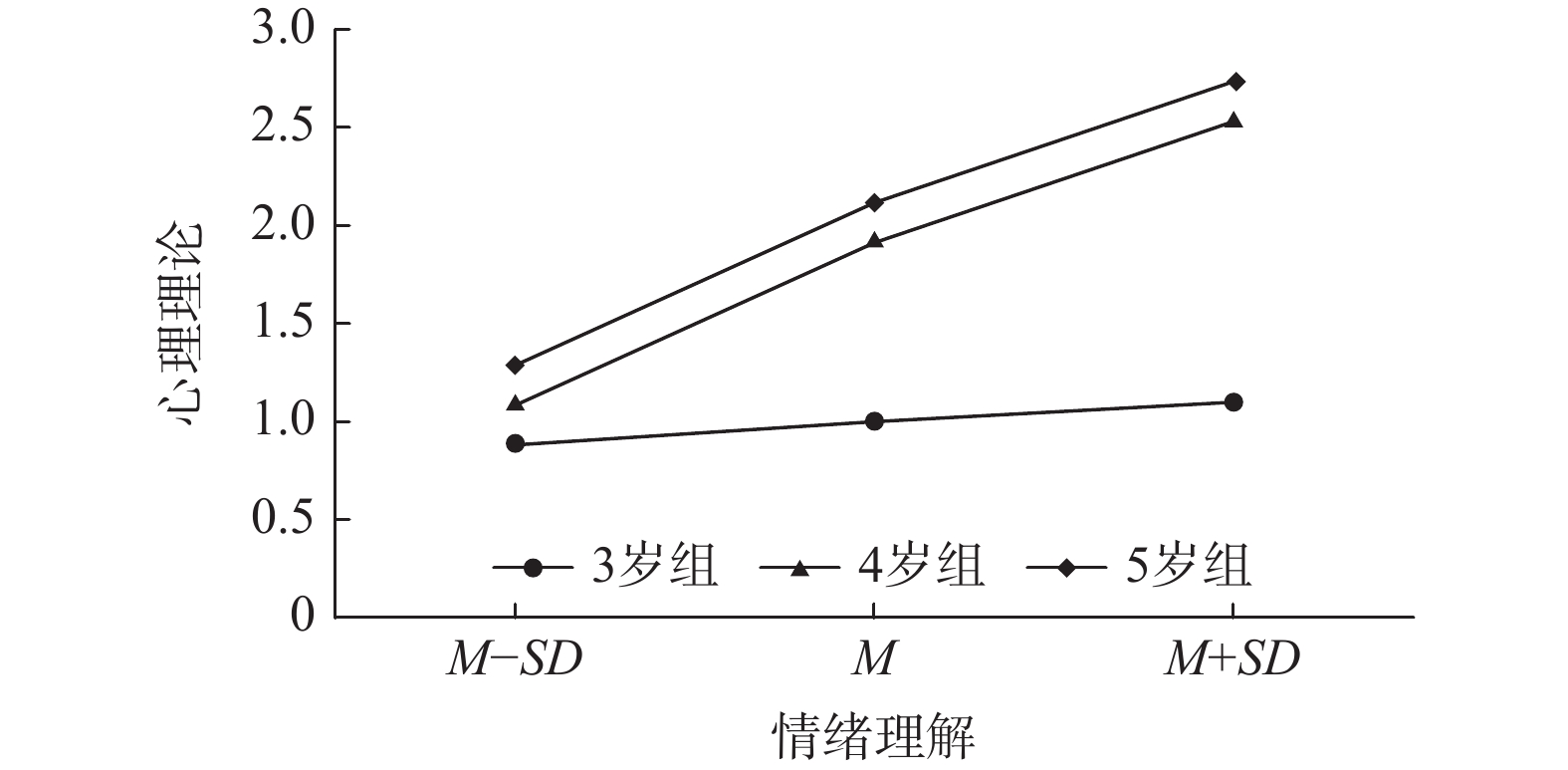
| 年龄 | Effect | BootSE | 95%CI | |
| 有调节的 中介效应 | 3岁 | 0.05 | 0.02 | [0.02, 0.10] |
| 4岁 | 0.19 | 0.09 | [0.02, 0.37] | |
| 5岁 | 0.19 | 0.09 | [0.02, 0.37] |
| 年龄 | Effect | BootSE | 95%CI | |
| 有调节的 中介效应 | 3岁 | 0.05 | 0.02 | [0.02, 0.10] |
| 4岁 | 0.19 | 0.09 | [0.02, 0.37] | |
| 5岁 | 0.19 | 0.09 | [0.02, 0.37] |
|
陈英和, 崔艳丽, 王雨晴. 幼儿心理理论与情绪理解发展及关系的研究. 心理科学, 2005, 28 (3): 527- 532.
DOI |
|
|
但菲, 徐桂娟, 索长清, 赵琳, 孙倩倩. 幼儿情绪理解能力的发展特点. 教育导刊(下半月), 2011, (1): 28- 32.
|
|
|
窦凯. (2016). 感知社会正念: 有效促进合作行为的心理机制(博士学位论文). 暨南大学, 广州.
|
|
|
郭滢, 肖红蕊, 龚先旻, 王大华. 情绪影响错误记忆认知机制的年龄差异. 心理发展与教育, 2022, 38 (1): 17- 25.
|
|
|
李丹丹. (2023). 偏好信息对于4至10岁儿童社会善念理解的影响(硕士学位论文). 华东师范大学, 上海.
|
|
|
李梓嘉, 赵欣. (2022). 给他人留选择: 儿童早期社会善念行为的发展. 见 第二十四届全国心理学学术会议摘要集 (pp. 1341–1342), 中国心理学会, 新乡.
|
|
|
刘俊升, 周颖, 李丹, 陈欣银. 儿童中期和青春期早期独处偏好与心理适应之关系: 有调节的中介效应. 心理学报, 2015, 47 (8): 1004- 1012.
|
|
|
王娟, 汪鑫鑫. 母亲语言支架预测儿童亲社会行为: 儿童情绪理解的中介作用. 中国临床心理学杂志, 2021, 29 (1): 19- 23.
|
|
|
王小英, 张玉梅, 王丽娟, 刘凤玲. 3~6岁儿童情绪理解过程: 情绪表现、归因和调节. 心理科学, 2010, 33 (4): 985- 987.
|
|
|
温忠麟, 叶宝娟. 有调节的中介模型检验方法: 竞争还是替补. 心理学报, 2014, 46 (5): 714- 726.
|
|
|
肖琼华. (2006). 幼儿移情影响因素的研究(硕士学位论文). 东北师范大学, 长春.
|
|
|
于爽. 情绪作为内感受的外在行动推理——一种基于预测加工的情绪理解. 中国社会科学评价, 2023, 33 (1): 38- 46, 158.
|
|
|
袁博, 廖苏霞, 郭俏俏, 高奇扬, 陈思宇. 流动儿童的社会善念水平及其提升. 心理与行为研究, 2022, 20 (2): 268- 273.
DOI |
|
|
张晶晶, 杨颖, 胡清芬. 儿童推断他人知识状态的知识偏差和无知偏差. 心理与行为研究, 2016, 14 (5): 618- 625.
DOI |
|
|
赵欣, 李丹丹, 杨向东. 学龄前儿童社会善念理解的发展与心理理论的关系. 心理学报, 2022, 54 (8): 892- 904.
|
|
|
周双珠, 陈英和, 胡竹菁. 道德和个人领域儿童情绪理解的发展特点及对其亲社会行为的影响. 心理学探新, 2017, 37 (1): 41- 47.
|
|
|
Araya, J. M. (2018). Emotion and predictive processing: emotions as perceptions?(Unpublished doctorial dissertation). The University of Edinburgh, United Kingdom.
|
|
|
Bolin, J. H. Andrew F. Hayes (2013). Introduction to mediation, moderation, and conditional process analysis: A regression-based approach. Journal of Educational Measurement, 2014, 51 (3): 335- 337.
DOI |
|
|
Conte, E., Grazzani, I., & Pepe, A. Social cognition, language, and prosocial behaviors: A multitrait mixed-methods study in early childhood. Early Education and Development, 2018, 29 (6): 814- 830.
DOI |
|
|
Flavell, J. H. (2002). Development of children’s knowledge about the mental world. In W. W. Hartup & R. K. Silbereisen (Eds.), Growing points in developmental science (p. 384). London: Psychology Press.
|
|
|
Galinsky, A. D., Maddux, W. W., Gilin, D., & White, J. B. Why it pays to get inside the head of your opponent: The differential effects of perspective taking and empathy in negotiations. Psychological Science, 2008, 19 (4): 378- 384.
DOI |
|
|
Happé, F. G. E., Winner, E., & Brownell, H. The getting of wisdom: theory of mind in old age. Developmental Psychology, 1998, 34 (2): 358- 362.
DOI |
|
|
Ibanez, A., & Schulte, M. Situated minds: Conceptual and emotional blending in neurodegeneration and beyond. Brain, 2020, 143 (12): 3523- 3525.
DOI |
|
|
Izard, C. E., & Harris, P. (1995). Emotional development and developmental psychopathology. In D. Cicchetti & D. J. Cohen (Eds.), Developmental psychopathology (pp. 467–503). Hoboken, NJ: John Wiley & Sons.
|
|
|
Longobardi, E., Spataro, P., & Rossi-Arnaud, C. Direct and indirect associations of empathy, theory of mind, and language with prosocial behavior: Gender differences in primary school children. The Journal of Genetic Psychology, 2019, 180 (6): 266- 279.
DOI |
|
|
Pons, F., Harris, P. L., & De Rosnay, M. Emotion comprehension between 3 and 11 years: Developmental periods and hierarchical organization. European Journal of Developmental Psychology, 2004, 1 (2): 127- 152.
DOI |
|
|
Sarmento-Henrique, R., Quintanilla, L., Lucas-Molina, B., Recio, P., & Giménez-Dasí, M. The longitudinal interplay of emotion understanding, theory of mind, and language in the preschool years. International Journal of Behavioral Development, 2020, 44 (3): 236- 245.
DOI |
|
|
Tager-Flusberg, H., & Sullivan, K. A componential view of theory of mind: Evidence from Williams syndrome. Cognition, 2000, 76 (1): 59- 90.
DOI |
|
|
van Doesum, N. J., de Vries, R. E., Blokland, A. A. J., Hill, J. M., Kuhlman, D. M., Stivers, A. W., ... van Lange, P. A. Social mindfulness: Prosocial the active way. The Journal of Positive Psychology, 2020, 15 (2): 183- 193.
DOI |
|
|
van Doesum, N. J., van Lange, D. A. W., & van Lange, P. A. M. Social mindfulness: Skill and will to navigate the social world. Journal of Personality and Social Psychology, 2013, 105 (1): 86- 103.
DOI |
|
|
van Lange, P. A., & van Doesum, N. J. Social mindfulness and social hostility. Current Opinion in Behavioral Sciences, 2015, 3, 18- 24.
DOI |
|
|
Weimer, A. A., Sallquist, J., & Bolnick, R. R. Young children’s emotion comprehension and theory of mind understanding. Early Education & Development, 2012, 23 (3): 280- 301.
|
|
|
Wellman, H. M., Fang, F. X., Liu, D., Zhu, L. Q., & Liu, G. X. Scaling of theory-of-mind understandings in Chinese children. Psychological Science, 2006, 17 (12): 1075- 1081.
DOI |
|
|
Zhao, X., Zhao, X., Gweon, H., & Kushnir, T. Leaving a choice for others: Children’s evaluations of considerate, socially-mindful actions. Child Development, 2021, 92 (4): 1238- 1253.
DOI |
| Viewed | ||||||
|
Full text |
|
|||||
|
Abstract |
|
|||||
