
Studies of Psychology and Behavior ›› 2026, Vol. 24 ›› Issue (1): 113-121.DOI: 10.12139/j.1672-0628.2026.01.013
• ? • Previous Articles Next Articles
Zeqi LIU1, Yuhua LI1, Yan GAO2, Jiaxin LIU1, Mengmeng SU*,1( )
)
Received:2024-12-17
Online:2026-01-20
Published:2026-01-20
Contact:
Mengmeng SU
刘泽琪1, 李玉华1, 高艳2, 刘佳欣1, 苏萌萌*,1()
通讯作者:
苏萌萌
基金资助:Zeqi LIU, Yuhua LI, Yan GAO, Jiaxin LIU, Mengmeng SU. Development and Validation of the Home Literacy Environment Scale for Chinese Children[J]. Studies of Psychology and Behavior, 2026, 24(1): 113-121.
刘泽琪, 李玉华, 高艳, 刘佳欣, 苏萌萌. 小学生家庭读写环境量表的编制及信效度检验[J]. 心理与行为研究, 2026, 24(1): 113-121.
Add to citation manager EndNote|Ris|BibTeX
URL: https://psybeh.tjnu.edu.cn/EN/10.12139/j.1672-0628.2026.01.013
| 维度 | 项目 | 出处 |
| 正式读写活动 | A1教授孩子阅读拼音或汉字 | 根据家庭读写模型量表( |
| A2教授孩子书写拼音或汉字 | 根据家庭读写模型量表( | |
| A3训练孩子在学校所学的阅读知识 | 根据家庭读写实践清单( | |
| A4教授以及听写孩子新词语或成语 | 结合《义务教育语文课程标准(2022年版)》创编 | |
| A5检查孩子背诵古诗、古文 | 结合《义务教育语文课程标准(2022年版)》创编 | |
| A6为孩子大声读出日常生活用品的名称 | 根据家庭读写实践清单( | |
| 非正式读写活动 | B1共同阅读绘本 | 根据斯帝佩克家庭学习活动调查表( |
| B2共同阅读寓言或故事、童话故事 | 结合《义务教育语文课程标准(2022年版)》创编 | |
| B3共同朗诵、吟诗或玩押韵游戏 | 根据家庭读写模型量表( | |
| B4共同玩成语或者词语接龙 | 结合《义务教育语文课程标准(2022年版)》创编 | |
| B5共同玩拼写或汉字字形的游戏 | 根据家庭读写模型量表( | |
| 自发性阅读活动 | C1孩子自主阅读绘本 | 根据研究( |
| C2孩子独立接受课外阅读课程 | 结合《义务教育语文课程标准(2022年版)》创编 | |
| C3孩子主动讲故事 | 结合《义务教育语文课程标准(2022年版)》创编 | |
| C4孩子用自己的话讨论 | 结合《义务教育语文课程标准(2022年版)》创编 | |
| 阅读理解活动 | D1提问孩子故事书的主要内容 | 根据研究( |
| D2提问孩子故事书的主要活动或人物 | 根据研究( | |
| D3让孩子用自己的语言概括故事书 | 根据研究( | |
| D4提问孩子对于故事书的启发和感受 | 结合《义务教育语文课程标准(2022年版)》创编 | |
| D5给孩子布置写作任务(日记等) | 结合《义务教育语文课程标准(2022年版)》创编 | |
| 教育外出活动 | E1参观科学馆/太空馆及讨论读写话题 | 根据研究( |
| E2参观美术馆/美术展及讨论读写话题 | 根据研究( | |
| E3去海洋公园/游乐场及讨论读写话题 | 根据研究( | |
| E4参观博物馆及讨论读写话题 | 根据研究( | |
| E5到外地探亲旅游及讨论读写话题 | 根据研究( | |
| 读写资源 | F1成人书籍数量(纸质与电子总和) | 根据家庭读写环境量表( |
| F2儿童书籍数量(纸质与电子总和) | 根据家庭读写环境量表( | |
| 读写兴趣 | G1孩子在家里将阅读当作娱乐 | 根据研究( |
| G2孩子享受空闲时光用来阅读 | 根据研究( | |
| G3孩子在整个周末都进行阅读 | 根据研究( | |
| G4孩子喜欢用阅读代替玩耍 | 根据研究( | |
| G5孩子喜欢阅读不同类型的书籍 | 根据研究( |
| 维度 | 项目 | 出处 |
| 正式读写活动 | A1教授孩子阅读拼音或汉字 | 根据家庭读写模型量表( |
| A2教授孩子书写拼音或汉字 | 根据家庭读写模型量表( | |
| A3训练孩子在学校所学的阅读知识 | 根据家庭读写实践清单( | |
| A4教授以及听写孩子新词语或成语 | 结合《义务教育语文课程标准(2022年版)》创编 | |
| A5检查孩子背诵古诗、古文 | 结合《义务教育语文课程标准(2022年版)》创编 | |
| A6为孩子大声读出日常生活用品的名称 | 根据家庭读写实践清单( | |
| 非正式读写活动 | B1共同阅读绘本 | 根据斯帝佩克家庭学习活动调查表( |
| B2共同阅读寓言或故事、童话故事 | 结合《义务教育语文课程标准(2022年版)》创编 | |
| B3共同朗诵、吟诗或玩押韵游戏 | 根据家庭读写模型量表( | |
| B4共同玩成语或者词语接龙 | 结合《义务教育语文课程标准(2022年版)》创编 | |
| B5共同玩拼写或汉字字形的游戏 | 根据家庭读写模型量表( | |
| 自发性阅读活动 | C1孩子自主阅读绘本 | 根据研究( |
| C2孩子独立接受课外阅读课程 | 结合《义务教育语文课程标准(2022年版)》创编 | |
| C3孩子主动讲故事 | 结合《义务教育语文课程标准(2022年版)》创编 | |
| C4孩子用自己的话讨论 | 结合《义务教育语文课程标准(2022年版)》创编 | |
| 阅读理解活动 | D1提问孩子故事书的主要内容 | 根据研究( |
| D2提问孩子故事书的主要活动或人物 | 根据研究( | |
| D3让孩子用自己的语言概括故事书 | 根据研究( | |
| D4提问孩子对于故事书的启发和感受 | 结合《义务教育语文课程标准(2022年版)》创编 | |
| D5给孩子布置写作任务(日记等) | 结合《义务教育语文课程标准(2022年版)》创编 | |
| 教育外出活动 | E1参观科学馆/太空馆及讨论读写话题 | 根据研究( |
| E2参观美术馆/美术展及讨论读写话题 | 根据研究( | |
| E3去海洋公园/游乐场及讨论读写话题 | 根据研究( | |
| E4参观博物馆及讨论读写话题 | 根据研究( | |
| E5到外地探亲旅游及讨论读写话题 | 根据研究( | |
| 读写资源 | F1成人书籍数量(纸质与电子总和) | 根据家庭读写环境量表( |
| F2儿童书籍数量(纸质与电子总和) | 根据家庭读写环境量表( | |
| 读写兴趣 | G1孩子在家里将阅读当作娱乐 | 根据研究( |
| G2孩子享受空闲时光用来阅读 | 根据研究( | |
| G3孩子在整个周末都进行阅读 | 根据研究( | |
| G4孩子喜欢用阅读代替玩耍 | 根据研究( | |
| G5孩子喜欢阅读不同类型的书籍 | 根据研究( |
| Model | WLSMV χ2 | df | χ2/df | RMSEA | CFI | TLI | SRMR |
| 六因子CFA | 3423.36 | 390.00 | 8.78 | 0.09 | 0.88 | 0.86 | 0.07 |
| 七因子CFA | 2445.02 | 384.00 | 6.36 | 0.07 | 0.92 | 0.91 | 0.05 |
| Model | WLSMV χ2 | df | χ2/df | RMSEA | CFI | TLI | SRMR |
| 六因子CFA | 3423.36 | 390.00 | 8.78 | 0.09 | 0.88 | 0.86 | 0.07 |
| 七因子CFA | 2445.02 | 384.00 | 6.36 | 0.07 | 0.92 | 0.91 | 0.05 |
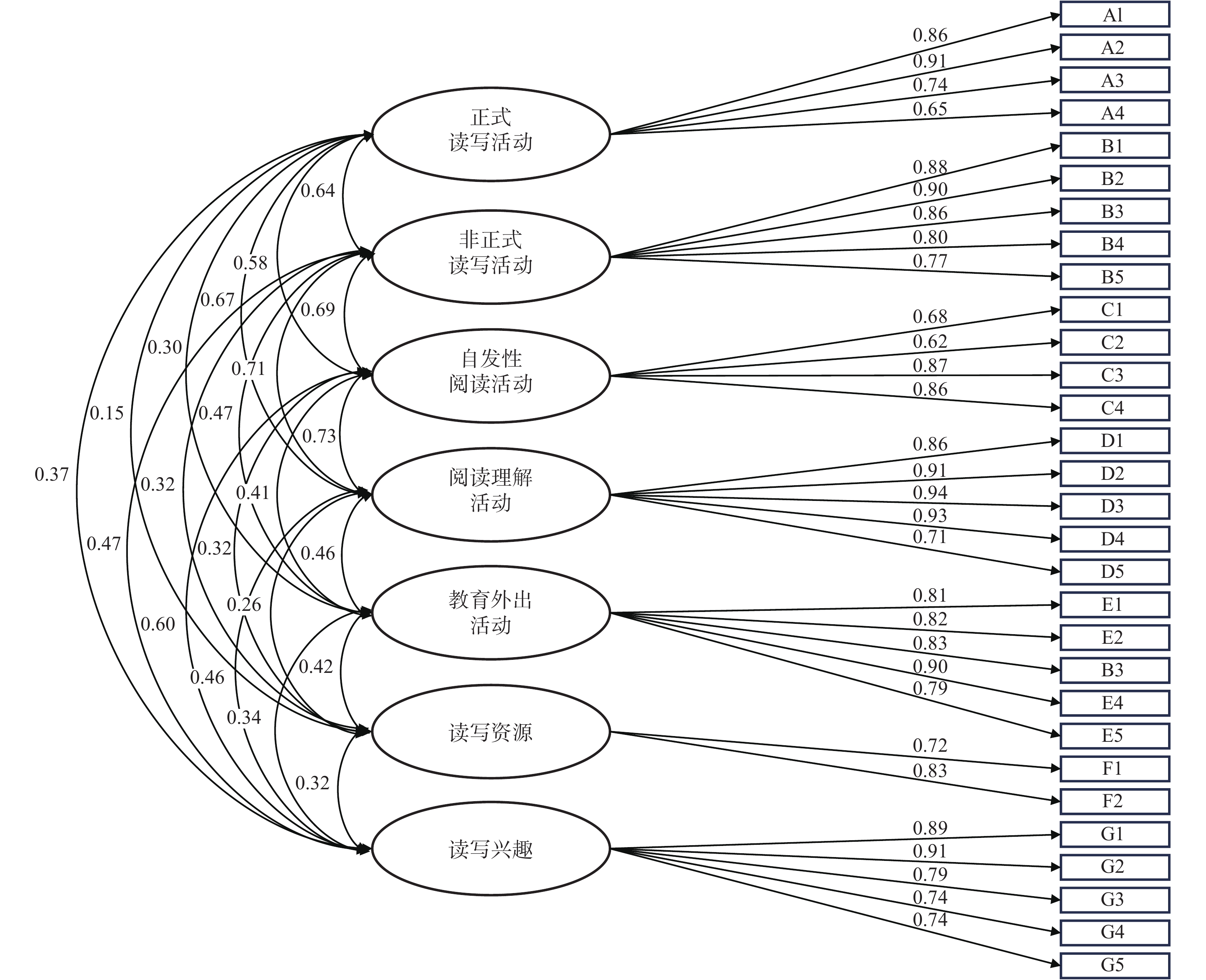
| 1 | 2 | 3 | 4 | 5 | 6 | 7 | |
| 1.正式读写活动 | |||||||
| 2.非正式读写活动 | 0.62*** | ||||||
| 3.自发性阅读活动 | 0.57*** | 0.62*** | |||||
| 4.阅读理解活动 | 0.68*** | 0.70*** | 0.66*** | ||||
| 5.教育外出活动 | 0.30*** | 0.45*** | 0.35*** | 0.43*** | |||
| 6.读写资源 | 0.15*** | 0.32*** | 0.26*** | 0.26*** | 0.40*** | ||
| 7.读写兴趣 | 0.35*** | 0.45*** | 0.56*** | 0.43*** | 0.32*** | 0.26*** | |
| 8.总量表 | 0.60*** | 0.74*** | 0.66*** | 0.73*** | 0.87*** | 0.52*** | 0.56*** |
| 1 | 2 | 3 | 4 | 5 | 6 | 7 | |
| 1.正式读写活动 | |||||||
| 2.非正式读写活动 | 0.62*** | ||||||
| 3.自发性阅读活动 | 0.57*** | 0.62*** | |||||
| 4.阅读理解活动 | 0.68*** | 0.70*** | 0.66*** | ||||
| 5.教育外出活动 | 0.30*** | 0.45*** | 0.35*** | 0.43*** | |||
| 6.读写资源 | 0.15*** | 0.32*** | 0.26*** | 0.26*** | 0.40*** | ||
| 7.读写兴趣 | 0.35*** | 0.45*** | 0.56*** | 0.43*** | 0.32*** | 0.26*** | |
| 8.总量表 | 0.60*** | 0.74*** | 0.66*** | 0.73*** | 0.87*** | 0.52*** | 0.56*** |
| 效标工具 | 正式读写活动 | 非正式读写活动 | 自发性阅读活动 | 阅读理解活动 | 教育外出活动 | 读写资源 | 读写兴趣 | 总量表 |
| SHLA | 0.83*** | 0.75*** | 0.78*** | 0.80*** | 0.43*** | 0.25*** | 0.48*** | 0.73*** |
| FI | 0.66*** | 0.83*** | 0.73*** | 0.78*** | 0.68*** | 0.38*** | 0.54*** | 0.89*** |
| HLM | 0.91*** | 0.75*** | 0.60*** | 0.67*** | 0.32*** | 0.18*** | 0.40*** | 0.62*** |
| 效标工具 | 正式读写活动 | 非正式读写活动 | 自发性阅读活动 | 阅读理解活动 | 教育外出活动 | 读写资源 | 读写兴趣 | 总量表 |
| SHLA | 0.83*** | 0.75*** | 0.78*** | 0.80*** | 0.43*** | 0.25*** | 0.48*** | 0.73*** |
| FI | 0.66*** | 0.83*** | 0.73*** | 0.78*** | 0.68*** | 0.38*** | 0.54*** | 0.89*** |
| HLM | 0.91*** | 0.75*** | 0.60*** | 0.67*** | 0.32*** | 0.18*** | 0.40*** | 0.62*** |
| WLSMV χ² | df | χ²/df | CFI | TLI | RMSEA | SRMR | |
| 全部样本 | 2556.78 | 384.00 | 6.66 | 0.92 | 0.90 | 0.07 | 0.05 |
| 男孩样本 | 1438.47 | 384.00 | 3.74 | 0.92 | 0.91 | 0.07 | 0.06 |
| 女孩样本 | 1576.56 | 384.00 | 4.11 | 0.90 | 0.89 | 0.08 | 0.06 |
| 形态等值(结构一致) | 3015.02 | 768.00 | 3.93 | 0.91 | 0.90 | 0.08 | 0.05 |
| 弱等值(载荷一致) | 3029.12 | 791.00 | 3.93 | 0.91 | 0.90 | 0.07 | 0.05 |
| 强等值(截距一致) | 3062.41 | 814.00 | 3.93 | 0.91 | 0.91 | 0.07 | 0.05 |
| WLSMV χ² | df | χ²/df | CFI | TLI | RMSEA | SRMR | |
| 全部样本 | 2556.78 | 384.00 | 6.66 | 0.92 | 0.90 | 0.07 | 0.05 |
| 男孩样本 | 1438.47 | 384.00 | 3.74 | 0.92 | 0.91 | 0.07 | 0.06 |
| 女孩样本 | 1576.56 | 384.00 | 4.11 | 0.90 | 0.89 | 0.08 | 0.06 |
| 形态等值(结构一致) | 3015.02 | 768.00 | 3.93 | 0.91 | 0.90 | 0.08 | 0.05 |
| 弱等值(载荷一致) | 3029.12 | 791.00 | 3.93 | 0.91 | 0.90 | 0.07 | 0.05 |
| 强等值(截距一致) | 3062.41 | 814.00 | 3.93 | 0.91 | 0.91 | 0.07 | 0.05 |
|
程亚华, 沈岚岚, 李宜逊, 伍新春, 李虹, 王铁群, 程芳. 家庭阅读环境对学龄儿童汉字识别、口语词汇知识与阅读理解的影响: 一个发展级联模型. 心理学报, 2024, 56 (1): 83- 92.
|
|
|
刘海丹, 李敏谊. 家庭读写环境与儿童接受性词汇发展关系的元分析. 心理科学进展, 2022, 30 (3): 556- 579.
|
|
|
舒华, 李文玲, 辜玉旻, Richard Anderson, 伍新春, 张厚粲, 轩月. 家庭文化背景在儿童阅读发展中的作用. 心理科学, 2002, 25 (2): 136- 139.
|
|
|
中华人民共和国教育部. (2022). 义务教育语文课程标准 (2022年版). 北京: 北京师范大学出版社.
|
|
|
Anderson, C. A., & Dill, K. E. Video games and aggressive thoughts, feelings, and behavior in the laboratory and in life. Journal of Personality and Social Psychology, 2000, 78 (4): 772- 790.
DOI |
|
|
Bevevino, M. M. The 87 percent factor. The Delta Kappa Gamma Bulletin, 1988, 54 (3): 9- 16.
|
|
|
Chall, J. (1983). Stages of reading development. New York: McGraw-Hill.
|
|
|
Coley, R. L., Kruzik, C., & Votruba-Drzal, E. Do family investments explain growing socioeconomic disparities in children’s reading, math, and science achievement during school versus summer months. Journal of Educational Psychology, 2020, 112 (6): 1183- 1196.
DOI |
|
|
Evans, G. W., & English, K. The environment of poverty: Multiple stressor exposure, psychophysiological stress, and socioemotional adjustment. Child Development, 2002, 73 (4): 1238- 1248.
DOI |
|
|
Georgiou, G. K., Inoue, T., & Parrila, R. Developmental relations between home literacy environment, reading interest, and reading skills: Evidence from a 3-year longitudinal study. Child Development, 2021, 92 (5): 2053- 2068.
DOI |
|
|
Gignac, G. E., & Szodorai, E. T. Effect size guidelines for individual differences researchers. Personality and Individual Differences, 2016, 102, 74- 78.
DOI |
|
|
Griffin, E. A., & Morrison, F. J. The unique contribution of home literacy environment to differences in early literacy skills. Early Child Development and Care, 1997, 127 (1): 233- 243.
DOI |
|
|
Krijnen, E., van Steensel, R., Meeuwisse, M., Jongerling J, & Severiens, S. Exploring a refined model of home literacy activities and associations with children’s emergent literacy skills. Reading and Writing, 2020, 33 (1): 207- 238.
DOI |
|
|
Lerkkanen, M. K., Kiuru, N., Pakarinen, E., Viljaranta, J., Poikkeus, A. M., Rasku-Puttonen, H., & Nurmi, J. E. The role of teaching practices in the development of children’s interest in reading and mathematics in kindergarten. Contemporary Educational Psychology, 2012, 37 (4): 266- 279.
DOI |
|
|
Masten, A. S., & Coatsworth, J. D. The development of competence in favorable and unfavorable environments: Lessons from research on successful children. American Psychologist, 1998, 53 (2): 205- 220.
DOI |
|
|
Mol, S. E., & Bus, A. G. To read or not to read: A meta-analysis of print exposure from infancy to early adulthood. Psychological Bulletin, 2011, 137 (2): 267- 296.
DOI |
|
|
Sénéchal, M., & LeFevre, J. A. Parental involvement in the development of children’s reading skill: A five-year longitudinal study. Child Development, 2002, 73 (2): 445- 460.
DOI |
|
|
Sénéchal, M., & LeFevre, J. A. Continuity and change in the home literacy environment as predictors of growth in vocabulary and reading. Child Development, 2014, 85 (4): 1552- 1568.
DOI |
|
|
Sénéchal, M., LeFevre, J. A., Thomas, E. M., & Daley, K. E. Differential effects of home literacy experiences on the development of oral and written language. Reading Research Quarterly, 1998, 33 (1): 96- 116.
DOI |
|
|
Silinskas, G., Sénéchal, M., Torppa, M., & Lerkkanen, M. K. Home literacy activities and children’s reading skills, independent reading, and interest in literacy activities from kindergarten to grade 2. Frontiers in Psychology, 2020, 11, 1508.
DOI |
|
|
Snowling, M. J. (2000). Dyslexia (2nd ed.). Oxford, United Kingdom: Blackwell.
|
|
|
Song, S., Su, M. M., Kang, C. Q., Liu, H. Y., Zhang, Y. Q., McBride-Chang, C., ... Shu, H. Tracing children’s vocabulary development from preschool through the school-age years: An 8-year longitudinal study. Developmental Science, 2015, 18 (1): 119- 131.
DOI |
|
|
Stevens, C., Lauinger, B., & Neville, H. Differences in the neural mechanisms of selective attention in children from different socioeconomic backgrounds: An event-related brain potential study. Developmental Science, 2009, 12 (4): 634- 646.
DOI |
|
|
Stipek, D., Milburn, S., Clements, D., & Daniels, D. H. Parents’ beliefs about appropriate education for young children. Journal of Applied Developmental Psychology, 1992, 13 (3): 293- 310.
DOI |
|
|
Su, M. M., Fan, Y., Wu, J. F., Qiao B. Y., & Zhou, W. The influence of the literacy environment on children’s writing development in Chinese. Frontiers in Psychology, 2022, 13, 1010471.
DOI |
|
|
Su, M. M., Peyre, H., Song, S., McBride, C., Tardif, T., Li, H., ... Shu, H. The influence of early linguistic skills and family factors on literacy acquisition in Chinese children: Follow-up from age 3 to age 11. Learning and Instruction, 2017, 49, 54- 63.
DOI |
|
|
Taylor, R. (1996). The Familia Inventory users’ manual. Grandview, MO: Family Reading Resources.
|
|
|
Whitehurst, G. J. (1993). The Stony Brook Family Reading Survey: Handbook of family measurement techniques (pp. 337–343). Stony Brook, NY: Sage.
|
|
|
Zhang, S. Z., Inoue, T., Shu, H., & Georgiou, G. K. How does home literacy environment influence reading comprehension in Chinese? Evidence from a 3-year longitudinal study. Reading and Writing, 2020, 33 (7): 1745- 1767.
DOI |
| [1] | Yake WANG, Yuxuan ZHANG, Linlin FENG, Mingfang KA, Feifei LIANG. Developmental Trajectories of Eye Movement in Reading Among Third- to Fifth-Grade Children and Their Relationship with Reading Comprehension [J]. Studies of Psychology and Behavior, 2026, 24(2): 161-169. |
| [2] | Weiqing FAN, Zhe GONG. Development and Psychometric Evaluation of the Government-Funded Normal University Students’ Identity Scale [J]. Studies of Psychology and Behavior, 2026, 24(2): 273-280. |
| [3] | Jiaxin CUI, Yuhan ZUO, Jiajia FENG, Zhanling CUI. Ideographic and Phonographic Languages Share a Common Cognitive Foundation: Evidence from Visual Form Perception [J]. Studies of Psychology and Behavior, 2025, 23(6): 766-773. |
| [4] | Xiaoting ZHAO, Haidong LIU, Li LI, Libin ZHANG, Guangzhen ZAHNG, Yunyun ZHANG. Development of a Group Assessment Tool for Social Domain in Children Aged 3-6 Years [J]. Studies of Psychology and Behavior, 2025, 23(5): 653-661. |
| [5] | Xiaowen LIU, Jing ZHANG, Jianhua WU, Jingtai LIU, Qingqing CHEN, Muwang YE. The Development and Application of a Public Robot Attitude Scale [J]. Studies of Psychology and Behavior, 2025, 23(5): 695-705. |
| [6] | Jirong BAI, Yimin FAN, Mingyue LUO, Mengwen JIANG, Yi XU, Hong LI. The Home Literacy Environment of Chinese Elementary School Students and Its Relationship with Reading Development [J]. Studies of Psychology and Behavior, 2025, 23(3): 330-337. |
| [7] | Min WU, Shuangyan LI, Wenqi SONG, Tianpeng ZHENG. Latent Transition Analysis of Children’s Sleep Quality and the Emotional Influence in Primary School Against the Background of “Double Reduction” Policy [J]. Studies of Psychology and Behavior, 2025, 23(1): 49-57. |
| [8] | Wenbo YU, Hetong QI, Tianlin WANG, Dandan LIANG. Assessing the Reliability of Statistical Learning Measures: Effects of Modality, Material, and Task [J]. Studies of Psychology and Behavior, 2024, 22(6): 814-821. |
| [9] | Lin LI, Wei GAO. The Development of Research Literacy Scale for Elementary Students and Latent Profile Analysis [J]. Studies of Psychology and Behavior, 2024, 22(6): 830-838. |
| [10] | Wenli LIAO, Shuang ZHONG, Qian FAN, Huachun XU. Revision of Positive and Negative Risk-Taking Questionnaire Among Chinese College Students [J]. Studies of Psychology and Behavior, 2024, 22(6): 839-846. |
| [11] | Hongwei NIU, Jiajia HAO, Xuejun BAI. Development and Validation of Chinese College Students Failure Mindset Scale [J]. Studies of Psychology and Behavior, 2024, 22(3): 379-386. |
| [12] | Shouying ZHAO, Rongrong REN, Wei CHEN, Bangjun MU. Development and Validation of Numerical Reasoning Test for Grade 7~8 Students [J]. Studies of Psychology and Behavior, 2024, 22(3): 387-394. |
| [13] | Xin GUO, Wen LIU, Jiaqi ZHANG, Lingxiang XIA, Jie WU, Yining WANG. Social Adjustment Questionnaire for Students in Grades 4 to 9: Reliability and Validity Test in a Large Sample [J]. Studies of Psychology and Behavior, 2024, 22(3): 395-401. |
| [14] | Zhao ZHOU, Shunxin JI, Tuo LIU. Development of the Problematic Mobile Phone Use Scale Short and Very Short Version [J]. Studies of Psychology and Behavior, 2023, 21(6): 846-853. |
| [15] | Haibo YANG, Xinyu ZHANG. Revision and Evaluation of Diagnostic Efficiency for the Simplified Chinese Version of the Ten-Item Internet Gaming Disorder Test [J]. Studies of Psychology and Behavior, 2023, 21(5): 658-666. |
| Viewed | ||||||
|
Full text |
|
|||||
|
Abstract |
|
|||||
