
Studies of Psychology and Behavior ›› 2026, Vol. 24 ›› Issue (2): 273-280.DOI: 10.12139/j.1672-0628.2026.02.017
• ? • Previous Articles Next Articles
Weiqing FAN1,2, Zhe GONG*,1,2( )
)
Received:2024-12-11
Online:2026-03-20
Published:2026-03-20
Contact:
Zhe GONG
范维情1,2, 贡喆*,1,2()
通讯作者:
贡喆
基金资助:Weiqing FAN, Zhe GONG. Development and Psychometric Evaluation of the Government-Funded Normal University Students’ Identity Scale[J]. Studies of Psychology and Behavior, 2026, 24(2): 273-280.
范维情, 贡喆. 公费师范生身份认同量表的编制及信效度检验[J]. 心理与行为研究, 2026, 24(2): 273-280.
Add to citation manager EndNote|Ris|BibTeX
URL: https://psybeh.tjnu.edu.cn/EN/10.12139/j.1672-0628.2026.02.017
| 条目 | 学生 | 教师 | 履约者 |
| S5当听到别人叫我大学生时,我会很开心 | 0.80 | ||
| S1我倾向于用大学生这个身份进行自我介绍 | 0.62 | ||
| S4我对自己的大学生身份很满意 | 0.76 | ||
| S8我总想着做些什么以符合大学生这个身份 | 0.45 | ||
| S2作为大学生,我知道应该如何学习和生活 | 0.41 | ||
| T6我一直梦想着成为一名教师 | 0.77 | ||
| T4如果今后能成为一名教师,我会很开心 | 0.76 | ||
| T5如果能被别人称呼为教师,我会觉得很自豪 | 0.72 | ||
| T7我经常主动参加与教师技能训练相关的活动 | 0.50 | ||
| T1教师是一个很受人尊重的职业 | 0.48 | ||
| P1签订公费师范生协议意味着我需要履行相应的合约义务 | 0.76 | ||
| P8我会按照签订的公费师范生协议履行相应的义务 | 0.73 | ||
| P2我知道公费师范生协议中包含哪些需要履行的合约义务 | 0.76 | ||
| P9我会主动寻找信息资源来确保我能够有效地履行公费师范生协议 | 0.68 | ||
| P4我很乐意履行公费师范生协议中所要求的合约义务 | 0.72 | ||
| 因子特征值 | 2.41 | 2.65 | 3.11 |
| 解释变异量(%) | 5.48 | 10.79 | 38.16 |
| 条目 | 学生 | 教师 | 履约者 |
| S5当听到别人叫我大学生时,我会很开心 | 0.80 | ||
| S1我倾向于用大学生这个身份进行自我介绍 | 0.62 | ||
| S4我对自己的大学生身份很满意 | 0.76 | ||
| S8我总想着做些什么以符合大学生这个身份 | 0.45 | ||
| S2作为大学生,我知道应该如何学习和生活 | 0.41 | ||
| T6我一直梦想着成为一名教师 | 0.77 | ||
| T4如果今后能成为一名教师,我会很开心 | 0.76 | ||
| T5如果能被别人称呼为教师,我会觉得很自豪 | 0.72 | ||
| T7我经常主动参加与教师技能训练相关的活动 | 0.50 | ||
| T1教师是一个很受人尊重的职业 | 0.48 | ||
| P1签订公费师范生协议意味着我需要履行相应的合约义务 | 0.76 | ||
| P8我会按照签订的公费师范生协议履行相应的义务 | 0.73 | ||
| P2我知道公费师范生协议中包含哪些需要履行的合约义务 | 0.76 | ||
| P9我会主动寻找信息资源来确保我能够有效地履行公费师范生协议 | 0.68 | ||
| P4我很乐意履行公费师范生协议中所要求的合约义务 | 0.72 | ||
| 因子特征值 | 2.41 | 2.65 | 3.11 |
| 解释变异量(%) | 5.48 | 10.79 | 38.16 |
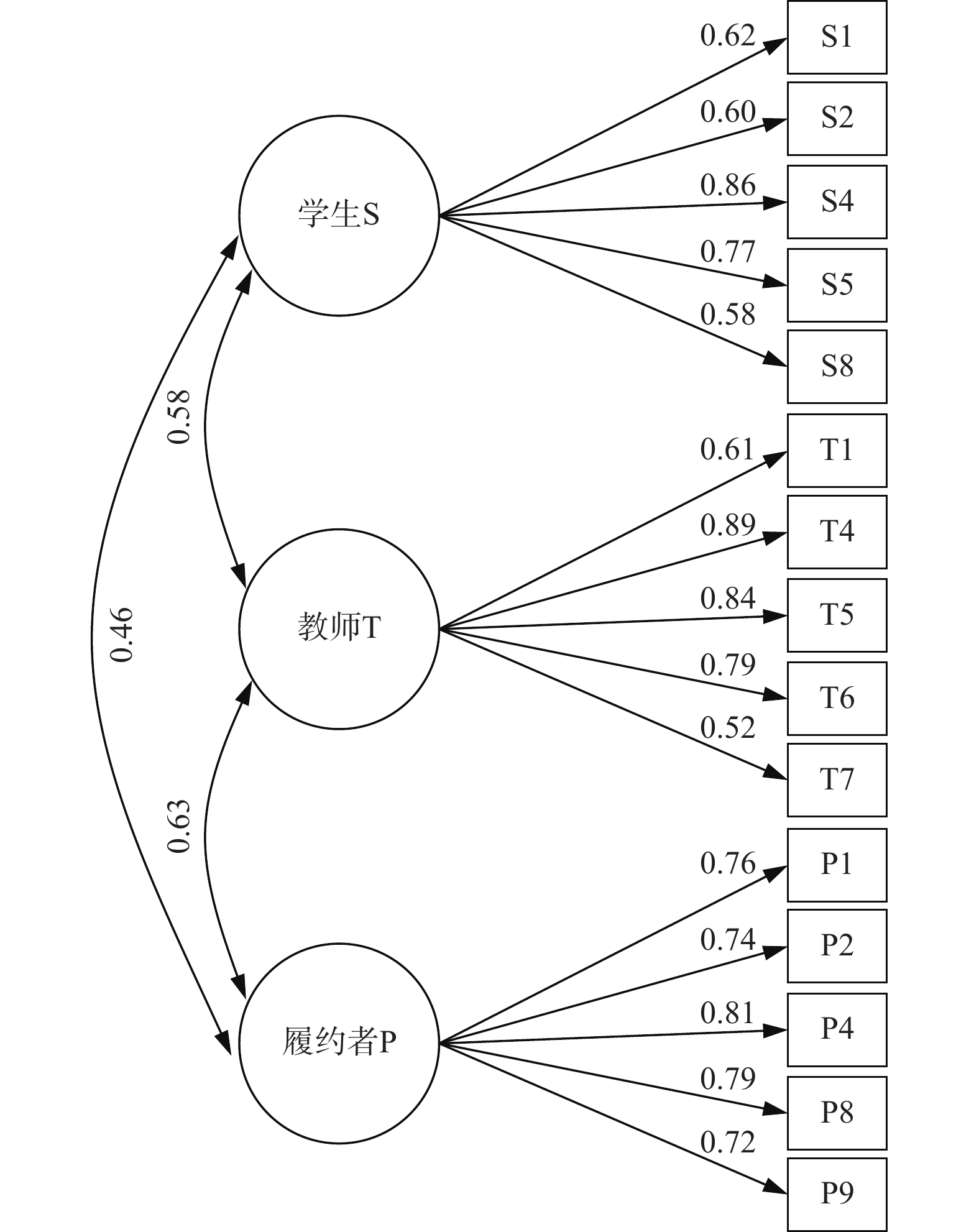
| 模型 | χ2 | df | χ2/df | CFI | TLI | RMSEA | SRMR |
| 单因子模型 | 1010.15 | 90 | 11.22 | 0.66 | 0.60 | 0.15 | 0.10 |
| 两因子模型一 | 703.30 | 89 | 7.90 | 0.77 | 0.73 | 0.12 | 0.08 |
| 两因子模型二 | 600.36 | 89 | 6.75 | 0.81 | 0.78 | 0.11 | 0.08 |
| 两因子模型三 | 728.61 | 89 | 8.19 | 0.76 | 0.72 | 0.12 | 0.10 |
| 三因子模型 | 253.06 | 87 | 2.91 | 0.94 | 0.93 | 0.06 | 0.05 |
| 模型 | χ2 | df | χ2/df | CFI | TLI | RMSEA | SRMR |
| 单因子模型 | 1010.15 | 90 | 11.22 | 0.66 | 0.60 | 0.15 | 0.10 |
| 两因子模型一 | 703.30 | 89 | 7.90 | 0.77 | 0.73 | 0.12 | 0.08 |
| 两因子模型二 | 600.36 | 89 | 6.75 | 0.81 | 0.78 | 0.11 | 0.08 |
| 两因子模型三 | 728.61 | 89 | 8.19 | 0.76 | 0.72 | 0.12 | 0.10 |
| 三因子模型 | 253.06 | 87 | 2.91 | 0.94 | 0.93 | 0.06 | 0.05 |
| M | SD | 1 | 2 | 3 | 4 | 5 | |
| 1.总量表 | 3.88 | 0.55 | |||||
| 2.学生 | 3.61 | 0.68 | 0.80*** | ||||
| 3.教师 | 3.75 | 0.74 | 0.87*** | 0.55*** | |||
| 4.履约者 | 4.26 | 0.61 | 0.77*** | 0.40*** | 0.53*** | ||
| 5.集体身份 | 3.92 | 0.73 | 0.58*** | 0.47*** | 0.48*** | 0.48*** | |
| 6.自尊 | 2.96 | 0.48 | 0.39*** | 0.29*** | 0.36*** | 0.31*** | 0.31*** |
| M | SD | 1 | 2 | 3 | 4 | 5 | |
| 1.总量表 | 3.88 | 0.55 | |||||
| 2.学生 | 3.61 | 0.68 | 0.80*** | ||||
| 3.教师 | 3.75 | 0.74 | 0.87*** | 0.55*** | |||
| 4.履约者 | 4.26 | 0.61 | 0.77*** | 0.40*** | 0.53*** | ||
| 5.集体身份 | 3.92 | 0.73 | 0.58*** | 0.47*** | 0.48*** | 0.48*** | |
| 6.自尊 | 2.96 | 0.48 | 0.39*** | 0.29*** | 0.36*** | 0.31*** | 0.31*** |
| 总量表 | 学生 | 教师 | 履约者 | |
| 内部一致性信度 | 0.89 | 0.81 | 0.84 | 0.88 |
| 分半信度 | 0.70 | 0.78 | 0.78 | 0.81 |
| 重测信度 | 0.67 | 0.63 | 0.71 | 0.50 |
| 总量表 | 学生 | 教师 | 履约者 | |
| 内部一致性信度 | 0.89 | 0.81 | 0.84 | 0.88 |
| 分半信度 | 0.70 | 0.78 | 0.78 | 0.81 |
| 重测信度 | 0.67 | 0.63 | 0.71 | 0.50 |
| 模型 | χ2 | df | CFI | RMSEA | ΔCFI | ΔRMSEA |
| 形态等值 | 395.46 | 174 | 0.92 | 0.07 | ||
| 弱(单位)等值 | 411.67 | 186 | 0.92 | 0.07 | <0.01 | <0.015 |
| 强(尺度)等值 | 438.30 | 198 | 0.92 | 0.07 | <0.01 | <0.015 |
| 误差方差等值 | 416.80 | 213 | 0.91 | 0.07 | <0.01 | <0.015 |
| 模型 | χ2 | df | CFI | RMSEA | ΔCFI | ΔRMSEA |
| 形态等值 | 395.46 | 174 | 0.92 | 0.07 | ||
| 弱(单位)等值 | 411.67 | 186 | 0.92 | 0.07 | <0.01 | <0.015 |
| 强(尺度)等值 | 438.30 | 198 | 0.92 | 0.07 | <0.01 | <0.015 |
| 误差方差等值 | 416.80 | 213 | 0.91 | 0.07 | <0.01 | <0.015 |
|
蔡贞, 汪玉兰, 毕重增. 农民工农民身份认同的结构与测量. 西南农业大学学报(社会科学版), 2012, 10 (4): 78- 81.
|
|
|
陈菁, 马勇军, 初环海, 李荣. 省属公费师范生违约行为研究——基于对山东省高校公费师范生的扎根理论分析. 山东高等教育, 2023, 11 (1): 64- 70.
|
|
|
胡月琴, 甘怡群. 青少年心理韧性量表的编制和效度验证. 心理学报, 2008, 40 (8): 902- 912.
|
|
|
黄俊官. 地方公费师范生身份认同的危机及对策. 郑州师范教育, 2022, 11 (6): 5- 8.
|
|
|
季益富, 于欣. 自尊量表. 中国心理卫生杂志, 1999 (增刊): 318- 320.
DOI |
|
|
李芳霞. 新建本科院校免费师范生学习动机研究——以宁夏师范学院为例. 佳木斯职业学院学报, 2016 (10): 208- 209, 390.
|
|
|
李广, 秦一铭, 柳欣源. 我国师范生公费教育: 成就、挑战与愿景. 教育研究, 2024, 45 (8): 34- 45.
|
|
|
林一钢, 冯虹. 师范生教师身份认同的实证研究. 教育发展研究, 2013, 33 (10): 78- 82.
|
|
|
吕催芳, 周永红, 王亚丽. 残障人获得感量表的编制及信效度检验. 中国临床心理学杂志, 2024, 32 (1): 117- 121.
|
|
|
吕乐. 六年制公费师范生新生心理健康水平分析. 湖南第一师范学院学报, 2018, 18 (2): 38- 40.
|
|
|
覃小琼, 孙蕾, 吴琼. 免费师范生学习动机特点的访谈研究. 心理研究, 2010, 3 (2): 93- 96.
|
|
|
曲正伟. 教师的“身份”与“身份认同”. 教育发展研究, 2007 (7): 34- 38.
|
|
|
王清涛. 公费师范生违约风险及其治理——基于不完全契约理论的分析. 教育发展研究, 2019, 39 (15): 119- 124.
|
|
|
吴丹. (2024-06-16). 加强研究生层次中小学教师培养. 人民日报, p4.
|
|
|
吴明隆. (2010). 问卷统计分析实务———SPSS 操作与应用. 重庆: 重庆大学出版社.
|
|
|
薛佳. 伦理、契约与身份: 西方责任政治分析的三重视角. 云南社会科学, 2021 (3): 18- 25.
|
|
|
袁璐, 黄任之, 杨天霞, 周红宇. 免费师范生自伤行为与焦虑抑郁情绪的相关分析. 四川精神卫生, 2014, 27 (1): 25- 27.
|
|
|
张淑华, 李海莹, 刘芳. 身份认同研究综述. 心理研究, 2012, 5 (1): 21- 27.
|
|
|
张莹瑞, 佐斌. 社会认同理论及其发展. 心理科学进展, 2006, 14 (3): 475- 480.
|
|
|
张源源, 薛芳芳. “前补偿”抑或“后激励”?——乡村振兴背景下定向师范生违约问题研究. 华东师范大学学报(教育科学版), 2022, 40 (6): 44- 56.
|
|
|
Abrams. D., & Hogg, M. A. (1988). Social identifications: A social psychology of intergroup relations and group processes. London: Routledge.
|
|
|
Bazargan-Forward, S. The identity-enactment account of associative duties. Philosophical Studies, 2019, 176 (9): 2351- 2370.
DOI |
|
|
Brewer, M. B., & Gardner, W. Who is this “We”? Levels of collective identity and self representations. Journal of Personality and Social Psychology, 1996, 71 (1): 83- 93.
DOI |
|
|
Burke, P. J., & Tully, J. C. The measurement of role identity. Social Forces, 1977, 55 (4): 881- 897.
DOI |
|
|
Carpenter, S., & Karakitapoglu-Aygün, Z. Importance and descriptiveness of self-aspects: A cross-cultural comparison. Cross-Cultural Research, 2005, 39 (3): 293- 321.
DOI |
|
|
Charng, H. W., Piliavin, J. A., & Callero, P. L. Role identity and reasoned action in the prediction of repeated behavior. Social Psychology Quarterly, 1988, 51 (4): 303- 317.
DOI |
|
|
Cheek, N. N., & Cheek, J. M. Aspects of identity: From the inner-outer metaphor to a tetrapartite model of the self. Self and Identity, 2018, 17 (4): 467- 482.
DOI |
|
|
Cramer, P. Development of identity: Gender makes a difference. Journal of Research in Personality, 2000, 34 (1): 42- 72.
DOI |
|
|
Fielding, K. S., McDonald, R., & Louis, W. R. Theory of planned behaviour, identity and intentions to engage in environmental activism. Journal of Environmental Psychology, 2008, 28 (4): 318- 326.
DOI |
|
|
Foote, N. N. Identification as the basis for a theory of motivation. American Sociological Review, 1951, 26 (1): 14- 21.
DOI |
|
|
Fugate, M., Kinicki, A. J., & Ashforth, B. E. Employability: A psycho-social construct, its dimensions, and applications. Journal of Vocational Behavior, 2004, 65 (1): 14- 38.
DOI |
|
|
Hogg, M. A., & Turner, J. C. Intergroup behaviour, self-stereotyping and the salience of social categories. British Journal of Social Psychology, 1987, 26 (4): 325- 340.
DOI |
|
|
Holland, J. L., Johnston, J. A., & Asama, N. F. The Vocational Identity Scale: A diagnostic and treatment tool. Journal of Career Assessment, 1993, 1 (1): 1- 12.
DOI |
|
|
Kowalski, M. G. Substantial freedom as identity of rights and duties. Proceedings of the Hegel Society of America, 2007, 18, 253- 275.
DOI |
|
|
Li, C. H. Confirmatory factor analysis with ordinal data: Comparing robust maximum likelihood and diagonally weighted least squares. Behavior Research Methods, 2016, 48 (3): 936- 949.
DOI |
|
|
Meade, A. W., & Bauer, D. J. Power and precision in confirmatory factor analytic tests of measurement invariance. Structural Equation Modeling: A Multidisciplinary Journal, 2007, 14 (4): 611- 635.
DOI |
|
|
Nash, K., & Wakefield, R. L. The role of identity in green IT attitude and intention. Journal of Computer Information Systems, 2022, 62 (5): 998- 1008.
DOI |
|
|
Netemeyer, R. G., Johnston, M. W., & Burton, S. Analysis of role conflict and role ambiguity in a structural equations framework. Journal of Applied Psychology, 1990, 75 (2): 148- 157.
DOI |
|
|
Reitzes, D. C., & Burke, P. J. College student identity: Measurement and implications. The Pacific Sociological Review, 1980, 23 (1): 45- 66.
DOI |
|
|
Rise, J., Sheeran, P., & Hukkelberg, S. The role of self-identity in the theory of planned behavior: A meta-analysis. Journal of Applied Social Psychology, 2010, 40 (5): 1085- 1105.
|
|
|
Sheeran, P. Intention-behavior relations: A conceptual and empirical review. European Review of Social Psychology, 2002, 12 (1): 1- 36.
|
|
|
Simon, B., & Klandermans, B. Politicized collective identity: A social psychological analysis. American Psychologist, 2001, 56 (4): 319- 331.
DOI |
|
|
Stets, J. E., & Burke, P. J. Identity theory and social identity theory. Social Psychology Quarterly, 2000, 63 (3): 224- 237.
DOI |
|
|
Tajel, H. (1978). Differentiation between social groups: Studies in the social psychology of intergroup relations. New York: Academic Press.
|
|
|
Thoits, P. A. Multiple identities and psychological well-being: A reformulation and test of the social isolation hypothesis. American Sociological Review, 1983, 48 (2): 174- 187.
DOI |
|
|
Vandiver, B. J., Cross, W. E., Jr., Worrell, F. C., & Fhagen-Smith, P. E. Validating the cross racial identity scale. Journal of Counseling Psychology, 2002, 49 (1): 71- 85.
DOI |
|
|
Wolstenholme, E., Carfora, V., Catellani, P., Poortinga, W., & Whitmarsh, L. Explaining intention to reduce red and processed meat in the UK and Italy using the theory of planned behaviour, meat-eater identity, and the Transtheoretical model. Appetite, 2021, 166, 105467.
DOI |
| [1] | Linxin LU, Zaihua LIU, Hongping LIU, Xiuyun LIN, Hanxiang ZHOU, Yongfei BAN, Ji SUN, Xiaoqing LI, Yiqing ZHANG, Haizhen HUANG. Intercultural Sensitivity Climate in Special Education Schools and Prosocial Behavior of Visually Impaired Students: A Multilevel Bayesian Mediation Model of Bicultural Identity Integration [J]. Studies of Psychology and Behavior, 2026, 24(2): 170-177. |
| [2] | Zeqi LIU, Yuhua LI, Yan GAO, Jiaxin LIU, Mengmeng SU. Development and Validation of the Home Literacy Environment Scale for Chinese Children [J]. Studies of Psychology and Behavior, 2026, 24(1): 113-121. |
| [3] | Shengxiang SHE, Shicheng LI, Yan SUN. Nudging Mechanism of “Easy to Difficult” Pro-Environmental Behaviors [J]. Studies of Psychology and Behavior, 2025, 23(6): 839-846. |
| [4] | Jiang DU. Unpacking Pre-Service Teachers’ Professional Identity in Chinese Local Comprehensive Universities: Demographic Variations and an Enrollment Motivation-Driven Serial Mediation Model [J]. Studies of Psychology and Behavior, 2025, 23(6): 854-860. |
| [5] | Chunmei ZHANG, Yubing LUO, Dongxue WEN, Hang ZHENG. Psychological Reactance and Deviant Behaviors in Adolescents: The Chain Mediation Effect of Deviant Peer Affiliation and Deviant Group Identity [J]. Studies of Psychology and Behavior, 2025, 23(5): 645-652. |
| [6] | Xiaowen LIU, Jing ZHANG, Jianhua WU, Jingtai LIU, Qingqing CHEN, Muwang YE. The Development and Application of a Public Robot Attitude Scale [J]. Studies of Psychology and Behavior, 2025, 23(5): 695-705. |
| [7] | Yanhong PENG, Xiaobin AN, Zhiyong LI, Mingzheng WU. The Relationship Between Professional Identity, Learning Engagement, and Educational Practice Ability of Normal University Students: Analysis Based on Variable-Centered and Person-Centered [J]. Studies of Psychology and Behavior, 2025, 23(4): 536-543. |
| [8] | Lulu XUE, Jiagen FENG, Haibo YANG, Ping FANG, Zhuo YANG. The Development and Application of the Identity Questionnaire for National Teacher Certification Examination [J]. Studies of Psychology and Behavior, 2024, 22(6): 822-829. |
| [9] | Lin LI, Wei GAO. The Development of Research Literacy Scale for Elementary Students and Latent Profile Analysis [J]. Studies of Psychology and Behavior, 2024, 22(6): 830-838. |
| [10] | Ning HANG, Jian GUAN. The Impact of Group Identity Shifting on Group Identity and Intergroup Attitudes: A Recategorization Model Based on Cognitive Consistency [J]. Studies of Psychology and Behavior, 2024, 22(5): 713-720. |
| [11] | Quan YANG, Gengfeng NIU, Xiaojun SUN. Echo-Adaptive Behavior of College Students with Different Self-Identity States [J]. Studies of Psychology and Behavior, 2024, 22(3): 338-345. |
| [12] | Ping FANG, Zijian YI, Yuan JIANG, Hui PANG. The Development of People’s Social Adaptation Scale [J]. Studies of Psychology and Behavior, 2023, 21(4): 433-439. |
| [13] | Hui PANG, Xiaonan JIN, Yuan JIANG, Ping FANG. The Development of People’s Social Risk Perception Scale [J]. Studies of Psychology and Behavior, 2023, 21(4): 440-445. |
| [14] | Yang GAO, Shiguang NI, Zhiyuan XIA, Wulin TIAN. Impact of Group Bragging Styles on Observers’ Cyberbullying: The Role of Observers’ Provocation and Group Identification [J]. Studies of Psychology and Behavior, 2023, 21(4): 471-478. |
| [15] | Hong LI, Jiahao LIN, Ning HE, Ziyi WANG, Liang ZHANG. The Mechanisms of How Moral Identity Impacts on Cooperative Behavior in Social Dilemmas [J]. Studies of Psychology and Behavior, 2023, 21(3): 410-417. |
| Viewed | ||||||
|
Full text |
|
|||||
|
Abstract |
|
|||||
