
心理与行为研究 ›› 2025, Vol. 23 ›› Issue (3): 361-368.DOI: 10.12139/j.1672-0628.2025.03.010
钞淼1,2,3, 张宇1,2, 谢启慧4, 刘拓*,1,2,3( )
)
收稿日期:2024-10-14
出版日期:2025-05-20
发布日期:2025-05-20
通讯作者:
刘拓
基金资助:
Miao CHAO1,2,3, Yu ZHANG1,2, Qihui XIE4, Tuo LIU*,1,2,3()
Received:2024-10-14
Online:2025-05-20
Published:2025-05-20
Contact:
Tuo LIU
摘要:
为探讨情感忽视对农村青少年短视频成瘾的影响及负性情绪的中介作用,并且考察留守与非留守群体的差异,采用问卷调查法,对417名农村青少年进行为期3个月的追踪研究。结果表明:(1)情感忽视显著正向预测农村青少年3个月后的短视频成瘾行为;(2)负性情绪在情感忽视对短视频成瘾的影响过程中起到了中介作用;(3)在是否留守的不同情况下,三者关系存在显著差异。具体而言,负性情绪在留守儿童中完全中介了情感忽视与短视频成瘾之间的关系,而在非留守儿童中仅起部分中介作用。
钞淼, 张宇, 谢启慧, 刘拓. 情感忽视对农村青少年短视频成瘾的纵向影响:负性情绪中介及留守差异[J]. 心理与行为研究, 2025, 23(3): 361-368.
Miao CHAO, Yu ZHANG, Qihui XIE, Tuo LIU. Longitudinal Effects of Emotional Neglect on Short Video Addiction Among Rural Adolescents: Negative Emotion Mediation and Left-Behind Differences[J]. Studies of Psychology and Behavior, 2025, 23(3): 361-368.
| 变量 | M | SD | 1 | 2 | 3 | 4 | 5 | 6 | 7 | 8 | 9 | 10 |
| 1.T1情感忽视 | 33.86 | 7.64 | ||||||||||
| 2.T1抑郁 | 5.78 | 4.26 | 0.48** | |||||||||
| 3.T1焦虑 | 6.53 | 4.37 | 0.43** | 0.83** | ||||||||
| 4.T1压力 | 7.08 | 4.28 | 0.42** | 0.85** | 0.88** | |||||||
| 5.T1负性情绪 | 19.40 | 12.23 | 0.47** | 0.94** | 0.95** | 0.96** | ||||||
| 6.T1短视频成瘾 | 27.14 | 10.52 | 0.22** | 0.27** | 0.35** | 0.35** | 0.34** | |||||
| 7.T2抑郁 | 5.61 | 4.03 | 0.36** | 0.56** | 0.53** | 0.52** | 0.56** | 0.33** | ||||
| 8.T2焦虑 | 6.02 | 4.26 | 0.32** | 0.53** | 0.59** | 0.55** | 0.59** | 0.34** | 0.86** | |||
| 9.T2压力 | 6.68 | 4.28 | 0.31** | 0.49** | 0.56** | 0.56** | 0.57** | 0.36** | 0.86** | 0.89** | ||
| 10.T2负性情绪 | 18.31 | 12.07 | 0.34** | 0.55** | 0.58** | 0.57** | 0.60** | 0.36** | 0.95** | 0.97** | 0.97** | |
| 11.T2短视频成瘾 | 27.03 | 10.65 | 0.21** | 0.30** | 0.29** | 0.31** | 0.31** | 0.53** | 0.43** | 0.43** | 0.45** | 0.46** |
表1 各变量描述统计与相关分析(n=417)
| 变量 | M | SD | 1 | 2 | 3 | 4 | 5 | 6 | 7 | 8 | 9 | 10 |
| 1.T1情感忽视 | 33.86 | 7.64 | ||||||||||
| 2.T1抑郁 | 5.78 | 4.26 | 0.48** | |||||||||
| 3.T1焦虑 | 6.53 | 4.37 | 0.43** | 0.83** | ||||||||
| 4.T1压力 | 7.08 | 4.28 | 0.42** | 0.85** | 0.88** | |||||||
| 5.T1负性情绪 | 19.40 | 12.23 | 0.47** | 0.94** | 0.95** | 0.96** | ||||||
| 6.T1短视频成瘾 | 27.14 | 10.52 | 0.22** | 0.27** | 0.35** | 0.35** | 0.34** | |||||
| 7.T2抑郁 | 5.61 | 4.03 | 0.36** | 0.56** | 0.53** | 0.52** | 0.56** | 0.33** | ||||
| 8.T2焦虑 | 6.02 | 4.26 | 0.32** | 0.53** | 0.59** | 0.55** | 0.59** | 0.34** | 0.86** | |||
| 9.T2压力 | 6.68 | 4.28 | 0.31** | 0.49** | 0.56** | 0.56** | 0.57** | 0.36** | 0.86** | 0.89** | ||
| 10.T2负性情绪 | 18.31 | 12.07 | 0.34** | 0.55** | 0.58** | 0.57** | 0.60** | 0.36** | 0.95** | 0.97** | 0.97** | |
| 11.T2短视频成瘾 | 27.03 | 10.65 | 0.21** | 0.30** | 0.29** | 0.31** | 0.31** | 0.53** | 0.43** | 0.43** | 0.45** | 0.46** |
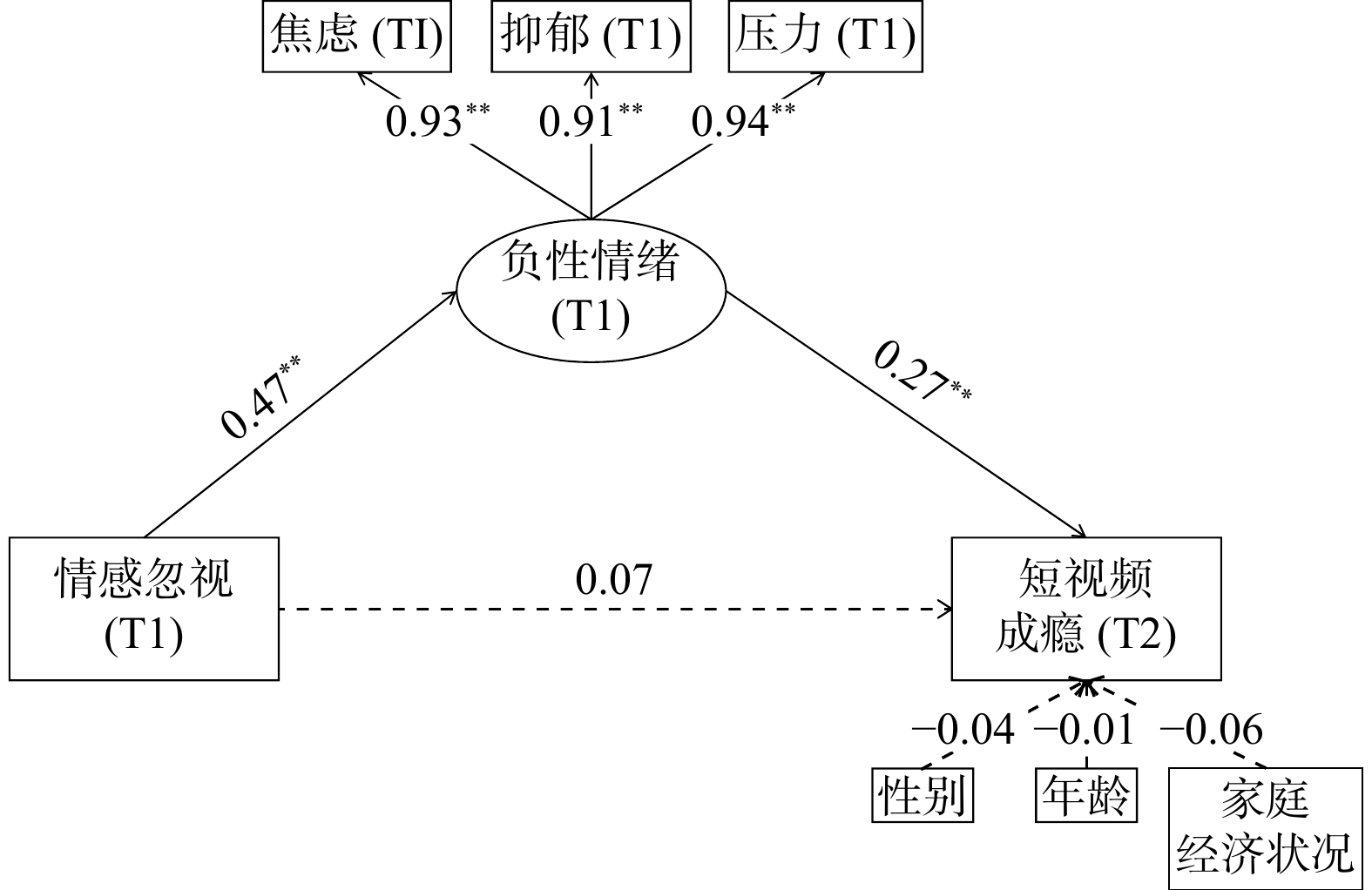
图1 负性情绪在情感忽视与农村青少年短视频成瘾中的纵向中介路径
| 变量 | 留守儿童(n=188) | 非留守儿童(n=229) | t | p | |||
| M | SD | M | SD | ||||
| T1情感忽视 | 34.11 | 7.72 | 33.41 | 7.71 | 0.93 | 0.350 | |
| T1抑郁 | 6.18 | 4.15 | 5.46 | 4.09 | 1.76 | 0.077 | |
| T1焦虑 | 6.76 | 4.27 | 6.34 | 4.38 | 1.19 | 0.324 | |
| T1压力 | 7.36 | 4.56 | 6.84 | 4.21 | 1.21 | 0.228 | |
| T1负性情绪 | 20.31 | 12.39 | 18.65 | 12.06 | 1.37 | 0.168 | |
| T2短视频成瘾 | 27.26 | 10.55 | 26.85 | 10.74 | 0.39 | 0.697 | |
| 家庭经济状况 | 2.49 | 0.63 | 2.68 | 0.69 | 2.91 | 0.004 | |
表2 留守儿童与非留守儿童各变量差异检验
| 变量 | 留守儿童(n=188) | 非留守儿童(n=229) | t | p | |||
| M | SD | M | SD | ||||
| T1情感忽视 | 34.11 | 7.72 | 33.41 | 7.71 | 0.93 | 0.350 | |
| T1抑郁 | 6.18 | 4.15 | 5.46 | 4.09 | 1.76 | 0.077 | |
| T1焦虑 | 6.76 | 4.27 | 6.34 | 4.38 | 1.19 | 0.324 | |
| T1压力 | 7.36 | 4.56 | 6.84 | 4.21 | 1.21 | 0.228 | |
| T1负性情绪 | 20.31 | 12.39 | 18.65 | 12.06 | 1.37 | 0.168 | |
| T2短视频成瘾 | 27.26 | 10.55 | 26.85 | 10.74 | 0.39 | 0.697 | |
| 家庭经济状况 | 2.49 | 0.63 | 2.68 | 0.69 | 2.91 | 0.004 | |
| 模型 | χ² | df | χ²/df | CFI | TLI | RMSEA | SRMR |
| M0 | 44.00 | 30 | 1.46 | 0.98 | 0.98 | 0.04 | 0.04 |
| M1 | 53.26 | 33 | 1.61 | 0.97 | 0.98 | 0.05 | 0.05 |
表3 各模型拟合参数
| 模型 | χ² | df | χ²/df | CFI | TLI | RMSEA | SRMR |
| M0 | 44.00 | 30 | 1.46 | 0.98 | 0.98 | 0.04 | 0.04 |
| M1 | 53.26 | 33 | 1.61 | 0.97 | 0.98 | 0.05 | 0.05 |
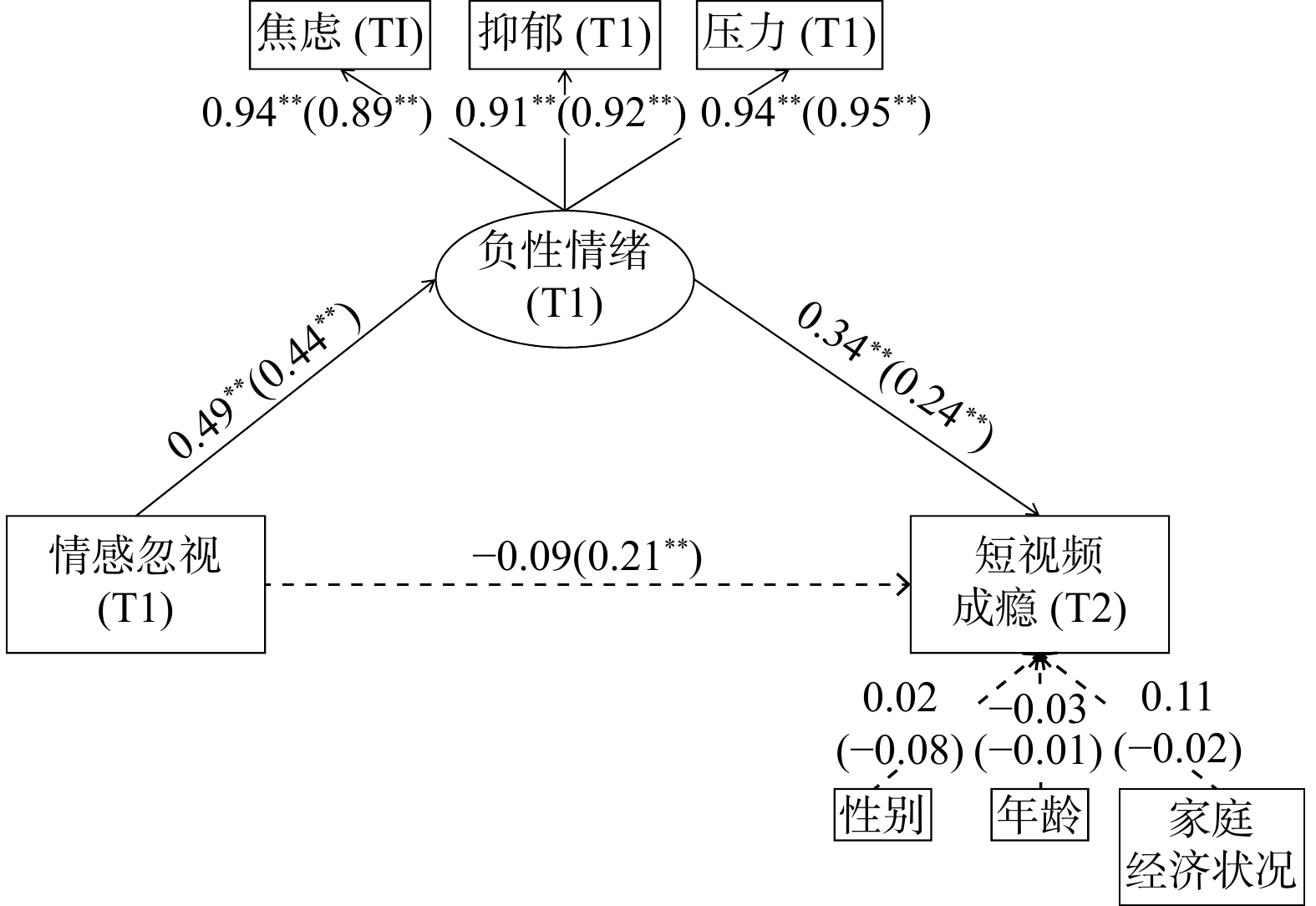
图2 负性情绪纵向中介作用的留守与否差异检验 注:括号外为留守儿童标准化路径系数,括号中为非留守儿童标准化路径系数。
|
白慧慧, 王雨晴, 孙婉靖. 留守儿童心理韧性的元分析. 心理与行为研究, 2022, 20 (2): 261- 267.
DOI |
|
|
共青团中央维护青少年权益部, 中国互联网络信息中心. (2023). 第5次全国未成年人互联网使用情况调查报告. 2024-08-12 取自 https://qnzz.youth.cn/qckc/202312/P020231223672191910610.pdf
|
|
|
国务院. (2016). 国务院关于加强农村留守儿童关爱保护工作的意见(国发〔2016〕13号). 2024-08-12 取自 https://www.gov.cn/gongbao/content/2016/content_5045947.htm
|
|
|
梁琦. 引导偏差与双向倒置: 农村留守儿童短视频成瘾研究. 天府新论, 2023, (4): 118- 131.
DOI |
|
|
潘建平, 杨武悦, 陈晶琦, 席卫平, 张慧颖, 彭玉林, 刘婷. 中国农村12~17岁中学生忽视评价常模的研制. 中国学校卫生, 2014, 35 (2): 165- 168.
|
|
|
孙宏艳. 视频时代如何引导学生运用网络学习——未成年人短视频使用与学习轻知识研究报告. 人民教育, 2023, (22): 48- 53.
|
|
|
王志昭. 短视频对青少年的利弊影响及治理. 新闻爱好者, 2019, (11): 60- 62.
|
|
|
赵丹, 陈遇春, 赵阔. 优质均衡视角下乡村小规模学校教育质量困境与对策. 华中师范大学学报(人文社会科学版), 2019, 58 (2): 157- 167.
|
|
|
中国互联网络信息中心. (2024). 第53次中国互联网络发展状况统计报告. 2024-08-12 取自 https://www.xdyanbao.com/doc/b2hvwp7tpq?userid=57555079&bd_vid=10614970690871471759
|
|
|
周楠, 臧宁, 王少凡, 李梓璇, 陈玲, 李蓓蕾, 曹洪健. 童年早期情感受虐与青少年早期手机成瘾水平: 一般与社交焦虑及家庭社会经济地位的作用. 心理科学, 2024, 47 (2): 325- 333.
|
|
|
Bernstein, D. P., Stein, J. A., Newcomb, M. D., Walker, E., Pogge, D., Ahluvalia, T., ... Zule, W. Development and validation of a brief screening version of the Childhood Trauma Questionnaire. Child Abuse & Neglect, 2003, 27 (2): 169- 190.
|
|
|
Bowlby, J. Attachment and loss: Retrospect and prospect. American Journal of Orthopsychiatry, 1982, 52 (4): 664- 678.
DOI |
|
|
Bronfenbrenner, U. (1979). The ecology of human development: Experiments by nature and design. Cambridge, MA: Harvard University Press
|
|
|
Burnay, J., Billieux, J., Blairy, S., & Larøi, F. Which psychological factors influence internet addiction? Evidence through an integrative model. Computers in Human Behavior, 2015, 43, 28- 34.
DOI |
|
|
Chao, M., Lei, J., He, R., Jiang, Y. P., & Yang, H. B. TikTok use and psychosocial factors among adolescents: Comparisons of non-users, moderate users, and addictive users. Psychiatry Research, 2023, 325, 115247.
DOI |
|
|
Chen, Y. H., Li, M. M., Guo, F., & Wang, X. S. The effect of short-form video addiction on users’ attention. Behaviour & Information Technology, 2023, 42 (16): 2893- 2910.
|
|
|
Chi, X. L., Hong, X., & Chen, X. C. Profiles and sociodemographic correlates of internet addiction in early adolescents in southern China. Addictive Behaviors, 2020, 106, 106385.
DOI |
|
|
De Bérail, P., Guillon, M., & Bungener, C. The relations between YouTube addiction, social anxiety and parasocial relationships with YouTubers: A moderated-mediation model based on a cognitive-behavioral framework. Computers in Human Behavior, 2019, 99, 190- 204.
DOI |
|
|
Ding, Q. W., Li, D. P., Zhou, Y. Y., Dong, H. N., & Luo, J. J. Perceived parental monitoring and adolescent internet addiction: A moderated mediation model. Addictive Behaviors, 2017, 74, 48- 54.
DOI |
|
|
Dong, S. M., Dong, Q. N., Chen, H. Y., & Yang, S. Childhood emotional neglect and adolescent depression: The role of self-compassion and friendship quality. Current Psychology, 2023, 42 (28): 24451- 24463.
DOI |
|
|
Gong, J. B., & Chan, R. C. K. Early maladaptive schemas as mediators between childhood maltreatment and later psychological distress among Chinese college students. Psychiatry Research, 2018, 259, 493- 500.
DOI |
|
|
Jiang, L., & Yoo, Y. Adolescents’ short-form video addiction and sleep quality: The mediating role of social anxiety. BMC Psychology, 2024, 12 (1): 369.
DOI |
|
|
Kardefelt-Winther, D. A conceptual and methodological critique of internet addiction research: Towards a model of compensatory internet use. Computers in Human Behavior, 2014, 31, 351- 354.
DOI |
|
|
Kircaburun, K., Griffiths, M. D., & Billieux, J. Childhood emotional maltreatment and problematic social media use among adolescents: The mediating role of body image dissatisfaction. International Journal of Mental Health and Addiction, 2020, 18 (6): 1536- 1547.
DOI |
|
|
Kwak, J. Y., Kim, J. Y., & Yoon, Y. W. Effect of parental neglect on smartphone addiction in adolescents in South Korea. Child Abuse & Neglect, 2018, 77, 75- 84.
|
|
|
Kwon, M., Kim, D. J., Cho, H., & Yang, S. The Smartphone Addiction Scale: development and validation of a short version for adolescents. PLoS One, 2013, 8 (12): e83558.
DOI |
|
|
Lee, S. W., Bae, G. Y., Rim, H. D., Lee, S. J., Chang, S. M., Kim, B. S., & Won, S. Mediating effect of resilience on the association between emotional neglect and depressive symptoms. Psychiatry Investigation, 2018, 15 (1): 62- 69.
DOI |
|
|
Li, F., Wang, G., Zhu, D., Liu, S. F., Liao, J. D., Zhang, S. Y., & Li, J. Parental neglect and short-form video application addiction in Chinese adolescents: The mediating role of alexithymia and the moderating role of refusal self-efficacy. Child Abuse & Neglect, 2023, 143, 106345.
|
|
|
Li, W., Garland, E. L., & Howard, M. O. Family factors in internet addiction among Chinese youth: A review of English- and Chinese-language studies. Computers in Human Behavior, 2014, 31, 393- 411.
DOI |
|
|
Liu, Q. Q., Tu, W., Shang, Y. F., & Xu, X. P. Unique and interactive effects of parental neglect, school connectedness, and trait self-control on mobile short-form video dependence among Chinese left-behind adolescents. Child Abuse & Neglect, 2022, 134, 105939.
|
|
|
Lovibond, P. F., & Lovibond, S. H. The structure of negative emotional states: Comparison of the Depression Anxiety Stress Scales (DASS) with the Beck Depression and Anxiety Inventories. Behaviour Research and Therapy, 1995, 33 (3): 335- 343.
DOI |
|
|
Meng, K. S., & Leung, L. Factors influencing TikTok engagement behaviors in China: An examination of gratifications sought, narcissism, and the Big Five personality traits. Telecommunications Policy, 2021, 45 (7): 102172.
DOI |
|
|
Podsakoff, P. M., MacKenzie, S. B., Lee, J. Y., & Podsakoff, N. P. Common method biases in behavioral research: a critical review of the literature and recommended remedies. Journal of Applied Psychology, 2003, 88 (5): 879- 903.
DOI |
|
|
Rozgonjuk, D., Sindermann, C., Elhai, J. D., & Montag, C. Fear of Missing Out (FoMO) and social media’s impact on daily-life and productivity at work: Do WhatsApp, Facebook, Instagram, and Snapchat Use Disorders mediate that association. Addictive Behaviors, 2020, 110, 106487.
DOI |
|
|
Sindermann, C., Elhai, J. D., & Montag, C. Predicting tendencies towards the disordered use of Facebook’s social media platforms: On the role of personality, impulsivity, and social anxiety. Psychiatry Research, 2020, 285, 112793.
DOI |
|
|
Sun, R. M., Zhang, M. X., Yeh, C., Ung, C. O. L., & Wu, A. M. S. The metacognitive-motivational links between stress and short-form video addiction. Technology in Society, 2024, 77, 102548.
DOI |
|
|
Trumello, C., Vismara, L., Sechi, C., Ricciardi, P., Marino, V., & Babore, A. Internet addiction: The role of parental care and mental health in adolescence. International Journal of Environmental Research and Public Health, 2021, 18 (24): 12876.
DOI |
|
|
Wang, K., Shi, H. S., Geng, F. L., Zou, L. Q., Tan, S. P., Wang, Y., ... Chan, R. C. K. Cross-cultural validation of the Depression Anxiety Stress Scale-21 in China. Psychological Assessment, 2016, 28 (5): e88- e100.
DOI |
|
|
Wang, M. Y., He, N., Xu, Q., Yue, Y. F., Li, M., & Lin, J. H. Childhood emotional neglect and problematic social media use among Chinese adolescents: A moderated mediation model. Addictive Behaviors, 2022, 131, 107309.
DOI |
|
|
Yao, N. S., Chen, J., Huang, S. Y., Montag, C., & Elhai, J. D. Depression and social anxiety in relation to problematic TikTok use severity: The mediating role of boredom proneness and distress intolerance. Computers in Human Behavior, 2023, 145, 107751.
DOI |
|
|
Yi, J. Y., Zhu, X. Z., Auerbach, R. P., Gardiner, C. K., Lin, C., Wang, Y. P., & Yao, S. Q. Insecure attachment as a predictor of depressive and anxious symptomology. Depression and Anxiety, 2012, 29 (9): 789- 796.
DOI |
|
|
Zhang, N., Hazarika, B., Chen, K., & Shi, Y. N. A cross-national study on the excessive use of short-video applications among college students. Computers in Human Behavior, 2023, 145, 107752.
DOI |
|
|
Zhang, X., Wu, Y., & Liu, S. Exploring short-form video application addiction: Socio-technical and attachment perspectives. Telematics and Informatics, 2019, 42, 101243.
DOI |
|
|
Zhen, R., Li, L., Ding, Y., Hong, W., & Liu, R. D. How does mobile phone dependency impair academic engagement among Chinese left-behind children. Children and Youth Services Review, 2020, 116, 105169.
DOI |
| [1] | 韩嘉桐, 关文军, 刘菁菁. 父母心理控制对中小学生短视频成瘾的影响:自主感和逆反心理的链式中介作用[J]. 心理与行为研究, 2026, 24(1): 95-102. |
| [2] | 任思梦, 张珊珊, 曾翠莲, 包俊俊, 章晨阳. 睡眠质量在负性情绪粒度与日常生活满意度间的中介作用:来自经验取样法的证据[J]. 心理与行为研究, 2025, 23(5): 678-684. |
| [3] | 祖雯妍, 杨晓峰. 核心自我评价与时间贫困感的关系:压力知觉与短视频成瘾的链式中介作用[J]. 心理与行为研究, 2025, 23(3): 391-398. |
| [4] | 刘怿涛, 张鸾苏, 周钰琪, 钟欣玥, 攸佳宁. 留守儿童青少年家庭累积风险对网络成瘾的影响:一个有调节的中介模型[J]. 心理与行为研究, 2024, 22(6): 791-798. |
| [5] | 周玉兰, 王云峰, 宋战兵, 楼佳颖, 李锐. 运动能力与留守儿童问题行为的关系:身体活动和久坐行为的中介作用[J]. 心理与行为研究, 2024, 22(3): 372-378. |
| [6] | 郭鑫, 刘文, 张嘉琪, 夏凌翔, 吴捷, 王依宁. 4~9年级学生社会适应问卷的信效度检验:基于大样本调查研究[J]. 心理与行为研究, 2024, 22(3): 395-401. |
| [7] | 徐滨, 金晓康, 魏士琳, 阴晓娟, 严世振, 贾丽娜, 金花. 童年期情感忽视对大学生情绪调节困难和丘脑静息态功能连接的影响:重评策略的中介作用[J]. 心理与行为研究, 2023, 21(2): 245-252. |
| [8] | 谭丽苹, 李晴, 郭成. 师生关系对留守儿童学习投入的影响:有调节的中介模型[J]. 心理与行为研究, 2022, 20(6): 782-789. |
| [9] | 赵金霞, 公绪霞. 母子依恋与农村儿童焦虑的关系:HPA轴活动的调节作用[J]. 心理与行为研究, 2022, 20(5): 665-671. |
| [10] | 余益兵, 于家伟, 李艳如, 杜宜展. 农村留守儿童领悟家庭支持、朋友支持与抑郁的交叉滞后分析[J]. 心理与行为研究, 2022, 20(4): 472-478. |
| [11] | 李晓玫, 姜英杰, 于明阳, 袁媛, 刘芳芳. 留守儿童心理虐待与攻击行为:心理弹性和人际敏感的链式中介作用[J]. 心理与行为研究, 2022, 20(3): 353-360. |
| [12] | 谭德琴, 谢瑞波, 丁菀, 吴伟, 宋省成, 李伟健. 亲子依恋和师生关系对留守儿童内化问题的影响:同伴依恋的中介作用[J]. 心理与行为研究, 2022, 20(3): 339-345. |
| [13] | 白慧慧, 王雨晴, 孙婉靖. 留守儿童心理韧性的元分析[J]. 心理与行为研究, 2022, 20(2): 261-267. |
| [14] | 陆芳, 付淑英. 农村儿童社会性发展问卷的编制[J]. 心理与行为研究, 2022, 20(2): 248-254. |
| [15] | 杨嘉炜, 李东玲, 刘建榕. 感知社会敌意对大学生攻击性的影响:负性情绪体验的作用[J]. 心理与行为研究, 2021, 19(3): 382-388. |
| 阅读次数 | ||||||
|
全文 |
|
|||||
|
摘要 |
|
|||||
